How Many Hours Should You Study Daily for IBPS Clerk 2026? | Best Bank Coaching in Mumbai | The Prayas India
Preparing for IBPS Clerk 2026 is not simply about spending long hours with books and study material. The real challenge is to create a preparation routine that gives enough time to Reasoning, Quantitative Aptitude, English, General Awareness and Banking Awareness, while also leaving sufficient time for mock tests, revision and analysis. For many aspirants, the question is not whether they should study hard, but how many hours they should study every day to prepare effectively for IBPS Clerk 2026.
There is no single number of study hours that works for every candidate. A college student who can devote an entire day to preparation will naturally follow a different routine from a working professional or a candidate preparing for multiple banking examinations. What matters most is the quality, consistency and structure of those hours. A focused six-hour study schedule can be considerably more productive than ten hours of distracted or unplanned preparation.
For aspirants targeting IBPS Clerk 2026, a practical daily target can generally fall between 4 and 8 focused study hours, depending on the candidate’s current level, available time and stage of preparation. Beginners may initially need fewer but highly structured hours, while candidates closer to the examination should gradually increase the intensity of practice, mock tests and revision.
How Many Hours Should You Study Daily for IBPS Clerk 2026?
For most serious aspirants, 5 to 7 focused hours per day is a realistic and sustainable target when preparation is being done consistently over several months. Candidates who are starting from scratch may begin with around four hours and gradually increase their study time as their concentration and familiarity with the syllabus improve.
The important distinction is between time spent studying and productive study time. Watching random videos, repeatedly reading the same notes or sitting at a desk with a book open does not automatically count as effective preparation. Productive hours should involve activities that directly improve your performance, such as solving questions, learning concepts, revising formulas, attempting sectional tests, analysing mistakes and studying relevant current affairs.
A useful daily target can therefore look like this:
- 4–5 hours: Suitable for candidates balancing college, work or other responsibilities.
- 5–7 hours: Ideal for many full-time aspirants preparing seriously.
- 7–8+ hours: Useful during intensive preparation or the final phase, provided the additional hours remain productive.
- 10–12 hours: Not necessary for most candidates and can become counterproductive if it leads to burnout and poor concentration.
The goal should not be to compete with someone else’s study-hour count. Instead, aspirants should build a routine that they can follow consistently and measure through mock-test scores, accuracy, speed and syllabus completion.
Study Hours Should Change According to Your Preparation Stage
The number of hours required for IBPS Clerk preparation is not constant throughout the year. A beginner who is learning basic concepts for the first time will need more time for understanding, while an experienced candidate can spend a greater proportion of the day solving questions and taking tests.
In the initial stage, the focus should be on understanding the syllabus and developing fundamentals. This is the phase where candidates should learn basic arithmetic concepts, reasoning approaches, English grammar and vocabulary while gradually becoming familiar with banking and current-affairs requirements.
During the practice stage, study hours should become more question-oriented. Instead of spending most of the day reading theory, candidates should solve topic-wise questions, previous-year questions and sectional tests. Speed and accuracy begin to become increasingly important at this stage.
The final stage should focus heavily on revision, mock tests and performance analysis. Candidates should already have covered most of the syllabus and should use their available time to identify weak areas and eliminate recurring mistakes.
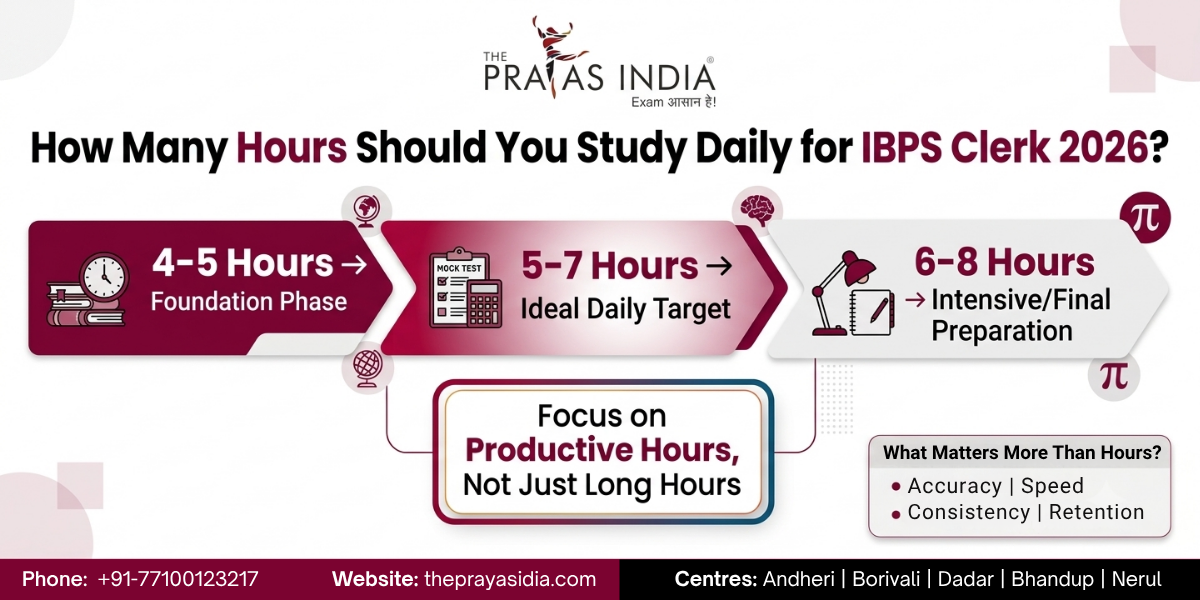
A Practical Study-Hour Progression
- Foundation Phase: 4–5 focused hours daily
- Practice Phase: 5–7 focused hours daily
- Mock-Test Phase: 6–8 focused hours daily
- Final Revision Phase: 6–8 focused hours, with greater emphasis on tests and revision
This approach is more sustainable than trying to study for extremely long hours from the first day.
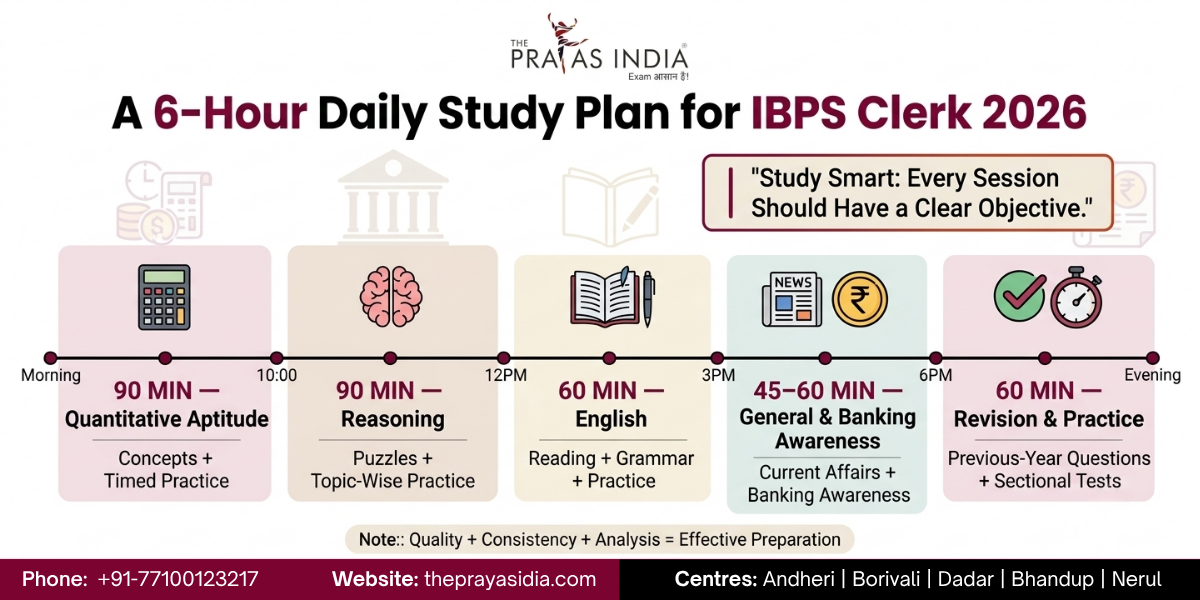
A 6-Hour Daily Study Plan for IBPS Clerk 2026
For a candidate preparing full-time, six focused hours can provide a strong foundation if those hours are divided intelligently. The purpose of a timetable is not merely to assign hours to subjects but to make sure that every important component of the examination receives regular attention.
Morning Session: Quantitative Aptitude — 90 Minutes
Start the day with Quantitative Aptitude when concentration is relatively high. Spend the first part of the session understanding or revising a concept and then immediately move to question practice.
For example, a session could include percentage, ratio, profit and loss, averages, simplification, number series or arithmetic-based questions. The exact topic can change according to your preparation plan, but the key is to combine concept learning with timed practice.
Candidates should maintain a record of questions that take too long or are repeatedly answered incorrectly. These questions can become part of a weekly revision list.
Second Session: Reasoning — 90 Minutes
Reasoning requires regular practice because familiarity with different question types directly influences solving speed. A 90-minute session can be divided between topic practice and timed sets.
Candidates can work on topics such as:
- Puzzles and seating arrangement
- Syllogism
- Inequality
- Coding-decoding
- Blood relations
- Direction sense
- Alphanumeric series
- Logical reasoning
- Miscellaneous reasoning questions
Rather than solving the same type of questions mechanically, aspirants should gradually introduce a time limit. The objective is to develop the ability to recognise the question type quickly and choose the appropriate solving approach.
Third Session: English — 60 Minutes
English does not necessarily require several hours every day, but it does require consistency. A focused one-hour session can be highly effective when divided between reading, grammar, vocabulary and question practice.
Candidates can spend part of the session reading an editorial or quality news article, followed by practice in areas such as:
- Reading comprehension
- Cloze test
- Error detection
- Sentence improvement
- Fillers
- Vocabulary
- Para jumbles
- Grammar-based questions
The important point is to avoid treating English only as a question-solving subject. Regular reading can improve comprehension speed, vocabulary and familiarity with sentence structures simultaneously.
Fourth Session: General Awareness & Banking Awareness — 45–60 Minutes
General Awareness becomes particularly important as candidates progress toward the Mains examination. Rather than trying to memorise a large volume of information in one sitting, aspirants should develop a daily current-affairs habit.
A useful approach is to cover:
- Banking and financial awareness
- Important national and international events
- Government schemes
- Appointments
- Awards and honours
- Important reports and indexes
- RBI-related developments
- Banking terminology
- Economy and financial news
Short daily revision followed by weekly consolidation is generally more effective than postponing current affairs until the last few weeks.
Fifth Session: Practice, Revision & Analysis — 60 Minutes
The final hour should not automatically become another theory session. It can be used for revision, previous-year questions, sectional tests or analysis of mistakes made during the day.
This session is particularly valuable because analysis is where preparation turns into measurable improvement. If a candidate repeatedly makes mistakes in a particular topic, simply solving more questions without understanding the reason for those mistakes may not produce meaningful improvement.
How Many Hours Should Working Professionals Study for IBPS Clerk?
A working candidate does not need to replicate the timetable of a full-time aspirant. Trying to study seven or eight hours every weekday after a full-time job can quickly become unrealistic. Instead, working professionals should focus on maintaining consistency during weekdays and using weekends for longer practice sessions.
A practical target could be around 3–4 focused hours on working days and 6–8 hours on weekends, depending on the individual’s schedule and energy levels.
For example, a working aspirant could use:
- Morning: 60–90 minutes for Quantitative Aptitude or Reasoning
- Commute/lunch break: Current affairs, vocabulary or short revision
- Evening: 90–120 minutes for practice and sectional tests
- Weekend: Full-length mock tests, detailed analysis and longer revision sessions
This approach allows candidates to prepare consistently without sacrificing sleep or creating an unsustainable routine.
The advantage of structured coaching can become particularly relevant for working aspirants. When study time is limited, having a defined syllabus, organised classes, doubt-solving support, practice material and regular tests can reduce the time spent deciding what to study next.
College Students: How Many Hours Are Enough?
College students often have more flexibility than working professionals, but their preparation can still become inconsistent because of classes, assignments and examinations. A realistic target of 4–6 focused hours on regular college days can be sufficient if the candidate maintains discipline.
On days with fewer academic commitments, students can increase preparation time and use those additional hours for mock tests, revision and difficult topics.
The biggest advantage for a college student is time. Instead of waiting until graduation to begin bank-exam preparation, students can gradually build their foundation early. By the time they become eligible for major banking examinations, they can already have strong command over basic concepts, calculation techniques, reasoning patterns and English fundamentals.
Is Studying for More Hours Always Better?
Long study hours can create the impression of serious preparation, but hours alone do not determine selection. A candidate who studies for nine hours but spends a large portion of that time passively reading may make less progress than someone who studies for five or six highly focused hours.
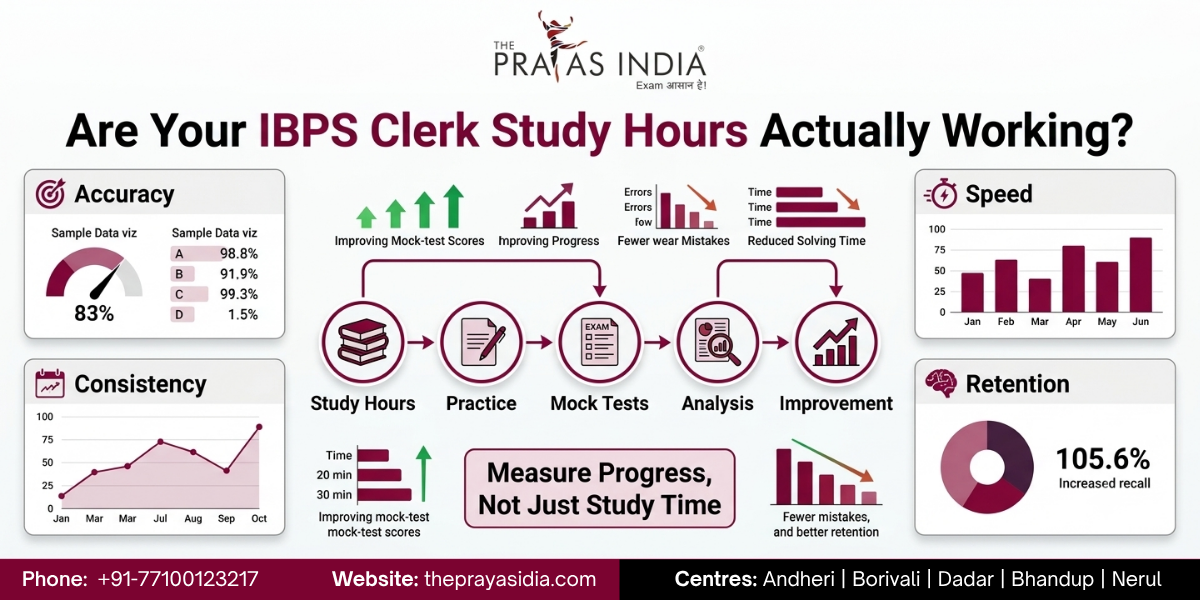
There are four indicators that matter more than the raw number of hours:
- Accuracy: Are you answering questions correctly?
- Speed: Can you solve questions within the required time?
- Consistency: Are your scores improving from one mock to the next?
- Retention: Can you recall concepts and information after revision?
If your study hours are increasing but your mock-test performance remains stagnant, the solution may not be to add more hours. You may instead need to change your preparation strategy, improve question analysis or seek structured guidance.
The Role of Mock Tests in Your Daily Study Hours
Mock tests should not be treated as something to begin only after completing the entire syllabus. Candidates should gradually introduce sectional tests and eventually full-length mocks into their preparation schedule.
During the foundation phase, a larger proportion of study time can be devoted to concepts. As the examination approaches, the balance should gradually shift toward practice and testing.
For example, a candidate may eventually dedicate:
- 30–40% of preparation time to concept revision
- 30–40% to question practice
- 20–30% to mock tests, analysis and revision
The exact proportion can vary according to individual strengths and weaknesses. Someone struggling with Quantitative Aptitude may need more concept-building time, while an experienced candidate may benefit more from timed practice and mock analysis.
A mock test should also be followed by analysis. Simply checking the score and moving on wastes a major learning opportunity. Candidates should identify questions they got wrong, questions they guessed, questions that consumed too much time and questions they skipped despite being solvable.
Why a Structured Study Plan Can Save Hours
One of the most common problems among banking aspirants is not a lack of effort but a lack of direction. Candidates often jump between YouTube videos, PDFs, test series and study materials without following a clear sequence. This can make an eight-hour study day surprisingly unproductive.
A structured preparation plan can reduce this problem by establishing:
- What needs to be studied
- When a topic should be completed
- Which topics require revision
- When sectional tests should begin
- When full-length mocks should be introduced
- How performance should be analysed
- Which weak areas require additional practice
This is one of the reasons many aspirants consider joining a dedicated banking-exam coaching programme. For candidates who need external structure, experienced faculty, regular practice and a defined preparation system, the right coaching environment can make preparation more organised and accountable.
For aspirants looking for bank exam coaching in Mumbai, The Prayas India provides a structured learning environment designed around competitive-exam preparation. The focus should not simply be on completing classes but on building the combination of conceptual clarity, regular practice, test-taking ability and exam-oriented strategy required for banking examinations.
How to Know Whether Your Daily Study Hours Are Actually Working
A fixed number of study hours is useful only when those hours are producing measurable progress. IBPS Clerk preparation should therefore be evaluated through performance rather than the clock. If you are studying for six hours every day but your sectional scores, accuracy or speed are not improving, it is time to examine the quality of your preparation rather than simply increasing the number of hours.
One of the simplest ways to evaluate your routine is to maintain a weekly performance record. Note your mock-test scores, accuracy percentage, average time taken, questions left unanswered and the topics in which you repeatedly make mistakes. This gives you a much clearer picture of whether your study plan is working.
For example, if your Reasoning accuracy is consistently high but your Quantitative Aptitude score remains low, adding another hour of general study may not be the best solution. That additional time should instead be allocated specifically to the areas causing the problem. This makes your preparation more targeted and prevents unnecessary study hours.
The 3-Phase Approach to Daily IBPS Clerk Preparation
A successful IBPS Clerk preparation routine should gradually move through three broad phases: learning, practising and testing. Candidates often make the mistake of spending too much time in the first phase and not enough in the other two.
Phase 1: Build Your Fundamentals
At the beginning, your priority should be conceptual clarity. Learn the basic methods, understand question types and create a strong foundation in Quantitative Aptitude, Reasoning and English.
During this phase, it is perfectly acceptable to solve questions slowly. Your objective is to understand the method correctly before worrying about speed.
Phase 2: Increase Practice
Once the fundamentals are clear, shift more of your daily hours toward question-solving. Start using timers and gradually reduce the amount of time taken to solve familiar question types.
Previous-year questions become particularly useful at this stage because they help you understand the nature and difficulty level of the examination.
Phase 3: Test and Analyse
As the examination approaches, mock tests and revision should occupy a larger part of your schedule. The objective is no longer simply to learn more concepts but to convert your preparation into exam performance.
IBPS’s 2026–27 calendar lists the CRP-CSA-XVI Preliminary Examination for 10 and 11 October 2026, followed by the Main Examination on 27 December 2026. Candidates should therefore plan their preparation around the actual examination stages rather than waiting until the last few weeks to begin serious testing.
How to Divide Your Time Between Prelims and Mains
One of the biggest advantages of IBPS Clerk preparation is that many foundational areas overlap between Prelims and Mains. However, the level and breadth of preparation required for Mains means that candidates should not completely postpone Mains-oriented preparation until after Prelims.
A smart strategy is to prepare the common subjects strongly from the beginning while gradually introducing Mains-specific areas such as General and Banking Awareness. This prevents the common situation where a candidate clears Prelims but has very little time to prepare for Mains.
A full-time aspirant can structure the day around three priorities:
- Core subjects: Quantitative Aptitude, Reasoning and English
- Mains-oriented preparation: General Awareness and Banking Awareness
- Performance improvement: Sectional tests, mocks, revision and analysis
This approach creates continuity between the two stages and makes the transition from Prelims to Mains much smoother.
What Should You Do on a Low-Productivity Day?
Not every day will be equally productive. Candidates sometimes become discouraged when they are unable to complete their planned seven or eight hours. Missing a daily target occasionally does not destroy your preparation. The bigger problem is allowing one unproductive day to become an unproductive week.
On days when your concentration is low, reduce the complexity of your tasks rather than abandoning preparation completely. Revision, vocabulary, current affairs, formula revision or previously attempted questions can be useful alternatives to difficult new topics.
The objective is to protect consistency. Your preparation should be designed around what you can sustain for months, not what you can force yourself to do for three or four days.
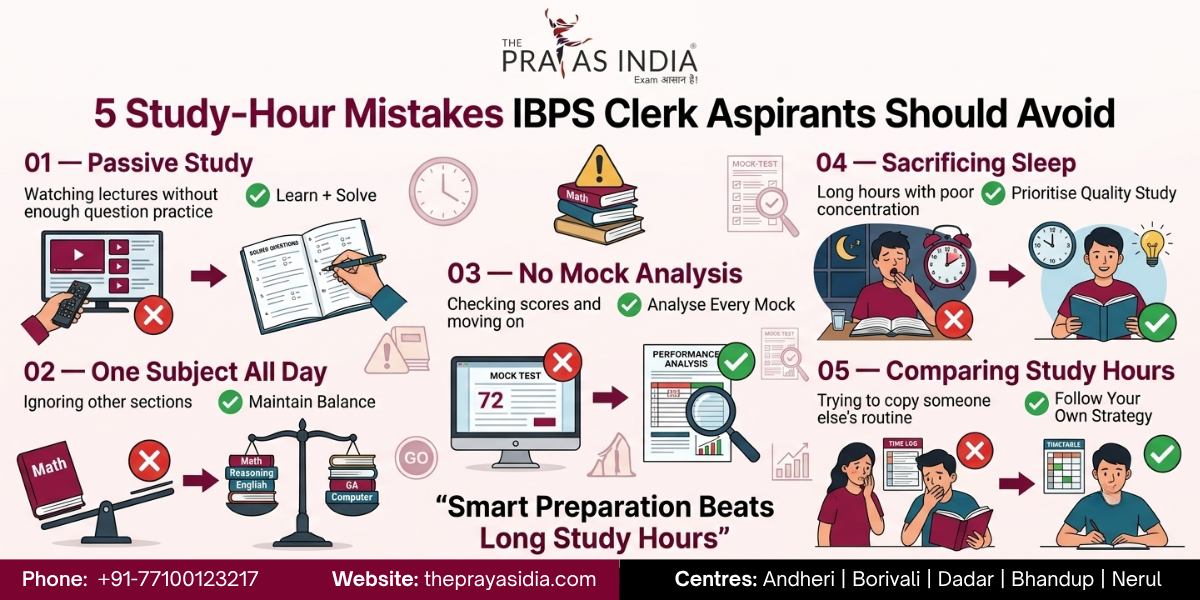
Common Study-Hour Mistakes IBPS Clerk Aspirants Should Avoid
Many candidates spend considerable time preparing for banking examinations but fail to convert that effort into marks because their study routine has structural problems. Recognising these mistakes early can save several weeks of preparation.
Counting Passive Study as Preparation
Watching hours of lectures without solving questions can create a false sense of progress. Classes are useful for learning concepts, but every concept should eventually be converted into question-solving ability.
Studying One Subject for the Entire Day
Spending an entire day on Quantitative Aptitude, for example, can make preparation monotonous and leave other sections neglected. A balanced schedule generally produces better overall coverage.
Ignoring Mock-Test Analysis
A mock score is only the starting point. Candidates should analyse incorrect, guessed, skipped and time-consuming questions to understand exactly where marks are being lost.
Sacrificing Sleep to Increase Study Hours
Sleep deprivation can negatively affect concentration, recall and decision-making. Increasing study hours at the expense of adequate rest may therefore reduce the quality of the following day’s preparation.
Constantly Changing Study Material
Using multiple books, PDFs, video courses and test series without completing any of them can create confusion. Candidates should select reliable resources and follow a structured sequence.
Comparing Your Hours With Other Aspirants
Someone claiming to study for twelve hours does not automatically have an advantage over a candidate studying for six focused hours. Your preparation should be measured by performance, not by someone else’s timetable.
How Coaching Can Help You Use Your Study Hours Better
For many aspirants, the biggest challenge is not finding six hours in the day but knowing how to use those six hours efficiently. A structured banking-exam coaching programme can help bring consistency to the preparation process by giving candidates an organised learning path.
Instead of spending hours deciding which topic to study, which questions to practise or when to take a mock test, candidates can work according to a defined preparation schedule. Faculty guidance can also help identify conceptual gaps and provide alternative approaches to difficult questions.
For students preparing for IBPS Clerk in Mumbai, choosing a coaching institute should involve more than simply comparing the number of classes offered. Aspirants should consider the overall preparation ecosystem, including faculty support, study material, test practice, doubt resolution, revision strategy and the extent to which the programme supports both Prelims and Mains preparation.
This is where a structured institute such as The Prayas India can become valuable for aspirants who want a more organised approach to bank-exam preparation. The objective should be to make every study session purposeful and connect classroom learning with individual practice, testing and performance analysis.
IBPS Clerk Preparation for Aspirants Starting Late
Candidates who have started their preparation late often make one major mistake: they immediately try to study for ten or twelve hours a day. Although the intention is understandable, such an approach is difficult to sustain and can quickly lead to exhaustion.
A better approach is to prioritise high-impact areas. Begin with the core concepts that appear frequently, combine learning with question practice and introduce timed tests early. As your confidence and stamina improve, increase your daily study hours gradually.
If you have limited time remaining, your preparation should become increasingly exam-oriented. Instead of trying to master every possible topic to the same depth, identify your strengths, weaknesses and the areas that can deliver the greatest improvement in your score.
A Sample Weekly IBPS Clerk Study Structure
Daily preparation is important, but weekly planning prevents important tasks from being ignored. A candidate can use weekdays for subject-wise preparation and reserve specific periods during the weekend for comprehensive testing and analysis.
A balanced week may include:
- Monday to Friday: Core concepts + topic-wise practice + current affairs
- Saturday: Sectional tests + weak-topic revision
- Sunday: Full-length mock + detailed analysis + weekly revision
- Every day: Short vocabulary/current-affairs revision
- Every week: Review of mistakes and progress
The exact schedule can be adjusted according to your level. A beginner may need more concept-building, while an experienced aspirant should devote more time to timed practice and mocks.
The Ideal Number of Hours Is the Number You Can Sustain
So, how many hours should you study daily for IBPS Clerk 2026?
For most serious aspirants, 5–7 focused hours per day is a strong target. Beginners can start with around 4–5 productive hours and gradually increase their preparation intensity. Working professionals may need to rely on shorter weekday sessions and longer weekend sessions, while full-time aspirants can dedicate 6–8 hours during intensive phases.
However, there is no magic number. The ideal study duration is the amount of focused preparation that allows you to consistently improve without compromising your health, concentration or ability to continue the routine tomorrow.
The real formula for IBPS Clerk preparation is not simply more hours = better preparation. It is:
Structured Study + Consistent Practice + Mock Tests + Analysis + Revision = Better Exam Readiness
If you are preparing for IBPS Clerk 2026 and feel that your preparation lacks structure, guidance or accountability, joining a focused bank-exam coaching programme can help you turn your available hours into a more systematic preparation plan. For aspirants looking for Bank Exam Coaching in Mumbai, The Prayas India can be considered as part of that preparation journey, with a focus on disciplined learning and exam-oriented practice.
Conclusion
IBPS Clerk 2026 preparation does not require you to spend every waking hour studying. What it requires is a realistic routine that you can follow consistently and a preparation strategy that converts your time into measurable improvement. For many candidates, five to seven focused hours every day can provide a strong foundation when those hours are divided intelligently between concepts, practice, current affairs, mock tests and revision.
As the examination gets closer, the emphasis should gradually shift from learning new concepts to improving speed, accuracy, question selection and mock-test performance. Candidates should also remember that Prelims and Mains preparation should not be treated as completely separate journeys. Building strong fundamentals early makes the later stages considerably more manageable.
If you are serious about securing a clerical position through IBPS and want professional guidance for your preparation, choosing the right coaching environment can help you stay on track. The right combination of faculty guidance, structured study material, regular tests, revision and individual practice can make your preparation considerably more organised.
For aspirants searching for the best bank coaching in Mumbai, The Prayas India offers a focused environment for candidates who want to prepare for competitive banking examinations with a structured and exam-oriented approach.
Contact Us
- Call Now: +91-77100 13217
- Website: theprayasindia.com
- Centres: Andheri | Borivali | Dadar | Nerul | Bhandup
Frequently Asked Questions
1. How many hours should I study daily for IBPS Clerk 2026?
For most serious aspirants, 5–7 focused hours per day is a practical target. Beginners can start with 4–5 hours and gradually increase their preparation time as they become comfortable with the syllabus and question practice.
2. Is 4 hours of study enough for IBPS Clerk?
Yes, especially if you are a working professional or college student. Four highly focused hours can be productive when you follow a structured timetable covering the important subjects and regularly evaluate your performance through tests.
3. Is studying 10 hours a day necessary for IBPS Clerk?
No. Studying for ten hours is not necessary for most candidates. Productivity, consistency, accuracy, speed and mock-test performance are more important than simply increasing the number of hours.
4. How many hours should a working professional study for IBPS Clerk?
A working professional can target approximately 3–4 focused hours on working days and use weekends for longer study sessions, mock tests and revision. The schedule should be adapted to the candidate's work commitments.
5. Should I prepare for IBPS Clerk Prelims and Mains together?
Yes. It is better to build strong fundamentals for both stages from the beginning. While Prelims-focused practice becomes important closer to the first examination, Mains-oriented General and Banking Awareness preparation should not be postponed entirely.
6. When should I start taking IBPS Clerk mock tests?
Candidates can introduce sectional tests after gaining basic familiarity with the relevant topics. Full-length mocks should gradually become a regular part of preparation as the examination approaches.
7. How can The Prayas India help with IBPS Clerk preparation?
A structured coaching programme can help candidates follow an organised preparation path through classes, practice, revision and test-based preparation. Aspirants should evaluate the programme based on faculty support, study material, testing, doubt resolution and overall preparation structure.
8. Is coaching necessary for IBPS Clerk preparation?
Coaching is not compulsory, and some candidates successfully prepare through self-study. However, structured coaching can be useful for aspirants who need expert guidance, a defined study plan, regular practice and accountability.
9. Which is the best bank coaching in Mumbai for IBPS Clerk?
The best coaching institute depends on an aspirant's individual requirements, learning style and preparation level. Candidates should compare faculty quality, course structure, study material, mock-test support, doubt-solving facilities and overall student guidance before making a decision. The Prayas India is one option for aspirants looking for structured bank-exam coaching in Mumbai.
10. Can I prepare for IBPS Clerk while preparing for SBI Clerk and other bank exams?
Yes. A large portion of the preparation for major banking examinations overlaps. Building strong fundamentals in Quantitative Aptitude, Reasoning, English and banking awareness can allow candidates to prepare for multiple banking exams more efficiently, while adjusting the strategy according to each examination's specific pattern and requirements.