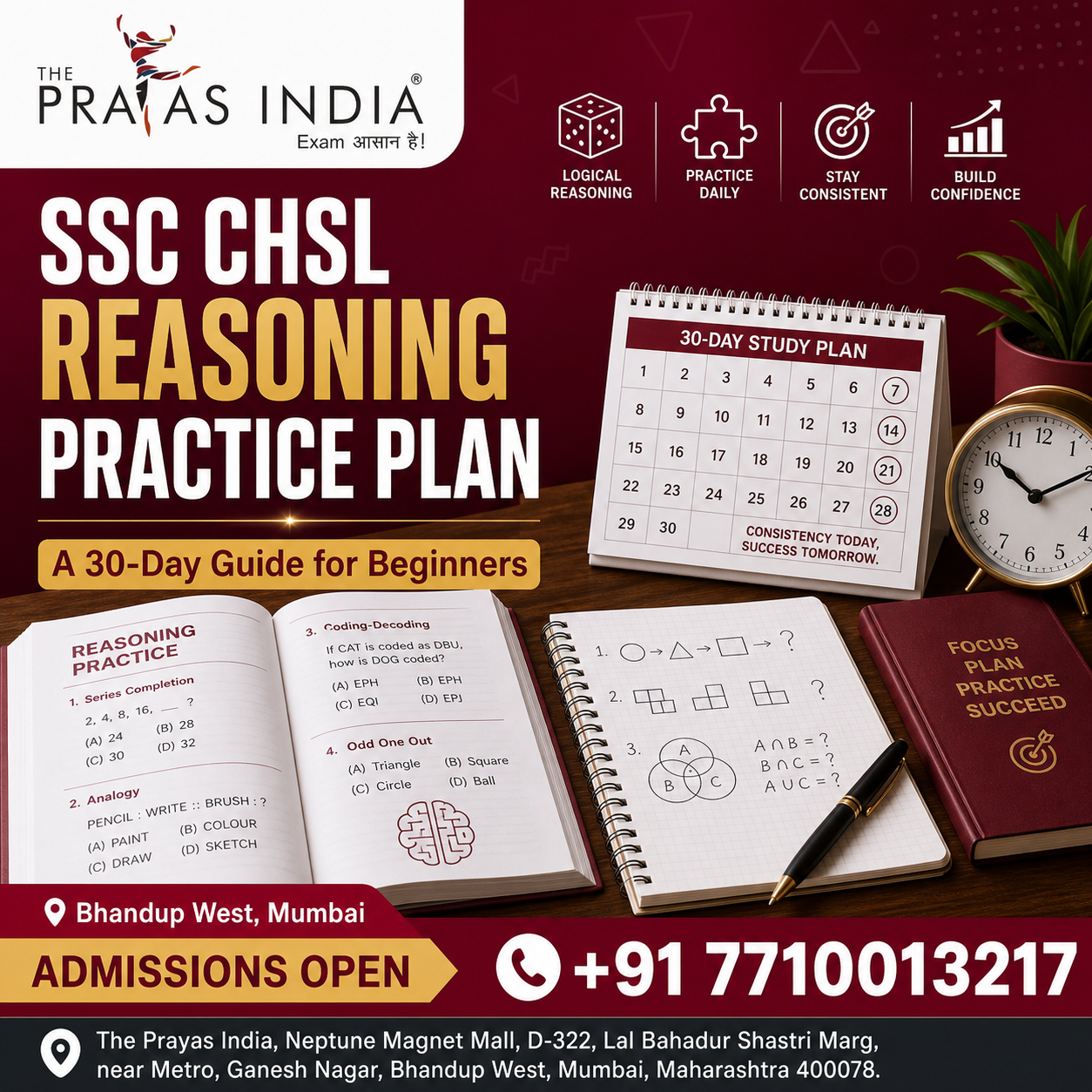
SSC CHSL Reasoning Practice Plan for Beginners in Bhandup
Reasoning is an important part of SSC CHSL preparation. For beginners, it can initially feel confusing to solve series, coding-decoding, analogy and other logical questions under time pressure. However, with a structured practice plan, regular revision and a gradual increase in difficulty, students can build confidence and improve their problem-solving approach.
If you are preparing for SSC CHSL in Bhandup or Bhandup West, following a consistent reasoning practice schedule can help you organise your preparation alongside other subjects. This guide explains how beginners can start practising reasoning, organise a weekly timetable and avoid common preparation mistakes.
Understand the SSC CHSL Reasoning Section
Before beginning your preparation, check the latest official SSC CHSL notification and syllabus. The examination pattern and topic coverage should always be verified against the current notification.
Common reasoning topics to review in your preparation include:
- Analogy and classification
- Number and alphabet series
- Coding-decoding
- Directions and distance
- Blood relations
- Order and ranking
- Venn diagrams
- Syllogism
- Figure-based and non-verbal reasoning
- Similarities, differences and logical relationships
Your exact topic list should follow the current official syllabus and the question types included in your chosen practice material.
Start with the Basics Before Solving Difficult Questions
Beginners sometimes start with difficult puzzles before understanding the underlying concepts. This can lead to frustration and unnecessary time spent on individual questions.
Instead, begin with simple examples and learn the method used to solve each type of question.
For example:
- In number series, look for differences, multiplication patterns or alternating sequences.
- In analogy questions, identify the relationship between the first pair before applying it to the next pair.
- In coding-decoding, check whether letters are shifted, rearranged or replaced according to a pattern.
- In direction questions, draw a simple diagram to track movement.
- In blood relation questions, use a family tree to make relationships clearer.
Once you understand the method, solve a small set of similar questions. Increase the difficulty only when you can solve basic examples with reasonable accuracy.
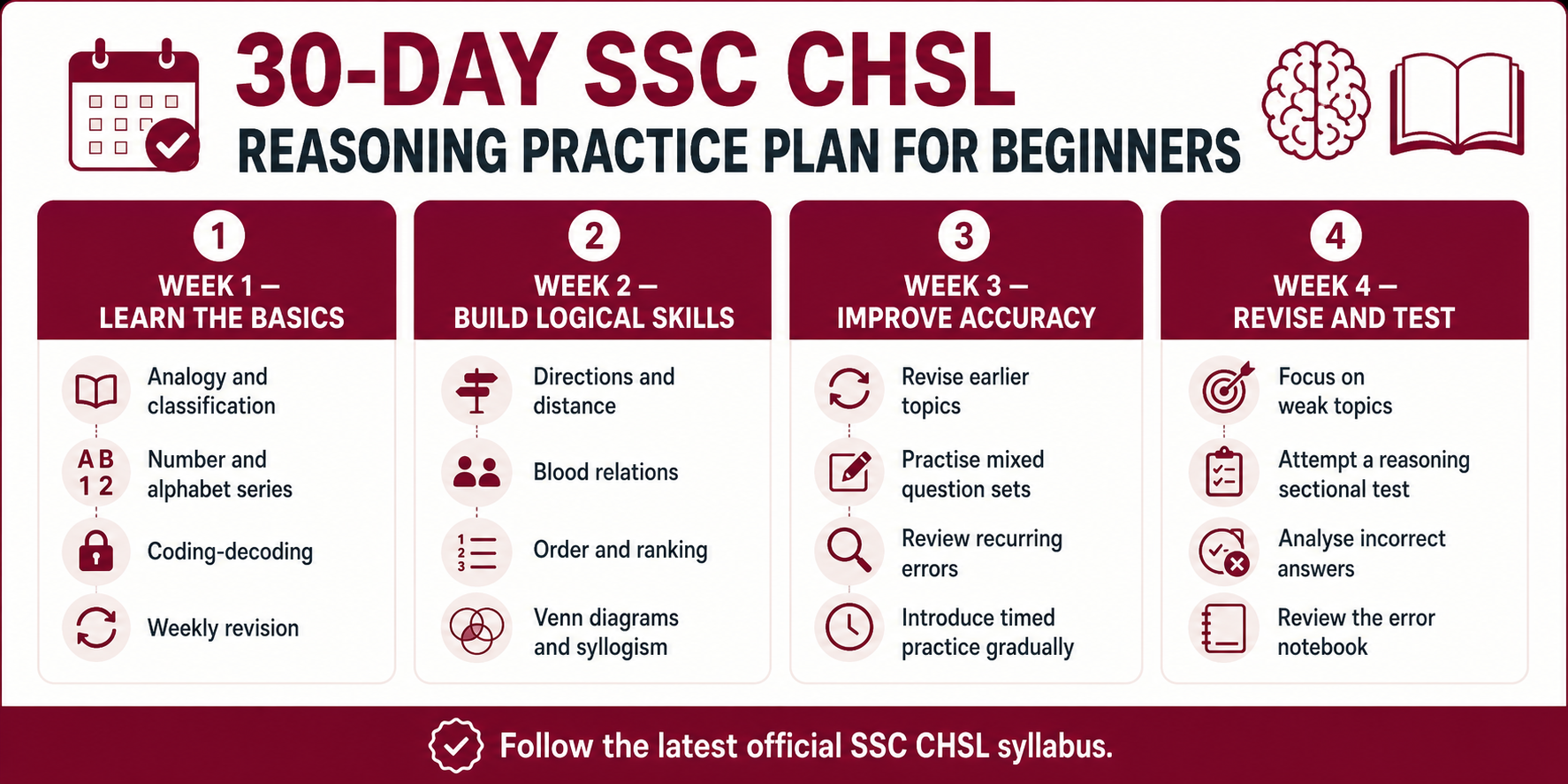
A 30-Day SSC CHSL Reasoning Practice Plan for Beginners
A 30-day plan gives beginners a clear starting point. Adjust the pace according to your current level, college or work commitments, and the time remaining before your examination.
Week 1: Build your foundation
Focus: Understanding common question types.
- Day 1: Take a short diagnostic practice test and note difficult topics.
- Day 2: Analogy and classification.
- Day 3: Number series.
- Day 4: Alphabet series.
- Day 5: Coding-decoding basics.
- Day 6: Revise the topics studied during the week.
- Day 7: Attempt a short mixed practice set and review mistakes.
Start with untimed questions if you need to understand the methods. Focus on learning rather than rushing.
Week 2: Practise logical relationships
Focus: Applying reasoning concepts.
- Day 8: Direction and distance.
- Day 9: Blood relations.
- Day 10: Order and ranking.
- Day 11: Venn diagrams.
- Day 12: Syllogism and logical statements.
- Day 13: Mixed practice from the week’s topics.
- Day 14: Revision and a short sectional test.
Keep a notebook of mistakes and write down the correct method for questions you found confusing.
Week 3: Improve accuracy and speed
Focus: Solving questions more efficiently.
- Day 15: Revise series and analogy.
- Day 16: Coding-decoding practice.
- Day 17: Directions and blood relations.
- Day 18: Classification and Venn diagrams.
- Day 19: Figure-based reasoning.
- Day 20: Timed mixed question sets.
- Day 21: Analyse your errors and revise weak areas.
Begin using a timer for selected practice sets. Do not sacrifice accuracy simply to finish questions faster.
Week 4: Revision and test practice
Focus: Bringing topics together.
- Day 22: Revise your weakest topic.
- Day 23: Practise series, analogy and classification.
- Day 24: Practise coding-decoding and logical relationships.
- Day 25: Revise directions, ranking and blood relations.
- Day 26: Attempt a timed reasoning sectional test.
- Day 27: Analyse incorrect and time-consuming questions.
- Day 28: Practise a mixed set from the syllabus.
- Day 29: Revise your error notebook and key methods.
- Day 30: Attempt a practice test and compare your performance with your initial assessment.
This plan is a framework rather than a guarantee of a particular score. Repeat the topics that need more practice before moving to more difficult question sets.
Daily Reasoning Practice Timetable
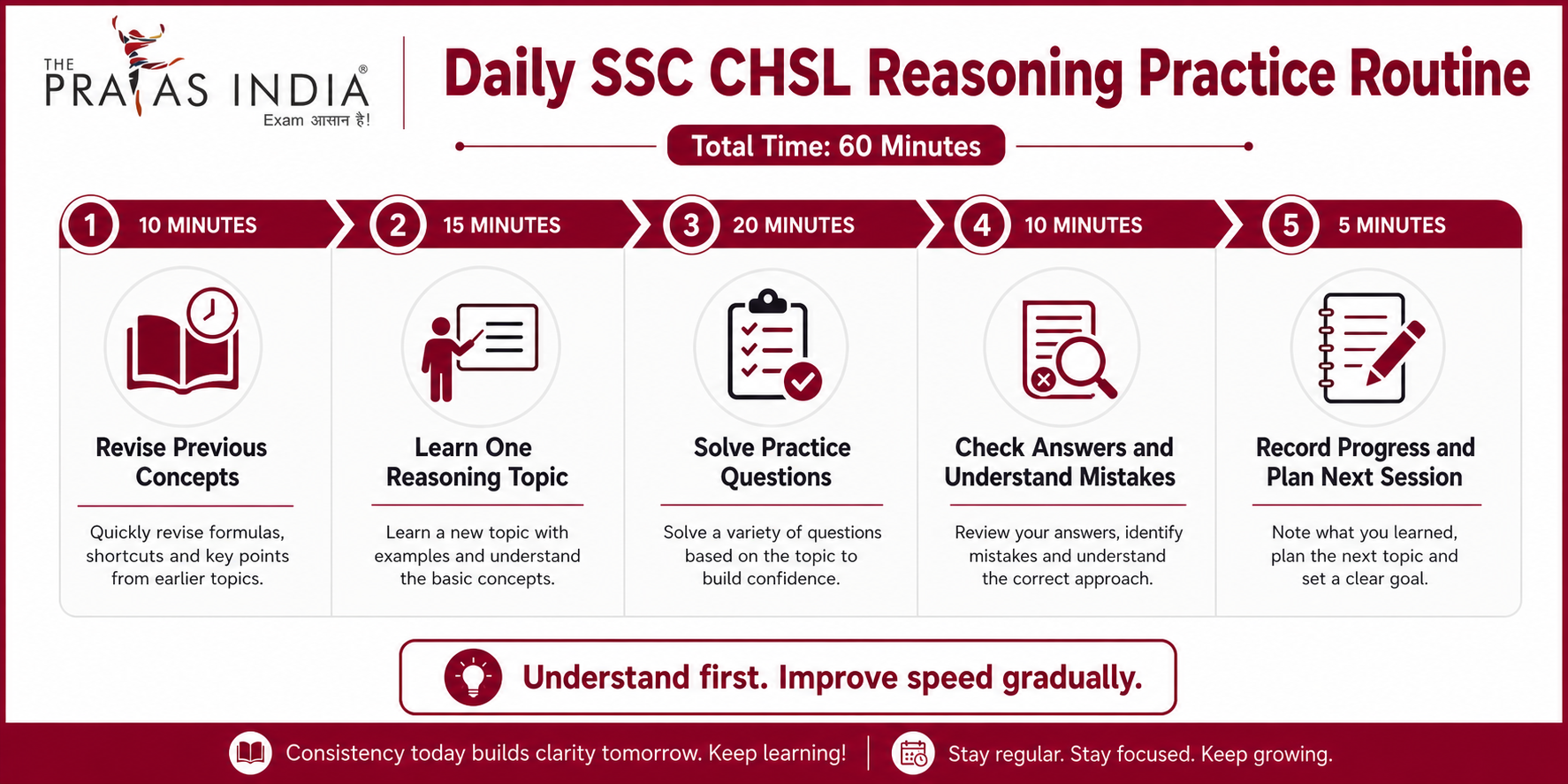
Beginners can start with approximately 45–60 minutes of reasoning practice per day, adjusting the duration according to their schedule.
| Duration | Activity |
|---|---|
| 10 minutes | Revise yesterday’s concepts |
| 15 minutes | Learn or review one topic |
| 20 minutes | Solve topic-wise questions |
| 10 minutes | Check answers and understand mistakes |
| 5 minutes | Record progress and plan the next session |
| Total: 60 minutes | 1-Hour Focused Study Block Template |
If you have more time, add another practice set or revise a weak topic. If your schedule is busy, complete a shorter session and return to your normal routine the next day.
Consistency is more valuable than trying to complete too many questions in one sitting.
How Many Reasoning Questions Should Beginners Practise?
There is no universal target that suits every student. Begin with a manageable set of questions that allows you to understand the method and review your answers.
A practical progression could look like this:
- Initial stage: Solve a small set of basic questions without rushing.
- Practice stage: Increase the number of questions as your accuracy improves.
- Timed practice stage: Attempt mixed sets within a set time limit.
- Revision stage: Focus on recurring errors and questions that take too long.
Track both accuracy and time taken. If you are making repeated mistakes, revisit the concept instead of simply increasing the number of questions.
Common SSC CHSL Reasoning Mistakes Beginners Should Avoid
Memorising shortcuts without understanding concepts
Shortcuts can be useful, but they are easier to apply correctly when you understand the underlying logic. Learn the method first and then practise faster approaches.
Ignoring incorrect answers
Checking only your score does not explain why you lost marks. Review every incorrect answer and identify whether the problem came from a concept gap, careless reading or a calculation mistake.
Practising only favourite topics
It is tempting to repeat questions that already feel easy. Make time for weaker areas and rotate topics throughout the week.
Starting timed tests too early
Timed practice is important, but beginners also need time to understand the basics. Begin with untimed questions when necessary, then gradually introduce time limits.
Using too many study resources
Switching between multiple books, videos and question banks can make preparation disorganised. Select a manageable set of reliable resources and follow the current official syllabus.
Skipping revision
Without revision, it is easy to repeat the same mistakes. Revisit older topics weekly and maintain a notebook of useful methods and errors.
How to Track Your Reasoning Progress
A simple progress tracker can help you decide what to study next. After each practice session, record:
- The topic you studied.
- The number of questions attempted.
- The number answered correctly.
- The time taken.
- The mistakes you made.
- The topic you need to revise next.
For example, if you consistently struggle with coding-decoding, allocate an additional session to that topic before increasing the difficulty of your mixed tests.
Review your progress every Sunday. Use the results to plan the next week’s practice instead of following a timetable without checking whether it is working.
Preparing for SSC CHSL in Bhandup and Bhandup West
Students preparing for SSC CHSL in Bhandup can combine independent practice with structured guidance, depending on their learning needs. A consistent routine, access to suitable practice material and regular review of mistakes can help keep preparation organised.
When comparing SSC coaching options in Bhandup West or elsewhere in Mumbai, consider factors such as:
- Whether the teaching approach suits beginners.
- Whether reasoning concepts are explained step by step.
- Availability of practice questions and mock tests.
- Opportunities to discuss doubts and review mistakes.
- Batch timings and travel convenience.
- Whether the course currently offered matches your target examination.
Students searching online for the Best SSC Coaching in Mumbai should compare course details, teaching support, timings and suitability rather than relying on a label alone.
You can contact The Prayas India Bhandup to enquire about currently available SSC courses, batch timings and preparation support. Confirm SSC CHSL course availability and the relevant details directly before enrolling.
A Simple Weekly Reasoning Checklist
At the end of each week, ask yourself:
- Did I practise the topics I planned?
- Can I explain the method behind my answers?
- Which question types caused the most mistakes?
- Did I review my incorrect answers?
- Have I started practising under timed conditions where appropriate?
- Which two topics need more attention next week?
Use your answers to make small, realistic adjustments. A flexible timetable that reflects your actual progress is more useful than a rigid schedule that ignores your weak areas.
Conclusion
A beginner-friendly SSC CHSL reasoning practice plan should focus on understanding concepts, practising regularly, reviewing mistakes and improving speed gradually. A 30-day schedule can help you establish a routine, while weekly progress checks keep your preparation focused.
If you are preparing for SSC CHSL in Bhandup or Bhandup West, compare available learning options and choose a study approach that suits your schedule and needs. The Prayas India Bhandup can be contacted to enquire about currently available SSC courses and preparation support.
Start with the basics, stay consistent and use every practice session to learn from your mistakes.
SSC CHSL Reasoning Practice FAQs
1. How should beginners start SSC CHSL reasoning preparation?
Start with the official syllabus, learn one topic at a time, practise basic questions and review mistakes before attempting more difficult sets.
2. How much time should I spend on reasoning daily?
Around 45–60 minutes can be a useful starting point. Adjust your schedule according to your preparation level and daily commitments.
3. Can I prepare SSC CHSL reasoning in 30 days?
A 30-day plan can help you establish a routine and practise common question types. Your progress depends on your starting level, consistency and revision.
4. Which reasoning topics should I study first?
Start with analogy, classification, number series, alphabet series and basic coding-decoding. Progress to other topics included in the latest official syllabus.
5. How can I improve reasoning speed and accuracy?
Understand the concepts, practise topic-wise questions, analyse errors and gradually introduce timed practice. Track both accuracy and time taken.
6. Are mock tests useful for SSC CHSL reasoning?
Yes. Mock tests help you practise under time pressure. Review incorrect answers and time-consuming questions after each test.
7. How do I choose SSC coaching in Bhandup?
Compare teaching methods, beginner support, practice materials, mock tests, batch timings and current course availability before deciding.
8. How can I enquire about SSC coaching at The Prayas India Bhandup?
Contact The Prayas India Bhandup to enquire about currently available SSC courses, batch timings and preparation support. Confirm SSC CHSL course availability before enrolling.
Preparing for SSC CHSL?
Build your reasoning skills with regular practice and a structured study plan. Contact The Prayas India Bhandup to enquire about currently available SSC courses, batch timings and preparation support.
The Prayas India – Bhandup Branch
Neptune Magnet Mall, D-322, Lal Bahadur Shastri Marg, near Metro, Ganesh Nagar, Bhandup West, Mumbai, Maharashtra 400078.