How to Prepare for Bank, SSC and Railway Exams Together: A Smart Study Strategy for Aspirants in Andheri, Mumbai
Preparing for multiple government competitive examinations can be a practical strategy for students who want to explore different career opportunities in the banking, central government and railway sectors.
Many aspirants prepare for Bank exams, SSC examinations and Railway recruitment simultaneously because these examinations share several subjects, including Quantitative Aptitude, Reasoning Ability, English and General Awareness.
However, preparing for all three categories is not as simple as following one common timetable. Each examination has its own question patterns, difficulty levels, time limits and additional subject requirements. Without proper planning, students may spend too much time studying overlapping topics while neglecting examination-specific preparation.
If you are preparing for competitive examinations in Mumbai, understanding how to manage multiple exam syllabuses can help you organise your study routine more effectively.
For aspirants in Andheri West, Andheri East, Lokhandwala, Oshiwara, Jogeshwari, Versova and Goregaon, choosing a convenient preparation location and following a structured learning schedule can also make consistent preparation easier.
This article explains how to prepare for Bank, SSC and Railway exams together, which subjects you can study commonly, how to divide your daily study hours and how to create an effective preparation strategy.
Understand the Common Subjects in Bank, SSC and Railway Exams
The first step towards preparing for multiple competitive examinations is identifying the subjects that overlap.
Instead of studying the same concepts separately for every examination, you can create a common preparation foundation.
However, remember that the level of difficulty and question format may differ across examinations.
Common Subject Comparison
| Subject | Bank Exams | SSC Exams | Railway Exams |
|---|---|---|---|
| Quantitative Aptitude | Yes | Yes | Yes |
| Reasoning Ability | Yes | Yes | Yes |
| English Language | Common in major banking exams | Yes | Depends on examination |
| General Awareness | Yes | Yes | Yes |
| Banking Awareness | Important in many banking Mains exams | Generally not a core section | Generally not a core section |
| General Science | Not generally a core section | Examination-dependent | Important in several railway exams |
| Computer Knowledge | Examination-dependent | Examination-dependent | Examination-dependent |
Which Subjects Should You Study Together?
Quantitative Aptitude and Mathematics
These subjects provide considerable overlap across Bank, SSC and Railway examinations.
Start with:
- Percentage
- Ratio and Proportion
- Average
- Profit and Loss
- Simple and Compound Interest
- Time and Work
- Time, Speed and Distance
- Number System
- Simplification
- Data Interpretation
Reasoning Ability
- Build a common foundation through:
- Coding-Decoding
- Blood Relations
- Direction and Distance
- Syllogism
- Inequality
- Series
- Analogy
- Classification
- Seating Arrangement
- Puzzles
Some topics, such as puzzles and seating arrangements, receive greater emphasis in many banking examinations, while other reasoning formats may be more prominent in SSC and Railway papers.
English Language
For Bank and SSC examinations, English preparation can be combined through:
- Grammar
- Vocabulary
- Reading Comprehension
- Error Detection
- Fill in the Blanks
- Cloze Test
- Sentence Improvement
- Para Jumbles
General Awareness
Develop a common foundation in current affairs, important national developments, government schemes, economics and general knowledge.
After building this foundation, add banking awareness, static GK and railway-related general science according to your target examinations.
The Smart Approach
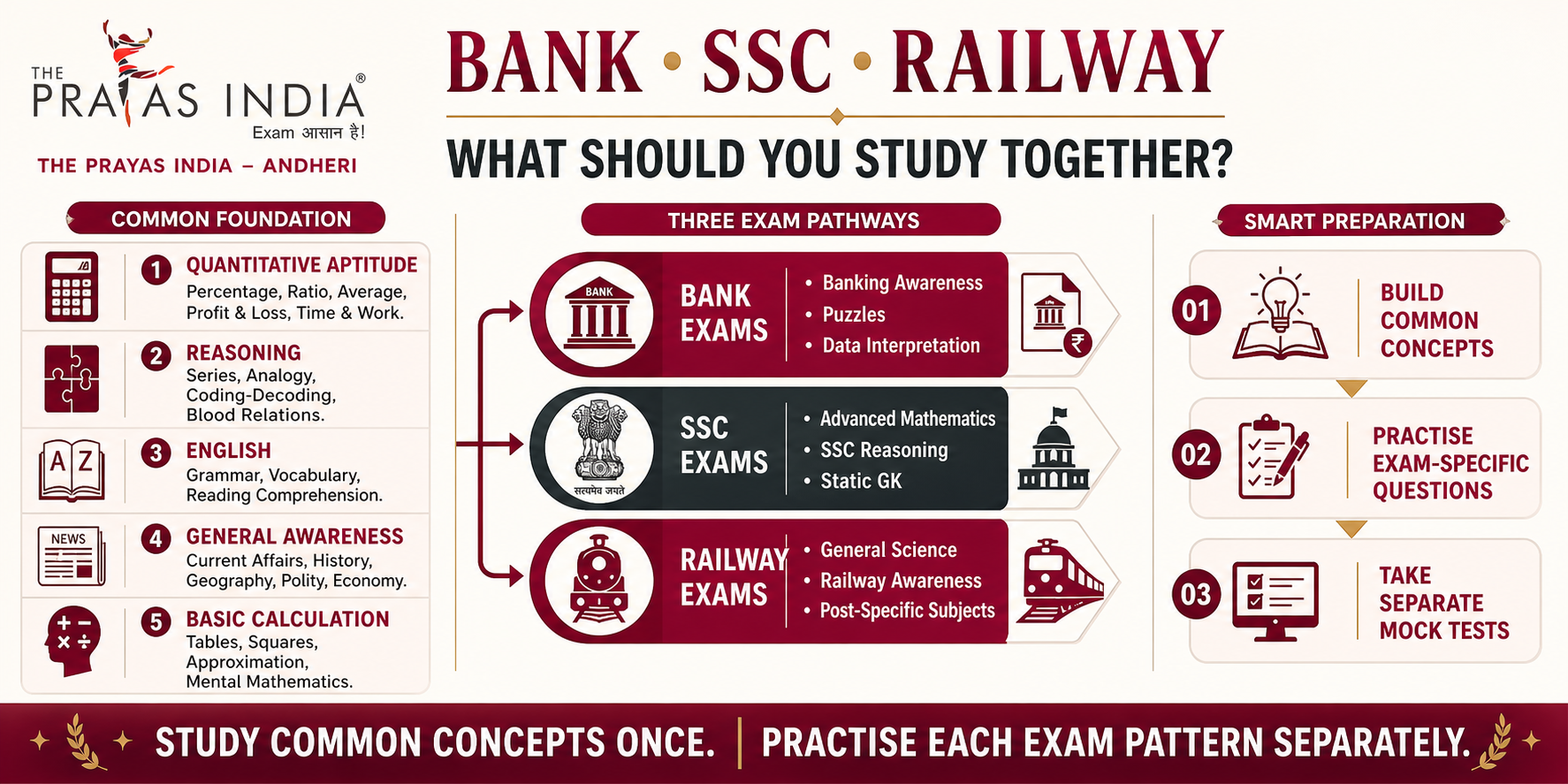
Study common concepts once at the foundation level, then practise them separately according to the pattern of Bank, SSC and Railway examinations.
This avoids unnecessary duplication while ensuring that your preparation remains examination-specific.
Know the Different Examinations You Can Target
Before creating a common preparation schedule, shortlist the examinations that match your educational qualifications and career interests.
Banking Examinations
Popular banking recruitment examinations include:
- IBPS PO
- IBPS Clerk
- SBI PO
- SBI Clerk
- RRB Office Assistant
- RRB Officer Scale I
- RBI Assistant
Banking examinations generally require strong calculation speed, reasoning ability, English proficiency and current affairs preparation. Many Mains examinations also require banking and financial awareness.
SSC Examinations
Students can consider:
- SSC CGL
- SSC CHSL
- SSC MTS
- SSC CPO
- SSC GD
SSC examinations generally require preparation in Quantitative Aptitude, General Intelligence and Reasoning, English and General Awareness, with additional requirements depending on the examination.
Railway Examinations
Popular Railway Recruitment Board examination categories include:
- RRB NTPC
- RRB Group D
- RRB ALP
- RRB Technician
- RRB JE
The subject requirements vary by post. For example, General Science is important in several Railway examinations, while technical subjects are relevant for technical recruitment.
Do Not Target Every Examination Without a Plan
Preparing for Bank, SSC and Railway exams together does not mean applying for every available vacancy.
First identify:
- Your educational eligibility.
- Your preferred job category.
- Your strongest subjects.
- The examination calendar.
- Your available preparation time.
Choose one primary examination category and one or two secondary targets based on syllabus compatibility and recruitment schedules.
Divide Your Preparation into Common and Exam-Specific Topics
One of the most effective ways to prepare for multiple examinations is to divide the syllabus into two categories.
Category A: Common Subjects
These subjects form the foundation of your preparation.
| Subject | Important Topics |
|---|---|
| Mathematics | Percentage, Ratio, Average, Profit and Loss |
| Advanced Mathematics | Algebra, Geometry, Mensuration, Trigonometry |
| Arithmetic | Time and Work, Speed and Distance, Interest |
| Reasoning | Series, Coding-Decoding, Analogy, Blood Relations |
| English | Grammar, Vocabulary, Comprehension |
| General Awareness | Current Affairs, History, Geography, Polity, Economy |
Category B: Examination-Specific Subjects
These topics require additional preparation depending on the examination.
| Examination | Additional Preparation |
|---|---|
| Bank PO / Clerk | Banking Awareness, Financial Awareness, Data Interpretation, Puzzles |
| SSC CGL / CHSL | Advanced Mathematics, SSC-specific Reasoning, Static GK |
| Railway NTPC | Railway-related Awareness, General Science, Mathematics |
| Railway Group D | General Science, Basic Mathematics, General Awareness |
| Railway ALP / JE | Relevant Technical Subjects |
Why Is This Division Useful?
Suppose you are preparing for IBPS Clerk, SSC CGL and RRB NTPC.
You can study Percentage, Ratio, Average and basic Reasoning as common subjects.
However, you should separately practise:
- Banking-level puzzles and Data Interpretation.
- SSC-level advanced mathematics and question formats.
- Railway-level General Science and relevant General Awareness.
This approach helps you avoid repeating the same basic concepts while still developing the skills required for different examinations.
Create a Practical Daily Timetable for Bank, SSC and Railway Preparation
When preparing for three examination categories, time management becomes particularly important.
You should not divide your study hours equally between every examination. Instead, allocate more time to common subjects and reserve separate sessions for examination-specific topics.
For example, if you can study for approximately six hours daily, you can follow this suggested schedule.
Six-Hour Daily Study Timetable
| Study Session | Subject | Duration |
|---|---|---|
| Session 1 | Quantitative Aptitude | 1 hour |
| Session 2 | Reasoning Ability | 1 hour |
| Session 3 | English Language | 45 minutes |
| Session 4 | General Awareness / Current Affairs | 45 minutes |
| Session 5 | Exam-Specific Topics | 1 hour |
| Session 6 | Practice Questions and Revision | 1 hour 30 minutes |
| Total | 6 hours |
How to Use the Examination-Specific Session
Rotate this one-hour session throughout the week.
| Day | Additional Preparation |
|---|---|
| Monday | Banking Awareness |
| Tuesday | SSC Advanced Mathematics |
| Wednesday | Railway General Science |
| Thursday | Banking Puzzles and DI |
| Friday | SSC Static GK and Reasoning |
| Saturday | Railway Awareness and Post-Specific Topics |
| Sunday | Weekly Revision and Mock Test Analysis |
This rotation helps you maintain contact with all three examination categories.
Adjust the Timetable According to Your Primary Exam
If SSC CGL is your main target, allocate additional time to Advanced Mathematics, English and SSC-specific practice.
If banking examinations are your priority, increase the time spent on puzzles, Data Interpretation, banking awareness and timed sectional practice.
If Railway NTPC or Group D is your primary target, give additional attention to General Science, Mathematics and examination-specific General Awareness.
The timetable should remain flexible enough to accommodate upcoming recruitment notifications and examination dates.
Prepare Mathematics and Reasoning with Different Difficulty Levels
Mathematics and Reasoning are among the most useful common preparation areas across Bank, SSC and Railway examinations.
However, the same topic may be tested differently.
Mathematics Preparation Strategy
Begin with basic arithmetic concepts.
Foundation Level
- Number System
- Percentage
- Ratio and Proportion
- Average
- Simplification
Intermediate Level
- Profit and Loss
- Simple and Compound Interest
- Time and Work
- Time, Speed and Distance
- Mixture and Allegation
Advanced Practice
- Algebra
- Geometry
- Mensuration
- Trigonometry
- Data Interpretation
Banking examinations often require fast calculations and interpretation of data. SSC examinations may require broader practice in advanced mathematics. Railway examinations require strong fundamentals and familiarity with the relevant question patterns.
Reasoning Preparation Strategy
Start with basic topics:
- Analogy
- Classification
- Coding-Decoding
- Direction Sense
- Blood Relations
- Number and Alphabet Series
After developing confidence, move towards:
- Seating Arrangements
- Puzzles
- Syllogism
- Inequality
- Statement-Based Questions
- Non-Verbal Reasoning
Practise questions from all three examination categories so you become comfortable with different formats.
Maintain Separate Practice Records
Create three sections in your notebook:
- Bank-Level Questions
- SSC-Level Questions
- Railway-Level Questions
Even when the underlying concept is common, record the different question approaches separately.
This will help you identify which topics require additional practice for each examination.
Manage English, General Awareness and General Science Smartly
These subjects require a slightly different preparation strategy because their importance varies across examinations.
English Language
English is particularly relevant for major banking examinations and SSC examinations.
A practical daily routine includes:
- 15 minutes of reading.
- 10 new vocabulary words.
- Grammar practice.
- Reading Comprehension exercises.
- Error Detection and Sentence Improvement.
- Cloze Test and Para Jumbles.
For banking exams, also practise timed reading comprehension and exam-level English questions.
For SSC exams, give adequate attention to grammar rules, vocabulary and previous-year question patterns.
General Awareness
General Awareness can support preparation across Bank, SSC and Railway examinations.
Focus on:
- Current Affairs.
- Indian History.
- Indian Geography.
- Indian Polity.
- Indian Economy.
- Important Government Schemes.
- Science and Technology.
- Important National and International Events.
For banking Mains, add:
- RBI-related developments.
- Banking Terminology.
- Monetary Policy.
- Financial Awareness.
- Digital Banking.
- Important Economic Updates.
General Science
General Science is particularly relevant to several Railway examinations and is also important in the General Awareness preparation of SSC examinations.
Study:
- Physics Fundamentals.
- Chemistry Basics.
- Biology.
- Human Body and Health.
- Everyday Science.
- Scientific Developments.
Instead of studying all three areas randomly, maintain separate short notes for banking awareness, static GK and general science.
This will make revision easier when examination dates approach.
Follow a Weekly Mock Test Strategy Instead of Taking Random Tests
When preparing for multiple examinations, taking mock tests without a proper schedule can create confusion.
You should practise according to the examination pattern rather than attempting only general aptitude tests.
Suggested Weekly Mock Test Schedule
| Day | Practice Activity |
|---|---|
| Monday | Banking Quantitative Aptitude Test |
| Tuesday | SSC Mathematics Sectional Test |
| Wednesday | Railway Mathematics and Reasoning Test |
| Thursday | Banking Reasoning Mock |
| Friday | SSC English and General Awareness |
| Saturday | Railway General Science and Awareness |
| Sunday | Full-Length Mock + Performance Analysis |
Why Should You Take Separate Mock Tests?
Although the subjects overlap, the examination experience is different.
For example:
- Banking exams require strong sectional time management and speed.
- SSC exams require familiarity with their particular question formats and examination structure.
- Railway exams require preparation according to the specific RRB recruitment pattern.
Maintain a Performance Tracker
After each test, record:
| Performance Indicator | What to Check |
|---|---|
| Accuracy | Correct versus attempted questions |
| Speed | Time taken per question |
| Weak Areas | Topics with repeated mistakes |
| Conceptual Errors | Questions misunderstood |
| Calculation Errors | Incorrect calculations |
| Revision Needs | Topics requiring additional practice |
Do not compare your performance across different examination categories without considering their different patterns and marking systems.
The purpose of mock tests is to identify weaknesses and improve them systematically.
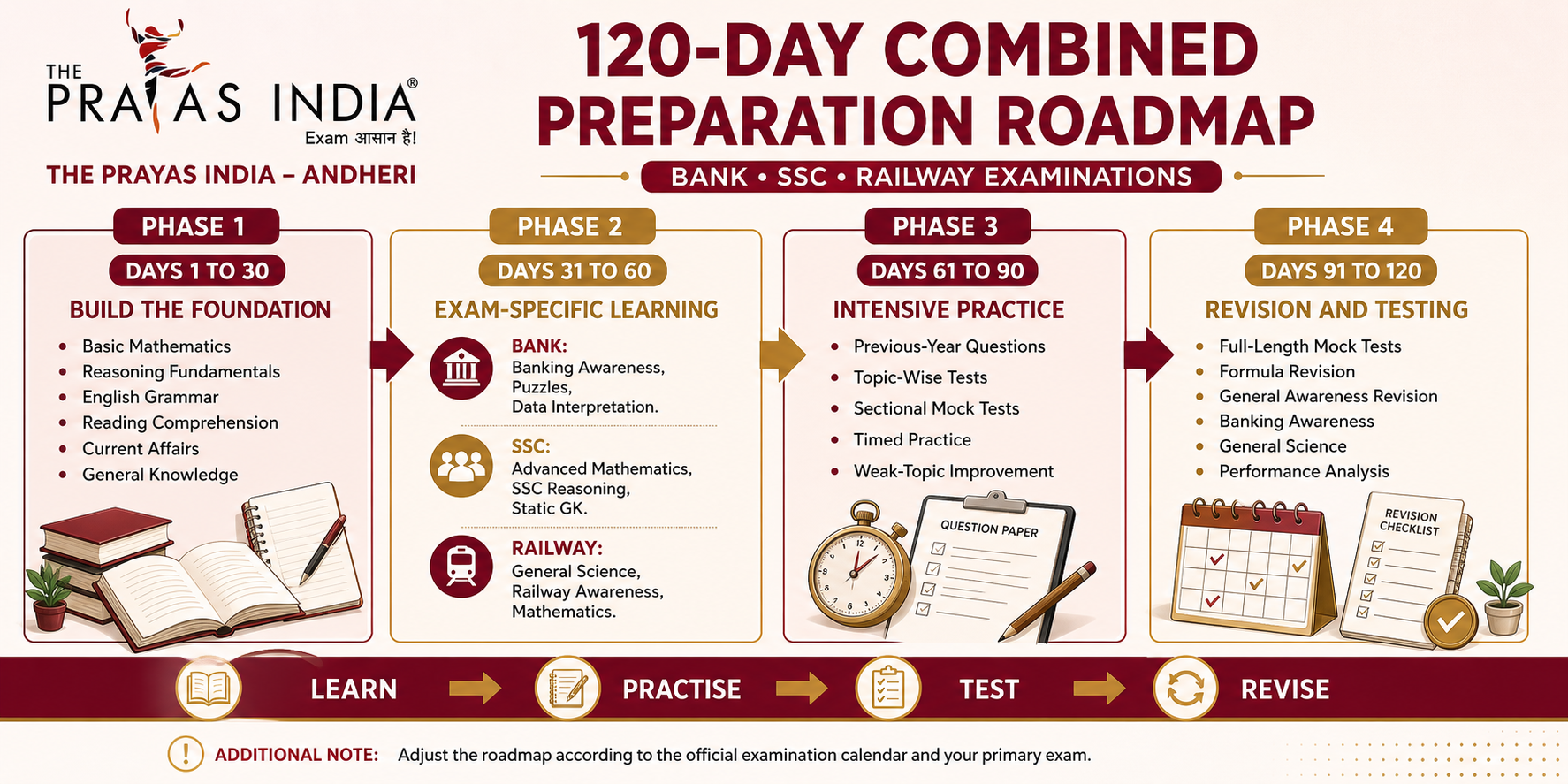
Create a 120-Day Combined Preparation Roadmap
If you are starting from the basics, a 120-day preparation roadmap can help you organise your study schedule.
This is a suggested framework, not a guarantee that every examination can be completed within four months.
Days 1–30: Build the Common Foundation
Focus on:
- Basic Mathematics.
- Fundamental Reasoning.
- English Grammar.
- Reading Comprehension.
- Current Affairs.
- Basic General Knowledge.
Your objective should be to develop conceptual clarity across the common subjects.
Days 31–60: Develop Examination-Specific Skills
Start introducing:
Bank
- Puzzles.
- Seating Arrangement.
- Data Interpretation.
- Banking Awareness.
SSC
- Advanced Mathematics.
- SSC-specific Reasoning.
- Static GK.
- English PYQs.
Railway
- General Science.
- Railway-level Mathematics.
- General Awareness.
- Examination-specific practice.
Days 61–90: Increase Practice and Testing
Focus on:
- Topic-wise tests.
- Previous-year questions.
- Sectional mock tests.
- Timed mathematical exercises.
- Banking-level reasoning.
- SSC advanced-level questions.
- Railway General Science revision.
Days 91–120: Revision and Examination Readiness
Prioritise:
- Full-length mock tests.
- Separate examination-specific revision.
- Current Affairs revision.
- Formula revision.
- Weak-topic improvement.
- Previous-year question analysis.
If an examination notification or exam date is approaching, adjust this roadmap and prioritise the relevant examination.
Common Mistakes to Avoid While Preparing for Three Exams Together
Preparing for Bank, SSC and Railway examinations simultaneously requires discipline. Some common mistakes can reduce preparation efficiency.
Mistake 1: Following the Same Study Material for Every Exam
A common foundation is useful, but one question bank may not cover the requirements of all three examination categories.
Better approach: Use common concept notes and separate examination-specific practice material.
Mistake 2: Ignoring Examination-Specific Subjects
Students sometimes concentrate heavily on Mathematics and Reasoning while neglecting Banking Awareness, General Science or advanced SSC topics.
Better approach: Reserve dedicated weekly sessions for additional subjects.
Mistake 3: Preparing for Too Many Examinations
Applying for every recruitment examination without checking eligibility or preparation requirements can divide your attention.
Better approach: Select a primary examination and a limited number of compatible secondary targets.
Mistake 4: Taking Mock Tests Without Analysis
Attempting tests repeatedly without reviewing mistakes does not necessarily improve performance.
Better approach: Spend sufficient time understanding incorrect answers and revising weak topics.
Mistake 5: Ignoring Current Affairs
General Awareness is important across these examination categories, although the content requirements differ.
Better approach: Study current affairs regularly and maintain separate notes for banking awareness and general knowledge.
Mistake 6: Changing Study Resources Frequently
Using multiple books, PDFs and online sources for the same subject can lead to unnecessary repetition.
Better approach: Select reliable resources and complete them systematically.
Mistake 7: Not Adjusting Preparation According to Exam Dates
A common timetable may work during the foundation stage, but it may not be appropriate when one examination is approaching.
Better approach: Shift your study hours towards the examination with the nearest relevant date while maintaining the necessary preparation for your other targets.
How to Manage Multiple Competitive Exam Preparations in Andheri, Mumbai
Students preparing for Bank, SSC and Railway examinations need more than a syllabus and study timetable. They also need a sustainable daily routine.
For aspirants living in Mumbai, selecting a suitable coaching location can help organise classroom learning, self-study and regular practice.
Students from Andheri West
Aspirants living around Andheri West can explore nearby competitive-exam preparation options and compare their batch schedules with their daily routine.
Students from Andheri East
Students from Andheri East should consider transport connectivity and the time required to reach an offline coaching centre.
Students from Lokhandwala and Oshiwara
Aspirants from Lokhandwala and Oshiwara can explore preparation options around Andheri West based on accessibility and course requirements.
Students from Jogeshwari
Students living in Jogeshwari can compare nearby coaching options while considering the time required for regular attendance.
Students from Versova
Aspirants from Versova can consider Andheri West as a location to explore for competitive-exam preparation.
Students from Goregaon
Candidates from Goregaon should evaluate daily commuting time, batch timings and the time remaining for independent study.
Explore The Prayas India – Andheri
If you are looking for competitive-exam preparation options in Mumbai, you can contact The Prayas India – Andheri to enquire about relevant courses and current batch availability.
Students interested in Bank, SSC and other competitive examinations can discuss their target examinations and understand the available preparation options before taking admission.
Branch Details
Institute: The Prayas India – Andheri
Address: Office 803, Time Chambers, Swami Vivekanand Road, near Paneri, Andheri West, Mumbai, Maharashtra 400058.
Phone: 08355951603
WhatsApp: +91 8355951603
Aspirants should evaluate course structure, teaching schedules, subject coverage and their individual preparation requirements before enrolling.
How to Balance Self-Study, Coaching and Revision
Even if you attend regular coaching classes, independent study remains an important part of competitive-exam preparation.
A common problem among students preparing for multiple examinations is spending most of their available time attending lectures and leaving insufficient time for practice.
Try to maintain a balance between the following activities.
| Activity | Purpose |
|---|---|
| Classroom Learning | Understand new concepts |
| Self-Study | Strengthen understanding |
| Question Practice | Improve problem-solving |
| Mock Tests | Develop examination readiness |
| Revision | Retain previously learned concepts |
| Current Affairs | Stay updated |
Follow a Simple Daily Rule
For every new topic you study:
- Understand the concept.
- Solve basic questions.
- Attempt examination-level questions.
- Record mistakes.
- Revise the topic after a suitable interval.
Do not measure your preparation only by the number of lectures completed or the number of hours spent studying.
Measure it through your understanding, accuracy, practice quality and ability to solve examination-level questions.
Final Strategy: One Common Foundation, Three Separate Examination Approaches
Preparing for Bank, SSC and Railway exams together can be manageable when your preparation is organised properly.
The most effective approach is to build a strong foundation in common subjects and gradually introduce examination-specific preparation.
Remember these important principles:
- Select examinations according to your eligibility.
- Identify common and additional subjects.
- Build strong Mathematics and Reasoning fundamentals.
- Practise English regularly.
- Maintain consistent General Awareness preparation.
- Add Banking Awareness and Railway General Science wherever required.
- Practise examination-specific previous-year questions.
- Attempt separate mock tests.
- Analyse mistakes and revise regularly.
- Prioritise examinations according to their recruitment schedules.
For aspirants in Andheri and nearby areas of Mumbai, exploring a convenient preparation centre can also help maintain a consistent study routine.
The Prayas India – Andheri welcomes enquiries from students interested in competitive-exam preparation.
Build your foundation, organise your preparation and approach every examination with a clear strategy.
Frequently Asked Questions – Bank, SSC and Railway Preparation
1. Can I prepare for Bank, SSC and Railway exams together?
Yes. You can prepare for these examinations together by studying common subjects such as Mathematics, Reasoning, English and General Awareness. However, you should separately prepare examination-specific topics such as Banking Awareness, SSC Advanced Mathematics and Railway General Science.
2. Which subjects are common in Bank, SSC and Railway exams?
Quantitative Aptitude or Mathematics, Reasoning Ability and General Awareness are important across many examinations in these categories. English is also important in major banking and SSC examinations. The exact subjects and their weightage depend on the recruitment examination.
3. How many hours should I study daily for Bank, SSC and Railway exams?
You can begin with approximately five to six focused study hours daily, depending on your existing knowledge and schedule. Divide your time between common subjects, examination-specific preparation, mock tests and revision. Adjust the timetable according to upcoming examinations.
4. Can I use the same Mathematics book for Bank, SSC and Railway exams?
A common Mathematics resource can help you understand fundamental concepts such as Percentage, Ratio, Average, Profit and Loss and Time and Work. However, you should use separate examination-level practice questions because the difficulty and question patterns can differ.
5. Which exam should I prepare for first: Bank, SSC or Railway?
Choose your primary examination according to your educational eligibility, career preference, strengths and recruitment schedule. You can select compatible secondary examinations that share common subjects without compromising your main preparation target.
6. Is coaching helpful for preparing for multiple government exams?
Coaching can help students follow a structured learning schedule, understand concepts, practise examination-level questions and receive academic guidance. Before enrolling, check whether the available course structure covers your target examinations and preparation requirements.
7. Where can I enquire about competitive-exam coaching in Andheri?
You can contact The Prayas India – Andheri at Office 803, Time Chambers, Swami Vivekanand Road, near Paneri, Andheri West, Mumbai, Maharashtra 400058. Call 08355951603 to enquire about relevant courses and current batch availability.
Preparing for Bank, SSC or Railway Exams?
Explore competitive-exam preparation options at The Prayas India – Andheri. Contact the branch to enquire about relevant courses, preparation guidance and batch availability.
THE PRAYAS INDIA – ANDHERI
Address: Office 803, Time Chambers, Swami Vivekanand Road, near Paneri, Andheri West, Mumbai, Maharashtra 400058.
Phone: 08355951603
THE PRAYAS INDIA – ANDHERI