How to Prepare for Government Exams After Graduation: A Complete Guide for Indian Aspirants
Graduation is an important turning point for students who want to build a stable and rewarding career. For many graduates, government jobs offer an opportunity to work in public administration, banking, railways, defence, taxation and other essential sectors. However, preparing for government exams after graduation can feel confusing, especially when there are multiple examinations, different eligibility criteria and overlapping syllabuses.
The first step is to understand which government exams match your educational qualification, interests and career goals. The next is to create a preparation strategy that combines syllabus coverage, regular practice, mock tests and revision.
For graduates living in Andheri, Jogeshwari, Goregaon, Lokhandwala, Oshiwara and other parts of Mumbai, choosing a realistic preparation routine is particularly important when balancing studies, work or other responsibilities.
This guide explains how to choose the right government exam after graduation, build a practical study plan, prepare for common subjects and avoid mistakes that can slow down your progress. It also explains how structured guidance from a coaching institute such as The Prayas India – Andheri can support your preparation.
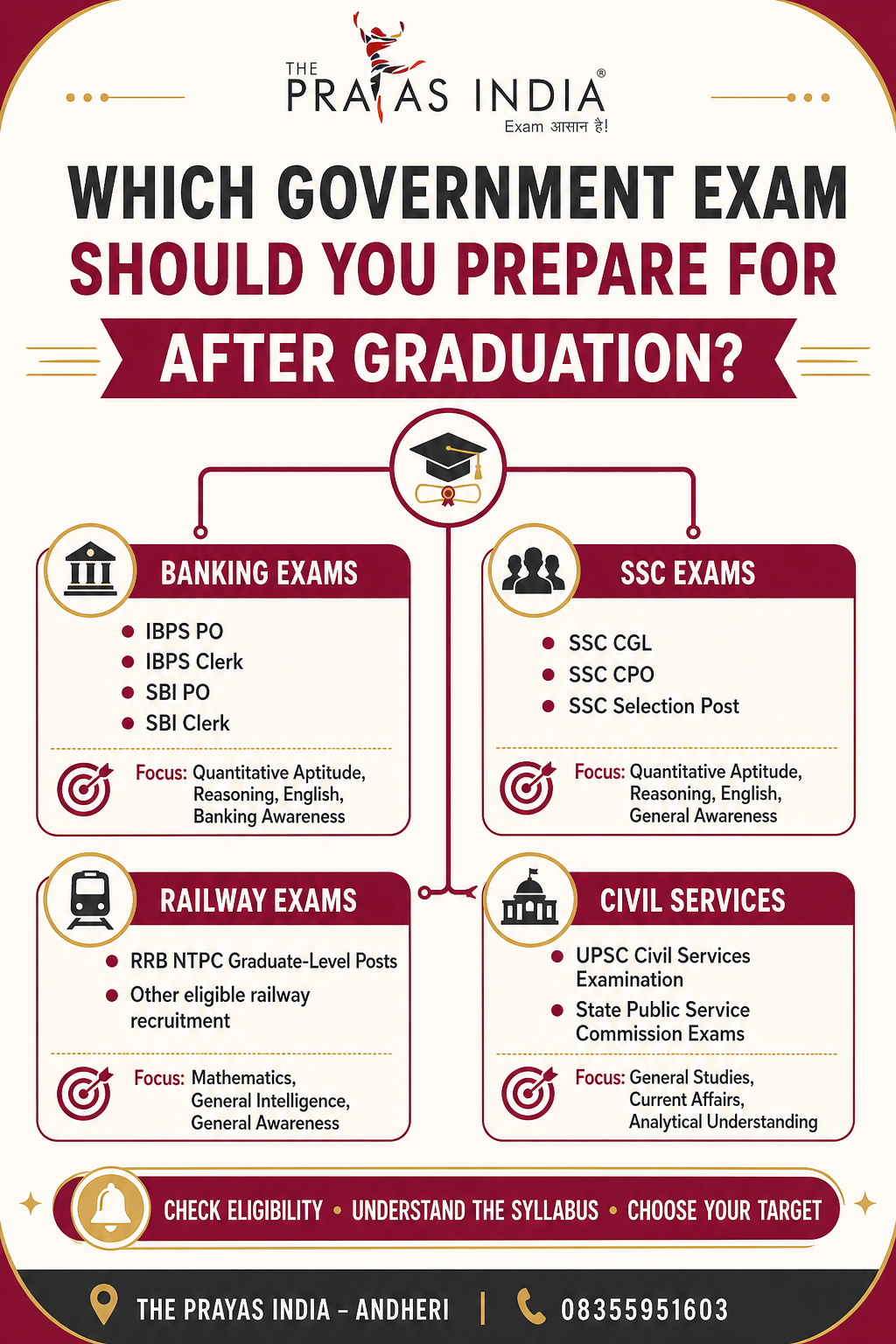
Understand Which Government Exams You Can Apply For After Graduation
Before purchasing books or joining a preparation course, identify the examinations for which you are eligible. Different government departments recruit graduates through different examination processes.
Here are some major categories to explore.
Banking examinations
Banking examinations are popular among graduates interested in careers in public-sector banks and financial institutions.
Some important examinations include:
- IBPS PO: Recruitment for Probationary Officer positions in participating banks.
- IBPS Clerk: Recruitment for clerical-level positions in participating banks.
- SBI PO: Recruitment for Probationary Officers in the State Bank of India.
- SBI Clerk: Recruitment for Junior Associate positions.
- RBI Grade B: Recruitment for officer-level positions in the Reserve Bank of India, subject to the notification’s eligibility conditions.
Banking examinations generally assess quantitative aptitude, reasoning ability, English language and general or banking awareness. The exact pattern and selection stages vary by examination.
SSC examinations
The Staff Selection Commission conducts several examinations for recruitment to central government departments and offices.
Graduates can consider:
- SSC CGL: Recruitment for various Group B and Group C posts.
- SSC CPO: Recruitment for Sub-Inspector positions in specified police organisations.
- SSC Selection Post: Recruitment for different posts with eligibility requirements that vary by vacancy.
SSC CGL is particularly relevant for graduates seeking opportunities in ministries, departments and other central government organisations.
Railway examinations
The Railway Recruitment Boards conduct recruitment examinations for different posts in Indian Railways.
Graduate-level opportunities may include:
- RRB NTPC Graduate-Level Posts: Various non-technical graduate-level positions, depending on the notification.
- Other railway recruitment opportunities for which a graduate degree is an accepted qualification.
Always check the specific recruitment notification because eligibility, age limits, post requirements and selection stages can differ.
Civil services examinations
Graduates interested in administration, policy implementation and public service can explore civil services examinations.
Important options include:
- UPSC Civil Services Examination: For services such as IAS, IPS, IFS and other participating services.
- State Public Service Commission examinations: Recruitment for administrative and other state government positions.
- Other specialised government examinations depending on the candidate’s educational background.
Civil services preparation generally requires a different approach from objective-focused examinations such as SSC or banking recruitment. It involves extensive reading, conceptual understanding, current affairs and, where applicable, descriptive answer writing and interview preparation.
Choose One Primary Exam Category Instead of Preparing for Everything
One of the biggest mistakes graduates make is trying to prepare for every government examination simultaneously.
Although several examinations share subjects such as mathematics, reasoning, English and general awareness, their difficulty levels, question patterns and selection processes are not identical.
A better approach is to select one primary examination category and keep one or two related examinations as secondary targets.
| Your interest | Primary exam category | Related opportunities |
|---|---|---|
| Banking and finance | IBPS PO / SBI PO | IBPS Clerk, SBI Clerk |
| Central government departments | SSC CGL | SSC Selection Post |
| Police and uniformed services | SSC CPO | Relevant state-level recruitment |
| Railway administration | RRB NTPC Graduate | Other eligible railway posts |
| Civil administration | UPSC CSE | State PSC examinations |
How to select the right examination
Consider these five factors:
- Career interest: Decide whether you prefer banking, administration, railways, police services or another government department.
- Educational eligibility: Check whether your degree and other qualifications meet the requirements.
- Age criteria: Review the applicable age limit and relaxation provisions in the official notification.
- Exam pattern: Understand the subjects, stages, marking scheme and time limits.
- Preparation requirements: Evaluate whether you can realistically devote the required time to that examination.
Do not select an examination simply because it is popular. Choose one that aligns with your interests and eligibility.
Understand the Common Subjects in Government Exams
Most major graduate-level competitive examinations test a combination of aptitude, language skills and general knowledge. Building a strong foundation in common subjects can help you prepare for more than one related examination.
Quantitative aptitude and mathematics
Mathematics is an important part of banking, SSC and railway examinations.
Start with fundamental concepts before moving to advanced questions.
Important topics include:
- Number system
- Simplification
- Percentage
- Ratio and proportion
- Average
- Profit and loss
- Simple and compound interest
- Time and work
- Time, speed and distance
- Mixture and allegation
- Algebra
- Geometry and mensuration
- Data interpretation
Preparation tip: Learn the underlying concept, solve basic questions and gradually increase the difficulty. Maintain a notebook of formulas and calculation shortcuts, but do not rely on shortcuts without understanding the method.
Reasoning ability
Reasoning questions assess logical thinking, pattern recognition and problem-solving ability.
Important topics include:
- Coding-decoding
- Blood relations
- Direction and distance
- Ranking and order
- Syllogism
- Inequality
- Analogy
- Classification
- Series
- Seating arrangement
- Puzzles
- Statement and conclusion
The topic distribution differs across examinations. Banking exams often require extensive puzzle and arrangement practice, while SSC and railway examinations may include a broader mix of verbal and non-verbal reasoning.
English language
English is relevant to many banking and SSC examinations and may also support performance in other competitive tests.
Focus on:
- Reading comprehension
- Grammar
- Vocabulary
- Sentence improvement
- Error detection
- Cloze test
- Para jumbles
- Fill in the blanks
- Synonyms and antonyms
Read a quality newspaper or editorial regularly, but combine reading with grammar exercises and question practice.
General awareness and current affairs
General awareness can become a scoring area when prepared consistently.
Depending on the examination, important areas may include:
- Indian history
- Geography
- Indian polity
- Economics
- General science
- Important government schemes
- Awards and honours
- Sports
- National and international events
- Banking and financial awareness
For current affairs, make short notes and revise them regularly. Banking aspirants should give additional attention to financial and banking developments, while UPSC and State PSC aspirants need broader and deeper coverage.
Create a Practical Study Plan After Graduation
A preparation plan should be based on your available time, current academic level and target examination. A graduate preparing full-time may follow a different routine from someone working alongside preparation.
The key is consistency rather than studying for an unrealistic number of hours.
Suggested daily study timetable
The following is an example for a candidate who can dedicate approximately six hours to preparation.
| Study session | Subject or activity | Suggested time |
|---|---|---|
| Session 1 | Quantitative aptitude | 90 minutes |
| Session 2 | Reasoning ability | 60 minutes |
| Session 3 | English language | 60 minutes |
| Session 4 | General awareness / current affairs | 60 minutes |
| Session 5 | Exam-specific practice | 60 minutes |
| Session 6 | Revision and error analysis | 30 minutes |
Adjust this schedule according to your strengths and weaknesses. If you are preparing for UPSC, you will need a more extensive plan for static subjects, current affairs, answer writing and the examination’s different stages.
A preparation roadmap for the first six months
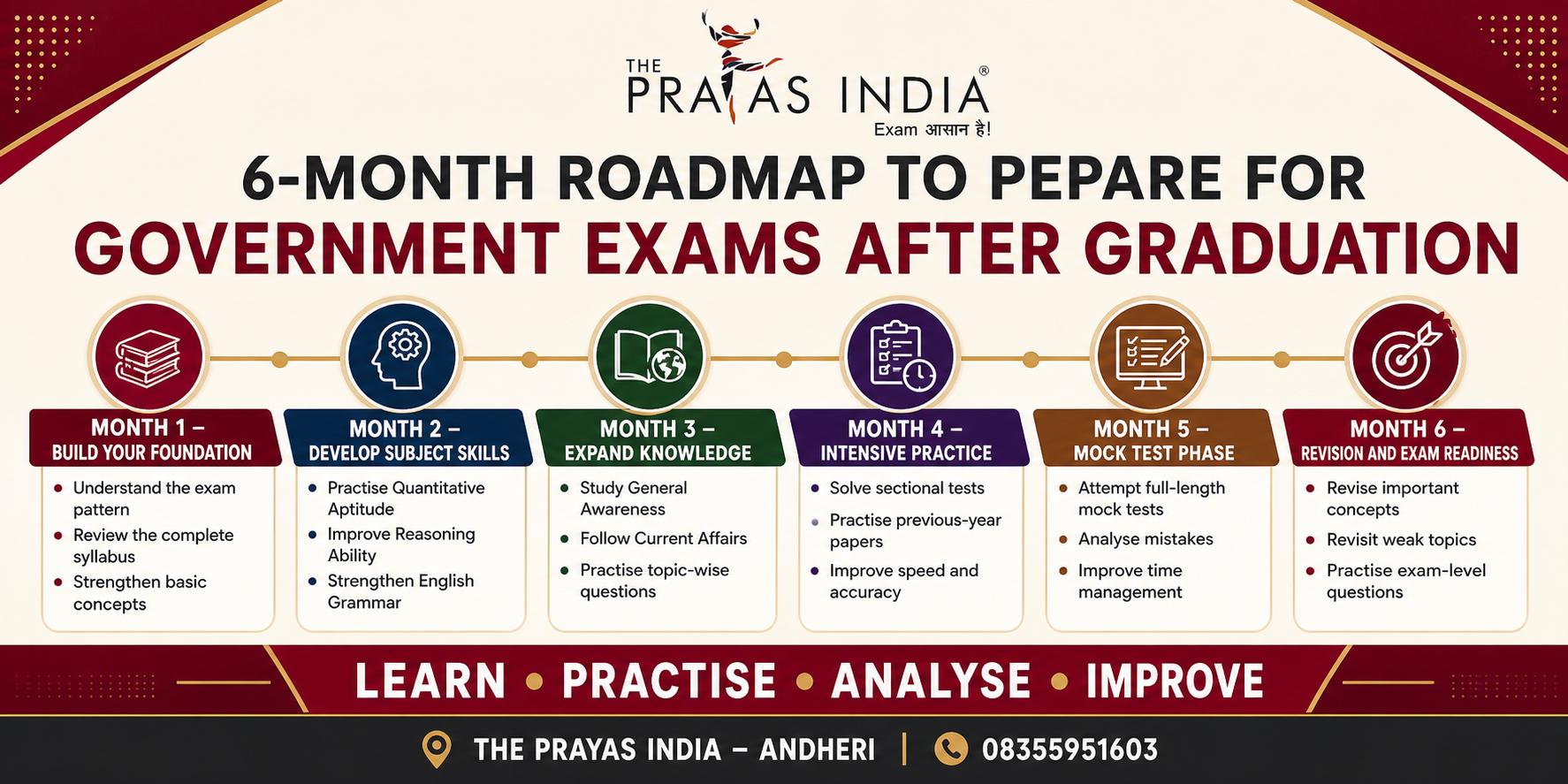
How to divide your preparation into phases
| Phase | Main objective | What to achieve |
|---|---|---|
| Months 1–2 | Foundation | Understand concepts and syllabus |
| Months 3–4 | Practice | Improve accuracy and question-solving ability |
| Month 5 | Testing | Develop speed and exam temperament |
| Month 6 | Revision | Strengthen weak areas and consolidate preparation |
This is a flexible roadmap, not a fixed guarantee of examination readiness. Some candidates may need more time, especially for examinations with extensive syllabuses.
Practise Previous-Year Question Papers and Mock Tests
Studying concepts is only one part of competitive-exam preparation. You must also learn how to apply those concepts under examination conditions.
Previous-year papers help you understand:
- Frequently tested topics
- Question formats
- Relative difficulty levels
- Time requirements
- Changes in examination patterns
How to use previous-year papers effectively
- Start with topic-wise questions after completing each chapter.
- Solve complete previous-year papers once you have covered the basics.
- Attempt some papers under timed conditions.
- Identify topics where you repeatedly make mistakes.
- Revisit those topics before attempting another paper.
How often should you attempt mock tests?
Your mock-test frequency should increase as your preparation progresses.
- Foundation stage: Take topic-wise and sectional tests.
- Practice stage: Begin attempting regular sectional tests and occasional full-length mocks.
- Exam-readiness stage: Attempt full-length mocks according to the target examination’s pattern and analyse each test carefully.
Do not measure preparation only by the number of mock tests completed. The quality of analysis matters more than the total count.
Learn Time Management and Accuracy Together
Government examinations often have strict time limits. Candidates need to solve questions accurately without spending too long on a single problem.
A practical way to improve is to maintain an error-analysis notebook.
After every mock test, classify mistakes into four categories:
- Conceptual mistakes: You did not understand the underlying concept.
- Calculation mistakes: You knew the method but made a calculation error.
- Time-management mistakes: You spent too much time on a question.
- Question-selection mistakes: You attempted a question that should have been skipped.
This classification helps you decide what to improve instead of randomly solving more questions.
Speed versus accuracy
Speed is important, but attempting questions without proper understanding can reduce your score. First improve accuracy on familiar question types, then gradually work on solving them faster.
For negative-marking examinations, understand the marking scheme and develop a sensible question-selection strategy.
Follow a Consistent Current Affairs and Revision Routine
Many graduates study current affairs irregularly and then struggle to revise a large amount of information before the examination.
A better approach is to study a manageable amount every day.
Daily current affairs routine
- Read important national and international news.
- Follow relevant government schemes and policy developments.
- Make concise notes instead of copying lengthy articles.
- Revise important facts from previous days.
- Practise current-affairs questions where relevant to your examination.
Weekly revision routine
Set aside time every week to revisit the topics studied during the previous six days.
A useful revision cycle is:
- Daily: Review what you studied that day.
- Weekly: Revise the week’s topics.
- Monthly: Consolidate important notes and current affairs.
- Before the examination: Focus on weak areas, key facts and previously marked mistakes.
Revision should be part of your timetable from the beginning, not something you postpone until the syllabus is complete.
Choose the Right Preparation Resources
Graduates often collect too many books, PDFs, applications and online lectures. This can create confusion and reduce actual study time.
- Instead, use a limited set of reliable resources.
- Your preparation material should include:
- The official examination notification and syllabus.
- Previous-year question papers.
- Standard subject-wise study material.
- A reliable current-affairs source.
- Sectional tests and full-length mock tests.
- A notebook for formulas, vocabulary and mistakes.
Check the latest official notification for the examination you are targeting. Syllabus, eligibility conditions, vacancies and examination patterns can change.
Avoid depending entirely on unofficial social-media updates or unverified claims about recruitment.
Common Mistakes Graduates Should Avoid
Even motivated candidates can lose valuable preparation time because of avoidable mistakes.
- Preparing for too many examinations: Trying to cover every syllabus at once can make preparation unfocused. Select a primary target and related alternatives.
- Ignoring the official syllabus: Do not study topics simply because they appear in random online videos. Use the official syllabus as your foundation.
- Collecting too many resources: More study material does not automatically mean better preparation. Complete and revise a manageable set of resources.
- Avoiding mock-test analysis: Attempting a test without reviewing your mistakes limits its usefulness.
- Neglecting revision: Learning a topic once is not enough. Schedule regular revision to retain concepts and facts.
- Comparing your progress with others: Different candidates begin with different academic backgrounds and preparation levels. Measure your progress against your own previous performance.
- Ignoring eligibility conditions: Always check age limits, educational qualifications, category-related relaxations and other requirements in the official notification before applying.
How Coaching Can Support Government Exam Preparation in Andheri
Self-study is an important part of competitive-exam preparation. However, some graduates benefit from a structured learning environment, especially when they need help understanding concepts, following a timetable or maintaining consistency.
A coaching programme may help candidates through:
- A structured subject-wise learning plan.
- Guided coverage of examination topics.
- Regular practice and doubt clarification.
- Test-based preparation and performance review.
- A more organised study routine.
The right choice depends on your learning needs, target examination and available schedule. Before enrolling, review the course syllabus, teaching approach, batch schedule, practice resources and support arrangements.
For graduates based in Andheri West, Andheri East, Lokhandwala, Oshiwara, Jogeshwari and nearby Mumbai areas, The Prayas India – Andheri is a local option to explore for competitive-exam preparation.
Candidates can contact the centre to understand the available courses and determine whether the programme matches their preparation goals.
How to Balance a Job and Government Exam Preparation
Not every graduate can prepare full-time. Some candidates need to work while preparing for competitive examinations.
If you are employed, create a timetable that fits your working hours instead of copying a full-time aspirant’s schedule.
A sample routine could be:
| Time | Activity |
|---|---|
| Morning – 60 minutes | Mathematics or reasoning |
| Lunch break – 20 minutes | Current affairs revision |
| Evening – 60 minutes | English or general awareness |
| Night – 45 minutes | Practice questions and revision |
| Weekend | Mock test and detailed analysis |
You can adjust the schedule according to your work timings and energy levels.
The important thing is to protect regular study time. Even a shorter but consistent routine can be more useful than an ambitious timetable that you cannot maintain.
Final Preparation Checklist Before Applying for an Exam
Before submitting an application or entering the final preparation phase, review these points:
- Have you checked the latest official notification?
- Do you meet the educational and age eligibility criteria?
- Have you understood the complete examination pattern?
- Have you completed the relevant syllabus?
- Are you regularly practising previous-year papers?
- Are you analysing your mock-test performance?
- Have you identified and worked on weak subjects?
- Are your revision notes organised?
- Have you checked the application dates and required documents?
Keep track of official announcements and application deadlines. Never rely on an old notification when applying for a new recruitment cycle.
Conclusion: Start Your Government Exam Preparation with a Clear Strategy
Preparing for government exams after graduation is a process that requires planning, patience and consistent effort. The first decision is to choose an examination category that matches your eligibility and career interests. After that, focus on understanding the syllabus, strengthening common subjects, practising previous-year papers and improving performance through mock tests.
You do not need to prepare for every government examination at the same time. A focused strategy, regular revision and careful analysis can make your preparation more organised.
If you are exploring competitive-exam coaching options in Mumbai, The Prayas India – Andheri can be one of the centres to consider. Understand the available programmes, compare them with your requirements and choose a preparation approach that you can follow consistently.
Your graduation gives you a starting point. A clear preparation plan helps you move towards your government career goal.
Frequently Asked Questions
1. Which government exams can I prepare for after graduation?
Graduates can explore examinations such as UPSC Civil Services, State PSC exams, SSC CGL, SSC CPO, IBPS PO, SBI PO and RRB NTPC Graduate-Level recruitment. Eligibility depends on the specific examination and its official notification.
2. Can I prepare for banking, SSC and railway exams together?
Yes, you can prepare for related examinations together because some subjects overlap, including mathematics, reasoning, English and general awareness. However, you should select a primary target and separately prepare for the topics and exam patterns specific to each examination.
3. How many hours should a graduate study for government exams?
Study time depends on your target examination, current preparation level and daily responsibilities. A focused routine of several hours can be useful for full-time preparation, while working candidates can build a shorter schedule around their job. Consistency, practice and revision are essential.
4. How can I start preparing for government exams from zero?
Begin by selecting an examination, reading its official notification and understanding the syllabus. Build basic concepts in the required subjects, practise topic-wise questions, solve previous-year papers and gradually introduce mock tests and regular revision.
5. Is coaching necessary to prepare for government exams after graduation?
Coaching is not compulsory. Candidates can prepare through self-study, books and online resources. However, structured guidance, regular practice, doubt clarification and a planned study routine may help some aspirants stay organised.
6. How important are mock tests for government exam preparation?
Mock tests help candidates practise under timed conditions, understand question patterns and identify weak areas. Analysing incorrect answers and time-management problems after each test is as important as attempting the test itself.
7. Where can I explore government exam coaching in Andheri, Mumbai?
Graduates in Andheri and nearby areas can explore The Prayas India – Andheri and contact the centre to enquire about available courses, batch schedules and preparation support. Review the programme details to check whether they match your target examination and learning requirements.
Plan Your Government Exam Preparation
Looking for structured guidance for competitive exams after graduation? Contact The Prayas India – Andheri to enquire about available courses and batch details.
THE PRAYAS INDIA – ANDHERI
Office 803, Time Chambers, Swami Vivekanand Road, near Paneri, Andheri West, Mumbai, Maharashtra 400058.
Phone: 08355951603