SBI Clerk vs IBPS Clerk 2026: A Detailed Comparison to Choose the Better Banking Career
Banking continues to be one of the most stable and respected career options in India. Among the various roles offered in the public sector banking system, clerical positions such as SBI Clerk (Junior Associate) and IBPS Clerk (Customer Service Associate) attract a large number of aspirants every year.
Both roles provide job security, fixed working hours, and opportunities for career growth. However, candidates often face confusion when deciding which one to target or prefer after selection. While the exam patterns are similar, the differences lie in salary structure, work pressure, promotion policies, and overall work environment.
This article presents a comprehensive and factually accurate comparison of SBI Clerk and IBPS Clerk for 2026, helping aspirants make an informed decision based on their priorities and career goals.
IBPS Calendar 2026-27
Overview of SBI Clerk and IBPS Clerk Exams
SBI Clerk (Junior Associate)
The SBI Clerk examination is conducted by the State Bank of India to recruit candidates for clerical positions across its branches nationwide.
- Conducting Authority: State Bank of India
- Selection Process: Preliminary Examination and Main Examination
- Interview: Not applicable
- Posting: Anywhere in India depending on vacancy and requirement
SBI, being the largest public sector bank in India, offers exposure to a high-volume banking environment.
IBPS Clerk (Customer Service Associate)
The IBPS Clerk examination is conducted by the Institute of Banking Personnel Selection to recruit clerks for multiple public sector banks.
- Conducting Authority: Institute of Banking Personnel Selection
- Selection Process: Preliminary Examination and Main Examination
- Interview: Not applicable
- Posting: Generally within the state selected by the candidate
IBPS recruits for various banks such as Punjab National Bank, Bank of Baroda, Canara Bank, and others, making the work environment dependent on the allotted bank.
SBI Clerk vs IBPS Clerk: Key Differences at a Glance
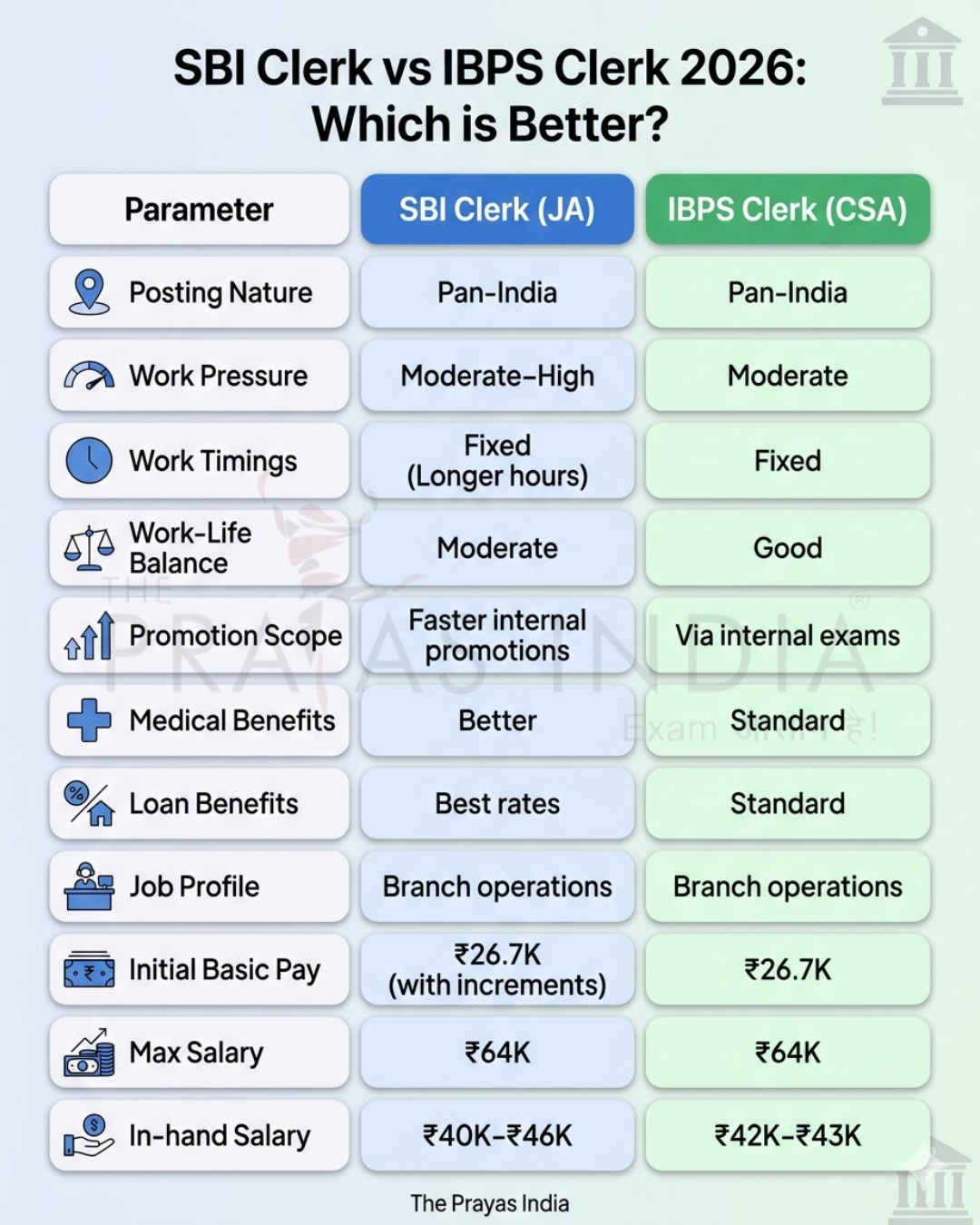
| Parameter | SBI Clerk (JA) | IBPS Clerk (CSA) |
|---|---|---|
| Recruitment | Single bank (SBI) | Multiple public sector banks |
| Posting | Pan-India | Mostly state-based |
| Work Pressure | Moderate to High | Moderate |
| Work Timings | Fixed but often extended | Fixed |
| Work-Life Balance | Moderate | Good |
| Promotion System | Faster internal promotions | Promotion through exams |
| Salary | Higher | Moderate |
| Allowances | Better | Standard |
| Job Role | Branch banking operations | Branch banking operations |
Get All Banking Exams Updates
Detailed Salary Comparison
Salary plays a crucial role in choosing between SBI Clerk and IBPS Clerk. The difference in pay is significant and often becomes a deciding factor.
SBI Clerk Salary Structure (2026)
- Basic Pay: Approximately ₹26,730 (including advance increments)
- Gross Salary: Around ₹45,000 to ₹47,000 per month (depending on location)
- In-hand Salary: Approximately ₹40,000 to ₹43,000
- Allowances: Dearness Allowance, House Rent Allowance, Transport Allowance, Special Allowance
- Additional Benefits: Medical coverage, concessional loan facilities, pension-related benefits
SBI employees receive comparatively higher allowances, which increases the overall compensation package.
IBPS Clerk Salary Structure (2026)
- Basic Pay: Approximately ₹19,900
- Gross Salary: Around ₹30,000 to ₹33,000 per month
- In-hand Salary: Approximately ₹28,000 to ₹30,000
- Allowances: Dearness Allowance, HRA, Transport Allowance
- Benefits: Standard medical and loan benefits (vary by bank)
The salary varies depending on the bank allotted and the city of posting.
Salary Comparison Table
| Component | SBI Clerk | IBPS Clerk |
|---|---|---|
| Basic Pay | ₹26,730 | ₹19,900 |
| Gross Salary | ₹45K–₹47K | ₹30K–₹33K |
| In-hand Salary | ₹40K–₹43K | ₹28K–₹30K |
| Perks | Higher | Moderate |
It is evident that SBI Clerk offers a significantly better salary package compared to IBPS Clerk.
Join New Batches of Banking Exams
Job Profile and Responsibilities
The job profile of both SBI Clerk and IBPS Clerk is largely similar, as both are involved in day-to-day banking operations.
Common Responsibilities
- Handling cash transactions
- Managing customer queries
- Opening bank accounts and KYC verification
- Processing loans and deposits
- Updating passbooks and maintaining records
- Supporting digital banking services
Key Difference
While the nature of work is similar, SBI branches generally experience higher customer footfall, leading to increased workload and responsibility.
Work Culture and Job Pressure
SBI Clerk Work Environment
- High customer volume due to SBI’s large network
- Faster-paced work environment
- Greater responsibility in daily operations
- Occasional extension of working hours
The work pressure in SBI is relatively higher because of its scale and reach.
IBPS Clerk Work Environment
- Workload depends on the allotted bank
- Comparatively less pressure in smaller or regional banks
- More structured and predictable work schedule
IBPS Clerks generally experience a more balanced and less stressful work environment.
IBPS Bank Exam Calendar 2026-27 PDF
Career Growth and Promotion Opportunities
SBI Clerk Promotion Structure
SBI provides a well-defined promotion policy:
- Clerks can appear for internal exams
- Opportunities for promotion to Officer cadre
- Faster career progression compared to other banks
- Performance-based growth opportunities
SBI employees often experience quicker upward mobility.
IBPS Clerk Promotion Structure
- Promotion depends on internal bank policies
- Requires clearing departmental exams
- Growth rate varies across banks
- Generally slower compared to SBI
Although growth is possible, it may take more time depending on the bank.
Work-Life Balance
Work-life balance is an important factor for many aspirants.
SBI Clerk
- Working hours may extend during peak periods
- Moderate work-life balance
- Transfers possible across regions
IBPS Clerk
- Fixed working hours
- Better work-life balance
- Posting usually within the selected state
Candidates prioritizing personal time often prefer IBPS Clerk roles.
Transfer and Posting Policy
- SBI Clerk: Pan-India transfer policy, including rural and urban postings
- IBPS Clerk: Posting usually within the state selected during application
This makes IBPS Clerk more suitable for candidates who want geographical stability.
The Prayas India Mock Test
Pros and Cons
SBI Clerk – Advantages
- Higher salary and allowances
- Better medical and loan benefits
- Faster promotions
- Strong institutional reputation
SBI Clerk – Disadvantages
- Higher work pressure
- Longer working hours
- Transfer liability across India
IBPS Clerk – Advantages
- Better work-life balance
- Lower work pressure
- State-level posting
- Stable and predictable work routine
IBPS Clerk – Disadvantages
- Lower salary
- Slower career growth
- Benefits vary across banks
Which One Should You Choose?
The choice between SBI Clerk and IBPS Clerk depends on your personal priorities.
Choose SBI Clerk if:
- You want a higher salary and better perks
- You are comfortable with a demanding work environment
- You aim for faster career growth
- You are open to relocation across India
Choose IBPS Clerk if:
- You prefer a balanced work-life routine
- You want to stay in your home state
- You are looking for a less stressful job
- You value stability over higher income
Final Verdict
When all factors are considered, SBI Clerk emerges as the better option in terms of salary, benefits, and career growth opportunities. It offers a more rewarding long-term career for candidates willing to handle higher work pressure.
However, IBPS Clerk remains a strong alternative for candidates who prioritize work-life balance, job stability, and location preference.
Conclusion
Both SBI Clerk and IBPS Clerk are excellent entry-level opportunities in the banking sector. The right choice depends on individual career goals and lifestyle preferences.
Candidates should carefully evaluate factors such as salary, growth prospects, work pressure, and posting location before making a decision. A well-informed choice will not only ensure job satisfaction but also contribute to long-term career success in the banking sector.
FAQs
SBI Clerk is generally considered better due to higher salary, better allowances, and faster promotion opportunities. However, IBPS Clerk is preferred by candidates who want better work-life balance and location stability.
Yes, SBI Clerk offers a higher salary. The in-hand salary of SBI Clerk is around ₹40,000–₹43,000, while IBPS Clerk offers approximately ₹28,000–₹30,000 depending on the bank and location.
SBI Clerk has more work pressure due to higher customer volume and workload. IBPS Clerk generally has moderate and more manageable work pressure.
Yes, SBI Clerk offers faster promotion opportunities through internal exams and performance-based growth. IBPS Clerk promotions depend on the respective bank and are usually slower.
Yes, IBPS Clerk postings are usually within the state chosen during the application, making it suitable for candidates who prefer staying close to home.
Yes, SBI Clerks have a pan-India transfer policy, and transfers can happen across different regions depending on requirements.
SBI Clerk is better for long-term career growth due to structured promotion policies and faster progression to officer-level positions.
Yes, both roles involve similar responsibilities such as customer handling, cash transactions, account management, and branch operations. 1. Which is better, SBI Clerk or IBPS Clerk in 2026?
2. Is SBI Clerk salary higher than IBPS Clerk?
3. Which job has more work pressure: SBI Clerk or IBPS Clerk?
4. Is there a difference in promotion between SBI Clerk and IBPS Clerk?
5. Can IBPS Clerk be posted in the home state?
6. Do SBI Clerks get transferred frequently?
7. Which is better for long-term career growth?
8. Are job roles the same for SBI Clerk and IBPS Clerk?