Awarded by Global Excellence
#1 Coaching Institute
Trusted by
70,000+ Students
Achievement
300 + Results
The Optional Subject is a component of the UPSC Civil Services Main Examination. A candidate chooses one Optional Subject from the subjects listed by UPSC, and that Optional is assessed through two papers.
According to the UPSC examination scheme, Optional Subject Paper I and Optional Subject Paper II carry 250 marks each. Therefore, the Optional contributes a total of 500 marks to the written component of the Mains Examination. The Essay and General Studies papers are also counted for merit, while the Indian Language and English papers are qualifying in nature.
The Optional papers are descriptive in nature and require candidates to demonstrate conceptual understanding, analytical ability, relevant examples, structured presentation and effective answer writing. Therefore, Optional preparation should not be treated as simply reading a textbook or memorising notes.
A good Optional strategy combines conceptual learning with syllabus mapping, previous-year question analysis, regular answer writing, revision and test practice.
| Component | Details |
|---|---|
| Optional Subject | One subject |
| Number of Papers | Two |
| Paper I | 250 marks |
| Paper II | 250 marks |
| Total Optional Marks | 500 |
| Nature of Paper | Descriptive |
| Preparation Focus | Concepts + PYQs + Answer Writing + Revision + Tests |
The UPSC publishes previous-year Optional question papers, making PYQ analysis an important part of preparation. The Commission’s current previous-question-paper archive includes separate Paper I and Paper II question papers for the Optional subjects.
The Optional Subject carries 500 marks, making it a substantial part of the Mains written examination. More importantly, Optional preparation demands depth rather than the broad coverage generally associated with General Studies.
An aspirant may have studied many subjects during Prelims and GS preparation, but Optional requires a different level of engagement. The candidate has to understand the syllabus at a granular level, identify recurring themes in previous-year questions, develop subject-specific notes and learn how to present answers according to the expectations of that particular discipline.
For example, a Geography answer may benefit from maps, diagrams and geographical concepts, whereas a Sociology answer may require thinkers, concepts, contemporary examples and sociological interpretation. Similarly, technical subjects can demand precise conceptual and mathematical treatment.
Therefore, the Optional should be approached as a specialised Mains paper rather than an additional General Studies subject.
For the Civil Services Main Examination, UPSC provides a wide range of Optional Subjects across humanities, social sciences, science, engineering, medicine and literature.
The current list includes the following subjects:
UPSC also allows candidates to choose Literature of one of the specified languages as an Optional Subject. The list includes:
Assamese, Bengali, Bodo, Dogri, Gujarati, Hindi, Kannada, Kashmiri, Konkani, Maithili, Malayalam, Manipuri, Marathi, Nepali, Odia, Punjabi, Sanskrit, Santhali, Sindhi, Tamil, Telugu, Urdu and English.
The availability of a particular Optional coaching batch is not necessarily the same across every coaching institute. Therefore, students should always verify the currently available subject-wise batches before enrolling.
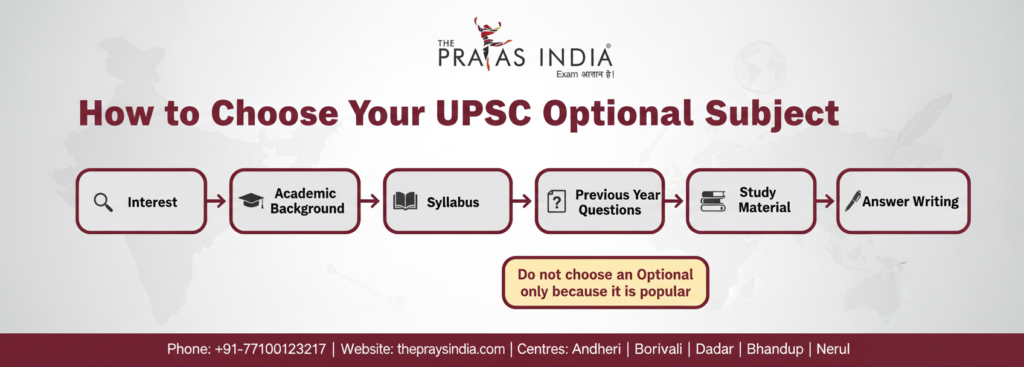
There is no single Optional Subject that is automatically suitable for every UPSC aspirant. The right choice depends on the candidate’s academic background, interest, understanding, preparation time, resources and ability to write answers in that subject.
The Prayas India also highlights factors such as interest, contribution to General Studies, syllabus, resource availability and guidance while discussing Optional selection.
UPSC preparation is a long process. Optional preparation may continue for several months and involves repeated revision and answer-writing practice.
Therefore, the subject should be one that you can study consistently without losing interest after the initial enthusiasm disappears.
Interest does not mean that the subject must be your favourite academic subject. It means that you should be comfortable spending a significant amount of time reading, understanding and revising it.
A graduation background can be useful for certain Optional Subjects because it may give you familiarity with terminology and fundamental concepts.
However, having a degree in a subject does not automatically mean that it is the best Optional for you. The UPSC syllabus and question requirements should still be examined before making a final decision.
Likewise, not having studied a subject formally does not automatically make it unsuitable. What matters is whether you can understand the syllabus, build conceptual clarity and develop sufficient answer-writing competence.
Never choose an Optional simply because someone says its syllabus is “short” or “easy”.
Download and read the official syllabus carefully. Break it into topics and subtopics and compare it with your existing knowledge.
Ask yourself:
Previous-year questions are one of the most useful tools for selecting and preparing an Optional.
Instead of looking only at how many questions were asked from a particular chapter, study the nature of the questions.
Look for:
UPSC’s official website provides previous-year question papers, including Optional papers, which students can use for this analysis.
The availability of reliable study material can make preparation more organised.
However, “more books” does not necessarily mean “better preparation”.
A focused resource list, good class notes, standard reference books, PYQs and properly structured revision material are generally more useful than collecting dozens of sources.
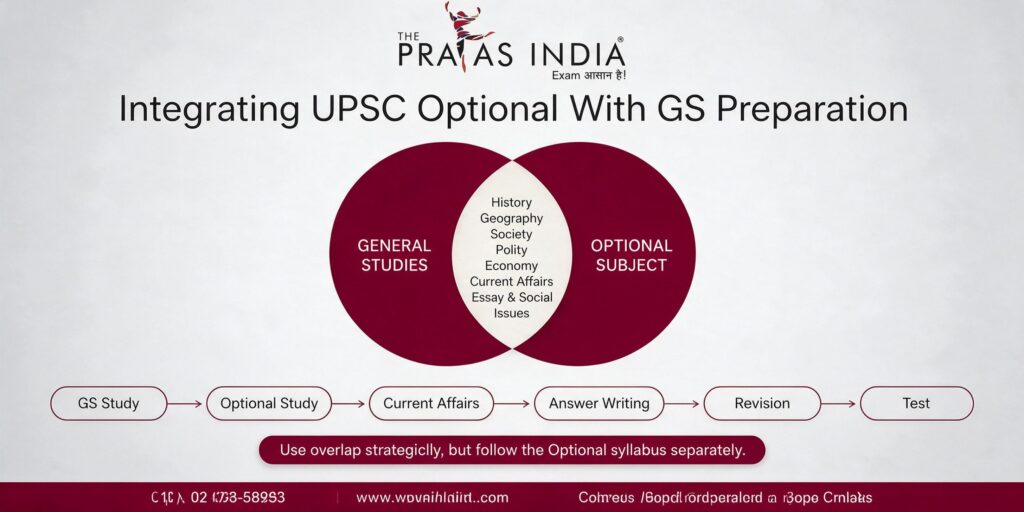
Some Optional Subjects have conceptual areas that overlap with portions of the General Studies syllabus.
This overlap can help an aspirant integrate preparation, but it should not become the only reason for choosing a subject.
GS overlap should be treated as one factor among several.
Optional preparation eventually has to translate into written answers.
Before finalising a subject, look at sample questions and try writing a few answers. This can help you understand whether you are comfortable expressing concepts in the language and structure expected by the subject.
This is one of the most common questions among UPSC aspirants.
The answer depends on the individual.
If your graduation subject is included in the UPSC Optional list and you already have strong conceptual knowledge of it, that background can be an advantage. You may already understand terminology, theories and fundamental concepts.
However, graduation-level knowledge and UPSC Optional preparation are not necessarily identical. The UPSC syllabus, previous-year questions and answer-writing requirements should be studied separately.
On the other hand, students can choose an Optional outside their graduation discipline if they are willing to build the required knowledge and writing skills.
The decision should therefore be based on suitability rather than a rigid rule such as “always choose your graduation subject” or “never choose your graduation subject.”
There is no single date that works for every aspirant, but postponing Optional preparation until the final stage can create unnecessary pressure.
A better approach is to understand the Optional syllabus relatively early and then integrate its preparation with the broader Mains strategy.
A practical sequence can look like this:
Understand the Syllabus → Analyse PYQs → Build Concepts → Complete Core Sources → Make Notes → Start Answer Writing → Take Tests → Revise → Practise Full-Length Papers
The exact timeline will depend on whether you are a beginner, working professional, college student, repeat candidate or already familiar with the subject.
Beginners should first understand what the Optional actually demands. Do not rush into collecting books or writing full-length answers without knowing the syllabus.
Start with the syllabus and PYQs. Then follow a structured learning sequence.
Candidates who have already covered the syllabus should focus more on answer writing, revision, test practice and identifying gaps.
Online classes and recorded lectures can be particularly useful for aspirants who have limited flexibility during weekdays. A structured schedule can help them continue Optional preparation alongside work.
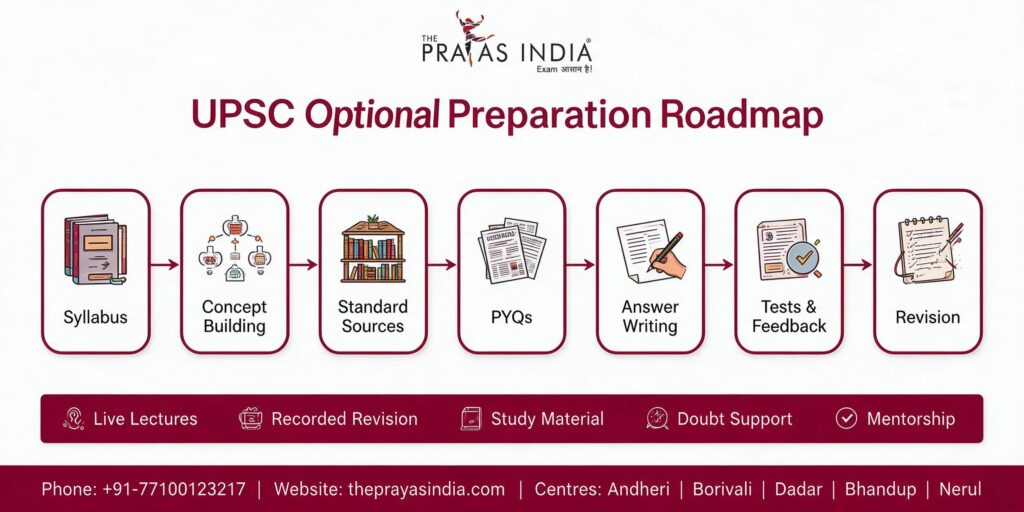
A strong Optional strategy should move through multiple stages rather than depending entirely on lectures.
Keep the syllabus with you throughout preparation.
Whenever you read a chapter, connect it with the relevant syllabus topic. This prevents preparation from becoming unnecessarily broad.
Once you understand the syllabus, examine previous-year questions topic by topic.
This will help you identify the areas UPSC repeatedly explores and the level of analytical depth expected.
Do not start answer writing seriously before developing sufficient conceptual understanding.
A good answer cannot compensate for weak subject knowledge.
Notes should make revision easier.
Avoid converting every lecture or book into a second textbook. Your final revision material should contain important concepts, examples, thinkers, diagrams, facts, case studies and other subject-specific points that you can reproduce in the examination.
Answer writing should gradually become a regular part of Optional preparation.
Initially, focus on understanding the question and building a logical structure. With practice, work on content enrichment, introductions, conclusions, examples, diagrams and time management.
Tests help you identify whether your preparation is translating into examination-ready answers.
The purpose of a test is not merely to obtain marks. It is also to identify gaps in:
Optional preparation requires repeated revision because the syllabus is detailed.
A practical revision cycle can move from:
First Reading → Notes → First Revision → Answer Writing → Test → Gap Identification → Second Revision → Final Revision
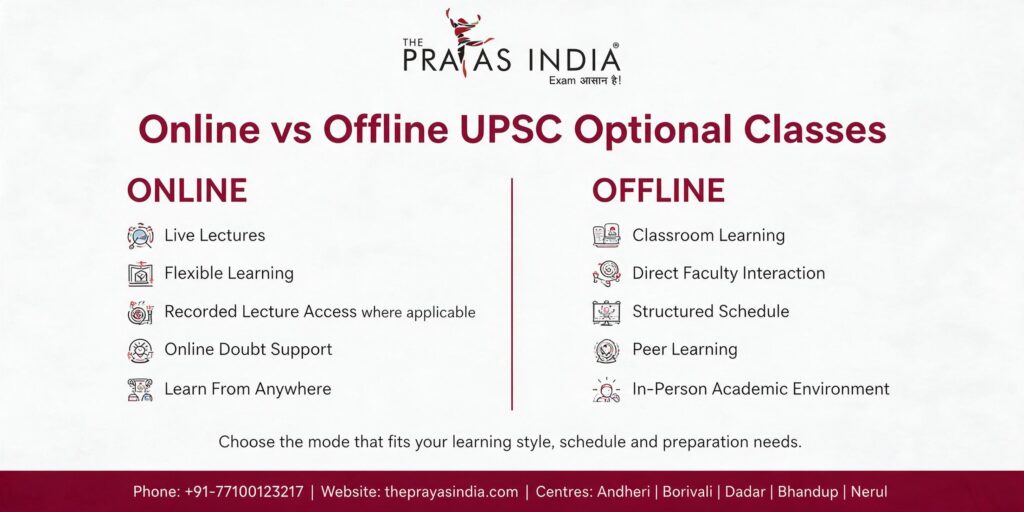
Aspirants today have different learning requirements. Some students prefer the structure and direct interaction of a classroom, while others need the flexibility of online learning.
Therefore, the choice between online and offline Optional classes should depend on your learning style, location, schedule and preparation requirements.
| Feature | Online Optional Classes | Offline Optional Classes |
|---|---|---|
| Live Learning | Available in applicable batches | Classroom-based |
| Flexibility | High | Structured |
| Faculty Interaction | Through online sessions and available support | Direct classroom interaction |
| Recorded Lectures | Available where included in the course | Depends on the specific batch/course |
| Study Material | Course-specific | Course-specific |
| Doubt Support | Available through designated channels | Direct classroom/support mechanisms |
| Peer Interaction | Digital | Face-to-face |
| Best Suited For | Flexible learners, working aspirants, students outside the centre location | Students who prefer classroom learning |
The exact features, recording access and subject-wise availability can vary by batch, so students should confirm the latest course details before admission.
The Prayas India provides online learning options as part of its UPSC preparation ecosystem. Its current UPSC course pages list online live learning, while its Optional offering includes subject-focused preparation.
Online Optional preparation can be particularly useful for students who cannot regularly attend a physical classroom.
Live classes allow students to learn according to a structured schedule while interacting with faculty during the learning process.
For Optional preparation, live learning can be useful because many topics require explanation rather than simple reading. Students can understand concepts, ask questions and follow a planned sequence.
Recorded lectures can provide an additional revision resource where recording access is included in the selected course.
A student may attend a live lecture and later revisit a difficult topic during revision. This can be especially useful for conceptual subjects where repeated explanation improves retention.
Online classes can help aspirants continue their preparation from different locations without needing to travel to a physical classroom.
This can be particularly useful for working professionals, college students and aspirants who live outside the centre locations.
Online preparation becomes more effective when it is combined with a planned syllabus, study material, answer-writing practice, tests and doubt resolution rather than relying only on video lectures.
The Prayas India describes its teaching methodology around Learn, Practice and Test, with study material, doubt support and progress tracking as part of its broader learning ecosystem.
Offline classroom learning remains a preferred option for many aspirants who perform better in a structured academic environment.
The Prayas India offers offline UPSC classroom programmes, with its current UPSC course pages listing centres including Andheri, Borivali, Dadar, Thane, Nerul and Bhandup for the broader UPSC programmes. Optional subject availability can vary by subject and batch.
Offline classes provide face-to-face interaction between students and faculty.
This can make it easier for students to ask questions during or after a lecture and participate in discussions.
A fixed classroom schedule can help students maintain consistency.
For aspirants who find it difficult to follow a self-created timetable, regular classes can provide an external structure to their preparation.
Studying alongside other UPSC aspirants can expose students to different ways of approaching a topic, writing answers and analysing questions.
The classroom environment can encourage students to remain focused on the subject and follow the course sequence.
The Prayas India has a dedicated Optional Subject preparation offering within its UPSC ecosystem. Its current website lists Prayas-तेजस [UPSC CSE Optional], and the UPSC section also highlights Optional preparation among its courses.
The objective of Optional coaching should not be limited to completing lectures. Students need a system that helps them move from understanding concepts to writing effective Mains answers.
A structured Optional preparation programme can therefore combine:
The Prayas India’s current Sociology Optional course, for example, describes syllabus coverage, study material, answer-writing practice, mock tests, current-affairs integration, doubt clearing and revision support as course features. Availability of similar features should be confirmed for the specific Optional subject and batch a student is considering.
A combination of live and recorded learning can be useful because both formats serve different purposes.
Live lectures can be used as the primary learning environment where the faculty explains concepts, discusses questions and guides students through the syllabus.
For difficult topics, interaction during a live class can help students understand the reasoning behind the concept rather than simply memorising notes.
Recorded lectures can be useful when a student wants to revisit a topic.
For example, after completing an entire unit, an aspirant may return to selected lectures to clarify a difficult concept before beginning revision or test practice.
This is particularly useful when the Optional has complex theories, thinkers, technical concepts or multiple interconnected topics.
A practical learning cycle can be:
Live Lecture → Notes → Self-Study → PYQs → Answer Writing → Test → Recorded Revision → Final Revision
This ensures that lectures become a part of preparation rather than becoming the entire preparation.
Study material should simplify preparation rather than increase the number of resources.
The ideal study material should help students understand:
The Prayas India states that its study material is designed and updated by its Research & Development team, while its Optional offering includes subject-specific material and preparation support.
However, students should still develop the habit of referring to the official UPSC syllabus and previous-year papers. Coaching material should support the preparation; it should not replace the candidate’s understanding of the actual UPSC requirements.
Answer writing is one of the most important components of Optional preparation.
Knowing a topic and being able to write a good answer within the examination time are two different skills.
A strong Optional answer should generally demonstrate:
The answer should directly address what the question is asking.
The response should have a logical flow rather than presenting disconnected information.
Every point should contribute to answering the question.
Relevant examples can make an answer more concrete.
Depending on the Optional, enrichment can include thinkers, scholars, theories, diagrams, maps, case studies, formulas, technical concepts or contemporary examples.
The answer should close the discussion logically instead of stopping abruptly.
Regular feedback can help students identify recurring problems in their writing and improve them before the examination.
Previous-year questions should be used throughout the preparation cycle.
During the beginning of preparation, PYQs help students understand what UPSC asks.
During the middle phase, they help identify important areas and connect syllabus topics with actual questions.
During revision, PYQs become a tool for testing whether the candidate can reproduce concepts in an examination-oriented format.
A useful method is to create a topic-wise PYQ notebook or digital document.
For every question, identify:
Syllabus Topic → Question Demand → Core Concept → Supporting Examples → Possible Structure
This turns PYQs into a preparation framework rather than simply a collection of old papers.
One common mistake is treating Optional and GS as completely separate preparation tracks.
Although they are different components, there can be useful areas of conceptual overlap.
For example, depending on the Optional, preparation may connect with areas such as:
However, overlap should be used intelligently.
The Optional syllabus should always remain the primary framework for Optional preparation. Do not assume that studying a topic for GS automatically completes the corresponding Optional requirement.
A good weekly schedule can therefore allocate separate time for Optional while using relevant GS and current-affairs preparation wherever genuine overlap exists.
Popularity does not guarantee suitability. A subject that works well for one aspirant may not match another aspirant’s academic background, interest or writing style.
Students sometimes select an Optional based on discussions, videos or recommendations without studying the official syllabus.
Always read the syllabus first.
The syllabus tells you what the subject contains. PYQs show you how UPSC has tested it.
Both should be studied together.
Resource overload can slow down preparation.
Build a focused source list and revise it repeatedly.
Many students wait until the entire syllabus is complete before writing answers.
It is generally better to gradually introduce answer writing while completing the syllabus.
Completing lectures does not mean completing preparation.
Revision converts learning into recall.
Coaching can provide structure, explanation and guidance, but the candidate still has to read, revise, practise and analyse independently.
Optional coaching may be useful for students who:
At the same time, coaching is not the only possible route to Optional preparation. Some experienced candidates may prefer self-study. The important question is whether your chosen preparation method gives you sufficient conceptual clarity, practice, feedback and revision.
Online classes may be particularly suitable for:
Offline classes may be suitable for students who:
The best mode is ultimately the one that you can follow consistently for the entire preparation period.
The Prayas India follows a broader learning approach built around Learn, Practice and Test. Its UPSC ecosystem includes classroom and online programmes, study materials, test-oriented preparation, mentorship and doubt support.
For Optional preparation specifically, students should look for a system that connects these stages:
Understand the syllabus and concepts through structured classes and study material.
Solve PYQs and practise subject-specific answers.
Attempt tests under time constraints and analyse the performance.
This cycle helps transform passive learning into active examination preparation.
The Prayas India’s current Optional offering also describes personalised mentorship, answer-writing practice, mock tests, current-affairs integration for relevant subjects, doubt clearing and revision support.
Optional preparation can become overwhelming when students do not have a clear roadmap.
A structured plan answers four basic questions:
What should I study?
The syllabus and standard sources define the content.
How should I study it?
Classes, self-study, notes and PYQs provide the learning framework.
How will I know whether I am improving?
Answer writing, tests and feedback provide measurable practice.
How will I retain what I have studied?
Revision cycles and recorded lectures where available can support retention.
This is why a good Optional preparation programme should not focus only on completing lectures. The objective should be to take the student from conceptual understanding to examination-ready answer writing.
Your Optional Subject should not be selected merely because another aspirant chose it or because it is frequently discussed online. It should be selected after understanding the syllabus, analysing previous-year questions and honestly evaluating your interest, background, resources and answer-writing comfort.
Once the subject is selected, preparation should move systematically from concept building to PYQs, answer writing, testing and repeated revision.
For aspirants who want structured guidance, The Prayas India provides UPSC Optional preparation through its dedicated Optional learning ecosystem, with online and offline learning options for applicable batches. Students can explore the currently available subject-wise courses, batch schedules and learning features before making an admission decision.
Whether you prefer the flexibility of online learning or the structure of an offline classroom, the objective should remain the same: understand the Optional deeply, practise consistently and become capable of writing high-quality answers under examination conditions.
Your Optional Subject should not be selected merely because another aspirant chose it or because it is frequently discussed online. It should be selected after understanding the syllabus, analysing previous-year questions and honestly evaluating your interest, background, resources and answer-writing comfort.
Once the subject is selected, preparation should move systematically from concept building to PYQs, answer writing, testing and repeated revision.
For aspirants who want structured guidance, The Prayas India provides UPSC Optional preparation through its dedicated Optional learning ecosystem, with online and offline learning options for applicable batches. Students can explore the currently available subject-wise courses, batch schedules and learning features before making an admission decision.
Whether you prefer the flexibility of online learning or the structure of an offline classroom, the objective should remain the same: understand the Optional deeply, practise consistently and become capable of writing high-quality answers under examination conditions.
Your Optional subject accounts for 500 marks of the Mains merit foundation. Don’t leave your preparation to chance—build conceptual depth under India’s premium administrative mentors.
Speak with a senior UPSC Optional Counselor right now:
Ready to Crack IAS ?
Begin your exam preparation with the best mentors of India.
#1 Coaching Institute
70,000+ Students
300 + Results
Dedicated batches for Graduate, Under graduate and Working Professionals
We are a team of highly experienced mentors. The Research & Development Team at Prayas continuously works hard for all our students.
We firmly believe in and follow the three steps of preparation:
Learn | Practice | Test
The Prayas study material is extremely comprehensive and very well designed. It is regularly updated by our Research & Development team.
It is imperative to be disciplined to crack competitive exams. Our mentors help aspirants in defining their study time table and strategy.
Instant solution of doubts is our USP. We have several dedicated groups and communities to help aspirants get their doubts solved in real time.
We provide individual progress tracker to every aspirant. It helps the aspirant complete syllabus in defined time frame and builds confidence.
We provide special basic lectures to beginners. Easy-to-understand explanation of important concepts helps them build a strong base.
We connect one-on-one with students who require support from us in their learning. Mentors are always available & ready for support.
Ours is a highly technology-driven platform that meets all the learning needs of aspirants. It simplifies their experience and helps them clear examinations with ease.
Enquire about New Batches, Fee Structure and Time Table
Book an aapointment with the expert mentors and counsellors of The Prayas IAS
Let us connect !
Begin your exam preparation with the best mentors of India.
Book an aapointment with the expert mentors and counsellors of The Prayas IAS
Ready to Crack UPSC CSE ?
Connect with us and begin your IAS preparation with the best mentors of India.