
Bank Exam Preparation: How to Create a Consistent Daily Routine
Is article ko The Prayas India ke Bhandup centre ke liye local SEO-focused website content ke roop mein structure kar raha hoon. Isme practical daily timetable, subject-wise study planning, revision, mock tests, aur Bhandup ke aspirants ke liye coaching-related guidance rahegi. Infographics aur feature image ke prompts bhi premium style mein honge, aur is baar feature image mein koi person nahi hoga.
Bank Exam Preparation: How to Create a Consistent Daily Routine
Preparing for competitive banking examinations requires more than collecting study materials or spending long hours with books. Candidates preparing for SBI PO, SBI Clerk, IBPS PO, IBPS Clerk and other bank recruitment examinations need a consistent routine that balances concept learning, practice, revision and mock tests.
For many aspirants in Bhandup, Mulund, Nahur, Kanjurmarg and nearby areas of Mumbai, maintaining this consistency can be challenging. College schedules, office hours, commuting, household responsibilities and distractions can make it difficult to follow a fixed study plan. Some candidates study intensely for two or three days but struggle to maintain the same momentum throughout the week.
The solution is not necessarily to study for more hours. It is to build a realistic daily routine that you can follow repeatedly, measure your progress against and adjust when necessary.
This guide explains how to create a practical daily study schedule for bank exams, organise subjects, manage revision, use mock tests effectively and develop habits that support long-term preparation. Aspirants looking for structured guidance can also explore the banking exam preparation support available at The Prayas India in Bhandup.
Why Is a Consistent Daily Routine Important for Bank Exam Preparation?
Bank examinations assess multiple skills, including quantitative aptitude, reasoning ability, English language proficiency and general or banking awareness, depending on the examination and stage. Preparing for these areas simultaneously requires regular practice rather than occasional study sessions.
A consistent routine helps you distribute your effort across subjects instead of repeatedly focusing on the topics you enjoy most. It also creates dedicated time for revision, allowing you to revisit concepts and mistakes before they are forgotten.
1. It improves conceptual understanding
Quantitative aptitude and reasoning often involve recognising patterns, selecting suitable methods and solving questions accurately under time pressure. Regular practice helps candidates become familiar with different question types and identify the approaches that work best for them.
2. It builds speed and accuracy
Competitive examinations impose time limits. Practising regularly helps you evaluate how long different questions take and whether you are making avoidable calculation or interpretation errors.
3. It prevents last-minute pressure
When you divide the syllabus into manageable daily targets, preparation becomes easier to monitor. You can identify unfinished topics earlier and revise them gradually instead of attempting to cover everything just before the examination.
4. It makes progress measurable
A timetable gives you a simple way to track completed topics, practice questions, revision sessions and mock-test performance. This information helps you decide what to study next instead of planning your day randomly.
Understand the Main Areas of Bank Exam Preparation
Before creating a timetable, understand which subjects require regular attention. The exact syllabus and examination pattern depend on the recruitment notification, so always verify the applicable requirements for your target examination.
Quantitative Aptitude
Quantitative aptitude generally involves arithmetic, calculation-based questions, data interpretation and other mathematical topics relevant to the examination. Candidates should combine concept learning with timed practice.
Start with the fundamentals of a topic, learn the relevant methods and solve questions of gradually increasing difficulty. Maintain a separate record of calculation mistakes and question types that take too long.
Reasoning Ability
Reasoning preparation may include puzzles, seating arrangements, syllogisms, inequalities, coding-decoding and other logical question types, depending on the exam.
Avoid attempting every difficult puzzle immediately. Build familiarity with the basic concepts first, then practise different formats and analyse why a particular approach worked or failed.
English Language
English preparation can include reading comprehension, vocabulary, grammar, sentence structure and other language-based question types.
Include reading practice in your daily schedule. Review unfamiliar words in context, revise grammar concepts and practise questions while paying attention to both accuracy and comprehension.
General Awareness and Banking Awareness
Depending on the examination stage, General Awareness may involve current affairs, banking and financial awareness, economic developments and other relevant topics.
Instead of reading large amounts of news without a plan, set aside a dedicated period for relevant updates and revision. Organise your notes by topic and revisit important information regularly.
Computer Awareness or Other Exam-Specific Topics
Some recruitment examinations or stages may include additional subjects or specific knowledge requirements. Include these in your timetable only when they are relevant to your target examination and its current official pattern.
Important: Do not assume that every banking examination has an identical syllabus. Check the latest official notification for your chosen exam before finalising your study plan.
How to Create a Daily Study Routine for Bank Exams
A useful timetable should account for your available time, present preparation level and personal responsibilities. Copying another candidate’s schedule may not work if their circumstances are different.
Step 1: Identify your available study hours
Start by calculating how much uninterrupted time you can realistically devote to preparation each day.
If you are a full-time student, you may be able to study during several periods throughout the day. If you are working, an early-morning session and a longer evening session may be more practical. Candidates who commute should also account for travel time and fatigue.
Do not build a timetable around an ideal day when you have unlimited energy. Build it around an ordinary day that you can repeat.
Step 2: Set daily targets instead of vague goals
A target such as “study reasoning today” is difficult to measure. A more useful target is “learn one reasoning concept, solve 25 practice questions and review incorrect answers.”
Your targets should be specific enough to tell you whether you completed the work. At the same time, keep them flexible enough to accommodate a difficult topic or an unexpected responsibility.
Step 3: Divide the day into focused sessions
Give every study session a defined purpose. For example, use one session for learning concepts, another for timed practice and a shorter session for revision.
Take brief breaks between demanding sessions. Avoid switching between several unrelated subjects every few minutes, as frequent interruptions can make focused study harder.
Step 4: Schedule revision before adding extra topics
New topics can create a feeling of progress, but forgetting previously learned material can weaken your overall preparation. Reserve time for reviewing formulas, vocabulary, current affairs notes and questions you answered incorrectly.
A practical approach is to revisit important material after a short interval and then review it again later in the week. Adjust the intervals according to how well you remember the information.
5: Keep a fixed time for performance analysis
Do not judge preparation only by the number of questions solved. Review whether your answers were correct, how long you took and which errors repeated.
Your analysis should identify the next action. If you repeatedly make calculation errors, add targeted calculation practice. If puzzles consume too much time, practise the relevant formats and compare alternative solving methods.
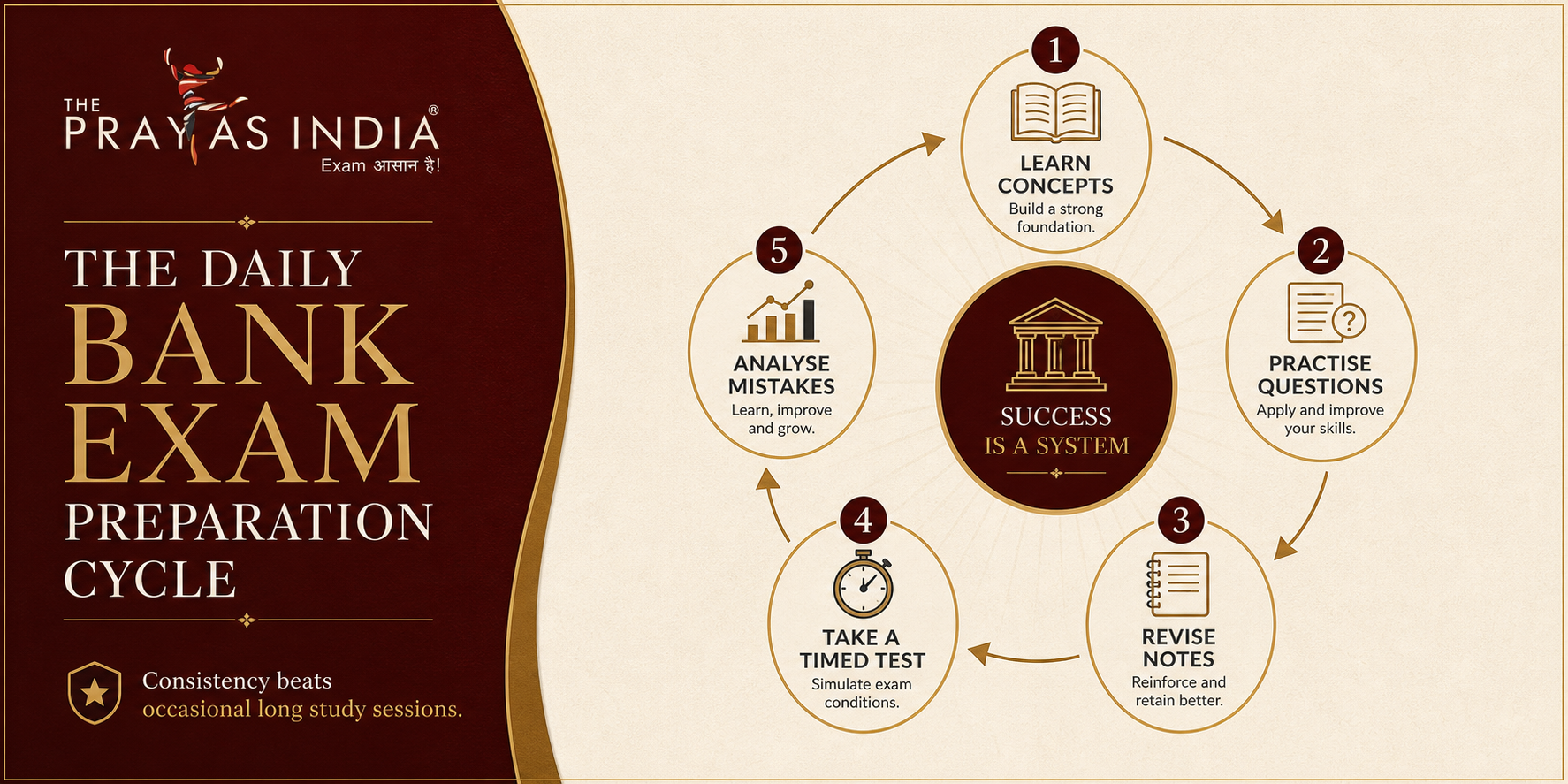
Sample Daily Timetable for Bank Exam Aspirants
Your ideal schedule depends on your current level and daily responsibilities. The following timetable is a starting point, not a compulsory routine. Change the time slots to suit your lifestyle while preserving the balance between subjects, practice and revision.
| Time | Study activity | Main objective |
|---|---|---|
| 6:30–7:00 AM | Current affairs and banking updates | Review important news and notes |
| 7:00–8:00 AM | Quantitative aptitude | Learn concepts and practise questions |
| 8:00–8:15 AM | Short break | Refresh before the next session |
| 8:15–9:00 AM | English language | Reading, vocabulary or grammar practice |
| 5:30–6:30 PM | Reasoning ability | Practise concepts, puzzles or timed sets |
| 6:30–7:00 PM | Revision | Revisit formulas, notes and mistakes |
| 7:00–7:45 PM | Sectional practice or mock analysis | Measure accuracy and identify weaknesses |
| 7:45–8:00 PM | Plan the next day | Set achievable study targets |
This example includes approximately six hours of scheduled study and review, excluding meal breaks and other personal activities. It can be shortened, expanded or split across the day according to your availability.
If you are a working professional, you might study for 60–90 minutes before work and complete two focused sessions in the evening. On particularly busy days, protect a smaller minimum routine rather than abandoning preparation completely.
How Should Beginners Organise Their First Month?
Beginners should avoid attempting to master every subject at once. The first month should establish a foundation, reveal weak areas and introduce a repeatable study habit.
Week 1: Understand the exam and establish the habit
- Check the official syllabus and examination pattern for your target exam.
- Take a diagnostic test or a short set of questions to understand your current level.
- Begin fundamental concepts in quantitative aptitude, reasoning and English.
- Start a short daily current affairs and revision session.
- Record the time you can realistically study each day.
Week 2: Build subject-wise practice
- Continue learning foundational concepts.
- Solve practice questions after every concept.
- Maintain an error notebook for incorrect answers.
- Practise reading comprehension and vocabulary regularly.
- Review current affairs notes from the previous week.
Week 3: Introduce timed practice
- Begin timed sectional tests where appropriate.
- Review whether your speed affects accuracy.
- Revisit difficult concepts instead of repeatedly attempting them without analysis.
- Continue revising older material.
- Adjust your timetable according to actual performance.
Week 4: Review progress and refine the schedule
- Take suitable practice tests or mock tests.
- Compare your performance with your initial diagnostic assessment.
- Identify the subjects requiring more attention.
- Remove unrealistic targets from your timetable.
- Plan the next month using your progress data.
The goal of the first month is not to achieve perfection. It is to develop a study system that you can maintain and improve over time.
How to Balance Study, Revision and Mock Tests
A common preparation mistake is to spend nearly all available time learning new concepts while postponing revision and testing. A balanced timetable should include all three activities.
Concept learning
Use this time to understand methods, rules and question formats. Make concise notes rather than copying entire chapters. After learning a concept, solve questions to confirm that you can apply it.
Practice sessions
Practise questions by subject and difficulty level. Start with accuracy-focused practice when learning a topic, then introduce time limits as your familiarity improves.
Revision sessions
Review formulas, vocabulary, important facts and mistakes. Focus particularly on material you frequently forget or answer incorrectly.
Mock tests and analysis
Use mock tests to understand your performance under timed conditions. After every test, examine:
- Questions answered correctly and incorrectly.
- Questions left unanswered and the reasons for leaving them.
- Time spent on different sections.
- Concepts that require further revision.
- Avoidable mistakes caused by rushing or misreading.
Do not take mock tests simply to increase the count on your preparation tracker. The real benefit comes from using the results to improve your next study session.
Weekly Study Plan: Keep Every Subject in Rotation
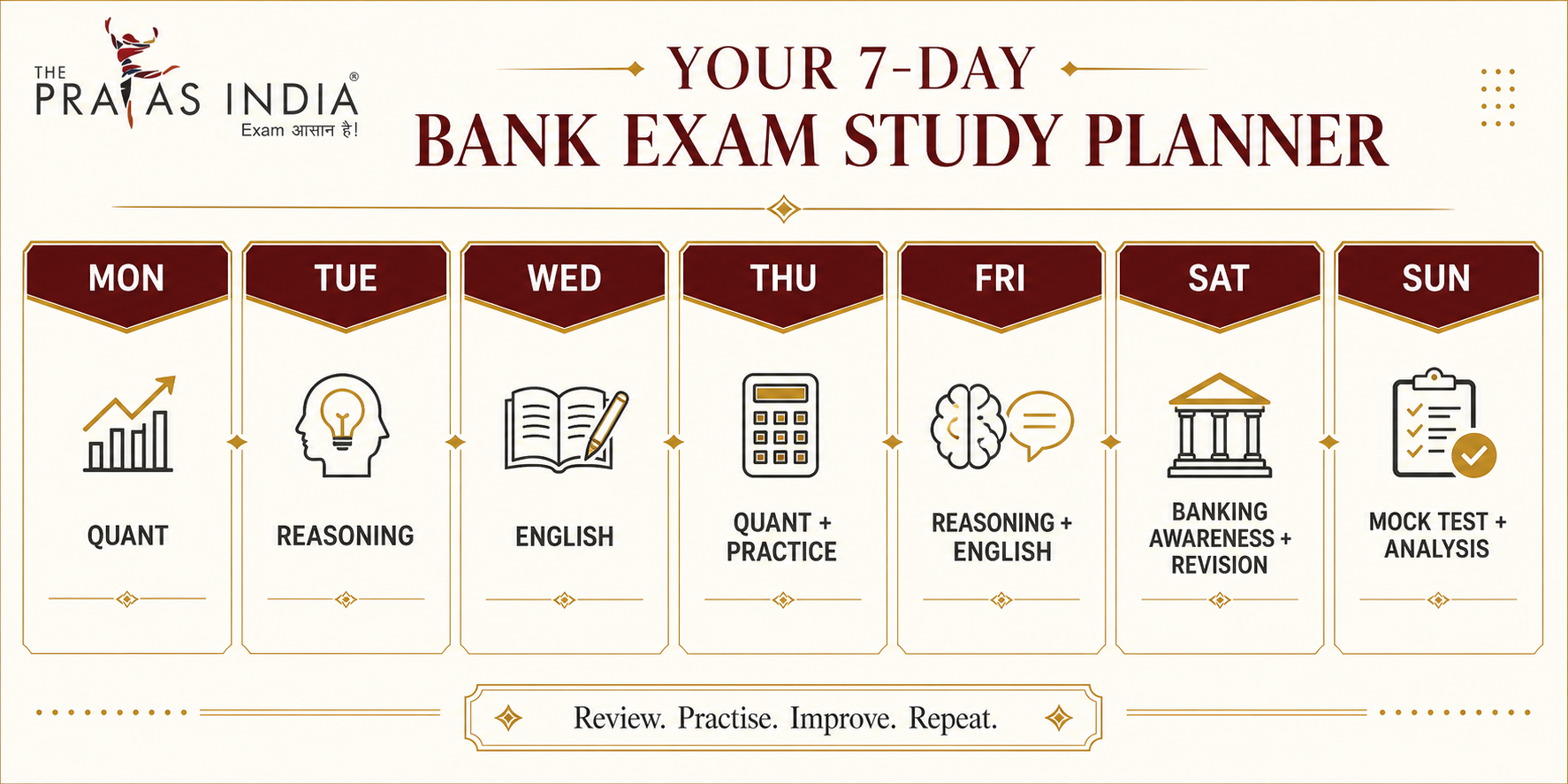
A weekly plan helps you maintain subject balance without making every day identical. Use the following framework and modify it according to the syllabus, exam stage and your weaknesses.
| Day | Primary focus | Supporting task |
|---|---|---|
| Monday | Quantitative aptitude | English reading and current affairs revision |
| Tuesday | Reasoning ability | Quantitative aptitude practice |
| Wednesday | English language | Reasoning revision and current affairs |
| Thursday | Quantitative aptitude | Timed practice and error analysis |
| Friday | Reasoning ability | English grammar or comprehension |
| Saturday | Mixed sectional practice | Banking awareness and weekly revision |
| Sunday | Mock test or cumulative practice | Detailed analysis and next-week planning |
This is a flexible framework rather than a fixed subject allocation. If you struggle with a particular section, dedicate additional sessions to it without neglecting the others.
Daily Habits That Make Your Routine Easier to Maintain
A timetable works best when supported by simple habits. You do not need to redesign your entire lifestyle to become more consistent; start by reducing the obstacles that repeatedly interrupt your study sessions.
Prepare your study materials in advance
Before ending your day, decide which topics you will study the next morning. Keep the required books, notes and practice questions ready. This reduces the time spent deciding what to do when a session begins.
Minimise digital distractions
Keep your phone away during focused sessions unless you need it for a specific study resource. Turn off unnecessary notifications and use a timer if it helps you remain focused.
Set a minimum target for difficult days
Unexpected work, travel or personal responsibilities may reduce your available study time. Establish a smaller minimum routine that includes at least one focused practice session and a brief revision period.
This approach helps you preserve the habit even when you cannot complete your full timetable.
Track progress honestly
Maintain a simple weekly record of completed sessions, topics covered, practice accuracy and recurring mistakes. Record what you actually achieved rather than what you intended to complete.
Protect rest and recovery
Adequate sleep, regular meals and short breaks support concentration and make demanding study sessions easier to sustain. Avoid relying on repeated late-night study sessions if they leave you too tired to work effectively the following day.
Common Daily Routine Mistakes to Avoid
Even a well-designed timetable can fail if it is unrealistic or poorly monitored.
1. Copying someone else’s timetable: A schedule designed for a full-time student may not suit a working aspirant. Match your routine to your available hours.
2. Setting too many targets: An overloaded plan creates unfinished tasks and discouragement. Prioritise the most important activities and increase your workload gradually.
3. Ignoring weaker subjects: Candidates often spend more time on subjects they already enjoy. Use practice results to decide where additional work is needed.
4. Skipping revision: Completing a chapter once does not guarantee that you will remember it. Schedule regular reviews.
5. Taking tests without analysing them: A mock test is a diagnostic tool. Identify why mistakes happened and plan corrective practice.
6. Changing the routine every few days: Constantly rebuilding the timetable can become a distraction. Keep a stable structure and review it at reasonable intervals.
7. Treating one missed day as failure: A missed session does not erase previous progress. Resume the routine at the next available opportunity instead of abandoning the entire plan.
How Coaching Can Support a Consistent Bank Exam Routine
Self-study is an important part of bank exam preparation, but some aspirants benefit from external structure and guidance. A coaching programme may help candidates organise subject learning, identify weak areas and maintain a regular practice schedule.
When evaluating a coaching institute, look beyond its location or promotional claims. Ask whether the course covers your target examination, how classes and practice sessions are organised, what support is available for doubts and whether mock-test analysis is included.
Also check the batch timings, course fees, study resources and current availability before enrolling. These details can vary between programmes.
For aspirants living in Bhandup West, Bhandup East, Mulund, Nahur and nearby parts of Mumbai, a conveniently located institute may make it easier to attend classes while continuing daily self-study.
Why consider The Prayas India in Bhandup?
Aspirants can contact The Prayas India to enquire about available banking exam preparation programmes and determine whether the teaching schedule and course structure suit their needs.
Before making a decision, discuss your target examination, current preparation level and daily availability with the institute. Ask how the programme can fit alongside your independent practice, revision and mock-test schedule.
The key is to choose a preparation arrangement that supports consistent work rather than relying entirely on classroom hours. Your personal study routine remains essential.
A Simple Daily Checklist for Bank Exam Aspirants
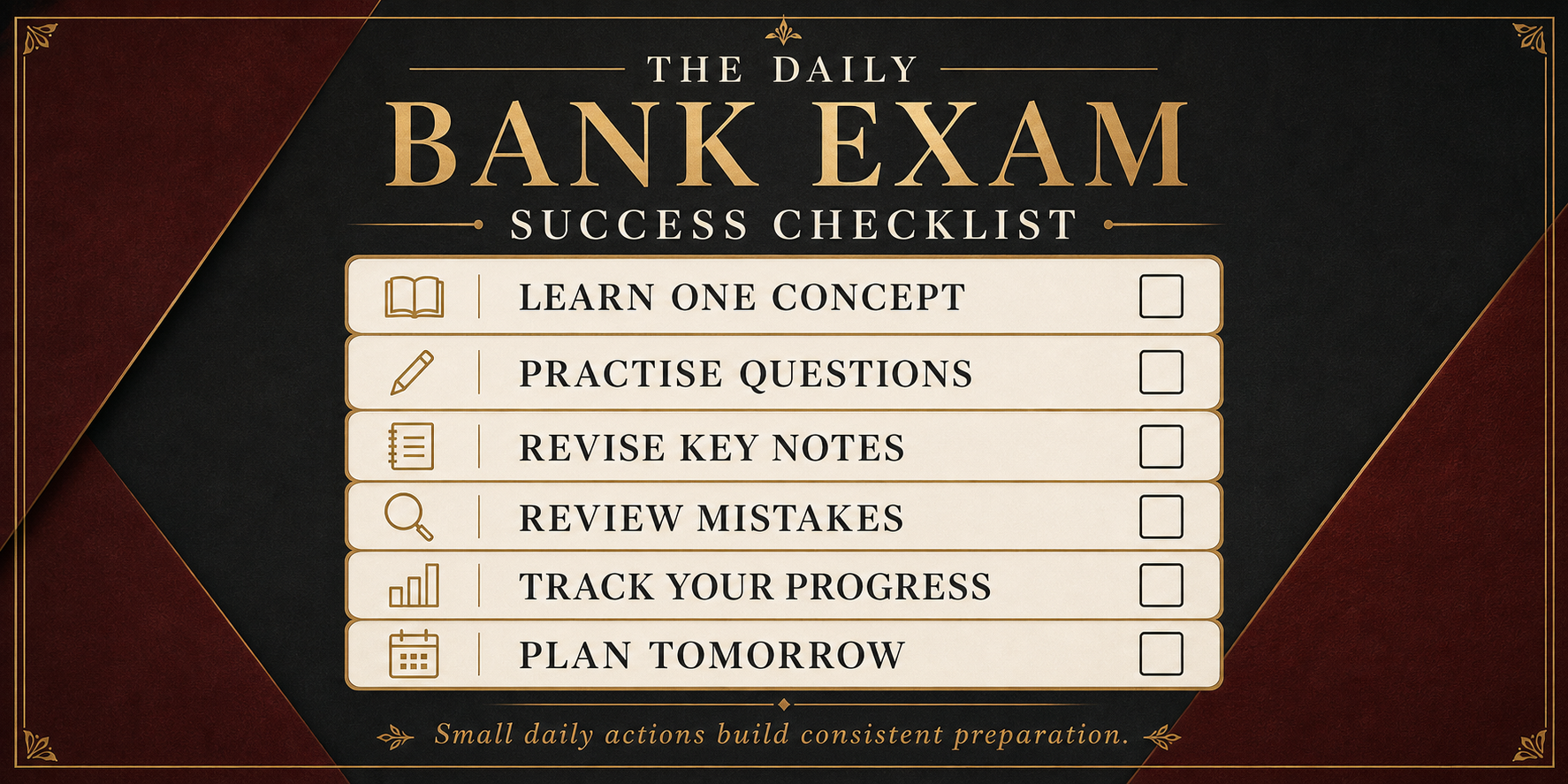
Use this checklist at the end of each day to evaluate whether you have covered the most important preparation activities.
Remember: You do not need to complete every item in the same way every day. Adjust the checklist according to your study stage and the time available.
Conclusion: Build a Routine You Can Follow Every Day
A successful bank exam preparation routine does not need to be complicated. It needs to be realistic, balanced and consistent. Start by identifying your available study hours, divide your subjects into manageable sessions, practise questions regularly and reserve time for revision and mock-test analysis.
Review your progress every week and make adjustments based on actual performance. If a timetable is repeatedly difficult to follow, simplify it before adding more study hours. Consistent effort over time is more useful than an ambitious schedule that lasts only a few days.
If you are preparing for SBI PO, SBI Clerk, IBPS PO, IBPS Clerk or another banking recruitment examination and are looking for local preparation guidance, contact The Prayas India in Bhandup to enquire about relevant courses, batch timings and available support.
Start with a practical plan, follow it consistently and improve it one week at a time.
THE PRAYAS INDIA • BHANDUP
Build a Consistent Routine for Your Bank Exam Preparation
Preparing for SBI PO, SBI Clerk, IBPS PO or IBPS Clerk? Enquire about banking exam preparation programmes at The Prayas India and find out whether the available course structure and batch timings suit your study routine.
VISIT OUR BHANDUP CENTRE
The Prayas India, D-322, Neptune Magnet Mall,
Lal Bahadur Shastri Marg, near Metro, Ganesh Nagar,
Bhandup West, Mumbai, Maharashtra 400078.
Contact the institute to confirm current course availability, fees, syllabus coverage and batch timings before enrolling.