Bank Exam Preparation Strategy for Beginners in Nerul: A Complete Guide
Preparing for a bank exam for the first time can feel challenging, especially when you are trying to understand the syllabus, manage your study time, and decide which subjects to prioritise. With a structured plan and consistent practice, beginners can build a strong foundation for banking examinations such as IBPS PO, IBPS Clerk, SBI PO, SBI Clerk, and other recruitment exams, depending on the notifications and eligibility criteria.
For students and working aspirants in Nerul, Navi Mumbai, the key is to start with the right strategy rather than attempting to study every topic at once. This guide explains how to begin bank exam preparation, create a realistic timetable, improve speed and accuracy, and evaluate coaching options.
Understand the Bank Exam You Want to Prepare For
Before beginning your preparation, identify the examination that matches your educational qualifications, interests, and career goals. Different banking recruitment examinations may have different stages, eligibility conditions, section-wise requirements, and selection processes.
Common examinations include:
- IBPS PO: Recruitment for Probationary Officer positions in participating banks.
- IBPS Clerk: Recruitment for clerical or customer-service-related positions under the applicable recruitment notification.
- SBI PO: Recruitment for Probationary Officer positions in the State Bank of India.
- SBI Clerk: Recruitment for Junior Associate positions in the State Bank of India.
- Regional Rural Bank examinations: Recruitment for various positions in participating Regional Rural Banks.
Read the latest official notification for the examination you choose. Check the age limit, educational qualification, application dates, exam pattern, language requirements, and selection stages before planning your preparation.
Understand the Bank Exam Syllabus and Pattern
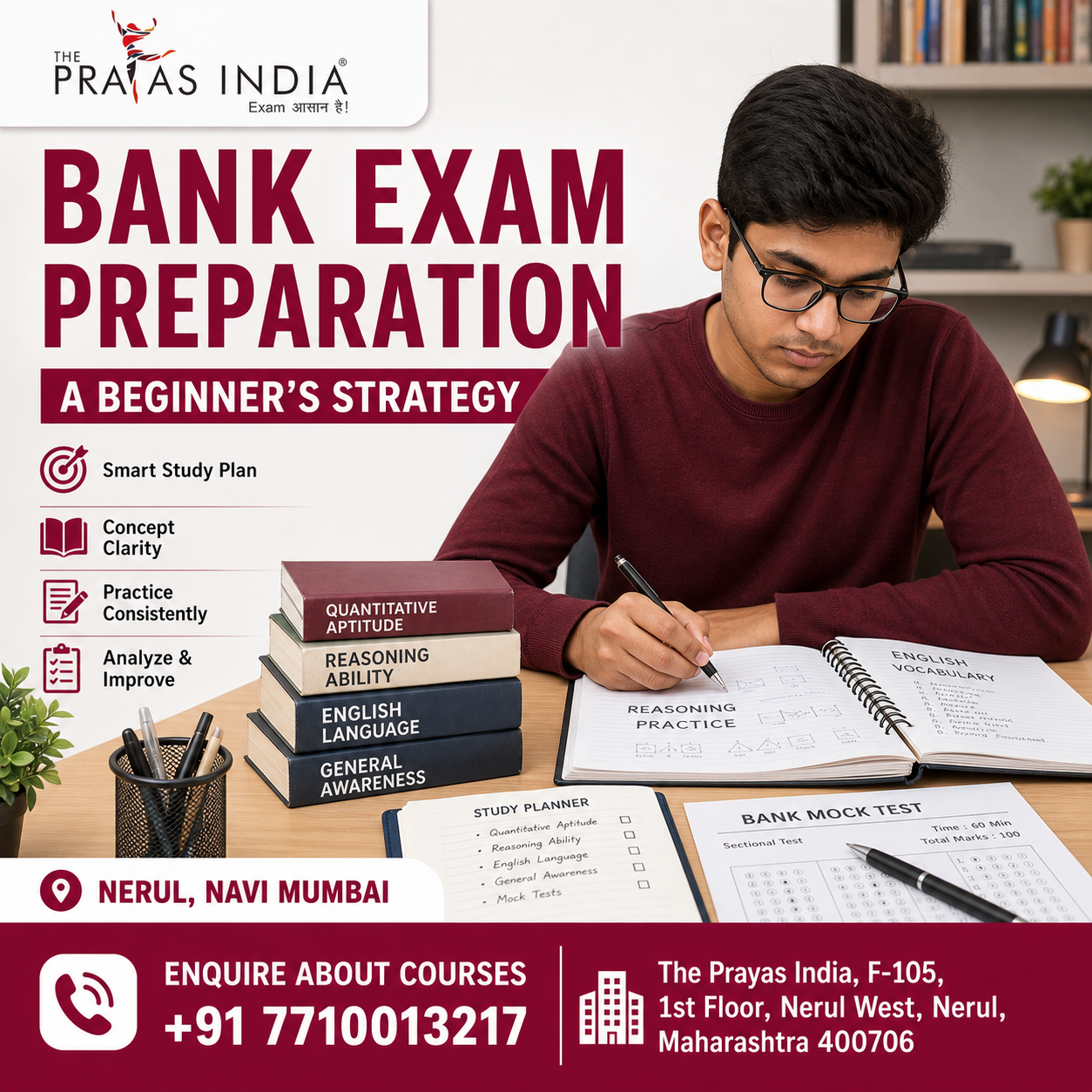
Most major bank recruitment examinations assess a combination of quantitative aptitude, reasoning ability, and English language skills. Depending on the examination, candidates may also need to prepare for general or banking awareness, computer-related topics, descriptive writing, or other components.
Quantitative Aptitude
This section tests numerical ability, calculation skills, and problem-solving.
Important topics to practise include:
- Simplification and approximation
- Number series
- Percentages
- Ratio and proportion
- Averages
- Profit and loss
- Simple and compound interest
- Time and work
- Time, speed, and distance
- Data interpretation
Beginners should start with basic arithmetic and calculation techniques before moving to lengthy or complex questions.
Reasoning Ability
Reasoning questions assess logical thinking, pattern recognition, and the ability to analyse information.
Focus on topics such as:
- Inequality
- Syllogism
- Coding-decoding
- Blood relations
- Direction sense
- Alphanumeric series
- Seating arrangement
- Puzzles
- Order and ranking
Begin with short, straightforward questions. Gradually increase the difficulty and introduce puzzles that require multiple steps.
English Language
English preparation involves reading comprehension, grammar, vocabulary, and sentence structure.
Work on:
- Reading comprehension
- Error detection
- Sentence improvement
- Fill in the blanks
- Cloze tests
- Para jumbles
- Vocabulary
- Grammar fundamentals
Read a short English article daily, note unfamiliar words, and revise them regularly. Consistent reading can help improve comprehension and familiarity with written English.
General and Banking Awareness
The importance and format of this section vary by examination and stage. Preparation may include current affairs, banking terminology, financial awareness, and important national or international developments.
Maintain concise notes and revise them regularly. Use reliable, updated sources and focus on the topics relevant to your chosen examination.
Important: Always confirm the latest syllabus and examination pattern from the official recruitment notification. Do not assume that every bank exam includes identical subjects or stages.
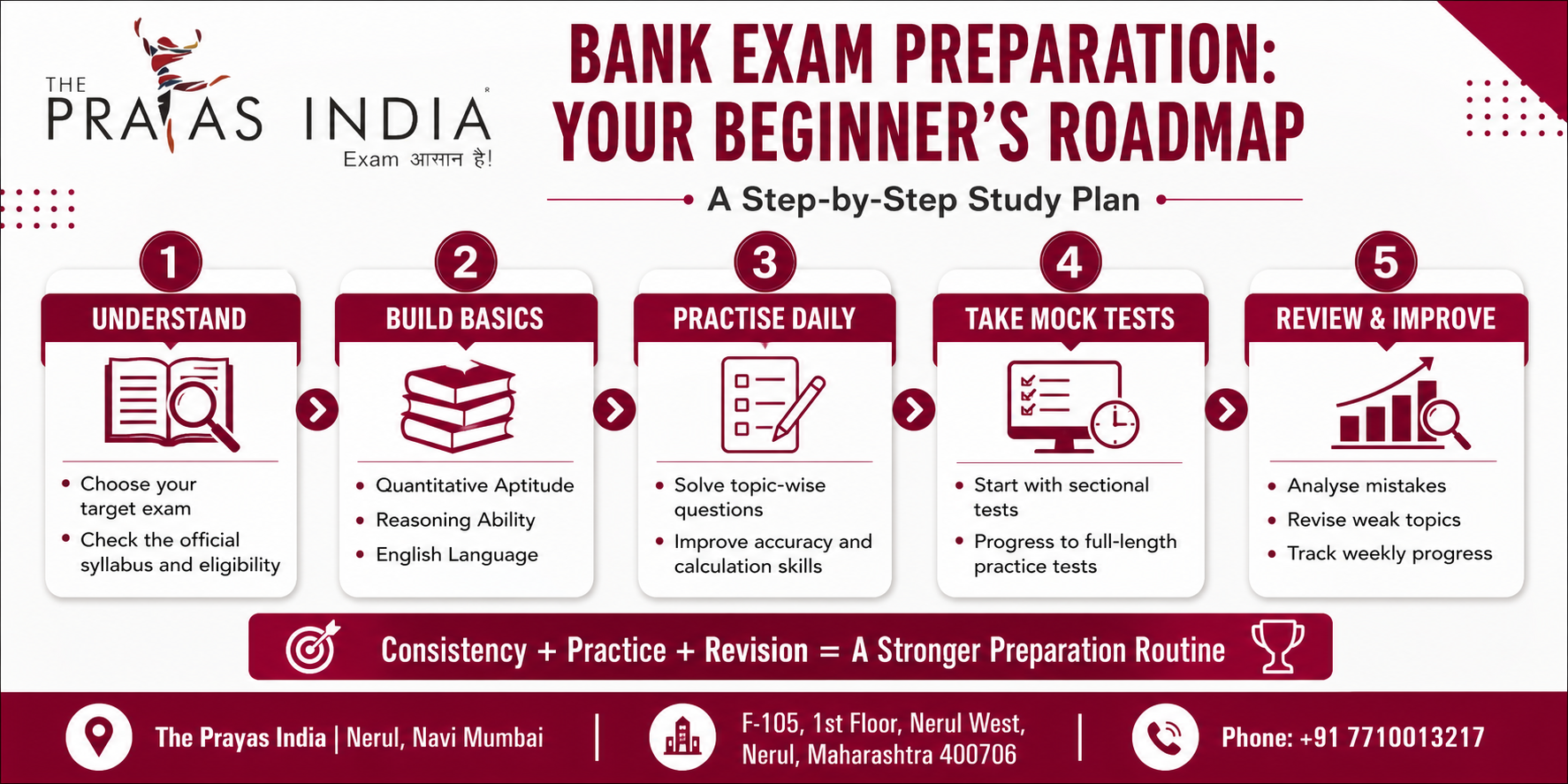
Follow a Step-by-Step Bank Exam Preparation Strategy
A beginner-friendly strategy should move from understanding the basics to practising questions under timed conditions.
Step 1: Assess Your Current Level
Attempt a short diagnostic test covering quantitative aptitude, reasoning, and English. Do not worry if your initial performance is low. The purpose is to identify your strengths, weaknesses, and areas requiring more practice.
Record your performance and revisit the same types of questions after a few weeks to measure improvement.
Step 2: Build Your Fundamentals
Spend the first phase of preparation understanding concepts and learning basic methods. Avoid rushing into advanced puzzles or lengthy calculations before you understand the underlying principles.
For example, revise percentages before attempting advanced profit-and-loss questions. Similarly, understand basic grammar rules before moving to more complex sentence-based exercises.
Step 3: Practise Topic-Wise Questions
After learning a concept, solve practice questions on that topic. Start with untimed questions to understand the method, then introduce a time limit once you become comfortable.
Maintain an error notebook with three categories:
- Conceptual mistakes
- Calculation or reading errors
- Questions taking too much time
Review this notebook weekly to identify repeated mistakes.
Step 4: Introduce Sectional Tests
Once you have covered the basics of a few topics, begin taking short sectional tests. These help you practise under time pressure and identify which topics need more attention.
Do not focus only on the score. Review the questions you answered incorrectly, guessed, skipped, or solved too slowly.
Step 5: Take Full-Length Mock Tests
When you have covered a reasonable portion of the syllabus, introduce full-length mock tests based on your target examination’s current pattern.
After each mock test, ask yourself:
- Which topics produced the most errors?
- Which questions consumed too much time?
- Were any easy questions left unanswered?
- Did I make avoidable calculation mistakes?
- Was my time allocation effective?
Use the answers to plan your next week of study.
A Practical Daily Study Timetable for Beginners
You do not need to study for extremely long hours from the beginning. A realistic schedule that you can maintain consistently is more useful than an ambitious routine that quickly becomes difficult to follow.
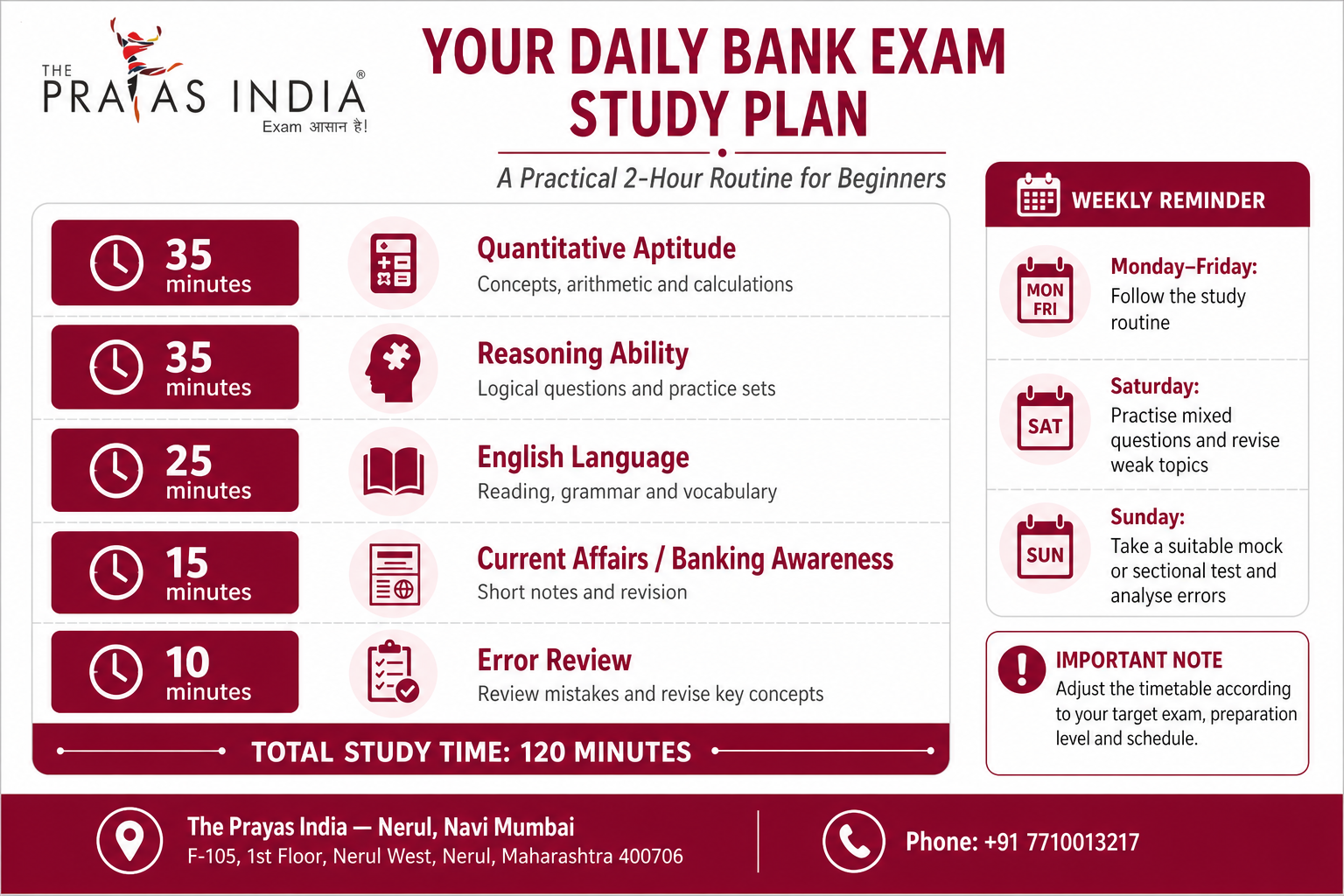
Here is an example of a two-hour daily timetable for beginners. Adjust it according to your current level, work or college schedule, and exam date.
| Study activity | Daily time |
|---|---|
| Quantitative aptitude concepts and practice | 35 minutes |
| Reasoning concepts and questions | 35 minutes |
| English reading and practice | 25 minutes |
| Current affairs or banking awareness | 15 minutes |
| Error notebook and revision | 10 minutes |
| Total | 120 minutes |
On days when you have additional time, use it for a sectional test, a mock test, or detailed review. Candidates approaching an examination may need a more intensive schedule based on their remaining syllabus and preparation level.
Use This Weekly Bank Exam Study Plan
A weekly plan helps you cover different subjects without neglecting revision.
| Day | Main focus |
|---|---|
| Monday | Quantitative aptitude fundamentals and English grammar |
| Tuesday | Reasoning basics and vocabulary |
| Wednesday | Arithmetic practice and reading comprehension |
| Thursday | Reasoning puzzles and sectional practice |
| Friday | Quantitative aptitude revision and banking awareness |
| Saturday | Mixed practice questions and weak-topic revision |
| Sunday | Mock test or sectional tests, followed by performance analysis |
Treat this as a starting framework rather than a fixed rule. Modify it to match the examination pattern and your individual strengths and weaknesses.
How to Improve Speed and Accuracy
Speed matters in competitive examinations, but rushing without understanding the questions can increase errors. Beginners should focus on accuracy first and then work on solving familiar question types more efficiently.
Use these methods:
Practise calculations regularly: Revise tables, squares, cubes, percentages, and fraction-to-percentage conversions relevant to aptitude questions.
Learn multiple methods carefully: Understand the standard solution before trying shortcuts. A shortcut is useful only when you can apply it correctly.
Use timed practice: Set a reasonable time limit for a group of questions and gradually improve your pace.
Avoid unnecessary guessing: Follow the marking scheme and examination instructions. If negative marking applies, consider the risk of an incorrect answer before guessing.
Analyse every test: A test is most useful when you understand why you lost marks or spent too much time.
Common Mistakes Beginners Should Avoid
Many aspirants spend time studying but struggle to turn that effort into consistent progress. Avoid these common mistakes:
Studying Without a Plan
Switching between subjects randomly can leave important topics unfinished. Set weekly targets and review your progress every Sunday.
Using Too Many Study Resources
Collecting multiple books, apps, and notes can make revision difficult. Choose a manageable set of reliable resources and complete them systematically.
Ignoring English or Reasoning
Focusing only on quantitative aptitude may create gaps in other sections. Give every relevant section regular attention according to your target exam.
Taking Mock Tests Without Analysis
Attempting one test after another without reviewing errors can lead to repeated mistakes. Reserve time for test analysis and revision.
Ignoring Official Notifications
Eligibility conditions, examination patterns, application schedules, and recruitment stages may change. Verify important details through the official recruitment website rather than relying only on old videos or articles.
Expecting Instant Results
Preparation takes time, and progress differs from one candidate to another. Measure improvement through better concept understanding, fewer repeated errors, and more effective time management.
How to Balance Bank Exam Preparation with College or Work
Students and working aspirants in Nerul may have to balance commuting, classes, work responsibilities, and personal commitments. A flexible timetable can make preparation easier to maintain.
Consider these practical steps:
- Set a fixed study slot that fits your routine.
- Use shorter revision sessions on busy days.
- Keep weekends for mock tests and difficult topics.
- Prepare a weekly checklist rather than setting unrealistic daily targets.
- Use travel or waiting time for vocabulary revision or current-affairs notes when practical.
- Protect adequate time for sleep and breaks to avoid burnout.
If you cannot complete the full timetable on a particular day, continue with the next planned session instead of abandoning the entire schedule.
How to Choose Bank Exam Coaching in Nerul
Some beginners prefer self-study, while others benefit from structured classes, guided practice, or a regular study routine. The right option depends on your learning style, preparation level, budget, and schedule.
Before choosing bank exam coaching in Nerul, compare the following factors:
Teaching Method
Check whether the teaching approach helps beginners understand concepts step by step. Ask how the classes cover fundamentals and advanced question types.
Practice and Mock Tests
Find out whether practice questions, sectional tests, and mock tests are included, and whether test performance is reviewed.
Doubt-Solving Support
Ask how students can clarify difficult questions and whether additional support is available when a topic is unclear.
Study Material and Revision
Understand what learning materials are provided and how revision is incorporated into the schedule.
Timings and Accessibility
Consider the class schedule, your college or work commitments, and travel time from your home or workplace in Nerul and nearby parts of Navi Mumbai.
Fees and Course Details
Request clear information about fees, course duration, inclusions, batch timings, and applicable terms before enrolling. Confirm which bank examinations the current course is designed to cover.
The Prayas India in Nerul can be contacted to enquire about currently available courses and preparation support. Confirm current course availability, batch details, and the teaching schedule directly before making a decision.
Start Your Bank Exam Preparation in Nerul with a Clear Plan
The most effective starting point for a beginner is to choose a target examination, understand its official syllabus, strengthen basic concepts, and practise consistently. A daily timetable, weekly revision, and careful mock-test analysis can help you identify gaps and improve your preparation over time.
If you are exploring preparation guidance in Nerul, Navi Mumbai, contact The Prayas India to enquire about currently available courses and decide whether the available learning support matches your requirements.
Branch address: F-105, 1st Floor, Nerul West, Nerul, Maharashtra 400706
Contact: +91 7710013217
WhatsApp: +91-7710013217
Location: Google Map
Start with manageable targets, track your progress, and keep your preparation aligned with the latest official examination requirements.
Frequently Asked Questions (FAQs)
1. How should a beginner start bank exam preparation?
Start by choosing a target examination, checking its latest official syllabus and eligibility criteria, and assessing your current level. Build your fundamentals in quantitative aptitude, reasoning, and English before moving to timed tests.
2. How many hours should beginners study for bank exams daily?
The ideal duration depends on your current level, schedule, and exam timeline. A consistent two-hour daily routine can be a useful starting point, with additional time for revision and mock tests when possible.
3. Which subjects are important for bank exams?
Quantitative aptitude, reasoning ability, and English are common components of many major bank recruitment examinations. Some exams or stages may also include general awareness, banking awareness, descriptive writing, or other requirements. Check the relevant official notification.
4. Can I prepare for bank exams while attending college?
Yes. Plan your preparation around college by setting regular study hours, dividing the syllabus into weekly targets, and using weekends for tests and revision. Keep your schedule realistic and sustainable.
5. When should beginners start taking mock tests?
Begin with a diagnostic test to understand your starting level. After learning the basics of several topics, introduce sectional tests and gradually add full-length mock tests based on your target examination pattern.
6. Is coaching necessary for bank exam preparation?
Coaching is not compulsory for every candidate. Some aspirants prepare independently, while others prefer structured teaching, practice schedules, or doubt-solving support. Choose an approach that suits your learning needs and budget.
7. How can I choose bank exam coaching in Nerul?
Compare the teaching method, relevant exam coverage, practice tests, test analysis, doubt-solving support, batch timings, fees, and travel convenience. Verify current course details directly before enrolling.
8. Where can I enquire about bank exam preparation support in Nerul?
You can contact The Prayas India at +91 7710013217 or send a message through WhatsApp. Ask about currently available courses and batch timings before visiting.
Note: Always verify the latest syllabus, eligibility criteria, selection stages, and marking scheme through the official recruitment notification.
Looking for Bank Exam Preparation Guidance in Nerul?
Planning to prepare for IBPS, SBI or other banking examinations? Contact The Prayas India to enquire about currently available courses, batch timings and preparation support.
The Prayas India – Nerul Branch
F-105, 1st Floor, Nerul West, Nerul, Maharashtra 400706
Phone: +91 7710013217