SAGAR Vision (Security and Growth for All in the Region): A Comprehensive Analysis
This topic is relevant for UPSC Prelims GS Paper 1 (Geography & Current Affairs) and Mains GS Paper 2 (International Relations) as it involves India’s maritime diplomacy, regional security, and Indo-Pacific strategy.
Introduction
Security and Growth for All in the Region (SAGAR) is India’s strategic maritime initiative, announced by Prime Minister Narendra Modi in March 2015 during his visit to Mauritius. The SAGAR vision reflects India’s commitment to a safe, secure, stable, and prosperous Indian Ocean Region (IOR), leveraging maritime cooperation for peace, economic growth, and regional security. The concept operating under the Indian philosophy of “Vasudhaiva Kutumbakam” (the world is one family) positions India as both a responsible stakeholder and a “net security provider” in the IOR.
Background & Context
India is a major maritime nation with a coastline stretching over 7,500 km, and islands in both the Arabian Sea and the Bay of Bengal. Over 90% of India’s trade by volume and 70% by value is carried by sea routes, highlighting dependence on the security and stability of the oceans. The Indian Ocean Region, connecting Asia, Africa, Australia, and the Middle East, is vital for regional and global commerce, energy flows, and strategic interests. Increasing threats such as piracy, terrorism, illegal trafficking, and environmental challenges, along with rising geopolitical competition (notably with China’s Belt and Road Initiative and String of Pearls), underscore the need for India’s assertive and inclusive maritime engagement.
Objectives of SAGAR
SAGAR is built upon the following goals:
- Enhancing Maritime Security: Strengthening coastal defence, combating piracy, terrorism, and unlawful activities; promoting freedom of navigation and overflight.
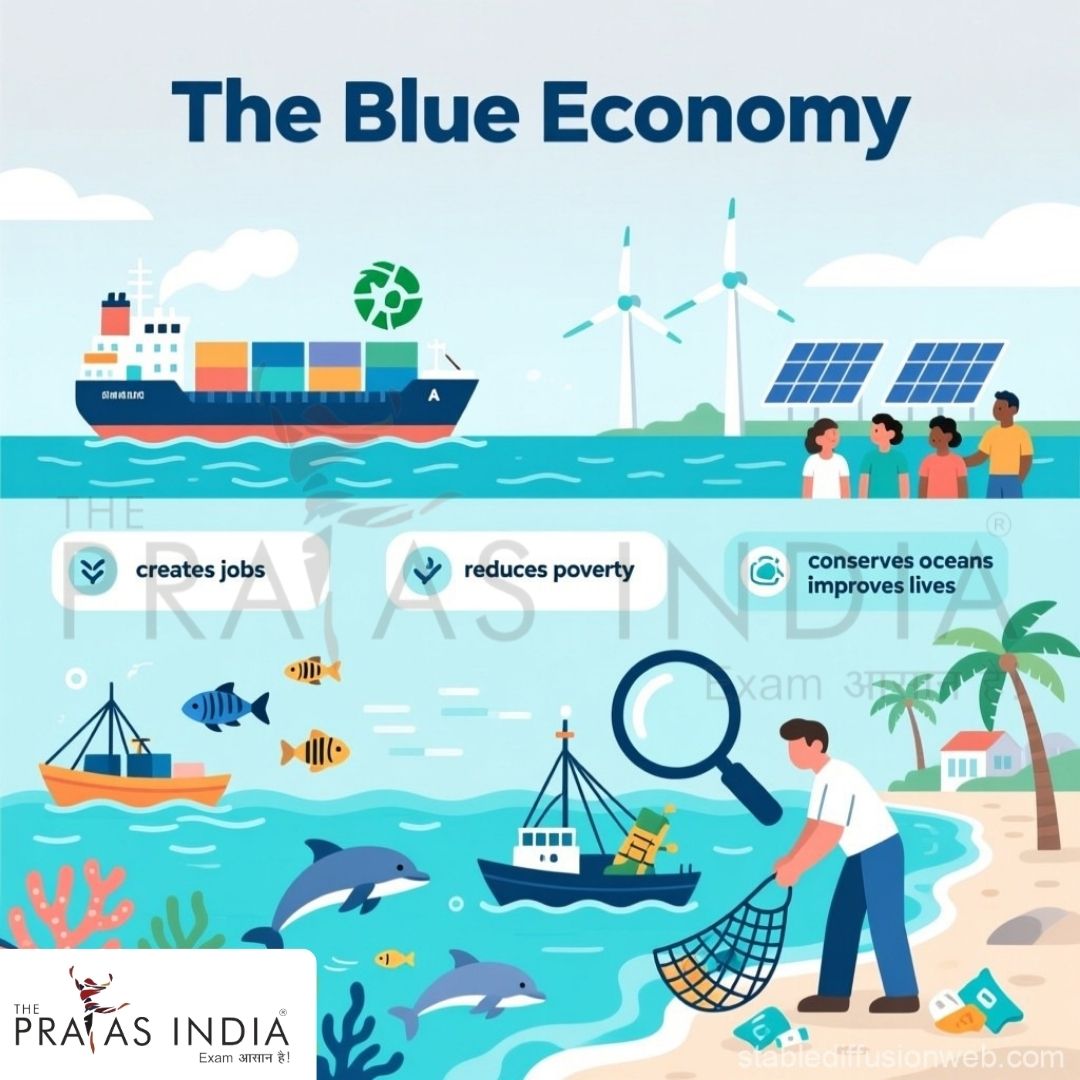
- Promoting Sustainable Use of Ocean Resources: Advancing the blue economy through fisheries, shipping, energy, and marine biotechnology; safeguarding ocean ecosystems.
- Capacity Building for Littoral States: Sharing technical expertise, disaster management support, radar networks, hydrography, and training with smaller coastal nations.
- Strengthening Maritime Cooperation: Fostering partnerships with IOR states, regional organizations, and extra-regional powers for collective security and development.
Pillars of the SAGAR Vision
SAGAR encompasses four broad dimensions:
- Strategic: Countering external influence, especially China’s expansion, and positioning India as a net security provider in the IOR.
- Economic: Promoting port-led development, trade routes, investment in maritime infrastructure, and harnessing the blue economy. Schemes like Sagarmala dovetail with SAGAR.
- Environmental: Protecting marine habitat, promoting sustainable fisheries, combating ocean pollution, and encouraging responsible resource use.
- Diplomatic: Deepening ties with IOR nations through dialogue forums (IONA, IORA, IONS), humanitarian assistance, and disaster relief (HADR), and advocating for a “rules-based order” in the Indian Ocean and Indo-Pacific.
Key Indian Initiatives under SAGAR
1. Coastal Surveillance Radar Systems: India has helped partners like Maldives, Seychelles, Mauritius, and Sri Lanka establish coastal radar networks for maritime domain awareness and security.
2. Mission SAGAR: In May 2020, India provided COVID-19 relief via naval deployments to island nations, reinforcing its role as first responder in the Indian Ocean.
3. Indo-Pacific Oceans Initiative (IPOI): Launched at the East Asia Summit in 2019, IPOI promotes maritime cooperation across seven pillars—maritime security, disaster risk management, marine ecology, resource sharing, technology, transport, and trade.
4. Collaboration with Island Nations: India has provided developmental aid, infrastructure projects, lines of credit, and capacity-building to Maldives, Mauritius, Seychelles, Sri Lanka, and Indonesia. This includes hydrographic surveys, joint naval exercises, and humanitarian assistance.
5. Other Initiatives: South Asia Satellite (SAS) for disaster response, Vaccine Maitri for COVID-19 vaccine supplies, Kaladan Multimodal Transit Project for improved connectivity.
SAGAR and India’s Foreign Policy
SAGAR is integral to India’s maritime diplomacy, forming the backbone of its Indian Ocean and Indo-Pacific outreach. It aligns with:
- Act East Policy: Deepening engagement with Southeast Asia and the Pacific.
- Neighbourhood First Policy: Prioritizing IOR littoral states in regional partnerships.
- Forum for India-Pacific Islands Cooperation (FIPIC): Strengthening diplomatic and economic engagement with island countries.
SAGAR promotes regional security, collective prosperity, and the norms of non-hegemonic cooperation and peaceful dispute resolution, advocating India’s vision for an open, inclusive Indo-Pacific.
Strategic Significance of SAGAR
- Countering China’s Influence: SAGAR is a response to China’s BRI and “String of Pearls” maritime encirclement, aiming to offset China’s commercial and military footprint in the IOR.
- Ensuring Free & Open Indo-Pacific: Supporting a rules-based order, freedom of navigation, and regional stability.
- Net Security Provider: India’s proactive assistance in disaster relief, anti-piracy operations, and capacity-building for smaller states boosts its credibility and leadership.
- Maritime Domain Awareness: Enhanced surveillance, information sharing, and joint exercises increase the security of Sea Lines of Communication (SLOCs).
Challenges Facing SAGAR Implementation
- Geopolitical Rivalry: Balancing China’s naval expansion and U.S.-led alliances in Indo-Pacific.
- Regional Instability: Terrorism, piracy, illegal trafficking, and traditional security challenges.
- Capacity Constraints: Relative limitations in India’s naval assets, surveillance capabilities, and financial resources.
- Environmental Threats: Overfishing, marine pollution, climate change, and degradation of marine ecosystems.
- Coordination & Perception Issues: Harmonizing multiple initiatives, managing duplication of actions, and ensuring inclusivity in leadership.
Recent Developments
- India’s participation in QUAD (Australia, India, Japan, US), IORA (Indian Ocean Rim Association), and IONS (Indian Ocean Naval Symposium) expands collaborative security frameworks.
- Expansion of SAGAR’s scope through initiatives like “MAHASAGAR”—broadening engagement from the Indian Ocean to the Indo-Pacific and Africa.
- Modernization of the Indian Navy, increased joint naval exercises, and regional infrastructure investments have strengthened SAGAR’s effectiveness.
Way Forward
- Maritime Infrastructure Development: Keeping pace with regional competitors; investing in port connectivity, shipbuilding, and logistics.
- Stronger Partnerships: Engaging with global and regional powers, increasing joint training and intelligence sharing.
- Promoting Blue Economy: Leveraging sustainable marine resources for economic growth and job creation.
- Sustainable Ocean Governance: Advancing regional and global frameworks for climate action, marine conservation, and responsible management of ocean resources.
- Enhancing Capacity: Upgrading surveillance systems, naval assets, and research capabilities.
Conclusion
SAGAR Vision is a testament to India’s proactive and inclusive approach to maritime security, growth, and regional cooperation. It positions India as a responsible leader championing peace, stability, and inclusive prosperity in the strategic expanse of the Indian Ocean and Indo-Pacific.
Frequently Asked Questions (FAQs) on SAGAR Vision
Q1: What is the SAGAR Vision?
SAGAR stands for “Security and Growth for All in the Region.” It is India’s strategic vision, first announced by Prime Minister Narendra Modi in 2015, aimed at ensuring a safe, secure, and stable Indian Ocean Region through maritime cooperation, sustainable development, and mutual growth.
Q2: Why was the SAGAR Vision introduced?
The SAGAR initiative was launched to address India’s critical dependence on maritime trade, increasing security threats in the Indian Ocean, and the need for stronger regional partnerships for mutual development and security.
Q3: What are the major objectives of SAGAR?
Enhancing maritime security, promoting the sustainable use of ocean resources, building the capacity of littoral states, and strengthening regional maritime cooperation.
Q4: What are the key pillars of the SAGAR Vision?
The vision includes strategic, economic, environmental, and diplomatic pillars—covering security, economic growth via the blue economy, sustainable ocean governance, and strengthened diplomatic engagement with Indian Ocean neighbors.
Q5: What are India’s main initiatives under SAGAR?
These include coastal surveillance radar systems in partner countries, Mission SAGAR humanitarian relief operations, the Indo-Pacific Oceans Initiative (IPOI), and extensive developmental and security partnerships with Maldives, Mauritius, Seychelles, and Sri Lanka.
Q6: How does SAGAR relate to India’s foreign policy?
SAGAR aligns with India’s Act East Policy and Neighbourhood First Policy, positioning India as a net security provider and leader in regional maritime diplomacy in the Indo-Pacific.
Q7: What strategic significance does SAGAR have?
It is vital for counterbalancing China’s growing influence, promoting a free and open Indo-Pacific, and ensuring India’s leadership in maritime domain awareness and regional cooperation.
Q8: What challenges does SAGAR face?
Challenges include regional instability, piracy, illegal fishing, environmental threats, China’s naval expansion, limited Indian naval capacity, and the need for enhanced international cooperation.
Q9: What are recent developments under SAGAR?
India’s enhanced engagement with multilateral groups like QUAD, IORA, and IONS, as well as capacity-building projects and humanitarian missions in the Indian Ocean, fall under the SAGAR framework.
Q10: What is the way forward for SAGAR?
Priorities include maritime infrastructure development, robust partnerships, blue economy growth, and sustainable, inclusive ocean governance.