Persian Gulf Region – Geopolitics, Economy, and Environmental Significance
- GS Paper 1: Physical Geography, World Geography, Climatology, Ocean Geography
- GS Paper 2: International Relations, India–West Asia Relations, Regional Groupings
- GS Paper 3: Energy Security, Maritime Security, Environment, Climate Change
- Prelims: World Geography, Important Straits, Strategic Water Bodies, Maps
- Geography Optional: Marine Geography, Geopolitics of Seas, Economic Geography, Maritime Trade Routes
Introduction
The Persian Gulf is a shallow, semi-enclosed inland marginal sea of the Indian Ocean, located between the Arabian Peninsula and Iran. Despite its modest size, it is one of the most strategically, economically, and geopolitically significant regions in the world. It forms the central energy heartland of the world economy and serves as a historic maritime corridor connecting South Asia, West Asia, and Europe.
The Gulf is bordered by eight countries—Iran, Iraq, Kuwait, Saudi Arabia, Bahrain, Qatar, the United Arab Emirates (UAE), and Oman—each of which maintains critical maritime, economic, and strategic stakes in the region. The waterbody is sometimes referred to as the “Arabian Gulf” in Arab nations, yet academically and internationally, “Persian Gulf” remains the widely accepted name.
Historically, the region has been an interaction zone for ancient civilizations—Mesopotamian, Persian, Arab, and Indus Valley—facilitating trade, navigation, pearl fishing, and cultural transmission. Today, it is a geopolitical hotspot due to its abundant hydrocarbon reserves, strategic shipping lanes, and military presence of global powers.
Physical Geography of the Persian Gulf
Location and Extent
- Lies between 24° to 30° N latitude and 48° to 56° E longitude
- Formed between the Arabian Peninsula (south–west) and Iran (north–east)
- Connected to the Arabian Sea via the Strait of Hormuz
Size and Dimensions
- Length: ~990 km
- Width: varies from 56–338 km
- Average depth: extremely shallow, ~35 meters
- Maximum depth: around 100 meters
- Coastline: roughly 8,000 km
It is one of the world’s shallowest marine water bodies, making it highly sensitive to temperature, salinity changes, and pollution.
Semi-Enclosed Sea Characteristics
As a semi-enclosed sea under UNCLOS, the Persian Gulf behaves similarly to:
- Mediterranean Sea
- Black Sea
- Red Sea
Its limited exchange with open oceans causes high salinity, low circulation, and sluggish flushing—aggravating pollution and ecological vulnerability.
Tectonic Setting
The Gulf occupies a foreland basin created due to:
- Zagros Fold Belt movement (Iran)
- Arabian Plate drifting northeastwards
- Gradual subsidence of the basin
This tectonic structure mirrors the region’s seismicity and formation of hydrocarbon traps.
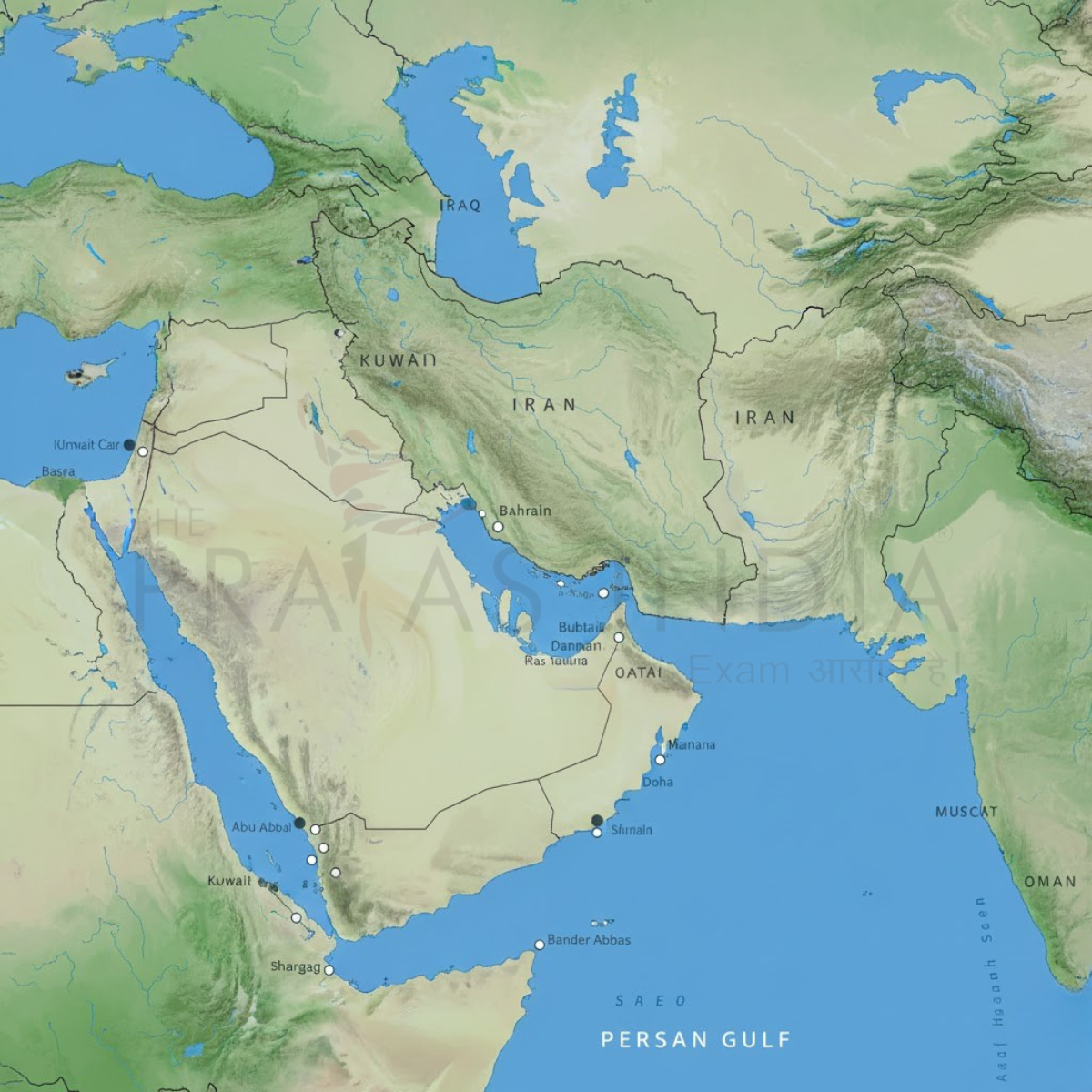
Bordering Countries of the Persian Gulf
There are eight countries bordering the Gulf. Their geographical and coastline distribution shapes their strategic influence.
1. Iran
- Northern coastline
- Longest Gulf coastline
- Major ports: Bandar Abbas, Bushehr
- Controls northern part of the Strait of Hormuz
2. Iraq
- Smallest coastline (~58 km) near the Shatt al-Arab
- Port: Umm Qasr
- Limited maritime access increases its geopolitical vulnerability
3. Kuwait
- Located at the northwest edge
- Rich offshore oil fields
- Port: Kuwait City
4. Saudi Arabia
- Long eastern coastline
- Major petroleum export terminals
- Ports: Dammam, Jubail
5. Bahrain
- Island nation; shallow waters
- Economic hub with extensive reclamation
- Environmental stress due to industrialization
6. Qatar
- Peninsula projecting into the Gulf
- World’s largest LNG producer
- Offshore gas field: North Dome/South Pars (shared with Iran)
7. United Arab Emirates (UAE)
- Western and northern coastline
- Ports: Jebel Ali, Abu Dhabi
- Rapid development, major tourism and trade hub
8. Oman
- Shares maritime boundaries via Musandam Peninsula
- Controls part of the Strait of Hormuz
- Strategic location despite small coastline
Geology & Origin
Formation
The Persian Gulf originated due to:
- Tectonic subsidence as the Arabian Plate drifted
- Marine transgression during the Holocene
- Accumulation of thick sedimentation
Sedimentation Patterns
Sediments come from:
- Tigris–Euphrates river system
- Aeolian (wind-blown) material
- Coastal erosion and carbonate deposition
Coastal Geomorphology
- Tidal flats (sabkhas)
- Coral reefs (limited)
- Sand dunes
- Mangrove forests (along UAE, Iran)
- Barrier beaches
Oceanographic Characteristics
Temperature
- Among the warmest seas globally
- Summer: 32–35°C
- Winter: 12–18°C
Salinity
- One of the highest salinity regions
- 37–42 ppt
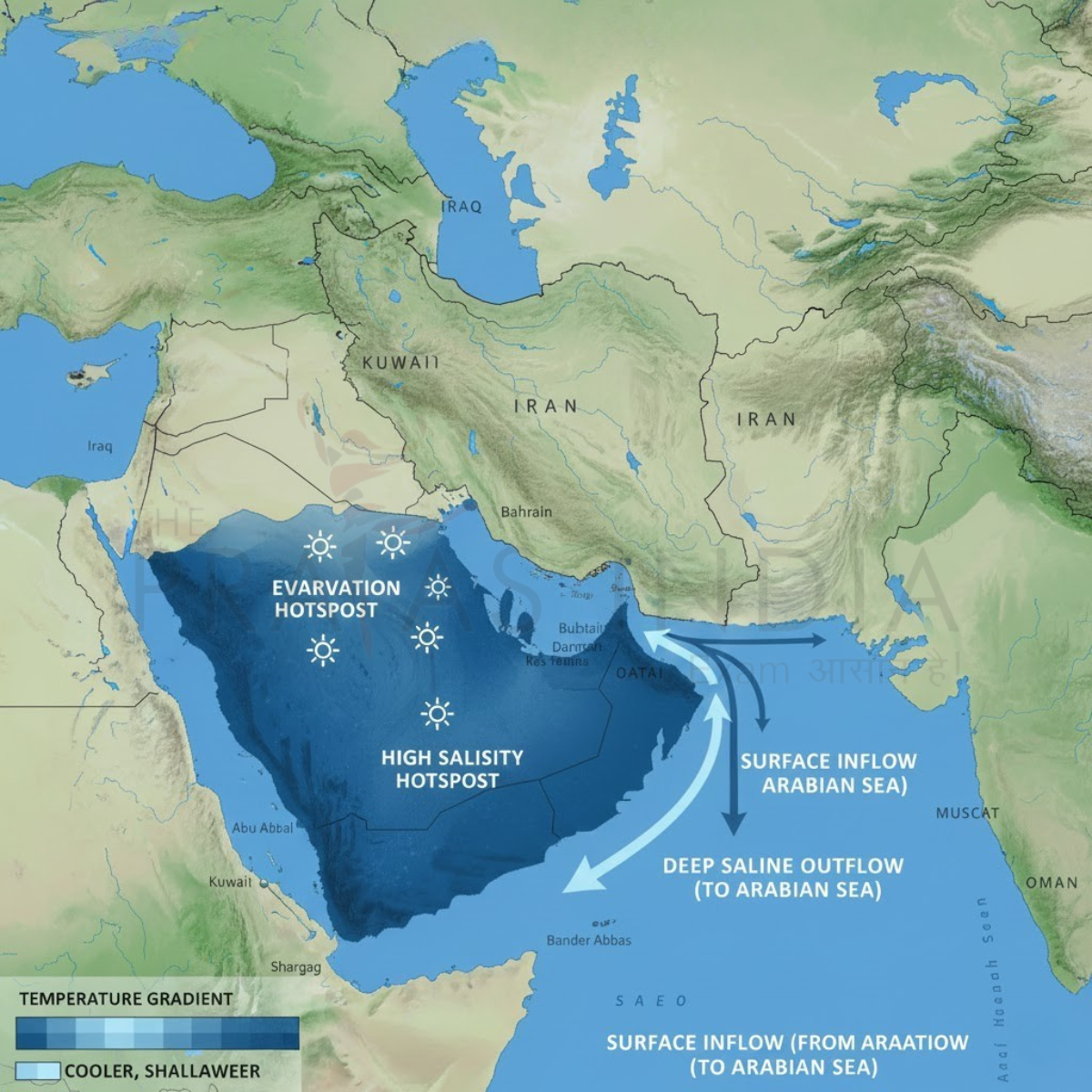
Extreme evaporation and limited inflow drive salinity up.
Tidal Pattern
- Mixed tide, predominantly semidiurnal
- Strong tidal currents at Hormuz
Currents & Circulation
- Surface water enters through the Strait of Hormuz
- Dense, high-salinity water sinks & exits at depth
- Circulation is sluggish → poor flushing
Evaporation
- Very high evaporation rate
- Creates dense saline water
- Drives local atmospheric moisture
Freshwater Inflow
- Only major source: Shatt al-Arab (Tigris–Euphrates)
Climate & Natural Resources
Climate
- Hyper-arid
- <100 mm rainfall
- Summer temperature exceeds 45°C
- Humidity high near coastlines
Natural Resources
- Hydrocarbons: 60% of global oil reserves lie in Gulf region
- Major offshore fields: Al-Shaheen, Zakum, Safaniya
- Natural Gas: World’s largest gas field (North Dome/South Pars)
- Marine biodiversity: Dugongs, turtles, coral reefs
- Fisheries: Declining due to overfishing
Strategic Significance
Strait of Hormuz
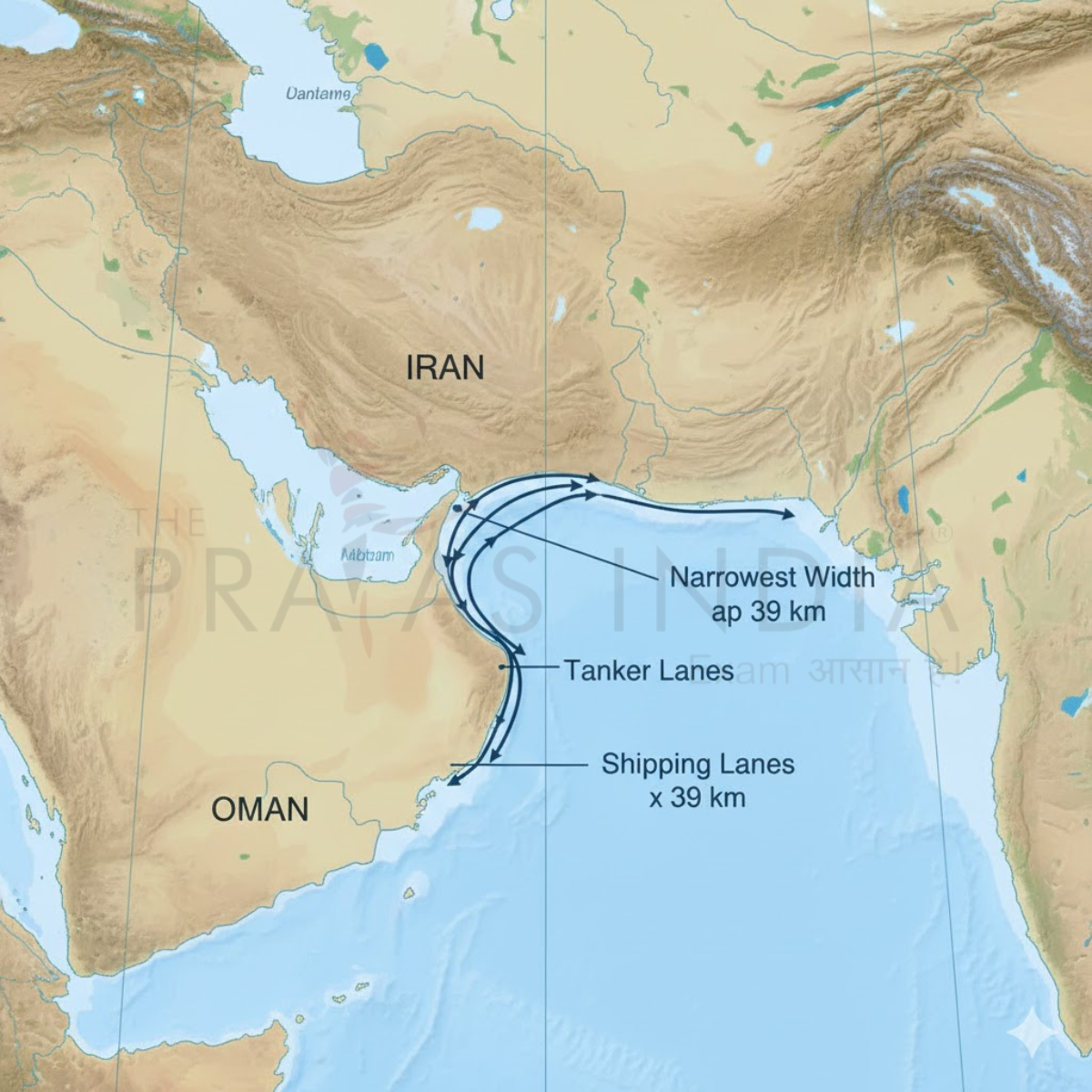
- World’s most critical oil chokepoint
- Width: 39 km (narrowest ~3 km)
- 20% of global crude oil trade passes through
- Guarded by Iran and Oman
Geostrategic Importance
- Naval presence of US, UK, France
- Frequent tensions: Iran–US, Iran–Saudi
- Vital shipping lanes for Asian economies
- Connectivity to Indo-Pacific routes
Economic Importance
- Largest global oil-exporting region
- Supports major global LNG supply
- Homes of OPEC powerhouses
- Major ports: Jebel Ali, Dammam, Kuwait, Doha
- Global oil benchmarks (Dubai–Oman crude)
- Marine trade: container, petrochemical, LNG routes
- Coastal cities: Dubai, Doha, Abu Dhabi—global business hubs
Environmental Issues
Major Concerns
- Oil spills (1991 Gulf War—largest in history)
- Coral bleaching due to high temperatures
- Reclamation reducing natural coastlines
- Red tide (algal blooms)
- Fisheries depletion
- Damage from ballast water discharge
- Plastic & industrial pollution
- War-induced marine degradation
Geopolitical Dynamics
Key Drivers
- Iran–Saudi rivalry
- GCC politics
- OPEC power structure
- US and Western naval presence
- China’s increasing engagement (energy security)
- Israel’s entry post-Abraham Accords
- Territorial disputes (islands between UAE & Iran)
- Nuclear tensions influencing shipping
India and the Persian Gulf
Energy Security
- India imports over 50–60% of crude oil from Gulf region
- Qatar is major LNG supplier
Diaspora
- Over 9 million Indians live in GCC nations
- Huge remittances
Strategic Relations
- India–Saudi Strategic Partnership Council
- India–UAE Comprehensive Economic Partnership Agreement
- Maritime cooperation with Oman (Duqm Port access)
- Counter-piracy operations in the Gulf of Aden
Trade Corridors
- INSTC (International North–South Transport Corridor)
- India–UAE–Europe Trade Route emerging
Case Studies
1. 1991 Gulf War Oil Spill
- Deliberate Iraqi spill
- Largest marine oil spill
- Massive impact on coral, fish, mangroves
2. 2019 Tanker Attacks in Hormuz
- Escalated Iran–US tensions
- Impacted global oil market
3. Coral Reef Decline in Bahrain & UAE
- Rising sea temperatures + pollution
- Coral mortality increasing
4. Qatar’s Natural Gas Boom
- World’s largest LNG exporter
- Shared South Pars/North Dome field
UPSC Practice Questions
1. Prelims Type
Which of the following countries does NOT border the Persian Gulf?
(a) Oman
(b) Qatar
(c) Jordan
(d) Bahrain
2. Mains Type
“Discuss the strategic significance of the Strait of Hormuz for India’s energy security.”
3. Map-Based Question
Locate the following on a world map:
– Strait of Hormuz
– Qatar Peninsula
– Shatt al-Arab delta
Conclusion
The Persian Gulf remains a complex geographic–strategic space where physical geography, resource abundance, and geopolitical rivalry intersect. As the global energy heartland, it significantly influences the world economy and international diplomacy. For India, the Gulf region is indispensable—ensuring energy security, hosting millions of expatriates, and shaping strategic maritime interactions.
Sustainable environmental management, peaceful navigation, and cooperative security frameworks are essential to preserving the Gulf’s ecological balance and strategic stability.
FAQs on Persian Gulf Region
1. Why is the Persian Gulf so important for global energy?
It holds the highest concentration of global oil reserves and is the world’s largest LNG exporting region.
2. Which countries border the Persian Gulf?
Iran, Iraq, Kuwait, Saudi Arabia, Bahrain, Qatar, UAE, and Oman.
3. Why is the Strait of Hormuz a chokepoint?
It is the only maritime exit for Persian Gulf oil, with 20% of global crude supply passing through it.
4. What environmental issues affect the Gulf?
Oil spills, coral bleaching, pollution, coastal reclamation, and rising temperatures.
5. What is India’s stake in the Persian Gulf?
Energy imports, diaspora presence, maritime security, and strategic partnerships.