
Aegean Sea: Location, Geology, Islands, Geopolitics & Climate Significance
- GS Paper 1: Physical Geography, Ocean Geography, World Geography
- GS Paper 3: Marine Ecosystems, Climate Change Impact, Maritime Resources
- Prelims: Seas & Straits, Islands, World Map, Currents, Maritime Boundaries
- Geography Optional: Oceanography, Marine Ecology, Coastal Geomorphology, Tectonic Framework
Introduction
The Aegean Sea is a semi-enclosed arm of the Mediterranean Sea, located between the Greek mainland to the west and the Anatolian (Turkish) coast to the east. It forms one of the most historically, geographically, and geopolitically significant marine regions in the world. The Aegean Sea has influenced ancient civilizations (Minoans, Mycenaeans, Greeks), served as a strategic maritime corridor for Mediterranean trade, and continues to remain a hotspot of tectonic activity, biodiversity, tourism, and Greece–Türkiye geopolitical disputes.
The region lies at the convergence of African, Eurasian, and Anatolian tectonic plates, making it one of the most seismically active zones in Europe. Its thousands of islands, grouped into well-defined archipelagos, give it a unique physical and cultural landscape.

Location & Physical Geography
- Coordinates: ~34°N–41°N latitude and 23°E–28°E longitude
- Area: Approx. 214,000 sq km
- Maximum Depth: ~3,543 m (east of Crete)
Boundaries
- West: Greek mainland, Peloponnese Peninsula, and Greek island chains
- East: Türkiye (Anatolian coast)
- North: Dardanelles Strait → Sea of Marmara → Black Sea
- South: Mediterranean Sea
Sub-basins of the Aegean
The Aegean is divided into three major basins:
- Northern Aegean Basin – deep trenches and fault lines
- Central Aegean Basin – relatively shallow continental shelves
- Southern Aegean Basin – deepest zone near Crete and volcanic arcs
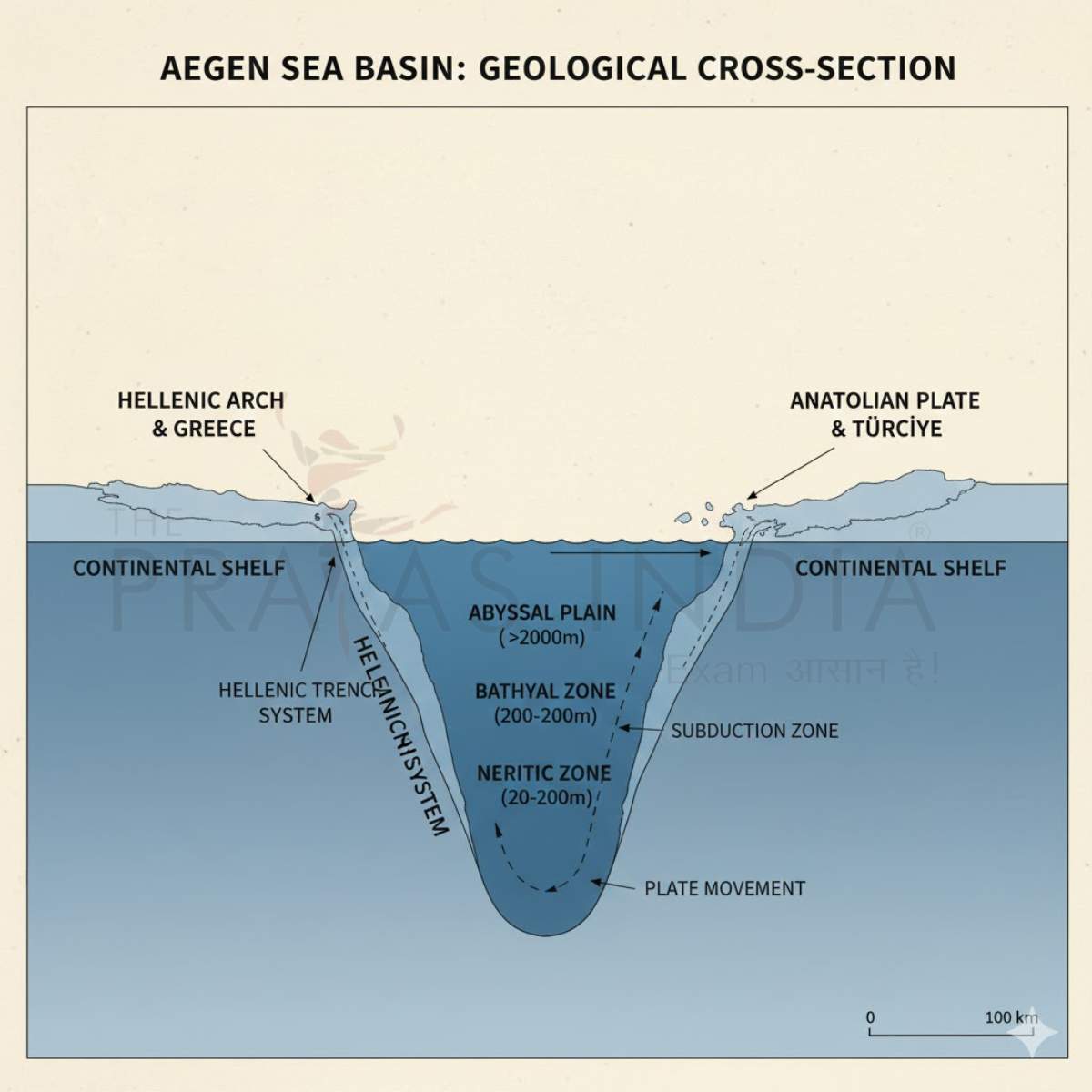
Continental Shelf
- Greek shelf: broader
- Turkish shelf: narrower, steeper
This asymmetry is central to maritime boundary disputes.
Tectonic & Geological Setting
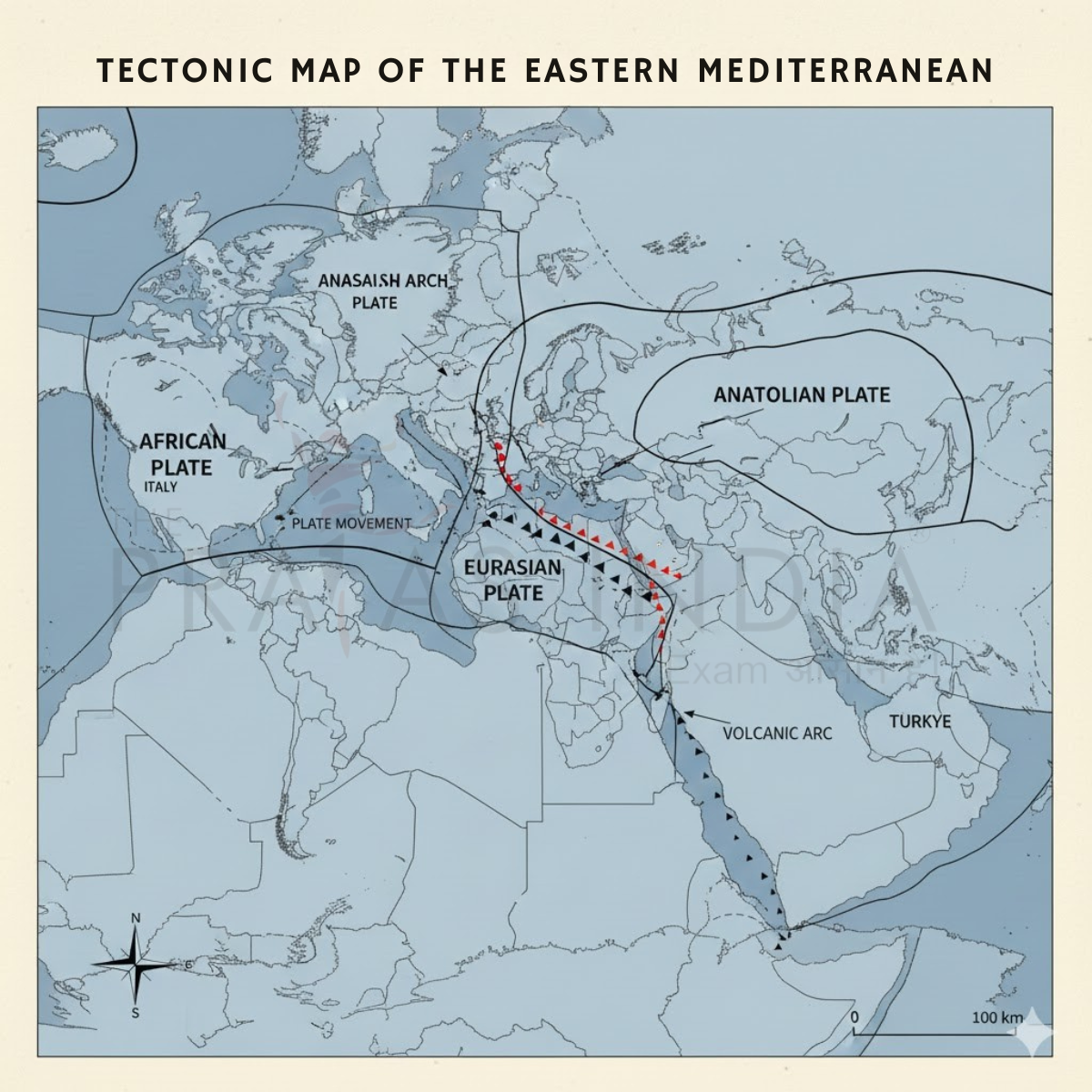
The Aegean region lies within the Alpide Belt, the second most active alpine mountain system in the world after the Pacific Ring of Fire.
Major Tectonic Processes
- Subduction of the African Plate under the Eurasian Plate
– Occurs south of Crete
– Creates Hellenic Trench - Anatolian Plate westward movement
– Driven by collision between Arabian and Eurasian plates - Back-arc extension in the Aegean
– Causes crustal thinning and basin formation - High seismicity
– Regular earthquakes (e.g., Izmir 2020, Athens 1999)
Volcanic Activity
The Aegean hosts the South Aegean Volcanic Arc, including:
- Santorini (Thira) – site of massive Bronze Age eruption (~1600 BCE)
- Nisyros
- Milos
- Kos
These volcanoes arise from subduction-induced melting beneath the Aegean.
Islands of the Aegean Sea
The Aegean contains over 2,000 islands, though only around 200 are inhabited.
Island Groups
1. Cyclades (Central Aegean)
- Circular cluster (“kyklos” = circle) around Delos
- Major islands: Naxos, Paros, Santorini, Mykonos
2. Dodecanese (Southeastern Aegean)
- “Dodeca” = twelve islands
- Major islands: Rhodes, Kos, Patmos, Karpathos
3. North Aegean Islands
Lesbos, Chios, Samos, Ikaria
4. Sporades (Northwestern Aegean)
Skiathos, Skopelos, Alonnisos
5. Crete
- Largest island
- Natural southern boundary of the Aegean
- Hosts major mountain ranges (White Mountains, Mt. Ida)

Climate & Oceanography
Mediterranean Climate
- Hot, dry summers
- Mild, wet winters
- Controlled by subtropical high-pressure systems in summer.
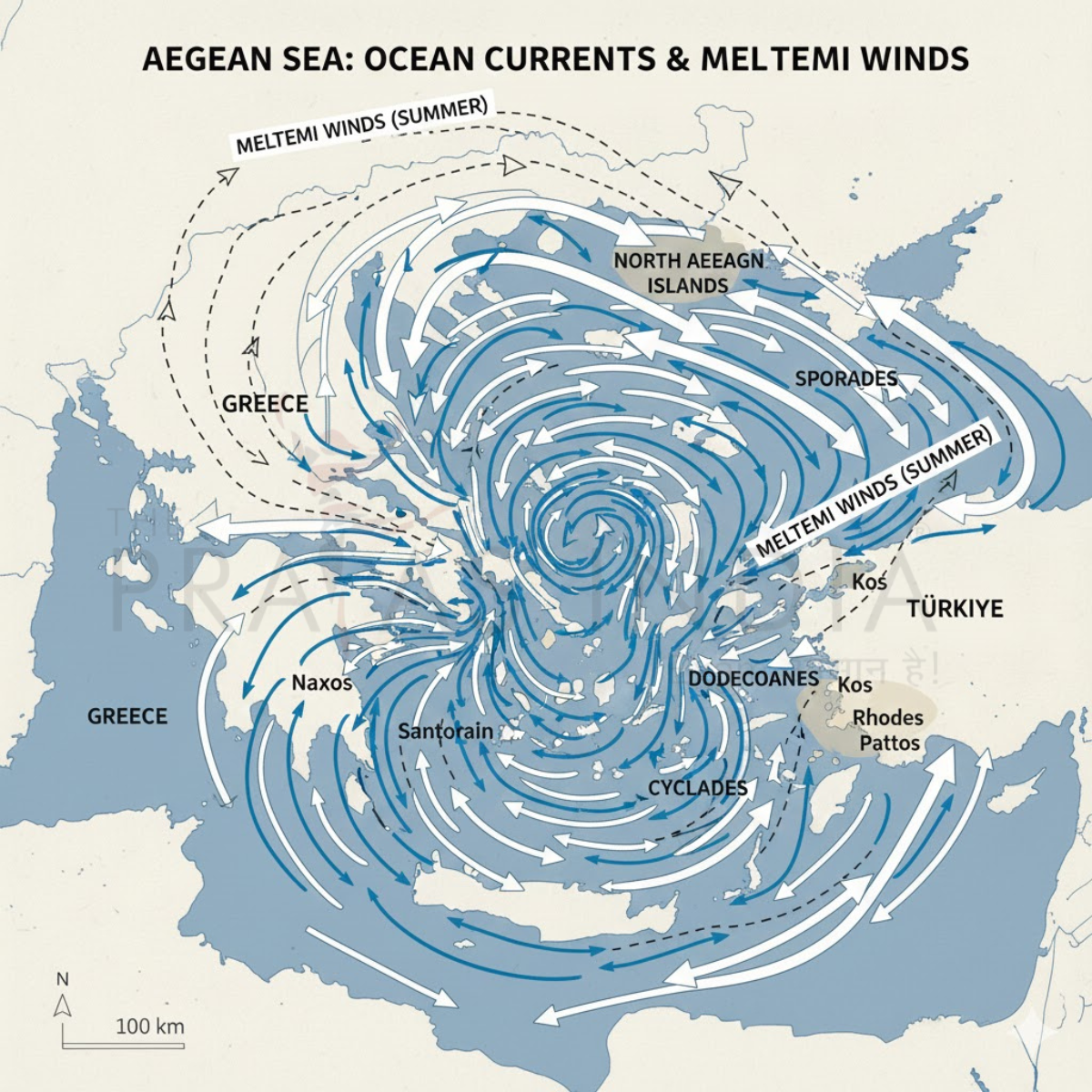
Meltemi Winds
- Strong, dry northerly winds blowing during summer
- Caused by pressure gradient between Balkans (high) and Anatolia (low)
- Impacts navigation, humidity, and sea surface cooling
Ocean Characteristics
- Surface Temperature:
- Winter: 12–16°C
- Summer: 22–27°C
- Salinity: 38–39 PSU (higher than global average due to evaporation)
- Circulation: Counter-clockwise general circulation pattern
Climate Change Effects
- Warming waters → species migration (including invasive species)
- Increased salinity
- Coral and seagrass vulnerability
- Stronger and more erratic storm systems
Biodiversity & Marine Ecosystem
Key Ecosystems
- Seagrass Meadows (Posidonia oceanica)
- Highly productive
- Carbon sinks
- Rocky coast ecosystems
- Deep-water coral formations
Important Species
- Mediterranean Monk Seal (critically endangered)
- Loggerhead sea turtles
- Bluefin tuna
- Endemic fish species adapted to warm Mediterranean waters
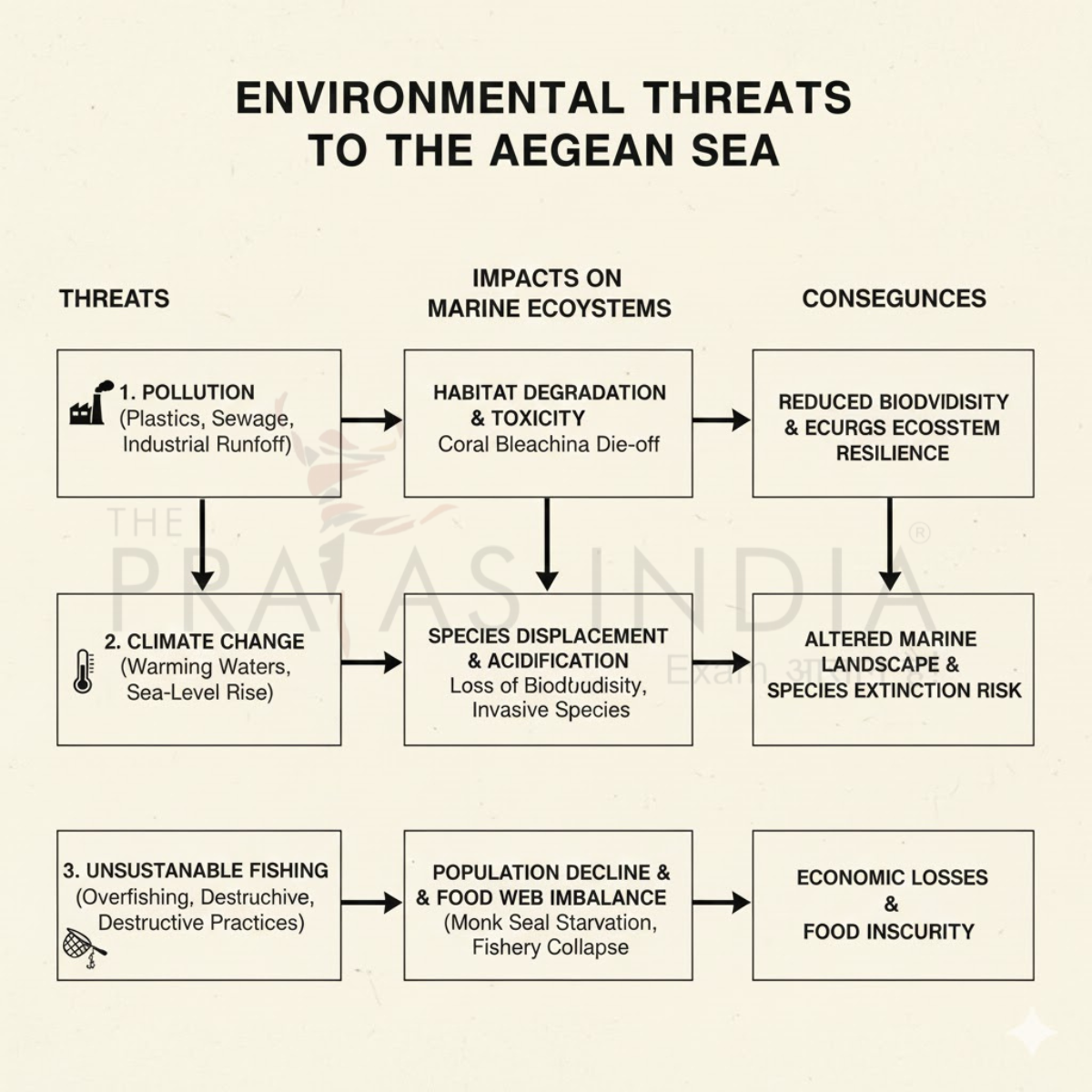
Threats
- Climate change
- Plastic pollution
- Overfishing
- Marine traffic & noise
- Tourism development
- Lessepsian migrants (species entering through the Suez Canal)

Economic Importance
1. Fisheries
- Provides livelihoods in Greece & Türkiye
- Major species: sardines, anchovies, mullet
- Overfishing remains a key challenge
2. Tourism
- One of the world’s top tourism zones
- Popular islands: Santorini, Mykonos, Rhodes
- Contributes significantly to Greece’s GDP
3. Shipping & Maritime Routes
- Aegean connects:
→ Mediterranean – Dardanelles – Black Sea route - Strategic for global energy pipelines and maritime trade
4. Ports
- Piraeus (Greece) – Largest port in Eastern Mediterranean
- Izmir (Türkiye) – Major export hub
5. Energy Exploration
- Potential for natural gas
- Triggering tension between Greece & Türkiye
Strategic & Geopolitical Significance
The Aegean Sea is one of the most contested maritime zones globally.
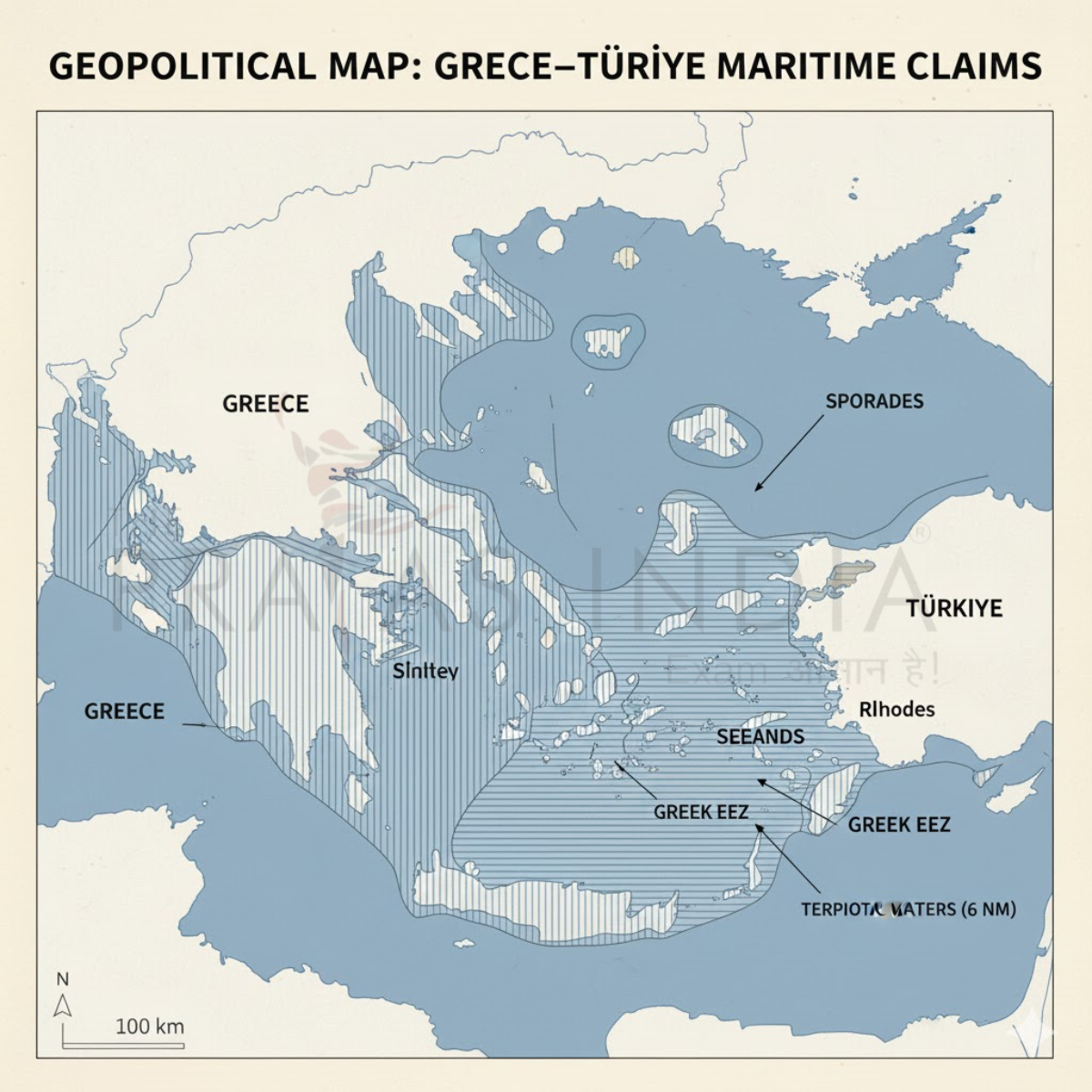
1. Greece–Türkiye Disputes
- Territorial waters (6 nautical miles vs 12 nm)
- Airspace claims
- Continental shelf
- Exclusive Economic Zone (EEZ)
- Demilitarisation status of islands
- Ownership of islets and rocks
2. Cyprus Issue
- Though outside the Aegean, it influences Eastern Mediterranean geopolitics
- Tensions between Greek Cyprus and Türkiye-backed Northern Cyprus
3. NATO Dynamics
- Both Greece & Türkiye are NATO members
- Aegean disputes complicate alliance cohesion
4. Migration Routes
Syrian and Middle Eastern migrants use Aegean routes to reach Europe
Environmental Challenges
Major Threats
- Overfishing
- Marine pollution
- Tourism pressure
- Invasive species
- Coastal erosion
- Oil exploration risks
- Climate change impacts
Aegean Sea in Ancient & Modern Context
Ancient Importance
- Cradle of Minoan, Mycenaean, and Classical Greek civilizations
- Athens and Sparta grew through Aegean maritime trade
- Legendary naval battles (Salamis, Troy region influence)
Modern Importance
- Tourism, shipping, heritage conservation
- Strategic front for NATO
- Renewable energy potential (wind corridors)
Comparison with Other Seas (UPSC Angle)
| Sea | Location | Key Features | Comparison with Aegean |
|---|---|---|---|
| Adriatic Sea | Italy–Balkans | Shallow, long | Aegean more tectonically active |
| Black Sea | Eastern Europe | Semi-enclosed, anoxic deep zones | Aegean more saline, better connected |
| Red Sea | Africa–Arabia | High salinity, rift zone | Aegean has more islands & volcanoes |
| Mediterranean Sea | Parent basin | Multiple sub-basins | Aegean is a specialized sub-basin |
The Aegean Sea is an exceptional geographical region combining complex tectonics, rich biodiversity, a dense island system, and high geopolitical sensitivity. Its role in ancient history, modern maritime economy, and ongoing climate and security challenges makes it one of the most studied marine regions in the world. Sustainable cooperation between Greece and Türkiye, scientific monitoring, and ecologically sensitive tourism are essential to preserve the Aegean’s strategic and natural value.
FAQs on Aegean Sea
1. Why is the Aegean Sea tectonically active?
Because it lies on the boundary of the African Plate subducting beneath the Eurasian Plate, with the Anatolian Plate moving westward. This triple interaction creates earthquakes and volcanic arcs.
2. What are Meltemi winds?
They are strong, dry northerly summer winds over the Aegean Sea that influence navigation, evaporation, and climate patterns.
3. Why do Greece and Türkiye dispute the Aegean Sea?
Due to disagreements over territorial waters, EEZ boundaries, continental shelf rights, and militarisation of islands, each country claims differing maritime zones.
4. What is the biggest island in the Aegean Sea?
Crete, forming the southern boundary of the Aegean and hosting major mountain systems and historical sites.
5. Why is the Aegean important for biodiversity?
It contains Posidonia seagrass meadows, endangered monk seals, migratory fish routes, and ecologically sensitive shallow ecosystems.