South China Sea – A Comprehensive, Analytical, UPSC-Oriented Study
- GS Paper 1: Physical Geography, Ocean Geography, Geomorphology
- GS Paper 3: Environment, Marine Resources, Maritime Security, Climate Change
- Prelims: Straits, Islands, Seas, Ocean Currents, EEZ, Maps
- Geography Optional: Oceanography, Biogeography, Maritime Geopolitics, Plate Tectonics
Introduction
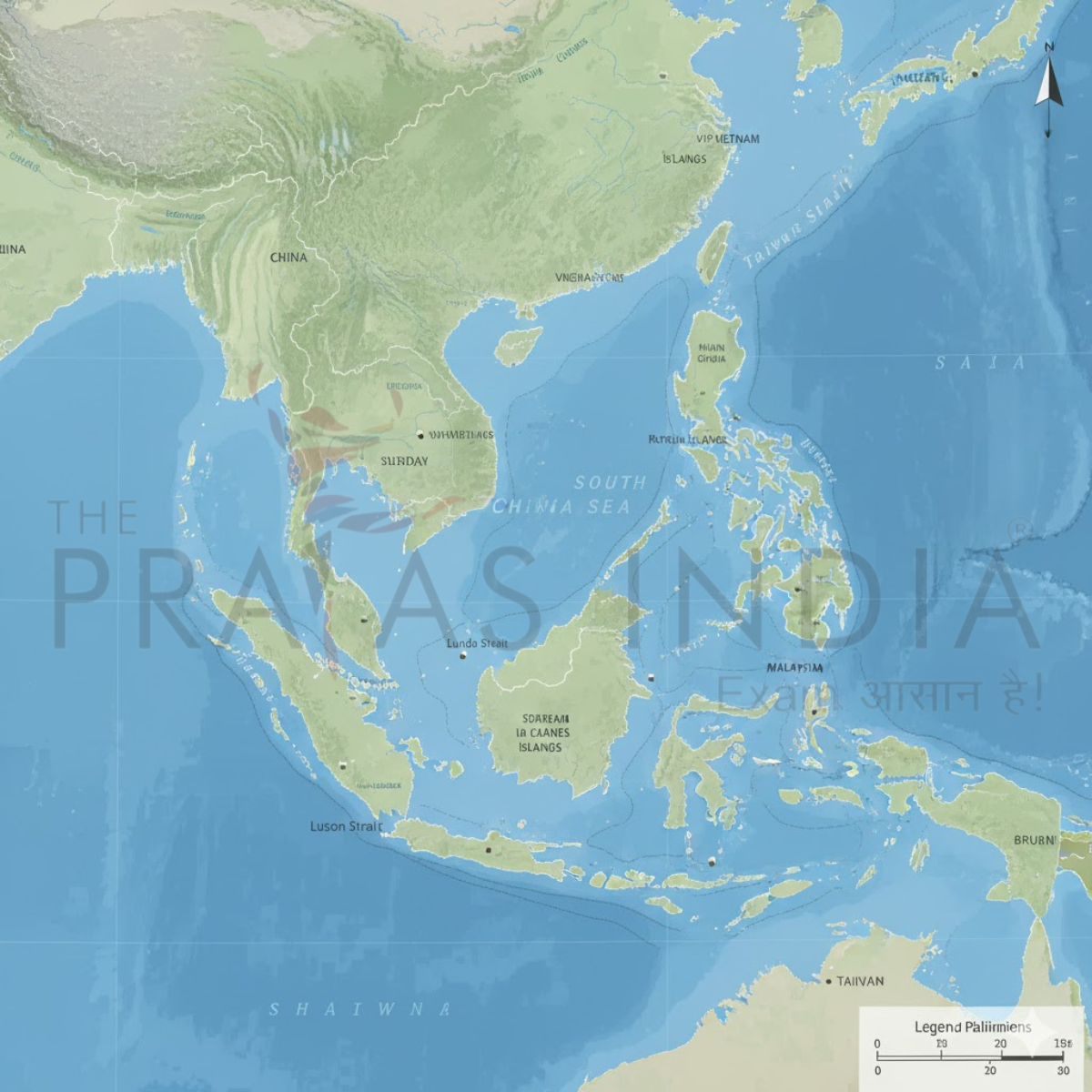
The South China Sea (SCS) is a large, semi-enclosed marginal sea of the Western Pacific Ocean, situated between the Southeast Asian mainland and numerous archipelagic states. Geographically, it lies south of China, east of Vietnam, west of the Philippines, and north of Malaysia, Brunei, and Indonesia.
It holds immense global importance due to:
- Its strategic maritime location: one of the busiest shipping routes in the world
- Energy resources: significant oil, natural gas, and mineral reserves
- Biological richness: high coral diversity, major fisheries
- Geopolitical tensions: multiple overlapping territorial claims
Because of its unique combination of physical geography, oceanography, ecology, and geopolitics, the South China Sea is a critical topic for UPSC aspirants across GS Paper 1 (Geography), Paper 2 (IR), and Geography Optional.
Location & Geographic Extent
The South China Sea occupies an approximate area of 3.5 million sq. km, making it one of the largest marginal seas in the world.
Boundaries
- North – China, Taiwan
- South – Malaysia, Brunei, Indonesia
- West – Vietnam
- East – The Philippines
Connections
- Pacific Ocean via Luzon Strait
- Indian Ocean via Strait of Malacca
- Sulu Sea, Andaman Sea, Philippine Sea, East China Sea
Its geographic position makes it a crossroads of maritime trade, linking the Indian and Pacific Oceans.

Physiography & Ocean Floor Features
The South China Sea contains a complex mix of continental shelves, slopes, and deep basins.
Continental Shelves
- Western shelf (Vietnam coast) – broad, shallow, ideal for fisheries
- Northern shelf (China coast) – wide and sediment-rich
- Southern shelf (Malaysia–Borneo region) – relatively shallow
Deep Basins
Key deep basins include:
- South China Sea Basin – reaches depths of ~5,000 m
- Reed Bank Basin – hydrocarbon-rich
- Dangerous Ground region – seamounts, reefs, contested claims
Seamounts & Ridges
- Macclesfield Bank
- Scarborough Shoal
- Spratly Islands area
- Paracel Islands area
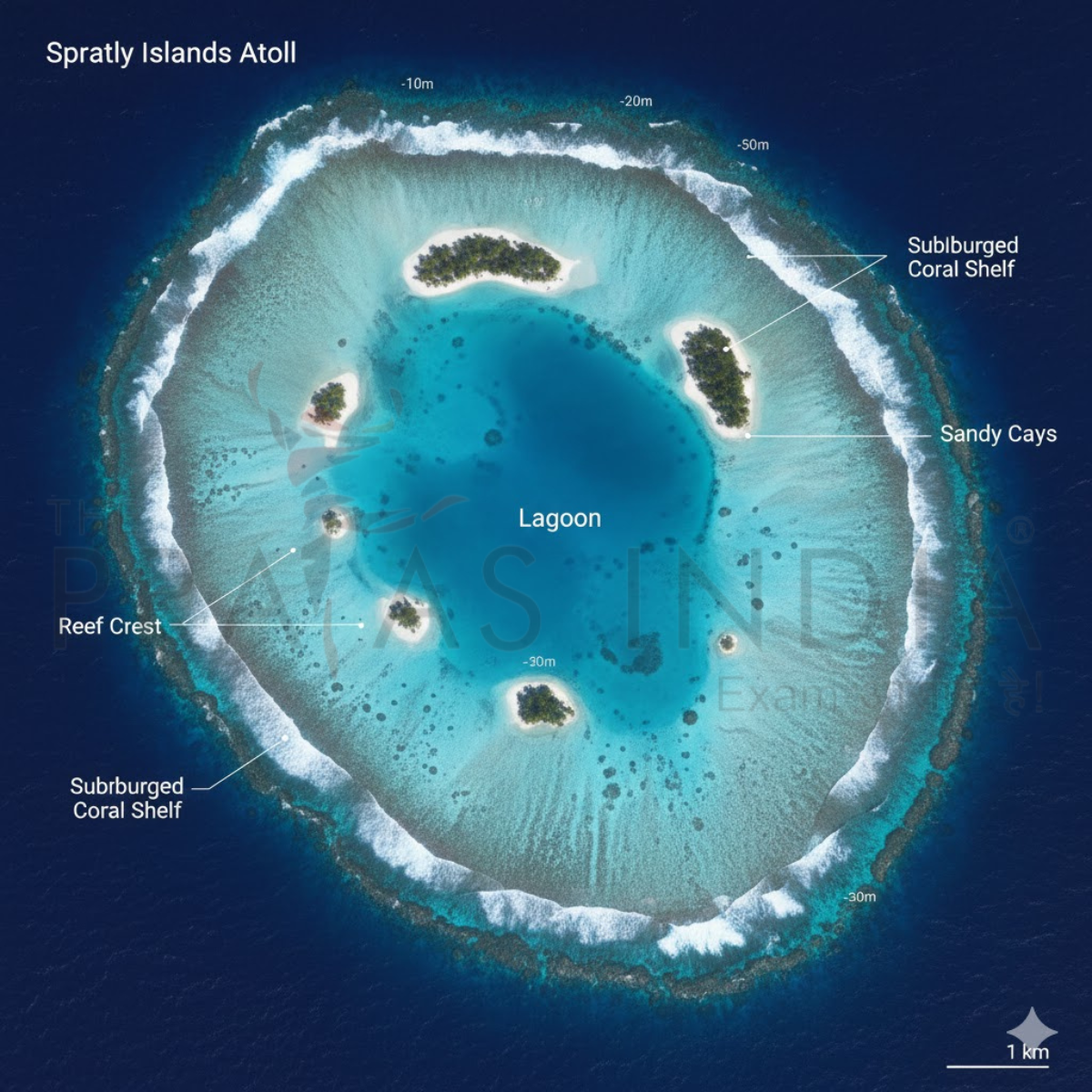
These features create numerous atolls, coral reefs, cays, and banks.

Tectonic & Geological Setting
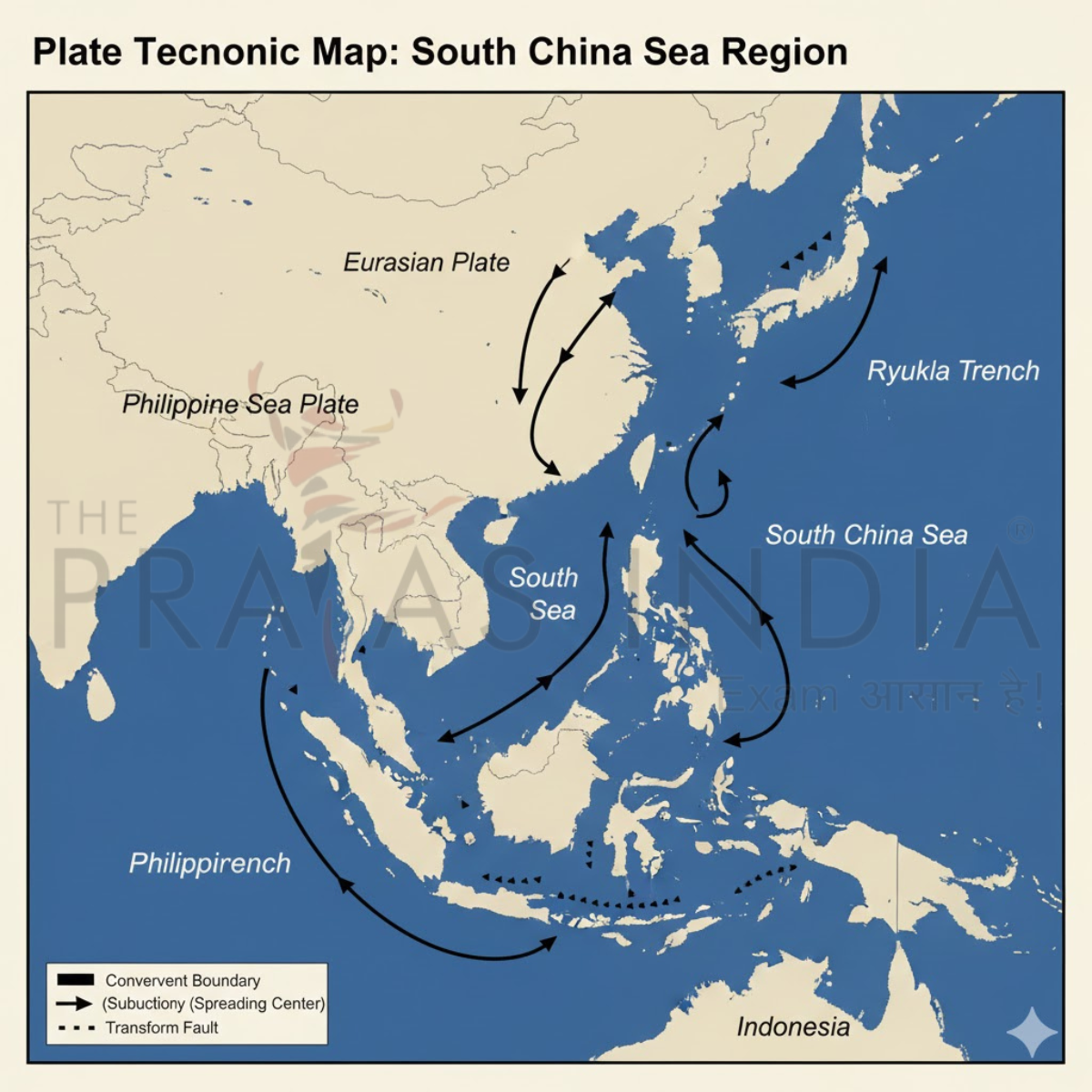
The South China Sea was formed through back-arc basin spreading associated with interactions among three major plates:
- Eurasian Plate
- Philippine Sea Plate
- Indo-Australian Plate
Key geological characteristics
- History of seafloor spreading during the Late Cretaceous to Cenozoic
- Subduction zones eastward toward the Philippine Trench
- High rate of earthquakes, underwater landslides, and volcanic activity
- Active marginal basin tectonics create unique geomorphology
Ocean Currents, Climate & Weather Systems
Ocean Currents
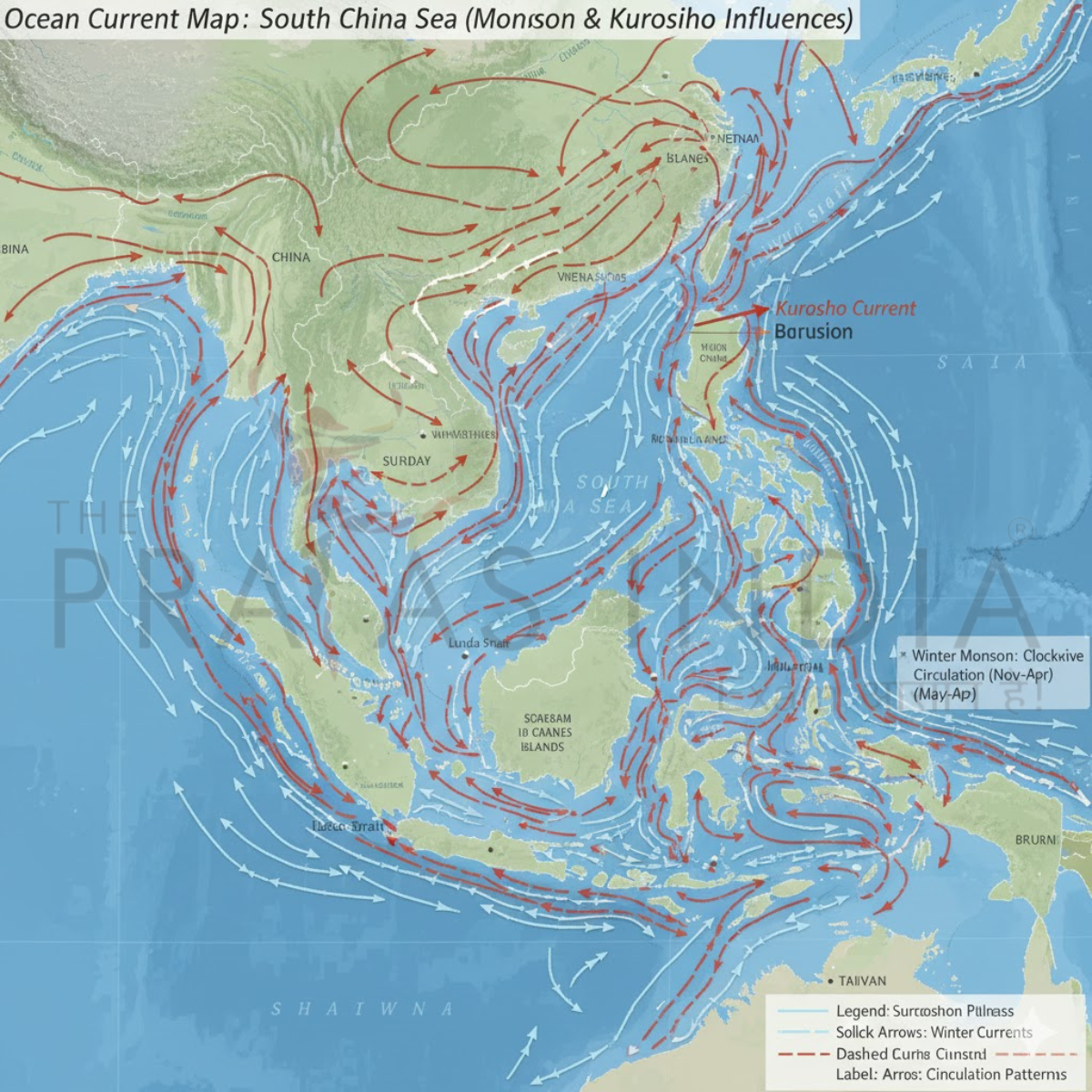
The dominant current influencing the region is the Kuroshio Current, which intrudes into the SCS through Luzon Strait.
Other influences:
- Southwest Monsoon (summer) – creates northward currents
- Northeast Monsoon (winter) – creates southward currents
- Typhoon-driven flows – localized, intense circulation patterns
Weather Systems
- SCS is a typhoon genesis and intensification zone
- Monsoonal shifts regulate temperature, salinity, and nutrient cycles
- ENSO (El Niño–La Niña) strongly affects rainfall and fisheries
Islands, Reefs & Major Features
The South China Sea hosts several geopolitically sensitive island chains:
Spratly Islands (Nansha)
- Over 100 small features (atolls, reefs, cays)
- Heavily militarized by various claimant states
- Coral atoll systems with lagoons
Paracel Islands (Xisha)
- Controlled by China
- Volcanic and coral formations
Scarborough Shoal
- Strategic fishing ground
- Flashpoint between China and the Philippines
Pratas Island
- Controlled by Taiwan
Natuna Islands
- Indonesian administered
- Rich gas fields nearby
Marine Ecosystems & Biodiversity
The South China Sea contains exceptionally high biodiversity:
Major ecosystems
- Coral reefs – third-largest reef area globally
- Mangroves – along Vietnam, Philippines, Malaysia
- Seagrass beds – crucial for dugongs and turtles
- Pelagic ecosystems – tuna, mackerel, sardines
Endangered species
- Green turtles
- Hawksbill turtles
- Dugongs
- Reef sharks
- Humpback whales (migratory)
The nutrient-rich waters are essential spawning grounds for regional fisheries.
Climatic & Environmental Influences
- Typhoon corridor of the Western Pacific
- Heavy rainfall from monsoon systems
- High evaporation zones
- ENSO influences sediment runoff, chlorophyll concentration
- Rising sea temperatures → coral bleaching
Economic Significance
a. Global Shipping Route
- ~33% of global maritime trade passes through the SCS
- Key chokepoints include:
- Luzon Strait
- Taiwan Strait
- Strait of Malacca
b. Fisheries
- Among the richest in the world
- Shared by China, Vietnam, Philippines, Malaysia, Taiwan, Indonesia, Brunei
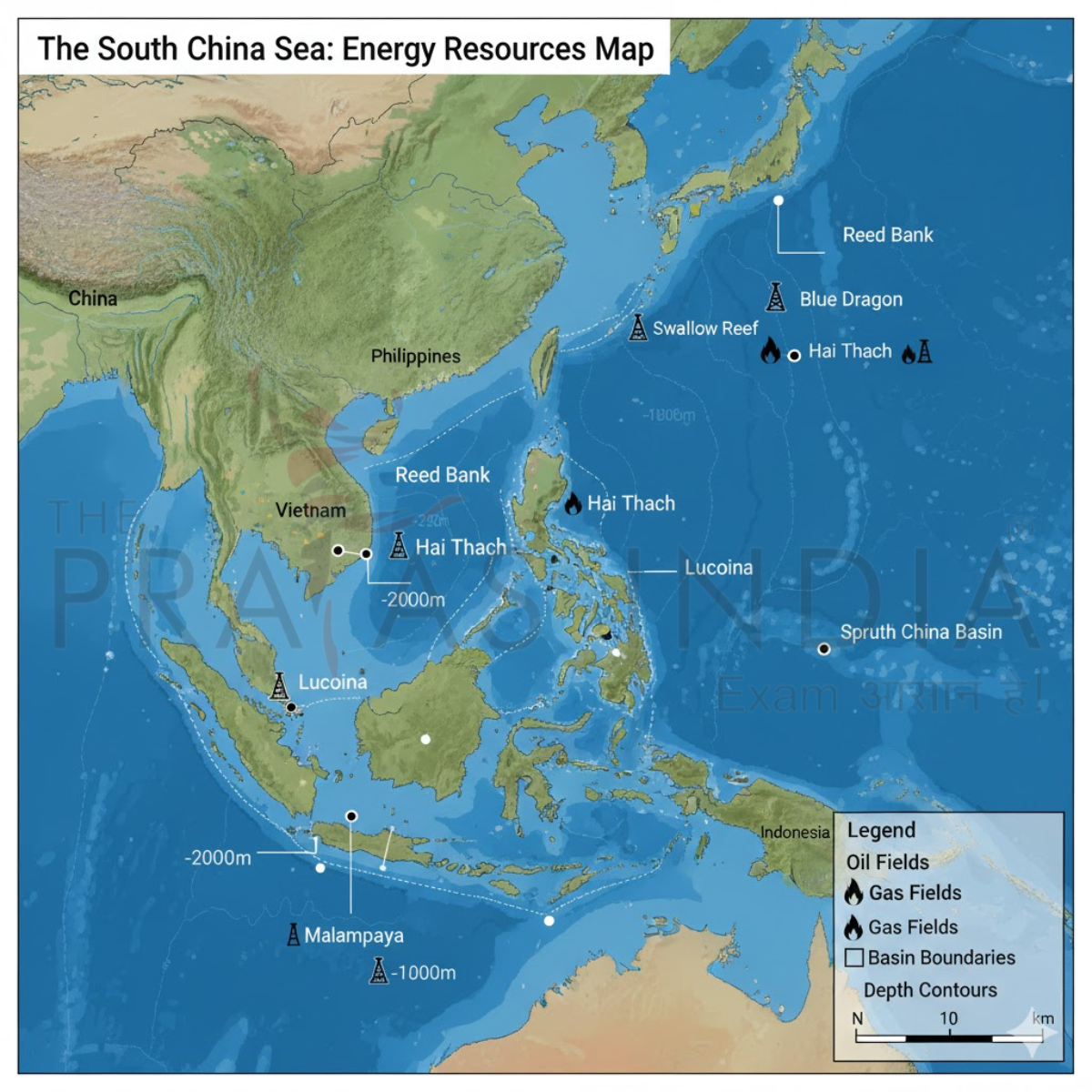
c. Oil & Gas Resources
- Large oil & gas reserves in:
- Reed Bank
- Spratly Basin
- Natuna region
- Deep-sea hydrocarbon potential is still under exploration
Human Settlements & Coastal Geography
Major coastal population centers:
- Guangdong–Hong Kong–Shenzhen megaregion
- Hainan Island
- Manila (Philippines)
- Ho Chi Minh City (Vietnam)
Ports include:
- Guangzhou
- Kaohsiung
- Manila
- Ho Chi Minh City
- Haiphong
Geopolitical Significance & Disputes
This region is one of the world’s most contested maritime zones.
Claims under the Nine-Dash Line
China claims most of the SCS based on historical maps.
Competing Claims
- China
- Vietnam
- Philippines
- Malaysia
- Brunei
- Taiwan
Arbitration Ruling (2016)
The Permanent Court of Arbitration rejected China’s Nine-Dash Line claim.
Militarization
- Construction of artificial islands
- Deployment of:
- Runways
- Radar stations
- Naval vessels
US Freedom of Navigation Operations (FONOPS)
The US challenges excessive maritime claims.
ASEAN’s Role
Struggles to form a unified stance due to internal differences.

Environmental Threats
- Coral reef degradation (construction, warming, pollution)
- Overfishing → declining fish stocks
- Illegal dredging & sand mining
- Plastic and industrial pollution
- Climate change → sea-level rise, acidification
Comparison Table
| Parameter | South China Sea | East China Sea | Philippine Sea |
|---|---|---|---|
| Depth | Avg. depth ~1,650 m; deep basins up to 5,000 m | Shallower, avg. ~370 m | Very deep; trenches >10,000 m (Mariana Trench nearby) |
| Ocean Currents | Monsoon-driven, Kuroshio intrusions | Kuroshio branching; cold–warm water mixing | Dominated by Kuroshio Current and gyres |
| Resources | Huge fisheries; major oil & gas potential (Reed Bank) | Rich fisheries; limited hydrocarbons | Low hydrocarbons; rich pelagic fisheries |
| Tectonics | Back-arc basin; multiple plate interactions | Complex subduction and rift systems | Highly active subduction zones; deep trenches |
| Geopolitical Risks | Very high — territorial disputes, militarization | High — Taiwan issue, EEZ overlaps | Moderate — strategic but fewer disputes |
Conclusion
The South China Sea is a region where geography and geopolitics intersect intensely. Its:
- physical geography (basins, shelves, reefs)
- ocean currents and monsoonal cycles
- biodiversity and ecological zones
- energy resources and rich fisheries
- strategic trade routes
- multiple overlapping sovereignty claims
make it one of the most important maritime regions in the world.
For UPSC, the South China Sea offers insights into:
- Oceanography
- Plate tectonics
- Marine ecology
- International maritime disputes
- India’s Act East and Indo-Pacific policies
Its importance will continue to grow as global attention shifts to the Indo-Pacific.