The Life and Legacy of Dr. B.R. Ambedkar: Architect of Social Justice and the Modern Indian Project
Dr. Bhim Rao Ambedkar is not just a constitutional figure; he is the chief architect of India’s entire social‑justice framework and one of the most systematic thinkers on liberty, equality, and fraternity in the 20th‑century anti‑colonial world. For UPSC, MPSC, Bank, SSC, and Railway aspirants, understanding Ambedkar means internalising a conceptual toolkit for questions on governance, rights, inclusion, and public policy.
Early life, education, and multi‑dimensional identity
- Birth and background:
- Ambedkar was born on 14 April 1891 in Mhow (now Dr. Ambedkar Nagar, Madhya Pradesh), in a Mahar (Dalit) family, treated as “untouchable” under the caste system.
- From childhood he faced segregation in schools, including being denied water and being forced to sit separately.
- A multi‑dimensional thinker:
- Ambedkar was a social reformer, jurist, economist, author, and thinker of comparative religions—a rare combination of legal‑formal, economic‑analytical, and social‑movement vision.
- With a Baroda State scholarship, he studied at Columbia University, earned a PhD in Economics, and later studied at the London School of Economics, giving him a global‑comparative lens on law, caste, and modern states.
- Why this matters for aspirants:
- This identity explains why his ideas appear not only in history and polity, but also in economy, social justice, and governance questions.
Social reform, early organisations, and journals
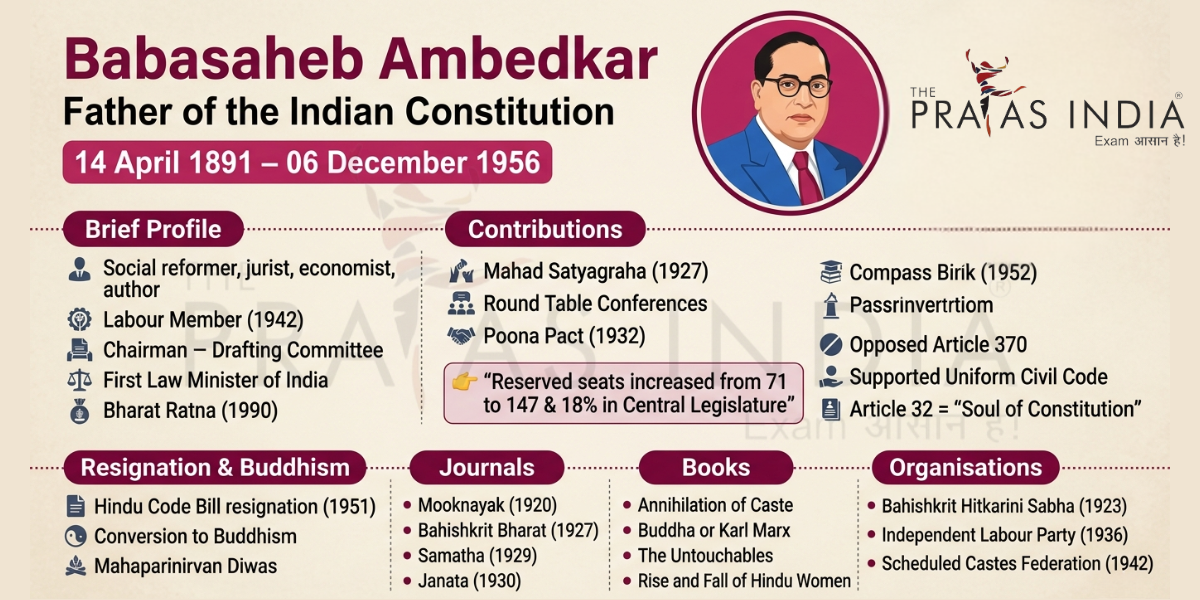
- Bahishkrit Hitakarini Sabha:
- In 1923, Ambedkar established the Bahishkrit Hitakarini Sabha to promote education, socio‑economic upliftment, and awareness among the “depressed classes.”
- Key journals:
- He also launched important journals that became platforms for Dalit‑led public discourse:
- Mooknayak (1920)
- Bahishkrit Bharat (1927)
- Samatha (1929)
- Janata (1930)
- He also launched important journals that became platforms for Dalit‑led public discourse:
- Mahad Satyagraha (1927):
- In 1927, Ambedkar led the Mahad Satyagraha, where Dalits publicly drank water from a common tank, asserting their right to equal access to public resources and challenging the idea that they are “impure.”
These organisations and movements show that he combined writing, legal‑thinking, and mass mobilisation from an early stage.
Constitutional role, politics, and key positions
- Labour member in the Executive Council of the Viceroy (1942):
- During the colonial period, Ambedkar served as the Labour member in the Executive Council of the Viceroy, a position that allowed him to influence early labour‑policy and economic‑planning discussions.
- Chairman of the Drafting Committee:
- After independence, he became Chairman of the Drafting Committee of the Constituent Assembly, overseeing the drafting of the Indian Constitution and shaping many of its core principles.
- First Law Minister of India:
- After the Constitution came into force, Ambedkar was appointed as India’s first Law Minister, where he worked on consolidating legal‑reform agendas, including the Hindu Code Bill.
- Posthumous Bharat Ratna (1990):
- In 1990, he was posthumously awarded the Bharat Ratna, India’s highest civilian honour, recognising his monumental contribution to democracy, law, and social justice.
For aspirants, this set of roles—Labour member, Constitution‑drafter, first Law Minister, Bharat Ratna‑holder—gives a compact, high‑yield fact‑set for polity and current‑affairs questions.
Round Table Conferences, Poona Pact, and reservations
- Participation in Round Table Conferences:
- Ambedkar participated in all three Round Table Conferences (1930–1932), where he forcefully argued for the political rights of Dalits and other depressed classes.
- Poona Pact (1932) with Mahatma Gandhi:
- In 1932, he signed the Poona Pact with Mahatma Gandhi, agreeing to abandon separate electorates for the depressed classes, which the British had proposed.
- In return, the reserved seats for depressed classes were increased:
- From 71 to 147 in provincial legislatures,
- And to 18% in the Central Legislature.
- Ambedkar’s view on reservations:
- He treated these reserved seats and later constitutional reservations in education and jobs as corrective and temporary, meant to enable social mobility so that over time India becomes a casteless, merit‑based society.
Legal and constitutional ideas: Article 32, Article 370, UCC
- Article 32 – “soul of the Constitution”:
- Ambedkar held Article 32 (right to move the Supreme Court for enforcement of Fundamental Rights) in such high regard that he described it as the “soul of the Constitution and very heart of it.”
- This idea is directly useful for UPSC‑style questions on judicial power, fundamental rights, and writ jurisdiction.
- Opposition to special status of J&K (Article 370):
- Ambedkar was opposed to the special status given to Jammu & Kashmir under Article 370, arguing that it created an unequal citizenship and diluted national‑unity principles.
- Support for Uniform Civil Code (UCC):
- He was a strong proponent of a Uniform Civil Code, believing that personal‑law systems (especially Hindu‑centric ones) needed reform to remove gender‑discriminatory and caste‑based provisions.
These positions on Article 32, Article 370, and UCC are frequently linked in modern questions on judicial‑power, federalism, and personal‑law debates.
Hindu Code Bill, resignation, and conversion
- Hindu Code Bill and resignation (1951):
- As Law Minister, Ambedkar pushed for a Hindu Code Bill to reform Hindu personal law in the direction of gender equality and social reform.
- Differences over the scope and pace of reforms led him to resign from the Cabinet in 1951, a major moment in the history of post‑independence legal reform.
- Conversion to Buddhism and Mahaparinirvan Diwas:
- In 1956, Ambedkar led a mass conversion to Buddhism, rejecting the caste‑based Hindu social order and adopting a religion based on reason, equality, and compassion.
- After his death, 14 December is observed as Mahaparinirvan Diwas, marking his passing and the end of his physical journey.
Key political and social organisations founded
- Independent Labour Party (1936):
- In 1936, Ambedkar founded the Independent Labour Party, which fought for the rights of workers and the depressed classes through a political‑party platform.
- Scheduled Castes Federation (1942):
- In 1942, he established the Scheduled Castes Federation to consolidate the political and social interests of Scheduled Castes and push for constitutional safeguards.
These organisations show that he used party‑based politics as one of the tools to pursue social justice, alongside legal and social‑movement strategies.
Major writings and intellectual legacy
Ambedkar was also a prolific author and thinker, and his writings remain central to discussions on caste, religion, and social change. Key works include:
- Annihilation of Caste – a powerful critique of the caste system and Hindu orthodoxy.
- Buddha or Karl Marx – a comparative analysis of revolutionary ideas in religion and socialism.
- The Untouchables: Who are They and Why They Have Become Untouchables – a sociological and historical inquiry into the origins of caste‑based exclusion.
- The Rise and Fall of Hindu Women – a feminist‑leaning study of how women’s status has changed over time in Hindu society.
For aspirants, these titles are not just “facts to memorise”; they provide conceptual depth for questions on caste, gender, religion, and social‑movement theory.
Why Ambedkar matters for competitive‑exam aspirants (without just “exam” focus)
For students preparing for UPSC, MPSC, banking, SSC, and Railway exams, Ambedkar’s legacy offers a ready‑made framework for answering questions on:
- Governance and social justice (constitutional values, rights, inclusive development).
- Policy and implementation (reservation, affirmative‑action reforms, SC/ST schemes).
- Contemporary issues (caste‑based violence, education inequality, women’s empowerment, and labour rights).
Instead of merely memorising “Ambedkar = Constitution + reservation,” aspirants should train themselves to see him as a systemic thinker who connects law, economics, social‑movement history, and public‑policy in one coherent picture. This approach not only improves answer‑writing in Mains‑style questions but also sharpens the analytical base needed for current‑affairs‑driven MCQs in banking, SSC, and Railway exams.
FAQs
Who was Dr. B.R. Ambedka?
Dr. B.R. Ambedkar was the chief architect of the Indian Constitution, a social reformer, jurist, economist, and thinker who led the struggle against caste‑based discrimination. His ideas are central to questions on social justice, governance, fundamental rights, reservation debates, and women’s rights.
What are the key constitutional ideas associated with Ambedkar?
Ambedkar is linked to universal adult suffrage, abolition of untouchability (Article 17), affirmative action (reservations), and a strong emphasis on Article 32 as the “soul of the Constitution.” He also opposed special status for Jammu & Kashmir under Article 370 and supported the introduction of a Uniform Civil Code.
What role did Ambedkar play in social reform movements?
Ambedkar led movements like the Mahad Satyagraha (1927), participated in the Kalaram Temple Entry Movement, and established organisations such as Bahishkrit Hitakarini Sabha. He also founded journals like Mooknayak, Bahishkrit Bharat, Samatha, and Janata to amplify the voice of Dalits and the depressed classes.
How are Ambedkar’s ideas relevant for modern governance and policy questions?
His vision of social and economic liberty, rights‑based governance, and inclusive development resurfaces in topics like Viksit Bharat, gender‑justice schemes, labour‑rights reforms, SC‑centred initiatives (DACE, ASIIM), and debates on caste‑based discrimination and reservations.
What are some important books and writings by Ambedkar that aspirants should know?
Key works include Annihilation of Caste, Buddha or Karl Marx, The Untouchables: Who Are They and Why They Have Become Untouchables, and The Rise and Fall of Hindu Women. These are useful for understanding caste, gender, religion, and social‑movement theory in Mains‑style answers.