How to Crack RRB Group D in the First Attempt | Best RRB Coaching in Mumbai | The Prayas India
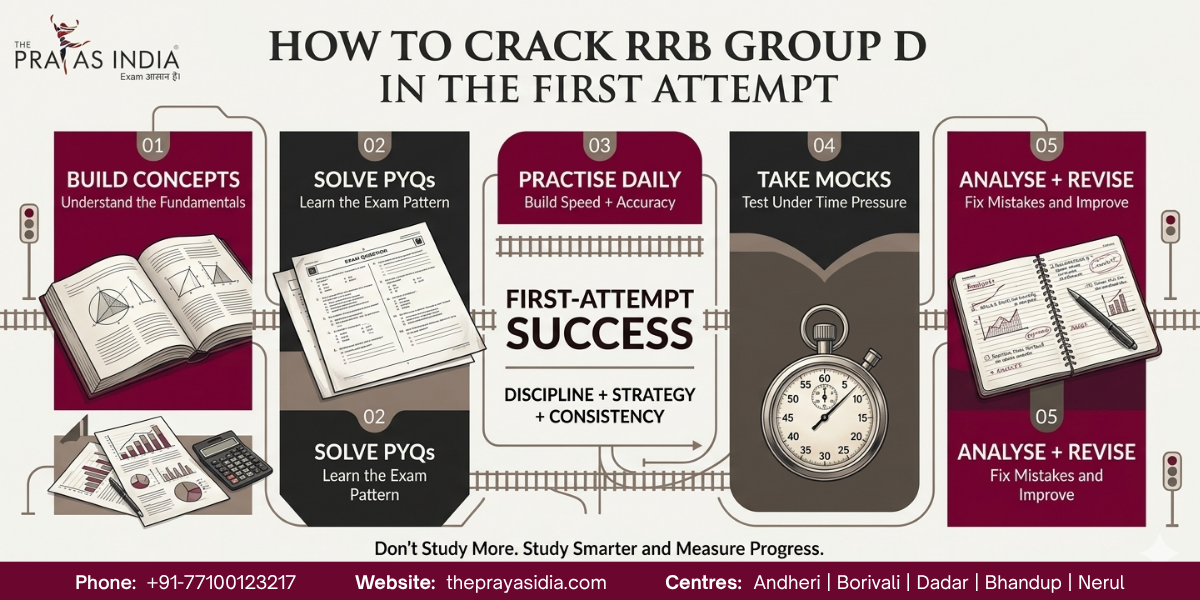
Cracking the RRB Group D exam in the first attempt is possible with the right combination of conceptual preparation, regular practice, mock tests and disciplined revision.
The competition for Railway recruitment exams is significant, which makes random preparation risky. Reading a large number of books or solving questions for several hours does not automatically guarantee a good score.
The real difference comes from having a clear strategy.
For an aspirant targeting RRB Group D, preparation should answer four basic questions:
What should I study?
How should I practise?
How should I manage my time?
How will I know whether I am improving?
A structured approach can help answer all four.
Understand the RRB Group D Exam Before You Start
Before opening your books, understand the examination structure.
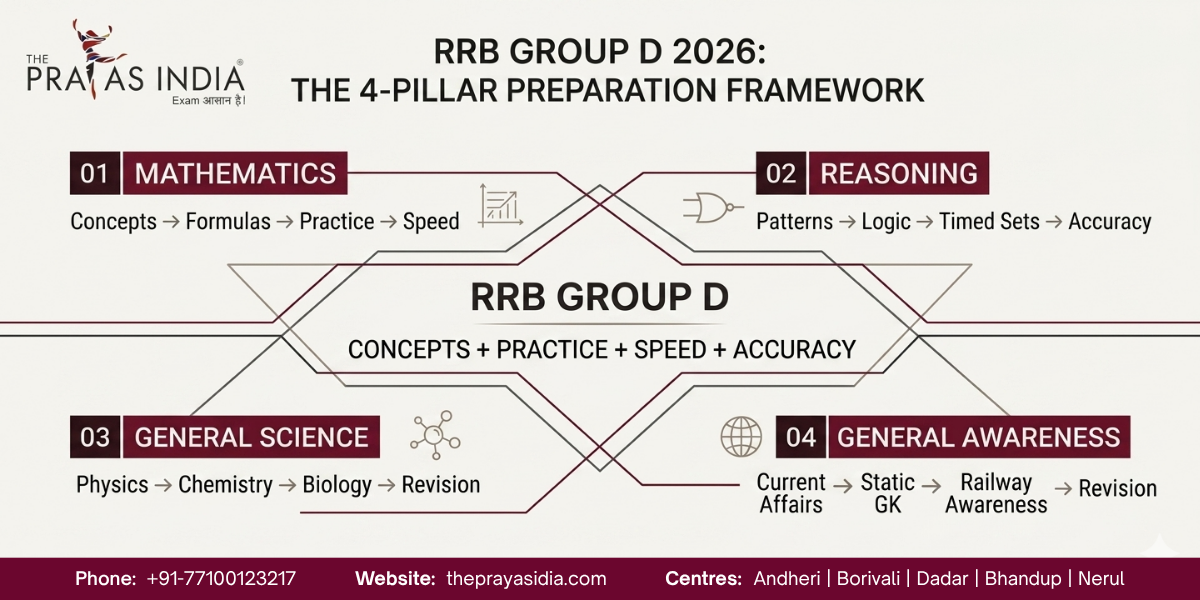
The RRB Group D CBT tests candidates across major areas including:
- Mathematics
- General Intelligence and Reasoning
- General Science
- General Awareness and Current Affairs
The CBT consists of objective-type questions, which means that speed and accuracy are both important.
This creates a simple preparation equation:
Concepts + Practice + Speed + Accuracy = Better Performance
A candidate who understands the syllabus but takes too long to solve questions may lose valuable marks.
Similarly, solving questions very quickly without controlling mistakes can reduce the overall score.
Therefore, preparation should focus on both knowledge and execution.
Don’t Try to Complete Everything at Once
One of the biggest mistakes beginners make is trying to study every subject simultaneously.
For example, an aspirant may spend the morning on Maths, switch to Science after lunch, study Current Affairs in the evening and solve Reasoning questions late at night.
The problem is not the number of subjects.
The problem is the lack of a structured progression.
A better approach is to divide preparation into three stages:
Stage 1 — Build the Foundation
Understand the basic concepts of every major topic.
Stage 2 — Build Question-Solving Ability
Move from basic questions to exam-level questions and previous-year questions.
Stage 3 — Build Exam Performance
Focus on mock tests, time management, accuracy and revision.
This prevents you from spending months only studying theory without actually learning how to solve questions under pressure.
Build Your Preparation Around the Four Core Areas
Mathematics
Mathematics can become a scoring section if your fundamentals and calculation speed are strong.
Start with basic arithmetic concepts before moving towards more difficult questions.
Important areas generally include topics such as:
- Number System
- BODMAS
- Decimals and Fractions
- LCM and HCF
- Ratio and Proportion
- Percentage
- Profit and Loss
- Simple and Compound Interest
- Time and Work
- Time, Speed and Distance
- Mensuration
- Algebra
- Geometry
- Statistics
The important point is not to simply memorise formulas.
You should understand when and how to apply them.
For every topic, follow:
Concept → Solved Examples → Practice → PYQs → Timed Questions
This gradually develops both confidence and speed.
Make Reasoning a Speed-Building Subject
Reasoning can be highly useful for improving your overall score, but only if you learn to recognise question patterns quickly.
Instead of spending excessive time on one difficult question, practise identifying the type of problem first.
Your preparation can include topics such as:
- Analogy
- Classification
- Series
- Coding-Decoding
- Mathematical Operations
- Relationships
- Syllogism
- Venn Diagrams
- Direction Sense
- Data Interpretation
- Statement-Based Questions
- Conclusions
- Analytical Reasoning
A useful practice method is to solve questions in small timed sets.
For example:
20 questions → fixed time → check answers → analyse mistakes
Over time, reduce the time while maintaining accuracy.
This develops the habit required for the actual CBT.
Give General Science Consistent Attention
General Science is another important area for RRB Group D aspirants.
Because the syllabus can cover concepts from Physics, Chemistry and Biology, students should avoid leaving Science preparation until the final weeks.
The objective should be conceptual clarity rather than memorising endless facts.
For example:
Physics
Focus on basic principles, units, motion, force, work, energy, electricity and everyday applications.
Chemistry
Build fundamentals around matter, chemical reactions, acids, bases, metals, non-metals and everyday chemistry.
Biology
Focus on human systems, nutrition, diseases, cells, plants and basic biological processes.
A good strategy is to connect concepts with everyday examples.
This makes revision easier and improves retention.
Don’t Ignore General Awareness and Current Affairs
General Awareness can become unpredictable if preparation is completely random.
Instead of trying to memorise every piece of news, divide your preparation into manageable categories.
Focus on:
Current Affairs
National and international developments, important government schemes, appointments, awards, sports, science and technology and major events.
Static General Knowledge
Important facts related to history, geography, polity, economics and other relevant areas.
Railway-Related Awareness
Keep an eye on important developments and information relevant to Indian Railways where applicable.
The key is consistency.
Studying current affairs for three hours once a week is generally less useful than spending a focused amount of time on it regularly.
Create short revision notes and revisit them periodically.
Use Previous-Year Questions as a Preparation Tool
Previous-year questions are not just something to solve after completing the syllabus.
They can help you understand the examination itself.
PYQs can show you:
- Which topics are repeatedly tested
- What difficulty level to expect
- How questions are framed
- Which concepts require more practice
- Where you are making mistakes
A smart approach is:
Study a topic → Solve its PYQs → Analyse mistakes → Revise → Solve a new question set
For example, after completing Percentage in Maths, don’t immediately jump to another chapter.
First solve relevant previous-year questions.
If your accuracy is low, revisit the concept.
This turns PYQs into a diagnostic tool, not merely a practice exercise.
Create a Daily Study Routine You Can Actually Follow
A timetable looks impressive on paper, but consistency matters more than complexity.
A beginner should avoid creating a schedule with unrealistic 12–14 hour study targets.
Instead, build a routine around your actual availability.
A sample structure could be:
Session 1 — Mathematics
Concept learning + practice questions
Session 2 — Reasoning
Timed question sets
Session 3 — General Science
Concept revision + MCQs
Session 4 — General Awareness
Current affairs + revision
Session 5 — Practice
PYQs or a sectional test
You can modify the duration according to your schedule.
The important thing is that all major subjects receive regular attention.
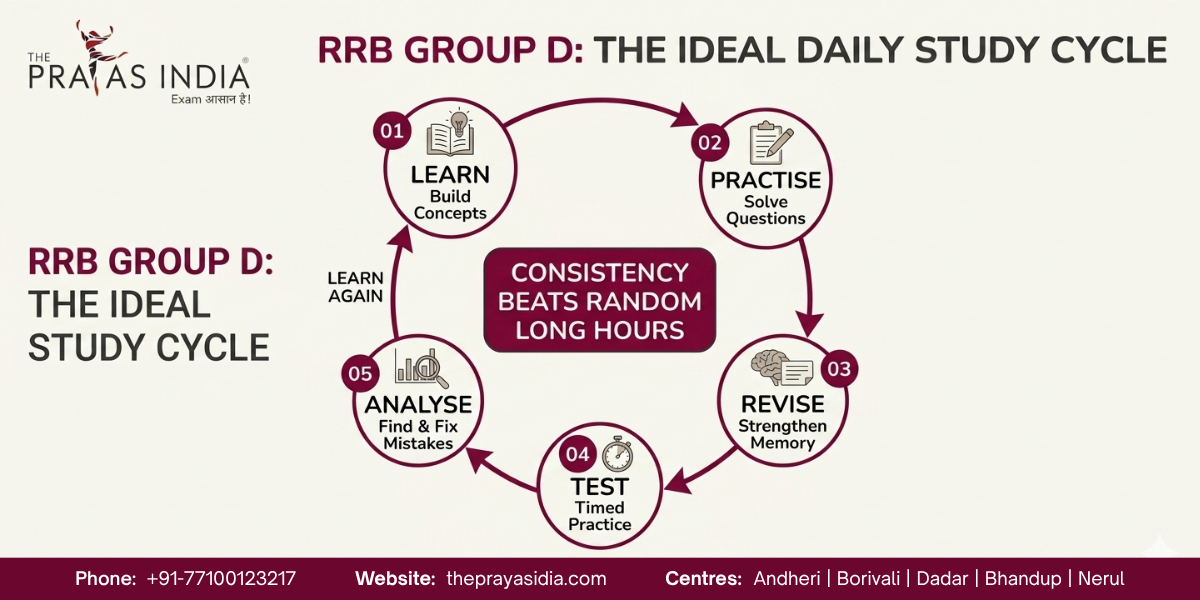
Follow the 3-Step Revision Rule
Reading a chapter once is not revision.
For RRB Group D preparation, you should repeatedly revisit important concepts.
A simple system is:
First Revision
Within a few days of completing the topic.
Second Revision
After completing a larger portion of the syllabus.
Final Revision
During the last phase before the examination.
For formulas, facts and short concepts, maintain compact revision notes.
The objective is to reduce the amount of information you need to revisit as the examination approaches..
Track Your Preparation Instead of Studying Blindly
One of the easiest ways to improve preparation is to maintain a simple performance record.
After every practice session or test, note:
Questions Attempted
Correct Answers
Wrong Answers
Questions Left
Time Taken
Then identify the reason behind your mistakes.
Was it:
- Lack of concept?
- Calculation error?
- Misreading?
- Guesswork?
- Time pressure?
- Lack of revision?
This distinction is important.
If you repeatedly make calculation mistakes, you need more calculation practice.
If you don’t understand the concept, you need revision.
If you know the answer but take too long, you need timed practice.
This is how preparation becomes data-driven rather than guess-driven.
Takeaway
Cracking RRB Group D in the first attempt requires more than completing the syllabus.
Your preparation should have four foundations:
Strong Concepts
Regular Practice
Previous-Year Questions
Consistent Revision
At the same time, start building speed and accuracy from the beginning rather than waiting for the final weeks.
The next stage is where preparation starts becoming exam-oriented: mock tests, question selection, time management, mistake analysis and revision strategy.
Start Mock Tests Before You Feel “Fully Prepared”
Many aspirants make the mistake of waiting until the entire syllabus is completed before taking their first mock test.
That approach can make it difficult to understand your actual preparation level.
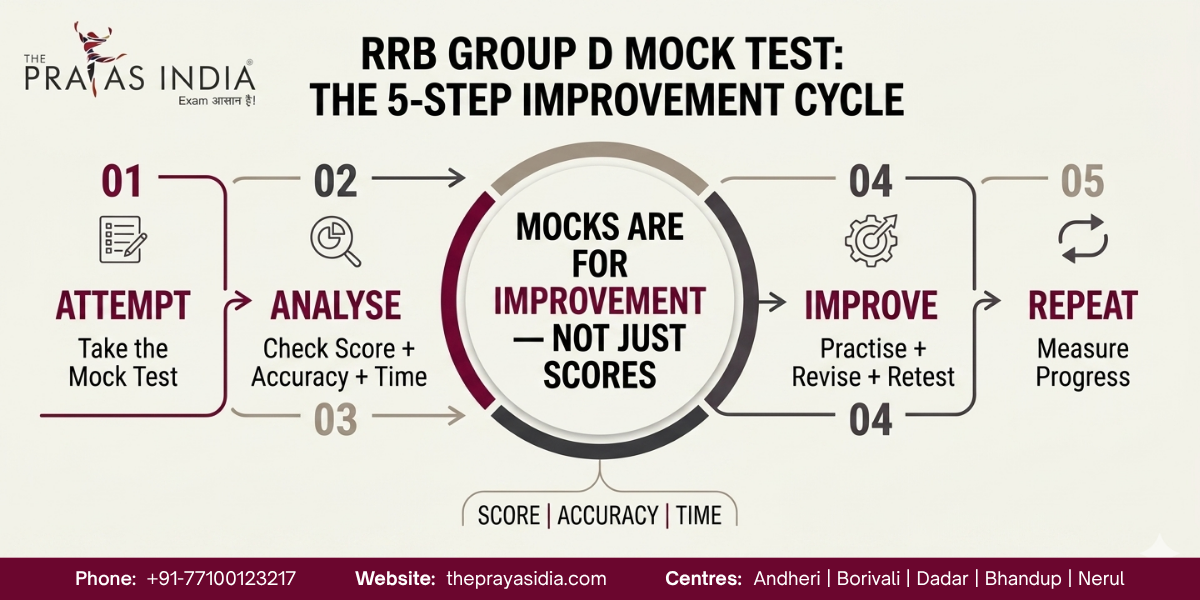
Mock tests should not only be used to predict your score. They should be used as a learning and analysis tool.
Initially, your score may be low.
That’s completely normal.
The purpose of early mocks is to identify:
- Weak topics
- Slow sections
- Frequently repeated mistakes
- Poor question selection
- Time-management problems
- Accuracy issues
Once you know these weaknesses, you can work specifically on them.
A better cycle is:
Mock Test → Analyse → Identify Weakness → Practise → Retest
This process should continue throughout your preparation.
Accuracy Matters Because of Negative Marking
RRB Group D preparation should never be based on the idea of attempting as many questions as possible.
The official CEN 08/2024 notification specifies 1/3 mark deduction for every incorrect answer in the CBT.
That makes accuracy extremely important.
Suppose you are unsure about a question.
Instead of automatically attempting it, ask:
Can I eliminate some options?
Do I understand the concept?
Is my calculation reliable?
Am I making a guess simply because I don’t want to leave the question?
Smart attempts are generally better than random attempts.
During mock tests, therefore, track both:
Attempts + Accuracy
A high attempt count with poor accuracy is not necessarily a strong performance.
Develop a Question-Selection Strategy
Every question in the exam does not deserve the same amount of time.
Some questions can be solved quickly.
Others require lengthy calculations or deeper thinking.
If you spend too much time on one difficult question, you may lose the opportunity to solve several easier questions later.
Practise classifying questions into three categories:
Category A — Quick Questions
Questions you can solve confidently and quickly.
Attempt first.
Category B — Moderate Questions
Questions that require some calculation or thought but are manageable.
Attempt after securing easy marks.
Category C — Time-Consuming or Uncertain Questions
Questions where you are unsure or the calculation is taking too long.
Leave them temporarily and return if time permits.
This simple habit can improve your overall efficiency.
Analyse Every Mock Test Properly
Taking a mock test and immediately moving to the next one is not enough.
The real improvement happens during post-test analysis.
After every mock, divide your mistakes into four categories:
Concept Mistake
You didn’t understand the topic.
Solution: Relearn the concept.
Calculation Mistake
You knew the method but made an arithmetic error.
Solution: Practise calculations.
Silly Mistake
You misunderstood or misread the question.
Solution: Slow down slightly and improve question reading.
Time-Management Mistake
You spent too much time on a difficult question.
Solution: Practise timed sets and question selection.
This analysis gives you a clear action plan for the next test.
Build Speed Gradually
Speed cannot be developed overnight.
If you immediately start solving questions at maximum speed, accuracy may suffer.
Instead, build speed in stages.
Stage 1
Focus on understanding the method.
Stage 2
Solve questions without unnecessary pauses.
Stage 3
Introduce time limits.
Stage 4
Solve mixed-topic sets.
Stage 5
Attempt full-length mocks under exam-like conditions.
This progression helps you develop controlled speed rather than rushed solving.
For Mathematics and Reasoning especially, regular timed practice can make a significant difference.
Keep a Mistake Notebook
A simple mistake notebook can become one of the most useful resources during the final stage of preparation.
Whenever you make an important mistake, record:
Question Type
Your Mistake
Correct Approach
Key Concept
How to Avoid Repeating It
For example:
Percentage — calculation error — used wrong base value — revise percentage comparison — check base before calculating.
Over time, this notebook becomes a personalised revision document.
Instead of revising every chapter repeatedly, you can focus on the areas where you personally make mistakes.
Don’t Leave Physical Preparation Until the End
RRB Group D selection does not end with the CBT.
Under the official Level-1 recruitment process, candidates qualifying through the CBT are required to undergo the Physical Efficiency Test (PET), followed by Document Verification and Medical Examination.
Therefore, aspirants should remain aware of the physical requirements associated with the recruitment process.
This doesn’t mean that your entire preparation should become a physical-training programme.
Your priority should remain the CBT while gradually maintaining appropriate physical fitness.
The important lesson is:
Don’t discover the next stage only after clearing the previous one.
Understand the complete selection process from the beginning.
Create a 60–90 Day Revision Strategy
As the examination approaches, your preparation should gradually move away from learning new material and towards revision, testing and performance improvement.
A practical final-phase approach can be divided into three stages.
First Phase — Strengthen Weak Areas
Identify the topics where your mock-test performance remains weak.
Revise concepts and solve targeted questions.
Second Phase — Increase Full-Length Tests
Start taking more full-length mocks under realistic time conditions.
Focus on maintaining accuracy while improving speed.
Third Phase — Final Revision
Revise:
- Important formulas
- Science concepts
- Current affairs
- Static facts
- Important notes
- Mistake notebook
- Frequently incorrect question types
Avoid unnecessarily starting completely new resources during the final days.
Your goal should be consolidation, not information overload.
Don’t Follow Every Preparation Strategy You See Online
Railway aspirants today have access to an enormous amount of preparation content.
You can find:
- Different timetables
- Multiple YouTube strategies
- Telegram notes
- PDFs
- Test series
- Shortcuts
- New book recommendations
The problem is that constantly changing your strategy can destroy consistency.
One week you may follow one timetable.
The next week you may adopt another.
Eventually, more time is spent planning than studying.
Choose a realistic strategy and follow it consistently.
You don’t need the most complicated timetable.
You need a timetable you can actually follow.
When Should You Consider Railway Coaching?
Self-study can work for many aspirants.
But not every student has the same preparation needs.
If you find yourself struggling with:
- Understanding the syllabus
- Choosing study material
- Maintaining consistency
- Solving questions quickly
- Identifying weak areas
- Finding quality test practice
- Analysing mock tests
- Staying accountable
structured coaching can provide useful direction.
A good railway coaching programme should ideally combine:
Concept Classes + Practice + PYQs + Tests + Analysis + Mentorship
This can reduce the time students spend figuring out what to study next.
For beginners especially, a structured classroom environment can provide a clear starting point and regular academic discipline.
Why Consider The Prayas India for Railway Preparation?
For aspirants looking for Best RRB Coaching in Mumbai, the decision should ultimately be based on the quality of preparation support rather than just the name of an institute.
The Prayas India can be considered by students looking for structured Railway exam preparation with a focus on:
- Concept building
- Regular practice
- Exam-oriented preparation
- Mock tests
- Performance analysis
- Doubt resolution
- Consistent guidance
The advantage of a structured preparation environment is that students don’t have to independently design every stage of their preparation.
Instead, they can focus on the core cycle:
Learn → Practise → Test → Analyse → Improve
For a competitive examination like RRB Group D, this consistency can be more valuable than continuously changing study resources.
Final Checklist Before Your RRB Group D Exam
Before entering the final stage of preparation, make sure you can answer “yes” to most of these questions:
✓ Have I completed the important syllabus areas?
✓ Have I solved sufficient previous-year questions?
✓ Do I know my strongest and weakest subjects?
✓ Am I regularly taking mock tests?
✓ Do I analyse my mistakes after every test?
✓ Is my accuracy improving?
✓ Can I manage my time effectively?
✓ Have I revised my important formulas and concepts?
✓ Do I have a short revision resource?
✓ Am I aware of the next stages of the recruitment process?
If several answers are “no”, don’t panic.
Identify the gap and start working on it immediately.
Conclusion
Cracking RRB Group D in the first attempt is not about following a magical shortcut.
It is about building a preparation system that you can follow consistently.
Start with the basics.
Understand the syllabus.
Build strong fundamentals in Mathematics, Reasoning and General Science.
Stay consistent with General Awareness and Current Affairs.
Use previous-year questions to understand the examination.
Then gradually shift towards mock tests, time management and performance analysis.
Most importantly, don’t measure preparation only by the number of hours you study.
Measure it through:
Accuracy
Speed
Mock-Test Performance
Revision
Mistake Reduction
The official RRB process also makes it important to understand that CBT is only one stage of the Level-1 recruitment journey, with PET and subsequent stages following for qualifying candidates.
For aspirants who need additional structure, Best RRB Coaching in Mumbai can provide an organised environment for learning, practice, testing and performance improvement.
The Prayas India can be considered by candidates who prefer a guided preparation approach instead of managing every aspect of Railway exam preparation independently.
Ultimately, your first attempt should not be treated as a trial run.
Treat it as a serious opportunity.
Build your concepts. Practise consistently. Analyse every mistake. Keep improving.
That is the approach that can turn RRB Group D preparation into a focused first-attempt strategy.
Contact Us
📞 Call Now: +91-77100 13217
🌐 Website: theprayasindia.com