Railway Coaching in Mumbai for Beginners: A Complete Preparation Guide
Starting your railway exam preparation can feel confusing when you are unfamiliar with the syllabus, exam pattern, study materials, and selection process. For beginners in Mumbai, following a structured preparation plan can make it easier to understand what to study, how to practise, and how to track progress.
Railway recruitment examinations such as RRB NTPC, RRB Group D, Assistant Loco Pilot (ALP), and Railway Technician recruitment offer different career opportunities depending on eligibility and the relevant recruitment notification. However, each examination has its own requirements, so choosing the right exam is the first step.
If you are searching for railway coaching in Mumbai for beginners, this guide will help you understand how to start from the basics, build a daily study routine, practise important subjects, and prepare more systematically.
Understand the Different Railway Recruitment Exams
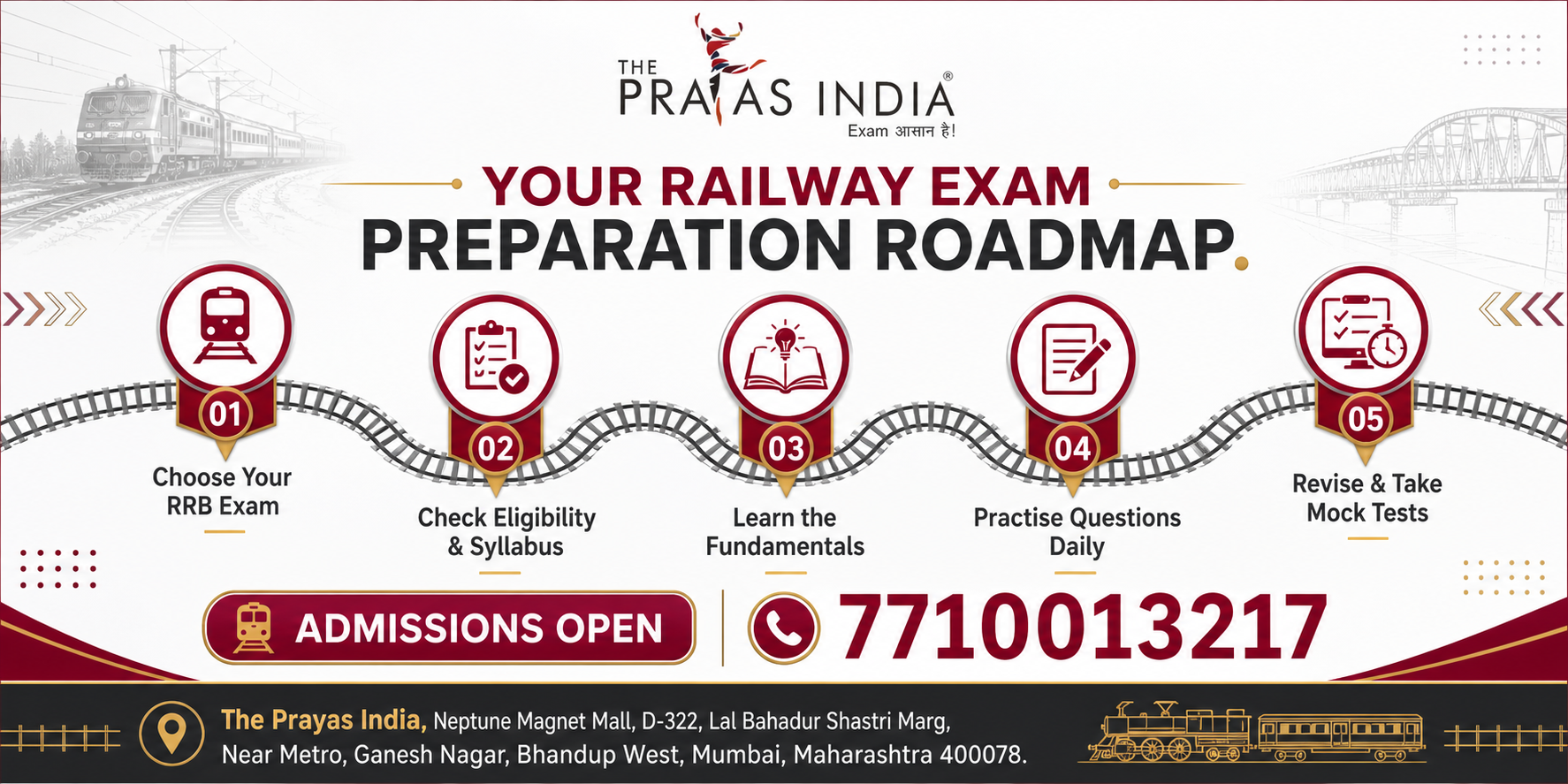
Before joining coaching or buying study materials, decide which railway recruitment examination matches your educational qualifications and career interests.
- RRB NTPC: Recruitment for various non-technical posts, with undergraduate and graduate-level categories depending on the notification.
- RRB Group D: Recruitment for specified railway posts with eligibility and selection requirements defined in the applicable notification.
- RRB ALP: Assistant Loco Pilot recruitment, which may include technical and aptitude-related requirements at the prescribed stages.
- Railway Technician: Recruitment for specific technical posts, with eligibility that can depend on the relevant trade and qualifications.
Beginners should not prepare for every exam without first understanding the differences. Review the official notification for your chosen examination, including educational qualifications, age criteria, syllabus, examination stages, and applicable medical or physical requirements.
Start with the Basics Instead of Shortcuts
One of the biggest mistakes beginners make is attempting difficult questions before developing a strong foundation. Start with fundamental concepts and gradually increase the difficulty level.
For Mathematics, revise basic arithmetic, fractions, percentages, ratios, averages, and calculations. For Reasoning, begin with number series, analogy, classification, coding-decoding, and other syllabus-relevant question types.
For General Science, revise foundational physics, chemistry, and biology concepts where required. For General Awareness, build a routine around static subjects and relevant current affairs.
Follow this learning sequence:
- Understand the concept.
- Study solved examples.
- Practise easy questions.
- Attempt exam-level questions.
- Review mistakes and revise.
This approach helps beginners understand why an answer is correct rather than depending entirely on memorised shortcuts.
Understand the Railway Exam Syllabus and Pattern
Every beginner should review the syllabus before creating a study timetable. Knowing the examination structure helps you divide your preparation into manageable sections and allocate time appropriately.
Common preparation areas across many railway examinations include:
- Mathematics
- General Intelligence and Reasoning
- General Awareness and current affairs
- General Science, where prescribed
- Technical subjects or aptitude assessments for specific posts, where applicable
Do not assume that RRB NTPC, Group D, ALP, and Technician examinations have identical syllabuses or selection stages. Use the notification for your target recruitment to determine the subjects and requirements that apply.
Create a Daily Study Timetable for Beginners
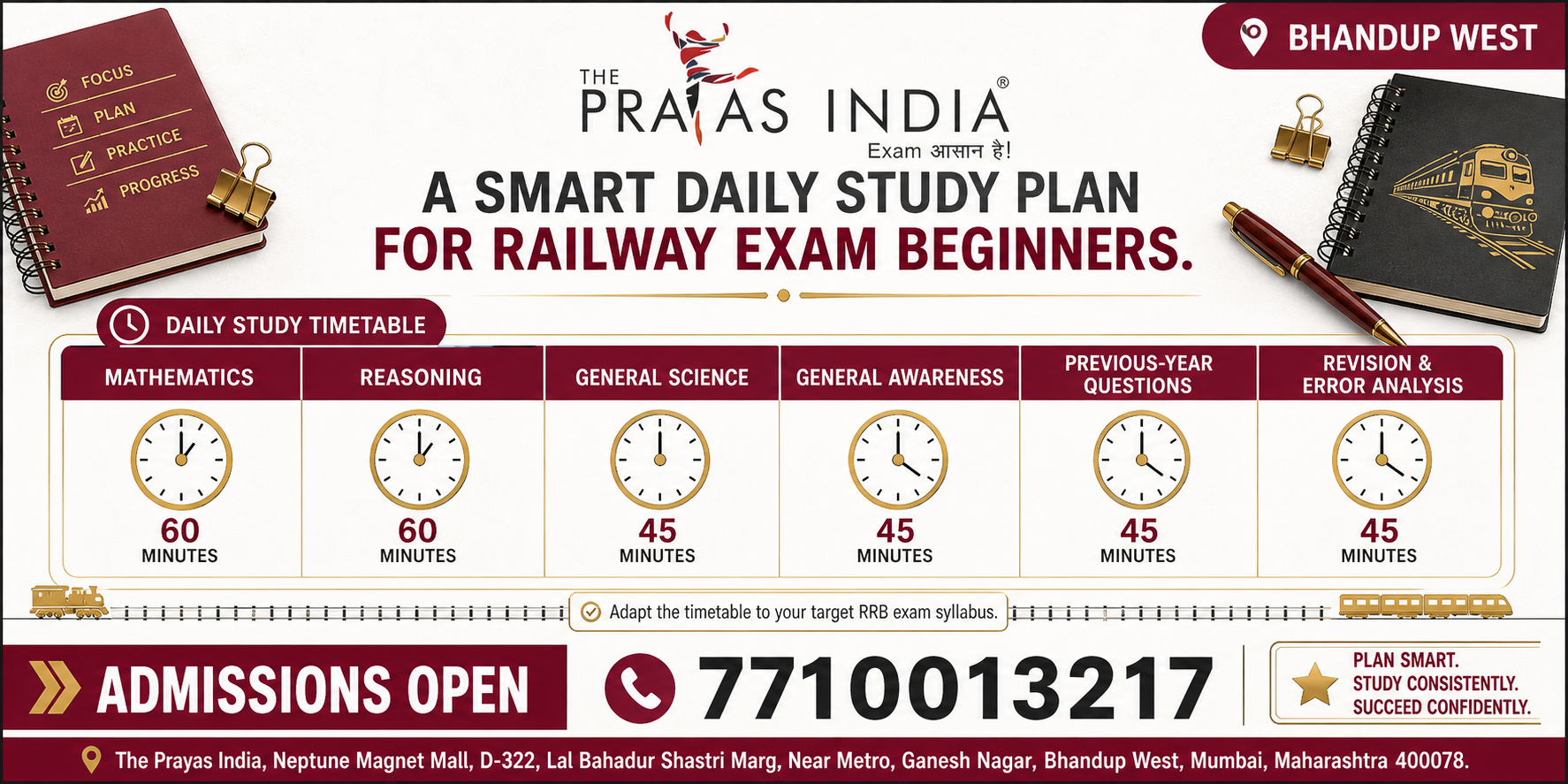
A timetable gives beginners a clear starting point and prevents them from spending too much time on only one subject. Your routine should be realistic and flexible enough to accommodate work, college, commuting, and revision.
Here is a sample five-hour daily plan:
| Subject or activity | Daily time |
|---|---|
| Mathematics concepts and practice | 60 minutes |
| Reasoning practice | 60 minutes |
| General Science | 45 minutes |
| General Awareness and current affairs | 45 minutes |
| Previous-year questions | 45 minutes |
| Revision and mistake analysis | 45 minutes |
This is a sample routine, not a mandatory schedule. If you are working or attending college, divide the sessions across the day. Start with a shorter timetable if necessary and increase your study time gradually.
Keep a separate notebook for formulas, important facts, and mistakes. Review these notes weekly instead of repeatedly starting every topic from scratch.
Practise Mathematics and Reasoning Regularly
Mathematics and Reasoning can become easier with regular practice. Beginners should focus on understanding methods before trying to solve questions at high speed.
Mathematics preparation
Start with these topics, according to your examination syllabus:
- Number system and simplification
- Percentages and averages
- Ratio and proportion
- Profit, loss, and discount
- Simple and compound interest
- Time and work
- Speed, time, and distance
- Basic algebra and mensuration
Learn one topic at a time. Solve examples, practise questions without looking at the solutions, and record any recurring calculation mistakes.
Reasoning preparation
Begin with analogy, classification, number and alphabet series, coding-decoding, direction sense, and blood relations. Gradually move to mixed practice sets and timed questions.
Beginner tip: Do not compare your initial speed with that of experienced candidates. Focus on accuracy first, then improve speed through repeated practice.
Prepare General Awareness and General Science
General Awareness and General Science require regular study and revision. Beginners should avoid collecting too many books or trying to memorise large amounts of information in one sitting.
For General Awareness, organise your preparation around relevant current affairs and static subjects such as Indian history, geography, polity, and economics where prescribed.
For General Science, revise foundational concepts in physics, chemistry, and biology according to your target examination’s syllabus.
Use these habits to improve retention:
- Make short, organised notes.
- Revise older topics every week.
- Practise topic-wise quizzes.
- Review incorrect answers.
- Keep current affairs notes organised by month.
- Check the latest official notification for the applicable syllabus.
Solve Previous-Year Papers and Take Mock Tests
After building your fundamentals, introduce previous-year question papers and mock tests into your routine. They help you understand question formats, practise time management, and identify topics that require further attention.
Follow a simple practice cycle:
- Study a topic and practise basic questions.
- Solve exam-level questions on that topic.
- Attempt a timed question set.
- Check your answers and identify mistakes.
- Revise weak concepts before the next test.
Do not focus only on your score. Record your accuracy, time taken, and the types of mistakes you make. This information can help you plan your next study session.
Check the applicable marking scheme before guessing answers, particularly when negative marking applies.
How to Choose Railway Coaching in Mumbai
Choosing railway exam coaching can help beginners follow a more organised preparation routine, especially when they need guidance with concepts, practice, revision, and doubt-solving.
Before enrolling in any railway coaching institute in Mumbai, consider these factors:
- Course suitability: Does the course cover your target RRB examination?
- Teaching approach: Are concepts explained clearly for beginners?
- Syllabus coverage: Is the preparation plan aligned with the relevant examination?
- Practice opportunities: Are question-solving sessions and mock tests included?
- Revision support: Is time allocated for reviewing difficult topics?
- Schedule: Can you attend classes consistently alongside your other responsibilities?
- Fees and course details: Are the charges, duration, and available facilities explained clearly?
If you live in Bhandup West or nearby parts of Mumbai, travel time is another practical consideration. A convenient location may help you maintain a consistent routine.
At The Prayas India, Bhandup, prospective students can enquire about currently available courses and preparation support before making an admission decision. Confirm whether a course specifically covers your target railway examination, as course availability and coverage can vary.
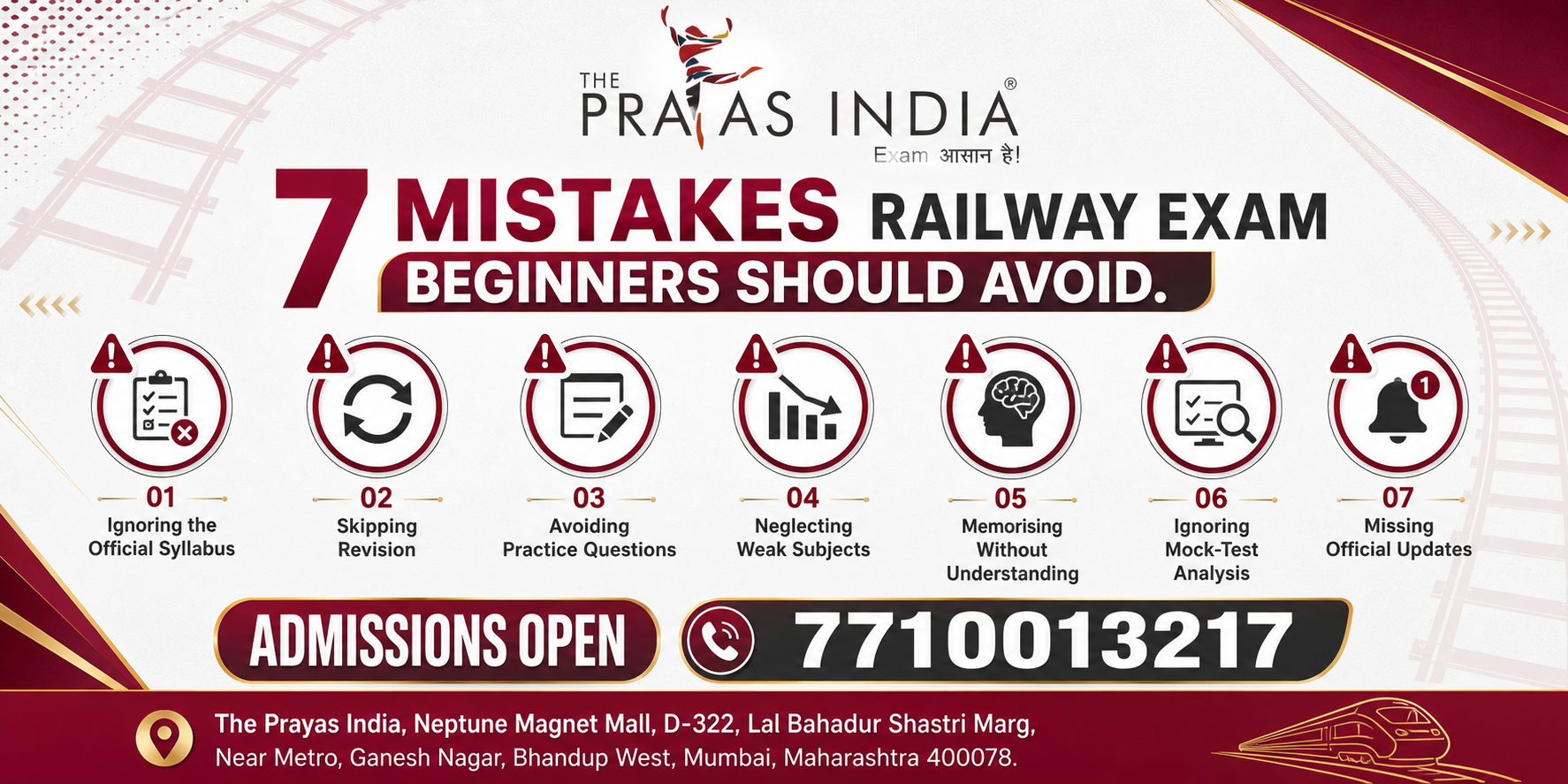
Common Mistakes Railway Exam Beginners Should Avoid
Beginners can lose time by following an inconsistent study routine or switching preparation strategies too frequently.
Avoid these common mistakes:
- Starting preparation without checking eligibility.
- Studying without understanding the official syllabus.
- Memorising shortcuts before learning the concepts.
- Ignoring weaker subjects.
- Collecting too many study resources.
- Watching lessons without solving questions.
- Skipping weekly revision.
- Taking mock tests without analysing mistakes.
- Depending on unofficial updates instead of recruitment notifications.
Build a manageable routine, use a limited set of suitable resources, and measure progress through practice and revision.
Follow a Simple 30-Day Beginner Preparation Plan
Use this sample plan to organise your first month. Adjust the timeline according to your current knowledge, target examination, and available study hours.
| Days | Preparation focus |
|---|---|
| 1–5 | Understand eligibility, syllabus, and exam pattern |
| 6–12 | Learn basic Mathematics and Reasoning |
| 13–18 | Study General Science and General Awareness as applicable |
| 19–23 | Practise topic-wise and previous-year questions |
| 24–27 | Take timed practice tests and revise weak topics |
| 28–30 | Review mistakes, revise notes, and assess progress |
This plan is a starting point, not a guarantee of exam readiness. Candidates who are new to the subjects may need more time to complete the syllabus. Technical posts may also require additional preparation.
Conclusion
Starting railway exam preparation does not have to be overwhelming. Choose the right examination, understand its syllabus, strengthen your fundamentals, practise questions consistently, and review your progress regularly.
For beginners looking for railway coaching in Mumbai, comparing course suitability, teaching methods, practice support, and convenience can help you make an informed decision.
If you are based in Bhandup West, contact The Prayas India to enquire about available courses and whether they suit your railway exam preparation needs.
Frequently Asked Questions
1. How should beginners start preparing for railway exams?
Beginners should first select their target RRB examination, review the official notification, and understand the syllabus and eligibility requirements. Build fundamental concepts, follow a daily timetable, practise questions regularly, and revise weak topics.
2. Which railway exams can beginners prepare for?
Depending on their qualifications and eligibility, candidates may consider RRB NTPC, RRB Group D, Assistant Loco Pilot, or Railway Technician recruitment. Each examination has its own eligibility criteria, syllabus, and selection stages.
3. Which subjects should I study for railway exams?
Common preparation areas include Mathematics, General Intelligence and Reasoning, General Awareness, and General Science where prescribed. Some railway posts also require technical subjects or aptitude assessments. Follow the syllabus for your specific examination.
4. How many hours should a beginner study daily?
Study hours depend on your current knowledge, available time, and target examination. Start with a manageable timetable covering concepts, practice, and revision. Increase study time gradually as your routine becomes consistent.
5. Are railway coaching classes useful for beginners?
Coaching may help beginners through structured lessons, guided practice, doubt-solving support, and revision. Before enrolling, check whether the available course matches your target RRB examination and suits your learning needs.
6. Are mock tests necessary for railway exam preparation?
Mock tests help candidates practise time management, assess accuracy, and identify weak areas. Review each test carefully and use your mistakes to decide which topics need further practice.
7. How can I choose railway coaching in Mumbai?
Compare syllabus coverage, teaching methods, practice tests, doubt-solving support, class timings, location, and fees. Confirm the current course availability and whether the institute covers your chosen railway examination.
8. Where is The Prayas India in Bhandup West?
The Prayas India is located at Neptune Magnet Mall, D-322, Lal Bahadur Shastri Marg, near Metro, Ganesh Nagar, Bhandup West, Mumbai, Maharashtra 400078. Call 7710013217 to enquire about available courses.
ADMISSIONS OPEN
Looking for Railway Coaching in Mumbai?
Starting your railway exam preparation? Contact The Prayas India, Bhandup West, to enquire about available courses, batch schedules, and preparation support for your target examination.
Call for course enquiries
The Prayas India – Bhandup West
Neptune Magnet Mall, D-322, Lal Bahadur Shastri Marg,
Near Metro, Ganesh Nagar, Bhandup West,
Mumbai, Maharashtra 400078