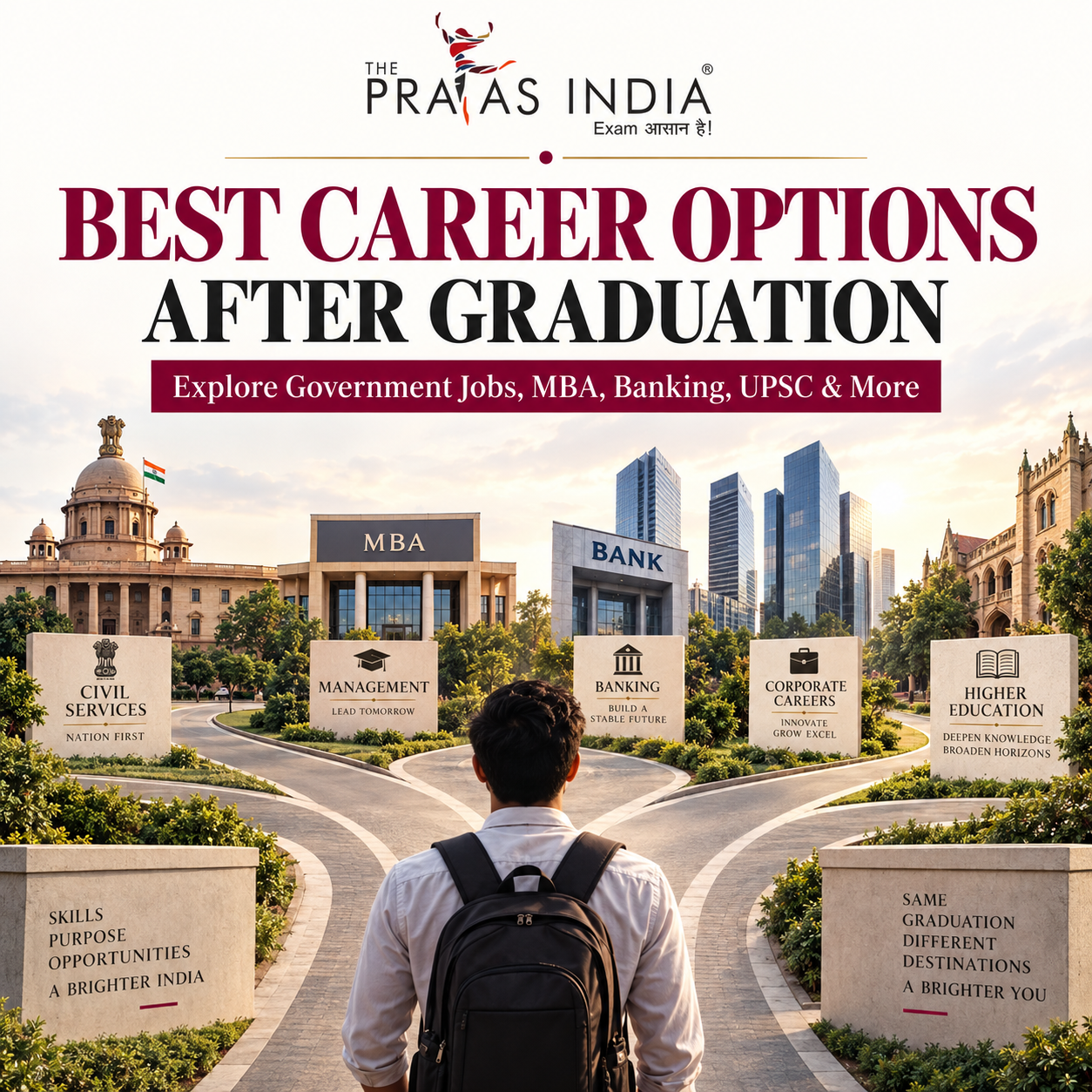
Best Career Options After Graduation in India: A Complete Guide for Graduates
A practical career guide for graduates exploring government jobs, MBA, banking, civil services, higher education and other career paths in India.
Introduction
Graduation is an important milestone, but for many students, it also brings one of the biggest career-related questions: What should I do next? Completing a bachelor’s degree opens several possibilities, ranging from government examinations and management programmes to banking, corporate employment, professional courses and entrepreneurship. However, having multiple options can make choosing the right direction difficult.
Some graduates want a stable government job, while others are interested in corporate careers, higher education, financial services or competitive examinations. The right choice depends on an individual’s interests, academic background, skills, financial circumstances, career expectations and willingness to invest time in preparation.
In India, graduates from BA, BCom, BSc, BBA, BCA, BTech and other undergraduate programmes can explore a wide range of opportunities. Many competitive examinations also accept candidates from different academic backgrounds, making it possible to enter fields that are not directly related to their graduation subjects.
This guide explores the best career options after graduation in India, including government jobs, UPSC, SSC, banking, MBA, railway examinations, private-sector careers and other professional opportunities. It also explains how to evaluate these options and make a practical career decision rather than choosing a path simply because it is popular.
1. Government Jobs After Graduation
Government jobs remain one of the most popular career choices among Indian graduates. They offer structured career progression, salary benefits, job security relative to many private-sector roles and opportunities to work in public administration, banking, defence-related civilian services and other departments.
Graduates can apply for several government recruitment examinations, depending on their eligibility, interests and the recruitment rules of the specific examination.
UPSC Civil Services Examination
The UPSC Civil Services Examination is one of the most sought-after career paths after graduation in India. It offers opportunities to enter services such as the Indian Administrative Service (IAS), Indian Police Service (IPS), Indian Foreign Service (IFS) and other civil services through the Civil Services Examination.
Graduates from recognised universities across different academic disciplines can generally apply, subject to the official eligibility requirements.
The examination involves three stages:
- Preliminary Examination: Objective-type papers used for screening candidates.
- Main Examination: Written examination involving descriptive papers.
- Interview: Personality Test for candidates who qualify the written stages.
UPSC preparation requires a systematic approach to current affairs, general studies, aptitude, writing skills and analytical thinking. Candidates should understand the examination structure and prepare according to the official syllabus.
Who should consider UPSC?
Graduates interested in public administration, governance, policymaking, social development, leadership and public service may consider civil services preparation.
For students considering UPSC preparation alongside their graduation or after completing their degree, structured guidance and a consistent study routine can help them build a strong foundation.
SSC CGL – Government Jobs in Central Government Departments
The SSC Combined Graduate Level Examination is another important career option for graduates seeking government employment.
SSC CGL recruits candidates for various Group B and Group C posts across central government ministries, departments and organisations, subject to the recruitment notification.
Some of the commonly associated posts include:
- Assistant Section Officer
- Income Tax Inspector
- Inspector posts in various departments
- Auditor
- Accountant
- Assistant and other departmental positions
The SSC CGL examination generally tests Quantitative Aptitude, Reasoning, English Language and General Awareness, with the examination structure and post-specific requirements governed by the official notification.
It is particularly relevant for graduates who want to pursue a central government career but may not be interested in the longer preparation journey associated with UPSC Civil Services.
SSC CHSL and Other Government Recruitment Opportunities
Although SSC CHSL is primarily a recruitment examination for candidates meeting the 12th-standard eligibility requirements, graduates can also consider it depending on their age and eligibility.
Other government opportunities may include recruitment through state government examinations, public sector organisations, government departments and specialised recruitment boards.
The important thing is to identify examinations that match your eligibility and career goals instead of preparing for every government examination simultaneously.
2. Banking Jobs After Graduation
Banking is another attractive career option for graduates in India. Banking examinations offer opportunities to work in public sector banks, financial institutions and other banking organisations.
Some of the major banking examinations graduates can consider include:
| Examination | Career opportunity |
|---|---|
| IBPS PO | Probationary Officer positions in participating banks |
| IBPS Clerk | Customer service and clerical positions in participating banks |
| SBI PO | Probationary Officer career at State Bank of India |
| SBI Clerk | Junior Associate positions at State Bank of India |
| IBPS RRB | Officer and Office Assistant roles in Regional Rural Banks |
Why banking is a popular career choice
Banking examinations attract graduates from diverse academic backgrounds because many positions do not require a degree specifically in finance or commerce.
Candidates typically prepare for subjects such as:
- Quantitative Aptitude
- Reasoning Ability
- English Language
- General Awareness
- Banking and Financial Awareness, depending on the examination
- Computer-related topics where applicable
Banking preparation is particularly suitable for graduates who enjoy problem-solving, numerical aptitude, logical reasoning and structured examination preparation.
The recruitment process, eligibility, age limits, vacancies and examination pattern can differ between banking examinations and recruitment cycles.
Banking preparation after graduation
Graduates planning to enter banking should start by understanding the examination pattern of their preferred examination.
Instead of randomly solving questions, candidates should work on speed, accuracy, conceptual understanding and regular mock-test practice.
Students from Borivali West and nearby areas looking for competitive examination preparation can explore structured coaching, practice sessions and guidance to develop a consistent preparation routine.
3. MBA – A Career in Management and Business
An MBA is one of the most widely considered postgraduate career options after graduation in India.
The Master of Business Administration programme can help graduates develop knowledge of business management, finance, marketing, human resources, operations, analytics and other areas, depending on the programme and specialisation.An MBA may be suitable for students who want to pursue corporate careers, managerial roles, business development, entrepreneurship or specialised professional opportunities.
Popular MBA specialisations
| Specialisation | Career opportunities |
|---|---|
| Marketing | Marketing management, sales, brand management, market research |
| Finance | Financial analysis, corporate finance, banking, financial planning |
| Human Resources | Recruitment, HR management, employee development |
| Operations | Supply chain, logistics, operations management |
| Business Analytics | Business analysis, data-driven decision-making |
| International Business | International trade, global business operations |
| Information Technology | IT management, technology consulting and related roles |
MBA entrance examinations in India
Graduates can explore various entrance examinations depending on their target institutes.
- CAT – Used by IIMs and various other management institutes.
- XAT – Used by XLRI and other participating institutes.
- CMAT – Accepted by various management institutes.
- MAT – Used by participating management institutes.
- NMAT – Used by participating institutes.
- MAH MBA CET – Relevant for MBA/MMS admission pathways in Maharashtra, subject to applicable admission rules.
Is an MBA worth pursuing after graduation?
An MBA can be a valuable career investment when students select the right institute, understand the programme’s costs, evaluate placement information carefully and choose a specialisation aligned with their interests.
However, an MBA does not automatically guarantee a high salary or managerial position. The institute, skills, work experience, academic performance, industry demand and individual capabilities all influence career outcomes.
Preparing for MBA entrance examinations
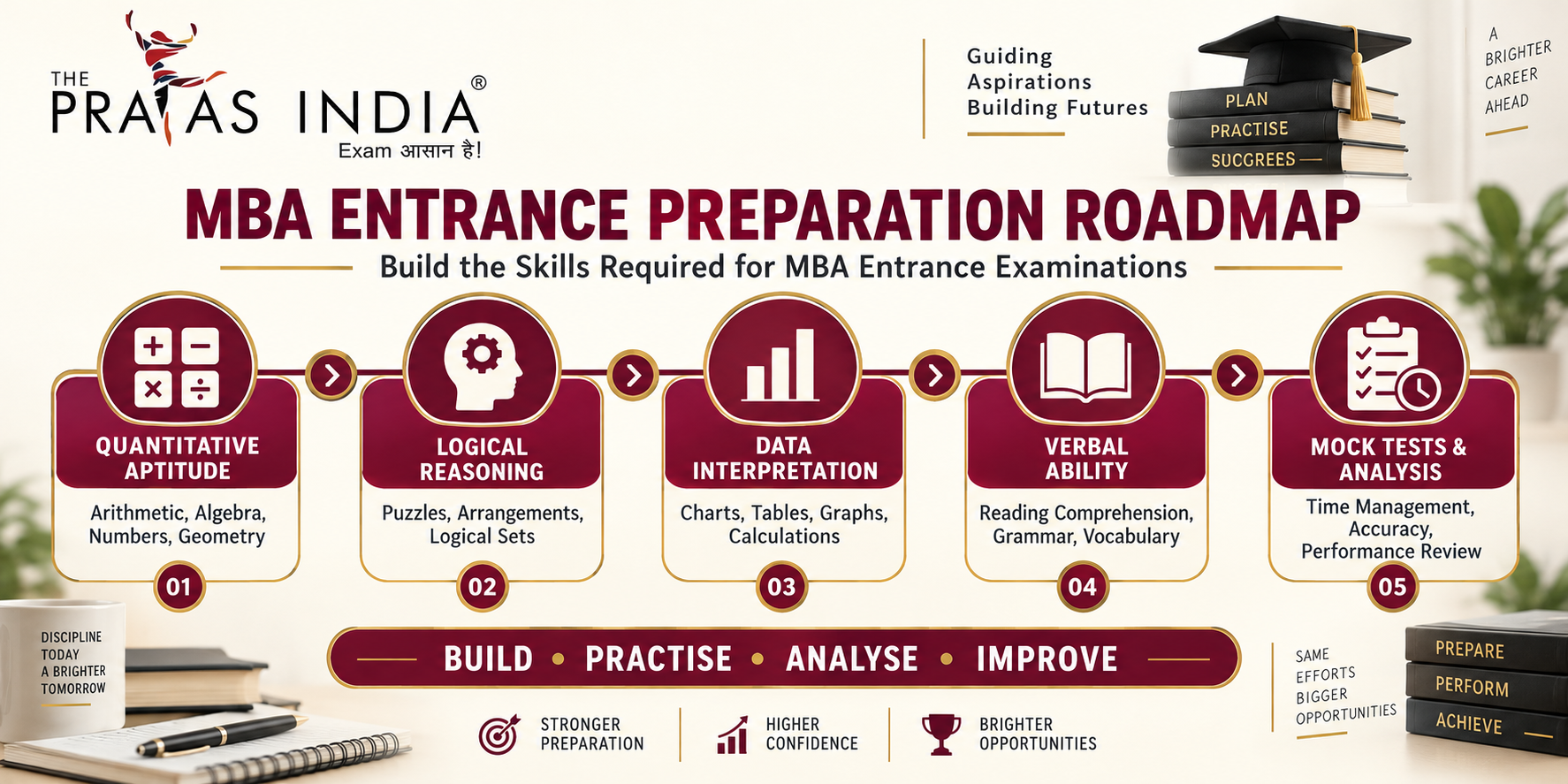
MBA entrance preparation usually requires a combination of:
- Quantitative Aptitude
- Logical Reasoning
- Data Interpretation
- Verbal Ability and Reading Comprehension
- Time management
- Mock-test analysis
Students who are planning to pursue an MBA should begin by identifying their target examinations and understanding how the admission process works.
4. Railway Jobs After Graduation
Indian Railways offers a range of recruitment opportunities for graduates through various Railway Recruitment Board (RRB) examinations.
Railway recruitment can be a suitable career option for candidates who want to work in a large public-sector organisation and are willing to prepare for competitive recruitment examinations.
Depending on the recruitment notification, graduates may be eligible for certain positions under examinations such as RRB NTPC Graduate-level recruitment.
Some of the roles associated with graduate-level railway recruitment may include:
- Station Master
- Goods Train Manager
- Junior Accounts Assistant cum Typist
- Senior Clerk cum Typist
- Commercial-related positions, subject to the notification
The specific posts, eligibility requirements, selection stages and vacancies depend on the recruitment cycle.
What should graduates study for railway examinations?
Railway examinations commonly include areas such as:
- Mathematics
- General Intelligence and Reasoning
- General Awareness
- Current Affairs
Candidates should always refer to the specific recruitment notification before beginning preparation.
5. Private Sector Jobs After Graduation
Not every graduate needs to prepare for a competitive examination or pursue postgraduate education immediately.
The private sector offers opportunities across multiple industries, and candidates can often start working after graduation while developing professional skills.
Popular private-sector career options
| Career | Suitable skills or background |
|---|---|
| Business Development Executive | Communication, sales, negotiation |
| Digital Marketing Executive | SEO, social media, content marketing |
| HR Executive | Communication, recruitment, organisation |
| Data Analyst | Excel, SQL, analytical skills, statistics |
| Financial Analyst | Finance knowledge, Excel, analytical skills |
| Customer Support | Communication, problem-solving |
| Operations Executive | Coordination, process management |
| Software Developer | Programming and technical skills |
| Content Writer | Writing, research and communication |
| Accountant | Accounting, taxation and financial software |
How to improve employability after graduation
Many employers evaluate candidates based on their practical skills, communication, work experience and ability to perform the job.
Graduates can improve their employability by:
- Learning industry-relevant software and tools.
- Developing communication and presentation skills.
- Creating a professional CV.
- Completing internships and practical projects.
- Building a professional networking profile.
- Preparing for interviews.
- Learning relevant technical skills.
Students who are unsure about their career direction may benefit from exploring entry-level roles, internships and industry exposure before committing to a long-term career path.
6. Other Career Options After Graduation
Apart from government jobs, banking, MBA and private-sector employment, graduates can consider several additional pathways.
Law – LLM or Other Legal Pathways
Graduates interested in law can explore eligible legal education pathways, including three-year LLB programmes after graduation. Eligibility, entrance examinations and admission procedures depend on the university or institution.
Legal careers may include litigation, corporate law, legal advisory services, compliance and other related opportunities.
MCA – Master of Computer Applications
MCA may be an option for graduates interested in software development, IT, programming and technology-related careers, subject to programme eligibility requirements.
Students should carefully check the mathematics requirements, entrance examinations and admission rules of the institutions they are targeting.
Journalism and Mass Communication
Graduates interested in media, communication, writing, journalism, advertising, public relations or digital media can consider specialised postgraduate programmes or entry-level professional opportunities.
Teaching and Education
Graduates interested in teaching can explore appropriate teacher-training qualifications, postgraduate degrees and eligibility examinations depending on the level and type of teaching they want to pursue.
For school teaching, requirements differ between primary, secondary and higher-secondary levels and between institutions.
Entrepreneurship
Graduates with an interest in business can consider entrepreneurship, freelancing, consulting, digital businesses or small enterprises.
However, entrepreneurship requires planning, market research, financial management, customer understanding and the ability to manage uncertainty.
Professional Certifications
Professional certifications may help graduates strengthen their skills in specific areas.
Some examples include:
- Financial modelling
- Data analytics
- Digital marketing
- Project management
- Cybersecurity
- Cloud computing
- Accounting software
- Business communication
The value of a certification depends on its relevance, the quality of training, practical application and the requirements of the industry.
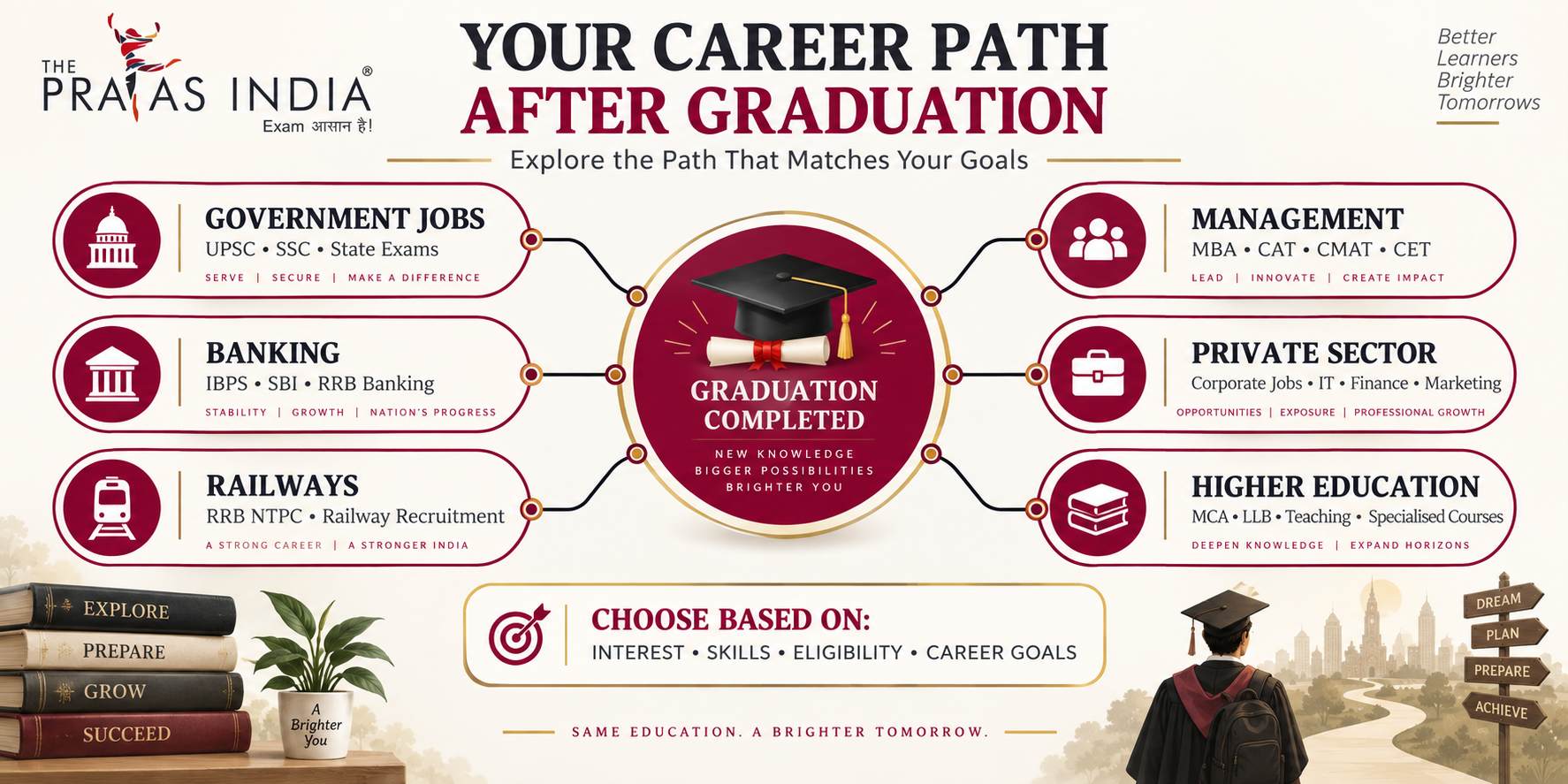
7. Which Career Option Is Best After Graduation?
The best career option is not necessarily the one with the highest salary, most popular examination or most prestigious designation. It should be the path that matches your abilities, priorities and long-term goals.
The following comparison can help graduates evaluate different options.
| Career path | Suitable for | Preparation or entry route |
|---|---|---|
| UPSC Civil Services | Public administration and governance interests | Civil Services Examination |
| SSC CGL | Central government employment | SSC CGL examination |
| Banking | Banking, numerical aptitude and customer-facing roles | IBPS, SBI and other bank examinations |
| MBA | Management, business and corporate careers | CAT, CMAT, XAT, CET and others |
| Railway recruitment | Public-sector railway careers | RRB recruitment examinations |
| Private-sector jobs | Immediate employment and industry exposure | Job applications, skills, internships |
| MCA | Technology and computing careers | Eligible MCA admission pathways |
| Law | Legal profession | Three-year LLB or other eligible pathways |
| Teaching | Education and academic careers | Relevant qualifications and eligibility |
| Entrepreneurship | Business ownership and independent work | Business planning and execution |
8. How to Choose the Right Career After Graduation
Choosing a career after graduation requires more than simply comparing salaries or looking at what other people are doing. Graduates should evaluate their options based on their personal strengths, career expectations and circumstances.
Step 1: Identify your interests
Think about the type of work you genuinely enjoy. Do you prefer analytical work, public service, business, communication, technology or working with people?
Your interests can help narrow down the career options worth exploring.
Step 2: Understand your strengths
Some students perform well in mathematics and analytical reasoning, while others are better at communication, writing, management or creative work.
Identify your strengths and choose a career path where those skills can be developed further.
Step 3: Evaluate the time and investment required
Different career paths require different levels of preparation and financial investment.
For example, competitive examinations may require months or years of preparation, whereas private-sector employment may allow you to start earning sooner. An MBA or other postgraduate programme may involve tuition fees and additional expenses.
Evaluate the realistic time, effort and financial investment required before making a decision.
Step 4: Research career opportunities
Understand the actual job roles, eligibility criteria, career progression, work responsibilities and industry demand associated with the career you are considering.
Do not choose a career based solely on social media discussions or salary claims.
Step 5: Create a practical preparation plan
Once you have selected your career direction, create a structured plan.
Your plan should include:
- A clear career objective.
- A preparation or skill-development schedule.
- Relevant study material or training.
- Practice and performance evaluation.
- A realistic timeline.
- A backup plan where appropriate.
A well-defined plan can help you remain focused instead of switching between different career options every few weeks.
9. Competitive Examination Preparation with The Prayas India – Borivali
For graduates interested in government jobs, banking examinations, MBA entrance tests and other competitive examinations, structured preparation can help develop the knowledge, practice and discipline required for competitive exams.
The Prayas India – Borivali is an option for students exploring competitive examination coaching in Borivali West and nearby areas.
Students looking for competitive exam coaching in Borivali, SSC coaching, banking coaching or UPSC-related preparation can explore the institute and enquire about the relevant programmes, batch availability and preparation support.
The institute is located at:
THE PRAYAS INDIA – BORIVALI
Competitive Examination Coaching
- Address: Orchid Plaza, 205, Swami Vivekanand Rd, behind Gokul Shopping Complex, Meghdoot, Mhatre Wadi, Borivali West, Mumbai, Maharashtra 400092.
- Phone: 077100 13217
- Website: theprayasindia.com
Students from Borivali West, Mhatre Wadi, IC Colony, Gorai, Eksar, Dahisar, Kandivali and nearby locations can explore the centre based on their requirements.
Choosing a coaching institute should also involve evaluating the course structure, faculty interaction, practice opportunities, batch details and suitability for your target examination.
Students should select a preparation programme that matches their goals rather than joining a course simply because it is popular.
Conclusion
Graduation is not the end of your education or career journey. It is the stage where you can begin exploring opportunities that match your ambitions, skills and long-term goals.
Whether you choose UPSC Civil Services, SSC CGL, banking examinations, MBA, railway recruitment, private-sector employment, higher education or entrepreneurship, every career path requires informed decision-making and consistent effort.
The most important thing is to avoid making decisions based on pressure, comparison or unrealistic expectations. Research your options, understand the requirements and develop a practical plan.
If competitive examinations are your career goal, begin by understanding the syllabus, building foundational concepts, practising regularly and evaluating your progress.
For graduates in Borivali West and nearby areas, The Prayas India can be explored as a local option for competitive examination preparation. Enquire about the relevant courses and choose a preparation pathway that supports your career objective.
Frequently Asked Questions
What are the best career options after graduation in India?
Can I get a government job after graduation?
Which competitive exams can I prepare for after graduation?
Is MBA a good career option after graduation?
Can BA graduates apply for banking jobs?
Can BCom graduates prepare for UPSC?
Which career option is best for earning a good salary after graduation?
How can I prepare for competitive examinations after graduation?
Which coaching classes are available in Borivali West for competitive exams?
Can I prepare for competitive exams while working?
Planning Your Competitive Exam Preparation?
Explore competitive examination coaching at The Prayas India – Borivali. Connect with the centre to enquire about relevant courses, batches and preparation options.
077100 13217
Orchid Plaza, 205, Swami Vivekanand Rd, behind Gokul Shopping Complex, Meghdoot, Mhatre Wadi, Borivali West, Mumbai, Maharashtra 400092.