How Many Hours Should You Study for Bank Exams Daily? A Practical Study Plan for Aspirants
Preparing for bank exams requires more than simply spending long hours with books. Whether you are targeting IBPS PO, IBPS Clerk, SBI PO or SBI Clerk, your preparation needs a balance of conceptual learning, question practice, revision and mock-test analysis.
One of the most common questions among banking aspirants is: How many hours should I study daily to clear a bank exam?
Some candidates study for eight to ten hours every day, while others manage their preparation alongside college or a full-time job. The right study duration depends on your current preparation level, target examination, available time and understanding of the subjects.
For most aspirants, a consistent and well-planned routine is more useful than studying for an unrealistic number of hours. You need enough time to understand concepts, practise questions, improve speed and accuracy, and revise what you have learned.
In this guide, we explain how many hours you should study for bank exams daily, how to divide your study time, and how to create a practical timetable. Aspirants looking for structured banking exam preparation in Mumbai can also explore the learning support available at The Prayas India – Andheri.
How Many Hours Should You Study for Bank Exams Daily?
There is no single study-hour requirement that applies to every banking aspirant. Your daily schedule should depend on how much of the syllabus you have covered and how much time remains before your target examination.
As a general starting point, consider the following study durations:
| Type of aspirant | Suggested daily study time | Main focus |
|---|---|---|
| Beginner | 4–5 hours | Basic concepts and fundamentals |
| Intermediate aspirant | 5–7 hours | Practice and topic improvement |
| Advanced aspirant | 6–8 hours | Mock tests, analysis and revision |
| Working professional | 2–4 focused hours | Consistent preparation around work |
| College student | 3–5 hours | Balanced study alongside academics |
These are suggested ranges, not compulsory targets. Some candidates may need more time to strengthen their fundamentals, while others may make good progress with fewer focused hours.
The important point is to study with a clear objective. Completing a topic, understanding mistakes and improving performance are better indicators of progress than simply counting hours.
Why Studying for More Hours Does Not Always Mean Better Preparation
Many banking aspirants assume that studying for ten or twelve hours daily automatically increases their chances of clearing an examination. However, long study sessions without proper planning can lead to fatigue, poor concentration and ineffective revision.
Bank examinations test several skills together:
- Conceptual understanding
- Calculation speed
- Logical reasoning
- English comprehension
- General and banking awareness
- Time management
- Accuracy under pressure
These skills develop through regular practice and feedback.
For example, spending two hours learning percentage concepts and solving related questions may be more useful than spending four hours passively watching mathematics lectures.
Similarly, attempting a mock test is only one part of preparation. You must also analyse incorrect answers, identify slow-solving areas and practise those topics again.
Focus on productive study hours
A productive study session should have a specific purpose.
Instead of writing “Study Mathematics” in your timetable, set a measurable target such as:
- Complete percentage concepts.
- Solve 40 percentage questions.
- Revise important calculation techniques.
- Analyse mistakes from the previous practice session.
This approach makes your preparation easier to track and improves accountability.
Divide Your Daily Study Hours Subject-Wise
Banking examinations generally include Quantitative Aptitude, Reasoning Ability and English Language. Depending on the examination and selection stage, candidates may also need to prepare for General Awareness, Banking Awareness, Computer Knowledge or other components.
Your timetable should give sufficient attention to every relevant subject.
Quantitative Aptitude – 90 minutes
Quantitative Aptitude requires conceptual clarity, calculation practice and the ability to solve questions within a limited time.
Important topics include:
- Simplification and approximation
- Number series
- Percentage
- Ratio and proportion
- Average
- Profit and loss
- Simple and compound interest
- Time and work
- Time, speed and distance
- Mixture and allegation
- Data interpretation
How to use your study time:
Spend the first part understanding concepts or revising formulas. Use the remaining time to solve topic-wise questions and analyse calculation errors.
If you are a beginner, focus on arithmetic fundamentals before moving to complex data interpretation sets.
Reasoning Ability – 75 minutes
Reasoning is an important section in banking examinations. It tests your ability to understand patterns, interpret information and solve logical problems.
Important topics include:
- Puzzles
- Seating arrangements
- Syllogism
- Inequality
- Blood relations
- Direction and distance
- Coding-decoding
- Alphanumeric series
- Order and ranking
- Input-output
How to use your study time:
Begin with basic topics and gradually move towards lengthy puzzles and seating arrangements. Practise different question types rather than repeatedly solving only your strongest topics.
English Language – 60 minutes
English preparation should combine grammar, vocabulary, reading and question-solving practice.
Important areas include:
- Reading comprehension
- Error detection
- Sentence improvement
- Cloze test
- Para jumbles
- Fill in the blanks
- Vocabulary
- Phrase replacement
- Grammar rules
How to use your study time:
Read an editorial or a quality English passage regularly. Practise grammar-based questions and maintain a vocabulary notebook. Review previously learned words instead of collecting new vocabulary without revision.
General and Banking Awareness – 45 minutes
General Awareness becomes particularly important in the General Awareness sections of relevant banking examinations, especially at the Mains stage.
Prepare areas such as:
- Current national and international events
- Banking and financial awareness
- Reserve Bank of India updates
- Government schemes
- Important appointments
- Reports and indices
- Awards and sports
- Economic developments
How to use your study time:
Study current affairs regularly and prepare concise notes. Revise information from previous weeks and months. Avoid postponing all current-affairs preparation until the final stage.
Revision and mock-test analysis – 30 minutes
Revision is essential because banking preparation involves remembering formulas, concepts, vocabulary, question approaches and current-affairs information.
Use this time to:
- Revise formulas and calculation techniques.
- Review difficult questions.
- Revisit vocabulary.
- Check mistakes from practice tests.
- Identify topics requiring additional attention.
Important: The timings above are a sample allocation for a candidate with approximately five hours of study. You can increase or reduce individual sessions depending on your current level and the requirements of your target examination.
A Practical Five-Hour Daily Timetable for Bank Exams
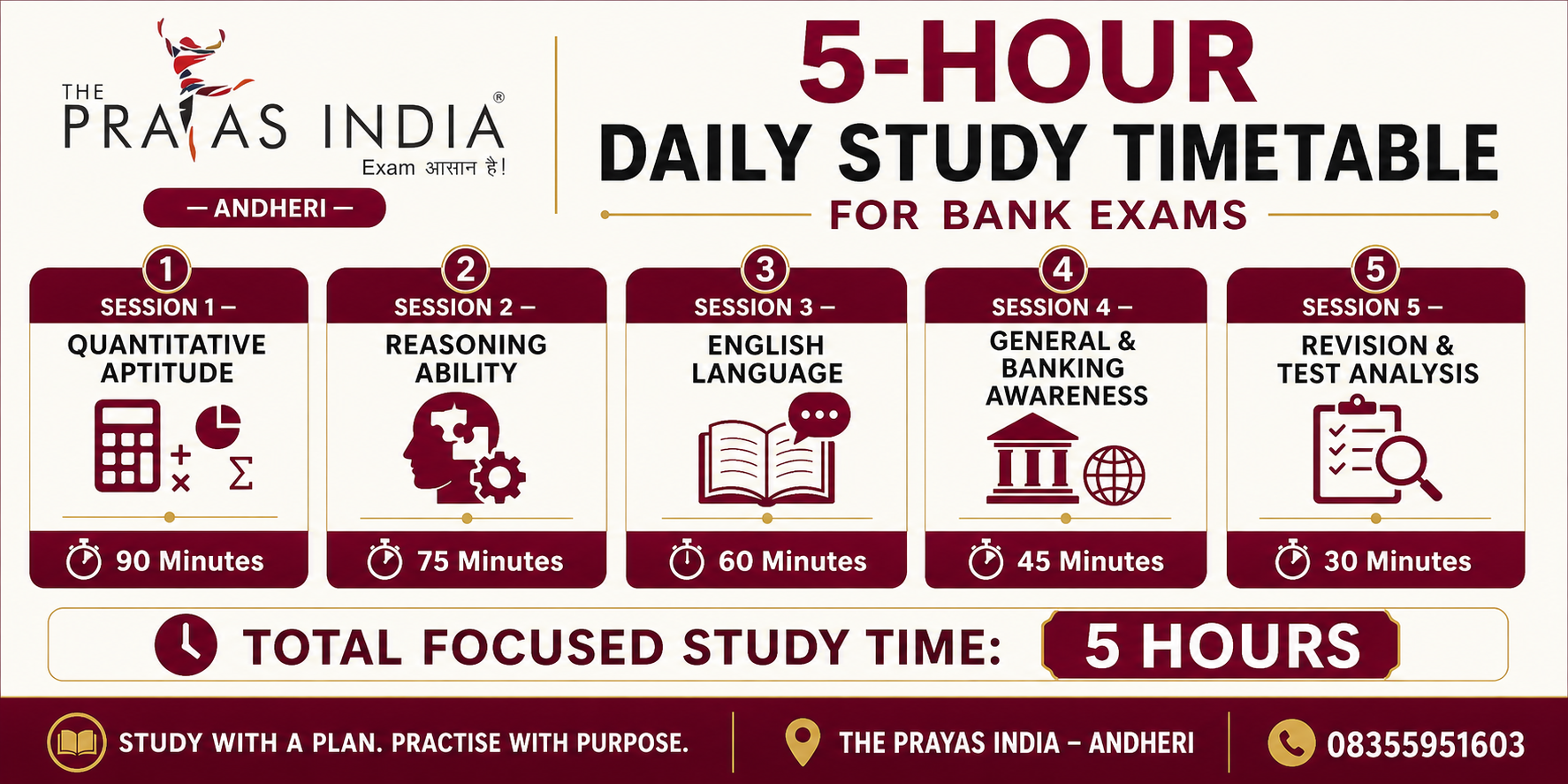
A timetable should be realistic enough to follow every day. The following example is suitable for an aspirant who can dedicate around five focused hours to preparation.
| Study session | Subject | Time |
|---|---|---|
| Session 1 | Quantitative Aptitude | 90 minutes |
| Session 2 | Reasoning Ability | 75 minutes |
| Session 3 | English Language | 60 minutes |
| Session 4 | General and Banking Awareness | 45 minutes |
| Session 5 | Revision and practice analysis | 30 minutes |
| Total | 5 hours |
You do not need to complete all five hours in one sitting. Divide the sessions between morning, afternoon and evening according to your routine.
Take short breaks between demanding sessions. Avoid studying continuously for several hours without rest.
Suggested daily study routine
How Many Hours Should Beginners Study for Bank Exams?
If you are starting from zero, you do not need to immediately follow an advanced aspirant’s timetable.
Beginners should first understand the examination pattern and build strong fundamentals. Trying to solve difficult puzzles or lengthy data interpretation sets without understanding basic concepts can create unnecessary pressure.
Recommended beginner routine
Start with approximately four hours of focused study each day.
| Subject or activity | Suggested time |
|---|---|
| Basic Mathematics | 75 minutes |
| Basic Reasoning | 60 minutes |
| English fundamentals | 60 minutes |
| Current Affairs | 30 minutes |
| Revision | 15 minutes |
| Total | 4 hours |
During the initial stage, prioritise understanding over speed.
For example, when learning percentages, understand the relationship between fractions, decimals and percentages. Practise basic questions before attempting complex arithmetic problems.
As your understanding improves, gradually increase your question-solving practice and introduce sectional tests.
When should beginners start taking mock tests?
You do not need to wait until the entire syllabus is complete.
Start with topic-wise tests after finishing individual chapters. Once you have covered the basic concepts across the major subjects, introduce sectional tests.
Full-length mock tests can be added as your preparation becomes more comprehensive. Always analyse your performance rather than attempting tests simply to increase their count.
How Many Hours Should Working Professionals Study for Bank Exams?
Working professionals often have limited time because of office schedules, commuting and personal responsibilities. However, they can still build a consistent preparation routine.
A realistic target may be two to four focused hours daily, depending on work timings and personal commitments.
Suggested timetable for working candidates
| Time | Activity |
|---|---|
| Before office – 60 minutes | Mathematics or Reasoning |
| Lunch break – 20 minutes | Current Affairs revision |
| After office – 60 minutes | English and question practice |
| Evening or night – 40 minutes | Banking Awareness and revision |
| Weekend | Mock test and detailed analysis |
If your daily schedule does not allow this exact division, adjust the sessions.
For instance, you can complete a longer practice session on weekends and use weekdays for concept revision, vocabulary and short question sets.
Do not compare your timetable with that of a full-time aspirant. Your objective should be to maintain steady progress within the time available to you.
How Should You Increase Your Study Hours Before the Bank Exam?
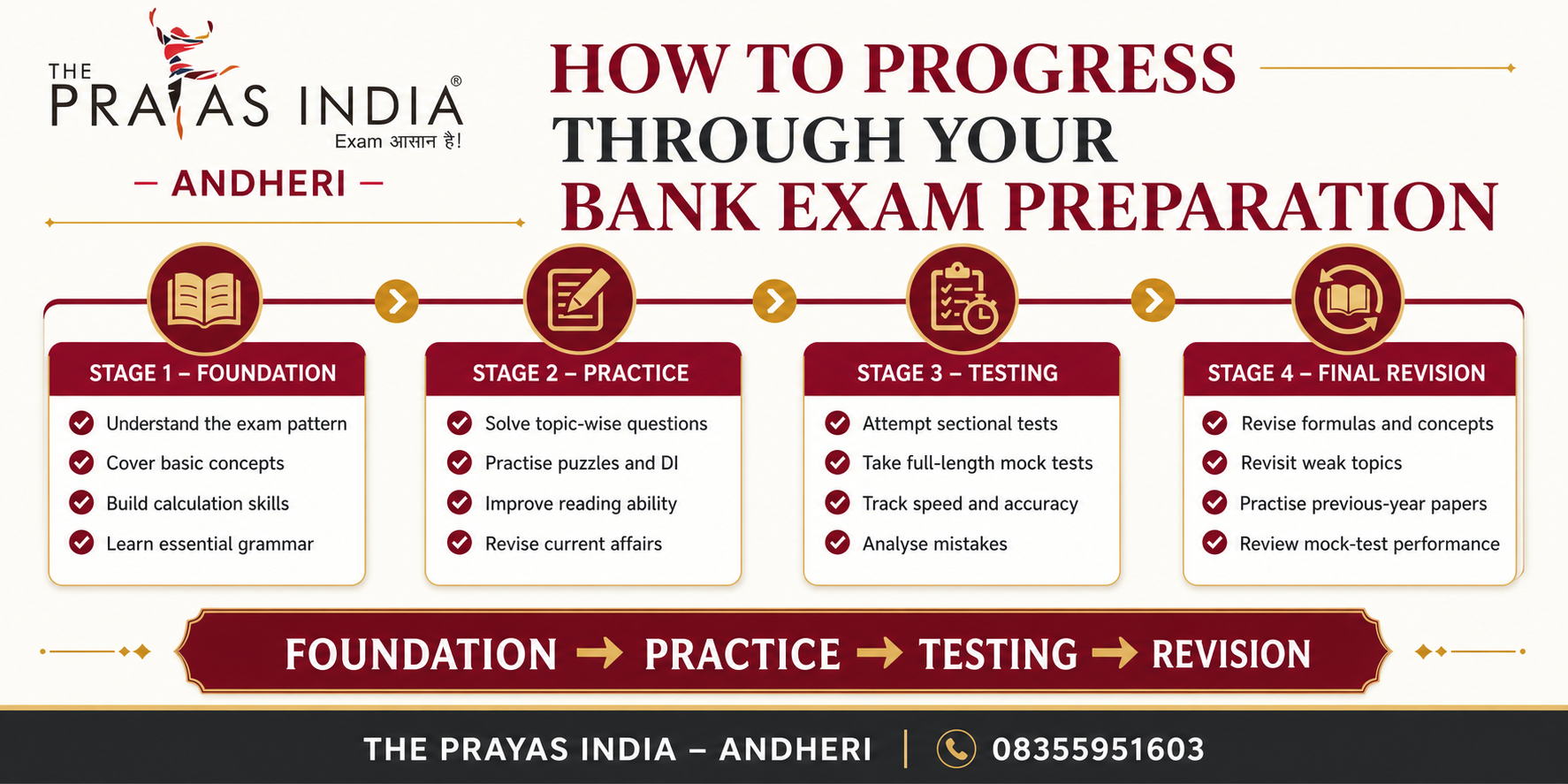
Your study routine should change as you move closer to the examination. Early preparation requires more concept learning, while later preparation generally requires more practice, revision and test analysis.
The following phased approach can help organise your preparation.
What should change in each preparation stage?
Foundation stage: Focus on basic concepts and understanding the syllabus. Avoid rushing through difficult questions.
Practice stage: Solve topic-wise questions and improve your understanding of different question patterns.
Testing stage: Attempt sectional and full-length mock tests based on the relevant examination pattern. Analyse your performance carefully.
Final revision stage: Focus on formulas, important concepts, current affairs, previous mistakes and examination-specific practice.
The amount of time you spend in each stage depends on your starting level and the examination date. Do not force a fixed schedule if your fundamentals need additional attention.
How Important Are Mock Tests in Daily Bank Exam Preparation?
Mock tests are an important part of banking exam preparation because they help you practise under timed conditions.
They can help you understand:
- How quickly you solve different question types.
- Which topics consume more time.
- Where you make calculation or reasoning errors.
- Whether your question-selection strategy is effective.
- How consistently you perform across different tests.
How to analyse a mock test
After completing a mock test, do not immediately move to another one.
Review the questions you attempted incorrectly, the questions you left unanswered and the questions that took too long.
Classify your mistakes into these categories:
- Conceptual errors: You did not understand the method or concept.
- Calculation errors: You understood the question but made a numerical mistake.
- Time-management errors: You spent too much time on one question.
- Question-selection errors: You attempted a question that was not suitable for your current level.
This analysis will help you decide which subjects or topics need additional study time.
Should you take one mock test every day?
Not necessarily. Daily full-length mocks are not compulsory for every candidate.
If you are still building your fundamentals, topic-wise and sectional tests may be more useful. As your preparation progresses, increase the frequency of full-length tests according to your target examination and your ability to analyse each test properly.
Common Mistakes to Avoid While Deciding Your Daily Study Hours
Even candidates who study regularly can make mistakes that reduce the effectiveness of their preparation.
Studying without a timetable
If you begin every day without a clear plan, you may spend too much time on familiar subjects and neglect weaker areas.
Prepare a daily schedule with specific targets.
Giving too much time to one subject
Some candidates enjoy Mathematics or Reasoning and spend most of their day practising those sections. However, neglecting English or General Awareness can affect overall preparation.
Give every relevant subject regular attention.
Ignoring revision
Completing a chapter does not mean you have mastered it permanently. Revise formulas, vocabulary, concepts and current-affairs notes at regular intervals.
Watching lectures without practising
Lectures can help you understand concepts, but you also need to solve questions independently. Follow each learning session with relevant practice.
Taking mock tests without analysing them
A mock test is useful only when you learn from its results. Review mistakes and revisit the concepts behind incorrect answers.
Following an unrealistic study schedule
A timetable that requires you to study for ten hours every day may not be suitable for your lifestyle or current preparation level.
Build a routine that you can maintain consistently.
How The Prayas India – Andheri Can Support Your Bank Exam Preparation
Bank exam preparation requires a combination of subject knowledge, question-solving practice and regular performance evaluation. Some aspirants prefer self-study, while others benefit from a structured learning environment.
A coaching programme may provide support through:
- Planned subject-wise learning.
- Guidance for important examination topics.
- Regular practice opportunities.
- Doubt clarification.
- Test-based preparation.
- A more organised study routine.
If you are based in Andheri West, Andheri East, Jogeshwari, Goregaon, Lokhandwala or nearby areas of Mumbai, you can explore The Prayas India – Andheri as a local option for banking exam preparation.
Before selecting a course, enquire about the available programmes, batch schedules, syllabus coverage and practice support. Choose an arrangement that matches your target examination and daily routine.
Conclusion: Consistency Matters More Than the Number of Study Hours
So, how many hours should you study for bank exams daily?
For many aspirants, four to six focused hours can provide a useful starting point. Beginners may start with fewer hours, advanced candidates may require more intensive practice, and working professionals can organise their preparation around their schedules.
The right study duration depends on your current level and preparation needs. Divide your time between Quantitative Aptitude, Reasoning, English, General Awareness and revision. Practise questions regularly, attempt suitable mock tests and analyse your mistakes.
Most importantly, do not judge your preparation only by the number of hours you spend studying. Judge it by how much you understand, how accurately you solve questions and how effectively you improve.
A consistent five-hour routine with clear goals can be more productive than an unplanned ten-hour study session.
If you are looking for structured guidance in Mumbai, explore the banking exam preparation options at The Prayas India – Andheri and build a study routine that works for you.
Frequently Asked Questions
1. How many hours should I study daily for bank exams?
Many aspirants can begin with four to six focused study hours daily. The ideal duration depends on your preparation level, target examination, syllabus coverage and available time. Consistent study with regular practice and revision is more important than simply increasing study hours.
2. Is five hours of study enough for IBPS PO or SBI PO?
Five focused hours can be a useful daily study target for many candidates. However, the required preparation time varies with your starting level, examination date and subject strengths. Your routine should include Quantitative Aptitude, Reasoning, English, General Awareness, practice and revision.
3. How many hours should beginners study for bank exams?
Beginners can start with approximately four focused hours daily. Initially, concentrate on understanding basic Mathematics, Reasoning and English concepts. Gradually increase question practice and introduce sectional tests as your fundamentals improve.
4. Can I prepare for bank exams while working full-time?
Yes. Working professionals can organise preparation around their office schedules. Two to four focused hours, supported by short revision sessions and weekend mock tests, can provide a manageable starting routine.
5. How much time should I give to Mathematics and Reasoning?
Your time allocation should depend on your strengths and weaknesses. A sample five-hour routine may include 90 minutes for Quantitative Aptitude and 75 minutes for Reasoning. Adjust these sessions according to your practice-test performance.
6. Should I take a bank exam mock test every day?
Daily full-length mock tests are not necessary for every candidate. Beginners should focus on topic-wise and sectional tests first. As preparation progresses, introduce full-length mocks and spend sufficient time analysing mistakes and improving weak areas.
7. Is coaching necessary for bank exam preparation?
Coaching is not compulsory. Candidates can prepare through self-study and reliable learning resources. However, structured classes, guided practice, doubt clarification and regular testing may help aspirants who need additional academic support.
Build a Smarter Bank Exam Study Routine
Looking for structured guidance for IBPS PO, IBPS Clerk, SBI PO or SBI Clerk preparation? Connect with The Prayas India – Andheri to enquire about available courses and batch details.
THE PRAYAS INDIA – ANDHERI
Office 803, Time Chambers, Swami Vivekanand Road, near Paneri, Andheri West, Mumbai, Maharashtra 400058.
Phone: 08355951603