How to Improve Bank PO Accuracy Without Attempting More Questions | Best Bank PO Coaching in Mumbai | The Prayas India
A Smarter Strategy to Improve Your Bank PO Score | The Prayas India
Bank PO preparation often becomes a race to increase the number of questions attempted. During mock tests, aspirants frequently compare their attempts with others and assume that a higher attempt count automatically means a better chance of clearing the exam. This approach, however, can become counterproductive when accuracy is not strong. Attempting more questions while making avoidable mistakes can reduce your effective score and create unnecessary pressure during the examination.
For exams such as SBI PO, IBPS PO and other banking recruitment examinations, question selection and accuracy are closely connected. You do not need to solve every question that appears on the screen. You need to identify the questions that are worth your time, solve them correctly and avoid spending too much time on questions where the probability of success is low.
This makes accuracy more than a calculation skill. It becomes a decision-making skill.
For an aspirant preparing seriously for Bank PO, the right question is therefore not simply, “How many questions should I attempt?” It is, “How can I maximise my score from the questions I choose to attempt?”
Why More Attempts Do Not Always Mean a Better Score
Imagine two candidates appearing for the same mock test. One attempts significantly more questions but makes several errors because of rushed calculations, poor question selection and uncertain guesses. The other attempts fewer questions but maintains a much higher accuracy rate.
The second candidate may actually be in a stronger position.
This is because your final performance depends on the quality of your attempts, not just their quantity. When an aspirant becomes obsessed with increasing attempts, there is a tendency to attempt questions that should have been skipped. A lengthy puzzle may consume several minutes, a complicated Quant question may disturb the rhythm of the section, or an uncertain English question may result in a negative mark.
The problem becomes even bigger when these decisions are repeated throughout the paper.
This is why improving accuracy can sometimes increase your score without increasing your attempt count. If you are currently making several avoidable mistakes, reducing those mistakes can be more valuable than adding another five or ten attempts.
The objective should be to find the right balance between attempts, accuracy and time.
Accuracy Is Not Just About Knowing the Answer
Many students assume that an incorrect answer means they did not know the concept. That is not always true.
In a Bank PO examination, you can get a question wrong even when you understand the underlying concept. You may misread a condition, make a calculation error, choose the wrong question or spend too much time trying to solve something that should have been left for later.
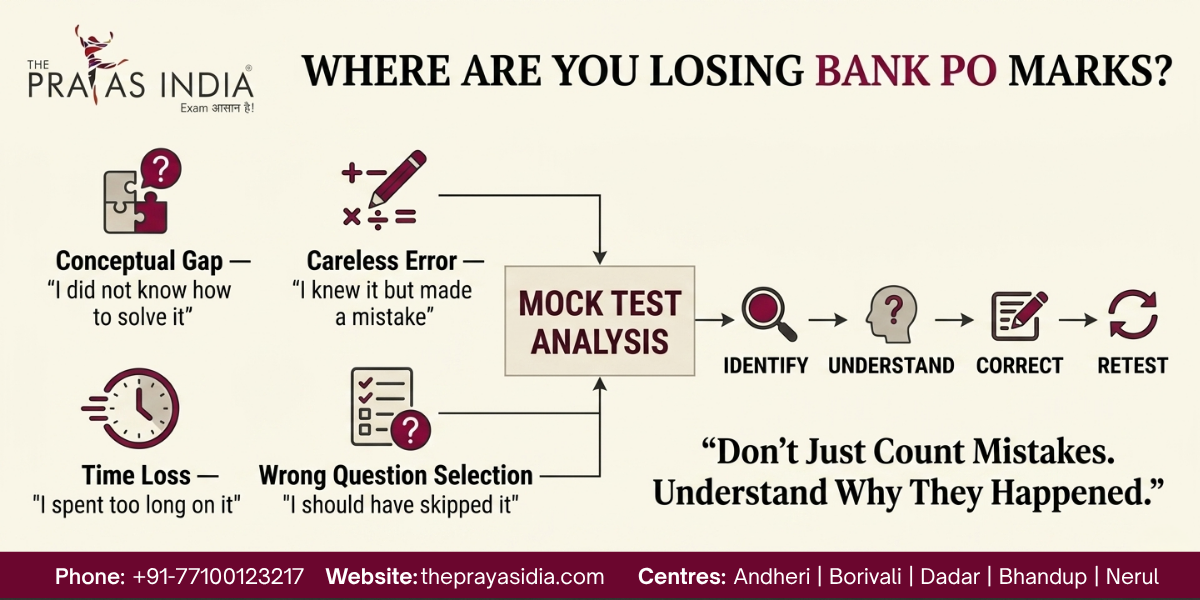
This means that accuracy has several dimensions.
A candidate who understands these different dimensions can improve much faster because the solution becomes specific. Instead of saying, “My accuracy is poor,” the aspirant can identify whether the actual problem is conceptual knowledge, careless execution, time management or question selection.
That diagnosis is the starting point for improvement.
The Four Reasons Behind Most Accuracy Problems
1. Conceptual Gaps
The first category is straightforward. Sometimes you genuinely do not know how to solve the question.
This can happen in Quant when a particular arithmetic concept is unclear, in Reasoning when a puzzle-based approach is unfamiliar, or in English when a grammar or comprehension concept has not been properly understood.
These errors cannot be fixed simply by attempting more questions. You need to return to the concept, understand the underlying logic and then practise questions based on it.
The important point is to avoid treating every incorrect question as a reason to solve another random set. If the foundation is weak, targeted revision is more useful than additional question volume.
2. Careless Mistakes
The second category is often more frustrating because the candidate actually knows how to solve the question.
A small calculation mistake, a missed word, an incorrectly copied value or an option marked in haste can turn a correct approach into a wrong answer. These errors may appear minor, but when they occur repeatedly across a mock test, they can have a significant effect on the final score.
The solution here is not necessarily more theory. You need to identify the conditions under which you make these mistakes.
Do they happen when you are rushing? Do they increase near the end of a section? Are they concentrated in calculations? Do you tend to change correct answers because of unnecessary doubt?
Once the pattern becomes visible, you can work specifically on it.
3. Time-Management Errors
Sometimes a question is not wrong because you lack the ability to solve it. It is wrong because you gave it too much of your limited examination time.
A lengthy Data Interpretation set may initially appear manageable, but after several minutes you may realise that the calculations are taking longer than expected. Similarly, a reasoning puzzle can consume valuable time even when you are close to solving it.
When too much time is spent on one question or set, easier questions later in the section may receive less attention. This creates a chain reaction: time loss leads to rushed attempts, and rushed attempts lead to accuracy loss.
Therefore, time management and accuracy should not be treated as separate skills. They influence each other continuously.
4. Wrong Question Selection
This is one of the most important areas for Bank PO aspirants.
A question may be technically solvable but still be a poor choice during the examination. If it requires too much time relative to the marks available, attempting it may not be the most efficient decision.
Strong candidates gradually develop the ability to distinguish between questions that deserve immediate attention and questions that should be postponed or skipped.
This doesn’t mean avoiding every difficult question. A difficult question from your strongest area may be worth attempting, while a seemingly easy question involving lengthy calculations may not be.
The real skill is understanding your own strengths, the question’s difficulty and the time it is likely to consume.
Your Mock Test Score Is Only the Starting Point
One of the biggest mistakes Bank PO aspirants make is treating a mock test as completed once the score appears on the screen.
A score of 72 may feel good or disappointing, but by itself it doesn’t explain what happened during the test.
Suppose you scored 72 after attempting 80 questions. That number does not tell you whether the remaining eight questions were genuinely difficult, whether you wasted time on five questions, whether seven mistakes were caused by careless errors or whether you guessed several answers.
A much more useful analysis would examine the entire attempt pattern.
You should know which questions were correct because you were confident, which were correct guesses, which were incorrect despite knowing the concept, which questions consumed excessive time and which questions you should have skipped.
This is where mock-test analysis becomes a preparation tool rather than merely a performance report.
After several mocks, these patterns become even more valuable. You may discover that your overall accuracy is acceptable but your Quant accuracy drops when you attempt lengthy arithmetic questions. Or perhaps your Reasoning score falls because you spend too much time on one puzzle. In English, you may notice that your accuracy is consistently lower in inference-based Reading Comprehension questions.
Once you identify such patterns, your preparation becomes more focused.
Question Selection Can Improve Accuracy Without More Practice
A common misconception is that accuracy improves only after solving thousands of questions. Practice certainly matters, but the quality of your decisions during practice matters just as much.
Consider a Quant section containing several questions. You might see one question that looks familiar but requires lengthy calculations and another that appears slightly more difficult but can be solved using a short method. If you automatically choose the familiar-looking question, you may spend two or three minutes on it.
A more experienced aspirant evaluates the question differently.
They consider whether they understand the requirement, whether they know the approach and whether the expected time investment makes sense.
This is what makes question selection a scoring skill.
During practice, therefore, don’t only record whether you solved a question correctly. Also ask yourself whether you made the right decision in choosing that question at that moment.
Over time, you will start recognising patterns. Certain question types may consistently take too much of your time, while others may give you reliable marks. That knowledge can become extremely valuable during the actual exam.
The “Easy First” Strategy Needs a Smarter Interpretation
Bank PO aspirants are often told to “attempt easy questions first.” While the basic principle is useful, it needs to be understood correctly.
Easy does not necessarily mean that the question looks simple.
A question may appear short but contain a tricky condition. Another may look complicated because of its wording but actually require a straightforward method.
Your definition of an “easy question” should therefore be based on your ability to solve it efficiently, not on its appearance.
During mock tests, pay attention to the questions where you consistently achieve high accuracy with relatively low time investment. These are the types of questions that can become your scoring opportunities.
At the same time, identify questions that repeatedly consume disproportionate time.
This personal data is more valuable than blindly following a fixed attempt strategy.
Build an Accuracy Tracker Instead of Only Tracking Scores
A simple accuracy tracker can change the way you approach mock tests.
Instead of maintaining only a list of scores, record the type of mistakes you make in each test. You don’t need an elaborate system. A basic record of recurring errors can be enough to reveal patterns.
For example, after five mocks you may discover that most of your Quant mistakes are careless calculations rather than conceptual errors. That means your preparation priority should not be another round of basic concept lectures. You may need timed calculation practice and a more disciplined solving process.
Similarly, if your Reasoning score is affected by spending too much time on puzzles, your priority should be set selection and time allocation. If English accuracy is suffering because of hurried reading, you need to work on comprehension and careful interpretation.
This approach prevents you from wasting time solving problems that are not actually your biggest weaknesses.
A Better Way to Review Every Mock
After finishing a mock, don’t immediately move to the next test.
First, divide your attempted questions into different groups. Look at the questions you got wrong, but also examine questions that you guessed correctly and questions that consumed excessive time.
The guessed questions deserve special attention because a correct guess can create a false impression of preparation. If you don’t understand why the answer is correct, you should not treat that question as a genuine strength.
Similarly, a question you answered correctly after spending three minutes may not be an efficient success. During the actual examination, that time may have been better spent elsewhere.
A strong mock review therefore considers accuracy, confidence and time together.
Accuracy Should Be Built Before the Final Exam Pressure
Trying to improve accuracy only in the final weeks before the examination can be stressful because by then the focus has already shifted toward full-length mocks and revision.
It is better to develop this habit early.
During topic-wise practice, start observing your mistakes. During sectional tests, begin tracking question selection and time. Once you move to full-length mocks, combine these observations into a complete performance profile.
This gradual process helps accuracy become part of your normal solving behaviour.
You no longer have to consciously remind yourself to avoid careless mistakes in every question. You begin to recognise risky situations naturally.
That is the kind of improvement that can make a difference when the real exam environment becomes stressful.
The Goal Is Not Maximum Attempts. It Is Maximum Efficient Attempts.
A good Bank PO strategy should not encourage you to chase a particular attempt number without considering the paper’s difficulty and your own performance.
Your ideal attempt level will depend on several factors, including your accuracy, speed, section-wise strengths and the difficulty of the particular examination.
A candidate who can maintain high accuracy while increasing speed may gradually increase attempts.
Another candidate may first need to reduce unnecessary attempts and improve accuracy before working on speed.
Both approaches can be correct.
The important point is that your strategy should come from your performance data rather than from someone else’s attempt count.
Takeaway
Improving Bank PO accuracy is not about becoming slower or avoiding difficult questions altogether. It is about becoming more selective, more disciplined and more aware of the cost of every decision during the exam.
When you understand the difference between conceptual errors, careless mistakes, time-management problems and wrong question selection, your preparation becomes much easier to diagnose.
Section-Wise Accuracy, Mock Analysis & Smarter Preparation
Part 1 established an important principle: a higher attempt count does not automatically mean a higher score. In Bank PO exams, the quality of your attempts matters just as much as the quantity. If you can reduce avoidable mistakes, improve question selection and manage your time more intelligently, your score can improve even without dramatically increasing the number of questions you attempt.
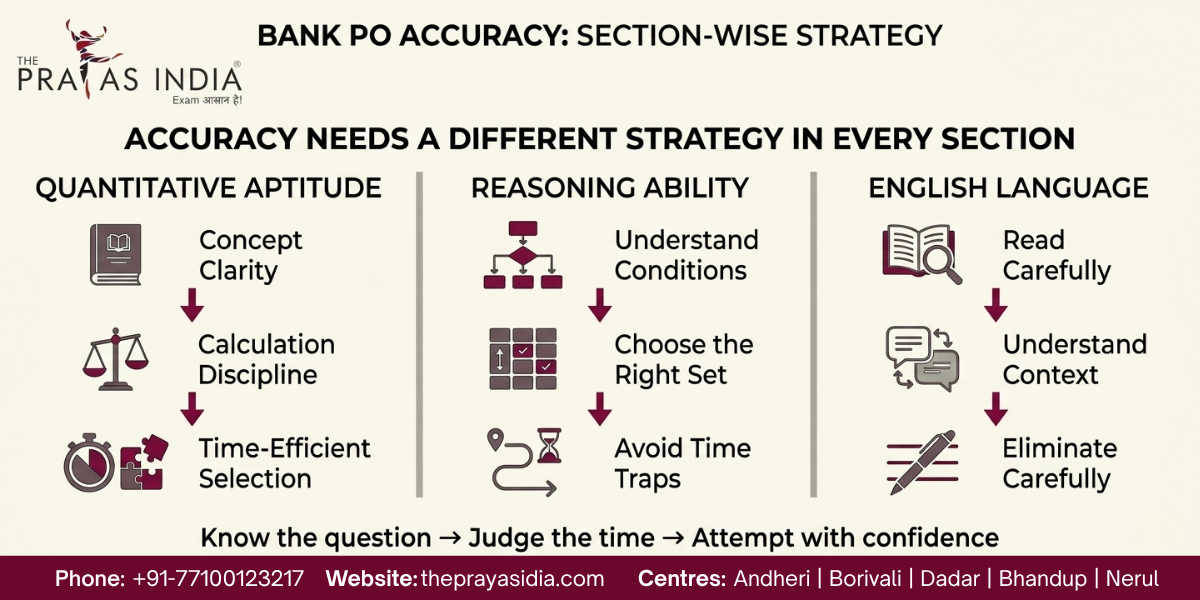
The next challenge is to apply this principle separately to Quantitative Aptitude, Reasoning Ability and English Language. Each section creates a different kind of pressure, so the same accuracy strategy cannot work everywhere. A candidate who is making calculation mistakes in Quant needs a different solution from someone who is losing marks because of poor puzzle selection in Reasoning.
This is why your preparation should move from a general idea of “improving accuracy” to a section-wise performance strategy.
Improving Quant Accuracy: Don’t Let Speed Create Errors
Quantitative Aptitude can become one of the biggest sources of avoidable marks loss in Bank PO examinations. Many aspirants understand the concepts but lose marks because they rush through calculations, choose lengthy questions or continue solving a question even when the method is taking too much time.
The first step is to distinguish between conceptual weakness and execution weakness.
If you cannot understand how a question should be approached, you need concept-based preparation. But if you understand the method and still make mistakes in percentages, ratios, averages, simplification or arithmetic calculations, the solution is different. You need controlled practice under time pressure.
For example, suppose you consistently make mistakes in percentage-based questions. Before assuming that your percentage concept is weak, analyse the actual errors. If you are using the correct formula but making multiplication or subtraction mistakes, repeatedly studying the percentage chapter may not solve the problem. You need to improve calculation discipline and practise similar questions under realistic time limits.
At the same time, avoid the temptation to solve every difficult Quant question simply because you recognise the topic. A familiar topic can still produce a time-consuming question. During a mock test, the better decision may be to leave it temporarily and attempt a shorter question first.
This is where accuracy and question selection work together.
Improving Reasoning Accuracy: Question Selection Becomes Critical
Reasoning Ability can be particularly challenging because one decision can influence several questions.
A puzzle or seating arrangement may contain multiple questions. If you choose the wrong set, you may spend several minutes trying to establish the arrangement and still fail to reach the questions you intended to solve.
This makes set selection extremely important.
During practice, don’t simply record whether you solved a puzzle correctly. Also record how long you took to understand and establish the set. If a particular type of puzzle repeatedly consumes too much time, you need to recognise that pattern.
The goal is not to avoid puzzles completely. Puzzles can become a major scoring opportunity when selected correctly. The objective is to identify the sets where the conditions are relatively manageable and the information can be organised efficiently.
For individual Reasoning questions, accuracy often improves when you slow down enough to understand the exact relationship being tested. Rushing through coding-decoding, syllogism, inequality or logical reasoning questions can create errors even when the underlying concept is familiar.
A strong Reasoning strategy therefore combines logical understanding, disciplined reading and intelligent set selection.
Improving English Accuracy: Read the Question Before Choosing the Answer
English Language can create a different type of accuracy problem because many errors are caused not by lack of knowledge but by hurried interpretation.
Reading Comprehension is a good example. An aspirant may read the passage quickly, recognise a familiar idea and select an option that sounds correct. However, the question may be asking what can be inferred from the passage rather than what is directly stated.
Similarly, in grammar-based questions, an option may appear grammatically correct in isolation but become incorrect when considered in the context of the complete sentence.
This is why English accuracy often improves when you develop the habit of reading for meaning instead of simply looking for familiar patterns.
In practice, analyse your incorrect questions carefully. If you repeatedly choose options because they “sound right,” you need to work on contextual understanding. If your errors are concentrated in grammar, identify the specific rules creating difficulty. If Reading Comprehension is the problem, examine whether the issue is comprehension, inference or rushed reading.
The solution should come from the error pattern rather than from simply solving more English questions.
How to Know When You Should Skip a Question
Skipping a question is often psychologically difficult for aspirants because it feels like giving up on marks.
In reality, strategic skipping is one of the most important examination skills.
When you encounter a question, quickly assess whether you understand the requirement and have a reliable method to solve it. If the answer is yes, continue. If you are unsure about the approach or realise that the question is becoming unnecessarily time-consuming, leaving it for later may be the smarter decision.
This does not mean you should create an artificial rule such as “never spend more than one minute on any question.” Different questions require different amounts of time, and some questions may be worth the additional effort.
Instead, develop an awareness of opportunity cost.
If you spend another two minutes on one difficult question, what other questions could you have attempted during those two minutes?
This mindset changes the way you look at the paper.
You are not simply solving questions.
You are managing a limited amount of time across multiple scoring opportunities.
The 3-Question Check Before Attempting
During practice, train yourself to quickly ask three questions before committing significant time to a problem:
Do I understand what the question is asking?
Do I know the method or approach I am going to use?
Is the expected time worth the potential return?
You don’t need to literally say these questions in your head during the exam. With enough practice, the process becomes automatic.
The purpose is to prevent impulsive attempts.
A question that looks attractive but has an uncertain solution method should not automatically receive priority over a question that you can solve confidently.
This habit can improve your effective accuracy because you reduce the number of low-confidence attempts.
Mock Tests Should Become Your Personal Performance Laboratory
A good mock test is not simply a prediction of your score. It is a controlled environment in which you can experiment with your strategy.
You can test whether attempting Quant first works better for you. You can experiment with different Reasoning set-selection approaches. You can observe whether slowing down slightly in English improves accuracy enough to justify the additional time.
This is why every mock should have a purpose.
Instead of taking a mock only to see whether your score has increased, decide what you are trying to improve.
One mock may focus on reducing careless errors. Another may focus on improving question selection. A later mock may test whether you can maintain accuracy while increasing speed.
This creates a much more meaningful preparation process.
Don’t Analyse Only the Wrong Answers
Wrong answers are obviously important, but they are not the only source of useful information.
Correctly answered questions can also reveal weaknesses.
Suppose you guessed five questions correctly. Your score may look better because of those answers, but you should not treat those five questions as evidence of strong preparation.
Similarly, suppose you solved a question correctly but took significantly longer than the expected time. That question may indicate a time-efficiency problem.
A complete mock analysis should therefore examine three groups:
- Wrong answers — Why did the mistake happen?
- Guessed answers — Did I actually know the answer?
- Time-consuming correct answers — Was the approach efficient?
This type of analysis provides a much more accurate picture of your preparation.
Build an Accuracy-First Mock Test Cycle
Your mock-test strategy should gradually move through different stages.
Initially, your focus should be on understanding your natural accuracy. Don’t worry too much about achieving a very high attempt count. First determine how many questions you can solve reliably.
Once accuracy becomes stable, start working on speed. Try to reduce the time required for familiar question types without compromising correctness.
After that, work on question selection. During the mock, identify which questions should receive priority and which should be postponed.
Finally, combine all three elements under realistic examination conditions.
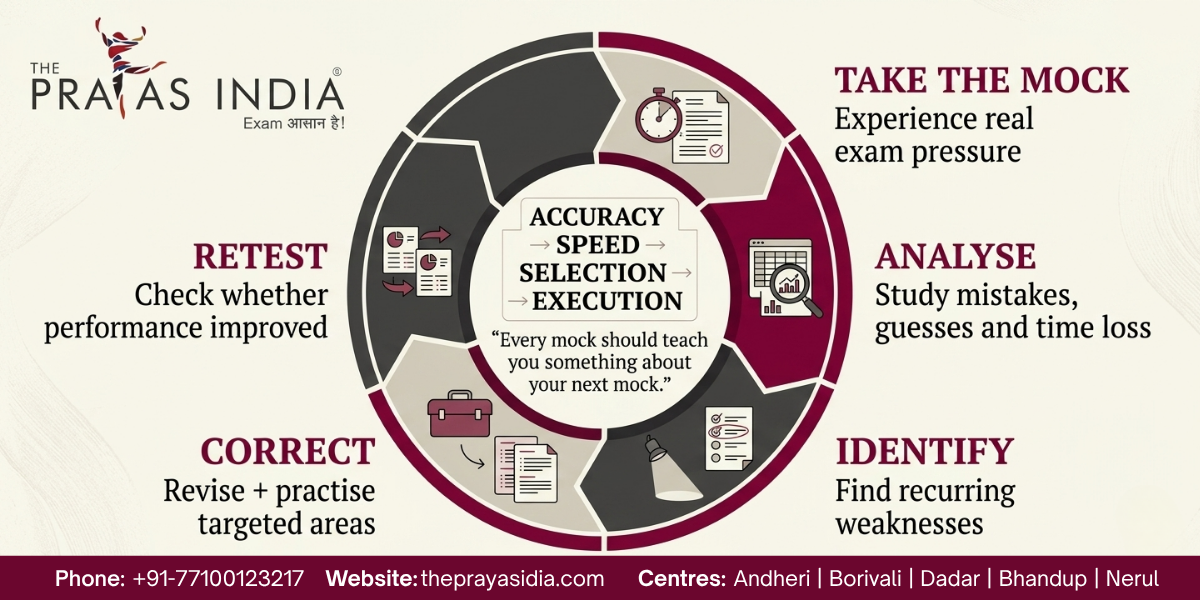
This creates a progression from:
Accuracy → Speed → Selection → Exam Execution
The order matters.
If you try to increase speed before developing accuracy, you may simply make mistakes faster.
When Should You Focus on Accuracy Instead of Attempts?
The answer depends on your mock-test data.
If your attempts are relatively low but your accuracy is already strong, increasing speed and learning to identify more solvable questions may be your next priority.
If your attempts are high but accuracy is consistently poor, increasing attempts further is unlikely to solve the problem. You need to identify your error patterns first.
If your accuracy is good in sectional tests but falls sharply in full-length mocks, examination pressure, fatigue or time allocation may be affecting your performance.
And if your accuracy changes dramatically from one mock to another, your strategy may not yet be stable enough.
This is why there is no universal attempt number that every Bank PO aspirant should blindly target.
Your strategy should be data-driven and personalised.
Can Coaching Help Improve Bank PO Accuracy?
Self-study can absolutely build a strong Bank PO preparation foundation. However, one of the challenges of preparing entirely on your own is that you may not always recognise your own recurring mistakes.
You may know that your score is low without understanding the underlying reason. You may continue using the same approach because it feels comfortable. You may take mock tests regularly but analyse them only at a superficial level.
This is where structured guidance can add value.
A good Bank PO coaching environment should not simply provide lectures and study material. It should help aspirants understand how they are performing and what they need to improve.
Regular tests, performance analysis, faculty guidance, doubt-solving and targeted practice can create a feedback loop that is difficult to maintain consistently without a structured system.
The purpose of coaching should therefore be to make your preparation more organised, measurable and responsive to your actual performance.
What to Look for in Bank PO Coaching in Mumbai
If you are searching for the Best Bank PO Coaching in Mumbai, don’t make your decision solely on the basis of advertisements, classroom facilities or the number of study materials included in a course.
Ask how the institute handles the areas that directly influence examination performance.
Does it provide regular mock tests? Are those tests properly analysed? Is there a mechanism for identifying weak topics? Are students guided on question selection and time management? Is there meaningful doubt support? Does the faculty help students understand why their performance is not improving?
These questions matter because Bank PO preparation is not simply about covering the syllabus.
The real challenge is converting preparation into accurate and timely performance.
A coaching institute that combines structured classes with practice, testing, analysis and mentorship can provide a more complete preparation environment for aspirants who need external guidance.
Why The Prayas India Can Be a Strong Choice for Bank PO Preparation
For aspirants looking for Bank PO Coaching in Mumbai, The Prayas India focuses on creating a structured preparation environment rather than treating coaching as only a classroom-learning experience.
Bank PO preparation requires consistent practice across Quantitative Aptitude, Reasoning Ability and English, along with regular testing and performance analysis. A student may understand the concepts but still struggle to convert that knowledge into marks because of poor question selection, time management or recurring mistakes.
This is where structured guidance becomes valuable.
The Prayas India can support aspirants through a preparation approach that connects learning, practice, testing, analysis and improvement. Instead of encouraging students to simply attempt more questions, the emphasis can be placed on understanding performance and developing a smarter examination strategy.
For students considering the Best Bank PO Coaching in Mumbai, the right institute should ideally help answer an important question: What should I change in my preparation after my latest test?
That is the difference between simply providing content and providing a preparation system.
For a serious aspirant, coaching should ultimately help create greater clarity, consistency and confidence—not dependency on endless study material.
Contact Us
📞 Call Now: +91-77100 13217
🌐 Website: theprayasindia.com
📍 Centres: Andheri | Borivali | Dadar | Nerul | Bhandup
A Practical Accuracy Strategy for the Final Weeks
As the examination approaches, your strategy should become increasingly focused on execution rather than continuously adding new resources.
At this stage, full-length mocks should be analysed carefully. You should know your strongest question types, your common mistakes and the situations in which your accuracy tends to fall.
Revision should be targeted toward weaknesses revealed by your performance rather than based entirely on what you feel like studying.
If your Quant accuracy is weak in a particular topic, revise and practise that area. If your Reasoning performance is affected by set selection, practise identifying workable sets. If English accuracy falls because of hurried comprehension, work on reading discipline and question interpretation.
The final phase should make your strategy more stable.
The objective is to enter the examination knowing what to attempt, what to avoid and how to recover when a section becomes difficult.
A Simple Rule to Remember
Bank PO preparation is not a competition to see who can solve the largest number of questions.
It is a test of how effectively you can use limited time to collect marks.
If you can solve a question correctly and efficiently, it is valuable.
If you can recognise that another question is likely to consume too much time, skipping it can also be valuable.
If you can identify why you made a mistake in a mock and prevent that mistake from happening again, that analysis may be more valuable than immediately taking another mock.
This is why accuracy is not about attempting less.
It is about attempting better.
FAQs
How can I improve Bank PO accuracy without increasing my attempts?
Start by analysing your mistakes rather than simply increasing question volume. Identify whether errors are caused by weak concepts, careless calculations, poor question selection or time pressure. Targeted correction can improve your score without requiring a major increase in attempts.
Is it better to attempt fewer questions with high accuracy?
It depends on the examination and your individual performance. Fewer attempts can be better when additional attempts are producing too many mistakes. However, once your accuracy becomes stable, improving speed and increasing efficient attempts can help you maximise your score.
How can mock tests improve Bank PO accuracy?
Mock tests provide evidence about your real performance under time pressure. When analysed properly, they can reveal recurring mistakes, inefficient approaches, poor question selection and section-wise weaknesses. The key is to learn from the mock rather than simply record the score.
Should I skip difficult questions in Bank PO exams?
Not every difficult-looking question should be skipped. The decision should depend on your familiarity with the concept, the likely solving time and your confidence in reaching the correct answer. A question that is difficult for another candidate may be manageable for you.
How can I reduce careless mistakes in Quant?
First identify when and where those mistakes occur. If they happen because you rush calculations, practise under controlled time limits and develop a habit of checking critical calculation steps. Tracking recurring errors is more effective than simply solving more questions.
Which is more important in Bank PO: speed or accuracy?
Both are important, but accuracy should form the foundation. Increasing speed before controlling mistakes can result in making errors faster. Once accuracy becomes stable, speed and question selection can be developed to improve overall efficiency.
What should I look for in the Best Bank PO Coaching in Mumbai?
Look beyond study material and classroom teaching. Consider faculty guidance, mock-test quality, performance analysis, doubt support, practice structure, mentorship and whether the institute helps you understand and correct recurring weaknesses.
Conclusion: Improve the Quality of Your Attempts
Bank PO preparation becomes more effective when you stop viewing the attempt count as the only measure of progress.
A candidate who attempts more questions but makes frequent mistakes may actually be less efficient than someone who attempts fewer questions with stronger accuracy. The objective should therefore be to develop the ability to recognise scoring opportunities, avoid unnecessary risks and use examination time intelligently.
The process begins with understanding your mistakes. From there, you can improve section-wise accuracy, develop better question-selection habits and use mock tests as a tool for continuous improvement.
For serious aspirants, structured guidance can make this process more consistent. The right Bank PO Coaching in Mumbai should not only help you learn the syllabus but also help you understand your performance and improve it.
Ultimately, the goal is not:
“How many questions can I attempt?”
It is:
“How many marks can I earn from the time and knowledge I have?”
That shift in mindset can make your Bank PO preparation more focused, more strategic and far more effective.