IBPS Clerk Prelims Preparation Strategy: How to Score High in 30 Days | The Prayas India
The IBPS Clerk Prelims exam is not necessarily difficult because of the syllabus. The real challenge is time, accuracy and question selection. With only one hour to attempt 100 questions across English Language, Numerical Ability and Reasoning Ability, candidates need more than just subject knowledge. They need a preparation strategy that helps them identify scoring questions quickly and avoid spending too much time on questions that can affect their overall attempt.
For aspirants who have around 30 days left, preparation should become more focused. This is not the stage to study everything randomly. The objective should be to strengthen high-priority topics, practise questions under time pressure, analyse mock tests and eliminate recurring mistakes.
A well-planned IBPS Clerk Prelims Preparation strategy can help candidates use these 30 days more effectively and build the speed required for the actual examination.
Why the Last 30 Days Matter in IBPS Clerk Preparation
The final 30 days can significantly change your preparation level if they are used properly. Many students spend the first few weeks learning concepts but fail to convert that knowledge into exam performance because they don’t practise enough timed questions.
The last month should therefore be treated as a transition from learning mode to performance mode.
During this period, your preparation should increasingly focus on solving questions within the actual time limits. You should know which topics are your strengths, which topics require revision and which question types are taking too much time.
A strong IBPS Clerk 30 Days Strategy should therefore combine revision, sectional practice, mock tests and detailed analysis.
The objective isn’t simply to increase the number of questions you solve. It is to improve the number of accurate and efficient attempts you can make within the available time.
Understand the IBPS Clerk Prelims Before You Start
Before creating a 30-day plan, candidates should understand the structure of the examination.
The IBPS Clerk Preliminary Examination consists of three sections:
- English Language
- Numerical Ability
- Reasoning Ability
Each section has a separate time limit, which means candidates cannot freely move between sections during the examination.
This makes time management particularly important.
You may be excellent at Reasoning, but you cannot simply spend extra time there because you have saved time in English. Every section has to be handled within its allotted duration.
Therefore, your preparation should not only answer the question “Can I solve this?”
It should also answer:
“Can I solve this within the time available?”
The Biggest Difference Between Preparation and Exam Performance
A student may be able to solve a question correctly during normal practice but struggle with the same question during the examination.
Why?
Because the examination introduces:
- Time pressure.
- Negative marking.
- Difficult questions placed alongside easy questions.
- The need to select questions quickly.
- Pressure to maintain accuracy.
- Sectional time limits.
This is why solving questions without a timer is not enough during the final month.
Your preparation needs to gradually simulate the actual examination environment.
The 30-Day Strategy: Four Focused Phases
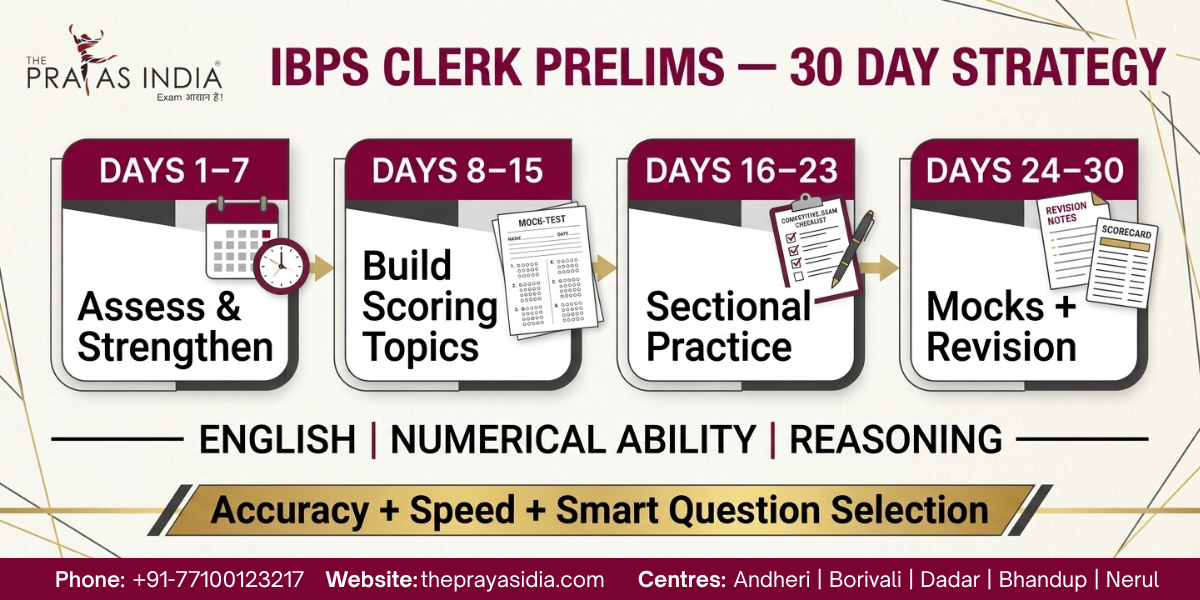
Instead of treating all 30 days as one long preparation period, divide the month into four stages.
Days 1–7: Identify and Strengthen Weak Areas
The first week should be used to evaluate your current preparation level.
Take a full or sectional mock and analyse your performance carefully. Don’t focus only on the score.
Find out which topics are causing problems.
For example, if your Numerical Ability score is low, determine whether the issue is calculation speed, arithmetic concepts, simplification, number series or data interpretation.
Similarly, in Reasoning, identify whether puzzles are consuming too much time or whether your basic topics such as inequality, syllogism and coding-decoding need revision.
In English, analyse whether your problems are related to reading comprehension, grammar, vocabulary, cloze tests or error detection.
The first week should give you a clear picture of where your marks are being lost.
Days 8–15: Strengthen High-Scoring Topics
Once your weaknesses are identified, focus on topics that can realistically improve your score.
Do not attempt to master every difficult topic in the syllabus.
Prioritise concepts that are frequently tested and that you can improve through focused practice.
The idea is to build a reliable scoring base.
At this stage, candidates should also begin solving more questions under time pressure.
Your goal should be to reduce the time required for familiar question types while maintaining accuracy.
Days 16–23: Increase Sectional and Mixed Practice
By the third week, your preparation should become more test-oriented.
Start taking regular sectional tests for all three subjects.
After each test, spend enough time analysing the paper.
Identify questions that you:
- Solved correctly and quickly.
- Solved correctly but too slowly.
- Attempted incorrectly.
- Left despite being solvable.
- Attempted even though they were not worth the time.
This analysis will help you improve your question-selection strategy.
Days 24–30: Mock Tests, Revision and Exam Strategy
The final week should not be about learning a large number of new concepts.
Instead, focus on revision and performance.
Take full-length mocks under exam-like conditions. Analyse them thoroughly and revise your weak areas.
Your final week should answer important questions such as:
Which section should I attempt first?
How much time should I spend on a puzzle?
Which Numerical Ability topics are my strongest?
Which English questions should I attempt immediately?
When should I leave a question?
The more clearly you can answer these questions before exam day, the more confident you are likely to feel during the actual examination.
How to Prepare English in the Last 30 Days
English can become a strong scoring section when preparation focuses on the types of questions that appear regularly.
Instead of spending hours trying to learn every possible grammar rule, focus on improving the areas that have the highest relevance to the examination.
Your preparation should include regular practice of reading comprehension, cloze tests, error detection, fillers, sentence-based questions and vocabulary.
Reading comprehension deserves special attention because it tests both reading ability and comprehension speed.
During practice, don’t simply read passages and check answers. Try to understand why an option is correct and why the other options are incorrect.
This develops better elimination skills.
Build Reading Speed Without Sacrificing Understanding
Many candidates try to read as quickly as possible during English preparation.
Speed alone is not enough.
If you read a passage quickly but fail to understand its central idea, you may spend even more time returning to the passage and searching for answers.
A better approach is to practise reading with purpose.
While reading a passage, focus on:
- The central argument.
- Important facts.
- The author’s viewpoint.
- Changes in tone.
- The relationship between different paragraphs.
With consistent practice, comprehension speed can improve naturally.
Make Grammar Practice More Practical
Grammar preparation should not become an exercise in memorising hundreds of rules.
Instead, focus on understanding common grammatical patterns and applying them through questions.
Practise areas such as subject-verb agreement, tenses, articles, prepositions, pronouns and sentence structure.
When you make an error, don’t simply mark the correct answer.
Understand why your chosen option was incorrect.
This approach makes revision more meaningful because you are correcting a specific weakness rather than simply collecting answers.
Vocabulary Should Be Built Through Context
Vocabulary can be difficult to improve in 30 days if you try to memorise hundreds of isolated words every day.
Instead, focus on learning words through context.
When you encounter an unfamiliar word while reading a passage or solving a question, note its meaning and usage.
You can maintain a short revision list of frequently encountered words.
The goal is not to become an expert in English vocabulary within one month.
The goal is to become more comfortable with the language used in the examination.
How to Prepare Numerical Ability in 30 Days
Numerical Ability is often the section where candidates lose time.
The problem isn’t always a lack of mathematical knowledge. Calculation speed can be equally important.
Your preparation should therefore combine concept revision with regular calculation practice.
Focus on important areas such as:
- Simplification and approximation.
- Number series.
- Quadratic equations.
- Data interpretation.
- Arithmetic.
- Percentage.
- Ratio and proportion.
- Average.
- Profit and loss.
- Time and work.
- Time, speed and distance.
The exact priority should depend on your previous mock-test performance.
If you are already comfortable with a topic, don’t spend most of your final month revising it while ignoring weaker areas.
Simplification and Approximation: Build Speed
Simplification questions can become scoring opportunities when your calculation skills are strong.
Use timed practice to improve your speed with fractions, percentages, multiplication, division, squares and basic calculations.
The objective should be to recognise common calculation patterns quickly.
At the same time, don’t sacrifice accuracy for speed.
A calculation completed five seconds faster is not useful if it produces a wrong answer.
The ideal combination is:
Fast Calculation + Correct Calculation
Arithmetic Requires Concept Clarity
Arithmetic questions can appear in different forms, so simply memorising formulas may not be sufficient.
Make sure you understand the basic concepts behind percentages, averages, ratio, profit and loss, interest, time and work, and time-speed-distance.
Once the concepts are clear, solve different variations of questions.
This will help you recognise the underlying structure even when the wording changes.
How to Prepare Reasoning Ability
Reasoning can become one of the strongest sections for candidates who practise consistently.
However, the key is to distinguish between questions that can be solved quickly and questions that require substantial time.
Basic topics such as inequality, syllogism, coding-decoding, blood relations, direction sense and alphanumeric series should become familiar enough to solve with minimal hesitation.
Puzzles and seating arrangements require a different approach.
Instead of trying to solve every puzzle you encounter, practise identifying the structure of a puzzle quickly.
Ask yourself whether the information provided is sufficient to build a clear arrangement and whether the questions are likely to be manageable within the available time.
This question-selection ability becomes extremely important during the actual exam.
Don’t Let Puzzles Consume Your Entire Reasoning Section
A difficult puzzle can consume several minutes without guaranteeing multiple correct answers.
This is one of the biggest traps in competitive exams.
During practice, learn to estimate the difficulty of a puzzle before committing too much time.
If the arrangement is unclear after reasonable effort, move on.
You can always return if time permits.
The objective is not to complete every puzzle.
The objective is to maximise your score from the available questions.
Practice Reasoning in Timed Sets
During the final 30 days, reasoning practice should increasingly involve timed sets.
For example, take a fixed group of questions and give yourself a specific time limit.
This helps develop:
- Faster reading.
- Better pattern recognition.
- Improved question selection.
- Greater calculation efficiency.
- Better control under pressure.
Eventually, your practice should resemble the conditions you will face in the examination.
Accuracy Should Come Before Maximum Attempts
Candidates often become obsessed with increasing their attempt count.
But the number of attempts alone does not determine performance.
Because of negative marking, careless attempts can reduce your score.
A better target is to increase quality attempts.
Suppose you attempt 80 questions with excellent accuracy. That may be more valuable than attempting 90 questions with several incorrect answers.
Your mock-test analysis should therefore track both:
Attempts + Accuracy
rather than attempts alone.
How to Use Mock Tests During the Final Month
Mock tests are one of the most important components of an effective IBPS Clerk 30 Days Strategy.
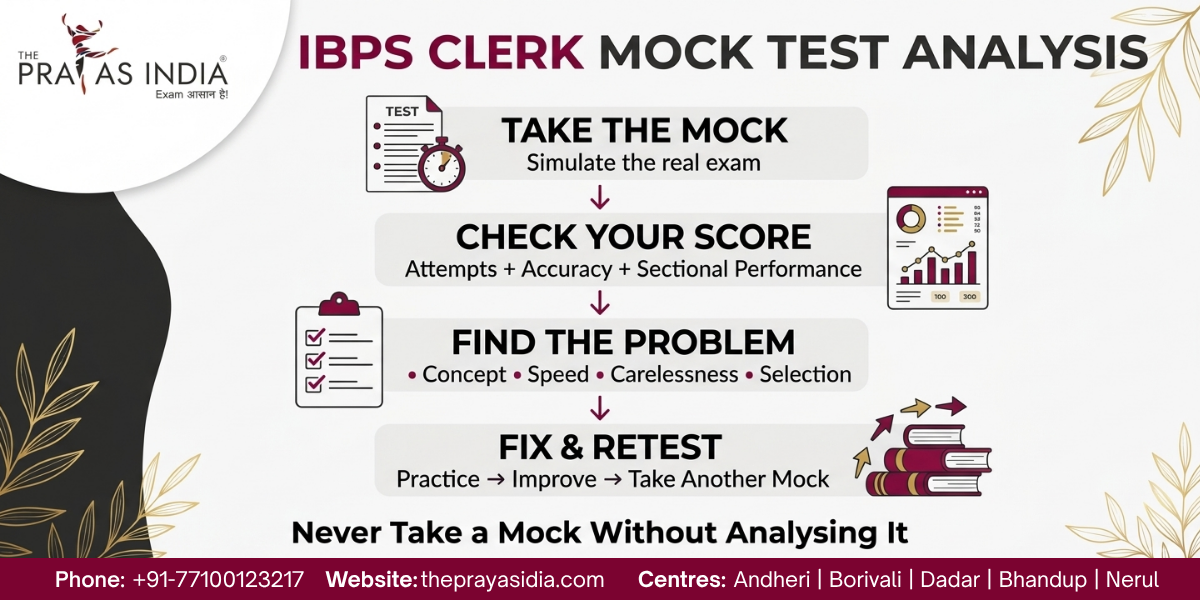
However, taking a mock without analysing it is an incomplete exercise.
After every mock, spend time understanding your performance.
Check:
- Which questions consumed excessive time?
- Which easy questions did you miss?
- Which mistakes were due to carelessness?
- Which topics continue to create problems?
- Which section is taking longer than expected?
- How many questions were left despite being solvable?
Your next study session should be influenced by this analysis.
That is how mocks become a preparation tool rather than merely a scorecard.
Build Your Own Attempt Strategy
There is no single attempt order that works perfectly for every candidate.
Some students are strongest in English and prefer to begin there.
Others are more comfortable with Reasoning or Numerical Ability.
Your strategy should be based on your mock-test performance.
Experiment during practice.
Try different approaches and compare:
- Total attempts.
- Accuracy.
- Time spent.
- Number of questions left.
- Overall score.
Once you identify a strategy that consistently works, practise it repeatedly before the examination.
Takeaway
A 30-day IBPS Clerk Prelims Preparation plan should not be built around studying for maximum hours.
It should be built around maximum improvement per hour.
The first stage is to identify your weaknesses. The next stage is to strengthen high-priority topics. After that, shift towards timed practice, sectional tests and finally full-length mocks and revision.
For English, focus on comprehension, grammar and regular practice. For Numerical Ability, combine concept clarity with calculation speed. For Reasoning, build familiarity with scoring topics while developing the ability to recognise and skip time-consuming puzzles.
Most importantly, don’t measure your preparation only by how much syllabus you have completed.
Measure it by how accurately and quickly you can solve questions under exam conditions.
A Practical Daily Study Plan for the Last 30 Days
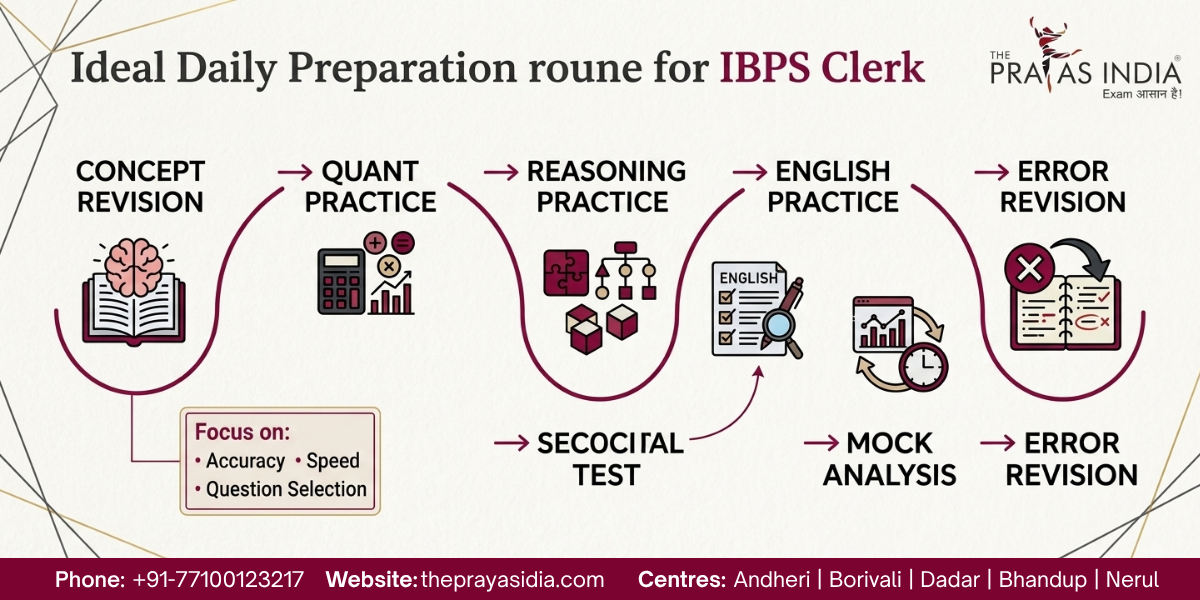
A good daily routine should give sufficient attention to all three sections while leaving time for revision and test analysis.
If you can dedicate around five to six focused hours each day, divide your preparation into different study blocks instead of studying one subject continuously.
Start with a short calculation or reasoning warm-up. Follow it with a focused Quant or Reasoning session, then move to English practice. The second half of your study schedule should include sectional questions, revision and analysis.
The exact number of hours can vary depending on whether you are a student, working professional or full-time aspirant. What matters most is that every study session has a specific purpose.
A typical day could include concept revision, timed practice, sectional questions, mock-test analysis and error revision.
Days 1–10: Build the Scoring Base
The first ten days of the 30-day plan should focus on strengthening the topics that can contribute consistently to your score.
Don’t spend the entire day learning new concepts. Divide your time between revision and practice.
For Quant, strengthen arithmetic fundamentals and regularly practise simplification, number series and other familiar question types.
For Reasoning, make basic topics such as syllogism, inequality, coding-decoding, blood relations and direction sense comfortable enough to solve quickly.
For English, focus on grammar-based questions, reading comprehension, cloze tests, fillers and vocabulary through regular reading.
At this stage, your goal should be to make the easier and moderate questions increasingly predictable.
Days 11–20: Move Towards Exam-Level Practice
The second phase should be more practice-oriented.
You should now start solving questions in timed sets rather than attempting everything without a clock.
For example, instead of solving 30 Quant questions casually, give yourself a fixed time and try to complete them with high accuracy.
The same approach should be applied to Reasoning and English.
Begin taking sectional tests regularly. These tests will help you understand whether your preparation works under pressure.
If your accuracy falls significantly when you introduce a timer, don’t immediately try to increase your speed. First identify why you are making mistakes.
Speed should improve through familiarity and better decision-making, not through random rushing.
Days 21–30: Full Mock Tests and Final Revision
The final ten days should resemble the actual examination as closely as possible.
Start taking full-length IBPS Clerk Prelims mock tests at regular intervals. Try to sit for the mock at a fixed time and complete it without distractions.
After every test, spend meaningful time analysing your performance.
If your score is not improving, don’t simply take another mock.
Find the reason.
A low score could result from weak concepts, poor time management, excessive attempts, calculation errors, incorrect question selection or lack of concentration.
Once you identify the problem, use the next study session to address it.
This cycle of Test → Analyse → Improve → Retest is one of the most effective ways to use the final days.
How to Improve Your IBPS Clerk Speed
Speed is not something that improves simply because you solve more questions.
You need to identify where your time is actually going.
If Quant calculations are slow, practise basic calculations regularly. If you spend too much time understanding English passages, improve your reading approach. If Reasoning puzzles consume most of your section time, work specifically on puzzle selection.
Try recording the approximate time you spend on different question types during sectional tests.
This will show you which areas are affecting your overall performance.
Remember that speed should always be developed alongside accuracy.
The 30-Second Decision Rule
During practice, develop the habit of making quick decisions about questions.
When you read a question, ask yourself whether you understand the approach immediately.
If the method is clear, solve it.
If the question requires lengthy calculations or the approach is unclear, consider leaving it temporarily.
This habit can prevent one difficult question from affecting several easier questions.
Over time, your ability to recognise familiar patterns will become faster.
Create an Error Notebook
One of the most useful tools during the final month is a simple error notebook.
Whenever you make a mistake in a mock or practice set, record the question type and the reason behind the mistake.
For example, your mistake could be due to:
- Lack of conceptual clarity.
- Calculation error.
- Misreading the question.
- Incorrect option selection.
- Guessing.
- Time pressure.
- Poor question selection.
Review this notebook regularly.
The purpose is not to collect hundreds of questions. It is to identify repeated mistakes and make sure you stop making them.
Don’t Ignore Revision
With the examination approaching, many candidates make the mistake of continuously solving new questions.
Practice is important, but revision becomes equally important in the final days.
Revise formulas, important concepts, common grammar rules, calculation shortcuts and frequently repeated question patterns.
For Reasoning, revise the approaches used for common question types.
For English, revise vocabulary and the errors you repeatedly make.
For Quant, focus especially on formulas and concepts that you tend to forget.
Revision should be short, frequent and targeted.
How to Handle the Final Week
The final seven days should be about polishing your preparation rather than creating unnecessary stress.
Avoid suddenly changing your entire study strategy.
Continue taking mocks, but give equal importance to analysing them.
Do not start collecting new books or study materials at the last minute.
Your focus should remain on the resources you have already been using.
The final week is also the right time to finalise your examination strategy.
You should know how you want to approach each section, which topics you are most comfortable with and which question types you generally prefer to skip.
How to Attempt IBPS Clerk Prelims Smartly
There is no universally correct sequence for attempting the three sections.
Your attempt order should depend on your strengths.
If English is your strongest section, you may prefer starting with English. If Reasoning gives you better accuracy, you may choose to begin there.
The important thing is to avoid experimenting with a completely new strategy on examination day.
Use your mock tests to determine what works.
Your final strategy should allow you to collect marks from easier questions before spending time on questions that require deeper calculation or reasoning.
What If Your Mock Scores Are Still Low?
A low mock score doesn’t necessarily mean you cannot perform well in the actual exam.
Instead of becoming discouraged, diagnose the score.
Suppose you are attempting a reasonable number of questions but your accuracy is poor. Your priority should be accuracy.
If your accuracy is good but attempts are low, focus on speed and question selection.
If one section consistently performs poorly, dedicate additional practice time to that section.
The most important thing is to identify the specific reason behind the score.
This is where proper mock analysis can make a major difference.
Common Mistakes to Avoid in the Last 30 Days
One of the biggest mistakes is trying to complete every topic regardless of its relevance to your current preparation level. This can create unnecessary pressure and leave insufficient time for practice.
Another common mistake is taking multiple mock tests without analysing them. A mock test should tell you something about your preparation. If you simply check your score and move to the next test, you are missing its biggest benefit.
Many aspirants also focus heavily on attempts while ignoring accuracy. Because incorrect answers can carry negative marks, reckless attempts can damage an otherwise good performance.
Finally, avoid changing your preparation resources repeatedly. The final month should be about consolidation, not collecting new books, PDFs and video courses.
When Should You Join IBPS Clerk Coaching?
Self-study can work for candidates who have strong fundamentals, know the examination pattern and can maintain a disciplined study routine. However, many aspirants struggle with consistency, doubt resolution, mock analysis and identifying the right topics to prioritise.
This is where structured IBPS Clerk coaching can provide an advantage.
A good coaching programme should not simply provide lectures. It should give students a preparation framework, regular practice, mock tests, performance analysis and guidance on how to improve.
For candidates preparing in Mumbai, choosing the Best IBPS Clerk Coaching in Mumbai should therefore be based on the quality of teaching, test series, study material, mentorship and the overall preparation system rather than advertisements alone.
Why Structured Guidance Can Make IBPS Clerk Preparation Easier
Banking exams require candidates to manage multiple subjects simultaneously.
Without a structured plan, students often spend too much time on their favourite subject while neglecting areas that require improvement.
A structured coaching environment can help maintain balance.
Regular classes provide a learning schedule, while sectional tests and mock exams create accountability. Mentors can also help students understand why their performance is not improving and what they should change.
For an aspirant who finds it difficult to maintain consistency through self-study, this structure can make the preparation process considerably more manageable.
Choosing the Right Banking Coaching in Mumbai
If you are considering joining a coaching institute, don’t choose solely on the basis of the words “Best Banking Coaching in Mumbai.”
Look at what the institute actually provides.
Check whether the programme includes comprehensive coverage of the IBPS Clerk syllabus, regular mock tests, doubt-solving support, performance analysis and updated preparation material.
Also consider whether the teaching approach is suitable for your current level.
A beginner may require stronger conceptual support, while a student who already knows the basics may need more emphasis on test-taking and performance improvement.
The right institute should be able to support both stages.
Why The Prayas India Can Be the Right Preparation Partner
Preparing for IBPS Clerk is not only about completing the syllabus. It is about building the ability to perform under time pressure.
This is where a structured preparation environment can help.
At The Prayas India, aspirants can approach their preparation with a combination of conceptual learning, regular practice, mock tests and performance-focused preparation. The objective is to help students understand the examination rather than simply complete lectures.
For students searching for IBPS Clerk Coaching in Mumbai, the focus should be on finding an institute where preparation is systematic, test-oriented and aligned with the actual requirements of competitive banking examinations.
The right guidance can be particularly useful for students who struggle to create a realistic study schedule or understand how to improve after taking mock tests.
Your Final 30-Day Checklist
Before entering the examination hall, make sure you have developed the following habits:
- You can identify easy questions quickly.
- You understand your strongest topics.
- You know which questions you should skip.
- You have taken sufficient sectional tests.
- You have taken full-length mocks under timed conditions.
- You have analysed your mistakes.
- You have revised important formulas and concepts.
- Your calculation speed has improved.
- Your accuracy is under control.
- You have a clear attempt strategy.
If these areas are under control, your preparation is likely much more exam-ready than simply completing another chapter from a book.
Conclusion: Make These 30 Days Count
Thirty days may look short, but it is enough time to make meaningful improvements when preparation is focused.
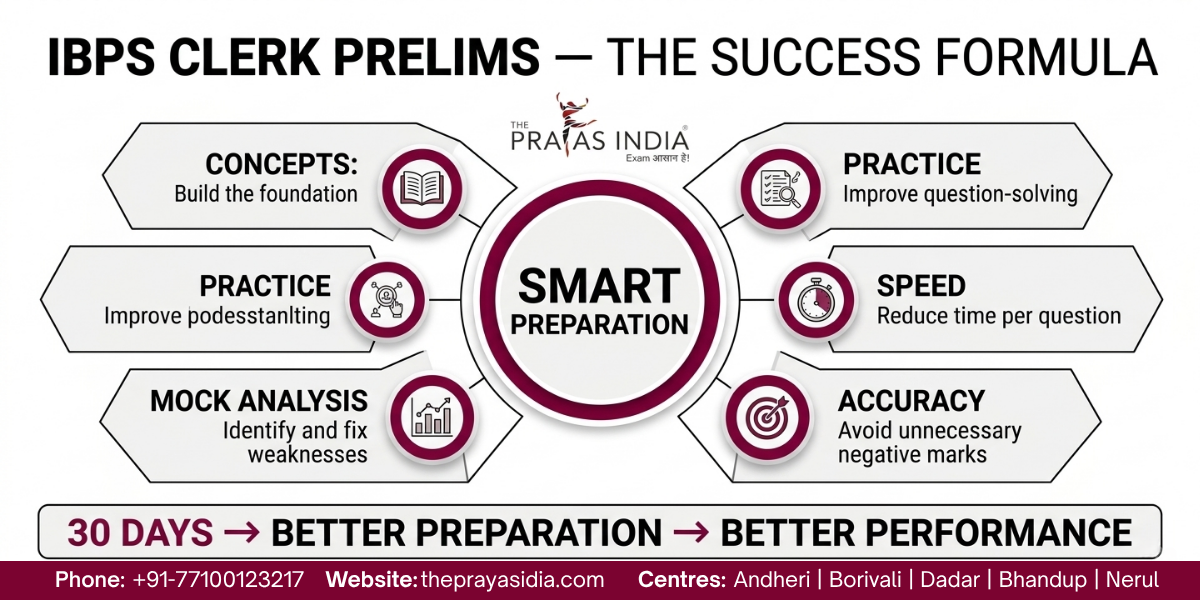
A successful IBPS Clerk Prelims Preparation strategy should move through three important stages: learn, practise and perform.
The first stage builds concepts. The second develops speed and accuracy. The final stage uses mocks and analysis to convert preparation into examination performance.
Don’t measure your progress only by the number of hours studied. Measure it by whether your mock scores are improving, whether your accuracy is becoming more consistent and whether you are making better decisions under time pressure.
If you are serious about cracking IBPS Clerk 2026 and feel that you need structured guidance, regular testing and a disciplined preparation environment, exploring the right IBPS Clerk Coaching in Mumbai can be an important step.
The Prayas India can help aspirants build a structured approach to banking exam preparation, with the focus on learning, practice and performance.
Your target should not simply be to finish the syllabus.
Your target should be to enter the IBPS Clerk Prelims exam knowing exactly how you are going to attempt it.
Contact Us
📞 Call Now: +91-77100 13217
🌐 Website: theprayasindia.com