
Master Quantitative Aptitude for Bank Exams: Important Topics and Practice Strategy
For many banking exam aspirants, Quantitative Aptitude is not just about solving mathematical questions. It is about understanding concepts, recognising patterns, selecting the right method, and reaching accurate answers within a limited time.
Candidates preparing for IBPS PO, IBPS Customer Service Associate (Clerk/CSA), SBI PO, SBI Clerk, and other banking recruitment examinations often find it challenging to balance calculation speed with accuracy. The good news is that Quantitative Aptitude can become more manageable when preparation follows a clear, topic-wise strategy.
Whether you are starting from the basics or improving your performance in mock tests, this guide explains the important topics, practical calculation techniques, common mistakes, and revision methods that can support your bank exam preparation.
Why Is Quantitative Aptitude Important in Banking Exams?
Banking examinations use numerical questions to assess mathematical understanding, analytical thinking, and problem-solving ability. Depending on the examination, Quantitative Aptitude or related numerical and data-analysis sections may appear in the preliminary examination, main examination, or both.
The exact pattern, marks, timing, and topics vary by recruitment and notification. Candidates should check the latest official information for their target examination on the IBPS website or SBI Careers website.
A structured preparation plan can help you:
- Improve calculation accuracy.
- Solve familiar question types more efficiently.
- Recognise which method suits a particular problem.
- Manage time during timed practice.
- Identify weak topics before the examination.
- Build confidence through measurable progress.
Instead of trying to master every shortcut immediately, begin with the fundamentals and build speed through repeated practice.
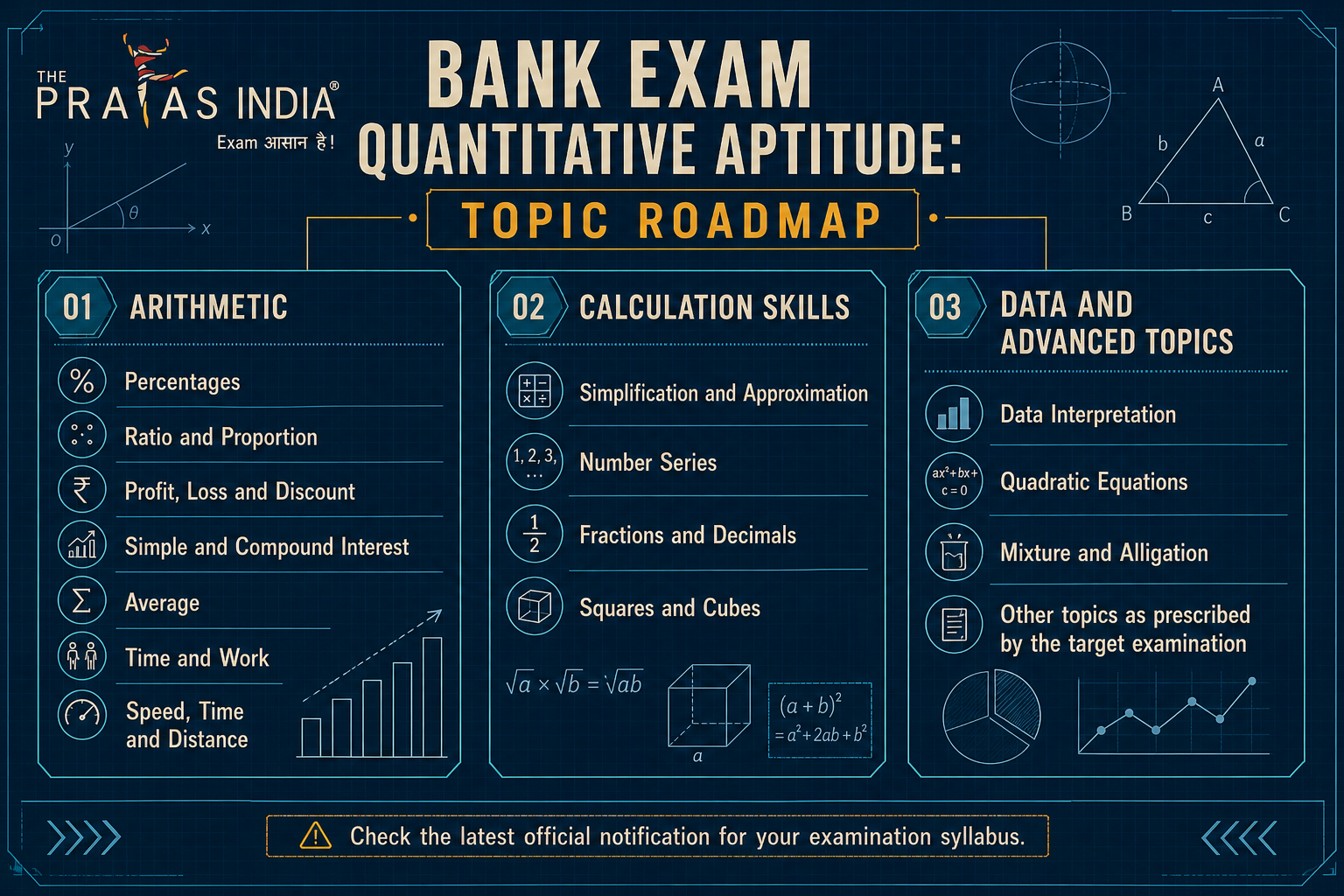
Important Quantitative Aptitude Topics for Bank Exams
The following topics commonly feature in banking exam preparation. Their relevance and question distribution can differ between examinations and recruitment cycles, so use the latest official notification as your reference.
1. Simplification and Approximation
Simplification questions test your ability to calculate efficiently while following mathematical rules. Approximation questions require you to estimate values and identify a sufficiently close answer where the question permits it.
Practise:
- Order of operations
- Fractions and decimals
- Squares and cubes
- Percentages and conversions
- Basic arithmetic operations
- Approximation using nearby values
Practice strategy: Revise multiplication tables, common squares, cubes, and fraction-to-percentage conversions. Solve a small set of questions daily and review every calculation error.
Do not sacrifice accuracy just to finish questions quickly. Develop a reliable method first and gradually reduce the time taken.
2. Number Series
Number series questions ask you to identify a missing or incorrect number by recognising a mathematical pattern.
Patterns may involve addition, subtraction, multiplication, division, squares, cubes, or a combination of operations.
Practice strategy: Check differences between consecutive numbers first. If the pattern is not obvious, examine second differences, ratios, alternating sequences, and relationships involving squares or cubes.
Avoid assuming that every series follows the same pattern. Practise identifying the rule before selecting an answer.
3. Percentage
Percentage is one of the most useful concepts in banking exam mathematics because it supports several other topics, including profit and loss, interest, data interpretation, and comparisons.
Important areas include:
- Percentage increase and decrease
- Converting fractions into percentages
- Successive percentage changes
- Comparing quantities
- Population and expenditure-based problems
Practice strategy: Learn common fraction-percentage equivalents, such as (1/2=50%), (1/4=25%), and (1/5=20%). Apply them to questions instead of relying on lengthy calculations every time.
Understand the difference between an increase and a decrease, particularly when a question involves successive changes.
4. Ratio and Proportion
Ratio and proportion questions assess how quantities relate to one another. They often appear in problems involving ages, partnerships, mixtures, and distribution.
Practise:
- Simplifying ratios
- Dividing a quantity in a given ratio
- Direct and inverse proportion
- Comparing quantities
- Multi-step ratio problems
Practice strategy: Write down the relationship between the quantities before calculating. This simple habit can help prevent confusion in lengthy questions.
5. Profit, Loss and Discount
These questions involve cost price, selling price, marked price, profit, loss, and discount.
Learn to distinguish between these values before applying formulas.
For example:
- Profit = Selling Price − Cost Price
- Loss = Cost Price − Selling Price
- Discount = Marked Price − Selling Price
Profit and loss percentages are generally calculated using cost price, while discount percentage is generally calculated using marked price. Read each question carefully to identify the correct base value.
Practice strategy: Start with single-step problems and progress to successive discounts, marked-price calculations, and questions involving multiple transactions.
6. Simple Interest and Compound Interest
Interest questions are useful for developing formula-based problem-solving skills.
Topics may include:
- Principal, rate and time
- Simple interest
- Compound interest
- Difference between simple and compound interest
- Amount after a specified period
- Annual and other compounding intervals, where applicable
Practice strategy: Understand what each variable represents before substituting values into a formula. Practise questions with different time periods and rates, and check whether the question asks for interest alone or the total amount.
7. Time and Work
Time and Work questions examine how efficiently individuals or groups complete a task.
You may encounter questions involving:
- Individual work rates
- Combined work
- Efficiency comparisons
- Work completed in a specified period
- Pipes and cisterns, where included in the target examination
Practice strategy: Convert the time required to complete a task into a work rate. For example, if a person completes a job in 10 days, the person’s one-day work rate is (1/10) of the job.
This approach often makes combined-work calculations easier to organise.
8. Speed, Time and Distance
These questions involve movement, travel time, and distance. Some problems include trains, boats and streams, or relative speed.
Remember the basic relationship:
Speed = Distance ÷ Time
Make sure all units are consistent before calculating. A speed expressed in kilometres per hour cannot be directly combined with a time expressed in seconds without conversion.
Practice strategy: Draw a simple diagram for multi-stage journeys and separate the different distances, speeds, and time intervals.
9. Average, Mixture and Alligation
Average questions involve finding a representative value for a group of quantities. Mixture and alligation questions may require you to compare the proportions of two or more components.
Practise:
- Average of numbers
- Average age
- Changes in group averages
- Replacement problems
- Mixture ratios
- Cost and concentration comparisons
Practice strategy: Remember that the total of a group equals its average multiplied by the number of items. Use this relationship to solve questions involving people joining or leaving a group.
10. Data Interpretation
Data Interpretation (DI) requires you to read numerical information from tables, bar graphs, line graphs, pie charts, and other formats used in the examination.
Questions may involve percentages, ratios, differences, averages, and comparisons.
Practice strategy: Read the title, units, legend, and time period before calculating. Identify what the question actually asks, and avoid performing unnecessary calculations.
Practise both individual DI questions and sets containing multiple questions based on the same data.
11. Quadratic Equations and Other Advanced Topics
Depending on the target examination, candidates may also need to practise quadratic equations, mathematical inequalities, probability, permutation and combination, or other advanced numerical topics.
Practice strategy: First confirm which topics are relevant to your examination. Then learn the basic methods, practise standard questions, and move towards mixed exercises.
Avoid spending excessive time on a topic simply because it seems difficult. Prioritise according to the official syllabus, your current ability, and your performance in practice tests.
How to Build a Quantitative Aptitude Practice Strategy
A good preparation strategy should answer three questions: What should you study? How should you practise? How will you measure improvement?
Step 1: Assess Your Current Level
Begin with a short diagnostic test covering a range of mathematical topics.
Divide your results into three groups:
- Comfortable topics: You can solve questions accurately.
- Developing topics: You understand the concepts but make occasional mistakes.
- Priority topics: You struggle to identify the correct method or complete questions.
Start with the priority topics while continuing to revise your stronger areas.
Step 2: Learn Concepts Before Shortcuts
Shortcuts can save time, but they are most useful when you understand the underlying mathematics.
For each topic, follow this sequence:
- Understand the concept and formula.
- Study a few worked examples.
- Solve basic questions independently.
- Practise mixed-difficulty questions.
- Attempt timed exercises.
- Review incorrect answers.
This sequence helps you develop methods you can apply even when a question looks different from the examples you have studied.
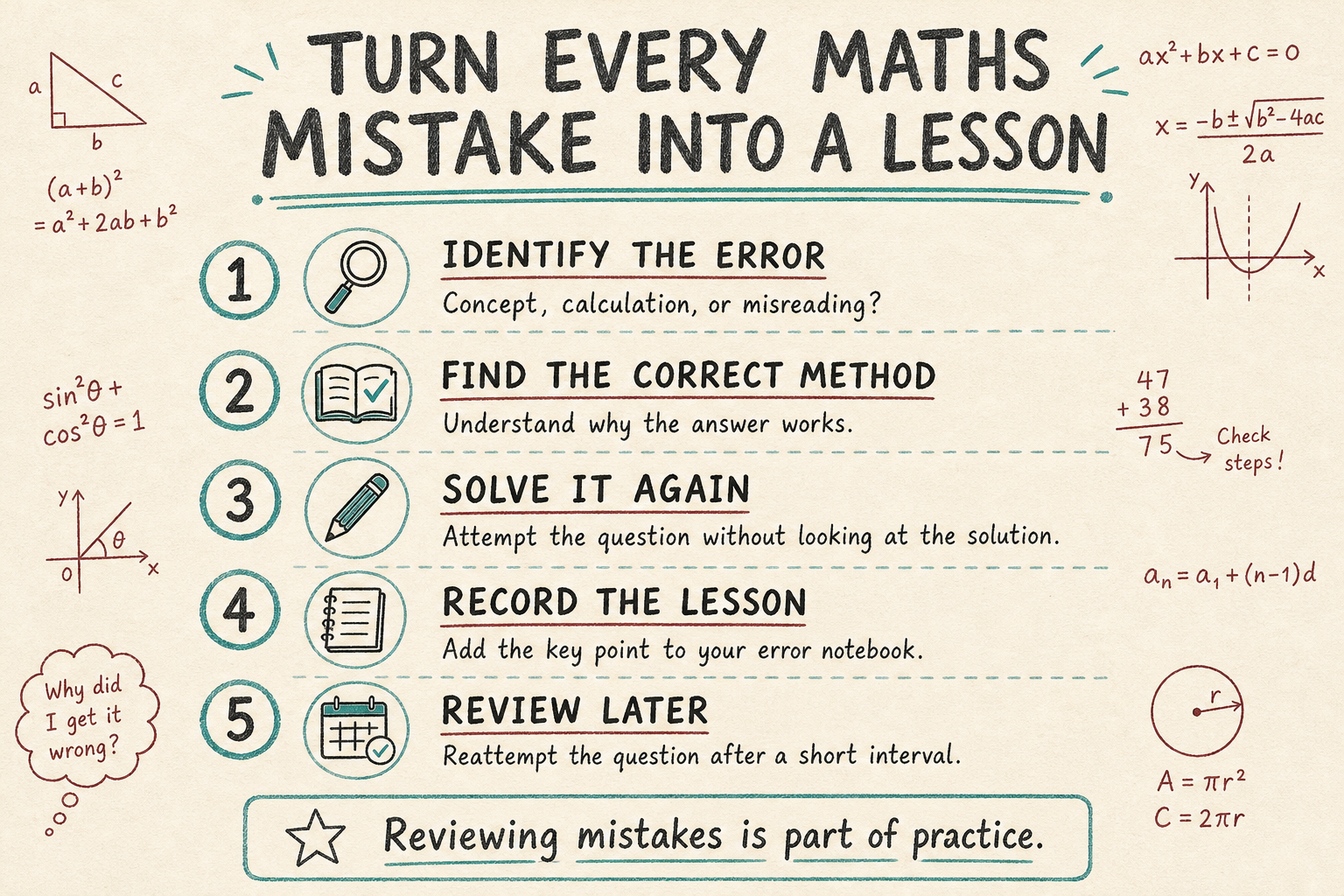
Step 3: Maintain a Calculation Notebook
Keep a dedicated notebook for recurring calculation errors, useful formulas, and concepts that need revision.
You can include:
- Fraction and percentage equivalents
- Common squares and cubes
- Formula summaries
- Questions you solved incorrectly
- Faster methods you understand and can reproduce
- Topics requiring another practice session
Review this notebook regularly instead of repeatedly collecting new study materials.
Step 4: Practise with a Timer
Once you understand a topic, introduce timed practice. Begin with a comfortable time limit and reduce it gradually as your accuracy improves.
Track three measures:
- Number of questions attempted
- Number of correct answers
- Time taken
A high attempt count is not automatically a sign of strong performance. Focus on accuracy and question selection as well as speed.
Step 5: Analyse Every Practice Test
After completing a topic test or mock test, classify your errors.
| Error Type | What to Do |
|---|---|
| Conceptual mistake | Relearn the underlying concept |
| Calculation error | Practise the relevant arithmetic |
| Misread question | Slow down when reading conditions |
| Time-consuming method | Compare alternative methods |
| Guessing or poor selection | Review when to skip a question |
Reattempt difficult questions after a short interval. If the same mistake occurs again, return to the concept rather than simply memorising the correct answer.
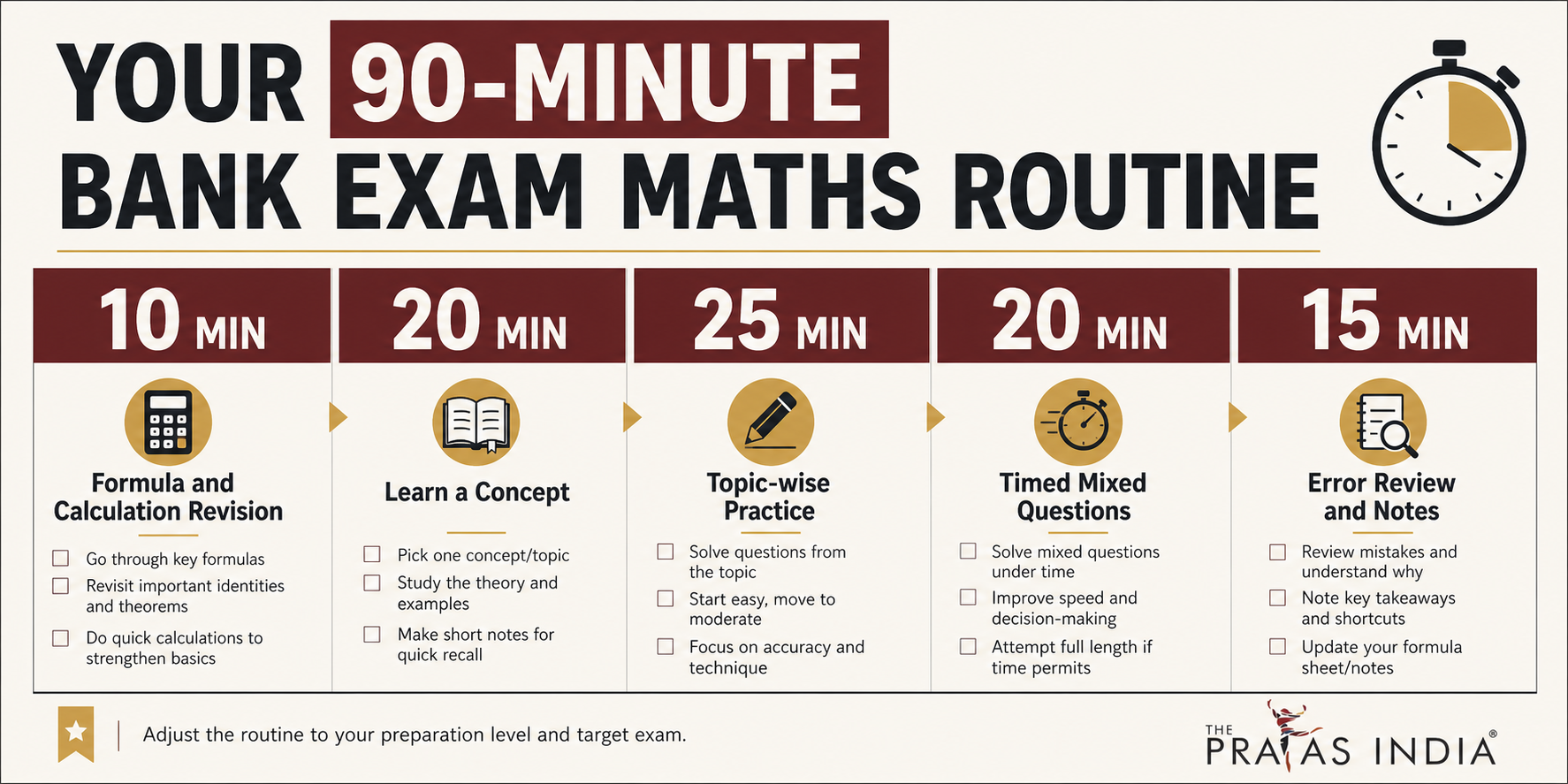
A Sample Daily Quantitative Aptitude Routine
The following is an illustrative 90-minute session for bank exam aspirants. Adjust it according to your preparation stage and other commitments.
| Activity | Time |
|---|---|
| Formula and calculation revision | 10 minutes |
| Concept learning | 20 minutes |
| Topic-wise question practice | 25 minutes |
| Timed mixed questions | 20 minutes |
| Error review and notes | 15 minutes |
| Total | 90 minutes |
Beginners may need more time for concept learning. Candidates who have already covered the syllabus can allocate more time to mixed questions, sectional tests, and error analysis.
Use one day each week to review your progress and revisit the topics where your accuracy remains inconsistent.
Common Quantitative Aptitude Mistakes to Avoid
Memorising Formulas Without Understanding Them
A formula is useful only when you know which values to substitute and when the formula applies. Learn the reasoning behind it and practise different question formats.
Attempting Every Question
Time is limited in competitive examinations. If a question is unusually lengthy or unfamiliar, consider moving to another question and returning later if time permits.
Ignoring Basic Arithmetic
Weakness in fractions, multiplication, percentages, and division can slow down otherwise straightforward questions. Include calculation practice in your routine.
Practising Only Your Favourite Topics
Familiar topics can feel comfortable, but avoiding weaker areas may limit your overall preparation. Schedule dedicated sessions for topics where you make repeated mistakes.
Skipping Revision
A concept you understood last week may still require revision. Review formulas, previously incorrect questions, and important calculation methods throughout your preparation.
How Can Coaching Support Bank Exam Mathematics Preparation?
Some aspirants prefer self-study, while others benefit from structured guidance and regular assessments. When comparing banking exam coaching options, focus on how the course supports your learning needs.
Consider asking about:
- Coverage of relevant Quantitative Aptitude topics
- Explanation of fundamental concepts
- Doubt-solving opportunities
- Topic-wise exercises and mock tests
- Guidance on calculation methods and time management
- Feedback on recurring mistakes
- Batch schedules, course duration, and fees
Students searching for bank exam coaching in Bhandup West, Mumbai, can explore local options and compare their actual course details before enrolling.
Explore Competitive Exam Preparation at The Prayas India, Bhandup
The Prayas India has a branch in Bhandup, Mumbai, where students can enquire about available competitive exam preparation options, batch schedules, and admission details.
- Branch address: The Prayas India, Neptune Magnet Mall, D-322, Lal Bahadur Shastri Marg, near Metro, Ganesh Nagar, Bhandup West, Mumbai, Maharashtra 400078.
- Phone: +91 7710013217
- Google Maps: https://maps.app.goo.gl/7RGDwfaV3gzGyfbaA
If you are considering coaching for IBPS, SBI, or another banking examination, contact the branch to confirm whether the specific course you need is currently available. Ask about the syllabus coverage, teaching approach, practice tests, fees, and batch timings before making your decision.
Final Thoughts
Quantitative Aptitude becomes easier to manage when preparation is built around concepts, regular practice, and careful review. Start with the fundamentals, develop calculation accuracy, practise topic-wise questions, and use timed tests to understand where you need to improve.
Rather than measuring preparation only by the number of questions solved, focus on learning from each mistake and applying the correct method more consistently.
If you are exploring competitive exam preparation in Mumbai, compare available learning options and confirm course details before enrolling. A realistic study routine and a willingness to review your mistakes can help you make steady progress towards your banking examination goals.
Frequently Asked Questions About Quantitative Aptitude for Bank Exams
1. Which topics are important in Quantitative Aptitude for bank exams?
Common preparation topics include simplification, number series, percentages, ratio and proportion, profit and loss, interest, time and work, speed and distance, averages, and data interpretation. Check the syllabus for your target examination.
2. How should beginners start preparing for bank exam mathematics?
Start with basic arithmetic, fractions, percentages, ratios, and averages. Learn the concepts, solve basic questions, and gradually move towards mixed exercises and timed tests.
3. How much time should I practise Quantitative Aptitude daily?
A focused 60–90-minute session can be a useful starting point. Adjust your study time according to your current level, target examination, and progress.
4. Are shortcuts necessary for bank exam mathematics?
Shortcuts can save time, but conceptual understanding should come first. Learn standard methods before using shortcuts so you can apply them correctly.
5. How can I improve calculation speed?
Practise arithmetic regularly, revise common fraction-percentage conversions, learn squares and cubes, and analyse calculation errors. Increase your speed gradually while maintaining accuracy.
6. Is Data Interpretation important for banking exams?
Data Interpretation is a common part of banking exam preparation. Question types and weightage vary by examination, so consult the latest official notification.
7. Where can I check the official bank exam syllabus?
Check the IBPS website or the SBI Careers website, depending on your target examination.
THE PRAYAS INDIA • BHANDUP
Preparing for Banking Exams?
Enquire about available competitive exam preparation courses, batch timings, and admission details at The Prayas India, Bhandup.
Phone: +91 7710013217
The Prayas India, Neptune Magnet Mall, D-322, Lal Bahadur Shastri Marg, near Metro, Ganesh Nagar, Bhandup West, Mumbai, Maharashtra 400078.