How to Improve Speed in IBPS Clerk Reasoning | Best Bank Coaching in Mumbai | The Prayas India
For many IBPS Clerk aspirants, Reasoning Ability is not difficult because the concepts are exceptionally advanced. The bigger challenge is solving familiar questions quickly enough while maintaining accuracy. In the IBPS Clerk Prelims 2026, Reasoning Ability carries 35 questions for 35 marks with a separately timed 20-minute section. That means candidates have to make decisions quickly: which questions to attempt first, which puzzle to leave temporarily, how much time to spend on a tricky condition, and when to move on.
This is why improving reasoning speed is not simply about solving more questions. Speed comes from a combination of conceptual clarity, pattern recognition, question selection, efficient calculation or notation, repeated timed practice, and systematic mock-test analysis. An aspirant who knows 20 reasoning concepts but spends four minutes on a question may score less than someone who knows the same concepts and can identify the correct approach within a few seconds.
For candidates preparing for banking exams in Mumbai, this distinction is particularly important. With the right preparation strategy and structured guidance from a reputed institute such as The Prayas India, aspirants can work on the exact skills that determine performance under sectional time pressure.
Understanding the Real Speed Challenge in IBPS Clerk Reasoning
Before trying to increase speed, candidates need to understand what actually consumes their time. In a typical Reasoning section, some questions are direct and can be solved in a few seconds, while others require several logical steps. Syllogism, inequality, coding-decoding, blood relations, direction sense and alphanumeric series can often be approached relatively quickly once the underlying patterns become familiar. Puzzles and seating arrangements, on the other hand, can consume substantial time because they require candidates to process multiple conditions simultaneously.
The official IBPS Clerk 2026 notification confirms that the Reasoning Ability section in Prelims has 35 questions, 35 marks and only 20 minutes, with the section separately timed. This makes time management an integral part of the examination strategy rather than something candidates can worry about after completing the syllabus.
A common mistake is to interpret speed as “solving every question faster.” That is not the correct objective. The real goal is to maximize marks within the available time. If a candidate spends six minutes trying to force a difficult puzzle and misses several easy inequality, syllogism or coding questions, the problem is not necessarily a lack of reasoning ability. It is poor question selection.
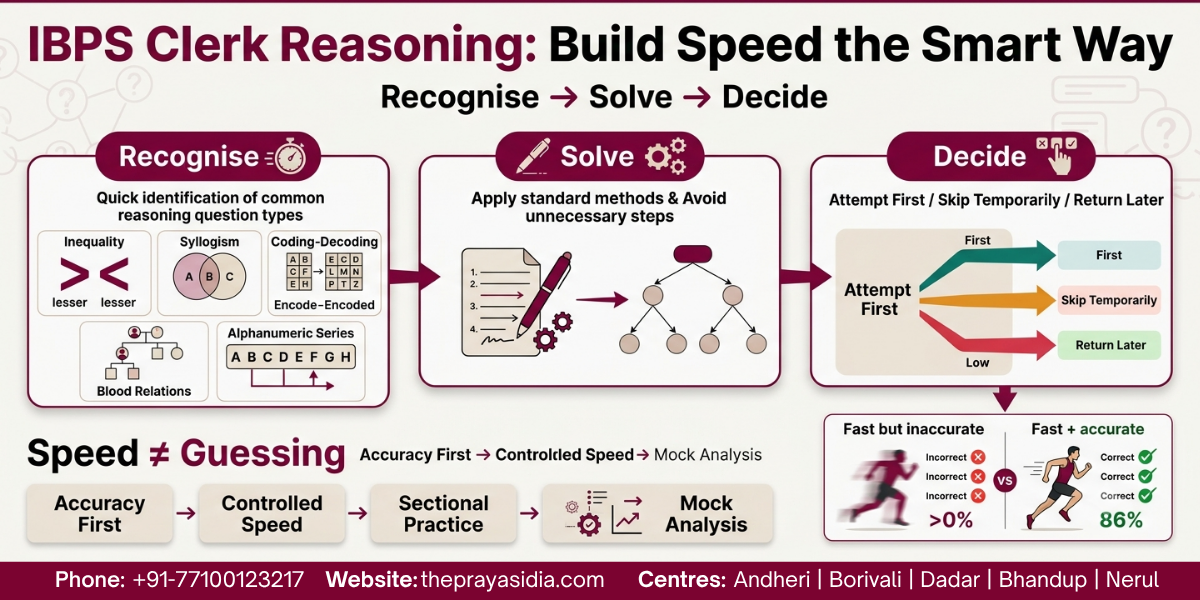
Speed therefore has three dimensions:
- Recognition speed: identifying the question type quickly.
- Execution speed: applying the correct method without unnecessary steps.
- Decision speed: knowing whether to attempt, skip or return to a question.
A strong IBPS Clerk candidate develops all three.
The First Step: Build Accuracy Before Chasing Speed
One of the most important principles of reasoning preparation is that speed should be built on accuracy. Trying to solve questions faster before understanding the concepts usually creates careless mistakes, incomplete deductions and repeated errors.
Suppose an aspirant solves 35 reasoning questions in 20 minutes but gets eight wrong. That is not meaningful speed. Another candidate may initially solve only 25 questions but get 24 correct. The second candidate has a much stronger foundation because increasing execution speed is easier than repairing a fundamentally inaccurate approach.
Start by solving individual topics without an extreme time limit. Understand why each option is correct or incorrect, learn the standard representation of different question types, and identify the conditions that usually cause confusion. Once accuracy becomes consistent, introduce short time limits.
For example, if you are practising inequalities, first aim to solve a set accurately. Then reduce the target time gradually. The same approach can be applied to syllogism, coding-decoding, blood relations, direction sense and other relatively direct topics. This creates what may be called controlled speed—you become faster without sacrificing reliability.
A Useful Speed-Building Progression
| Stage | Primary Objective | Practice Approach |
|---|---|---|
| Stage 1 | Concept clarity | Untimed topic-wise questions |
| Stage 2 | Accuracy | Small sets with error analysis |
| Stage 3 | Controlled speed | Timed 10–15 question sets |
| Stage 4 | Sectional speed | 20-minute reasoning sections |
| Stage 5 | Exam readiness | Full mocks + detailed analysis |
The important point is that these stages should overlap. A candidate should not spend months doing only untimed practice and suddenly start taking mocks close to the examination. Timed practice needs to become a regular part of preparation once the fundamentals are reasonably strong.
Know Which Reasoning Topics Can Give You Faster Marks
Speed improves considerably when candidates develop a clear understanding of question selection. The Reasoning syllabus contains several different question types, and treating all of them equally during an exam can be inefficient.
Current IBPS Clerk preparation resources consistently identify puzzles and seating arrangements as major components of the Reasoning section, while topics such as syllogism, inequality, coding-decoding, blood relations and alphanumeric series are also important areas for preparation.
This does not mean that every examination will contain exactly the same distribution. Instead, candidates should learn to classify questions according to time required versus marks available.
Fast-Execution Questions
These are generally the questions you should be comfortable solving quickly after sufficient practice:
- Inequality
- Syllogism
- Direction Sense
- Blood Relations
- Order and Ranking
- Alphanumeric Series
- Basic Coding-Decoding
- Simple miscellaneous reasoning
The exact difficulty can vary, so the classification should never be treated as a fixed rule. A complicated question from an apparently easy topic may still deserve to be skipped temporarily.
Medium-Time Questions
These may require a little more processing:
- Moderate coding-decoding
- Comparison-based questions
- Certain logical reasoning questions
- Simple input-output patterns
- Moderate seating arrangements
High-Time Questions
These commonly include:
- Complex seating arrangements
- Floor-based puzzles
- Box-based puzzles
- Scheduling puzzles
- Distribution puzzles
- Multiple-variable arrangements
The purpose of this classification is not to avoid difficult questions. It is to prevent one difficult question from controlling your entire section.
Why Puzzles Should Not Control Your Entire Reasoning Section
Puzzles and seating arrangements are among the most important areas in banking reasoning, but they are also where many candidates lose valuable minutes. The mistake is usually psychological: once a candidate starts a puzzle, there is a tendency to continue until it is solved, even when the puzzle is proving unusually time-consuming.
A better approach is to develop a puzzle selection habit. During practice, do not simply ask, “Can I solve this puzzle?” Ask, “How quickly can I understand this puzzle, and how many questions can I realistically obtain from it?”
When you open a puzzle, scan the number of variables, the number of conditions and the nature of the clues. If the arrangement appears familiar and several clues are directly usable, it may be worth attempting. If the puzzle contains numerous uncertain conditions and requires extensive case formation, it may be better to leave it temporarily and collect marks from direct questions first.
This habit becomes particularly valuable in a separately timed 20-minute Reasoning section.
The goal is not to become afraid of difficult puzzles. Instead, you should become comfortable with leaving a puzzle when the opportunity cost is too high.
Develop Standard Methods Instead of Reinventing the Process
One hidden reason behind slow reasoning performance is that candidates solve the same type of question differently every time. They read the question, think about the information, experiment with a method and then construct a solution from scratch.
Experienced candidates often appear faster because they have developed standard mental frameworks.
For example, when solving a blood relation question, you should not repeatedly construct a complicated verbal explanation in your head. Use a small family tree or relationship notation. In direction questions, use a simple directional diagram. In seating arrangements, establish the orientation before placing individuals. In inequalities, chain the relationships systematically rather than repeatedly comparing individual statements.
The objective is to reduce the number of mental decisions required for familiar question types.
This is where practice becomes more valuable than passive study. Every time you solve a question, ask yourself whether your method can be shortened without reducing accuracy. Over hundreds of questions, these small improvements can produce a significant difference in examination performance.
Use the “One Method, Many Questions” Principle
A strong reasoning student should gradually build a personal toolkit of standard approaches.
For instance, if you learn one reliable approach for syllogism, you should practise enough variations to recognize when that approach applies. The same principle works for inequalities, direction sense, blood relations and seating arrangements.
Instead of memorising hundreds of individual questions, learn the structures behind them.
For example:
Inequality: Learn how to form and interpret chains.
Syllogism: Understand statement relationships and conclusion testing.
Blood Relations: Convert verbal relationships into a compact family diagram.
Direction Sense: Use a fixed directional framework.
Seating Arrangement: Establish orientation and fixed positions before processing uncertain clues.
Puzzles: Separate definite information from conditional information and build cases only when necessary.
This approach improves both speed and confidence because the candidate begins to recognise patterns instead of treating every question as a completely new problem.
Create a Daily Speed Drill for Reasoning
A useful speed-building routine does not need to involve a full mock test every day. In fact, targeted drills can sometimes produce faster improvement because they isolate a particular weakness.
A daily reasoning speed session can be divided into three stages.
Stage 1: Quick Questions
Begin with a small set of direct questions from topics such as inequality, syllogism, coding-decoding, blood relations, direction sense and alphanumeric series. The purpose is to activate the patterns you already know.
Stage 2: One Arrangement or Puzzle
Solve one moderate puzzle or seating arrangement under a defined time limit. Do not immediately increase the difficulty. First develop the ability to complete standard arrangements efficiently.
Stage 3: Error and Time Analysis
After completing the set, record three things: how many questions you attempted, how many were correct and where you spent excessive time.
This third stage is frequently ignored. Candidates complete a practice set, check the answers and immediately move to the next set. But if you do not understand why you were slow, solving another hundred questions may not solve the problem.
Track Speed With a Reasoning Performance Sheet
Instead of saying “my reasoning is slow,” convert the problem into measurable data.
Maintain a simple record such as:
| Date | Topic | Questions | Correct | Wrong | Time Taken | Main Issue |
|---|---|---|---|---|---|---|
| Day 1 | Syllogism | 20 | 17 | 3 | 11 min | Concept confusion |
| Day 2 | Inequality | 20 | 19 | 1 | 8 min | Slow reading |
| Day 3 | Blood Relation | 15 | 15 | 0 | 6 min | Good |
| Day 4 | Seating Arrangement | 10 | 8 | 2 | 15 min | Case formation |
| Day 5 | Mixed Set | 35 | 30 | 5 | 20 min | Question selection |
Over time, this creates a much clearer picture of your preparation. You may discover that your problem is not overall reasoning speed but one specific issue—for example, slow puzzle selection or excessive time spent reading conditions.
That distinction matters because different problems require different solutions.
The 20-Minute Section Requires a Planned Attempt Strategy
Candidates should enter the Reasoning section with a broad strategy rather than deciding everything for the first time during the examination.
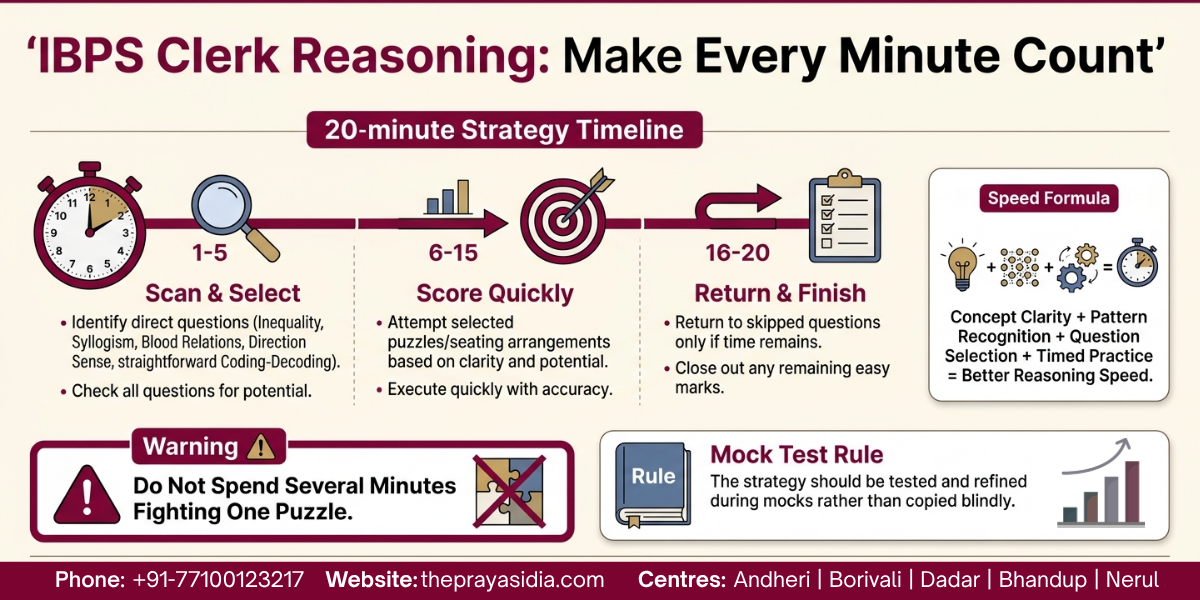
A practical approach is to scan the section and identify direct questions first. Solve the questions that can be completed confidently without lengthy arrangements. Then evaluate the available puzzle or seating sets and select the one offering the best combination of familiarity, clarity and potential marks.
Do not interpret this as a rigid sequence that must be followed in every mock or examination. Your strategy should evolve through practice. Some candidates may perform better by taking one easy arrangement early, while others may prefer to complete all direct questions first.
The key is to test your strategy during mocks before the actual examination.
A good attempt strategy should answer four questions:
- Which questions do I identify as immediate attempts?
- How long will I allow myself to remain stuck?
- Which puzzle or arrangement will I choose first?
- When will I return to questions I skipped?
Once these decisions become habitual, you save valuable mental energy during the actual examination.
Speed Comes From Pattern Recognition, Not Panic
Many students believe that faster candidates simply “think faster.” In reality, a large part of competitive-exam speed comes from recognising familiar structures.
When you first learn a particular reasoning concept, every question demands conscious thinking. After repeated exposure, the brain begins to recognise the structure automatically. You start identifying the question type before consciously analysing every detail.
This is why quality practice matters. Solving 100 questions mechanically is less valuable than solving 50 questions while actively understanding the recurring patterns, shortcuts, traps and decision points.
The same principle applies to puzzles. Initially, a floor-based puzzle may appear intimidating because there are many statements. With repeated practice, you learn to identify the floor structure, mark fixed positions, interpret directional conditions and organise information much faster.
The eventual objective is to make the first 20–30 seconds of a question productive. Instead of wondering how to begin, you should quickly identify the structure and the most efficient starting point.
Avoid These Common Habits That Reduce Reasoning Speed
Aspirants often try to improve speed by simply increasing the number of questions they solve. But several habits can actually make preparation less efficient.
Solving Without a Timer
Untimed practice is useful during the concept-building stage, but relying on it throughout preparation creates a false sense of comfort. Banking examinations are timed, so candidates eventually need to practise under realistic constraints.
Chasing Attempts Instead of Accuracy
Trying to increase attempts every day without monitoring errors can lead to guesswork. Since wrong answers attract a penalty under the IBPS objective-test framework, reckless attempts can damage the final score.
Spending Too Long on One Puzzle
A difficult puzzle may be solvable, but that does not automatically make it worth attempting immediately. The time spent must be considered against the marks that could be collected elsewhere.
Changing Methods Constantly
If you use one approach for a question today and a completely different approach tomorrow, it becomes difficult to build automaticity. Once you identify a reliable method, practise it repeatedly before experimenting with alternatives.
Ignoring Mock-Test Analysis
A mock test is not finished when the score appears on the screen. The real learning begins during analysis. Identify questions that were solved correctly but too slowly, questions that were incorrectly solved despite knowing the concept, and questions that should have been skipped.
These categories reveal different weaknesses and allow you to make targeted improvements.
How The Prayas India Can Help Improve Bank Exam Reasoning Speed
For aspirants looking for structured bank exam preparation in Mumbai, coaching can provide an advantage when it goes beyond simply teaching the syllabus. Reasoning speed requires regular practice, doubt resolution, timed exercises, performance feedback and exposure to different question patterns.
The Prayas India focuses on competitive-exam preparation with structured classroom learning and exam-oriented practice. For an IBPS Clerk aspirant, the value of guided preparation lies in developing both conceptual understanding and examination temperament. Instead of spending excessive time trying to discover every shortcut independently, students can learn standard approaches, practise them systematically and identify their weaknesses through regular testing.
For students targeting banking exams, the ideal preparation environment should help answer practical questions: Which reasoning topics deserve priority? How should a puzzle be approached? When should a question be skipped? How can accuracy be maintained while increasing attempts? How should mock-test performance be analysed? These are the skills that eventually convert preparation into examination performance.
The Right Mindset for Improving Reasoning Speed
Reasoning speed rarely improves overnight. It develops through repeated exposure and deliberate practice. A student who currently takes 30 minutes to complete a mixed reasoning set should not try to jump directly to an aggressive 20-minute target. The better strategy is to reduce the time gradually while maintaining accuracy.
Think of speed as a progression:
Understand → Practise → Standardise → Time → Analyse → Improve
Once the process becomes systematic, improvement becomes measurable. A candidate may initially notice that direct questions are becoming faster. Later, puzzle selection improves. Eventually, the candidate begins to recognise patterns almost immediately after reading a question.
That is the level of preparation required for competitive banking examinations. The goal is not merely to know the Reasoning syllabus. The goal is to convert reasoning knowledge into marks under strict time pressure.
Topic-Wise Strategy to Improve IBPS Clerk Reasoning Speed
Improving speed becomes much easier when preparation is divided according to question type. Every reasoning topic does not require the same method, and every question should not receive the same amount of time. The most effective preparation strategy is to develop a standard approach for each major topic and then practise that approach until the process becomes almost automatic.
Current IBPS Clerk preparation resources place considerable emphasis on Puzzles and Seating Arrangement along with topics such as Syllogism, Inequality, Coding-Decoding, Blood Relations, Direction Sense and Order & Ranking. Recent exam analyses also show that the distribution can vary significantly from one paper or shift to another, which is why candidates should prepare broadly rather than rely on a fixed expected number of questions.
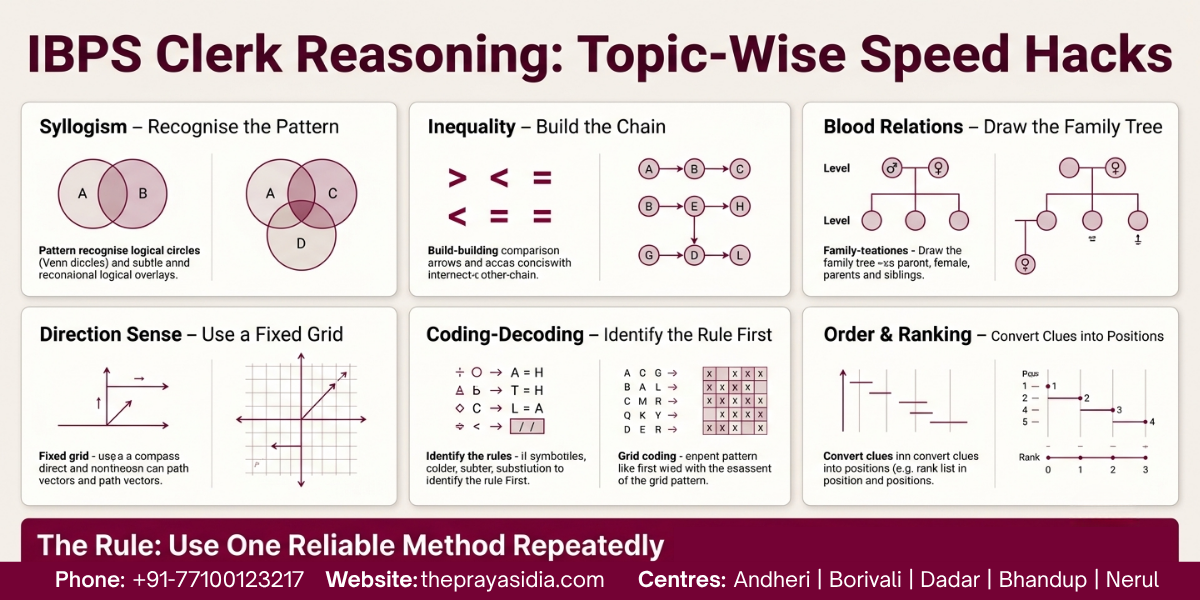
Syllogism: Focus on Recognition
Syllogism can become a high-speed topic once candidates understand the standard relationships between statements and conclusions. The biggest time-saving improvement comes from stopping the habit of reading every conclusion repeatedly without a structured approach.
During practice, identify the statement pattern first and apply the same logical framework consistently. Work on different combinations of “All,” “No” and “Some,” and practise questions where conclusions involve either direct relationships or possibility-based interpretations.
The objective should not be to memorise answers to familiar examples. Instead, you should develop the ability to recognise the logical structure immediately. Once this happens, a topic that initially feels time-consuming can become one of the quicker parts of the Reasoning section.
Inequality: Build Instant Comparison Chains
Inequality questions are another area where systematic notation can significantly improve speed. Instead of processing relationships entirely in your head, create a clear chain using the symbols provided.
For example, if the question establishes relationships between A, B, C and D, connect them systematically and then evaluate the conclusions against the chain. Avoid repeatedly going back to the original statements.
With practice, your brain starts identifying whether a conclusion is directly established, contradicted or impossible from the given relationship. The key is consistency. A standard method reduces both solving time and careless errors.
Blood Relations: Stop Solving Them Verbally
Blood relation questions often become slow when candidates attempt to understand the entire relationship through sentences. A small family diagram is usually more efficient.
Start with the person whose relationship is being established and work backwards or forwards using simple symbols. Mark gender wherever it is relevant and avoid adding unnecessary information to the diagram.
The goal is to convert language into structure. Once the relationship is represented visually, the final answer often becomes obvious.
Direction Sense: Draw Before You Think
Direction-based questions should be approached with a fixed directional framework. Establish North, South, East and West first, and then plot movements according to the information provided.
The important point is not to rely on mental rotation. Mental rotation may work for simple questions, but under examination pressure it increases the possibility of confusion, especially when several turns are involved.
A small diagram usually takes only a few seconds and can save considerably more time than trying to visualise the entire movement mentally.
How to Improve Speed in Puzzles and Seating Arrangement
Puzzles deserve a separate preparation strategy because they can consume a large portion of the available time. Recent IBPS Clerk analyses have shown substantial variation in the number and type of puzzle and seating-arrangement questions across papers, reinforcing the importance of preparing multiple formats rather than mastering only one type.
The first step is to become comfortable with the major frameworks: linear arrangements, circular arrangements, floor-based puzzles, box-based puzzles, day/month scheduling, comparison-based puzzles and other variable arrangements.
Do not immediately practise only the hardest sets. Begin with one-variable arrangements and gradually introduce additional variables. The purpose is to train yourself to recognise the structure quickly.
Step 1: Identify the Frame
Before processing the clues, determine what kind of arrangement you are dealing with. Is it a row, circle, floor, box, schedule or comparison?
Drawing the correct frame immediately reduces mental load.
Step 2: Find the Anchor Clues
Not all clues are equally useful. Some clues provide an exact position, a fixed gap or a strong relationship. These are your anchor clues.
Place definite information first. Avoid starting with vague statements such as “A sits somewhere to the left of B” if another clue gives a fixed position for A or B.
Step 3: Separate Definite and Conditional Information
A common source of confusion is mixing confirmed information with assumptions.
If a clue says that one person may occupy either of two positions, treat those as separate cases rather than selecting one randomly. Create Case 1 and Case 2, and allow subsequent clues to eliminate the incorrect possibility.
Step 4: Read the Questions Strategically
Once an arrangement is sufficiently developed, check what the questions actually require. You do not always need to complete every possible detail before answering a question.
This can be particularly useful when several questions are based on the same arrangement. Once the main structure is established, you should aim to extract all possible answers efficiently instead of repeatedly rebuilding the same puzzle.
The 4-Minute Discipline for Puzzle Practice
A useful training technique is to introduce a time budget for standard puzzle sets. The exact target should depend on your current ability, but the principle is simple: do not allow a single puzzle to consume unlimited time.
During practice, start by solving puzzles without an aggressive timer so that you understand the logical structure. Then introduce a moderate time limit. Once accuracy becomes stable, gradually reduce the time.
If a particular puzzle repeatedly takes much longer than others, do not simply label yourself “weak in puzzles.” Investigate the reason. Perhaps you are choosing the wrong starting clue. Maybe you are writing too much information. Perhaps you are not separating cases properly. Or you may be spending too much time trying to solve every detail before reading the questions.
This kind of diagnosis is far more useful than merely increasing the number of puzzle sets you solve.
How to Use Mock Tests to Increase Reasoning Speed
Mock tests are one of the most effective tools for developing examination speed, but only when they are analysed correctly. Taking a mock every day without reviewing it can create the illusion of preparation without addressing the underlying weaknesses.
After each mock, divide your reasoning questions into four categories:
| Category | What It Means | What You Should Do |
|---|---|---|
| Correct + Fast | Strong area | Maintain through revision |
| Correct + Slow | Knowledge is good, execution needs work | Timed drills |
| Wrong + Concept Known | Carelessness or poor application | Analyse the exact mistake |
| Wrong + Concept Unknown | Genuine weakness | Relearn and practise |
A fifth category is equally important: questions you skipped but could have solved.
These questions can reveal a major opportunity. If you repeatedly skip a particular puzzle type because it looks lengthy, but later solve it comfortably during analysis, your problem may be question selection rather than reasoning ability.
This is why mock analysis should examine not just the score but the decision-making process behind the score.
The “Correct but Slow” Category Is the Most Important for Speed
Many candidates focus only on incorrect questions when analysing a mock. That is necessary, but it is not sufficient for a speed-based examination.
Suppose you correctly solve an inequality question but take 90 seconds when you could eventually reduce the time to 30 seconds. The answer is correct, so the question will not appear in your error analysis. Yet it is still a major source of lost marks because the extra minute could have been used elsewhere.
Create a separate list of questions that you answered correctly but took too long to solve.
For every such question, ask:
- Did I use an unnecessarily complicated method?
- Did I reread the question multiple times?
- Did I fail to recognise the question type immediately?
- Did I make unnecessary calculations or diagrams?
- Could I have eliminated options faster?
- Was I uncertain about the concept?
This analysis turns ordinary practice into targeted speed training.
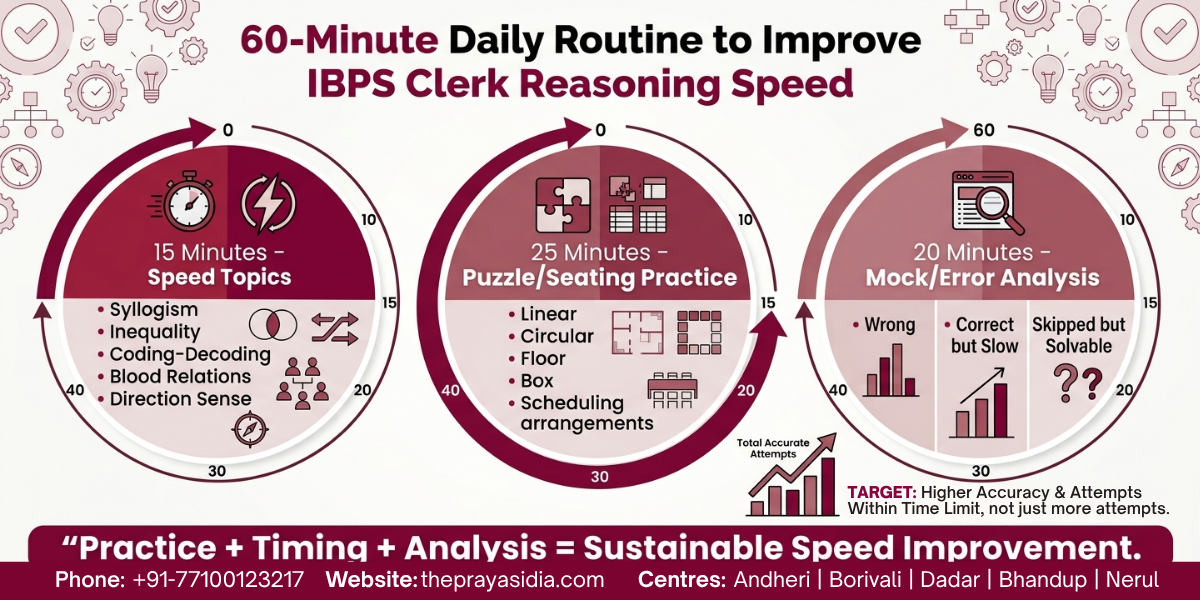
Build a 60-Minute Daily Reasoning Speed Routine
Candidates do not necessarily need to spend several hours every day on Reasoning to improve speed. What matters more is focused practice.
A practical 60-minute session can look like this:
First 15 Minutes: Speed Topics
Practise direct questions from areas such as inequality, syllogism, coding-decoding, blood relations, direction sense and order/ranking. Use a timer and focus on maintaining high accuracy.
Next 25 Minutes: Puzzle or Seating Practice
Choose one or two arrangements according to your level. Focus on the process rather than simply reaching the answer. Note which clue helped you establish the arrangement and where you lost time.
Final 20 Minutes: Analysis
Review the questions you got wrong, questions you solved slowly and questions you skipped unnecessarily.
This final 20-minute analysis can be more valuable than simply solving another set.
A 30-Day Plan to Improve Reasoning Speed
If you are preparing for IBPS Clerk and want a structured speed-building approach, divide the month into four stages rather than trying to improve everything simultaneously.
Days 1–7: Strengthen Fundamentals
Revise the basic concepts of all major reasoning topics. Focus on understanding standard methods rather than chasing speed. Solve topic-wise questions and identify your weakest areas.
Days 8–15: Introduce Timed Practice
Start taking short timed quizzes. Work particularly on direct-scoring topics and begin practising standard puzzle formats under controlled time limits.
Days 16–23: Mixed Reasoning Sets
Move from isolated topics to mixed sets. This is important because the examination does not tell you which question to solve first. You need to recognise the topic and difficulty while moving through the paper.
Days 24–30: Mock-Based Refinement
Take sectional and full-length mocks. Analyse every reasoning section carefully. Track your attempts, accuracy, time distribution and question selection.
By the final stage, you should have a clear understanding of which questions you solve quickly, which topics slow you down and which puzzle types deserve more practice.
What Should Be Your Ideal Reasoning Target?
There is no universal number of attempts that guarantees success because difficulty levels, competition and sectional performance can vary. Candidates should therefore avoid blindly copying someone else’s attempt strategy.
A better benchmark is personal improvement.
If you currently solve 20 questions accurately in the available time, work toward 22. Once 22 becomes stable, target 24. Continue improving while protecting accuracy.
The progression should look like:
20 accurate → 22 accurate → 24 accurate → 26 accurate
The numbers are illustrative, not fixed examination targets. Your actual goal should depend on the paper’s difficulty and your performance across other sections.
The most important principle is that additional attempts are useful only when they remain sufficiently accurate.
How The Prayas India Fits Into Your IBPS Clerk Preparation
Preparing for a competitive banking examination requires more than collecting study material. Candidates need a structured learning environment where concepts, practice, testing and performance analysis work together.
For an IBPS Clerk aspirant, professional bank coaching can help establish this structure. Classroom guidance can make difficult reasoning concepts easier to understand, while regular practice can help students move from concept familiarity to application. Mock tests and performance analysis then provide the feedback needed to improve speed and question selection.
For students searching for bank coaching in Mumbai, The Prayas India offers an exam-oriented preparation environment for banking and other competitive examinations. The objective should not simply be to complete the Reasoning syllabus but to build the ability to use that knowledge effectively under actual examination conditions.
A candidate who understands the concepts but cannot manage time may struggle in the exam. Similarly, a candidate who attempts questions very quickly but makes frequent mistakes will also lose valuable marks. The strongest preparation combines both dimensions: accuracy and speed.
Final Strategy: Make Speed a Skill, Not a Last-Minute Target
Improving speed in IBPS Clerk Reasoning is a gradual process. It begins with conceptual clarity, develops through repeated practice and becomes reliable through timed tests and detailed analysis.
Do not wait until the final weeks before the examination to start working on speed. Every stage of preparation should gradually introduce greater time awareness. Begin with accurate topic-wise solving, move to timed drills, then mixed sets, sectional tests and finally full mocks.
Most importantly, remember that speed is not about rushing through questions. It is about recognising familiar patterns quickly, selecting the right questions, applying efficient methods and knowing when to move on.
For IBPS Clerk aspirants, the ideal Reasoning section is not one in which every question is attempted. It is one in which the maximum possible marks are collected from the available 20 minutes with controlled accuracy.
That is the real difference between merely knowing Reasoning and being exam-ready in Reasoning.
Contact Us
📞 Call Now: +91-77100 13217
🌐 Website: theprayasindia.com
📍 Centres: Andheri | Borivali | Dadar | Nerul | Bhandup
Frequently Asked Questions
1. How can I improve my speed in IBPS Clerk Reasoning?
Start with accuracy, develop standard methods for recurring question types and then introduce timed practice. Focus particularly on question recognition, puzzle selection and mock-test analysis. Regularly track questions that you solve correctly but too slowly.
2. Which IBPS Clerk Reasoning topics should I practise first?
Begin with fundamental topics such as Syllogism, Inequality, Coding-Decoding, Blood Relations, Direction Sense and Order & Ranking, while simultaneously building a strong foundation in Puzzles and Seating Arrangement. Recent preparation analyses consistently identify puzzles and seating arrangements as major areas of focus.
3. How should I practise puzzles for IBPS Clerk?
Learn the basic frameworks first, including linear, circular, floor, box and scheduling arrangements. Identify anchor clues, separate definite information from conditional information and gradually introduce timed practice.
4. Should I solve the easiest reasoning questions first?
Generally, starting with questions that you can recognise and solve confidently can help maximise marks per minute. However, your exact sequence should be tested through mocks because individual strengths and paper difficulty vary.
5. How much time should I spend on Reasoning practice every day?
A focused 60-minute session can be highly productive when divided between speed-topic drills, puzzle practice and analysis. Candidates with more preparation time can increase the duration, but quality and consistency matter more than simply accumulating hours.
6. Why am I still slow even after solving many reasoning questions?
The problem may not be the number of questions you solve. You may be using inefficient methods, spending too long on difficult questions, rereading clues, failing to recognise patterns or not analysing your mistakes. Track the exact source of lost time.
7. Can coaching help improve reasoning speed?
Yes, structured coaching can help by providing standard methods, guided practice, timed tests, doubt resolution and performance feedback. The key is to combine classroom learning with individual practice and mock-test analysis.
8. Is speed more important than accuracy in IBPS Clerk Reasoning?
Neither should be considered in isolation. Speed without accuracy produces unreliable attempts, while accuracy without sufficient speed limits the number of questions you can attempt. The ideal preparation aims for high accuracy at progressively faster solving speeds.