IBPS Clerk English Preparation: How to Improve Accuracy in 30 Days | Best IBPS Clerk Coaching in Mumbai | The Prayas India
English Language can become one of the most scoring sections in the IBPS Clerk examination, but only when preparation focuses on accuracy rather than simply increasing the number of questions attempted. Many aspirants spend hours memorising vocabulary or solving random English questions, yet their mock-test accuracy remains inconsistent because they have not identified the specific reasons behind their mistakes.
A better approach is to treat the next 30 days as an accuracy-building programme. Instead of trying to master everything simultaneously, candidates should identify their weak areas, strengthen the underlying concepts, practise questions under controlled time limits and analyse every incorrect answer. This allows preparation to move from uncertainty to consistency.
For IBPS Clerk aspirants preparing for the upcoming examination, English should not be treated as a subject that can be improved through last-minute practice alone. Grammar, vocabulary, reading comprehension, sentence structure and question interpretation all require repeated exposure. The good news is that accuracy can improve significantly within 30 days when preparation is systematic.
For students looking for IBPS Clerk coaching in Mumbai, structured guidance can make this process more efficient by providing a planned syllabus, regular practice, sectional tests, doubt resolution and performance analysis. The objective is not merely to solve more questions, but to develop the ability to identify the correct answer with confidence and within the time available.
Why Accuracy Matters More Than Attempts in IBPS Clerk English
A common mistake among banking aspirants is to measure progress only by the number of questions they attempt. For example, a student may feel that moving from 20 attempts to 25 attempts automatically represents improvement. It does not.
Suppose a candidate attempts 25 questions but gets five wrong. Another candidate attempts 22 questions and gets only one wrong. Depending on the scoring and paper difficulty, the second candidate may be in a much stronger position because accuracy protects the score.
This is particularly important because objective tests in IBPS examinations carry negative marking for incorrect answers. A candidate therefore needs to develop a habit of asking “Can I answer this correctly?” rather than simply “Can I attempt this?”
Accuracy also has a psychological benefit. When candidates know that they can reliably solve a particular question type, they approach the section with greater confidence. That confidence reduces unnecessary hesitation and helps them make better decisions when the clock is running.
Therefore, the right progression should be:
Concept Clarity → Accuracy → Speed → Question Selection → Higher Attempts
Trying to increase attempts before establishing accuracy often creates careless mistakes and reinforces incorrect solving habits.
The 30-Day Accuracy Framework for IBPS Clerk English
Thirty days is enough to make meaningful progress if the preparation is focused. However, the objective should not be to complete an enormous number of questions. The objective should be to identify weaknesses and systematically eliminate them.
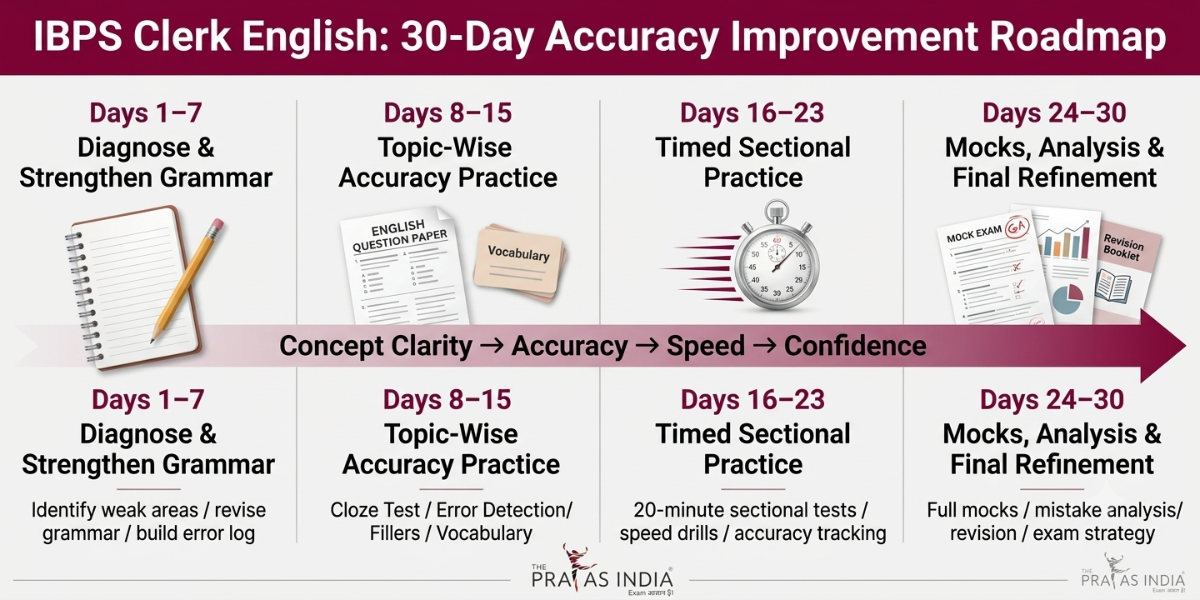
A practical 30-day English preparation plan can be divided into four stages:
| Phase | Days | Primary Objective |
|---|---|---|
| Phase 1 | 1–7 | Diagnose weaknesses and strengthen grammar basics |
| Phase 2 | 8–15 | Topic-wise accuracy building |
| Phase 3 | 16–23 | Timed practice and sectional tests |
| Phase 4 | 24–30 | Mock tests, analysis and final refinement |
This progression prevents candidates from jumping directly into full-length mocks without developing the skills required to perform well.
The first week is about understanding the problem. The second is about fixing it. The third introduces time pressure, while the final week focuses on exam-level execution.
Days 1–7: Diagnose Your English Weaknesses
The first seven days should not be spent trying to solve hundreds of questions. Instead, begin with a diagnostic approach.
Take a short English sectional test or a previous-year-style practice set under timed conditions. Then analyse every incorrect answer. Do not simply write down the correct option. Ask why your answer was wrong.
Was the grammar rule unclear? Did you misunderstand the sentence? Did you select an option because it “sounded correct”? Did you know the vocabulary but misinterpret the context? Did you spend too much time reading the passage?
These questions reveal the actual cause of low accuracy.
Create an English Error Log
Your error log should contain categories such as:
- Subject-verb agreement
- Tenses
- Articles
- Prepositions
- Pronouns
- Conjunctions
- Adjectives and adverbs
- Sentence structure
- Vocabulary
- Contextual meaning
- Reading comprehension
- Cloze test
- Para jumbles
- Careless mistakes
Over several practice sessions, patterns will emerge.
For example, if five of your last ten errors involve subject-verb agreement, spending another hour on unrelated vocabulary may not be the most productive use of your preparation time.
The error log turns preparation into a targeted process.
Strengthen Grammar Before Increasing Question Volume
Grammar forms the foundation of accuracy in many IBPS Clerk English questions. Candidates who have weak grammar often compensate by relying on what “sounds right.” This can work occasionally, but it is unreliable when answer choices are deliberately designed to look similar.
A strong grammar foundation allows you to identify errors logically.
Subject-Verb Agreement
Understand how the subject determines the form of the verb, particularly in sentences containing intervening phrases.
Tenses
Focus on understanding how different tenses communicate time and sequence rather than memorising isolated rules.
Articles
Learn the contextual use of a, an and the, including situations where no article is required.
Prepositions
Build familiarity with common combinations and understand how prepositions function within sentence structures.
Pronouns
Pay attention to antecedents, number and grammatical consistency.
Conjunctions
Understand relationships such as contrast, cause, condition and addition.
The objective is not to become a grammar scholar. It is to become accurate enough to recognise the grammatical logic behind exam questions.
Days 8–15: Build Accuracy Topic by Topic
Once your weak areas are identified, the second phase should focus on topic-wise practice.
Do not mix every English topic into every practice session. Instead, work in focused blocks.
For example, spend one session on Error Detection and Sentence Correction, another on Fillers and Cloze Tests, and another on Reading Comprehension.
This approach makes it easier to identify patterns.
Error Detection and Sentence Correction
These questions reward grammatical understanding and careful reading.
The biggest mistake candidates make is scanning the sentence too quickly and choosing an option based on familiarity. Instead, read the complete sentence and identify the grammatical structure.
Check:
Subject → Verb → Object → Modifier → Connector → Context
Then determine whether the sentence is grammatically and contextually correct.
Do not assume that every question contains an obvious grammatical error. Some questions test whether you can recognise that the sentence is already correct.
Fillers: Use Context Instead of Guessing Vocabulary
Fill-in-the-blank questions are not always pure vocabulary questions.
A candidate may know the meanings of all the options but still select the wrong answer because the word does not fit the sentence’s context.
When solving fillers, read the complete sentence first. Identify whether the blank requires a noun, verb, adjective, adverb or another grammatical form. Then understand the overall meaning.
For multiple blanks, do not necessarily solve them independently. Often, one blank provides contextual information that helps you identify the other.
This is an important distinction between vocabulary knowledge and contextual vocabulary application.
Cloze Test: Read for Meaning Before Choosing Options
Cloze Tests can appear intimidating because several blanks are presented within a passage. However, they become more manageable when you stop treating each blank as an isolated vocabulary question.
Read the passage once to understand its central idea.
Then return to the blanks.
For each blank, consider:
- What grammatical form is required?
- What meaning does the sentence demand?
- Which options fit grammatically?
- Which option fits the broader context?
- Does the selected word maintain the flow of the passage?
This approach reduces random selection.
A word can be grammatically correct but contextually inappropriate. Therefore, always evaluate both grammar and meaning.
Reading Comprehension: Accuracy Begins Before the Questions
Reading Comprehension is often considered time-consuming, but the real problem for many candidates is inefficient reading.
Some candidates read every line multiple times. Others rush through the passage and then return repeatedly because they cannot remember where the information was located.
Develop a balanced reading approach.
Read for:
- Central idea
- Author’s purpose
- Tone
- Important arguments
- Supporting details
- Contrast or comparison
- Conclusion
For factual questions, return to the relevant part of the passage instead of relying entirely on memory.
For inference questions, make sure the inference is supported by the passage. Do not select an option simply because it appears logically possible in the real world.
The question is asking what can be concluded from the passage, not what you personally believe.
Vocabulary: Build Contextual Knowledge, Not Just Word Lists
Vocabulary preparation is often reduced to memorising long lists of words. While learning new words is useful, memorisation without contextual understanding can produce limited results.
Instead of learning a word as:
Word → Meaning
try learning it as:
Word → Meaning → Synonym → Antonym → Example → Context
For example, when learning a new word, use it in a sentence and identify how its meaning changes depending on context.
Also maintain a revision cycle. Words learned today should be reviewed after a few days and then again later.
A smaller vocabulary bank that you can actually recognise and apply is more valuable than a huge list of words that you cannot recall during the examination.
The Difference Between Knowing English and Scoring in English
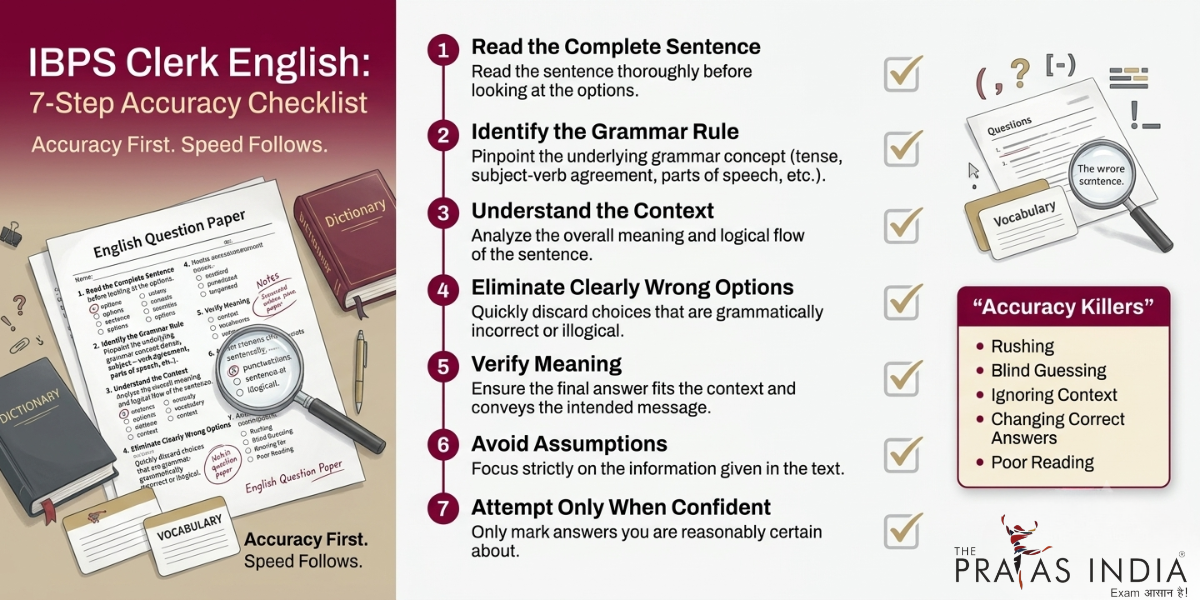
A candidate can know grammar rules and still perform poorly in the IBPS Clerk English section.
Why?
Because examination performance depends on application under time pressure.
You may know the rule for subject-verb agreement but miss an error because you read too quickly. You may know the meaning of a vocabulary word but select the wrong option because the context changes its intended meaning. You may understand Reading Comprehension but lose time because your reading strategy is inefficient.
This is why practice must gradually transition from knowledge-based learning to exam-based application.
The goal during the first two weeks should be to reduce uncertainty.
By the end of the second week, you should be able to recognise common question types and identify your typical errors.
The third and fourth weeks will then focus increasingly on speed, sectional testing and mock analysis.
How to Improve English Accuracy Without Losing Speed
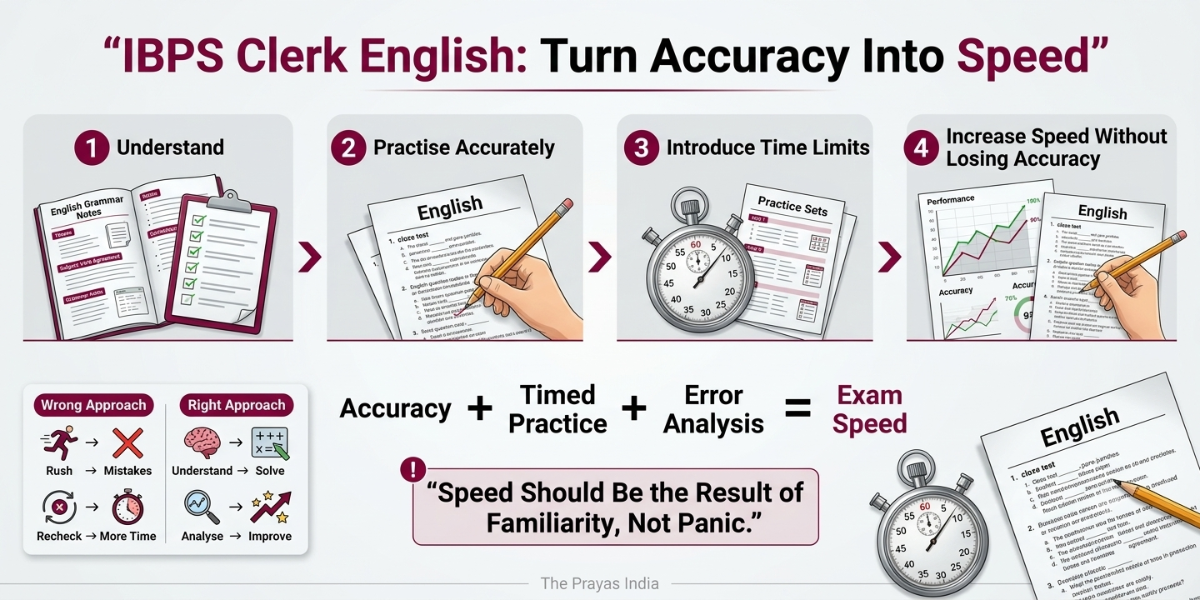
Accuracy and speed are not competing goals. When preparation is structured properly, improving one can eventually improve the other.
A candidate who repeatedly makes mistakes may need to slow down temporarily to understand why those mistakes occur. Once the correct process becomes familiar, speed can be increased gradually.
Consider Error Detection.
Initially, you may need several seconds to check the subject, verb, tense and sentence structure. With repeated practice, these checks become more automatic.
The same principle applies to Reading Comprehension, Cloze Tests and Fillers.
Therefore, do not force speed during the early stages of your 30-day programme. First build the correct mental process, then make that process faster through timed practice.
A Simple Daily Routine for the First 15 Days
A practical daily English routine could include four components.
1. Grammar Revision — 30 Minutes
Revise one focused grammar concept and solve questions based on it.
2. Vocabulary — 20 Minutes
Learn a manageable number of words and revise previously learned vocabulary.
3. Topic Practice — 40–50 Minutes
Choose one or two specific question types and practise them with accuracy as the primary goal.
4. Error Analysis — 20 Minutes
Review mistakes from the day’s practice and update your error log.
The exact duration can be adjusted according to your overall study schedule. The important point is that error analysis should not be skipped.
Without analysing mistakes, candidates often repeat the same errors with increasing speed.
What Aspirants Should Avoid During These 30 Days
Avoid Random Question Practice
Solving hundreds of unrelated questions can create volume without improvement. Practice should have a purpose.
Avoid Learning Too Many New Resources
Constantly switching between books, videos, PDFs and apps can reduce consistency. Choose reliable resources and complete them systematically.
Avoid Memorising Vocabulary Without Revision
Words disappear from memory when they are not reviewed. Build a recurring revision cycle.
Avoid Taking Mocks Without Analysis
The score alone does not explain why you performed poorly.
Avoid Blind Guessing
If you have no conceptual or contextual basis for an answer, random selection can damage accuracy.
Avoid Comparing Your Score Every Day
Your objective is not to beat another aspirant’s mock score. Your objective is to improve your own performance.
Preparing for IBPS Clerk? Structured Guidance Can Make the Difference
For many aspirants, the biggest challenge is not finding study material. It is deciding what to study, in what order, how much to practise and how to measure improvement.
This is where structured bank coaching can become valuable.
A focused coaching programme can provide a planned learning sequence, expert explanations, regular practice, mock tests and performance feedback. For candidates preparing for competitive banking examinations in Mumbai, the right coaching environment can also help maintain consistency throughout the preparation cycle.
The Prayas India focuses on exam-oriented preparation for banking aspirants, helping students work systematically on concepts, practice, speed and accuracy.
For IBPS Clerk English specifically, structured guidance can help candidates understand why an option is correct rather than simply memorising the answer. This distinction becomes important as questions increasingly require contextual understanding and careful interpretation.
What Makes a Good IBPS Clerk Coaching Programme?
Before joining any coaching institute, aspirants should evaluate the actual preparation system rather than relying only on promotional claims.
A useful programme should provide:
- Structured subject-wise preparation
- Concept-focused classes
- Topic-wise practice
- Previous-year question exposure
- Sectional tests
- Full-length mock tests
- Detailed performance analysis
- Doubt-solving support
- Revision planning
- Exam-oriented time-management strategies
The objective should be to create a preparation ecosystem where students can identify their weaknesses and systematically work on them.
For an aspirant struggling with English accuracy, this might mean identifying recurring grammar errors. For another student, it could involve improving reading speed or contextual vocabulary. The preparation approach should therefore be adaptable to individual performance.
Days 16–20: Transition From Accuracy to Speed
By Day 16, you should have a clearer understanding of your English strengths and weaknesses. Your error notebook should show which grammar concepts repeatedly cause problems, which question types consume excessive time and where careless mistakes occur.
Now introduce timed practice.
The purpose of timed practice is not to create panic. It is to teach your brain to make decisions under limited time.
Start with short practice sessions. For example, instead of attempting an entire English section immediately, solve a small set of Error Detection questions within a predetermined time. Then repeat the exercise with Fillers, Cloze Tests or Reading Comprehension.
Once you become comfortable, increase the length of the timed sessions.
A Useful Speed-Building Cycle
Use the following sequence:
Untimed Practice → Timed Practice → Accuracy Check → Error Analysis → Repeat
If accuracy falls dramatically when you introduce the timer, do not simply practise faster. First identify why accuracy is falling.
Are you:
- Reading questions incompletely?
- Skipping important contextual clues?
- Selecting options too quickly?
- Spending too much time on difficult questions?
- Changing correct answers because of doubt?
The solution depends on the cause.
How to Improve Error Detection Speed
Error Detection questions can become relatively quick once you develop a systematic scanning method.
Instead of reading every word with equal attention, train yourself to check the sentence structure in a logical order.
Step 1: Check the Subject and Verb
Look for subject-verb agreement, especially when additional phrases appear between the subject and verb.
Step 2: Check the Tense
Determine whether the tense is appropriate for the time reference and overall sentence meaning.
Step 3: Check Pronouns
Make sure pronouns agree appropriately with the nouns they refer to.
Step 4: Check Articles and Prepositions
Look for incorrect or missing articles and inappropriate prepositions.
Step 5: Check Context and Meaning
Even if the grammar appears correct, ensure that the sentence makes contextual sense.
This structured approach gradually reduces the amount of time you need to spend on each sentence.
Days 21–23: Start Full Sectional Tests
The third week should bring your preparation closer to actual examination conditions.
Take regular English sectional tests under a strict time limit. Do not pause the test to check vocabulary or grammar rules. Treat each test as a performance exercise.
After completing the test, calculate more than your score.
Track:
| Metric | What It Tells You |
|---|---|
| Total Attempts | Your current solving capacity |
| Correct Answers | Actual scoring performance |
| Accuracy | Reliability of your answers |
| Average Time | Overall efficiency |
| Time-Consuming Questions | Selection problems |
| Concept Errors | Knowledge gaps |
| Careless Errors | Execution problems |
| Skipped Solvable Questions | Confidence/recognition issues |
This analysis helps you distinguish between a knowledge problem and a performance problem.
For example, if you understand most grammar questions but take too long to solve them, your problem is speed. If you solve quickly but make frequent errors, your problem is accuracy. If you leave questions that you could easily have solved, your problem may be question recognition.
How to Improve Reading Comprehension Accuracy and Speed
Reading Comprehension can have a significant impact on your English sectional performance because it tests more than vocabulary. It requires reading efficiency, contextual understanding, inference and attention to detail.
One of the most common mistakes is reading the passage too slowly because the candidate is trying to understand every sentence perfectly. Another mistake is rushing through it and then repeatedly returning to the passage because important information was missed.
The ideal approach lies between these extremes.
Read the passage with a purpose. Try to understand the central theme, author’s viewpoint, tone, major arguments and important transitions.
Words such as however, therefore, although, in contrast, consequently can provide useful clues about how the argument is developing.
For factual questions, go back to the relevant portion of the passage rather than relying entirely on memory. For inference-based questions, make sure the conclusion is supported by the passage.
Most importantly, do not bring outside knowledge into an inference question. The answer must be derived from the information and reasoning presented in the passage.
A Practical Reading Comprehension Method
Try the following four-step method:
Read
Understand the broad idea rather than memorising every sentence.
Identify
Notice the central argument, tone and key supporting points.
Locate
Return to the relevant section when answering detail-based questions.
Verify
Check whether the chosen option is directly supported or logically inferred from the passage.
This method can improve both speed and accuracy because it prevents unnecessary rereading.
Improve Vocabulary Without Spending Hours Memorising Words
Vocabulary preparation should continue throughout the 30-day programme, but it should become more focused during the final two weeks.
Rather than trying to memorise hundreds of new words, prioritise words that repeatedly appear in banking-exam material, newspapers, previous-year questions and quality practice sets.
Create a compact vocabulary revision sheet containing:
- Word
- Meaning
- Synonym
- Antonym
- Example sentence
- Common usage
For difficult words, create associations or contextual examples that make them easier to remember.
Revision is more important than accumulation.
A candidate who knows 300 words well can often perform better than someone who has memorised 1,000 words but cannot recognise them under examination pressure.
Days 24–27: Full-Length Mock Tests and Deep Analysis
During the fourth week, full-length mocks should become an important part of your preparation.
However, taking mock tests is only half the process.
The real improvement comes from mock analysis.
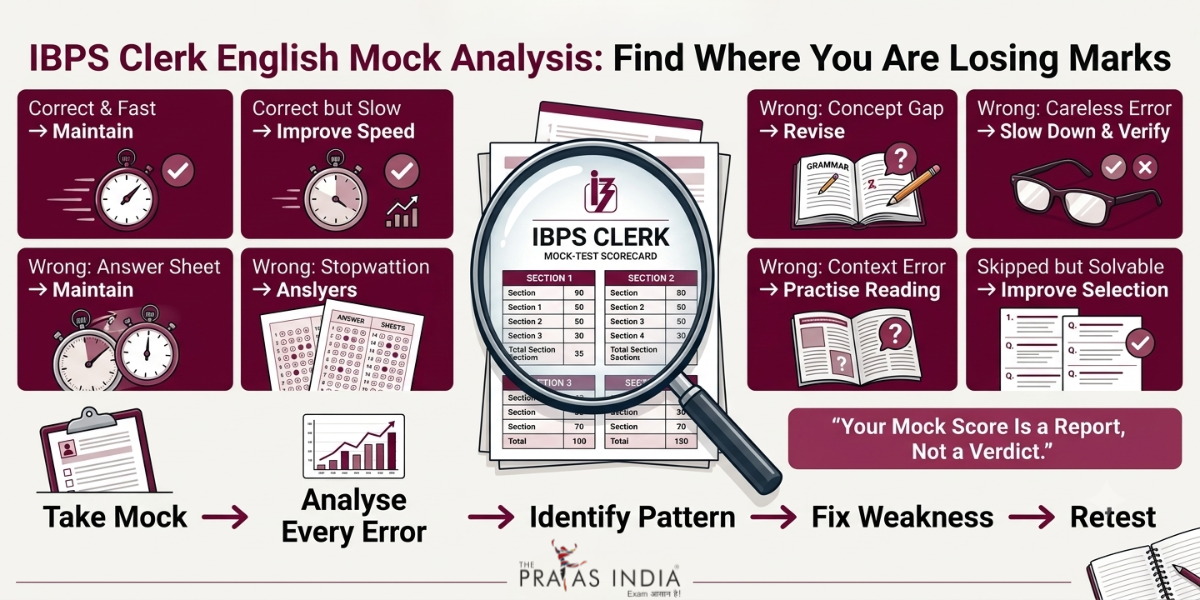
After each test, classify your English questions into categories:
Correct and Fast
These indicate your strongest areas.
Maintain them through regular revision.
Correct but Slow
These are opportunities for speed improvement. Re-solve them and look for a more efficient approach.
Incorrect Due to Concept
Return to the relevant grammar, vocabulary or comprehension concept.
Incorrect Due to Carelessness
Identify exactly what went wrong. Was the question misread? Did you overlook a word? Did you choose an answer without checking the sentence?
Incorrect Due to Context
These errors often occur in Fillers, Cloze Tests and Reading Comprehension. Practise understanding the broader meaning rather than solving individual words mechanically.
Skipped but Solvable
This category can reveal missed scoring opportunities. Work on recognising such questions more confidently.
Don’t Just Record Your Mock Score
Suppose your English sectional score increases from 19 to 22. That is useful, but it does not explain why you improved.
Your analysis should answer more specific questions.
Did accuracy improve?
Did solving speed improve?
Did you make fewer careless mistakes?
Did you spend less time on Reading Comprehension?
Did you improve question selection?
These metrics provide much more actionable information.
For example, if your score improves because you attempted more questions but your accuracy falls, the improvement may not be sustainable. If your attempts remain similar but your accuracy increases significantly, your preparation is moving in a healthier direction.
Days 28–30: Final Refinement and Exam Readiness
The last three days should not be used for aggressive syllabus expansion.
At this point, you should know your strengths and weaknesses. The goal is to consolidate your preparation and enter the examination with a stable strategy.
Revise your grammar notes, vocabulary list and error notebook. Review the question types that repeatedly caused problems during your mocks.
If a particular grammar concept has repeatedly created mistakes, revise it again. If Reading Comprehension is consuming too much time, practise one or two passages using your refined approach.
Do not introduce multiple new resources simply because the examination is close.
Your final days should be about confidence through familiarity, not anxiety through information overload.
How to Set a Realistic Accuracy Target
Accuracy targets should be based on your current performance rather than an unrealistic ideal.
If your current accuracy is around 70%, trying to suddenly reach 95% may create unnecessary pressure. Instead, establish progressive milestones.
For example:
Week 1: Identify and reduce repeated errors.
Week 2: Build toward consistent accuracy during topic-wise practice.
Week 3: Maintain accuracy under sectional time pressure.
Week 4: Replicate that performance in full-length mocks.
The exact percentage will differ from candidate to candidate. The important point is that accuracy should remain stable when time pressure increases.
A strong preparation indicator is not simply achieving a high score once. It is achieving consistent performance across multiple tests.
The Right Balance Between Speed and Accuracy
Speed and accuracy should not be treated as opposite goals.
A candidate who solves 20 questions with very high accuracy but cannot complete the section may need to improve speed. Another candidate who attempts 30 questions but makes frequent mistakes needs accuracy improvement.
The ideal candidate gradually moves toward a point where familiar questions are solved quickly, difficult questions are identified early and unnecessary time is not wasted.
This is why question selection is so important.
You do not need to become equally fast at every type of question. You need to become fast at recognising which questions deserve your attention.
Common Mistakes That Reduce IBPS Clerk English Accuracy
1. Choosing Answers Because They “Sound Right”
English questions often contain options that appear natural but are grammatically incorrect or contextually inappropriate.
Always identify the reason behind your answer.
2. Ignoring Context
A word may be grammatically correct but still fail to fit the meaning of the sentence.
Context should guide your decision.
3. Overthinking Simple Questions
Sometimes candidates identify the correct answer immediately and then talk themselves out of it.
If your answer is supported by the grammar or passage, do not change it merely because another option appears attractive.
4. Spending Too Much Time on One Question
A difficult question can become expensive when it consumes time that could have been used for several easier questions.
Learn to move on.
5. Taking Mocks Without Analysing Them
A mock test cannot improve your performance automatically. The analysis that follows it is where the learning happens.
6. Ignoring Previous-Year Questions
Previous-year questions help candidates understand the type of concepts, language and question structures that repeatedly appear in competitive banking examinations.
7. Constantly Changing Study Material
Choose dependable resources and follow them systematically rather than collecting large amounts of material.
Previous-Year Questions Should Be Part of Your 30-Day Strategy
Previous-year questions are particularly useful because they expose you to the style and difficulty of actual competitive-exam questions.
Use them not just for testing but for learning.
When you encounter an unfamiliar grammar construction, understand the rule behind it. When a vocabulary question is difficult, add useful words to your revision list. When an RC question is confusing, analyse why the correct option is supported by the passage.
Over time, previous-year questions become a bridge between conceptual preparation and actual examination thinking.
How Professional IBPS Clerk Coaching Can Help Improve English Accuracy
Self-study can be effective when a candidate has strong discipline, reliable resources and the ability to evaluate their own performance objectively. However, many aspirants struggle not because they are unwilling to study but because they lack a structured preparation system.
This is where professional coaching can provide additional value.
A well-designed IBPS Clerk coaching programme can organise the syllabus, provide topic-wise practice, introduce sectional testing at the right stage and help students identify performance gaps.
For an English section specifically, guided preparation can help candidates understand the difference between knowing a grammar rule and applying it under time pressure.
For students searching for the best IBPS Clerk coaching in Mumbai, The Prayas India focuses on structured bank-exam preparation with an emphasis on concepts, practice, speed, accuracy and examination strategy.
What to Look for Before Joining IBPS Clerk Coaching in Mumbai
Choosing a coaching institute is an important decision, particularly if you are preparing for a competitive banking examination where consistency over several months matters.
Before enrolling, consider whether the institute provides:
Structured Curriculum
The syllabus should be organised logically rather than taught as disconnected topics.
Experienced Faculty
Teachers should be able to explain not just the answer but the reasoning and method behind it.
Regular Tests
Frequent sectional and full-length tests help candidates become comfortable with examination pressure.
Detailed Performance Analysis
Tests should help you understand your weaknesses rather than simply produce a score.
Doubt Resolution
Students should have opportunities to clarify concepts they repeatedly struggle with.
Revision Support
Important concepts should be revisited instead of being taught once and forgotten.
Exam-Oriented Preparation
The preparation should reflect the actual demands of banking examinations, including time management and question selection.
For an aspirant in Mumbai, these factors can help determine whether a coaching programme is genuinely useful for their preparation or simply offers a large amount of study material.
Why Choose The Prayas India for IBPS Clerk Preparation?
The Prayas India focuses on helping competitive-exam aspirants prepare through a structured and exam-oriented approach. For banking aspirants, the objective is to connect concept learning, practice, testing and performance improvement rather than treating them as separate activities.
For IBPS Clerk English, this approach can be particularly valuable because accuracy develops through repeated application.
A student may understand a grammar rule during a class, but real improvement happens when that rule is applied across practice questions, sectional tests and full-length mocks. When mistakes are tracked and revisited, the candidate gradually becomes more consistent.
The same process applies to vocabulary and Reading Comprehension. The goal is to make correct decision-making increasingly automatic.
For aspirants looking for IBPS Clerk coaching in Mumbai, structured guidance can also provide accountability. A defined study schedule, regular tests and performance reviews can make it easier to remain consistent during preparation.
Your 30-Day IBPS Clerk English Strategy in One Framework
If the entire article is condensed into one preparation framework, it looks like this:
Days 1–7:
Diagnose weaknesses → Revise grammar → Start error log
Days 8–15:
Practise individual topics → Build contextual vocabulary → Improve accuracy
Days 16–20:
Introduce timed practice → Improve solving speed → Maintain accuracy
Days 21–23:
Take sectional tests → Analyse time usage → Refine question selection
Days 24–27:
Take full mocks → Analyse every error → Fix recurring weaknesses
Days 28–30:
Revise → Practise strategically → Finalise exam approach
The most important part is that these stages should overlap. You should continue revising grammar while taking mocks, and you should continue analysing errors even during the final days.
Preparation is not a collection of isolated tasks. It is a continuous improvement cycle.
Final Takeaway: Make Accuracy Your Competitive Advantage
Improving IBPS Clerk English accuracy in 30 days is possible when preparation is approached systematically.
You do not need to memorise every grammar rule, learn thousands of vocabulary words or solve an unlimited number of questions. What you need is a focused approach that identifies your weaknesses, strengthens the relevant concepts and repeatedly tests your ability to apply them.
The first 15 days should build your foundation. The next 15 should transform that foundation into speed, consistency and exam-level performance.
Remember the progression:
Learn → Practise → Analyse → Correct → Time Yourself → Test Again
Do not measure your preparation only by the number of questions you solve. Measure it by how many mistakes you eliminate and how consistently you can reproduce your performance under time pressure.
For aspirants preparing for IBPS Clerk in Mumbai, structured coaching can provide additional support through organised learning, practice, testing and performance analysis. The Prayas India aims to help banking aspirants develop these skills through an exam-focused preparation environment.
Your objective should not be to become perfect in 30 days.
Your objective should be to become more accurate, more confident and more consistent every day for 30 days.
That is how English can move from being a source of uncertainty to becoming one of your scoring areas in IBPS Clerk.
Contact Us
📞 Call Now: +91-77100 13217
🌐 Website: theprayasindia.com
📍 Centres: Andheri | Borivali | Dadar | Nerul | Bhandup
Frequently Asked Questions
1. Can I improve my IBPS Clerk English accuracy in 30 days?
Yes. Thirty days can be sufficient to make meaningful improvement if you already have some basic familiarity with English and follow a structured plan. Focus on identifying repeated errors, strengthening grammar, improving contextual vocabulary, practising question types and analysing mocks.
2. How should I start IBPS Clerk English preparation?
Begin with a diagnostic test to identify your strengths and weaknesses. Then revise fundamental grammar concepts, build a targeted vocabulary list and start topic-wise practice. Maintain an error log from the beginning.
3. Which English topics should I focus on for IBPS Clerk?
Your preparation should cover the major question types relevant to the examination, including Reading Comprehension, Cloze Tests, Fillers, Error Detection, Sentence Improvement, Para Jumbles, vocabulary and grammar-based questions. Prioritise topics based on your mock-test performance.
4. How can I improve English accuracy without reducing speed?
First establish the correct solving process through untimed practice. Once accuracy becomes stable, gradually introduce time limits. Speed should come from familiarity and efficient decision-making rather than rushing.
5. How many English questions should I practise daily?
There is no universal number. Quality matters more than volume. Your daily practice should include topic-wise questions, vocabulary/grammar revision and sufficient time for analysing mistakes.
6. How can I improve Reading Comprehension for IBPS Clerk?
Practise reading passages regularly and focus on identifying the central idea, tone, arguments and supporting details. For questions, rely on the information provided by the passage rather than outside assumptions.
7. Should I join IBPS Clerk coaching in Mumbai?
It depends on your preparation style and requirements. Self-study can work for disciplined candidates, while structured coaching can be valuable for students who need a planned curriculum, faculty guidance, regular tests, doubt resolution and performance analysis.
8. How important are mock tests for IBPS Clerk English?
Mock tests are important because they help you evaluate accuracy, speed, question selection and time management under exam-like conditions. However, the analysis after the mock is just as important as taking the test itself.
9. How can The Prayas India help with IBPS Clerk preparation?
The Prayas India provides structured preparation for banking examinations, with an emphasis on concepts, practice, testing, speed, accuracy and exam strategy. This can help aspirants build a more organised preparation routine.