
Common Mistakes That Reduce SBI Clerk Prelims Scores | Best Bank Coaching in Mumbai | The Prayas India
SBI Clerk Prelims is often described as a speed-based examination, but speed alone does not determine the final score. Two candidates with similar preparation can perform very differently because of the decisions they make during the paper.
One candidate may know the concepts but spend too much time on a difficult question. Another may attempt questions too quickly and lose marks through avoidable errors. Someone else may prepare extensively but fail to analyse mock tests, meaning the same mistakes continue from one test to another.
These are not necessarily major knowledge gaps. They are execution mistakes.
For SBI Clerk Prelims, the difference between a good attempt and an inefficient attempt often comes down to how well you manage three things:
Question selection + Speed + Accuracy
The good news is that these mistakes can be identified and corrected during preparation. Once you know where your score is leaking, you can build specific habits to prevent those losses.
Why Small Mistakes Matter in SBI Clerk Prelims
SBI Clerk Prelims is highly competitive. Candidates often prepare the same syllabus, practise similar question types and take multiple mock tests. As a result, small differences in execution can have a meaningful impact on performance.
Consider a candidate who makes five avoidable calculation errors.
Another candidate spends several minutes on one difficult puzzle and consequently leaves easier questions.
A third candidate knows the English concepts but reads questions too quickly and misses important words.
Individually, these may look like minor issues.
Together, they can significantly reduce the number of correct attempts.
This is why preparation should not focus only on learning more topics. It should also focus on removing score-reducing habits.
Mistake 1: Treating Every Question as Equally Important
One of the most common mistakes in SBI Clerk Prelims is approaching the paper sequentially and assuming that every question deserves the same amount of attention.
It does not.
A direct simplification question, an easy grammar-based question and a complicated puzzle may all carry the same marks, but they do not require the same amount of time.
If you spend too long on a difficult question, you are effectively giving up the opportunity to solve easier questions elsewhere.
This is where question selection becomes important.
Instead of asking:
“Can I solve this question?”
ask:
“Is solving this question the best use of my time right now?”
That small change in thinking can improve your overall attempt strategy.
Build a Quick Question Hierarchy
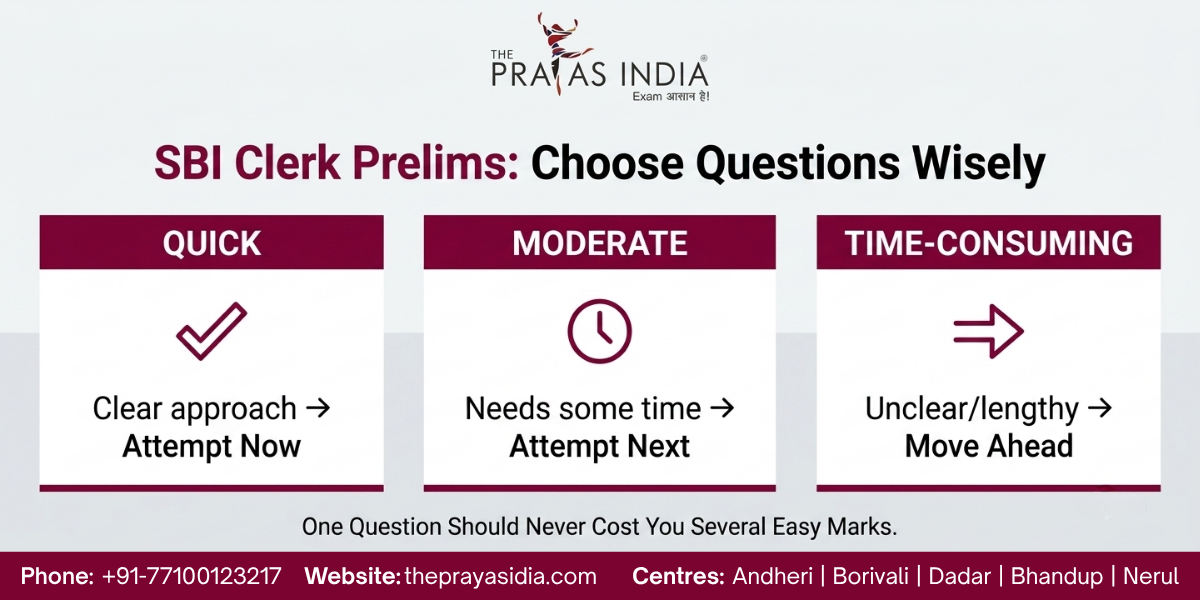
During practice, train yourself to classify questions into three broad categories.
Quick Questions
The method is immediately visible and the calculation is manageable.
Attempt early.
Moderate Questions
The approach is clear but requires some time.
Attempt after securing quick marks.
Time-Consuming Questions
The question involves lengthy calculations, complicated conditions or an unclear approach.
Leave temporarily and return if time permits.
This classification should become automatic through repeated timed practice.
Mistake 2: Spending Too Long on One Question
This mistake is particularly dangerous because candidates often do not realise how much time they are losing.
You begin a question thinking it will take 30 seconds.
Then you encounter an unexpected calculation.
You try another method.
You make an error.
You restart.
Suddenly two minutes have disappeared.
The problem becomes even bigger when this happens repeatedly.
The solution is not to panic or rush through every question. Instead, develop a mental exit point.
If you have spent reasonable time and still do not see a clear path, move ahead.
Skipping a question is not a sign of weakness.
In a competitive examination, it can be a sign of good strategy.
Mistake 3: Chasing Speed Before Building Accuracy
Speed is important in SBI Clerk Prelims, but trying to become faster before becoming accurate can create another problem.
Suppose you currently solve 25 questions with 90% accuracy.
You decide that you need to attempt 35.
You start rushing.
Your attempts increase, but your accuracy falls significantly.
The result may not improve.
This is why speed should be developed progressively.
A better sequence is:
Understand → Practise → Build Accuracy → Add Time Pressure → Increase Speed
First become comfortable with the question type.
Then introduce timing.
Finally, work on reducing the time required without compromising accuracy.
Mistake 4: Ignoring Calculation Errors in Quantitative Aptitude
Many Quant candidates understand the concept but lose marks because of basic calculation mistakes.
These can include:
- Incorrect addition or subtraction
- Multiplication errors
- Wrong percentage conversion
- Misreading decimal values
- Sign errors
- Incorrect unit conversion
- Copying a number incorrectly
- Making a calculation too complicated
These errors are particularly frustrating because the candidate often knows how to solve the question.
The problem is execution.
The solution is not simply “calculate faster.”
It is to develop calculation discipline.
Build Calculation Discipline
During practice, pay attention to how you calculate.
If you repeatedly make mistakes in percentages, spend dedicated practice time on percentage-fraction conversions.
If multiplication is slowing you down, improve your number familiarity.
If DI calculations are causing errors, practise approximation and comparison techniques where appropriate.
Also develop the habit of checking the question before finalising the answer.
A two-second verification can sometimes prevent an avoidable mistake.
Mistake 5: Not Understanding the Difference Between Speed and Rushing
Speed means completing a task efficiently.
Rushing means attempting it without sufficient control.
These are very different.
A fast candidate reads carefully, recognises the method and executes it efficiently.
A rushed candidate may:
- Misread the question
- Miss a negative word
- Select the wrong option
- Make a calculation error
- Forget a condition
- Click an incorrect answer
Therefore, when your mock score is low, do not automatically conclude:
“I need to solve faster.”
Ask first:
“Did I lose marks because I was slow, or because I was careless?”
The solution will be different.
Mistake 6: Reading English Questions Too Quickly
English is often considered one of the easier sections in SBI Clerk Prelims, but that assumption can create careless mistakes.
Candidates may rush through:
- Error detection
- Fillers
- Sentence improvement
- Reading comprehension
- Cloze tests
- Phrase replacement
A single word can change the meaning of a question.
Words such as not, except, incorrect, most appropriate and least require particular attention.
Speed should come from familiarity with patterns, not from skipping words.
Reading Comprehension: Avoid Two Extremes
Some candidates read every sentence extremely slowly.
Others read the passage so quickly that they have to return repeatedly to find information.
Both approaches can waste time.
Develop a middle path.
Read with a purpose.
Identify:
- Central idea
- Tone
- Important arguments
- Relationships between ideas
- Relevant details
Then answer the questions using the passage strategically.
Regular RC practice can gradually improve both reading speed and comprehension.
Mistake 7: Attempting the Reasoning Section Without a Plan
Reasoning is not necessarily difficult because every question is complicated.
The bigger challenge is that some question types can consume a lot of time.
Puzzles and seating arrangements are common examples.
A candidate may see a familiar-looking puzzle and immediately start solving it without assessing the setup.
This can be costly.
Before committing to a puzzle, quickly consider:
How many conditions are there?
Can I establish the arrangement quickly?
How many questions are attached to the set?
Does the information look manageable?
Do I have a clear starting point?
If the answer is uncertain, move ahead and look for another scoring opportunity.
Mistake 8: Not Practising Sectional Timing
Many aspirants take full-length mocks but do not practise individual sections under strict timing.
This can slow down improvement.
Sectional tests allow you to isolate specific problems.
If Quant is taking too long, practise Quant separately.
If Reasoning accuracy is low, focus on Reasoning.
If English attempts are low despite good accuracy, work on speed.
A combination of:
Topic Tests → Sectional Tests → Full-Length Mocks
creates a more effective preparation cycle.
Mistake 9: Taking Mock Tests Without Analysing Them
A mock test is not complete when you see the score.
The real learning starts after the test.
Suppose you score 68.
The score alone tells you very little.
You need to know:
- How many questions did you attempt?
- How many were incorrect?
- Which section caused the most errors?
- Which questions took too long?
- Which easy questions were missed?
- How many errors were conceptual?
- How many were careless?
- Did you spend too long on one set?
- Did your section order work?
Without this analysis, you may repeat the same mistakes in your next mock.
Create a Mistake Log
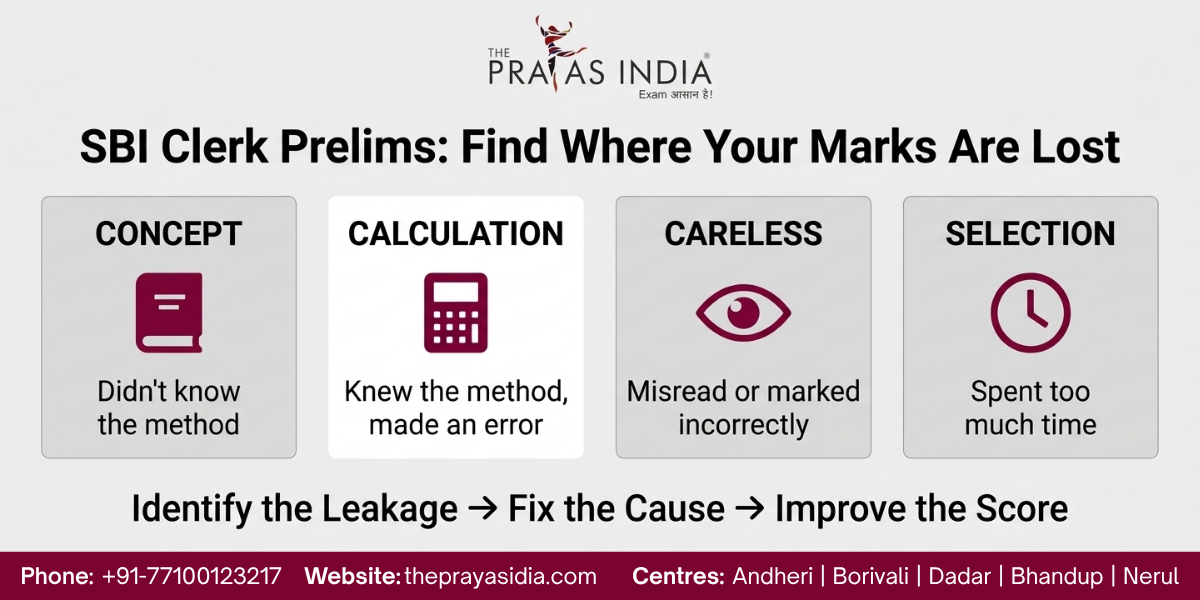
Maintain a simple mistake log with four categories:
Conceptual Mistake
You did not know how to solve the question.
Calculation Mistake
You knew the method but calculated incorrectly.
Careless Mistake
You knew the answer but misread or marked incorrectly.
Selection Mistake
You chose a question that consumed too much time.
This classification is powerful because each problem requires a different solution.
Conceptual mistakes → Learn the concept
Calculation mistakes → Practise calculations
Careless mistakes → Improve checking discipline
Selection mistakes → Improve question selection
Mistake 10: Copying Someone Else’s Attempt Strategy
You may see a topper saying:
“I always attempt Reasoning first.”
Or:
“English should always be attempted first.”
Or:
“You must attempt 80+ questions.”
These statements may describe someone’s personal strategy.
They are not necessarily your strategy.
Your ideal attempt order depends on your preparation and the actual paper.
A candidate with excellent English and moderate Reasoning may benefit from a different approach than someone whose strongest section is Reasoning.
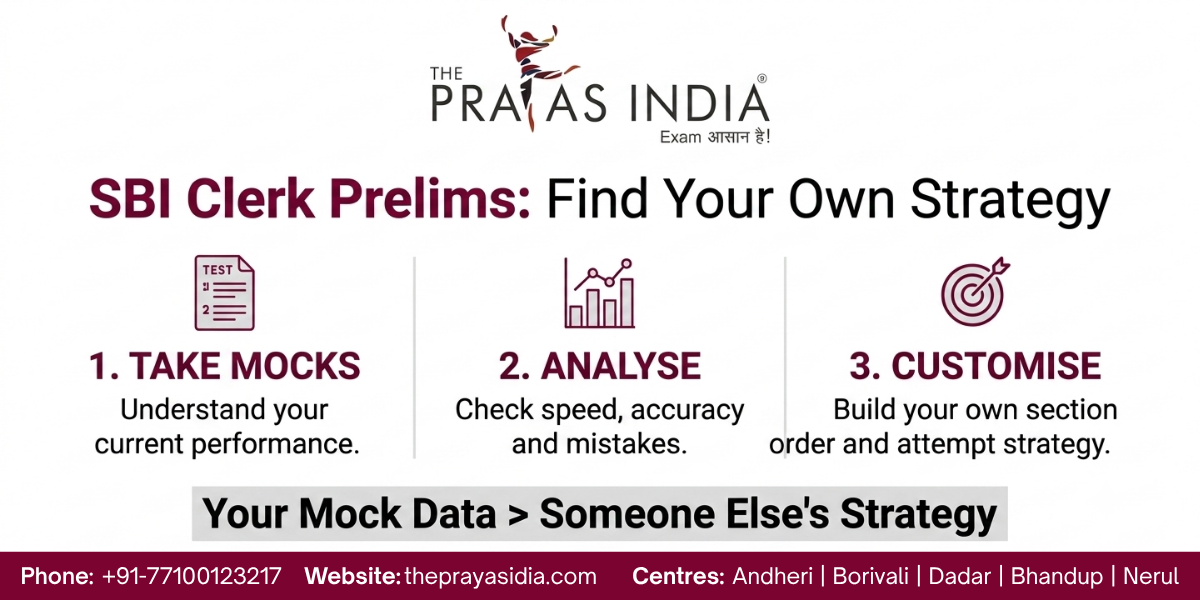
Use other candidates’ strategies as ideas.
Use your mock-test data as evidence.
A Better Way to Think About SBI Clerk Prelims Preparation
Instead of asking:
“How many questions should I attempt?”
start asking:
“How many questions can I attempt accurately within the available time?”
This shift is important.
A candidate attempting 70 questions at high accuracy may perform better than a candidate attempting 80 with several avoidable errors.
Similarly, a candidate attempting fewer questions initially may improve significantly once calculation speed and question selection improve.
The goal should be controlled improvement.
Key Takeaway
Most SBI Clerk Prelims score losses do not always come from a lack of knowledge.
They can come from:
Poor question selection.
Spending too long on difficult questions.
Rushing for speed.
Calculation errors.
Careless reading.
Poor puzzle selection.
Insufficient sectional practice.
Taking mocks without analysis.
Repeating the same mistakes.
Copying someone else’s strategy.
The first step towards improving your score is identifying which of these problems is affecting your preparation.
Start With a Mistake Audit
Before changing your preparation strategy, analyse your last few mock tests.
Do not look only at the total score.
Instead, make a list of every incorrect or unnecessarily time-consuming question and classify it.
| Mistake Type | What It Means | What You Should Do |
|---|---|---|
| Conceptual | Method was unclear | Revise the concept |
| Calculation | Method was right, calculation wrong | Practise calculations |
| Careless | Misread or marked incorrectly | Improve checking |
| Selection | Spent too much time | Improve question selection |
| Time Pressure | Could not reach questions | Improve speed and sequencing |
After analysing three to five mocks, you will usually see a pattern.
Perhaps most of your Quant mistakes are calculation-related.
Perhaps your Reasoning score falls because you choose lengthy puzzles.
Perhaps English accuracy drops when you rush.
Once you identify the pattern, your preparation becomes much more focused.
Don’t Treat Every Wrong Answer the Same Way
A wrong answer is not always evidence that you need to study the topic again.
Consider two situations.
You answer a percentage question incorrectly because you do not understand the underlying concept.
That requires conceptual revision.
Now consider another percentage question where you know the method but calculate 15% as 0.015 instead of 0.15.
Repeating the concept may not solve the problem.
You need calculation practice and greater attention during execution.
This distinction can save considerable preparation time.
Build a “Score Leakage” Sheet
A simple score-leakage sheet can help you understand exactly where marks are disappearing.
For every mock, record:
Conceptual errors
Calculation errors
Careless errors
Wrong question selection
Questions left due to time
Questions you could have solved but skipped
After several mocks, calculate which category is responsible for the highest number of lost marks.
That category should become your immediate priority.
For example, if you lose eight marks because of careless errors but only two because of conceptual gaps, spending another week learning new concepts may not be the best use of your time.
You need to reduce carelessness first.
Improve Accuracy Before Increasing Attempts
A common preparation mistake is setting an attempt target too early.
A candidate may decide:
“I need to attempt 75+ questions.”
But the more useful question is:
“What is my accuracy at 60, 65, 70 or 75 attempts?”
Your mock analysis should reveal the relationship between attempts and accuracy.
For example:
| Attempts | Accuracy | Observation |
|---|---|---|
| 60 | 95% | Very controlled |
| 65 | 93% | Strong |
| 70 | 87% | More risk |
| 75 | 78% | Excessive guessing/errors |
In such a case, simply pushing attempts to 75 may not be beneficial.
The objective is to identify the optimal attempt range where your speed and accuracy work together.
Avoid Guessing Just to Increase Attempts
Attempting a question without a reasonable basis can damage your performance, particularly when negative marking applies.
Before answering an uncertain question, consider:
Do I understand the question?
Can I eliminate options confidently?
Do I have a reasonable basis for selecting an answer?
If the answer is no, moving ahead may be better.
Smart candidates are not necessarily those who attempt the most questions.
They are the ones who understand when an attempt is worth the risk.
Section-Wise Mistake Correction Strategy
The three SBI Clerk Prelims sections require different correction methods.
English Language: Correct the Reading Habit
If English errors are primarily caused by rushing, do not simply solve more questions.
Instead, practise controlled reading.
For example, while solving error detection, consciously read the complete sentence before looking at the options.
For Reading Comprehension, avoid repeatedly going back to the passage because you did not understand the central idea initially.
For fillers and vocabulary-based questions, develop familiarity through regular revision.
The goal is to make your reading process faster without becoming careless.
Quantitative Aptitude: Build Calculation Confidence
If Quant is your weak area, identify whether the problem is conceptual or computational.
For conceptual gaps, revise the relevant topic and solve basic questions first.
For calculation problems, practise:
- Tables
- Squares
- Cubes
- Fraction-percentage conversions
- Approximation
- Mental calculations
- Basic arithmetic
- Percentage calculations
- Ratio calculations
Regular short calculation drills can be more useful than occasionally spending several hours solving random Quant questions.
Reasoning: Improve Selection Before Speed
If your Reasoning score suffers because of puzzles, do not automatically try to solve puzzles faster.
First improve selection.
During practice, look at multiple sets before choosing one.
Ask:
Which set has the clearest structure?
Which one gives multiple questions from one arrangement?
Which one can I establish quickly?
This habit can save more time than trying to reduce your puzzle-solving time by a few seconds.
Reasoning Questions Outside Puzzles
Do not allow puzzles to consume your entire Reasoning section.
Depending on the paper and your preparation, also evaluate other areas such as:
- Inequality
- Syllogism
- Direction sense
- Blood relations
- Alphanumeric series
- Coding-decoding
- Ranking
- Miscellaneous logical questions
The exact question mix can vary, so the objective is to remain flexible.
If a puzzle is consuming excessive time, other scoring opportunities may be available.
Mock Tests Should Become Diagnostic Tools
A mock should answer more than:
“What is my score?”
It should tell you:
Where did I lose time?
Where did I lose accuracy?
Which questions should I have attempted earlier?
Which questions should I have skipped?
Which section disturbed my timing?
Did my strategy work under pressure?
This is what makes mock analysis powerful.
A candidate who takes ten mocks but does not analyse them may learn less than someone who takes five mocks and studies every mistake carefully.
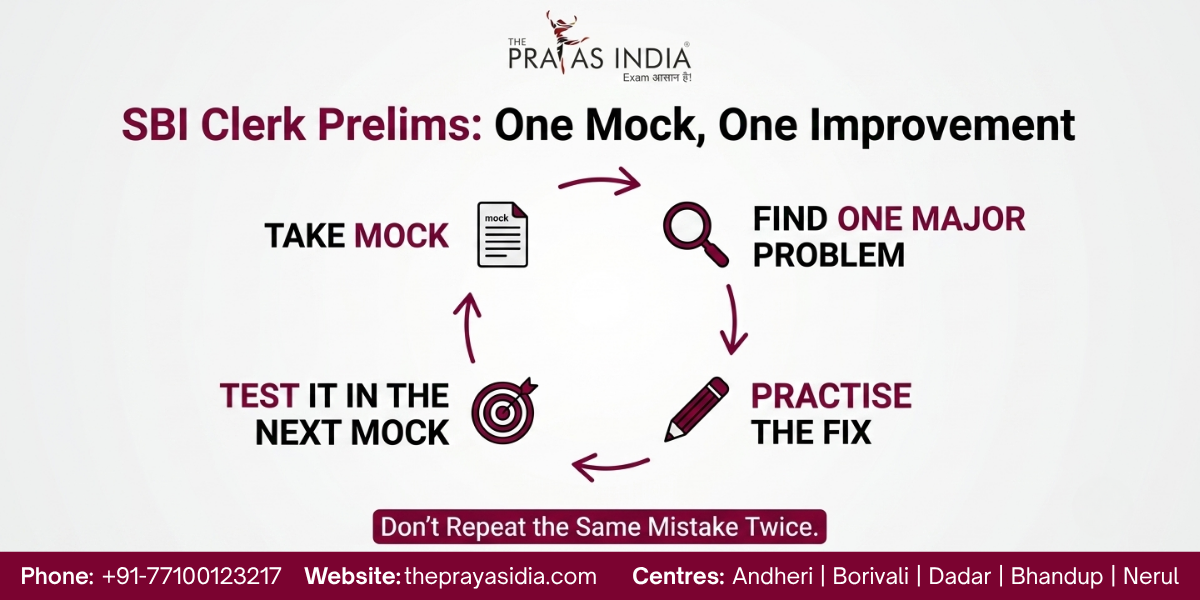
Use the “One Mock, One Improvement” Rule
After every mock, identify one major correction.
For example:
Mock 1
You spent too long on a puzzle.
Correction: Practise puzzle selection.
Mock 2
You made five calculation errors.
Correction: Add a daily calculation drill.
Mock 3
English accuracy dropped because you rushed.
Correction: Slow down initial reading slightly.
Mock 4
You could not complete the section.
Correction: Improve question selection and sequencing.
This prevents you from trying to fix ten things at once.
The Final 15–20 Days: Stop Creating New Problems
As the SBI Clerk Prelims exam approaches, your preparation strategy should become more selective.
This is not the ideal time to keep jumping between resources.
Focus on:
Revision
Sectional tests
Full-length mocks
Calculation practice
Important question types
Error correction
Time management
Exam strategy
If a particular topic has been repeatedly weak, address it strategically, but avoid trying to master every possible concept at the last minute.
Your objective should be to make your existing preparation more reliable.
Create an Exam-Day Attempt Strategy Before the Exam
Do not decide your entire strategy for the first time inside the examination hall.
By the final stage of preparation, you should already know:
- Which section you prefer to start with
- Which question types you attempt first
- Which questions you normally skip
- How long you can afford to spend on a difficult question
- Which section tends to consume extra time
- How you recover when a section feels difficult
Practise this strategy in full-length mocks.
However, remember one important point:
A strategy is a framework, not a prison.
If the actual paper is unexpectedly difficult, you must be willing to adapt.
What to Do If the Paper Is Difficult
This is an important part of exam strategy.
Suppose the Reasoning section is much harder than your expectations.
Do not panic.
If the section is difficult for you, there is a reasonable possibility that it is difficult for many other candidates as well.
Your goal should be to maximise your own score rather than compare your performance with an imaginary ideal attempt.
In a difficult paper:
Protect accuracy.
Avoid unnecessary risks.
Select manageable questions.
Use time carefully.
Move forward instead of getting emotionally stuck.
Adaptability is an important examination skill.
What to Do If the Paper Is Easy
An easy paper creates a different challenge.
Candidates may become overconfident and start attempting questions too quickly.
This can increase careless mistakes.
When the paper feels easy, maintain discipline.
Read carefully.
Calculate carefully.
Check where necessary.
Do not allow confidence to turn into rushing.
An easy paper rewards efficient accuracy, not reckless speed.
How The Right Coaching Environment Can Help
Self-study can certainly play an important role in SBI Clerk preparation, but many aspirants find it difficult to identify exactly why their mock performance is not improving.
A structured coaching environment can provide a more systematic approach.
When evaluating Bank Coaching in Mumbai, look beyond the number of classes.
Consider whether the institute provides:
Regular Mock Tests
Frequent testing helps candidates become comfortable with the pressure of timed examinations.
Sectional Practice
Section-specific tests can identify weaknesses much faster.
Performance Analysis
A useful analysis should explain more than your score. It should help identify your time traps, accuracy issues and question-selection problems.
Doubt Resolution
Persistent conceptual gaps should be addressed before they become repeated mock-test errors.
Current Affairs Support
For banking examinations, a structured current-affairs and banking-awareness preparation system can make revision more manageable.
Mentorship
Personalised guidance can help candidates understand which areas deserve more attention and which habits are affecting their scores.
Choosing the Best Bank Coaching in Mumbai
Aspirants searching for the best bank coaching in Mumbai should evaluate an institute according to the quality of its preparation system rather than relying only on promotional claims.
Ask yourself:
Does the programme provide regular tests?
Is there a proper mock-analysis system?
Are faculty members available for doubts?
Is there dedicated practice for speed and accuracy?
Does the preparation cover both Prelims and Mains?
Is current affairs preparation structured?
Are students guided on question selection and exam strategy?
Is there a consistent revision plan?
These factors can make a meaningful difference because competitive exam preparation is not simply about consuming study material.
It is about turning preparation into performance.
A Simple Daily Mistake-Correction Routine
You do not need a complicated system.
Even 30–45 minutes of targeted correction can be useful when done consistently.
Step 1 — Review
Look at questions you got wrong or took too long to solve.
Step 2 — Categorise
Mark each mistake as conceptual, calculation, careless or selection-related.
Step 3 — Correct
Understand the actual reason behind the mistake.
Step 4 — Practise
Solve a small set of similar questions.
Step 5 — Recheck
Return to the same concept or question type after a few days.
This creates a feedback loop.
Instead of repeatedly solving random questions, you are systematically eliminating weaknesses.
SBI Clerk Prelims Score Improvement Formula
A useful way to think about your preparation is:
Score Improvement = Better Concepts + Better Selection + Better Speed + Better Accuracy + Better Mock Analysis
Ignoring any one of these can limit your progress.
Strong concepts without speed may reduce attempts.
High speed without accuracy may increase negative marks.
Good accuracy without selection may leave easy questions unattempted.
Regular mocks without analysis may simply repeat the same mistakes.
The strongest preparation combines all five.
Final Takeaway
SBI Clerk Prelims score improvement is not always about studying harder.
Sometimes, it is about losing fewer marks.
Stop spending excessive time on questions that do not offer enough value.
Stop rushing simply to increase attempts.
Stop repeating calculation errors without identifying their cause.
Stop taking mocks without analysing them.
Stop copying another candidate’s strategy without testing whether it works for you.
Instead:
Identify your mistakes.
Measure your performance.
Fix one weakness at a time.
Practise under time pressure.
Build your own attempt strategy.
Repeat until the process becomes consistent.
For aspirants preparing for bank exams in Mumbai, a structured coaching environment can make this process more systematic through regular practice, mock tests, analysis, mentorship and exam-focused guidance.
The ultimate goal is not merely to complete the SBI Clerk Prelims syllabus.
It is to reach the examination hall knowing what to attempt, what to skip, how much time to spend and how to protect your accuracy.
That is how preparation starts converting into marks.
Contact Us
📞 Call Now: +91-77100 13217
🌐 Website: theprayasindia.com
📍 Centres: Andheri | Borivali | Dadar | Nerul | Bhandup
FAQs
1. What are the most common mistakes in SBI Clerk Prelims?
Some common mistakes include spending too much time on difficult questions, rushing for speed, making calculation errors, misreading English questions, selecting lengthy puzzles, ignoring sectional practice and taking mock tests without proper analysis.
2. How can I improve my SBI Clerk Prelims score?
Start by analysing your mock tests and identifying your biggest source of score loss. Then work specifically on conceptual gaps, calculation errors, careless mistakes, question selection and time management.
3. Should I focus on speed or accuracy for SBI Clerk Prelims?
You need both. Accuracy should be established first, after which you can gradually increase speed through timed practice. High attempts with poor accuracy may not improve your overall performance.
4. How many mock tests should I take for SBI Clerk Prelims?
The exact number depends on your preparation stage. More important than simply counting mocks is analysing each one thoroughly and using the findings to improve your next attempt.
5. How do I avoid silly mistakes in SBI Clerk Prelims?
Identify the exact type of careless error you repeatedly make. Slow down slightly when reading important conditions, maintain calculation discipline and review your mistakes regularly. Targeted correction is more effective than simply telling yourself to “be careful.”
6. How can I improve Reasoning speed for SBI Clerk Prelims?
Practise common reasoning topics regularly and develop strong question-selection skills. For puzzles and seating arrangements, learn to identify manageable sets before committing significant time.
7. How can I improve Quantitative Aptitude accuracy?
Strengthen your concepts, practise calculation regularly and analyse every calculation-related error. Build familiarity with percentages, fractions, ratios, approximation and other frequently used numerical relationships.
8. Is coaching necessary for SBI Clerk Prelims?
Not every aspirant requires the same preparation method. However, structured coaching can be useful for candidates who need regular tests, mentorship, performance analysis, doubt resolution and a systematic preparation schedule.
9. How should I prepare for SBI Clerk Prelims in the final weeks?
Prioritise revision, sectional tests, full-length mocks, calculation practice, error correction and exam strategy. Avoid constantly changing resources and focus on making your existing preparation more reliable.
10. How can The Prayas India help with SBI Clerk preparation?
The Prayas India focuses on structured bank-exam preparation through conceptual learning, practice, mock tests, performance analysis and exam-oriented guidance, helping aspirants work systematically towards their SBI Clerk goals.