How to Analyse Bank Exam Mock Tests and Improve Your Score | Best Bank Coaching in Mumbai | The Prayas India
For a bank exam aspirant, taking mock tests is often considered a sign that preparation has entered an advanced stage. But a mock test by itself does not improve performance. The real improvement begins after the test, when a student sits down to understand why certain questions were missed, where time was lost and which mistakes are likely to happen again.
This distinction is particularly important for aspirants preparing for SBI, IBPS and other banking examinations. These exams require candidates to balance speed, accuracy and question selection within a limited time. A student may know the underlying concept but still lose marks because of calculation errors, inefficient solving methods or spending too much time on questions that should have been skipped.
For students targeting a career in the banking sector, mock-test analysis should therefore become a regular part of preparation rather than something done occasionally before the examination. A well-analysed mock can reveal more about your preparation than the score displayed on the result screen.
This is also where structured Bank Coaching in Mumbai can provide useful guidance. When students have access to regular tests, performance tracking and a systematic preparation framework, they can move beyond simply asking, “What did I score?” and start asking the more important question: “What should I change before my next test?”
A Mock Test Is a Diagnostic Tool, Not Just a Scorecard
The first mindset change an aspirant needs to make is to stop treating every mock as a final judgement of preparation.
A mock test represents your performance under a particular set of questions and a particular set of circumstances. A low score can indicate a conceptual weakness, but it can also result from poor time management, excessive guesswork, unfamiliar question types or a temporary lapse in concentration.
Similarly, a high score should not automatically mean that everything is ready for the actual examination. You may have scored well while making several avoidable mistakes or relying heavily on questions that happened to match your strengths.
The score is therefore only the starting point.
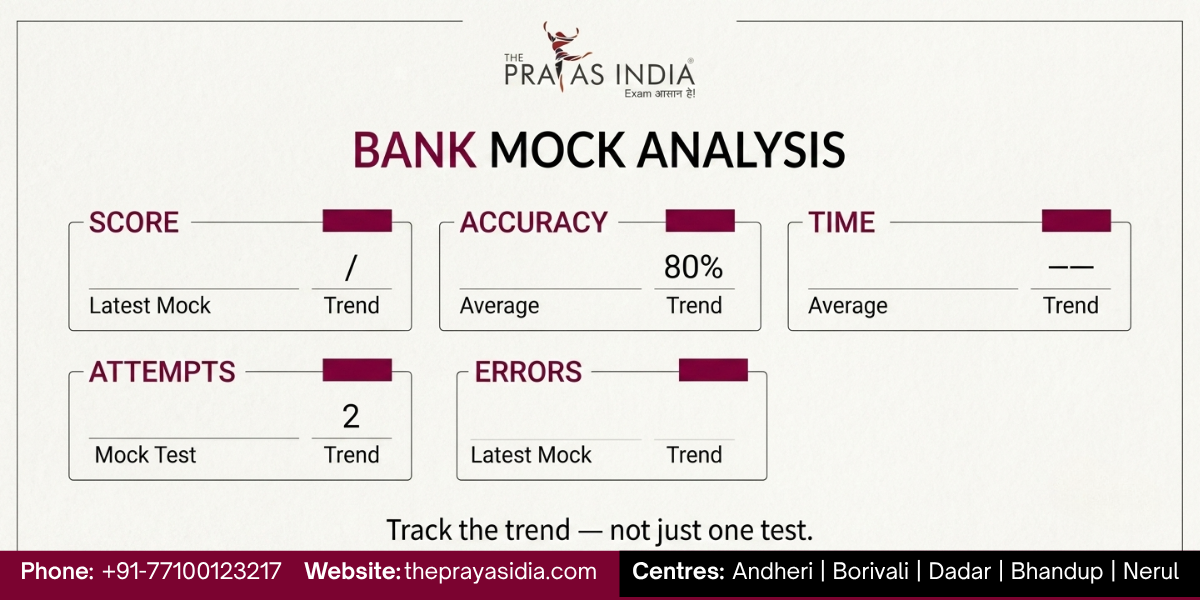
After completing a mock, students should look at the complete performance picture: attempts, correct answers, incorrect answers, unattempted questions, time spent and question types. This creates a much more useful understanding of preparation.
Look Beyond the Overall Score
Suppose two students both score 75 marks in a mock test. On the surface, their performance appears identical. But their actual preparation may be completely different.
One student may have attempted fewer questions with very high accuracy, while the other may have attempted many more questions but made a large number of errors. One may have completed the paper comfortably within the available time, while the other may have rushed through the final section.
This is why aspirants should not compare their preparation using only overall marks.
A more useful analysis begins with section-wise performance.
| Performance Indicator | What It Can Reveal |
|---|---|
| Attempts | Your willingness and ability to identify solvable questions |
| Accuracy | Quality of question solving and decision-making |
| Time | Efficiency and section management |
| Wrong Answers | Conceptual, calculation or interpretation errors |
| Unattempted Questions | Possible speed or selection issues |
| Section Score | Areas requiring targeted improvement |
When these indicators are examined together, students can identify the actual reason behind a score rather than making assumptions.
Analyse Your Mock in Three Stages
A practical way to analyse a bank exam mock is to divide the process into three stages.
The first stage is immediate analysis. Once the test ends, record your score, attempts, accuracy and section-wise performance. Do not immediately start another mock.
The second stage is question-level analysis. Go through the questions you answered incorrectly, questions you left unanswered and questions that consumed excessive time. Understand the reason behind each outcome.
The third stage is action planning. Convert your observations into specific tasks for the next few study sessions.
This final stage is where many aspirants stop short. They identify their mistakes but do not change their preparation routine. If the same problem appears in the next mock, the analysis has not produced any real improvement.
A mock analysis becomes useful only when it leads to a change in preparation behaviour.
Start With the Questions You Got Wrong
Incorrect answers deserve immediate attention, but not every wrong answer has the same cause.
A useful analysis should classify mistakes.
For example, a wrong answer could result from:
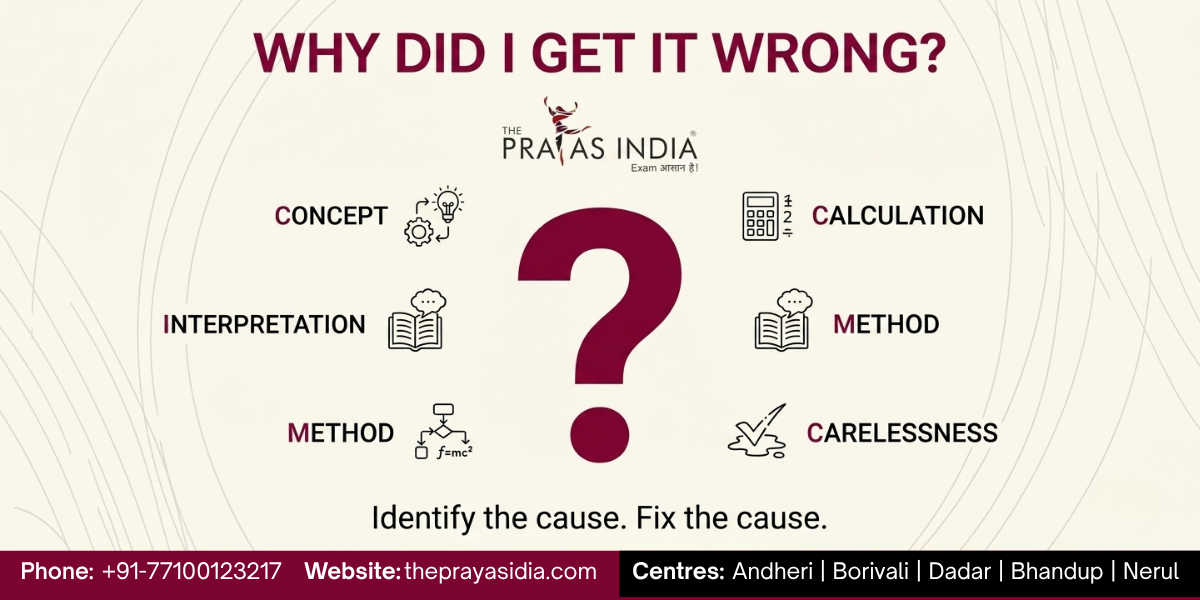
- Conceptual error: You did not understand the underlying concept.
- Calculation error: The method was correct but the arithmetic went wrong.
- Interpretation error: You misunderstood the question or conditions.
- Method error: You knew the concept but used an inefficient approach.
- Guessing error: You attempted without sufficient confidence.
- Careless error: You knew the answer but made an avoidable mistake.
This classification is important because each problem requires a different solution.
If conceptual errors dominate, more learning and basic practice are required. If calculation mistakes are frequent, targeted calculation practice may be more useful. If careless mistakes repeatedly appear, slowing down slightly and developing a checking habit may produce better results than simply attempting more questions.
Identify Questions That Took Too Long
Wrong answers are not the only problem.
A question that you eventually solved correctly may still be a problem if it consumed far more time than it should have.
Bank exams reward efficient decision-making. Spending several minutes on one difficult question can mean losing the opportunity to attempt multiple easier questions elsewhere.
During mock analysis, mark the questions that took significantly longer than expected. Then ask yourself whether the extra time was justified.
Sometimes a question genuinely requires additional calculation or reasoning. In other cases, you may have continued because you were reluctant to leave a question after investing time in it.
This is where question-selection skills become important.
The objective is not to solve every question. The objective is to identify the questions that offer the best opportunity to score within the available time.
Compare Your Attempts With Your Accuracy
Attempts and accuracy should always be analysed together.
A student who attempts 80 questions with 90% accuracy may have a very different preparation profile from someone attempting 95 questions with 70% accuracy.
High attempts are not automatically a positive indicator if they come with excessive errors. Similarly, extremely cautious attempts may indicate that the student is not taking enough scoring opportunities.
Your ideal attempt level should gradually emerge through repeated mock analysis.
Look for a pattern across several tests rather than making a decision based on one mock. If increasing attempts consistently causes accuracy to collapse, you may need to improve question selection. If accuracy remains high but attempts are too low, speed and confidence may require attention.
Analyse Section-Wise Performance
Overall scores can sometimes hide major differences between sections.
Imagine a candidate performing strongly in English and Reasoning but consistently losing marks in Quantitative Aptitude. The overall score may appear acceptable, but the weak section could become a serious limitation in a competitive examination.
Section-wise analysis helps identify these patterns early.
For Quantitative Aptitude, examine whether mistakes are concentrated around arithmetic, simplification, data interpretation or another area. For Reasoning, identify whether puzzles, seating arrangements, inequalities or other question types are affecting performance. For English, analyse whether errors arise from comprehension, grammar, vocabulary or question interpretation.
The goal is not to label yourself as “weak in Quant” or “weak in English.” Instead, identify the specific skills that are reducing your performance.
That distinction makes preparation far more actionable.
Use an Error Log Instead of Relying on Memory
Many students analyse a mock immediately after taking it but forget most of the lessons a few days later.
An error log solves this problem.
The log does not need to contain every incorrect question. Record the important mistakes and the lesson associated with them.
A simple format can include:
| Question Type | Mistake | Reason | Corrective Action |
|---|---|---|---|
| Quant | Wrong answer | Calculation error | Practise calculations |
| Reasoning | Time-consuming | Inefficient approach | Learn faster method |
| English | Incorrect option | Misread passage | Improve reading accuracy |
| Quant | Skipped | Concept unclear | Revise concept |
| Reasoning | Wrong selection | Overestimated ease | Practise question selection |
Over time, the error log becomes a personalised revision resource.
Before another mock, students can quickly review recurring mistakes. This prevents the same errors from repeatedly appearing without correction.
Key Takeaway
A bank exam mock test should never end when the timer stops. The real learning begins when you analyse what happened during those few minutes.
Aspirants should move beyond the overall score and examine attempts, accuracy, time usage, section-wise performance and individual mistakes. Wrong answers should be classified according to their cause, while questions that took excessive time should be reviewed even if they were eventually answered correctly.
The purpose of analysis is not to criticise your performance. It is to identify specific changes that can improve the next attempt.
For students preparing for SBI, IBPS and other banking examinations, developing this habit early can make mock tests far more valuable. Instead of repeatedly taking tests without understanding the results, aspirants can create a continuous cycle of testing and improvement.
This structured approach is also one of the areas where professional Bank Coaching in Mumbai can support students by providing regular testing, preparation guidance and a framework for evaluating performance.
A mock test becomes truly valuable when its results are converted into a clear improvement plan. After identifying incorrect answers, time-consuming questions and section-wise weaknesses, the next step is to decide what you will actually do differently before the next test. This is where serious bank exam preparation separates itself from random practice.
For aspirants preparing for SBI Clerk, IBPS Clerk, SBI PO, IBPS PO and other banking examinations, the objective should not be to take the maximum number of mocks. The objective should be to make every mock contribute something to the next one. A candidate who takes fewer tests but analyses them deeply can often make more meaningful progress than someone who takes several tests without reviewing the underlying mistakes.
For students targeting banking-sector careers, this process should also remain connected to the larger goal of securing a strong performance in competitive recruitment examinations. Structured preparation, consistent testing and targeted improvement can make the journey more organised. This is where choosing the Best Bank Coaching in Mumbai can be useful for aspirants who want guidance alongside self-study.
Convert Mock-Test Analysis Into a Study Plan
Once your mistakes have been identified, do not simply write them down and move on. Convert them into specific study tasks.
Suppose your mock analysis shows that you are repeatedly losing marks in Data Interpretation because calculations take too long. Your next step should not simply be “practise Quant more.” Instead, create a focused task such as practising calculation-heavy DI sets under a time limit.
Similarly, if reasoning puzzles are consuming excessive time, work on recognising puzzle structures and practise deciding when to continue and when to move on. If English errors are largely caused by reading comprehension, devote targeted sessions to comprehension and inference-based questions.
This creates a direct connection between mock performance and daily preparation.
A useful cycle is:
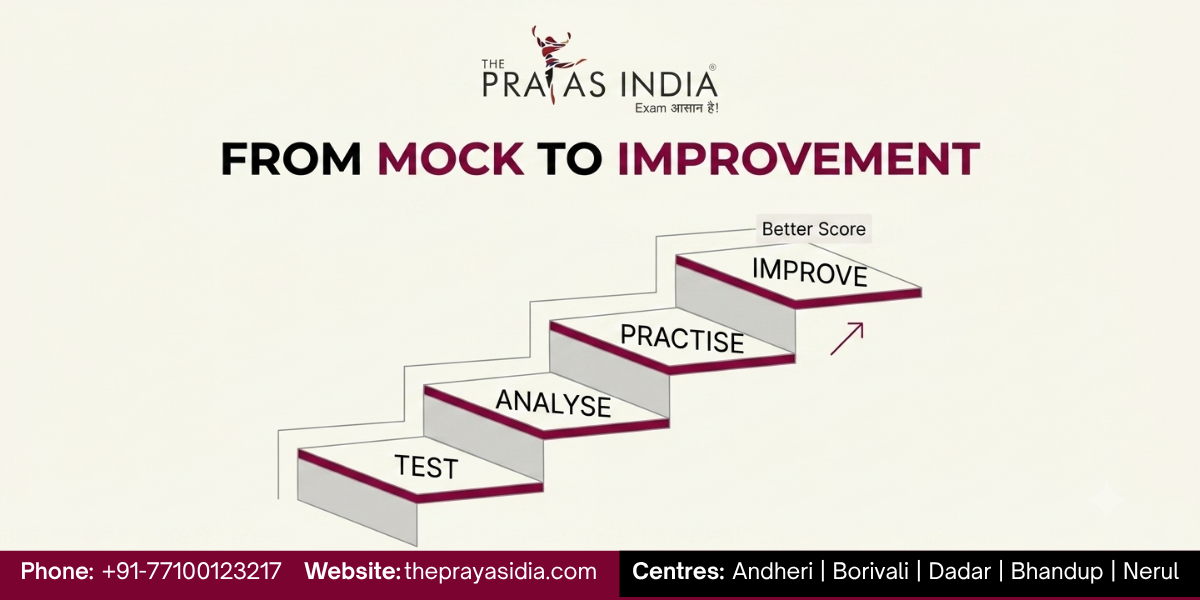
Mock Test → Analysis → Identify Problem → Targeted Practice → Revision → Next Mock
When this cycle is repeated consistently, every test becomes part of a larger improvement process rather than an isolated activity.
Prioritise Problems According to Their Impact
Not every weakness deserves the same amount of study time.
A small recurring calculation mistake may be corrected relatively quickly, while a fundamental weakness in a major topic could require several focused sessions. Students should therefore prioritise weaknesses according to their impact on overall performance.
Consider three questions when deciding what to fix first:
- Does the problem occur repeatedly?
- Is it costing several marks or significant time?
- Can targeted practice realistically improve it?
If the answer to all three is yes, the area deserves immediate attention.
This approach prevents students from spending hours trying to fix minor issues while major performance barriers remain untouched.
Improve Speed Without Sacrificing Accuracy
Speed is essential in bank exams, but increasing speed blindly can create another problem: declining accuracy.
A candidate who attempts questions rapidly but makes frequent errors may end up with a lower effective score than a slightly slower candidate who maintains strong accuracy.
The better strategy is to first establish a reliable solving method and then make it faster through repetition.
For example, in Quantitative Aptitude, students can gradually improve calculation efficiency through regular practice. In Reasoning, recognising familiar structures can reduce the time required to understand a set. In English, consistent reading practice can improve comprehension speed.
Speed should therefore be treated as a skill developed through familiarity and controlled practice, not as something achieved by rushing.
Track Your Attempts, Accuracy and Time Over Multiple Mocks
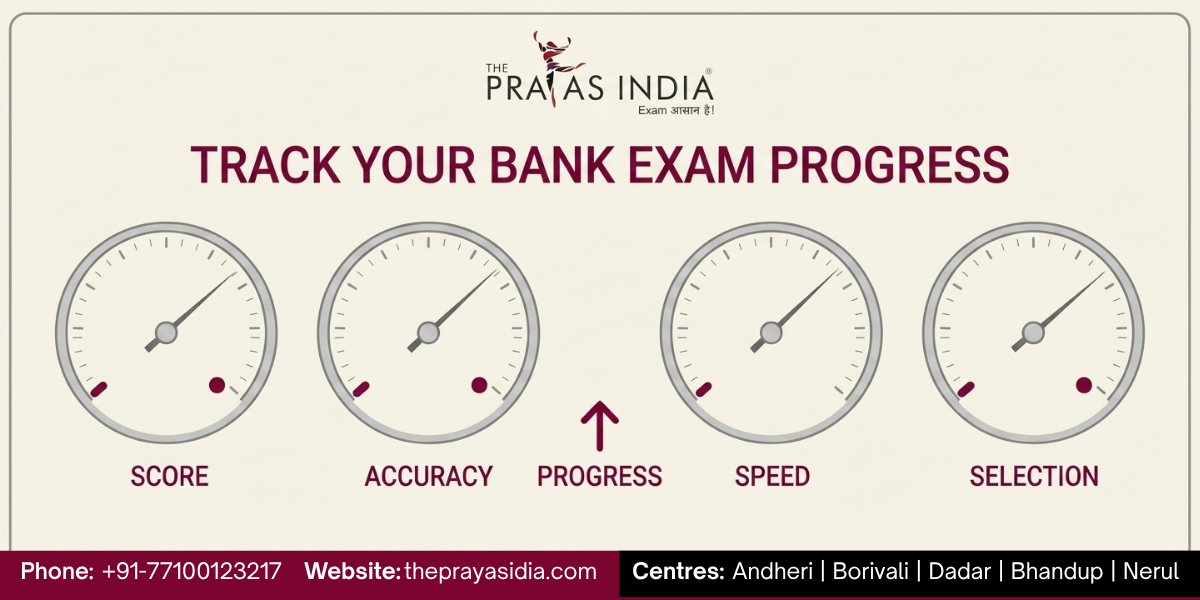
One mock tells you where you stand today. Several mocks can show you whether your preparation is actually moving forward.
Maintain a simple performance tracker for every test. Record your overall score, section-wise scores, attempts, accuracy and major mistakes.
After several tests, compare the numbers.
| Metric | What Improvement Looks Like |
|---|---|
| Attempts | Gradually increasing without reckless guessing |
| Accuracy | Becoming more consistent |
| Time | Reducing on familiar question types |
| Section Scores | Weak areas gradually catching up |
| Errors | Repeated mistakes becoming less frequent |
| Overall Score | Showing a sustainable upward trend |
Do not become overly concerned about one unusually low score. Competitive exam preparation naturally contains fluctuations. The more important indicator is the direction of your performance across multiple tests.
Learn to Recognise Questions You Should Skip
One of the most valuable outcomes of mock analysis is better question selection.
During analysis, identify questions that consumed too much time relative to their potential value. Then ask whether you could have recognised that situation earlier.
This does not mean avoiding every difficult question. Some challenging questions can be worth attempting if you have a clear approach and sufficient time. The important skill is knowing when the expected benefit of continuing is no longer worth the time being spent.
With repeated mock practice, students can develop a more instinctive sense of which questions deserve immediate attention and which can be postponed.
This becomes especially important when preparing for competitive bank exams, where efficient time allocation can significantly influence the number of useful attempts.
Create Separate Strategies for Prelims and Mains
Mock analysis should also reflect the stage of the examination you are preparing for.
For preliminary examinations, speed, accuracy and question selection are particularly important because candidates need to maximise useful attempts within tight sectional or overall time constraints.
Mains preparation requires a broader analysis. Depending on the examination, students may need to focus more deeply on Reasoning, Quantitative Aptitude, English, General Awareness, Computer Aptitude or other relevant components. Here, mock analysis should identify not only speed-related problems but also depth of understanding and consistency.
The same mock-analysis habit can therefore support both stages, but the performance indicators you prioritise should evolve with your preparation stage.
Use Mock Tests to Build Exam Temperament
A mock test also trains something that cannot be developed through untimed practice alone: the ability to remain composed while solving unfamiliar questions under pressure.
There will be tests where the opening questions appear difficult. There may be sections where the questions are unexpectedly time-consuming. A student who has practised only comfortable questions may struggle when the paper feels different from expectations.
Repeated mock testing exposes you to these situations.
The purpose is not merely to become familiar with a particular pattern but to develop the ability to adapt. When one section feels difficult, you should be able to avoid panic, protect your accuracy and make sensible decisions about where to spend your remaining time.
That mental flexibility is an important part of competitive examination readiness.
Build a Weekly Mock-Analysis Routine
Students often struggle with mock analysis because they treat it as an additional activity instead of incorporating it into their weekly schedule.
A better approach is to assign a fixed place to testing and analysis. For example, after a full-length mock, reserve a dedicated session for reviewing incorrect and time-consuming questions. The following study sessions can then be adjusted according to what the analysis reveals.
If the mock exposes a weakness in arithmetic, calculation practice should be added. If reasoning sets are consuming too much time, additional timed puzzle practice can be scheduled. If English accuracy is stable but speed is low, reading and timed comprehension exercises may become more important.
The schedule should therefore respond to your performance instead of remaining completely fixed throughout preparation.
Don’t Take Mocks Just to See Your Rank
Competitive exams naturally encourage comparison. Mock platforms may provide rankings, percentiles and comparative statistics, but these numbers should not become the only objective.
Your rank can change depending on the difficulty of the test and the performance of other candidates. What matters more for preparation is whether you are becoming faster, more accurate and more consistent.
Instead of asking only, “What was my rank?” ask:
Which mistakes did I repeat?
Which questions should I have skipped?
Where did I lose time?
Which section needs attention this week?
What will I change before my next mock?
These questions turn mock testing into a learning process.
Connect Your Bank Exam Preparation With Your Career Goal
For many aspirants, clearing a bank examination is connected to a larger career objective: securing a stable and competitive position in the banking sector.
That makes preparation more than an exercise in improving mock scores. It becomes a long-term investment in career progression.
Students should therefore approach preparation with discipline from the beginning. A structured timetable, consistent practice, quality mock tests and detailed analysis can create a stronger foundation.
For aspirants considering Bank Coaching in Mumbai, the right coaching environment can provide additional structure through faculty guidance, practice resources, test series and performance evaluation. The key is to use that support actively rather than depending entirely on classroom learning.
How The Prayas India Can Support Bank Exam Preparation
Preparing independently can sometimes make it difficult to determine whether a low mock score is caused by a conceptual gap, poor strategy or inadequate practice. Structured guidance can help students identify these issues more efficiently.
The Prayas India can support banking aspirants through a preparation approach focused on learning, practice and performance evaluation. Regular testing gives students an opportunity to experience examination-style questions, while analysis helps them identify areas that require further attention.
For students preparing for SBI and IBPS examinations, a structured approach can make it easier to organise daily preparation around the actual requirements of the examination.
Students should still take responsibility for their own progress. Coaching can provide direction, but consistent practice, mock analysis and revision are what turn that direction into measurable improvement.
Build Your Own Mock-Test Improvement Formula
Every student will have a different preparation profile, so there is no single formula that works identically for everyone.
However, a simple framework can keep the process organised:
1. Take the mock seriously.
Attempt it under realistic examination conditions rather than treating it as casual practice.
2. Record the performance.
Note your score, attempts, accuracy and section-wise results.
3. Review wrong answers.
Identify the exact reason behind each important mistake.
4. Review time-consuming questions.
Find questions where your time investment was disproportionate.
5. Identify recurring patterns.
Look across multiple mocks rather than focusing only on one test.
6. Create targeted practice.
Turn weaknesses into specific study tasks.
7. Test again.
Use the next mock to determine whether the correction worked.
This formula is simple, but consistency is what makes it effective.
Final Takeaway
Analysing bank exam mock tests is one of the most effective ways to turn practice into measurable improvement. The score displayed after a test is only one part of the story. The real value lies in understanding why marks were lost and what needs to change before the next attempt.
Aspirants should examine incorrect answers, time-consuming questions, accuracy, attempts and section-wise performance. They should classify mistakes, maintain an error log and convert recurring weaknesses into targeted study tasks.
At the same time, speed should be improved without sacrificing accuracy, and question selection should become an important part of mock preparation. Tracking performance across multiple tests can reveal whether preparation is actually moving in the right direction.
For students targeting SBI, IBPS and other banking examinations, a structured mock-analysis routine can make preparation more focused and less dependent on guesswork. When combined with disciplined self-study and professional guidance from a Bank Coaching in Mumbai, it can help aspirants approach the examination with greater clarity and confidence.
Ultimately, the purpose of a mock test is not simply to tell you where you stand. It should tell you what to do next.
Contact Us
- Call Now: +91-77100 13217
- Website: theprayasindia.com
- Centres: Andheri | Borivali | Dadar | Nerul | Bhandup
FAQs
1. How should I analyse a bank exam mock test?
Start by reviewing your overall score, attempts, accuracy and section-wise performance. Then examine incorrect answers, unattempted questions and questions that consumed excessive time. Finally, convert these observations into targeted practice tasks.
2. Should I take another mock immediately after analysing one?
3. What should I do if my mock-test score is consistently low?
Identify whether the primary problem is conceptual knowledge, accuracy, speed, question selection or time management. Once the main issue is identified, focus your preparation on correcting that specific problem instead of simply increasing the number of mocks.
4. How can mock analysis improve bank exam accuracy?
Analysing the reasons behind incorrect answers helps identify recurring patterns such as calculation mistakes, conceptual gaps, misreading or careless errors. Targeted correction can gradually reduce these mistakes.
5. How can I improve speed through mock tests?
Identify question types that take too long, learn efficient approaches and practise similar questions under controlled time limits. Speed should improve progressively without allowing accuracy to fall sharply.
6. Should I analyse questions that I answered correctly?
Yes, especially if a correct answer took unusually long to solve. A question can be correct but still reveal an inefficient approach or poor question-selection decision.
7. How many mock tests should I take for SBI or IBPS exams?
The ideal frequency depends on your preparation stage and current performance. More important than the exact number is whether you are analysing each test and correcting the weaknesses it reveals.
8. Is an error log useful for bank exam preparation?
Yes. An error log can help you track recurring conceptual, calculation, interpretation and careless mistakes. Reviewing it regularly can prevent the same errors from appearing repeatedly.
9. Can bank coaching help with mock-test analysis?
Structured bank coaching can provide test practice, performance feedback, strategy guidance and a systematic preparation framework. Students can use these resources alongside self-study to improve their preparation.
10. How can The Prayas India help bank exam aspirants?
The Prayas India offers a structured preparation environment for banking examinations, helping aspirants combine conceptual learning, practice, testing and performance improvement while keeping their career goals in focus.