How to Prepare for Bank Exams Without Losing Consistency | Best Bank Coaching in Mumbai | The Prayas India
Bank exam preparation often begins with a great deal of enthusiasm. Aspirants create detailed timetables, purchase study material, download mock-test apps, collect current-affairs PDFs and decide to study for several hours every day. For the first few days, everything appears manageable. But as preparation continues, maintaining the same level of discipline becomes increasingly difficult.
The problem is rarely a lack of ambition. Most banking aspirants genuinely want to clear exams such as SBI PO, SBI Clerk, IBPS PO, IBPS Clerk, RRB and other banking recruitment examinations. The real challenge is maintaining a sustainable preparation routine while managing college, work, personal responsibilities, multiple subjects, mock tests and the uncertainty that comes with competitive exams.
Consistency, therefore, should not be understood as studying for the same number of hours every single day. It is better understood as the ability to keep moving forward even when motivation, available time or daily productivity changes.
A candidate who studies five focused hours on a productive day and two focused hours on a difficult day can still make strong progress if the preparation continues systematically. On the other hand, studying ten hours for a few days and then taking a week-long break creates a much bigger problem.
For banking aspirants, the goal should be to build a preparation system that is strong enough to survive difficult days.
This is particularly important because bank exams are not based on one subject. Candidates have to manage Quantitative Aptitude, Reasoning Ability, English Language, General Awareness, Banking Awareness and, depending on the examination, additional sections and stages. Without a consistent system, one subject often receives too much attention while another gradually becomes a weakness.
Consistency Is More Important Than Occasional Long Study Sessions
One of the most common mistakes in competitive-exam preparation is measuring progress by the number of hours studied on a single day.
Aspirants sometimes feel that a ten-hour study session means they have made exceptional progress. The next day, however, fatigue sets in and the routine collapses. This creates a cycle of intense preparation followed by guilt, followed by another unrealistic timetable.
Bank exam preparation rewards repetition.
You need to solve questions regularly, revise concepts repeatedly, analyse mistakes, read current affairs consistently and take mocks at appropriate intervals. These activities become effective through continuity.
A two-hour focused session repeated consistently can be more valuable than an irregular eight-hour session.
Instead of asking, “How many hours should I study today?”, ask:
“What important preparation work must I complete today?”
That shift can make your routine more practical.
Build a Minimum Daily Study Target
A useful way to maintain consistency is to establish a minimum daily target.
This is not your ideal target. It is the minimum amount of meaningful work you will complete even on a difficult day.
For example, your regular target might include several hours of study, but your minimum commitment could be:
- One Quant practice set
- One Reasoning practice set
- English revision or reading
- Current-affairs revision
- Analysis of previously attempted questions
The exact target should depend on your preparation stage and available time.
The purpose is psychological as well as academic. A minimum target prevents a difficult day from becoming a completely unproductive day.
Once the habit of showing up is established, increasing study hours becomes much easier.
Stop Creating Timetables You Cannot Follow
A timetable should reflect your real life.
If you have college or a full-time job, creating a schedule that assumes six to eight uninterrupted hours of daily study is unlikely to remain sustainable.
Similarly, if your preparation requires travel, family responsibilities or coaching classes, these factors need to be included rather than ignored.
A practical bank-exam timetable should answer three questions:
When can I study consistently?
Which subjects require my highest concentration?
Which tasks can be completed during lower-energy periods?
For example, difficult Quant or Reasoning concepts can be scheduled during your most productive hours, while current-affairs revision or vocabulary work can be placed in shorter periods.
The best timetable is not the one that looks impressive on paper.
It is the one you can actually follow for several months.
Divide Preparation Into Preparation Blocks
Instead of trying to study continuously for many hours, divide your preparation into focused blocks.
A typical study day could contain separate blocks for:
Concept Building: Learn or revise a specific topic.
Practice: Solve questions under controlled conditions.
Analysis: Identify mistakes and understand why they occurred.
Revision: Revisit formulas, rules, shortcuts and previously learned concepts.
Current Affairs: Cover and revise relevant banking and general awareness developments.
This structure is more productive than simply writing “Study Quant” or “Study Reasoning” in a timetable.
Each session should have a defined outcome.
For example, instead of writing:
“Reasoning – 2 hours”
write:
“Solve 25 seating-arrangement questions and analyse all incorrect attempts.”
The second task is measurable.
Follow a Subject Rotation Strategy
Bank exams require balanced preparation.
If you enjoy Reasoning but struggle with Quant, it is natural to spend more time solving Reasoning questions. Unfortunately, this can allow the weaker subject to become an even bigger problem.
A subject rotation system helps prevent this.
During the week, ensure that every major area receives regular attention.
A practical rotation may include:
- Quantitative Aptitude
- Reasoning Ability
- English Language
- General Awareness
- Banking Awareness
- Mock tests and analysis
- Revision
The proportion of time does not have to be equal.
Your weaker subjects can receive additional practice, while your stronger subjects need regular maintenance.
The objective is to prevent any section from becoming neglected.
Identify Your High-Value Topics
Consistency becomes easier when you know where your time should go.
Bank exams contain a large number of concepts, but not every topic deserves the same amount of preparation time at every stage.
Analyse previous papers and mock tests to understand the areas that repeatedly matter.
For Quant, this may include topics such as:
- Arithmetic
- Data Interpretation
- Simplification and approximation
- Number series
- Quadratic equations
- Percentage, ratio and proportion
- Profit and loss
- Time, speed and distance
- Time and work
For Reasoning, areas can include:
- Puzzles and seating arrangements
- Inequality
- Syllogism
- Coding-decoding
- Blood relations
- Direction sense
- Input-output
- Logical reasoning
For English, focus can include:
- Reading comprehension
- Error detection
- Cloze tests
- Para jumbles
- Sentence improvement
- Vocabulary
- Grammar
- Fillers
The exact emphasis should be based on the specific exam and current pattern.
The important point is that consistency does not mean repeatedly studying everything.
It means repeatedly working on what matters.
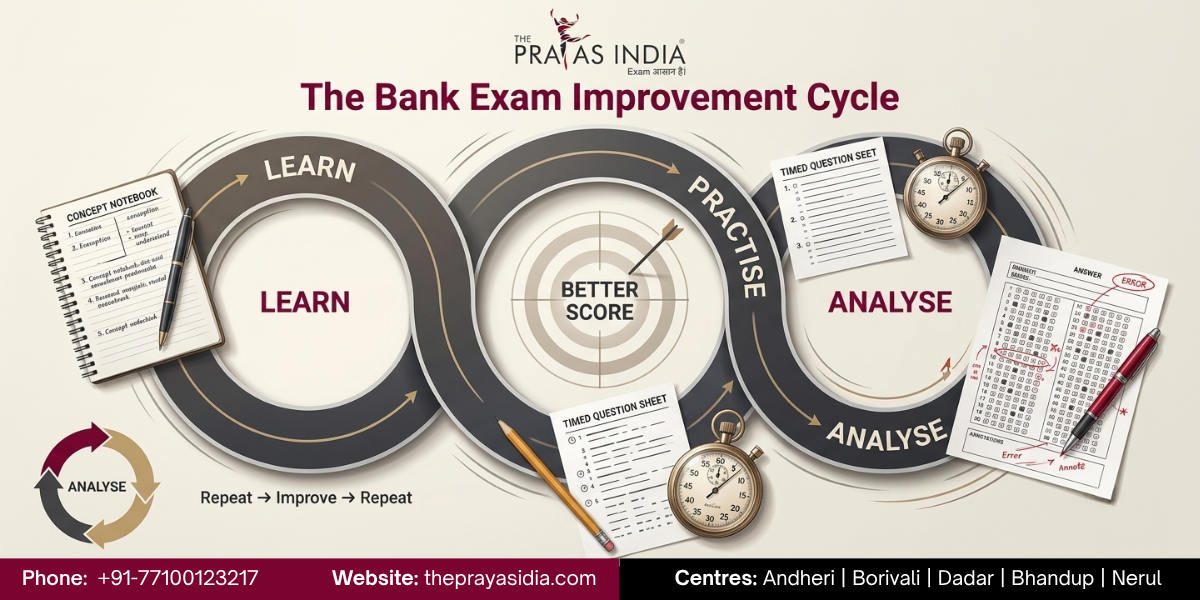
Use the 3-Step Learning Cycle
A strong banking preparation routine should follow a simple cycle:
Learn → Practise → Analyse
Learning gives you the concept.
Practice teaches you how the concept behaves under different question types.
Analysis identifies whether you can actually apply it accurately and quickly.
Many aspirants stop after the second stage.
They solve 50 questions and immediately move to the next topic. If they make mistakes, they simply check the correct answer and continue.
That is not enough.
The third stage—analysis—is where a significant part of improvement happens.
Ask yourself:
- Did I misunderstand the concept?
- Did I make a calculation mistake?
- Did I misread the question?
- Did I spend too much time?
- Did I use an inefficient method?
- Could I have skipped the question?
- Did lack of revision cause the mistake?
Your answers reveal what needs to change.
Make Mistake Analysis a Daily Habit
A mistake notebook can become one of the most useful tools in bank exam preparation.
But it should not become another enormous notebook filled with copied questions.
Keep it focused.
Record recurring mistakes such as:
- Formula errors
- Calculation mistakes
- Grammar rules you repeatedly forget
- Puzzle interpretation errors
- Questions where you mismanaged time
- Questions where you selected the wrong approach
- Questions that you should have skipped
Periodically revise this material.
The objective is not simply to remember that you made a mistake.
It is to ensure that the same mistake becomes less likely in the future.
Don’t Let One Bad Day Break Your Routine
Everyone has unproductive days.
You may feel tired, distracted or simply unable to concentrate. Trying to force an unrealistic schedule on such a day can create unnecessary frustration.
Instead, switch to your minimum preparation routine.
You can revise formulas, analyse an old mock, read current affairs or solve a smaller question set.
The important principle is:
Reduce the workload when necessary, but don’t completely break the habit.
A single difficult day does not damage your preparation.
The bigger problem occurs when one missed day becomes three, and three become ten.
Consistency protects you from that pattern.
Build a Weekly Review System
Daily planning tells you what to do.
Weekly review tells you whether your preparation is working.
At the end of every week, spend some time reviewing your progress.
Look at:
- Topics completed
- Questions attempted
- Accuracy levels
- Mock-test performance
- Weak areas
- Revision completed
- Current-affairs coverage
- Repeated mistakes
- Study sessions missed
Don’t judge yourself only by study hours.
A candidate who studied fewer hours but improved accuracy and reduced mistakes may have progressed more than someone who spent many hours passively reading material.
Your weekly review should therefore measure outcomes, not just effort.
Use Mock Tests as a Consistency Tool
Mock tests are not only for checking your preparation shortly before the examination.
They can also create structure.
Once you introduce regular mocks into your routine, preparation becomes more measurable.
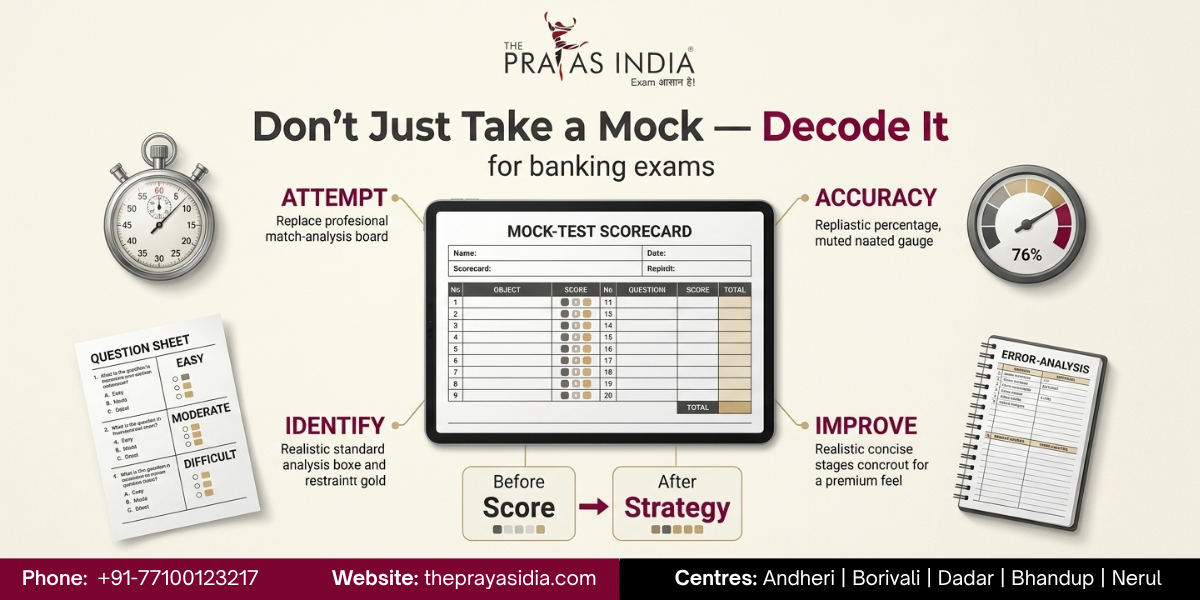
You can track:
Attempt → Accuracy → Time → Score → Mistakes → Improvement
This creates a feedback loop.
Suppose your Quant score is stable but your time is consistently high. Your problem may not be conceptual knowledge; it may be question selection or calculation speed.
If your Reasoning attempts are high but accuracy is poor, you may need to slow down and improve selection.
If your English score fluctuates significantly, your preparation may need greater consistency in grammar, vocabulary and reading practice.
Mock tests turn vague preparation into measurable preparation.
Don’t Take Mocks Without Analysing Them
Taking a mock and immediately checking your score is one of the least productive ways to use a test.
The score tells you what happened.
Analysis tells you why it happened.
After every mock, divide questions into categories:
Correct + Fast: Maintain the approach.
Correct + Slow: Improve efficiency.
Incorrect + Attemptable: Identify the conceptual or execution mistake.
Incorrect + Difficult: Decide whether the question type needs further preparation.
Unattempted + Easy: Investigate why you missed the opportunity.
This analysis can help you improve both preparation and exam strategy.
Protect Your Revision Time
New learning often feels more productive than revision.
Aspirants enjoy completing new chapters because it creates a visible sense of progress.
But banking exams require recall under pressure.
Without revision, formulas fade, grammar rules become inconsistent, shortcuts are forgotten and previously solved question types start feeling unfamiliar.
Therefore, reserve specific time for revision.
Your revision system can include:
- Daily quick revision
- Weekly topic revision
- Monthly consolidation
- Repeated revision of weak areas
- Revision of mock-test mistakes
The exact schedule can vary, but revision should never be treated as something to do only after the syllabus is completed.
Current Affairs Requires Consistency Too
General and banking awareness cannot be built effectively through last-minute preparation alone.
Reading current affairs once and never revisiting it creates poor retention.
A better approach is to combine daily exposure with periodic revision.
Focus on developments relevant to:
- Banking and financial sector
- Economy
- Government schemes
- Appointments
- Awards
- Important reports
- National and international events
- RBI-related developments
- Important banking terminology
- Static banking awareness
Keep your notes concise.
The goal is to create material that can actually be revised multiple times.
Avoid the “Everything at Once” Approach
Bank-exam aspirants often attempt to change everything simultaneously.
They start a new study plan, a new test series, a new current-affairs source, a new YouTube channel and multiple books at the same time.
This creates information overload.
Instead, keep your preparation ecosystem limited.
Choose:
- One structured source for concepts
- One reliable question-practice source
- One mock-test system
- One current-affairs source
- One revision method
Consistency becomes much easier when you reduce unnecessary decision-making.
Build a Routine That Can Survive Low-Motivation Days
Motivation is useful when it appears.
It is not reliable enough to be the foundation of a competitive-exam strategy.
Your preparation should continue even when you don’t feel motivated.
This is why routines, fixed study blocks, weekly targets and measurable tasks are so important.
On high-energy days, you can exceed your regular target.
On low-energy days, complete the minimum target.
On normal days, follow the standard plan.
This creates a preparation rhythm that does not depend entirely on mood.
Don’t Compare Your Daily Progress With Other Aspirants
Competitive exams naturally create comparison.
You may see someone claiming to study ten hours a day, complete multiple mocks or finish the entire syllabus rapidly.
This can create unnecessary pressure.
Your preparation should be measured against your own baseline.
Ask:
Is my accuracy improving?
Am I becoming faster?
Are my weak topics becoming stronger?
Am I making fewer repeated mistakes?
Is my mock score improving?
These indicators matter far more than someone else’s study-hour claims.
Coaching Can Add Structure to Bank Exam Preparation
Self-study can work for many aspirants, but maintaining consistency becomes more challenging when there is no external academic structure.
This is one reason candidates consider joining a bank coaching institute in Mumbai.
The value of a good coaching programme is not simply that it provides lectures. A structured programme can create a preparation ecosystem around the aspirant.
This may include:
- A defined study sequence
- Regular classes
- Topic-wise practice
- Mock tests
- Performance analysis
- Doubt-solving
- Revision schedules
- Mentorship
- Current-affairs guidance
- Peer learning
For students who repeatedly struggle with starting and stopping their preparation, this external structure can be particularly useful.
When evaluating the best bank coaching in Mumbai, aspirants should therefore look beyond promotional claims and examine whether the institute provides a system that supports long-term preparation.
The Prayas India and a Structured Preparation Approach
For banking aspirants, joining a coaching institute should be a decision based on academic fit rather than simply brand recognition.
The Prayas India provides a structured preparation environment for candidates targeting banking and competitive examinations, with an approach that can help students organise concepts, practice questions, evaluate performance and stay connected with their preparation goals.
For an aspirant who has repeatedly struggled with consistency, the right classroom environment, regular practice schedule, mock-test discipline and academic guidance can make preparation easier to sustain.
The larger objective should be simple: reduce uncertainty, create structure and keep improving.
Consistency When You Have College or a Full-Time Job
Not every banking aspirant has the luxury of preparing throughout the day. Many candidates are studying alongside college, internships, jobs or other responsibilities. For such aspirants, consistency becomes less about the number of hours available and more about using limited time intelligently.
A working candidate may not be able to study six hours every day, but two or three focused hours can still produce meaningful progress when used consistently. The important thing is to identify fixed preparation windows that are unlikely to be disturbed.
For example, a candidate may use the morning for Quant or Reasoning practice, commute time for current-affairs revision and evenings for English or mock analysis. The exact arrangement will vary, but the principle remains the same: assign a purpose to every available block of time.
Don’t compare your schedule with a full-time aspirant. Build a system around your own circumstances and make that system sustainable.
Create a Weekly Bank Exam Preparation Architecture
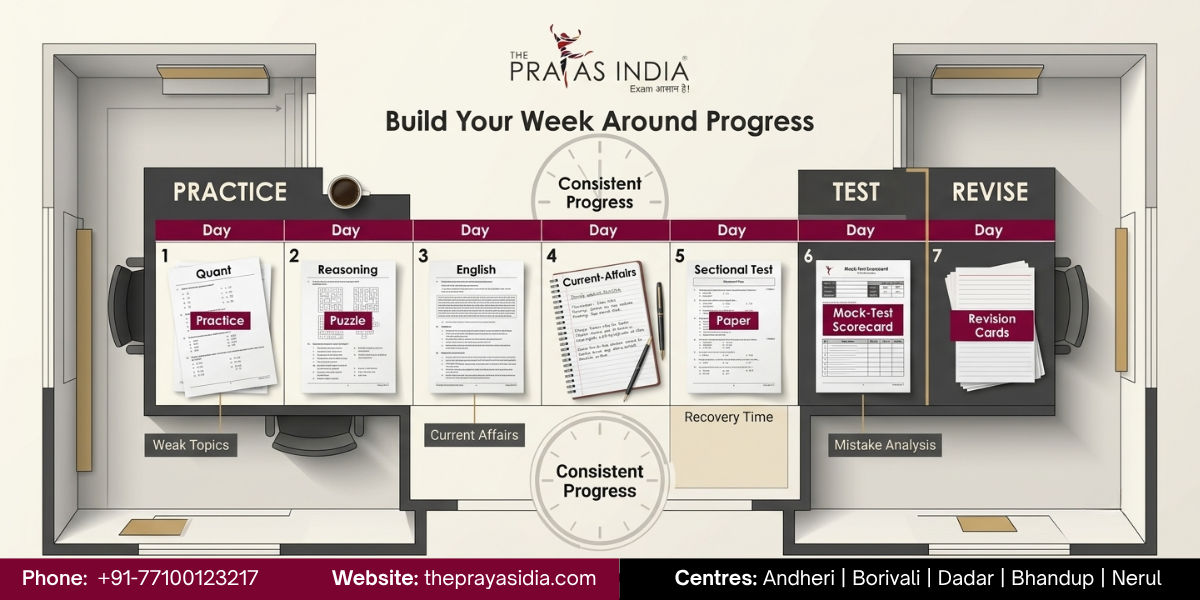
Instead of planning every minute of every day, create a weekly structure.
A weekly plan gives you flexibility while still ensuring that important areas receive adequate attention.
A balanced week can include:
- Concept learning for weak topics
- Daily Quant and Reasoning practice
- Regular English practice
- Current-affairs revision
- Sectional tests
- Full-length mock tests
- Mock analysis
- Revision of mistakes
- One weekly performance review
This approach is particularly useful when unexpected responsibilities interfere with your schedule.
If you miss one study session, you don’t have to redesign your entire month. You simply adjust the weekly plan and continue.
Give Your Weakest Subject More Attention
Consistency does not mean distributing your time equally across every subject.
If your Reasoning score is already strong but Quant remains weak, spending identical hours on both subjects may not be the best strategy.
Your preparation should be driven by performance.
After analysing practice sets and mocks, identify the areas where you lose the most marks.
These may include:
- Low conceptual understanding
- Slow calculations
- Poor question selection
- Weak vocabulary
- Grammar errors
- Difficulty with puzzles
- Lack of revision
- Careless mistakes
Once you identify the real problem, allocate additional time to it.
This makes your preparation more targeted and prevents the frustration of studying for long hours without seeing meaningful improvement.
Use Short Sessions When Your Schedule Is Tight
Consistency becomes easier when you stop believing that every study session must be long.
A 30-minute session can be useful.
You can use it for:
- 15–20 Quant questions
- One Reasoning set
- Vocabulary revision
- Current-affairs revision
- Formula revision
- Mock-error analysis
These smaller sessions are particularly useful for students and working professionals.
The objective is not to replace deep study with short sessions. It is to ensure that limited time is still converted into productive preparation.
Keep One Day for Consolidation
Many aspirants spend the entire week learning new material.
By the weekend, they have covered several topics but remember only a fraction of them.
A consolidation session can solve this problem.
Use part of one day to revisit:
- Concepts studied during the week
- Important formulas
- Difficult question types
- Current affairs
- Mock-test mistakes
- Previously weak areas
This is where information starts becoming usable knowledge.
Build a “No Zero Day” Rule
A practical consistency rule is to avoid completely zero-preparation days whenever possible.
This does not mean you must study for hours every day.
On a difficult day, your preparation could simply involve revising formulas, solving a short sectional set or analysing ten mistakes from an earlier mock.
The purpose is to maintain continuity.
However, this rule should not become unhealthy pressure. Rest is also part of sustainable preparation. If you are genuinely exhausted, proper recovery can be more productive than forcing a low-quality study session.
Consistency means returning to preparation—not refusing yourself rest.
Learn How to Restart After a Break
Almost every serious aspirant experiences a break in preparation.
You may fall sick, face academic deadlines, become busy at work or simply lose momentum.
The mistake is believing that you need to “start from zero” after every break.
You don’t.
Begin by reviewing your previous position.
Identify:
What had I completed?
What remained unfinished?
What has become weak because of the break?
Which upcoming exam stage matters most?
Then create a short recovery plan.
Do not try to complete everything you missed in one week.
The objective is to restore rhythm first.
Once consistency returns, intensity can gradually increase.
Don’t Punish Yourself for Lost Days
Guilt often makes restarting more difficult.
An aspirant misses five days and then creates a timetable that requires ten hours of daily study to compensate. The schedule becomes impossible, another failure occurs and the cycle continues.
A better approach is to accept the interruption and restart from the current position.
Your preparation is not improved by feeling guilty about the previous week.
It is improved by using the next week effectively.
Use Performance Data Instead of Guesswork
One of the strongest ways to maintain consistency is to make preparation measurable.
Maintain a simple performance record.
Track:
| Area | What to Track |
|---|---|
| Quant | Accuracy, speed, topic-wise score |
| Reasoning | Puzzle selection, accuracy, time |
| English | Accuracy, reading speed, grammar errors |
| Awareness | Revision level, recall |
| Mocks | Score, attempts, accuracy, time |
| Mistakes | Repeated errors and their causes |
You don’t need complicated spreadsheets.
A basic record is enough to identify patterns.
If your score remains unchanged for several weeks, continuing with exactly the same preparation method may not solve the problem. Your data should tell you where the strategy needs modification.
Set Process Goals Alongside Score Goals
Score goals are important, but they can sometimes create unnecessary pressure.
Instead of saying only:
“I need to score 80+.”
also create process goals such as:
- Complete a fixed number of practice sets.
- Analyse every full-length mock.
- Revise mistakes twice a week.
- Maintain daily current-affairs revision.
- Improve accuracy in a weak topic.
- Reduce average time on selected question types.
Process goals are within your control.
When these improve consistently, scores usually have a stronger foundation to grow.
Don’t Change Your Preparation Strategy Every Week
Aspirants often become impatient.
One week they follow one strategy. The next week they discover a new study plan online and completely change their routine.
This constant switching prevents meaningful evaluation.
Give your preparation strategy enough time to produce measurable results.
If something is not working, modify it based on evidence.
Don’t change it simply because another aspirant uses a different approach.
Choose Quality Over an Excessive Number of Resources
More resources do not automatically mean better preparation.
Using five books, several YouTube channels, multiple Telegram groups and numerous test platforms can create confusion rather than improvement.
Your preparation should have a clear resource hierarchy.
A practical system can include:
Primary learning source: For concepts and fundamentals.
Practice source: For topic-wise questions.
Mock source: For exam simulation and performance tracking.
Current-affairs source: For regular awareness preparation.
Revision notes: For quick recall.
Once your resources are adequate, focus on using them repeatedly.
Consistency and Exam-Specific Preparation
Different banking examinations may have different patterns, difficulty levels, selection processes and timelines.
Therefore, your consistency system should eventually become exam-specific.
For example, preparation for a preliminary examination may emphasise speed, accuracy and question selection, while preparation for a mains examination requires greater depth and broader awareness.
A candidate preparing for multiple exams should identify the common syllabus first and then allocate time to exam-specific requirements.
This prevents unnecessary duplication.
Balance Speed With Accuracy
Bank examinations are time-bound.
But increasing speed without controlling accuracy can reduce your score.
A consistent preparation strategy should therefore improve both.
For every practice session, ask:
How many questions did I solve?
How many were correct?
How much time did I spend?
Which questions consumed disproportionate time?
Over several weeks, this creates a clear picture of your performance.
The objective is not simply to solve more questions.
It is to solve the right questions accurately within the available time.
Build Exam Temperament Through Timed Practice
Consistency should eventually translate into performance under pressure.
Untimed practice is useful during the learning phase, but candidates must gradually introduce time restrictions.
Start with topic-level timing.
Then move towards sectional tests.
Eventually, incorporate full-length mocks.
This progression teaches you how to make decisions when the clock is running.
You begin learning which questions deserve immediate attention, which should be postponed and which should be skipped.
That is a skill that cannot be developed through passive study.
Create a Personal “Skip List”
Bank exams reward intelligent selection.
Some questions may technically be within your ability but require too much time.
During mock analysis, identify question types where your time investment repeatedly exceeds the likely benefit.
This becomes your personal skip list.
It does not mean permanently avoiding the topic.
It means recognising when a question is not worth attempting under exam conditions.
This can significantly improve time management and reduce unnecessary pressure.
Use Peer Learning Without Losing Focus
Studying with serious aspirants can provide accountability.
Discussing difficult questions, comparing approaches and participating in structured doubt-solving can improve preparation.
However, peer groups can also become distracting if they turn into endless discussions about cut-offs, rumours, new resources and other candidates’ scores.
Choose your study environment carefully.
The ideal peer group should encourage preparation rather than anxiety.
Coaching Can Provide an External Consistency Framework
Self-study requires you to create your own structure.
For some candidates, this works extremely well. For others, maintaining the same level of discipline for several months becomes difficult.
This is one reason structured bank coaching can be valuable.
A professional coaching environment can provide fixed classes, scheduled practice, regular tests, faculty guidance and an academic routine. These external commitments can make it easier for candidates to stay connected with preparation even when motivation fluctuates.
For aspirants searching for the best bank coaching in Mumbai, consistency support should therefore be one of the criteria used to evaluate an institute.
Ask whether the programme provides:
- Structured classes
- Regular practice
- Topic-wise tests
- Full-length mocks
- Performance analysis
- Doubt-solving
- Mentorship
- Current-affairs support
- Revision planning
- Exam-oriented guidance
The objective should be to find an environment that complements your self-study rather than replacing it.
What Makes a Bank Coaching Institute Worth Joining?
Before taking admission, don’t select an institute simply because it promises a high number of selections.
Evaluate the actual preparation ecosystem.
Look at the quality and consistency of faculty support. Understand how the institute handles doubts and whether students receive meaningful feedback on their performance. Check whether mock tests are followed by analysis rather than just score announcements.
Also consider the learning environment.
For candidates looking for bank coaching in Mumbai, location and schedule matter because a coaching programme that is difficult to attend consistently can undermine the purpose of joining it.
The right institute should fit your preparation requirements, schedule and learning style.
The Prayas India: Building a Structured Banking Preparation Journey
The Prayas India offers structured coaching support for aspirants preparing for banking and other competitive examinations.
For a candidate who struggles with maintaining a routine, a structured classroom schedule combined with regular practice, testing and academic guidance can provide useful external accountability.
However, coaching should be viewed as one component of preparation.
Students still need to practise independently, revise consistently, analyse their mistakes and take responsibility for their progress.
The strongest preparation model is therefore:
Coaching + Self-Study + Practice + Mock Analysis + Revision
When these elements work together, consistency becomes a system rather than a temporary burst of motivation.
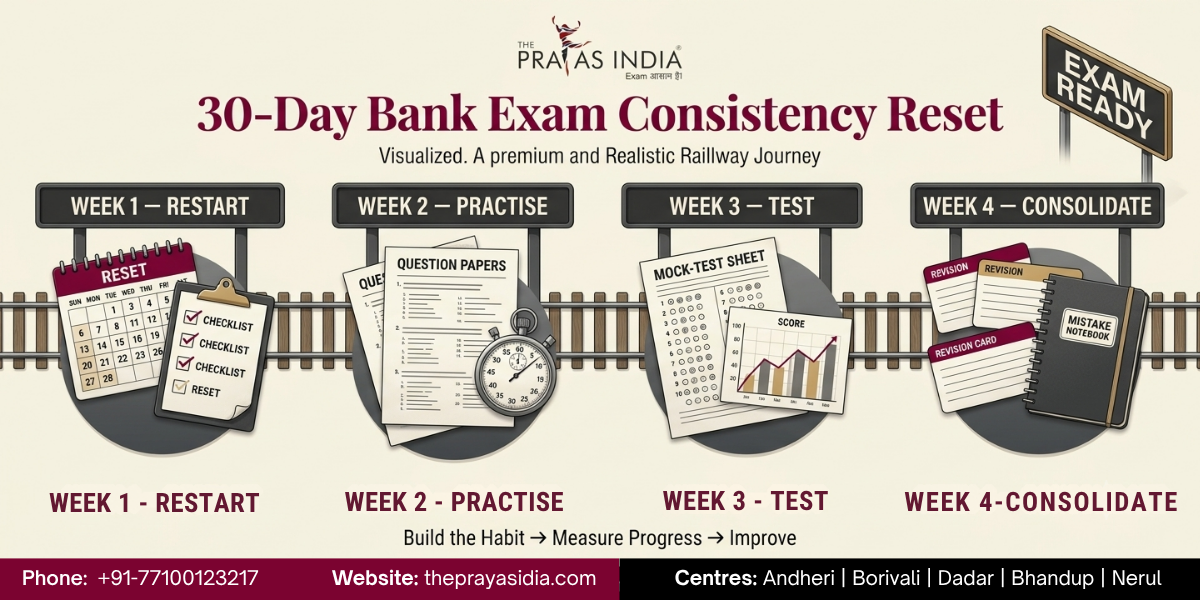
A 30-Day Consistency Reset
If your preparation has become irregular, don’t wait for the beginning of a new month.
Start with a 30-day reset.
Week 1: Rebuild the Routine
Focus on fixed study timings, basic revision and identifying weak areas.
Week 2: Increase Practice
Add regular sectional practice and begin tracking accuracy and time.
Week 3: Introduce More Testing
Increase mock or sectional-test frequency and analyse performance carefully.
Week 4: Consolidate
Focus on revision, mistakes, weak topics and exam-specific strategy.
The purpose of this reset is not to complete the entire syllabus.
It is to rebuild the habit of consistent preparation.
Your Consistency Checklist
Before starting each week, ask yourself:
- Do I know my priority subjects?
- Have I scheduled revision?
- Have I planned mock tests?
- Do I know my weakest topics?
- Have I allocated time for current affairs?
- Is my timetable realistic?
- What will I do if I miss a study session?
- When will I review my performance?
These questions keep your preparation proactive rather than reactive.
Final Takeaway
Clearing a bank exam is rarely the result of one extraordinary week of preparation. It is usually the outcome of hundreds of ordinary study sessions completed with discipline.
Some days will be highly productive. Some will not. Your timetable may occasionally break. Your mock scores may fluctuate. You may discover that a topic you thought was strong actually needs more work.
None of these situations has to derail your preparation.
The real advantage comes from having a system that allows you to return to the process repeatedly.
Keep your daily targets realistic. Focus on high-value topics. Practise regularly. Analyse your mistakes. Revise before you forget. Use mock tests as feedback rather than judgement. Track your progress and make changes based on performance.
And if you find it difficult to create and maintain this structure independently, consider whether a professional bank coaching institute in Mumbai can provide the academic environment, accountability and guidance you need.
For serious aspirants, admissions into a structured banking preparation programme can be a practical step when the goal is to bring greater discipline and direction to preparation.
The most important question is not whether you can study for ten hours today.
It is whether you can show up, practise, analyse and improve tomorrow—and continue doing it until the examination.
Contact Us
- Call Now: +91-77100 13217
- Website: theprayasindia.com
- Centres: Andheri | Borivali | Dadar | Nerul | Bhandup
FAQs
1. How can I stay consistent during bank exam preparation?
Set realistic daily targets, maintain fixed study blocks, practise regularly and review your progress every week. Focus on maintaining continuity rather than trying to study an unrealistic number of hours every day.
2. How many hours should I study for bank exams?
There is no universal number. Your study hours should depend on your current level, exam timeline and other responsibilities. The quality and consistency of preparation matter more than simply counting hours.
3. How can working professionals prepare consistently for bank exams?
Use fixed study windows before or after work, utilise shorter sessions for revision and current affairs, and reserve longer periods for practice and mock analysis. A realistic weekly plan is more sustainable than an aggressive daily timetable.
4. How important are mock tests for bank exam preparation?
Mock tests are essential for developing speed, accuracy, question selection and exam temperament. Their value increases significantly when you analyse mistakes and use the results to modify your preparation.
5. What should I do if I lose consistency during preparation?
Don't attempt to compensate with an unrealistic timetable. Review what you have already completed, identify pending priorities and restart with manageable daily targets. The first objective should be restoring your routine.
6. How should I divide time between Quant, Reasoning and English?
Your allocation should depend on your strengths and weaknesses. Give additional time to subjects where your accuracy, speed or conceptual understanding is weak while maintaining regular practice in stronger areas.
7. How can I avoid getting distracted by too many study resources?
Limit yourself to a small number of reliable resources for concepts, practice, mocks and current affairs. Completing and revising selected material is generally more useful than continuously collecting new resources.
8. Is joining bank coaching necessary for clearing banking exams?
Not necessarily. Some candidates succeed through disciplined self-study. However, structured coaching can provide academic guidance, regular testing, doubt support, mentorship and external accountability, which may be particularly useful for aspirants who struggle with consistency.
9. What should I look for in the best bank coaching in Mumbai?
Consider faculty quality, course structure, mock tests, practice material, performance analysis, doubt-solving, mentorship, current-affairs support, batch schedule and whether the institute's teaching approach fits your preparation needs.
10. Can The Prayas India help with bank exam preparation?
The Prayas India provides structured coaching support for banking and competitive-exam aspirants, combining classroom learning with practice, testing and academic guidance to help students build a more organised preparation approach.