
How to Analyse RRB Group D Mock Tests for Better Performance? | Best RRB Coaching in Mumbai | The Prayas India
Mock tests are an important part of RRB Group D preparation, but simply taking test after test does not guarantee improvement. Many aspirants complete a mock, check their score, look at the answer key and move on to the next test. This approach may tell you whether you performed well or poorly, but it does not explain why your performance changed or what you need to do differently. Proper mock-test analysis is what turns a test from a simple assessment into a preparation tool.
For RRB Group D aspirants, this becomes particularly important because competitive examinations reward not only subject knowledge but also accuracy, speed, question selection and the ability to remain composed under time pressure. A candidate may know the concepts but still lose marks because of careless calculations, incorrect interpretation, poor time allocation or spending too long on questions that should have been skipped. Analysing these patterns after every mock can gradually eliminate such problems.
Candidates preparing with structured guidance can use mock analysis alongside classroom learning, topic-wise practice and revision. If you are looking for RRB coaching in Mumbai, the ideal preparation environment should help you move beyond syllabus completion and focus on actual examination performance. Your mock tests should show whether your preparation is converting into marks and where additional guidance or practice is required.
Your Mock Score Is Only the Starting Point
The first thing students usually notice after a mock is their score. While the score is certainly important, it should be treated as the starting point of your analysis rather than its conclusion. A score tells you the final outcome of your attempt, but it does not tell you whether you lost marks because of weak concepts, poor time management, unnecessary guessing or avoidable mistakes.
Suppose your score increases from one mock to the next. That may indicate improvement, but it could also be because the second paper was easier. Similarly, a lower score does not always mean that your preparation has deteriorated. You may have encountered unfamiliar questions or a comparatively difficult paper. This is why one mock should never be used to make a final judgement about your preparation.
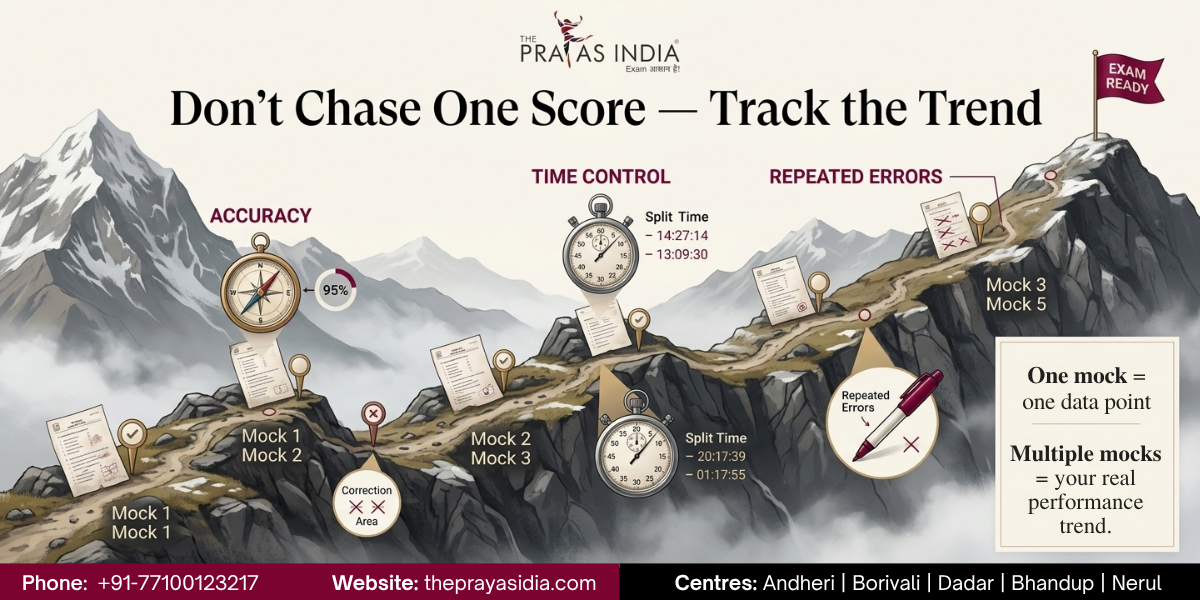
Instead, track your performance across multiple tests and look for consistent patterns in your attempts, accuracy and time usage.
While reviewing every mock, record important indicators such as:
- Total score
- Number of questions attempted
- Number of correct answers
- Number of incorrect answers
- Unattempted questions
- Overall accuracy
- Time taken
- Section-wise performance
- Topics responsible for repeated mistakes
Once these numbers are tracked over several tests, you get a much clearer picture of your preparation level.
Analyse Before You Start Solving the Answers Again
After completing a mock, resist the temptation to immediately open the answer key and start checking solutions. First, spend a few minutes reviewing your own experience during the test.
Think about where you felt comfortable and where you struggled. Remember the questions that consumed unusually high amounts of time. Identify the point at which you started feeling rushed. Consider whether you changed answers because of uncertainty or attempted questions simply because you wanted to increase your attempt count.
This first reflection is useful because the answer key can tell you whether an answer was correct, but it cannot tell you what was happening in your mind while you were solving the paper.
Write down your immediate observations before beginning detailed analysis. These observations can later be compared with your actual performance data.
Use a Four-Category System for Every Question
One of the most effective ways to analyse an RRB Group D mock is to classify questions according to both correctness and efficiency. Instead of looking only at right and wrong answers, examine how you reached each result.
You can divide your attempted questions into four practical categories:
- Correct + Quick: Questions you solved accurately within a reasonable amount of time. These represent your strongest scoring opportunities.
- Correct + Slow: Questions you got right but spent too much time solving. These indicate that your method or decision-making may need improvement.
- Wrong + Solvable: Questions where you had sufficient knowledge but made a calculation, reading, logic or execution mistake.
- Wrong + Knowledge Gap: Questions where you genuinely did not know the concept, fact or method required.
This classification immediately makes your analysis more useful. A large number of “Wrong + Knowledge Gap” questions suggests that you need more learning and revision. If “Wrong + Solvable” questions dominate, your problem may be execution rather than knowledge. If many questions fall into “Correct + Slow,” speed and question selection should become priorities.

Correct but Slow Is Still a Problem
Students often review only the questions they got wrong. However, questions that were answered correctly but consumed excessive time deserve equal attention.
Imagine that you spend nearly three minutes solving one question and eventually get it correct. There is no visible negative mark from that question, so it may look like a successful attempt. But those three minutes could potentially have been used to solve several easier questions.
This is why your mock analysis should identify questions where the solving time was disproportionate to the marks available.
Ask yourself:
- Was there a shorter method?
- Did I perform unnecessary calculations?
- Did I fail to recognise a simpler approach?
- Was the question actually worth the time I invested?
- Would I attempt it in the same way in the real examination?
The objective is not to become faster at every question. The objective is to become better at identifying which questions deserve your time.
Find the Real Reason Behind Every Wrong Answer
A wrong answer should never simply be labelled as “wrong.” The purpose of analysis is to understand the reason behind the error.
Two candidates may both get a Mathematics question wrong, but their problems may be completely different. One candidate may not understand the underlying concept, while another may know the formula but make a calculation mistake. A third may understand everything but rush because too much time was spent earlier in the test.
These candidates require different solutions.
Classify your mistakes into categories such as:
- Conceptual error: You did not understand the underlying method or concept.
- Calculation error: The approach was correct, but arithmetic or calculation went wrong.
- Reading error: You misunderstood the question or missed an important condition.
- Memory error: You had studied the information but could not recall it during the test.
- Guessing error: You attempted despite having insufficient confidence.
- Time-pressure error: You rushed because of poor time allocation earlier in the test.
- Selection error: You chose a question that was too lengthy or difficult for the time available.
Once the cause is identified, the corrective action becomes much clearer.
Build an Error Notebook That Actually Helps
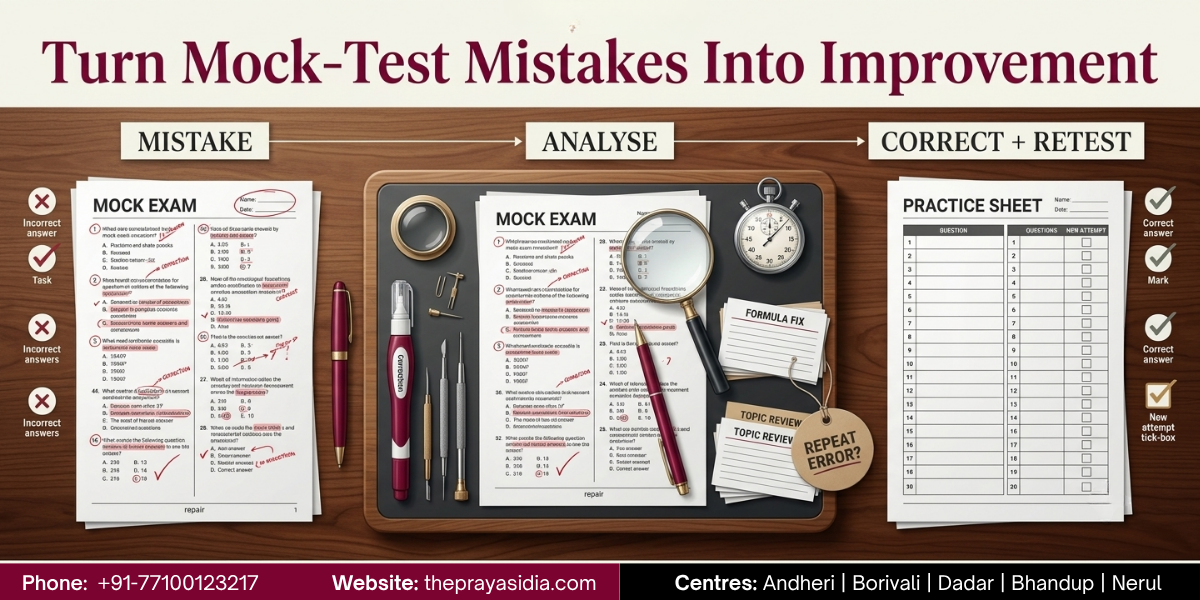
An error notebook should not become another collection of copied solutions. Its purpose is to record the mistakes that are likely to affect your future performance.
For every important mistake, write the topic, the nature of the error and the corrective action. If the same mistake appears again in another mock, mark it as a repeated error.
For example, instead of writing only:
“Wrong answer in percentage.”
write something more useful:
“Percentage calculation error due to rushing. Repractise percentage questions under a time limit.”
This creates a direct connection between the mock and your preparation schedule.
Over time, your error notebook can become one of your most valuable revision resources because it represents your personal weaknesses, not a generic list of difficult topics.
Identify Your Most Expensive Mistakes
Not every mistake affects your performance in the same way. Some errors cost only one mark, while others can affect several subsequent questions because they consume valuable time.
Your most expensive mistakes are generally those that involve unnecessary time investment, repeated errors or poor decision-making.
Look for patterns such as:
- Spending several minutes on one difficult question
- Continuing with a complicated question despite low confidence
- Attempting questions without understanding the requirement
- Making repeated calculation mistakes
- Changing correct answers unnecessarily
- Rushing through easier questions near the end
- Ignoring easier questions while working on a difficult set
These mistakes deserve immediate attention because correcting them can improve both your accuracy and your overall attempt.
Section-Wise Analysis Gives You Better Direction
Your overall score may hide significant differences between subjects. For example, you may perform well in Reasoning but struggle with General Science. Your Mathematics accuracy may be good but your speed may remain low. General Awareness may be responsible for a large portion of your incorrect answers despite strong performance in other areas.
This is why section-wise analysis is essential.
Instead of saying, “My mock score is low,” identify the exact problem:
“My Mathematics accuracy is good but my solving time is high.”
Or:
“My General Science score is low because I have conceptual gaps in specific topics.”
Or:
“My Reasoning score drops because I spend too long on certain question types.”
These observations are actionable. They can directly influence what you study during the following week.
Mathematics: Analyse Speed, Accuracy and Topic-Wise Performance
Mathematics requires a balance between understanding and execution. You may know the concepts but still lose marks if calculations are slow or if you spend too much time on questions that are not efficient to attempt.
After every mock, identify which Mathematics topics are giving you the most trouble. Look at both accuracy and time.
For example, you may discover that you are comfortable with percentage, average and ratio questions but struggle with certain time-and-work, algebra or data-based problems. Instead of revising the entire Mathematics syllabus again, you can target those specific areas.
Your Mathematics analysis should track:
- Topics with the highest number of errors
- Questions taking excessive time
- Repeated calculation mistakes
- Concepts requiring revision
- Question types that should be attempted earlier
- Question types better left for later
This targeted approach makes your practice sessions more productive.
Reasoning: Question Selection Can Change Your Score
Reasoning performance is not only about solving ability. It is also about recognising which questions deserve your attention.
A candidate may spend too much time trying to crack one complicated arrangement while several easier questions remain available elsewhere in the section. In a competitive examination, that can become an expensive decision.
During mock analysis, identify whether your problem is actually solving or selecting.
Ask yourself whether you:
- Spent too long on a single puzzle or arrangement
- Failed to recognise an easier question
- Continued solving despite repeated dead ends
- Took too long to understand the structure
- Could have returned to the question later
With regular practice, you should become increasingly comfortable with leaving a low-value question temporarily and moving towards a better scoring opportunity.
General Science: Separate Conceptual Weakness From Forgetting
When you get a General Science question wrong, determine whether you never understood the concept or simply forgot information you had studied previously.
These are two different preparation problems.
A genuine knowledge gap requires learning and understanding.
A recall problem requires better revision.
If you repeatedly forget information from a particular Science topic, don’t simply read the chapter again and move on. Add that topic to your revision cycle and test yourself after a gap.
This approach encourages active recall instead of passive reading.
General Awareness: Let Your Mocks Tell You What to Revise
General Awareness can become overwhelming because there is a large amount of information available to aspirants. The challenge is not merely finding information but remembering the information that is relevant to the examination.
Mock tests can help identify where your current revision is weak.
When you repeatedly get questions wrong from a particular area, add those topics to a focused revision list. Instead of continuously consuming new material, spend part of your study time revisiting information you have already encountered.
Your preparation should gradually move from:
Collecting information → Understanding information → Revising information → Recalling information
This transition becomes increasingly important as the examination approaches.
Don’t Analyse Only the Questions You Attempted
There is another important part of mock analysis that candidates frequently ignore: the questions they did not attempt.
A question you left may have been:
- Too difficult
- Too lengthy
- Outside your current preparation level
- Correctly skipped because of time
- A potential scoring opportunity that you failed to notice
These categories have very different meanings.
If you skipped a difficult question that would have taken several minutes, that may have been a good decision.
If you skipped a simple question because you did not recognise it quickly enough, your question-selection skills may need improvement.
Therefore, occasionally review a sample of your unattempted questions after the mock.
This can reveal hidden scoring opportunities.
Analyse Time Allocation, Not Just Total Time
Completing the test within the allotted duration does not necessarily mean that your time management was good.
You need to understand where your time went.
If you spent a disproportionately large amount of time on one section or question type, it may have reduced the time available for easier questions elsewhere.
After each mock, reconstruct your time usage as accurately as possible.
Ask:
- Which section consumed the most time?
- Which question type caused delays?
- Where did I begin rushing?
- Did I spend time on questions with low probability of success?
- Did I leave enough time for the questions I usually solve well?
This analysis can eventually help you build a more reliable examination strategy.
Use the Mock to Create Your Next Week’s Study Plan
A mock test should influence what you do after it.
If your analysis shows that Science is weak, your next week’s schedule should include additional Science revision. If Mathematics is accurate but slow, include timed calculation practice. If Reasoning suffers because of question selection, practise identifying manageable sets before solving them.
This creates a productive cycle:
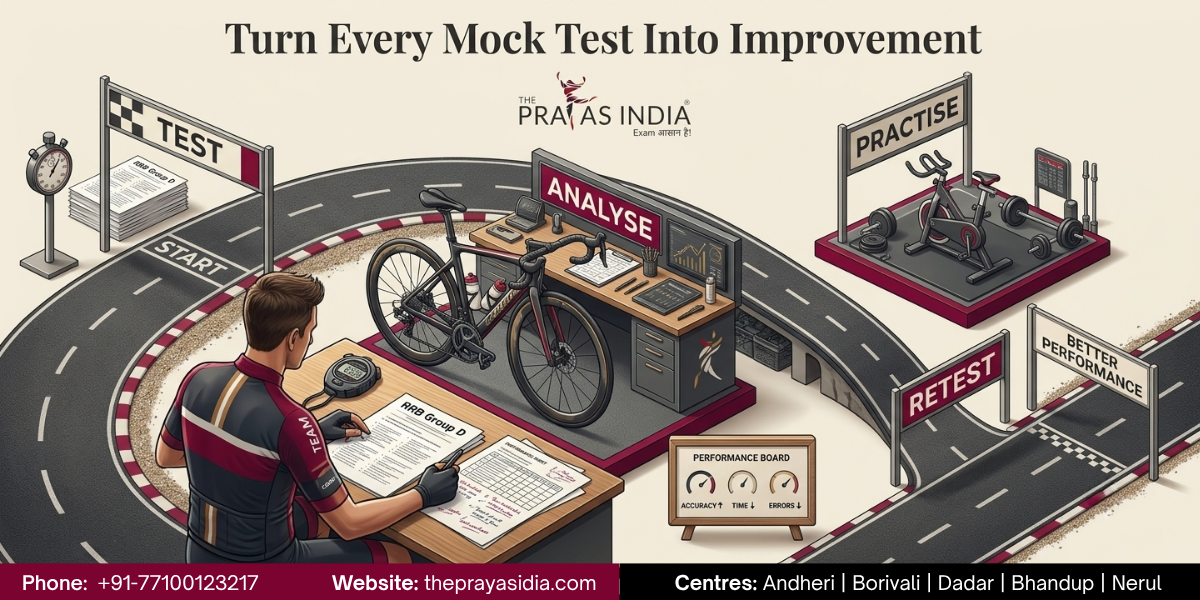
Mock Test → Analysis → Weakness Identification → Targeted Practice → Next Mock
The purpose of taking the next mock is then not merely to obtain another score. It is to check whether your previous weakness has actually improved.
Avoid Taking Mocks Just for the Sake of Numbers
Aspirants sometimes believe that taking a large number of mocks automatically indicates serious preparation. In reality, the quality of analysis matters more than the raw number of tests.
If you take several mocks but repeat the same mistakes because you never review them properly, the additional tests may have limited value.
Instead, prioritise a cycle in which every mock produces a clear learning outcome.
After each test, you should be able to identify:
- One major weakness
- One repeated mistake
- One topic requiring revision
- One time-management problem
- One change to implement in the next mock
This keeps your preparation progressive rather than repetitive.
The Role of Coaching in Mock-Test Improvement
Self-analysis is possible, but many aspirants struggle to recognise the difference between a knowledge problem and a test-taking problem. A structured coaching environment can provide an additional layer of feedback through faculty guidance, regular tests, performance tracking and discussion of common errors.
This is an important factor to consider when choosing RRB coaching in Mumbai.
Before taking admission, don’t look only at whether an institute provides classes and study material. Understand whether its preparation system also supports regular testing, mock analysis, doubt resolution and performance improvement.
A strong coaching programme should help you understand not only what to study, but also how to perform with what you have studied.
The Prayas India and RRB Group D Preparation
The Prayas India provides a structured preparation environment for aspirants preparing for competitive and railway examinations. For RRB Group D candidates, guided classroom preparation combined with regular practice and testing can help create a more organised preparation cycle.
Students preparing independently often know that they need to take mocks but may not always know how to interpret the results. A structured learning environment can help bring greater discipline to this process by connecting classroom concepts with examination-level questions and performance review.
For candidates exploring RRB coaching in Mumbai, this combination can be an important part of the admission decision. The right preparation environment should help you progress from learning concepts to applying them accurately and eventually performing confidently under timed conditions.
Your Next Mock Should Be Better Than Your Last One
The ultimate purpose of mock-test analysis is not to produce a perfect report. It is to make your next attempt better.
If you identify that you are losing marks through calculation errors, correct that problem before your next mock. If you are spending too much time on difficult questions, practise moving on earlier. If General Awareness is causing repeated mistakes, strengthen your revision cycle. If your attempts are high but accuracy is falling, work on selection and controlled attempts.
Over several tests, these small corrections can create significant improvement.
For an RRB Group D aspirant, the most productive mindset is therefore not “How many mocks have I completed?” but “How much have my mocks helped me improve?”
That shift can turn mock testing into one of the strongest components of your preparation strategy.
From Mock-Test Analysis to Consistent Improvement
A mock test becomes genuinely valuable only when its analysis influences what you do next. Once you know where your marks are being lost, the next step is to convert those observations into a practical improvement plan. This is where many aspirants fail to complete the process. They identify that Mathematics is slow or General Awareness is weak, but they continue following the same study routine without making any meaningful changes.
Your preparation should work like a continuous feedback system. Every test should provide information, that information should change your practice, and the next test should show whether the change worked. When this process is repeated consistently, mock tests stop being stressful scorecards and become instruments for improving your actual examination performance.
Build a Mock-to-Study Feedback Cycle
After analysing a mock, don’t create a long list of everything that went wrong. Select the problems that are most important and realistically correctable before your next test. If you try to fix ten different weaknesses simultaneously, your preparation can become scattered and difficult to manage.
Instead, identify two or three high-priority issues and connect each one with a specific action.
For example:
- Low Mathematics speed: Add timed arithmetic practice to your daily routine.
- Repeated Science errors: Revise the relevant concepts and solve topic-wise questions.
- Poor question selection: Practise identifying easy, moderate and time-consuming questions.
- Careless mistakes: Slow down during critical calculation or reading steps.
- Low General Awareness retention: Introduce shorter but more frequent revision sessions.
This approach ensures that mock analysis directly affects your study schedule.
Create a Priority System for Your Weak Areas
Not every weakness deserves equal attention. Some topics may be difficult but rarely affect your score, while another seemingly small weakness may repeatedly cost several marks.
Prioritise weaknesses according to three factors: frequency, impact and improvement potential.
A topic that appears repeatedly in your mocks, causes several errors and can improve through targeted practice should receive immediate attention. A low-frequency topic that consumes a large amount of study time may not deserve the same priority.
Your weekly preparation can therefore be divided into:
High Priority: Repeated mistakes and major scoring weaknesses.
Medium Priority: Topics where performance is inconsistent.
Maintenance: Areas where accuracy is already strong and only regular revision is required.
This prevents you from spending equal time on every chapter simply because it exists in the syllabus.
Develop a Personal Accuracy Strategy
Accuracy should not be treated as a number that you check only after the test. It should influence how you attempt questions.
If your analysis shows that you frequently lose marks through guessing, introduce a stricter confidence rule. If calculation errors are common, give yourself a few additional seconds to verify critical steps. If reading errors are frequent, focus on understanding the exact requirement before beginning the calculation.
The aim is not to become excessively cautious. Spending too much time trying to guarantee every answer can damage your speed. Instead, develop controlled accuracy—knowing when a question is reliable enough to attempt and when uncertainty is high enough to move on.
Learn the Difference Between Speed and Rushing
Many candidates assume that faster solving automatically means better performance. In reality, there is a significant difference between speed and rushing.
Speed comes from familiarity, efficient methods and repeated practice. Rushing usually comes from anxiety, poor time allocation or trying to compensate for time lost earlier.
If your mock analysis shows that your final questions contain many careless errors, don’t simply tell yourself to “solve faster.” Find out why you were rushed.
You may have spent too much time on difficult questions at the beginning.
You may have failed to maintain a steady pace.
You may have taken unnecessary risks.
Once the underlying cause is identified, the solution becomes much more practical.
Practise Question Selection Separately
Question selection deserves dedicated practice because it is a skill in itself.
During some practice sessions, don’t focus only on solving questions. Instead, take a set of mixed questions and give yourself a short amount of time to identify which ones you would attempt first.
Look for questions that appear:
- Familiar
- Conceptually straightforward
- Short or moderate in calculation
- Less dependent on lengthy casework
- Likely to produce a reliable answer
Then identify questions that appear:
- Unusually lengthy
- Conceptually unfamiliar
- Calculation-heavy
- Confusing
- Time-intensive relative to the likely benefit
This exercise helps develop the ability to make quick decisions before committing time.
Use Previous-Year Questions Alongside Mocks
Mock tests are useful for simulation, but previous-year questions provide another important perspective. They help you understand the style of questions that have actually appeared in the examination and reveal recurring concepts and patterns.
After analysing a weak area in a mock, use previous-year questions from that area to strengthen your preparation.
For example, if your mock analysis shows weakness in a particular Mathematics topic, don’t simply read the theory again. Solve relevant previous-year questions and compare your performance with the level expected in the actual examination.
This connects your weakness analysis with authentic exam-oriented practice.
Build a Revision System Around Your Errors
Revision becomes significantly more effective when it is based on actual mistakes.
Instead of revising the entire syllabus with equal intensity, create smaller revision groups based on your mock performance.
Your revision notebook can contain:
- Concepts you repeatedly forget
- Formulas that cause calculation errors
- Science facts you repeatedly miss
- General Awareness areas requiring additional recall
- Question types where your approach is inefficient
- Common traps that have caused mistakes
- Short methods or techniques worth revisiting
Review these notes at regular intervals.
The closer you get to the examination, the more valuable such personalised revision becomes because the material directly reflects your own performance history.
Use Spaced Revision Instead of Last-Minute Revision
Aspirants often postpone revision because they believe they will remember everything until the examination. In reality, information that is not revisited tends to become difficult to recall.
A better approach is to revise important material multiple times with gaps between sessions.
For example, after learning a topic, review it again after a few days, test yourself later and revisit it after another gap.
This approach is particularly useful for General Science, General Awareness and factual information.
The objective is not to spend hours rereading the same material. It is to create enough recall opportunities for important information to remain accessible during the examination.
Don’t Let Mock Scores Control Your Confidence
Mock-test scores can fluctuate, and that is normal.
One difficult test can make a prepared candidate feel underprepared. One unusually easy test can create false confidence. Neither should determine your overall assessment.
Instead, track multiple indicators over time.
Look for trends such as:
- Increasing accuracy
- Reduced careless errors
- Better time control
- Faster recognition of easy questions
- Fewer repeated mistakes
- Improved section-wise consistency
- More efficient question selection
These improvements may appear before a major jump in your overall score.
If the underlying performance indicators are improving, your preparation is moving in the right direction.
Build a Mock-Test Calendar
Your mock schedule should become more structured as the examination approaches.
During the early preparation phase, use topic-wise and sectional tests to strengthen individual areas. Once you have reasonable syllabus coverage, introduce more full-length tests. During the final phase, increase realistic exam simulations while protecting sufficient time for analysis and revision.
A practical progression can look like:
Foundation Phase: Topic tests + sectional practice
Development Phase: Sectional tests + occasional full mocks
Performance Phase: Regular full-length mocks + detailed analysis
Final Revision Phase: Exam-like mocks + targeted revision + error correction
The exact frequency can be adjusted according to your preparation level, but the principle remains the same: testing frequency should increase without sacrificing analysis quality.
Simulate Real Examination Conditions
A mock is most useful when it resembles the actual examination environment.
Whenever possible, take full-length tests under realistic conditions. Sit at a fixed time, avoid unnecessary interruptions and follow the same rules you expect to follow during the actual examination.
This helps you evaluate more than academic knowledge.
You also begin to understand:
- How your concentration changes over time
- Whether you panic when the paper becomes difficult
- How quickly you recover from a difficult question
- Whether your pace remains stable
- How effectively you manage the final portion of the test
These behavioural observations can be extremely valuable.
What to Do When Your Mock Score Stops Improving
A score plateau does not necessarily mean that you have reached your maximum potential.
It may indicate that your current preparation method has stopped addressing the actual reason behind your mistakes.
If your score remains stable across several mocks, examine your performance again.
Ask whether:
- The same mistakes are repeating
- Your weak topics have actually been revised
- You are taking too many tests without enough practice
- Your attempts are increasing at the cost of accuracy
- You are spending too much time on difficult questions
- Your current study plan is based on assumptions rather than mock data
A plateau is often a signal to change the quality of preparation, not simply increase its quantity.
The 24-Hour Rule After a Mock
Try to analyse an important mock while your experience of the test is still fresh.
Within the same day, or as soon as practically possible, review the major mistakes and time-management problems.
Record the most important observations and decide what you will change.
The longer you wait, the easier it becomes to forget why you made a particular decision during the test.
Your immediate reaction is valuable data.
Use it.
Don’t Copy Another Aspirant’s Attempt Strategy
Your preparation strategy should be personal.
Someone else may attempt more questions than you because they have different strengths, calculation speed or experience. Another candidate may score well with a different question order.
Instead of copying their strategy, use their approach only as something to experiment with.
Test it in your own mocks.
If it improves your performance, retain it.
If it doesn’t, return to the strategy that works better for you.
Competitive-exam preparation is ultimately about discovering the combination of methods that allows you to perform consistently.
How Coaching Can Improve Your Mock-Test Preparation
Aspirants can certainly analyse mocks independently, but structured guidance can make this process more systematic. Faculty can help identify whether a candidate’s problem is conceptual, procedural or strategic, while regular testing creates accountability and allows progress to be monitored.
This becomes an important consideration for candidates searching for the best RRB coaching in Mumbai.
When evaluating a coaching institute, look beyond classroom teaching. Ask whether the programme includes a meaningful testing and feedback system. A student should ideally have access to regular practice, mock tests, performance review and guidance on correcting recurring mistakes.
The objective of coaching should be to reduce the distance between studying a topic and performing successfully in the examination.
Choosing the Right RRB Coaching in Mumbai
Before taking admission, candidates should evaluate whether the institute’s preparation system matches their individual needs. A beginner may require stronger foundation support, while a repeat aspirant may benefit more from advanced practice, mock analysis and performance correction.
Look for an institute that provides a balanced combination of:
- Structured classroom preparation
- Experienced and approachable faculty
- RRB Group D-focused study material
- Topic-wise and previous-year question practice
- Regular sectional tests
- Full-length mock tests
- Detailed performance analysis
- Doubt-solving support
- Revision and current-affairs guidance
- Mentorship and academic monitoring
The right coaching environment should make your preparation more organised, measurable and consistent.
The Prayas India for RRB Group D Aspirants
The Prayas India provides structured coaching support for students preparing for competitive and railway examinations. For RRB Group D aspirants, a guided preparation environment can help establish a disciplined routine that combines classroom learning with practice, testing and revision.
Mock-test analysis is particularly valuable within such a system because students can identify performance gaps and then work on them through targeted preparation. Instead of taking tests as isolated events, aspirants can use them as checkpoints throughout their preparation journey.
For students exploring RRB coaching in Mumbai, The Prayas India can be considered as part of a structured preparation approach where learning is supported by regular practice and performance-oriented preparation.
Admission Is the Beginning of the Preparation Journey
Taking admission into a coaching programme should not be viewed simply as enrolling for classroom lectures. The real value of a structured programme lies in how effectively it supports your preparation from the first concept to the final mock.
Before making an admission decision, understand what kind of support you need.
If you are starting from the basics, look for strong conceptual teaching and a structured syllabus.
If your concepts are already strong, prioritise quality practice, test exposure and performance analysis.
If consistency is your biggest challenge, consider whether regular classes, tests and academic monitoring can provide the structure you need.
A thoughtful admission decision can help you build a preparation routine that is sustainable over the long term.
A Simple Formula for Better Mock Performance
RRB Group D mock-test analysis can be remembered through a simple cycle:
TAKE THE TEST → CHECK THE SCORE → CLASSIFY MISTAKES → IDENTIFY THE CAUSE → PRACTISE THE WEAK AREA → RETEST
The important part is not the first step alone.
Taking the test gives you data.
Analysis gives that data meaning.
Targeted practice creates improvement.
The next test confirms whether the improvement is real.
When this cycle becomes a regular part of preparation, your mock scores can become increasingly representative of your actual readiness.
Final Takeaway
The best mock-test strategy is not to chase the highest score in every individual test. It is to make every test contribute something to your preparation.
One mock may teach you that your Mathematics speed needs work. Another may reveal that you are losing marks through careless errors. A third may show that your question selection needs improvement. Gradually, these observations help you build a more disciplined and efficient approach.
For RRB Group D aspirants, the ultimate objective is to reach the examination with more than just syllabus knowledge. You should enter with an understanding of how you perform under pressure, where you tend to make mistakes, which questions suit you and how you should use your available time.
That understanding comes from repeated testing and honest analysis.
If you are preparing for RRB Group D and considering RRB coaching in Mumbai, choose a preparation environment that supports the complete journey—from concepts and practice to mocks, analysis, revision and final exam readiness.
The goal is simple: make every mock better than the previous one, and make every mistake useful for the next attempt.
Contact Us
- Call Now: +91-77100 13217
- Website: theprayasindia.com
- Centres: Andheri | Borivali | Dadar | Nerul | Bhandup
FAQs
1. Why is mock-test analysis important for RRB Group D preparation?
Mock-test analysis helps you understand more than your score. It identifies recurring mistakes, weak topics, time-management issues, question-selection problems and areas where your accuracy needs improvement. This allows you to modify your preparation based on actual performance.
2. How should I analyse an RRB Group D mock test?
Start by checking your score, attempts and accuracy. Then review incorrect answers, slow questions and selected unattempted questions. Classify your mistakes according to their cause and create specific corrective actions for your next study sessions.
3. Should I analyse questions that I answered correctly?
Yes. Correct answers that took too much time can still affect your overall performance. Identifying such questions helps you improve solving efficiency and decide whether certain questions should be attempted immediately or revisited later.
4. How can I improve my accuracy in RRB Group D mock tests?
Identify the reasons behind your incorrect answers. If errors come from weak concepts, revise the topic. If they come from calculation or reading mistakes, practise carefully. If guessing is responsible, improve your question-selection discipline.
5. How many RRB Group D mock tests should I take?
There is no fixed number suitable for every aspirant. Early preparation can focus more on topic-wise and sectional tests, while full-length mocks should become more regular as the examination approaches. Always leave sufficient time for detailed analysis.
6. Should I take a mock test every day?
Daily mocks are not necessary for every stage of preparation. Taking too many full-length tests without analysing them can reduce their value. A balanced combination of learning, practice, revision, testing and analysis is generally more useful.
7. What should I do if my RRB Group D mock score is not improving?
Look beyond the score and identify repeated patterns. Check whether the same topics, mistakes, time-management issues or question-selection problems are appearing across multiple tests. Then change your practice plan according to those findings.
8. How can mock tests improve my time management?
Mocks provide a realistic environment in which you can observe where your time is being spent. By analysing slow questions and sections that consume disproportionate time, you can develop a better attempt order and learn when to move on from lengthy questions.
9. How important are previous-year questions for RRB Group D?
Previous-year questions are useful for understanding the nature and level of questions asked in the examination. They should be combined with conceptual preparation, topic-wise practice and mock tests for a well-rounded preparation strategy.
10. Can beginners take RRB Group D mock tests?
Yes, but beginners should not rely exclusively on full-length mocks from the beginning. Topic-wise and sectional tests can help build confidence and accuracy first. Full-length tests can gradually be introduced as syllabus coverage improves.
11. What should I look for in the best RRB coaching in Mumbai?
Consider faculty, teaching methodology, study material, previous-year question practice, mock tests, performance analysis, doubt-solving, revision support and academic guidance. A strong institute should support the complete preparation cycle rather than only classroom teaching.
12. How can The Prayas India help with RRB Group D preparation?
The Prayas India provides structured preparation support for competitive and railway examinations. Its learning environment can help aspirants combine guided teaching with practice, testing, revision and performance-focused preparation.