How to Improve Accuracy in SSC CGL Maths | Best SSC Coaching in Mumbai | The Prayas India
Accuracy Is the Real Difference-Maker in SSC CGL Maths
SSC CGL Maths is not only about how many questions you can solve. It is equally about how many of those questions you can solve correctly under examination pressure. An aspirant may know the concepts, understand the formulas and even solve difficult questions during practice, yet still lose valuable marks because of calculation mistakes, incorrect interpretation, hurried steps or poor question selection.
This is why accuracy deserves to be treated as a separate preparation objective. Speed naturally receives a lot of attention during SSC CGL preparation because candidates have to manage a demanding paper within a limited time. However, speed without control can become counterproductive. Solving five additional questions does not help if several previously attempted questions are incorrect.
For serious SSC CGL aspirants, the objective should therefore be to develop a balance between conceptual clarity, calculation speed, question selection and accuracy. Once these four elements start working together, Mathematics becomes much more manageable during mocks as well as the actual examination.
For students preparing for SSC CGL in Mumbai, a structured preparation environment can make this process easier because accuracy can be developed through regular practice, sectional tests, mock analysis and continuous correction of recurring mistakes. This is also where choosing the right SSC Coaching in Mumbai becomes relevant for aspirants who want a systematic preparation plan rather than random practice.
Start by Identifying Where Your Accuracy Is Being Lost
Before trying to improve accuracy, you need to know what is actually causing your mistakes. Many students simply solve more questions after getting a low score in a mock test. That increases practice volume but does not necessarily solve the underlying problem.
Suppose you attempted 20 questions and got four wrong. Those four mistakes may have completely different causes. One could be a calculation error, another could be a formula mistake, the third could come from misreading the question and the fourth could be a question you attempted despite not being confident about the approach.
Treating all four as “silly mistakes” gives you very little useful information.
A better approach is to classify your errors.
Your SSC CGL Maths mistakes can broadly fall into these categories:
- Conceptual errors: You did not understand or correctly apply the underlying concept.
- Calculation errors: The approach was correct, but arithmetic went wrong.
- Reading errors: You misunderstood a condition, unit, value or requirement in the question.
- Formula errors: You remembered the wrong formula or applied it incorrectly.
- Time-pressure errors: You rushed because you were spending too much time elsewhere.
- Question-selection errors: You attempted a question that was not worth the time or risk.
- Carelessness: Signs, decimal points, percentages or basic operations were handled incorrectly.
Once these categories become visible, your preparation becomes much more targeted.
Accuracy Begins With Strong Fundamentals
One of the biggest misconceptions in competitive-exam preparation is that solving a large number of questions automatically improves performance. Practice matters, but the quality of practice depends on the quality of your understanding.
If your concepts in percentage, ratio, averages, profit and loss, algebra, geometry or time and work are weak, solving hundreds of questions can simply reinforce incorrect methods.
Before chasing speed, make sure that the basic concepts are sufficiently clear. You should understand not only which formula to use but also why a particular method works and when it should be applied.
For example, in percentage-based questions, an aspirant who understands percentage change, successive changes and the relationship between percentages and fractions can often recognise shortcuts naturally. A student who has only memorised formulas may struggle when the same concept is presented in an unfamiliar format.
This is particularly important in SSC CGL because familiar concepts can appear through different question structures. Conceptual flexibility allows you to identify the underlying mathematical idea instead of depending entirely on memorised patterns.
Build your fundamentals topic by topic:
- Arithmetic
- Percentage
- Ratio and Proportion
- Average
- Profit, Loss and Discount
- Simple and Compound Interest
- Time and Work
- Time, Speed and Distance
- Mixture and Alligation
- Algebra
- Geometry
- Mensuration
- Trigonometry
- Data Interpretation
You do not need to master every topic simultaneously. Build accuracy progressively, beginning with the areas where your conceptual base is weakest.
Don’t Chase Speed Before You Can Solve Correctly
Speed is important in SSC CGL Maths, but trying to become fast too early can create habits that are difficult to correct later.
During the initial learning phase, allow yourself enough time to understand the question and complete the solution correctly. Once you can consistently solve a particular question type without making avoidable errors, gradually introduce time pressure.
Think of the progression as:
Correct Method → Consistent Accuracy → Faster Execution → Exam-Level Speed
This approach may initially feel slower, but it creates a more reliable foundation.
A student who solves a question correctly in two minutes can work towards bringing the time down. A student who solves it in one minute but gets it wrong has to first repair the method before speed becomes useful.
The aim is not to become the fastest person in the practice room. The aim is to become an aspirant who can recognise, solve and verify questions efficiently under examination conditions.
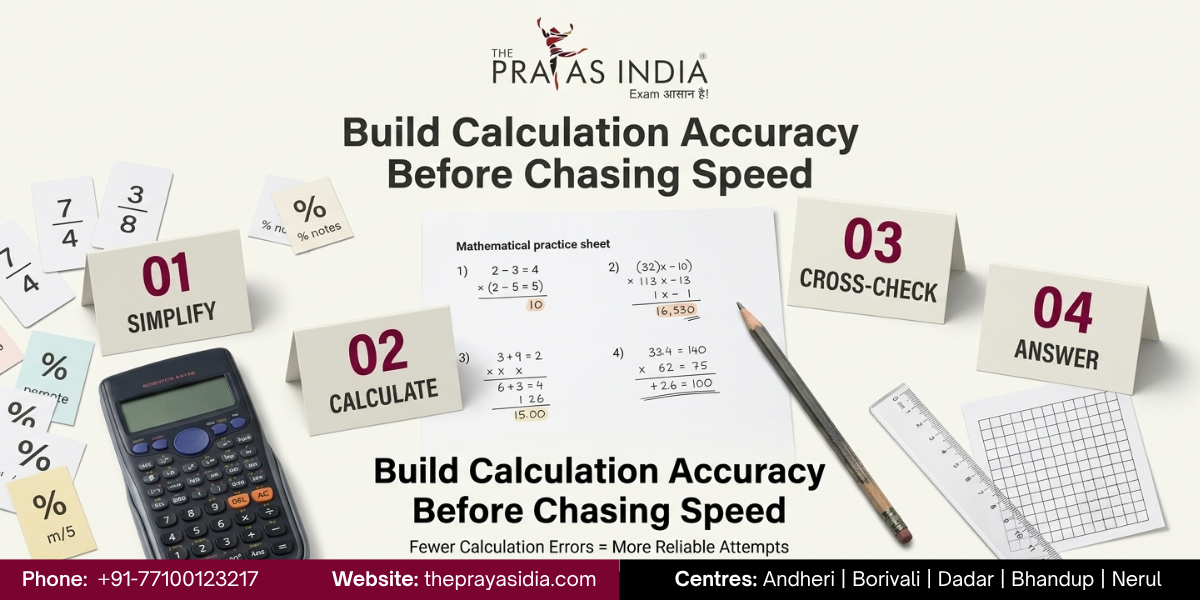
Develop a Calculation System
Calculation is one of the most common sources of avoidable errors in SSC CGL Maths. Even when the mathematical approach is completely correct, a small arithmetic mistake can turn a correct solution into an incorrect answer.
The solution is not simply “calculate faster”. You need to develop a consistent calculation system.
Start by becoming comfortable with frequently used fractions, percentage equivalents, squares, cubes and basic multiplication patterns. These should become familiar enough that you do not have to repeatedly calculate them from scratch.
For example, recognising relationships such as common fraction-percentage conversions can reduce unnecessary calculation time and also reduce the possibility of arithmetic mistakes.
At the same time, do not turn shortcuts into blind memorisation. You should know when a shortcut is appropriate and when a conventional calculation is safer.
Useful calculation habits include:
- Memorise frequently used fraction-to-percentage conversions.
- Practise squares and common multiplication combinations.
- Simplify fractions before performing calculations.
- Cancel common factors whenever possible.
- Avoid unnecessary decimal calculations.
- Keep intermediate calculations organised.
- Recheck signs and units in lengthy calculations.
Over time, these habits reduce the mental load associated with routine arithmetic.
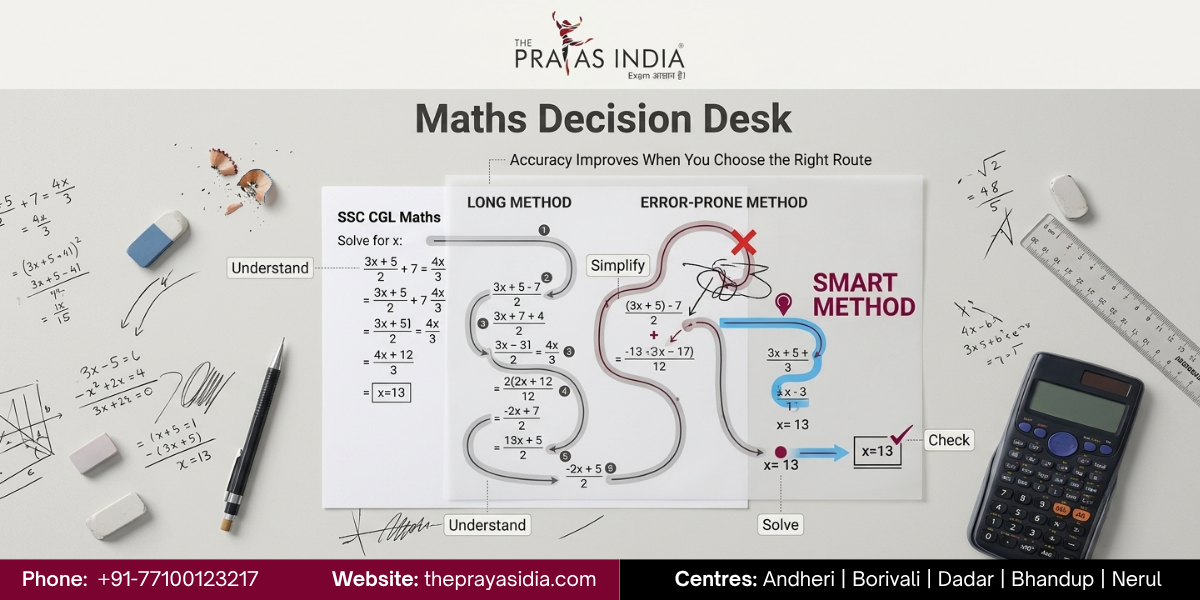
Learn to Recognise the Easiest Route
Accuracy does not always come from solving a question through the longest and most detailed method. In many SSC CGL questions, recognising the right approach can make the difference between a controlled solution and a rushed calculation.
Suppose a question can be solved through a long algebraic equation but also through a simple ratio relationship. The second approach may not only be faster but may involve fewer opportunities for calculation mistakes.
This is why question exposure matters.
As you solve more quality questions, start asking yourself:
“Is there a simpler way to reach the answer?”
That question can gradually develop your mathematical judgement.
However, shortcuts should be adopted carefully. A shortcut that you have seen once in a video or coaching class should not automatically become part of your exam strategy. Practise it sufficiently to ensure that you understand its conditions and can apply it accurately.
Use an Error Log Instead of Simply Checking Your Score
A mock-test score tells you what happened. An error log helps you understand why it happened.
After every SSC CGL Maths sectional test or mock, record the questions you got wrong and identify the reason. Also record questions that took significantly longer than expected, even if you eventually solved them correctly.
This is important because a question that consumes too much time can be a performance problem even when the final answer is correct.
Your error log can include:
| Error Type | What to Record |
|---|---|
| Concept | Which topic or concept was weak? |
| Calculation | Where did the arithmetic go wrong? |
| Approach | Was there a simpler method? |
| Reading | Did you miss a condition or value? |
| Time | How long did the question take? |
| Selection | Should you have skipped it initially? |
| Correction | What should you do differently next time? |
Do not create an enormous notebook filled with complete solutions to every question. The purpose of the error log is to identify patterns, not to reproduce your entire mock test.
If percentage questions repeatedly produce calculation mistakes, you know where to focus. If geometry questions repeatedly consume too much time, you need to work on recognition and approach. If easy arithmetic questions are going wrong because of rushing, your issue may be concentration rather than mathematical ability.
Analyse Correct Answers Too
An interesting but often overlooked aspect of accuracy improvement is that not every correct answer represents a good attempt.
You may get a question correct after spending far too much time on it. You may also reach the correct answer through a complicated method that increases the chance of making a mistake.
Therefore, mock analysis should include three categories:
Wrong and easy to correct: These should be fixed immediately.
Correct but inefficient: These need method improvement.
Correct and efficient: These should become part of your reliable question-solving toolkit.
This approach creates a much more meaningful performance review than simply looking at the final score.
Build Topic-Wise Accuracy Before Full-Test Accuracy
Trying to improve your overall accuracy directly can sometimes make preparation confusing. A better method is to establish reliability topic by topic.
Take one topic and practise a controlled set of questions. Do not immediately focus on extreme difficulty. Start with questions that represent the actual concepts you need to master.
Once you can solve a topic consistently with minimal errors, introduce mixed questions and then time pressure.
For example, your progression for Profit and Loss could look like:
Concept Revision → Basic Questions → Mixed Applications → Timed Set → Error Analysis → Reattempt
The same process can then be applied to other topics.
This gives you measurable progress and prevents the common situation where students keep taking full mocks without fixing the specific weaknesses responsible for their low accuracy.
Key Takeaway
Improving accuracy in SSC CGL Maths is not about becoming excessively cautious or solving every question slowly. It is about developing control over your preparation and decision-making.
Strong fundamentals reduce conceptual mistakes. Better calculation habits reduce arithmetic errors. Familiarity with different question types improves method selection. Regular mock analysis reveals recurring weaknesses. Together, these habits create the foundation for higher accuracy.
The next stage is to take this foundation into timed practice, where accuracy has to coexist with speed, question selection and examination pressure. That is where a structured preparation plan becomes particularly valuable for aspirants targeting SSC CGL.
Turn Accuracy Into an Exam-Time Habit
Knowing how to solve questions correctly during practice is only the first stage. SSC CGL Maths demands that you maintain that accuracy while working against the clock. This is where many aspirants experience a drop in performance. A question that takes two minutes in a relaxed practice session may take considerably longer in a mock when the pressure of the remaining questions starts affecting decision-making.
The solution is to introduce exam-like conditions into your preparation gradually. Do not suddenly shift from untimed practice to full-length mocks. Instead, reduce the time available for topic-wise sets, then move towards sectional tests and eventually complete mocks.
The objective is to make accurate solving feel natural even when the clock is running.
A useful progression is:
- Untimed concept practice
- Topic-wise timed sets
- Mixed-topic practice
- Sectional tests
- Full-length mocks
- Reattempt of incorrect and inefficient questions
This progression allows speed and accuracy to develop together instead of forcing you to choose one over the other.
Learn the Difference Between Speed and Rushing
There is an important difference between solving quickly and solving hurriedly.
Speed means you understand the question quickly, select an appropriate method and execute it efficiently.
Rushing means you are attempting to finish quickly even when you have not fully understood the question.
Rushing often produces avoidable mistakes: reading “not” as “now”, overlooking a unit, using the wrong percentage base, copying a number incorrectly or marking an option without completing the calculation.
The best SSC CGL aspirants do not try to maintain maximum speed on every question. They adjust their pace according to the difficulty and familiarity of the question.
Easy questions should be handled confidently. Moderate questions should receive controlled attention. Questions that look calculation-heavy or unfamiliar should be evaluated before committing significant time.
That is a much more sustainable approach to accuracy.
Develop a Question-Selection Strategy
Accuracy is closely connected with question selection because every question carries a cost in terms of time and concentration.
If you spend several minutes struggling with one difficult question, you are not only risking an incorrect answer but also sacrificing the opportunity to solve easier questions elsewhere in the section.
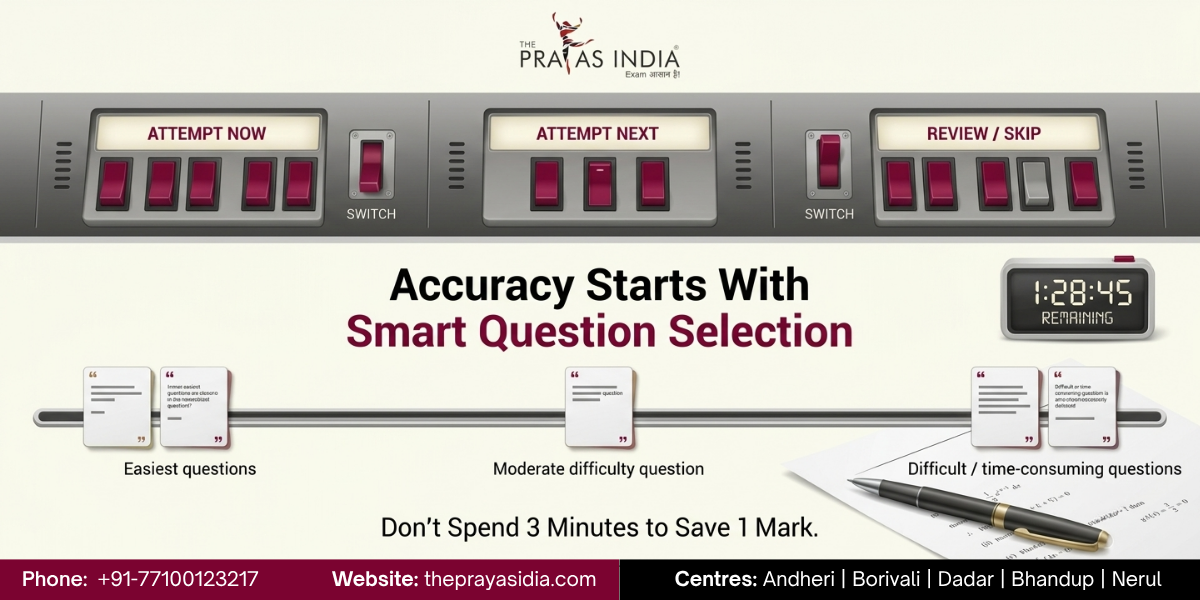
During mocks, classify questions mentally into three broad groups:
First Priority: Familiar and Direct
These are questions where the concept and approach are immediately clear. Attempting them first helps you build momentum while collecting relatively reliable marks.
Second Priority: Solvable With Some Work
These questions require calculation or multiple steps, but the approach is familiar. Attempt them once the easier questions have been addressed.
Third Priority: Uncertain or Time-Consuming
These questions require an unfamiliar method, lengthy calculation or considerable interpretation. They should not automatically become your priority simply because they are visible.
The exact attempt strategy will depend on the latest examination pattern and your individual strengths, but the underlying principle remains consistent: do not allow one difficult question to control your entire paper.
Use Mock Tests as a Diagnostic Tool
A mock test should not be treated simply as a score-generating exercise. Its real value lies in showing you how you behave when faced with a complete set of questions under pressure.
After each mock, analyse more than your final score.
Look at:
- Questions answered incorrectly
- Questions left unanswered
- Questions taking excessive time
- Easy questions missed
- Calculation mistakes
- Conceptual mistakes
- Questions where the method was inefficient
- Questions changed from correct to incorrect
- Topics producing repeated errors
This analysis should influence your next study session.
For example, if you discover that most of your mistakes are coming from calculation-heavy arithmetic questions, spending the next day solving only difficult geometry problems may not address the actual problem. Your preparation should respond to evidence from your performance.
That is how mock tests become a tool for improvement rather than merely a test of preparation.
Reattempt Your Mistakes After a Gap
One of the most effective ways to determine whether you have genuinely corrected a mistake is to solve the question again later without looking at the solution.
Immediately after seeing the explanation, a method can appear obvious. But that does not necessarily mean you have learned it.
Keep difficult or incorrectly solved questions aside and reattempt them after a few days.
If you can solve them independently, the correction has probably become part of your working knowledge. If you make the same mistake again, the topic needs further attention.
This process is particularly useful for recurring errors in arithmetic, algebra and geometry, where a small misunderstanding can affect multiple question types.
Improve Accuracy Through Revision, Not Just New Questions
A common SSC CGL preparation pattern is to continuously solve new questions while rarely revisiting old mistakes. This creates the feeling of constant activity without necessarily producing proportional improvement.
Revision should include your formulas, shortcuts, common traps and previously identified mistakes.
Instead of revising an entire topic from the beginning every time, create compact revision material containing only the information you are likely to forget or misuse.
For example:
Percentage Revision Sheet
- Common fraction-percentage relationships
- Successive percentage changes
- Increase/decrease concepts
- Common traps
- Personal mistakes from mocks
The same approach can be applied to other high-frequency topics.
The purpose of revision is not to reread everything. It is to make your weak points progressively less weak.
A Daily Routine for Improving SSC CGL Maths Accuracy
Your daily routine should combine learning, practice and analysis. Spending two or three hours solving questions without reviewing mistakes may not be as effective as a shorter but more structured session.
A practical routine can include:
| Activity | Purpose |
|---|---|
| Concept Revision | Strengthen fundamentals |
| Topic Practice | Build question familiarity |
| Calculation Drill | Improve arithmetic control |
| Timed Set | Develop speed with accuracy |
| Error Analysis | Identify recurring mistakes |
| Reattempt | Confirm improvement |
The exact duration can be adjusted according to your overall SSC CGL timetable.
What matters most is that analysis is not removed from the schedule. Without reviewing your mistakes, you may continue repeating the same errors across different tests.
Don’t Let Negative Marking Change Your Thinking
Where negative marking applies in the relevant SSC CGL paper, incorrect attempts can directly affect your score. This makes accuracy and question selection even more important.
However, this does not mean that you should become excessively conservative.
The goal is not to attempt only questions where you are 100% certain. The goal is to develop enough familiarity with question types to distinguish between:
“I can solve this.”
and
“I am hoping I can solve this.”
That distinction becomes increasingly important during mocks.
A strong preparation programme should therefore include not only question-solving practice but also discussions around attempt strategy, time allocation and performance analysis.
How Structured Coaching Can Improve Your Maths Preparation
Self-study can build a strong foundation, but many aspirants eventually reach a stage where they know the concepts yet struggle to identify why their mock-test performance is inconsistent. Structured coaching can help bridge this gap by bringing together teaching, practice, testing and analysis within one preparation system.
For an aspirant searching for the best SSC Coaching in Mumbai, the important consideration should not be the number of classes or study materials alone. Look for an environment where concepts are explained systematically, doubts can be addressed, regular tests are conducted and performance is analysed.
Accuracy improves when students receive repeated exposure to different question types and learn how experienced educators approach common traps and time-consuming problems.
The Prayas India can be considered by students looking for structured SSC CGL preparation in Mumbai. A well-organised preparation programme can help aspirants create consistency across Quantitative Aptitude, Reasoning, English and General Awareness while giving them a systematic framework for mock-test practice and revision.
For students considering admission, the right approach is to evaluate the faculty support, course structure, test methodology, study material and overall preparation environment before enrolling.
The Bigger Goal: Make Accuracy Automatic
The strongest improvement in SSC CGL Maths happens when accuracy stops being something you consciously worry about during every question.
You begin to recognise familiar concepts faster. Your calculations become more controlled. You notice common traps. You become better at deciding which questions deserve your time. Most importantly, you learn from your mistakes instead of repeatedly making them.
That transformation does not happen through one shortcut or one mock test. It develops through consistent cycles of practice, analysis, correction and reattempt.
For an aspirant targeting SSC CGL, the preparation goal should therefore be bigger than simply increasing the number of questions solved every day. The goal should be to build a system in which every practice session contributes to better performance.
Final Takeaway
Accuracy in SSC CGL Maths is a skill that can be deliberately developed.
Start with strong concepts, improve your calculation habits, practise the right question types, analyse your mistakes and gradually introduce time pressure. During mocks, pay attention not only to your score but also to your decision-making, time usage and recurring errors.
Most importantly, remember that speed and accuracy are not opposing goals. The right preparation strategy allows one to strengthen the other.
If you are preparing for SSC CGL and looking for SSC Coaching in Mumbai, a structured learning environment can provide the practice, testing and guidance needed to make this process more systematic.
The objective is simple: solve the questions you know, avoid unnecessary mistakes, manage your time intelligently and enter the examination with a repeatable strategy.
FAQs
1. How can I improve my accuracy in SSC CGL Maths?
Begin by identifying the exact reasons behind your mistakes. Strengthen weak concepts, practise calculations, maintain an error log, analyse mock tests and gradually introduce timed practice. Accuracy improves through repeated correction rather than simply solving more questions.
2. Why do I make mistakes in SSC CGL Maths even when I know the concepts?
Conceptual knowledge is only one part of performance. Mistakes can also come from rushing, calculation errors, misreading questions, poor time management or choosing unsuitable questions. Analysing your errors can help identify the actual cause.
3. Should I focus on speed or accuracy first?
Accuracy should generally be established before aggressively increasing speed. Once you can solve questions correctly and consistently, timed practice can help you improve execution speed without sacrificing reliability.
4. How can I reduce calculation mistakes in SSC CGL?
Practise basic calculations regularly, become familiar with common fractions and percentages, simplify calculations wherever possible and maintain a consistent method of writing intermediate steps. Reviewing your calculation errors is equally important.
5. How important are mock tests for improving SSC CGL Maths accuracy?
Mock tests are extremely useful because they reveal how accurately and efficiently you perform under time pressure. However, the analysis after the mock is just as important as taking the test itself.
6. Should I maintain an SSC CGL Maths error notebook?
Yes. A compact error log can help you identify recurring conceptual, calculation, reading and time-management mistakes. Revisit these errors regularly and reattempt selected questions without looking at the solution.
7. How should I approach difficult Maths questions in SSC CGL?
Do not automatically spend a large amount of time on a difficult question. Evaluate whether the approach is clear and whether the expected time investment is justified. Strong question selection is an important part of an effective exam strategy.
8. Can SSC CGL Maths accuracy improve through coaching?
Yes, structured coaching can help through systematic concept teaching, guided practice, mock tests, doubt resolution and performance analysis. The effectiveness ultimately depends on the quality of the programme and the consistency of the student's own practice.