How The Prayas India Improves Railway Exam Preparation | Best RRB Coaching in Mumbai
Railway recruitment examinations attract lakhs of aspirants every year because they offer a stable government career, diverse job opportunities and a structured selection process. Exams conducted under the Railway Recruitment Boards, including RRB NTPC, RRB Group D, RRB ALP and RRB Technician, require candidates to prepare across multiple subjects while maintaining speed, accuracy and consistency.
For many aspirants, the biggest challenge is not finding study material. The internet offers an enormous amount of lectures, PDFs, practice questions and mock tests. The real challenge is creating a preparation system that tells you what to study, when to study it, how much to practise and how to measure improvement.
This is where structured RRB coaching can become valuable.
For students looking for Railway exam coaching in Mumbai, The Prayas India provides a preparation environment focused on conceptual clarity, regular practice, mock-test performance and exam-oriented strategy. Rather than treating preparation as a collection of disconnected subjects, the right coaching approach helps students build a systematic routine that can be sustained throughout the examination journey.
Railway Exam Preparation Requires More Than Completing the Syllabus
One of the most common mistakes among Railway exam aspirants is equating syllabus completion with exam readiness. Finishing a chapter does not necessarily mean that you can solve questions accurately under time pressure.
A candidate may understand percentages, profit and loss or number systems during a classroom session but still struggle when those concepts appear in a timed examination. Similarly, knowing the rules of grammar does not automatically translate into consistently accurate performance in an objective test. The difference lies in application.
Railway examinations demand a combination of knowledge, practice, speed, accuracy and decision-making. Candidates have to recognise question patterns quickly, choose an appropriate method and arrive at an answer without wasting unnecessary time.
A structured preparation programme can address these different stages together. Instead of moving randomly from one resource to another, students can follow a planned sequence in which concepts are taught, practised, tested and revised.
This approach is particularly useful for aspirants who are preparing for their first Railway examination or those who have previously appeared for an RRB exam but struggled to convert their preparation into a competitive score.
The Role of Structured RRB Coaching in Your Preparation
Self-study can certainly be part of Railway exam preparation, but it often becomes difficult to maintain direction when there are too many resources and no clear system for prioritisation.
A structured coaching programme provides an organised framework. Students know which concepts need to be covered, which topics require additional practice and how their preparation should progress as the examination approaches.
The benefit is not simply the number of classes conducted. The more important factor is how different components of preparation work together.
A well-designed RRB preparation programme should connect:
Concepts → Practice → Testing → Analysis → Improvement
When these stages operate as a continuous cycle, preparation becomes more measurable. Instead of repeatedly studying the same topics without knowing whether performance is improving, students can identify specific weaknesses and work on them systematically.
For an aspirant targeting competitive Railway recruitment examinations, this structure can reduce uncertainty and create greater accountability throughout preparation.
Conceptual Clarity Should Come Before Shortcuts
Railway exams are often associated with shortcuts and tricks, particularly in Mathematics and Reasoning. While efficient methods can certainly save time, relying on shortcuts without understanding the underlying concepts can create problems when questions are presented differently.
Strong preparation should therefore begin with fundamentals.
In Mathematics, students need clarity in areas such as arithmetic, algebra, geometry, mensuration, percentages, ratios, averages, time and work, time and distance and other relevant topics depending on the examination.
In Reasoning, the ability to understand patterns and relationships is more valuable than memorising isolated solutions. Similarly, General Science and General Awareness require systematic learning and regular revision because information-based preparation cannot be completed effectively through last-minute study alone.
At The Prayas India, the focus of a structured preparation approach can help students build their foundation before moving towards faster solving techniques and intensive examination practice.
Once concepts become familiar, shortcuts become tools for efficiency rather than substitutes for understanding.
A Personalised Approach Can Make Preparation More Effective
Not every Railway exam aspirant starts from the same level.
One student may have strong Mathematics fundamentals but struggle with General Awareness. Another may perform well in Reasoning but require considerable practice to improve calculation speed. Some students may be comfortable with self-study but need external accountability to maintain consistency.
This is why a one-size-fits-all preparation approach is not always effective.
The first step towards improvement is understanding the candidate’s current performance. Once strengths and weaknesses become visible, preparation can become more targeted.
For example, if a candidate consistently loses marks in arithmetic questions, simply taking more full-length tests may not solve the problem. The candidate may need focused concept revision followed by topic-wise practice. If the concepts are already strong but solving time is high, the priority should shift towards timed practice and question selection.
This distinction between learning the concept and improving the performance is an important part of effective Railway exam preparation.
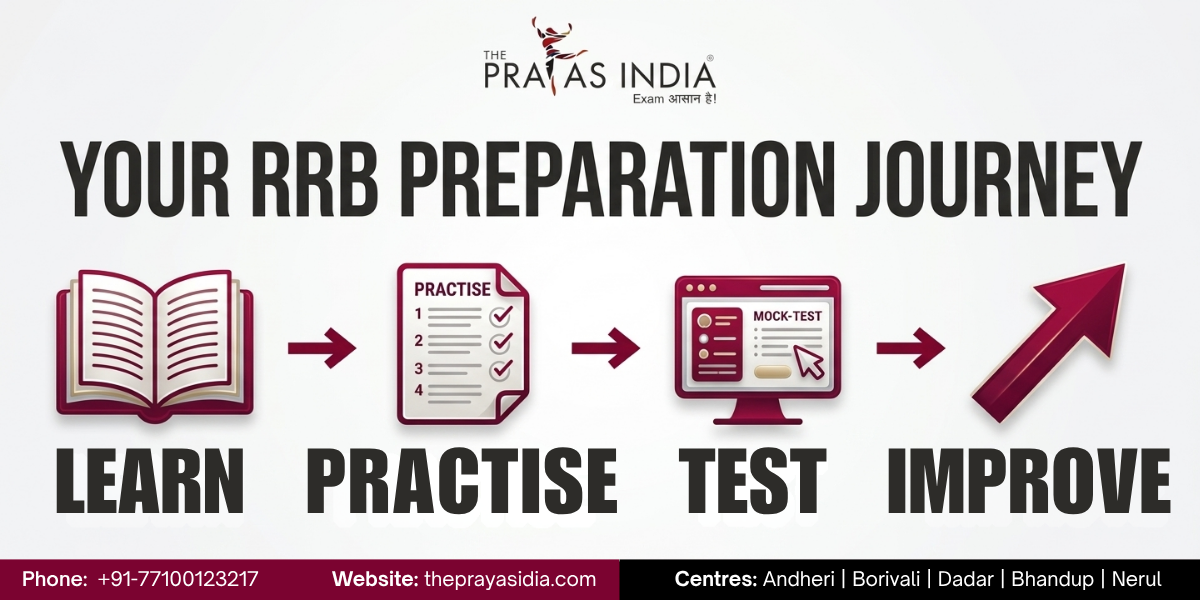
Regular Practice Builds Exam-Ready Skills
Understanding a concept once is not enough. Competitive examination performance develops through repetition.
Regular practice helps candidates become familiar with the way questions are framed and identify the methods that work most efficiently. It also exposes weaknesses that may remain invisible during theoretical study.
For example, a student may feel comfortable with a particular topic after watching a lecture. However, when attempting twenty questions under a time limit, the student may discover that calculations are slow or that similar-looking questions require different approaches.
This is exactly why topic-wise practice should form an important part of Railway exam preparation.
Instead of waiting until the end of the syllabus to start solving questions, aspirants should practise alongside their learning. Each completed topic can be followed by a focused question set, allowing the student to immediately test whether the concept has actually been understood.
Over time, this creates a stronger connection between learning and application.
Mock Tests Should Be Used as Performance Tools
Mock tests are often treated as scorecards. Students take a test, look at the number of marks obtained and then move on to the next test.
That approach misses one of the biggest benefits of mock testing.
A mock test is also a diagnostic tool.
It can tell you which topics are causing repeated mistakes, where you are spending too much time, whether your attempts are increasing, whether accuracy is improving and which sections are affecting your overall performance.
For Railway exam aspirants, this analysis is particularly important because speed and accuracy need to develop together.
Suppose a candidate increases attempts from 70 to 85 but accuracy falls significantly. Simply increasing attempts further may not be the answer. The candidate may need to improve question selection and reduce low-confidence attempts.
Similarly, if accuracy is high but the number of attempts remains low, speed and time management may need attention.
A structured coaching environment can make this analysis more meaningful by helping students understand not just what their score is, but why their score is at that level.
Learn to Identify Your High-Value Questions
An effective RRB preparation strategy should teach students to think beyond the question itself.
During the examination, the goal is not necessarily to solve every question in the order presented. The goal is to use available time intelligently.
Some questions will immediately appear familiar. Others will require moderate calculation or reasoning. A few may be unusually lengthy or confusing.
Learning to recognise these differences can improve overall efficiency.
A candidate who spends several minutes on one difficult problem may lose the opportunity to solve multiple questions that were comparatively straightforward. Therefore, question selection becomes an important examination skill.
This is one area where regular timed practice and mock-test analysis can make a substantial difference. As students become familiar with their own solving patterns, they begin to recognise which question types they should attempt immediately and which ones they should postpone.
Speed and Accuracy Must Develop Together
Speed is frequently emphasised in Railway exam preparation, but speed without accuracy can become counterproductive.
Rushing through questions may increase the number of attempts while simultaneously increasing calculation errors, misread questions and incorrect assumptions. On the other hand, excessive caution may result in very high accuracy but too few attempts.
The ideal preparation process gradually brings these two factors together.
Early preparation should focus heavily on conceptual accuracy. Once the concepts become stronger, timed practice can be introduced more intensively. As familiarity increases, candidates can work on reducing unnecessary steps, improving calculation speed and making faster decisions.
This creates a natural progression:
First understand → then practise → then increase speed → finally optimise attempts.
Trying to reverse this sequence often creates unnecessary pressure.
Consistency Is More Important Than Occasional Long Study Sessions
Railway exam preparation can extend over several months, and maintaining consistency throughout this period is often harder than starting with enthusiasm.
Many aspirants create ambitious study schedules and follow them for a few days before falling back into irregular preparation. This creates gaps in revision and practice, making it difficult to retain concepts.
A sustainable routine is generally more effective than occasional marathon study sessions.
Even when a candidate has limited time on a particular day, completing a smaller but focused set of activities can help preserve momentum. A short revision session, a timed practice set or a mock-test analysis session can all contribute to maintaining continuity.
A structured coaching programme can support this consistency by providing a defined timetable, regular classes and planned practice instead of leaving the entire preparation schedule to the student.
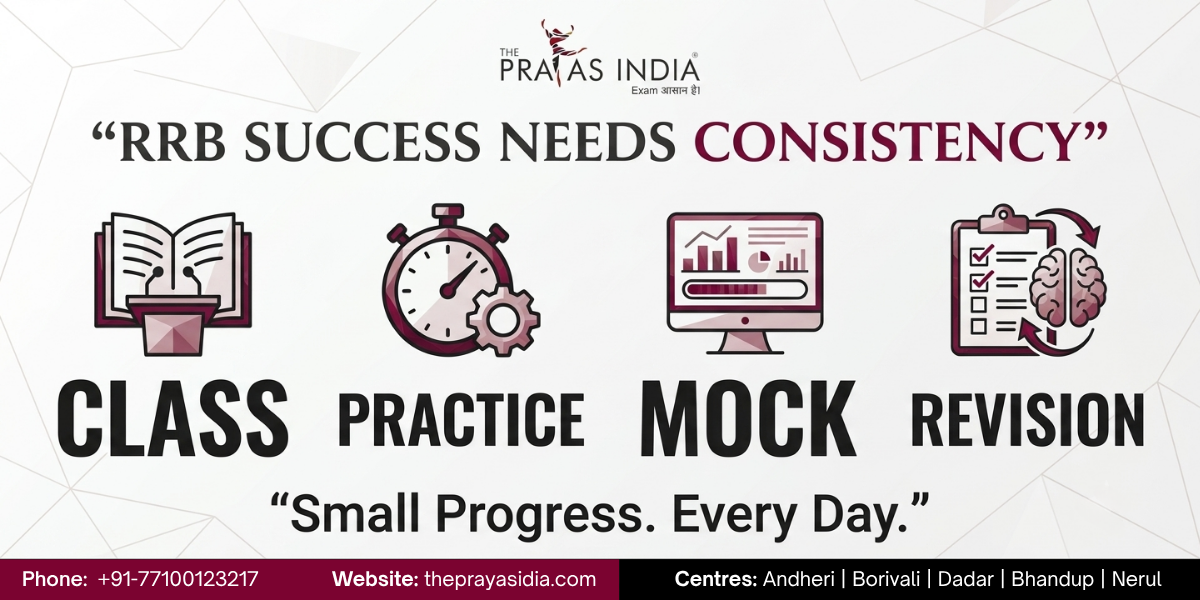
Regular Revision Prevents Last-Minute Preparation Pressure
Railway examination preparation involves several subjects, and retaining everything until the examination requires repeated revision. Reading a topic once and moving on is rarely enough, particularly for information-heavy areas.
Revision should therefore be integrated into the preparation cycle from the beginning.
A useful system is to revisit important concepts at regular intervals instead of waiting until the entire syllabus has been completed. Short revision sessions can reinforce formulas, concepts, important facts and previously identified mistakes.
The same principle applies to questions that were answered incorrectly in practice or mock tests. Revisiting those questions can be more valuable than repeatedly solving questions that you already answer correctly.
An error log can help here. Candidates can record recurring mistakes, difficult concepts, calculation errors and questions that took unusually long to solve. Revisiting this record periodically creates a personalised revision list based on actual performance.
Turning Weak Areas Into Strengths
Every aspirant has certain topics that feel uncomfortable. The mistake is to either ignore them completely or spend all preparation time trying to master one difficult area.
A better strategy is to identify the reason behind the weakness.
Sometimes the problem is conceptual. Sometimes it is insufficient practice. Sometimes the candidate knows the topic but lacks speed. In other cases, the problem may simply be exam pressure.
Each situation requires a different response.
A structured preparation environment can help candidates identify these patterns more clearly through regular assessments and practice. Once a weakness is properly diagnosed, the preparation can become targeted rather than random.
The objective is not to become perfect in every topic overnight. It is to gradually reduce the number of questions that you cannot confidently handle.
Preparing With an Exam-Oriented Mindset
The difference between studying and preparing for an examination is often the way you approach the process.
Studying focuses primarily on acquiring information.
Exam preparation adds another layer: Can I recall it? Can I apply it? Can I solve the question quickly? Can I maintain accuracy under pressure?
Railway exam preparation should gradually move through all these stages.
At The Prayas India, the larger value of a structured coaching approach lies in creating an environment where classroom learning can be connected with practice and testing. Students can work towards becoming comfortable not just with individual concepts but with the demands of a competitive examination.
For aspirants looking for RRB coaching in Mumbai, this integrated approach can make preparation more organised and purposeful.
The goal is not simply to attend classes. It is to develop the skills required to perform when the actual examination clock is running.
A Structured Study Plan Keeps Railway Preparation on Track
One of the biggest advantages of following a structured Railway exam preparation programme is that it brings direction to the entire study journey. Without a plan, aspirants often move between subjects based on convenience or short-term motivation. They may spend several days focusing heavily on Mathematics, then shift suddenly to General Awareness, while Reasoning and revision continue to get postponed. Over time, this creates an uneven preparation profile.
A structured study plan helps distribute preparation more effectively. Each subject receives appropriate attention, while practice, revision and testing are integrated into the schedule rather than treated as activities to be completed later.
For a candidate preparing for RRB NTPC, Group D, ALP, Technician or other Railway recruitment examinations, the exact study plan will depend on the examination pattern and individual preparation level. However, the underlying approach remains similar: learn systematically, practise consistently, test regularly and improve based on performance.
The Prayas India can provide a structured learning environment where aspirants can work through their preparation in a planned manner instead of trying to manage every aspect independently.
Faculty Guidance Can Reduce Preparation Confusion
Railway exam preparation involves a large amount of content, and one of the challenges faced by self-study aspirants is deciding what deserves priority.
Students often encounter multiple methods for solving the same Mathematics problem, different approaches to Reasoning questions and large volumes of General Awareness material. Without proper guidance, it can become difficult to determine which approach is efficient and which resources are actually useful.
Experienced faculty can help simplify this process.
Instead of merely explaining a topic, effective teaching should help students understand the logic behind a concept, identify common question patterns and learn how to approach the topic under examination conditions.
This is especially useful for beginners. When the foundation is weak, attempting shortcuts too early can create confusion. A guided learning process allows students to build conceptual clarity first and gradually introduce faster solving methods as their understanding improves.
For aspirants searching for the best RRB coaching in Mumbai, faculty quality should therefore be evaluated not simply by how much content is covered, but by how effectively students are taught to apply that content.
Doubt-Solving Is an Important Part of Preparation
A small conceptual doubt can become a recurring problem if it is not addressed. This is particularly true in subjects where topics build upon one another.
For example, a weakness in basic arithmetic can affect several later topics in Quantitative Aptitude. Similarly, an incomplete understanding of a particular reasoning pattern can make related questions seem difficult even after repeated practice.
Regular doubt-solving can prevent these gaps from accumulating.
Students should be encouraged to ask questions, revisit confusing concepts and understand why a particular solution works instead of simply memorising an answer.
A strong preparation environment makes doubt resolution part of the learning process rather than something students have to manage entirely on their own.
Performance Tracking Turns Preparation Into a Measurable Process
One of the most useful features of structured preparation is the ability to track progress over time.
Instead of asking only whether you are “studying enough,” performance tracking allows you to ask more useful questions:
Are my attempts increasing?
Is my accuracy improving?
Which subjects are becoming stronger?
Which topics continue to cause mistakes?
Am I taking too long to solve particular question types?
Are my mock scores improving consistently?
These indicators provide a much clearer picture of preparation quality.
At The Prayas India, regular practice and testing can help aspirants understand where they currently stand and where further improvement is required. The purpose of performance tracking should not be to create unnecessary pressure but to make preparation more objective.
When progress is measured properly, students can replace vague concerns with specific action points.
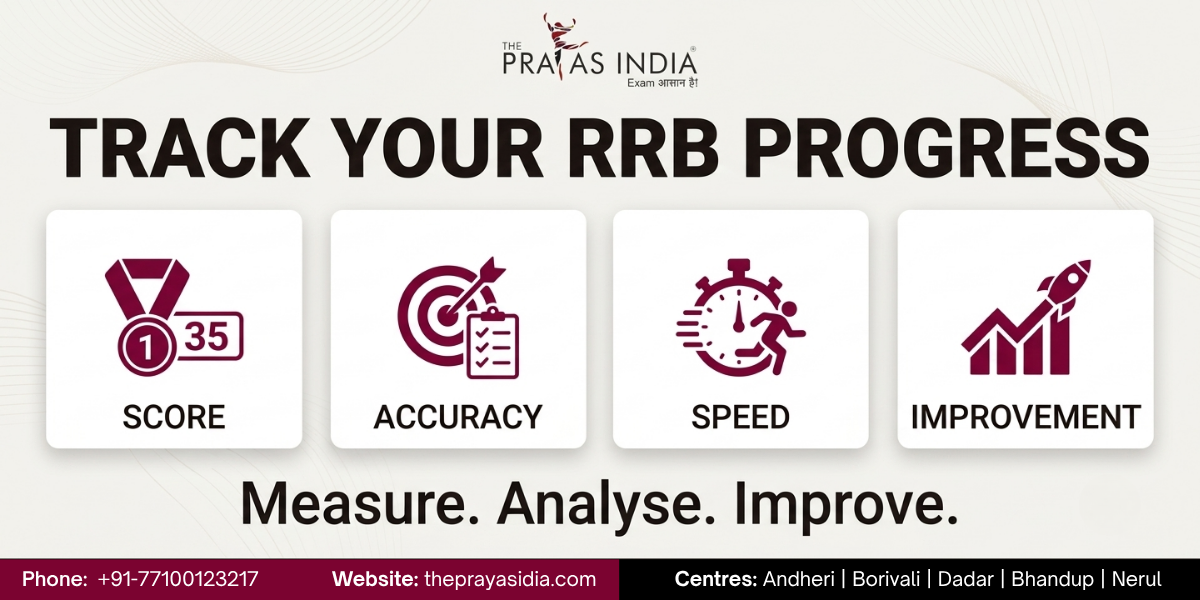
Building a Strong RRB Preparation Routine
Consistency becomes easier when preparation is converted into a routine rather than a daily decision.
A candidate should ideally know what needs to be completed each day before the study session begins. This could include a specific concept class, a topic-wise practice set, a short revision session and analysis of previously attempted questions.
The exact number of hours will differ from one aspirant to another. A college student, a working professional and a full-time aspirant may have completely different schedules. What matters is that the available time is used consistently.
A sustainable routine should also include flexibility. Missing one study session should not lead to abandoning the entire schedule. Instead, the candidate should adjust the following days and continue.
This ability to recover from an imperfect day is important because Railway preparation is a long-term process.
Revision Should Be Planned, Not Postponed
Many students treat revision as something they will do after completing the syllabus. This can create a problem because earlier topics gradually become less familiar while new topics continue to accumulate.
A better system is to revise continuously.
Short revision cycles can be incorporated into the weekly schedule. Important formulas, frequently tested concepts, General Awareness notes and recurring mistakes can be reviewed regularly.
Mock-test errors should also become part of revision. If a candidate repeatedly makes the same type of mistake, that mistake deserves more attention than a topic where accuracy is already consistently high.
This creates a more personalised revision process.
Instead of revising everything equally, students can focus more heavily on the areas where their performance data shows a need for improvement.
Preparing for Different RRB Examinations
The Railway Recruitment Board conducts different examinations for different categories of posts, and aspirants should understand the specific requirements of the examination they are targeting.
RRB NTPC preparation may require a different emphasis from RRB Group D, while RRB ALP and Technician preparation can involve additional examination stages and technical requirements depending on the post.
Therefore, students should not assume that preparing for one Railway examination automatically prepares them for every other examination.
At the same time, there can be significant overlap in foundational areas such as Mathematics, Reasoning, General Awareness and General Science. A strong base can therefore provide a useful foundation for multiple Railway recruitment opportunities.
This makes it important to select preparation resources and coaching programmes that understand the specific requirements of the examination you intend to take.

How to Choose the Right Railway Exam Coaching in Mumbai
Choosing an RRB coaching institute is an important decision because the preparation programme can influence your study routine, practice discipline and overall examination strategy.
Aspirants should look beyond advertisements and focus on the actual academic structure of the programme.
Consider whether the institute provides experienced faculty, systematic coverage of the syllabus, regular practice, mock tests, performance analysis, doubt-solving support and revision opportunities. It is also useful to understand whether the teaching methodology matches your learning requirements.
The location and batch schedule may matter for students attending offline classes in Mumbai, while working professionals may need greater flexibility. Similarly, beginners may benefit from a programme that spends adequate time building fundamentals instead of assuming prior knowledge.
The right coaching institute is therefore not simply the one with the most promotional claims. It is the one whose teaching, testing and support system aligns with your preparation needs.
Why Mumbai Aspirants Can Benefit From a Structured Learning Environment
Mumbai offers a large pool of competitive-exam aspirants, which can make the preparation environment highly competitive. For many students, having access to a structured classroom environment can create useful discipline and accountability.
Instead of preparing in isolation, students can learn alongside other aspirants, discuss approaches and become familiar with competitive examination standards.
For candidates who struggle with consistency during self-study, a fixed class schedule can also create an external routine. Regular classes combined with practice and testing can make it easier to maintain momentum over an extended preparation period.
The Prayas India offers its coaching presence across Mumbai, with centres in Andheri, Borivali, Dadar, Bhandup and Nerul, giving aspirants options based on their location and convenience.
The Prayas India Approach: From Learning to Examination Readiness
The objective of effective Railway coaching should extend beyond completing lessons.
Aspirants need to gradually move through different stages of preparation. Initially, the focus should be on understanding concepts and establishing a strong foundation. This should be followed by topic-wise practice, timed question sets and regular mock tests.
As the examination approaches, preparation should become increasingly focused on revision, performance analysis and exam strategy.
This progression can be represented simply as:
Concepts → Practice → Mocks → Analysis → Revision → Exam Readiness
A structured programme can help students move through these stages without leaving important components until the final weeks.
For an aspirant looking for Railway exam coaching in Mumbai, this integrated approach can provide a more organised alternative to preparing through disconnected resources.
Avoid These Common Railway Exam Preparation Mistakes
Even motivated candidates can lose valuable preparation time because of a few recurring mistakes.
One common mistake is collecting too many study resources. More books, PDFs and video lectures do not necessarily create better preparation. In many cases, they create confusion and reduce the time available for practice.
Another mistake is postponing mock tests until the syllabus is complete. Mock tests should be introduced progressively so that candidates can develop examination skills alongside conceptual preparation.
Ignoring weak areas is another problem. Students naturally prefer topics they enjoy or understand easily, but competitive performance often depends on reducing weaknesses as much as strengthening existing advantages.
Finally, candidates sometimes compare their preparation constantly with others. A friend’s study hours, mock score or preparation strategy may not be relevant to your own performance. Your preparation should be driven by your goals and your measurable progress.
Building Confidence Through Preparation, Not Guesswork
Confidence in a competitive examination should come from familiarity with the process.
When students regularly attend classes, practise questions, take mocks and analyse mistakes, the examination environment becomes less unfamiliar. They know what their strengths are, which topics require attention and how they tend to perform under time pressure.
This creates a more practical form of confidence.
Instead of relying on motivation alone, aspirants can enter the final stage of preparation knowing that they have repeatedly tested their strategy.
That is one of the most valuable outcomes of structured preparation.
Final Thoughts: Prepare With a System, Not Just a Syllabus
Railway examinations reward candidates who can combine knowledge with disciplined execution. Completing the syllabus is important, but it is only one part of becoming examination-ready.
You also need regular practice, effective revision, mock-test experience, performance analysis, time management and the ability to identify and correct weaknesses.
This is where a structured coaching programme can add value.
For aspirants searching for the best RRB coaching in Mumbai, The Prayas India can provide a systematic preparation environment designed around learning, practice, testing and improvement. With faculty guidance, structured classes and an examination-oriented approach, students can work towards making their Railway exam preparation more organised and measurable.
The right preparation journey is not about studying everything at once. It is about knowing what to study, practising it consistently, measuring your performance and improving one stage at a time.
For Railway aspirants, that structured approach can make the difference between simply preparing for an examination and genuinely becoming ready to compete.
Contact Us
- Call Now: +91-77100 13217
- Website: theprayasindia.com
- Centres: Andheri | Borivali | Dadar | Nerul | Bhandup
Frequently Asked Questions
Is coaching necessary for Railway exam preparation?
Coaching is not compulsory, and some candidates successfully prepare through self-study. However, structured coaching can provide a planned syllabus, faculty guidance, regular practice, mock tests and performance tracking, which may be particularly useful for aspirants who find it difficult to maintain direction or consistency independently.
How can The Prayas India help with RRB exam preparation?
The Prayas India can support Railway exam preparation through a structured learning approach involving conceptual teaching, practice, mock tests, analysis, revision and guidance. The exact preparation requirements can vary depending on the RRB examination and the student's starting level.
Which Railway exams can aspirants prepare for?
Railway recruitment includes multiple examinations and recruitment categories, including RRB NTPC, RRB Group D, RRB ALP and RRB Technician, among others. Candidates should select their target examination based on the relevant notification, eligibility and selection process.
How many hours should I study for Railway exams?
There is no universal number of hours that guarantees success. A consistent and realistic schedule is more useful than an extremely long routine that cannot be maintained. Your daily study time should depend on your current preparation level, target examination and other commitments.
Are mock tests important for RRB preparation?
Yes. Mock tests help candidates practise under time pressure and identify issues related to accuracy, speed, question selection and time management. Their value increases significantly when students analyse their performance after each test.
When should I join Railway exam coaching?
It is generally better to join once you have decided on your target examination and are ready to follow a structured preparation routine. Starting earlier provides more time for concept building, practice, revision and mock-test improvement.
How do I choose the best RRB coaching in Mumbai?
Look at the complete academic system rather than promotional claims. Consider faculty guidance, syllabus coverage, practice methodology, mock tests, doubt-solving, revision support, batch timings and location. The right institute should match your preparation needs and learning style.
Can I prepare for multiple Railway exams together?
Some RRB examinations have overlapping subjects and foundational concepts, so preparation for multiple exams can be possible. However, candidates should always account for the specific syllabus, examination pattern and additional requirements of each target examination.