How to Avoid Negative Marking in CAT | Best CAT Coaching in Mumbai | The Prayas India
The Common Admission Test (CAT) is not simply a test of how many questions you can solve. It is equally a test of how intelligently you choose questions, manage your time, control your accuracy, and respond under pressure. One of the biggest factors that can affect your CAT score is negative marking. A candidate may know a considerable portion of the syllabus and still lose valuable marks by attempting questions without sufficient confidence.
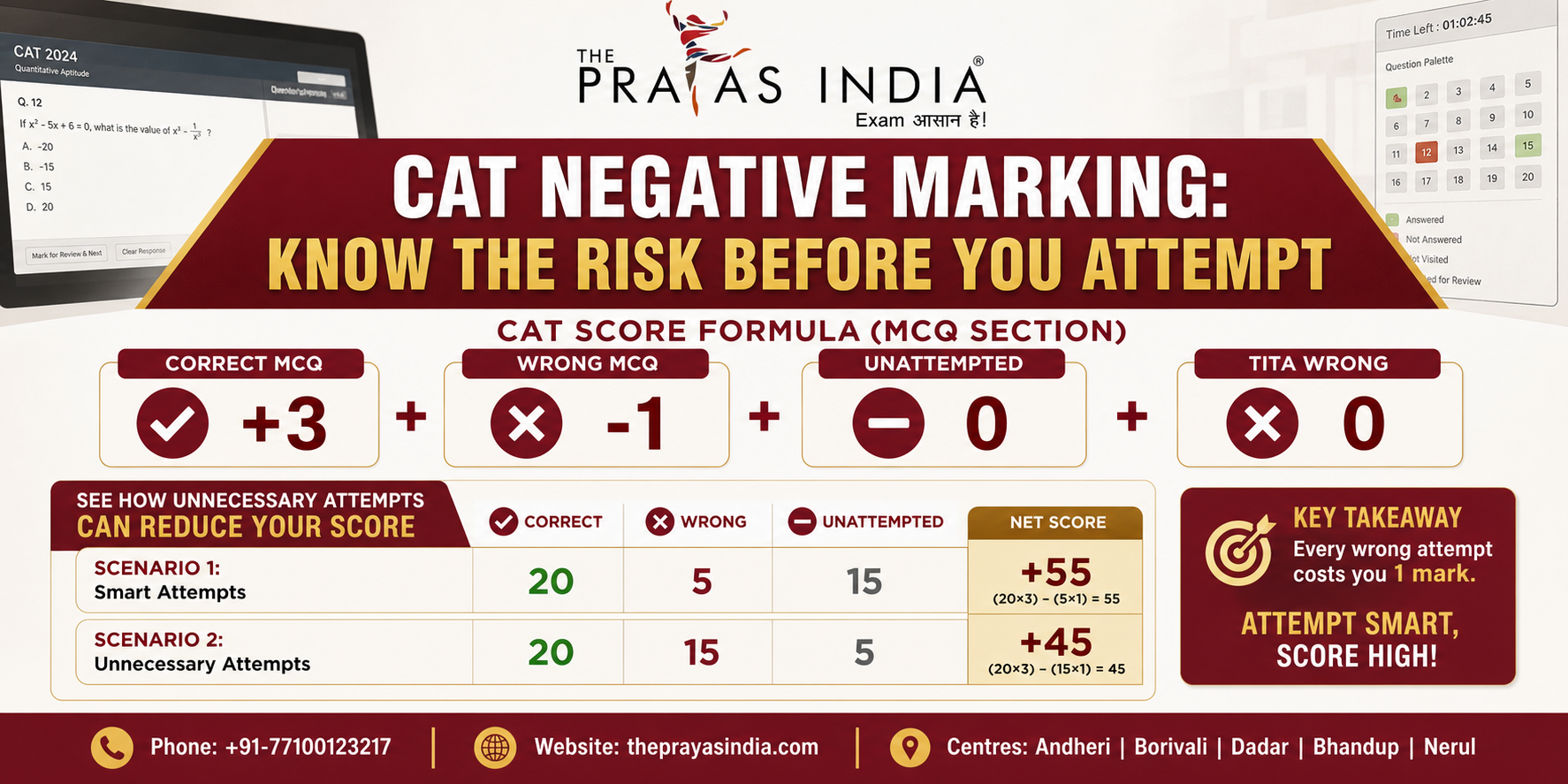
In CAT, the difference between a good attempt and an excessive attempt can have a significant impact on your final score. The recent CAT pattern has included both Multiple-Choice Questions (MCQs) and Type-in-the-Answer (TITA) questions. Correct answers generally carry +3 marks, while an incorrect MCQ attracts a -1 mark penalty. TITA questions do not carry negative marking.
This makes question selection an essential part of CAT preparation. Instead of trying to attempt the maximum possible number of questions, aspirants should focus on building a strategy that maximises accuracy, question quality, and net score.
For students preparing for CAT 2026, understanding how negative marking works and developing the right attempt strategy well before the examination can make the actual test experience much more controlled.
What Is Negative Marking in CAT?
Negative marking in CAT is designed to discourage blind guessing, particularly in MCQs. A correct answer generally gives you 3 marks, while an incorrect MCQ costs you 1 mark. An unattempted question receives no marks and no penalty. TITA questions, where candidates enter the answer instead of selecting an option, have traditionally carried no negative marking.
Consider a simple example. Suppose you attempt 20 MCQs. If 15 are correct and 5 are incorrect, your score from these questions would be:
15 × 3 = 45 marks
5 × -1 = -5 marks
Net score = 40 marks
Now imagine another candidate attempts only 16 MCQs but gets 14 correct and 2 incorrect:
14 × 3 = 42 marks
2 × -1 = -2 marks
Net score = 40 marks
The example shows why the number of attempts alone does not determine the quality of a CAT attempt. Accuracy matters just as much as the number of questions you answer.
The exact number and distribution of MCQs and TITA questions can vary between CAT editions, so aspirants should always check the instructions for their particular examination. The recent pattern, however, clearly demonstrates why candidates need to distinguish between question types before developing their attempt strategy.
Why Does Negative Marking Matter So Much?
Negative marking becomes particularly important in CAT because the examination is conducted under strict sectional time limits. Recent CAT patterns have used three sections—VARC, DILR and QA—with 40 minutes allocated to each section. Once a section ends, candidates cannot return to it.
Therefore, a candidate is not merely deciding whether a question is solvable. The candidate is constantly making three decisions:
- Is this question worth my time?
- Do I have enough confidence to attempt it?
- Is the probability of getting it correct high enough to justify the risk?
Developing the ability to answer these questions quickly can significantly improve your test-taking strategy.
1. Understand the Difference Between Smart Attempts and Blind Attempts
The first step towards avoiding negative marking is to stop treating every question as an opportunity that must be attempted. CAT rewards candidates who can identify where their strengths can generate marks efficiently.
A smart attempt is a question where you have a reasonable understanding of the concept, can interpret the question correctly, and have a realistic path toward the answer. A blind attempt is one where you are choosing an option primarily because you feel that you have to mark something.
This distinction is especially important in MCQs. If you are completely unsure about a question and have no meaningful elimination or solving approach, randomly selecting an option exposes you to negative marking without providing a strong probability of success.
During preparation, therefore, candidates should develop a habit of classifying questions into categories such as:
Sure-shot questions: You know the concept and can solve the question confidently.
Likely questions: You understand the approach but may need some calculation or elimination.
Risky questions: You have partial understanding but are uncertain about the final answer.
Avoid-for-now questions: You do not understand the question, method or underlying concept.
This classification should eventually become almost automatic during mock tests.
2. Do Not Chase Attempt Numbers
One of the most common mistakes CAT aspirants make is setting a fixed target such as “I must attempt 20 questions in this section.” Attempt targets can be useful as broad preparation benchmarks, but they should not become rigid examination rules.
Suppose a particular section contains several difficult questions. Attempting additional questions simply to reach a predetermined number may increase the number of incorrect answers. On the other hand, if the paper contains several questions from topics you are comfortable with, your natural attempt count may increase without compromising accuracy.
Your objective should therefore be to maximise your net score, not your attempt count.
A useful mindset is:
Quality of Attempts > Quantity of Attempts
During mock analysis, compare your attempts with your accuracy. If increasing your attempts consistently causes accuracy to fall, your selection strategy needs improvement.
If you are able to increase attempts while maintaining strong accuracy, your strategy is moving in the right direction.
3. Use the First Few Minutes to Understand the Section
The first few minutes of a CAT section can influence the quality of the remaining 35–40 minutes. Instead of immediately attempting the first question that appears, develop the habit of understanding the nature of the section.
In VARC, you may need to decide which reading comprehension passages appear more approachable and which verbal questions can be solved efficiently.
In DILR, set selection is particularly important. Spending too much time on a difficult set before identifying its complexity can consume a significant portion of the section.
In QA, scanning can help you identify familiar arithmetic, algebra, geometry or number-system questions before spending time on unfamiliar or calculation-heavy problems.
The objective is not to spend a large amount of time scanning. Rather, it is to make your initial decisions deliberately instead of reacting randomly to the first few questions.
4. Develop a Three-Level Attempt Strategy
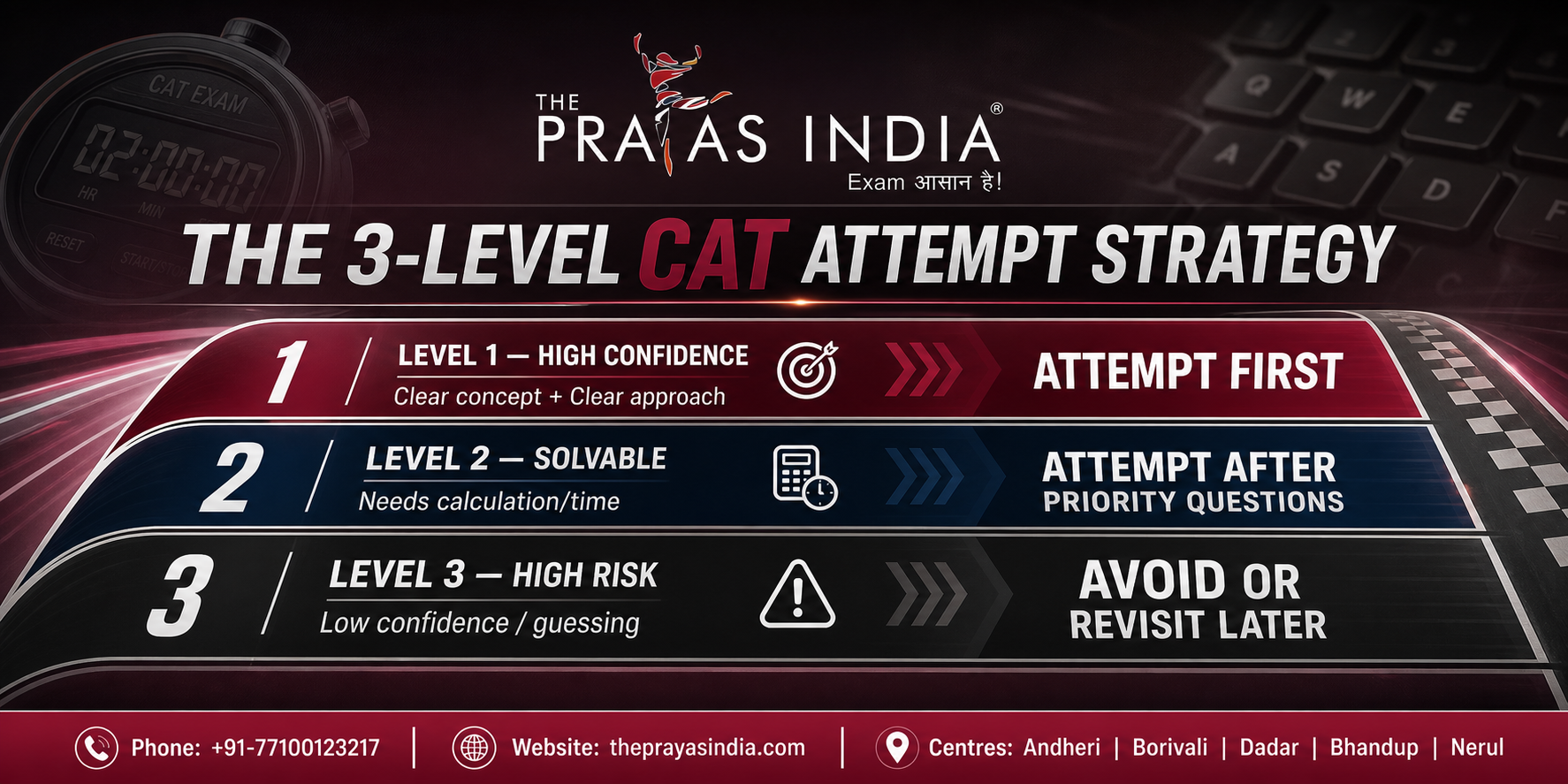
A practical way to reduce negative marking is to divide questions into three broad categories.
Level 1: High-Confidence Questions
These are questions where you immediately understand the concept and have a clear solving route. These questions should generally receive priority because they offer a stronger possibility of converting time into marks.
Level 2: Solvable but Time-Consuming Questions
These questions may be within your ability but require additional calculations, reading or logical processing. Attempt them after securing the relatively easier opportunities.
Level 3: High-Risk Questions
These are questions where the concept is unclear, the calculation is becoming unreliable, or you are making an answer choice without sufficient evidence. These questions should be approached cautiously, particularly when they are MCQs.
This three-level approach prevents you from spending valuable time on questions simply because they appeared early in the section.
5. Learn When to Skip an MCQ
Skipping a question is not a sign of weakness in CAT. It can be a strategic decision.
If you read an MCQ and immediately realise that the concept is outside your preparation, the calculation is becoming unnecessarily long, or two or more options appear equally plausible without a reliable elimination method, moving ahead can protect both your time and score.
The key is to distinguish between “I cannot solve this yet” and “I should never attempt this.”
A question that appears difficult initially may become easier after you have completed other questions and settled into the section. Therefore, skipping does not always mean permanently abandoning the question.
You can mark it for review and return to it if time permits.
However, remember that CAT sections are time-bound. A candidate should not spend too much time collecting difficult questions for later. The purpose of skipping is to protect your time, not to create a long list of questions that you may never revisit.
6. Be Careful With Option Elimination
Option elimination can be a powerful technique in CAT, but it should not become an excuse for random guessing.
Suppose you can confidently eliminate two options in an MCQ and have a logical reason for choosing between the remaining two. That is very different from randomly selecting one option from four.
Similarly, in QA, checking whether an option satisfies the conditions of a problem can sometimes reduce calculation time. In VARC, understanding the author’s argument can help eliminate options that are too extreme, irrelevant or inconsistent with the passage.
In DILR, establishing constraints before evaluating answer choices can prevent you from making assumptions that are not supported by the data.
The important principle is:
Elimination should be evidence-based, not hope-based.
The more reliable your elimination process becomes during practice, the more confidently you can handle difficult MCQs.
7. Do Not Let One Difficult Question Affect the Next Five
Negative marking is not only a technical issue. It is also connected to emotional control during the examination.
A difficult question can create frustration, especially if you have already spent several minutes on it. Some candidates continue working on the same problem because they feel that leaving it would mean wasting the time already invested.
This is a classic trap.
The time you have already spent is gone. The important question is whether spending another two or three minutes is likely to produce a meaningful return.
If the answer is no, move ahead.
A difficult question should not be allowed to affect the next several questions. Maintaining a fresh decision-making process throughout the section is more important than proving that you can solve every problem.
8. Treat DILR Set Selection as a Negative-Marking Strategy
DILR deserves special attention because negative marking can indirectly arise from poor set selection.
A DILR set may initially look interesting but become extremely time-consuming once you start solving it. If you spend 12–15 minutes on a set and still have not established enough information to answer the questions, continuing without reassessing the situation can damage the rest of your section.
Instead, evaluate a set on three parameters:
Structure: Can you understand what the set is asking?
Progress: Are your calculations or deductions producing useful information?
Return: Does the set appear capable of producing multiple answers within reasonable time?
If the answer to these questions is weak, consider moving to another set.
A strong DILR strategy is not about solving every set. It is about identifying the sets that offer the best opportunity to convert your time into marks.
9. In VARC, Avoid Overthinking Between Two Options
VARC can create a different kind of negative-marking problem. Instead of random guessing, candidates may overanalyse two options and eventually choose an answer based on personal interpretation rather than the passage.
For Reading Comprehension questions, your answer should be anchored in the passage.
When two options seem close, ask:
- Which option is directly supported by the passage?
- Which option answers the exact question being asked?
- Is one option too extreme?
- Is the option introducing information that the passage does not establish?
- Is the option answering a slightly different question?
This process can improve accuracy without requiring you to spend excessive time debating every option.
Remember that CAT VARC is not testing whether an option sounds intelligent. It is testing whether you can identify the option that best fits the evidence and logic of the question.
10. In QA, Control Calculation Errors Before They Become Negative Marks
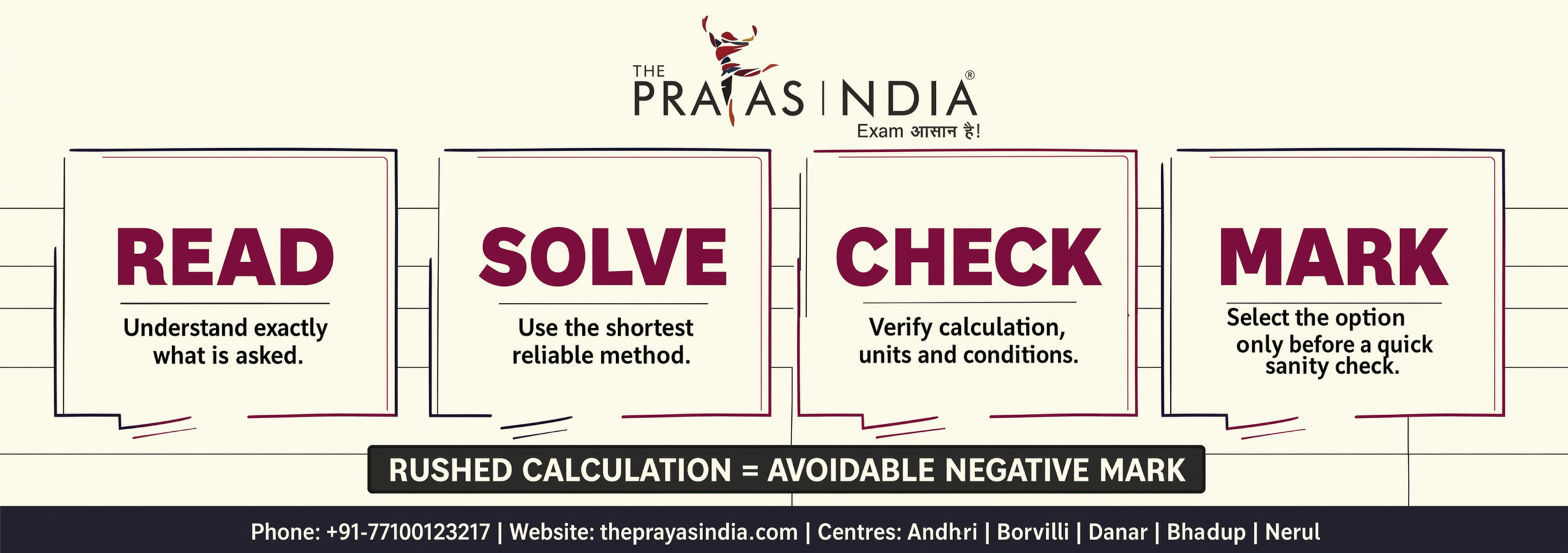
Many QA mistakes are not caused by a lack of conceptual knowledge. They happen because of calculation errors, misreading, incorrect substitution or rushing through the final step.
Before selecting an MCQ option, develop the habit of performing a quick mental verification.
For example, if you calculate a percentage, check whether the result is within a sensible range. If you solve an equation, substitute the result back when practical. If a ratio question produces an unusual value, quickly review whether the interpretation of the question was correct.
These small checks can prevent avoidable negative marks.
However, verification should also be proportional to the question. Spending two minutes checking a simple calculation defeats the purpose of efficient test-taking. The goal is controlled accuracy, not excessive caution.
11. Understand TITA Questions and Their Different Risk Profile
TITA, or Type-in-the-Answer, questions are different from MCQs because there are no answer options to select. In the recent CAT pattern, TITA questions have carried no negative marking for incorrect responses.
This changes the risk calculation.
If you have reached a reasonable answer through your calculations but are not completely certain, the absence of negative marking means the decision can be different from that of an MCQ. However, you still need to consider time.
A TITA question may not have a negative-marking risk, but spending too much time on it can cost you an opportunity to solve another question.
Therefore, the correct strategy is not simply “attempt every TITA immediately.” Instead, understand the question, estimate the time required and make the attempt when it fits your sectional strategy.
The exact question distribution can change from one CAT edition to another, so candidates should always follow the instructions and question format displayed in their actual examination.
12. Use Mock Tests to Identify Your Negative-Marking Pattern
One of the best ways to reduce negative marking is to stop treating mock tests merely as score-generating exercises.
After every mock, analyse your wrong answers.
Do not simply write:
“I got this question wrong.”
Instead, classify the reason:
Concept gap: You did not know how to solve it.
Calculation error: You knew the method but made a mistake.
Misreading: You misunderstood the question.
Over-attempt: You attempted despite low confidence.
Time pressure: You rushed because the section was nearing completion.
Guessing: You selected an answer without sufficient evidence.
Set selection error: You invested too much time in an inefficient DILR set.
This classification is extremely valuable because different mistakes require different solutions.
If most of your errors are conceptual, you need stronger fundamentals.
If most are calculation mistakes, you need accuracy drills.
If most are over-attempts, you need a better question-selection strategy.
If most are caused by time pressure, you need better pacing and mock simulation.
This is why structured mock-test analysis is an important component of serious CAT preparation.
13. Maintain an Error Log
A CAT error log can become one of the most useful tools in your preparation.
Create separate categories for:
- Wrong answers
- Guessed answers
- Questions left despite being solvable
- Questions that consumed too much time
- Repeated conceptual mistakes
- Calculation mistakes
- Misreading mistakes
- DILR set-selection mistakes
Review the log regularly.
Over time, patterns will emerge. You may discover, for example, that you frequently make mistakes in percentage-based calculations, spend too long on certain DILR arrangements, or attempt VARC questions even when your understanding of the passage is uncertain.
Once the pattern becomes visible, you can address the actual problem instead of simply taking more mocks.
14. Build Accuracy Before Increasing Attempts
Many students try to increase their attempt count too early.
If your accuracy is unstable, increasing attempts can simply increase the number of negative marks.
A better approach is to build your preparation in stages.
Stage 1: Concept Accuracy
Focus on understanding the syllabus and solving questions without unnecessary time pressure.
Stage 2: Controlled Timing
Introduce time limits while maintaining a strong accuracy level.
Stage 3: Question Selection
Start practising which questions to attempt, skip and revisit.
Stage 4: Full Mock Simulation
Combine concepts, timing, selection and accuracy under actual mock-test conditions.
Stage 5: Strategy Refinement
Analyse your scores and modify your approach based on actual performance rather than assumptions.
This gradual progression can help you develop an examination strategy that is based on evidence from your own performance.
15. Avoid These Common Mistakes That Increase Negative Marking
Several habits repeatedly cause unnecessary score loss in CAT.
Attempting Because “There Is Still Time”
Having time left does not automatically mean that every remaining question should be attempted. Use the remaining time intelligently.
Guessing Because You Have Already Spent Time
Time already spent should not force you to make a poor decision. Reassess the question objectively.
Trying to Solve Questions in Sequence
CAT does not require you to solve questions in the order presented. Move strategically between questions when the interface and section structure allow it.
Ignoring Accuracy While Tracking Attempts
A high attempt count with low accuracy can be misleading. Track net score and accuracy together.
Spending Too Long on One DILR Set
DILR rewards selection. If a set is not yielding progress, reassess quickly.
Changing Correct Answers Without Evidence
Changing an answer simply because you become nervous can turn a correct response into an incorrect one. Change an answer when you identify a specific error or stronger reasoning.
Treating Every MCQ as a Must-Attempt Question
MCQs carry negative marking, so attempt decisions should be based on confidence and evidence rather than obligation.

16. How CAT Coaching Can Help You Improve Attempt Strategy
Negative marking is not something that can be solved merely by reading a list of tips. The real improvement comes from repeated practice, analysis and feedback.
A structured CAT preparation programme can help students understand the difference between conceptual mistakes and test-taking mistakes. Regular sectional tests and full-length mocks can provide opportunities to practise question selection under time pressure.
Mentorship can also be useful because students often become accustomed to their own preparation habits and may not notice inefficient patterns. An external analysis of mock performance can help identify whether the problem lies in accuracy, speed, selection or conceptual understanding.
At The Prayas India, CAT aspirants can work on these areas through structured preparation, practice, mock tests and performance analysis. The objective is not simply to increase the number of questions attempted but to develop a balanced approach to accuracy, speed and intelligent question selection.
For students looking for CAT coaching in Mumbai, the availability of classroom guidance and preparation support across Andheri, Borivali, Dadar, Bhandup and Nerul can make it easier to follow a consistent preparation routine alongside regular practice.
17. A Practical Negative-Marking Strategy for CAT 2026
A useful strategy for CAT preparation is to divide your approach into three phases.
Before the Exam
Build strong fundamentals across VARC, DILR and QA. Practise different question types and understand your strengths and weaknesses.
Do not wait until the final weeks to start taking mocks. Introduce sectional tests and progressively move towards full-length simulations.
During the Mock-Test Phase
Track more than your total score.
Record:
- Attempt count
- Accuracy
- Correct MCQs
- Incorrect MCQs
- TITA performance
- Questions left unattempted
- Time spent per question
- DILR sets selected
- Section-wise mistakes
This information will help you identify your actual test-taking behaviour.
During the Examination
Remain flexible.
Do not enter the examination with a rigid rule such as “I must attempt X questions.” Instead, assess the paper, identify opportunities and adjust your attempts according to difficulty and confidence.
The goal is to maximise the marks you can realistically convert—not to prove that you attempted the maximum number of questions.
18. Final Checklist to Avoid Negative Marking in CAT
Before the examination, make sure you have developed the following habits:
- Understand the CAT marking scheme.
- Know the difference between MCQ and TITA questions.
- Do not blindly guess MCQs.
- Prioritise high-confidence questions.
- Avoid chasing a fixed attempt number.
- Use option elimination only when supported by logic.
- Practise DILR set selection.
- Avoid spending excessive time on one question.
- Improve calculation accuracy in QA.
- Base VARC decisions on passage evidence.
- Analyse every mock test properly.
- Maintain an error log.
- Track accuracy along with attempts.
- Learn when to skip and when to revisit.
- Stay calm after a difficult question.
- Protect your time for questions with a better chance of conversion.
Conclusion
Avoiding negative marking in CAT is not about attempting fewer questions at all costs. It is about making better decisions about which questions deserve your time and which questions do not.
The most effective CAT strategy combines conceptual preparation with disciplined test-taking. Candidates need to know their strengths, recognise question difficulty quickly, control calculation errors, select DILR sets carefully and avoid unnecessary risk in MCQs.
Most importantly, your strategy should evolve through mock-test analysis. Every incorrect answer can teach you something—whether it reveals a conceptual gap, a calculation problem, poor time management or an unnecessary attempt.
With consistent practice and structured guidance, you can gradually turn question selection and accuracy into strengths. For CAT aspirants preparing in Mumbai, The Prayas India provides structured CAT preparation support with centres in Andheri, Borivali, Dadar, Bhandup and Nerul, helping students work systematically towards their management entrance goals.
The aim should always be simple: attempt intelligently, protect your score, and make every minute of the CAT examination count.
Contact Us
- Call Now: +91-77100 13217
- Website: theprayasindia.com
- Centres: Andheri | Borivali | Dadar | Nerul | Bhandup
Frequently Asked Questions
1. Does CAT have negative marking?
Yes. In the recent CAT pattern, incorrect MCQ responses carry a negative mark, while TITA questions do not carry negative marking. Correct answers generally receive +3 marks. Candidates should follow the instructions provided in their particular CAT examination.
2. How can I avoid negative marking in CAT?
Avoid blind guessing, prioritise questions you understand, use evidence-based option elimination and skip questions where your confidence is extremely low. Mock-test analysis can help identify the situations in which you are most likely to make unnecessary attempts.
3. Should I attempt every question in CAT?
No fixed attempt number should be treated as a compulsory target. The appropriate number of attempts depends on the difficulty of the paper, your preparation level, question selection and accuracy.
4. Is there negative marking for TITA questions?
Recent CAT patterns have had no negative marking for incorrect TITA questions. However, the exact examination instructions should always be checked on the day of the test.
5. Should I guess an MCQ if I can eliminate two options?
It depends on your confidence and the quality of your elimination. Elimination based on clear evidence is different from selecting an option randomly. Candidates should also consider the time required and the opportunity cost of attempting another question.
6. How can mock tests help reduce negative marking?
Mocks allow you to identify patterns in your errors. By analysing incorrect attempts, guesses, calculation mistakes, time-consuming questions and question-selection decisions, you can systematically improve your examination strategy.
7. How important is accuracy in CAT?
Accuracy is extremely important because an incorrect MCQ can reduce your score through negative marking. A candidate should therefore focus on maintaining a healthy balance between attempts, accuracy and time management.
8. Can coaching help improve CAT question selection?
Structured coaching, regular tests, mock analysis and mentorship can help candidates develop better question-selection and time-management habits. The benefit comes from consistent practice and analysis rather than simply attending classes.
9. Which CAT sections require careful attempt selection?
All three sections—VARC, DILR and QA—require strategic selection. DILR is particularly dependent on set selection, while VARC and QA require candidates to distinguish between questions that can be solved efficiently and those that may consume disproportionate time.
10. Where can I prepare for CAT in Mumbai?
The Prayas India offers CAT preparation support in Mumbai through its centres in Andheri, Borivali, Dadar, Bhandup and Nerul, providing aspirants with structured preparation, practice and guidance.