IBPS Clerk Prelims 2026: How to Improve Speed and Accuracy in the Last 2 Weeks | The Prayas India
The IBPS Clerk (CSA) Prelims 2026 is scheduled for October 10 and 11, 2026, which means aspirants are now entering the most important phase of their preparation. With only around two and a half weeks remaining, the focus should gradually shift from learning everything from scratch to improving speed, accuracy, question selection and exam temperament.
For many candidates, the difference between a comfortable attempt and a stressful paper is not simply the number of topics they have studied. It is how efficiently they can identify familiar questions, solve them within the available time and avoid mistakes under pressure. This is why the final phase should be treated as a performance-building period.
If your concepts are reasonably prepared, these final days can be used to convert preparation into execution. Regular timed practice, sectional tests, full-length mocks and systematic analysis can help you understand where you are losing time and marks. Candidates who are still working on weaker topics should also avoid trying to cover the entire syllabus indiscriminately. Instead, they should prioritise frequently practised areas and strengthen the topics that can realistically improve their performance before the examination.
For aspirants preparing for the October 10 and 11 exam dates, the objective now should be simple: solve the right questions, solve them quickly and minimise avoidable errors.
Why Speed and Accuracy Matter in IBPS Clerk Prelims
IBPS Clerk (CSA) Prelims is a competitive examination where candidates have to manage multiple sections within a limited amount of time. This makes speed an important part of preparation, but speed alone is not enough.
Suppose a candidate attempts a large number of questions but makes several calculation, reading or interpretation errors. The additional attempts may not translate into a better performance. Similarly, a candidate who focuses only on accuracy but spends too much time on individual questions may leave many manageable questions unanswered.
The practical target during the final preparation period should therefore be balanced performance.
You need to develop the ability to:
- Recognise familiar question patterns quickly.
- Skip questions that are consuming excessive time.
- Solve straightforward questions without overthinking.
- Maintain accuracy while increasing attempts.
- Move between questions without losing concentration.
- Manage section-wise time efficiently.
- Remain calm when a particular question or set appears difficult.
The purpose of the last two weeks is not to become dramatically faster overnight. It is to eliminate inefficient habits that are currently costing you time.
First Identify Where You Are Losing Time
Before trying to increase your speed, determine exactly where your time is going.
Many students simply assume that they need to “solve faster.” But speed problems can have different causes. You may be spending too much time reading questions, performing calculations manually, getting stuck on puzzles, reconsidering answer options or making repeated corrections.
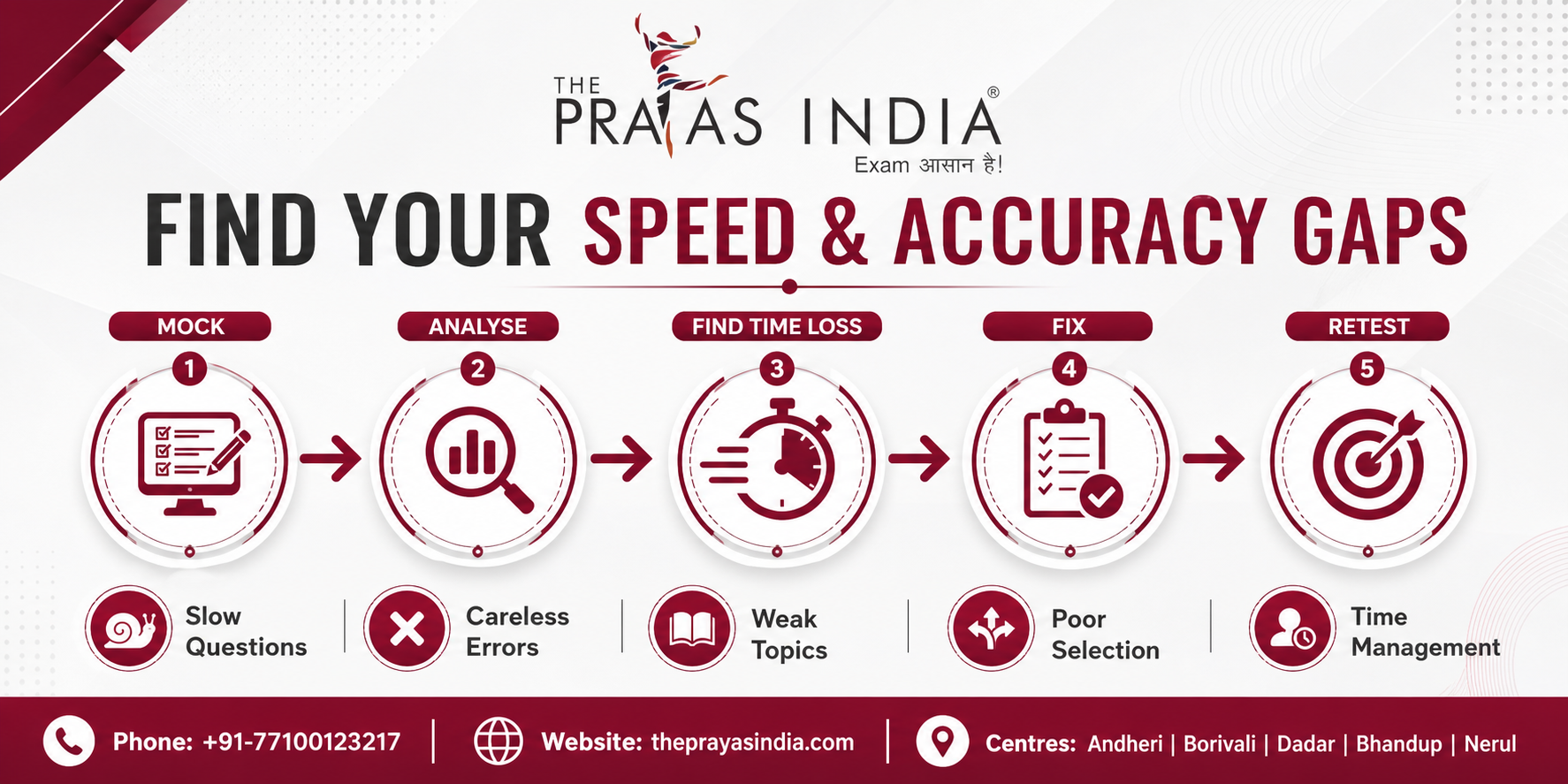
Take a few recent sectional tests or mock tests and analyse them carefully.
For every section, ask:
1. Which questions took unusually long?
Identify questions where you spent significantly more time than necessary.
2. Which questions did you get wrong despite knowing the concept?
These are often execution errors rather than knowledge gaps.
3. Which questions did you leave despite being capable of solving them?
These can reveal poor question selection.
4. Which topics consistently reduce your speed?
For example, certain reasoning sets or calculation-heavy numerical questions may require additional timed practice.
5. Where are careless mistakes occurring?
Look for calculation errors, incorrect data interpretation, misreading of conditions and marking the wrong option.
This analysis gives you a much more useful strategy than simply increasing the number of questions you solve every day.
How to Improve Speed in the Final Two Weeks
Practise With a Timer, Not Just a Question Count
One of the most common mistakes during preparation is measuring practice only by the number of questions completed.
For example, solving 50 reasoning questions without a time limit may give you confidence, but it does not necessarily prepare you for an actual Prelims environment. Your brain needs to become comfortable with making decisions under time pressure.
Instead of saying, “I will solve 50 questions today,” create a timed target.
For example:
- 15 minutes of reasoning practice
- 15 minutes of numerical ability practice
- 10–15 minutes of English practice
- Then review the questions
The exact duration can vary according to your current level. What matters is that your practice increasingly resembles the pressure of the actual examination.
Timed practice also helps reveal an important distinction: knowing how to solve a question and being able to solve it quickly are two different skills.
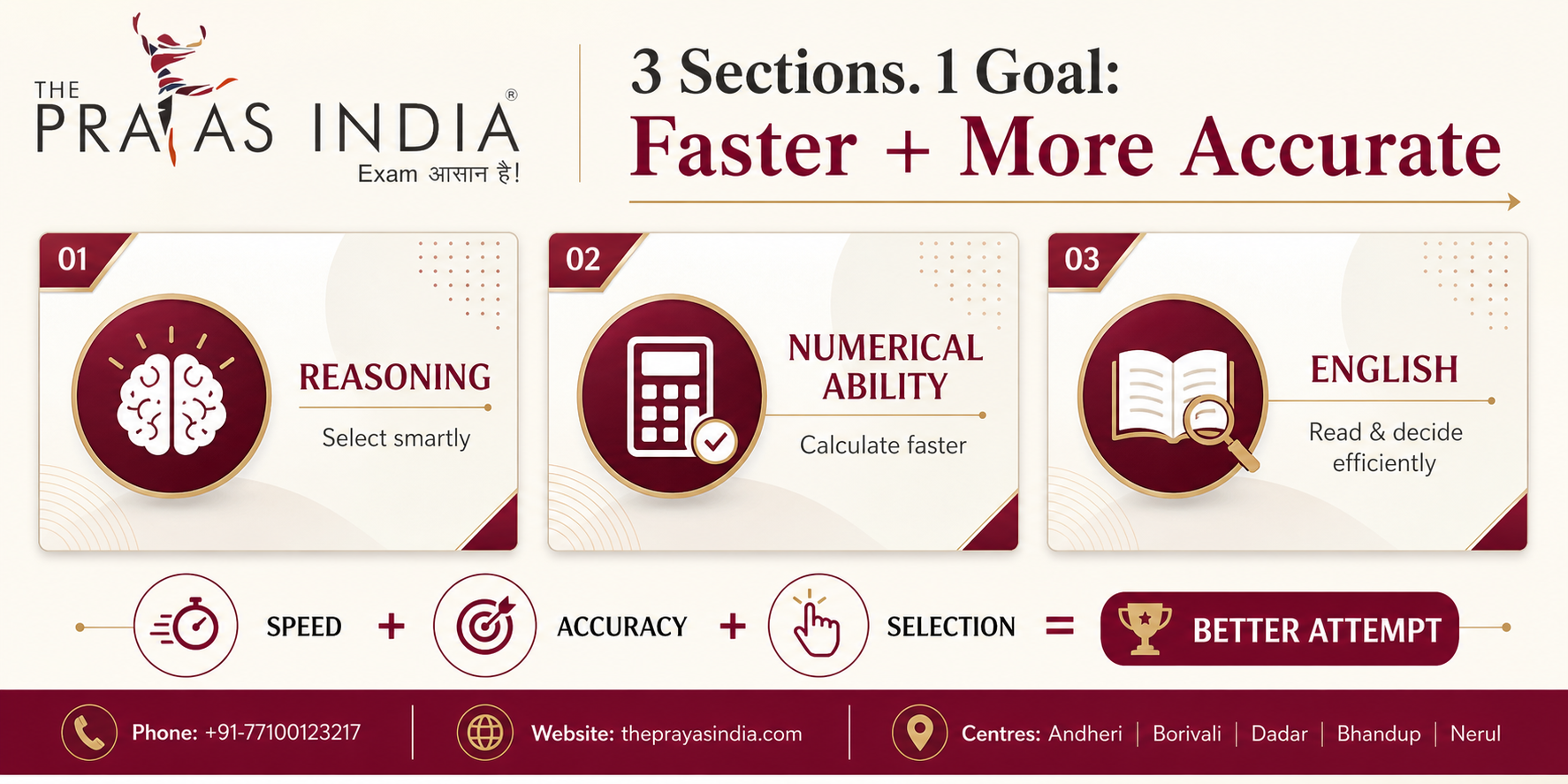
Reasoning Ability: Improve Question Selection
Reasoning can become a major source of time loss if you start with a difficult puzzle or spend too long trying to force an unfamiliar arrangement.
In the final two weeks, your practice should focus heavily on question recognition and selection.
During sectional tests, train yourself to quickly identify questions that look familiar and manageable. Questions involving familiar patterns should generally receive attention before a complicated set that requires substantial setup.
For puzzles and seating arrangements, the objective should not be to solve every set you see. You should develop the ability to assess a set before investing significant time in it.
Ask yourself:
- Is the information easy to organise?
- Can I establish the basic arrangement quickly?
- Are there too many cases?
- Have I practised this pattern before?
- Does the set appear manageable within the remaining time?
This skill becomes particularly important because spending several minutes on one difficult set can affect the number of easier questions you eventually get to.
Focus Areas for Final Reasoning Practice
Depending on your preparation level, give regular timed practice to areas such as:
- Puzzles and seating arrangements
- Inequality
- Syllogism
- Coding-decoding
- Blood relations
- Direction sense
- Alphanumeric series
- Order and ranking
- Miscellaneous logical reasoning questions
The priority should be familiarity + speed + selection, rather than endlessly adding new question types.
Numerical Ability: Build Calculation Speed
For many candidates, Numerical Ability is where avoidable time loss happens. Even when the concept is clear, lengthy calculations can slow down the entire section.
The final two weeks should therefore include dedicated calculation practice.
Work on:
- Simplification
- Approximation
- Percentage calculations
- Ratio and proportion
- Average
- Profit and loss
- Simple and compound interest
- Time and work
- Time, speed and distance
- Data interpretation
- Number-based arithmetic questions
The purpose is not to memorise every possible shortcut. It is to become comfortable with calculations that repeatedly appear during practice.
You should also learn to recognise when approximation can save time and when an exact calculation is actually necessary.
A good calculation routine can include short daily drills involving percentages, fractions, multiplication, division and commonly used numerical relationships. Even 15–20 minutes of focused calculation practice can make your solving process more comfortable over time.
However, speed should never come at the expense of basic accuracy. A faster incorrect calculation does not improve your score.
English Language: Improve Reading and Decision Speed
English preparation during the final phase should focus on comprehension, grammar-based recognition and efficient option selection.
Candidates often lose time because they read every question too slowly or repeatedly reconsider options after reaching a reasonable conclusion.
For Reading Comprehension, practise identifying:
- The central idea
- The author’s purpose
- Directly stated information
- Logical inferences
- Tone and context
- Options that contradict the passage
For grammar and vocabulary-based questions, revision of frequently practised concepts can help you respond more quickly.
The key is to avoid unnecessary overthinking. If you have analysed the question carefully and identified the strongest option based on the available information, move forward instead of repeatedly changing your decision without a clear reason.
Accuracy: The Most Important Part of Speed Improvement
It is easy to think that improving speed means attempting more questions. But the more useful approach is to improve your effective attempts.
Effective attempts are questions that you attempt with a reasonable probability of being correct.
If you increase your attempts by five but introduce several avoidable mistakes, the benefit may be limited. Therefore, every mock should be evaluated using more than just the number of questions attempted.
Track:
Attempts → Correct → Incorrect → Accuracy → Time Used
For example, if your attempts are increasing while accuracy is falling consistently, you should not simply push your attempts even higher. You need to understand why the errors are occurring.
Common reasons include:
- Misreading the question
- Calculation mistakes
- Guessing under pressure
- Rushing through familiar questions
- Misinterpreting puzzle conditions
- Selecting an option without checking all information
- Changing a correct answer unnecessarily
Your final preparation should aim to reduce these errors systematically.
Use the 3-Category Error Log
A simple error log can make your mock analysis much more productive.
After every test, divide mistakes into three categories.
Category 1: Concept Error
You did not understand the underlying concept or method.
Action: Revise the concept and solve a small set of related questions.
Category 2: Execution Error
You knew the concept but made a calculation, reading or application mistake.
Action: Practise similar questions under a timer and slow down slightly at critical steps.
Category 3: Selection Error
You chose a question that consumed too much time or attempted a question that should have been skipped.
Action: Improve your question-selection strategy.
This classification prevents you from treating every wrong answer as a “weak topic.”
Mock Tests Should Become More Important Now
At this stage, mock tests should not be treated merely as score-generating exercises. Their real value lies in helping you understand your examination behaviour.
A mock can tell you:
- Where you start losing time.
- Which section makes you uncomfortable.
- Which topics produce avoidable mistakes.
- Whether your attempts are balanced.
- Whether you rush during the final minutes.
- Which questions you should have skipped.
- Whether your accuracy changes under pressure.
After completing a mock, spend sufficient time analysing it.
Do not immediately move to the next test just because the previous score was disappointing. The analysis is where much of the improvement happens.
Follow the “Mock → Analysis → Practice → Retest” Cycle
A productive final-phase cycle can be:
Take a Mock
↓
Analyse Every Important Mistake
↓
Identify One or Two Specific Problems
↓
Practise Those Problems
↓
Take Another Timed Test
↓
Compare Performance
This approach is more useful than taking multiple mocks without studying your mistakes.
If a candidate repeatedly makes calculation errors in Numerical Ability, taking more mocks without targeted calculation practice may not solve the problem.
Likewise, if a candidate repeatedly spends too much time on reasoning puzzles, the solution may be better set-selection practice rather than simply attempting additional full-length tests.
Don’t Chase a Sudden Score Jump Every Day
Mock scores can fluctuate. A lower score in one test does not automatically mean your preparation has deteriorated, just as a sudden high score does not guarantee the same performance in the actual examination.
Instead of obsessing over individual scores, monitor trends.
Look at:
- Accuracy trend
- Average attempts
- Time management
- Section-wise performance
- Repeated errors
- Question-selection quality
- Performance in familiar topics
The objective during the final phase should be to make your performance more stable and predictable.
Build a Two-Week Speed and Accuracy Routine
With the October 10 and 11 exam dates approaching, your preparation should now become highly structured.
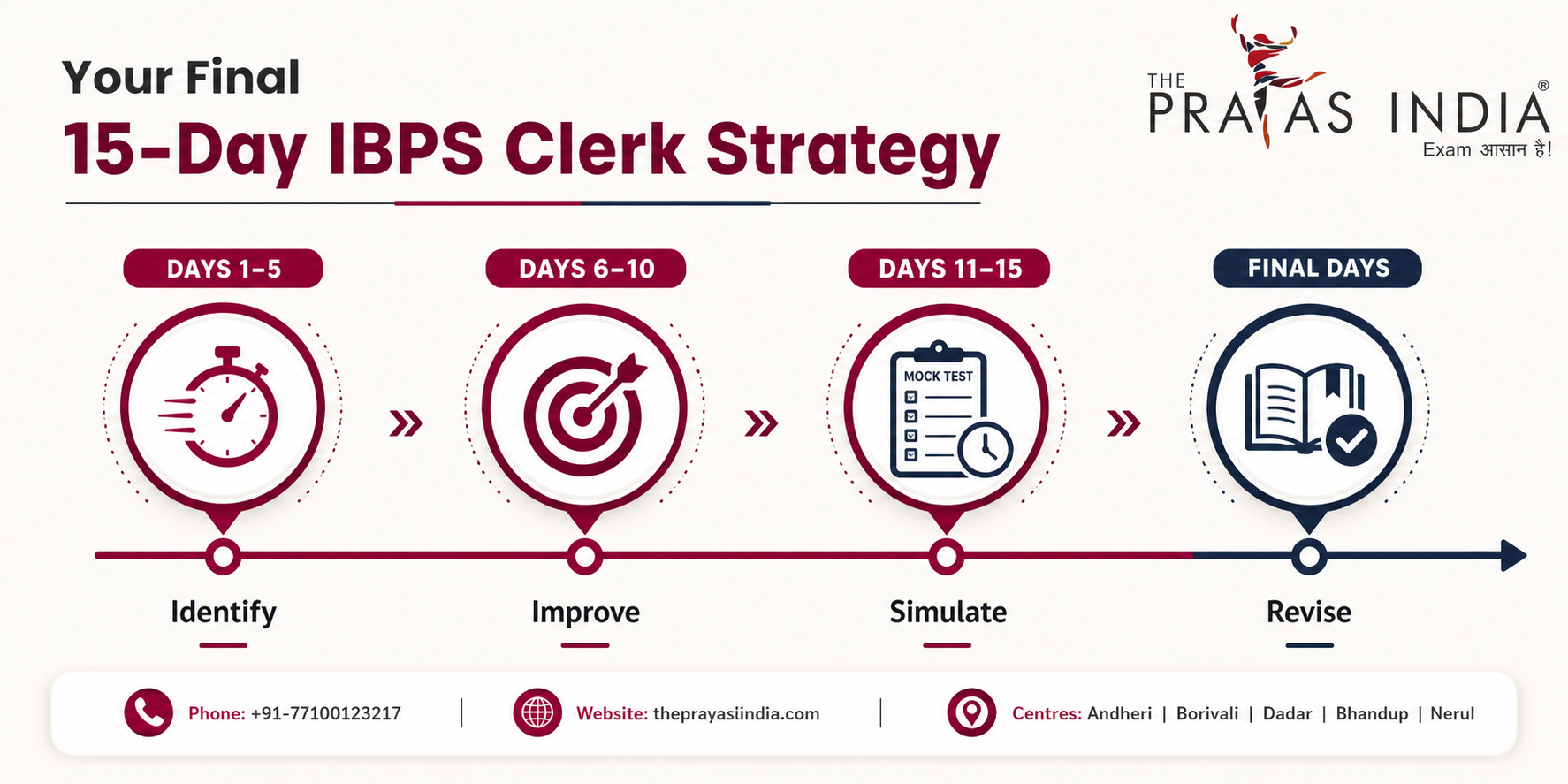
Days 1–5: Identify and Fix
Focus on discovering your major speed and accuracy problems.
Take sectional tests and at least some full-length mocks according to your current preparation level. Analyse them carefully and identify the two or three issues that are costing you the most marks or time.
Do not try to fix ten different problems simultaneously.
Days 6–10: Targeted Improvement
Now practise the specific areas identified during your analysis.
For example:
- Calculation drills
- Puzzle selection
- RC practice
- Simplification
- Inequality
- Syllogism
- Arithmetic
- Grammar
- Data interpretation
Keep the practice timed.
Days 11–15: Exam Simulation
Shift towards full-length examination simulation.
Try to recreate the test environment as closely as possible. Follow the same broad routine, maintain section discipline and practise moving on when a question is taking too long.
After each test, analyse performance instead of simply recording the score.
Final Days: Revision and Stability
The final days should be about maintaining confidence and reducing mistakes.
Revise familiar concepts, formulas, important question patterns and your personal error log.
Avoid turning the last phase into an uncontrolled attempt to learn everything that you have not studied yet.
What You Should Not Do in the Last Two Weeks
The final phase can become counterproductive if you make drastic changes to your preparation.
Don’t Start Too Many New Topics
If a topic has never been studied and requires substantial time to understand, consider whether it is realistically worth disrupting your existing preparation for it.
Your priority should be strengthening areas where improvement is achievable.
Don’t Take Mocks Without Analysis
A mock test without analysis gives you a score. A mock test followed by detailed analysis gives you information that can improve your next performance.
Don’t Sacrifice Accuracy Just to Increase Attempts
Higher attempts are useful only when accompanied by controlled accuracy.
Don’t Spend Excessive Time on One Question
The ability to move on is an important part of competitive-exam strategy. If a question is consuming disproportionate time, recognise the situation and make a decision.
Don’t Change Your Entire Strategy at the Last Moment
Use the final days to refine your approach rather than constantly experimenting with completely new methods.
How The Prayas India Can Support Your Final IBPS Clerk Preparation
The final stage of preparation becomes easier to manage when you have a structured study plan, regular practice and a system for analysing performance.
At The Prayas India, aspirants preparing for banking examinations can use structured guidance to strengthen their preparation through planned classes, practice, mock-test support and revision-oriented preparation.
For students who need flexibility, online coaching can help them continue preparation from their preferred location, while offline coaching provides a classroom-based learning environment and regular academic interaction.
If you are still preparing for IBPS Clerk (CSA) Prelims 2026, the remaining days should be used strategically. Instead of trying to measure preparation only by how many chapters are completed, focus on whether your performance is becoming faster, more accurate and more consistent.
Admissions for banking exam preparation are open at The Prayas India, with Online and Offline coaching options available for aspirants who want structured support during their preparation.
A Practical Daily Routine for the Final Phase
Your daily routine should balance revision, timed practice and analysis.
A practical structure could look like this:
Morning:
Revise important concepts, formulas and previously studied topics.
Midday:
Complete a timed sectional practice session.
Afternoon/Evening:
Work specifically on the weak area identified through your tests.
Evening:
Take a mock or sectional test according to your schedule.
Night:
Analyse mistakes and update your error log.
The exact timetable can be adjusted according to your personal schedule. The important principle is that every day should include some combination of revision + timed practice + analysis.
Your Final Speed and Accuracy Checklist
Before entering the final days of preparation, make sure you can answer “yes” to most of these questions:
- Can I recognise easy and difficult questions quickly?
- Do I know which types of questions usually consume my time?
- Can I skip a time-consuming question without hesitation?
- Have I practised calculations under a timer?
- Have I analysed my recent mocks?
- Do I know my most common careless mistakes?
- Am I maintaining an error log?
- Is my accuracy stable while my attempts improve?
- Have I practised all three sections regularly?
- Do I have a clear approach for managing the paper?
- Am I revising instead of constantly adding new material?
- Have I practised in a realistic timed environment?
If several answers are “no,” use the remaining preparation period to address those specific gaps rather than changing your entire strategy.
Final Takeaway
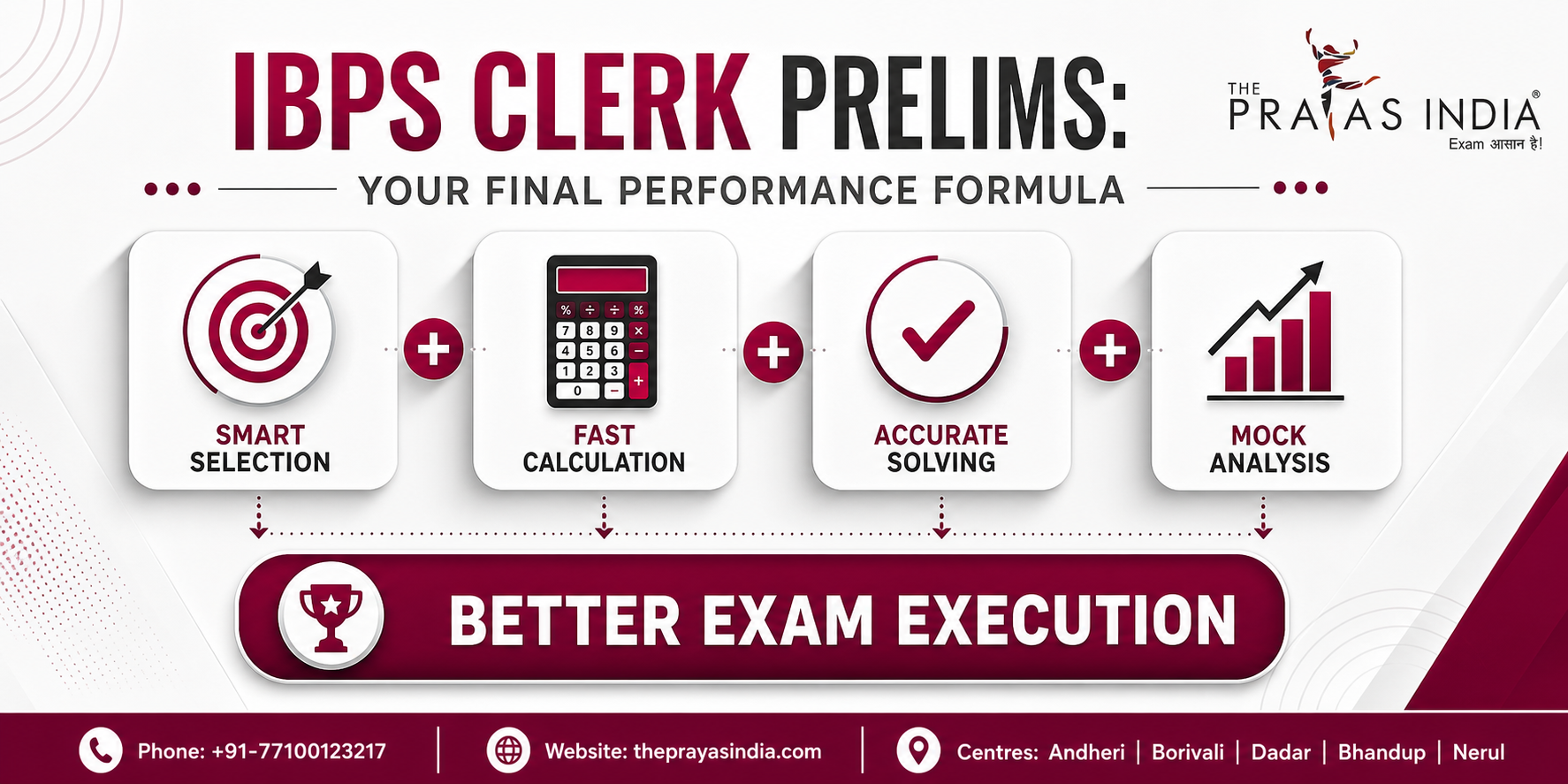
With the IBPS Clerk (CSA) Prelims 2026 exam scheduled for October 10 and 11, the final preparation period should be about turning knowledge into efficient exam performance. Speed and accuracy should not be treated as separate goals. The real objective is to develop the ability to identify the right questions, solve familiar questions efficiently, avoid careless mistakes and manage your time under pressure.
Use the remaining days for timed practice, mock tests, detailed analysis, targeted revision and repeated correction of mistakes. Do not measure your preparation only by the number of questions or chapters completed. Measure it by how consistently you can perform within a realistic time limit.
For aspirants who need additional structure, expert guidance and regular practice during this final phase, The Prayas India’s Online and Offline coaching support can help bring greater discipline to your IBPS Clerk preparation.
The final two weeks are not about studying everything. They are about performing better with what you already know.
Frequently Asked Questions
1. How can I improve my speed for IBPS Clerk Prelims 2026 in the last two weeks?
Focus on timed sectional practice, calculation drills, familiar question types and regular mock tests. Analyse where you are losing time and work specifically on those areas.
2. How can I improve accuracy in IBPS Clerk Prelims?
Analyse your mistakes after every mock and classify them as concept, execution or selection errors. Revising repeated mistakes and avoiding unnecessary guesses can help improve accuracy.
3. Should I take mock tests every day before IBPS Clerk Prelims 2026?
The ideal frequency depends on your current preparation level. Full-length mocks should be combined with proper analysis and targeted practice rather than taken simply to increase the number of tests.
4. What should I do if my IBPS Clerk mock-test speed is low?
Identify which section and question types are consuming the most time. Practise those areas separately under a timer and work on question selection.
5. How should I prepare for Reasoning in the final two weeks?
Focus on commonly practised topics and timed question-solving. Give particular attention to puzzles, seating arrangements and other areas where question selection can significantly affect your time.
6. How can I improve calculation speed for IBPS Clerk Numerical Ability?
Practise basic calculations, simplification, approximation, percentages, fractions and arithmetic operations regularly. Short, timed calculation drills can help you become more comfortable with numerical questions.
7. How should I prepare for English in the last two weeks?
Revise frequently tested concepts and practise Reading Comprehension, grammar-based questions and other familiar question types under timed conditions. Focus on accurate and efficient option selection.
8. What is more important in IBPS Clerk Prelims: speed or accuracy?
Both are important. High speed with frequent mistakes can reduce effective attempts, while excessive caution can limit the number of questions attempted. The goal should be a balanced combination of speed, accuracy and smart question selection.
9. Should I start new topics in the last two weeks of IBPS Clerk preparation?
Prioritise revision and strengthening topics you have already studied. New topics can be considered selectively if they are manageable within your remaining preparation time and do not disrupt your existing strategy.
10. How can I analyse my IBPS Clerk mock tests effectively?
Record your attempts, correct and incorrect answers, time used and recurring mistakes. Identify whether each error resulted from a concept gap, execution mistake or poor question selection, then practise accordingly.
11. How can I manage time better in IBPS Clerk Prelims?
Develop a clear section-wise approach through repeated timed practice. Learn to recognise questions that can be solved efficiently and move on when a question is taking disproportionately long.
12. Can coaching help with IBPS Clerk Prelims 2026 preparation?
Structured coaching can provide a planned study routine, guided practice, mock tests, revision support and expert guidance. The Prayas India offers Online and Offline coaching for banking exam aspirants.
Cracking IBPS Clerk Prelims 2026 in the Last 2 Weeks?
Boost your speed and accuracy with specialized banking test-taking strategies. Connect with expert mentors at The Prayas India to fine-tune your final mock test analysis and secure your selection.
Official Website: theprayasindia.com
Visit Our Mumbai Centres: