IBPS RRB 2026: How to Balance Speed, Accuracy and Mock Tests | The Prayas India
The IBPS RRB 2026–27 recruitment cycle is an important opportunity for aspirants preparing for banking examinations. As per the examination schedule, Officer Scale-I (PO) Prelims are scheduled for November 21 and 22, 2026, while Office Assistant (Clerk) Prelims will be conducted on December 6, 12 and 13, 2026. With the exams approaching, preparation should focus not only on completing the syllabus but also on developing the ability to solve questions quickly and accurately.
Many aspirants make the mistake of focusing only on speed. Others become so concerned about avoiding mistakes that they attempt too few questions. In a competitive exam like IBPS RRB, both approaches can create problems. The objective should be to develop a balanced strategy where you can identify the right questions, solve them efficiently and avoid unnecessary errors.
Why Speed and Accuracy Both Matter in IBPS RRB
IBPS RRB preparation requires regular practice because knowing a concept is different from applying it within a limited time. During the actual examination, you need to read the question, understand what is being asked, select an approach and arrive at the answer without spending excessive time.
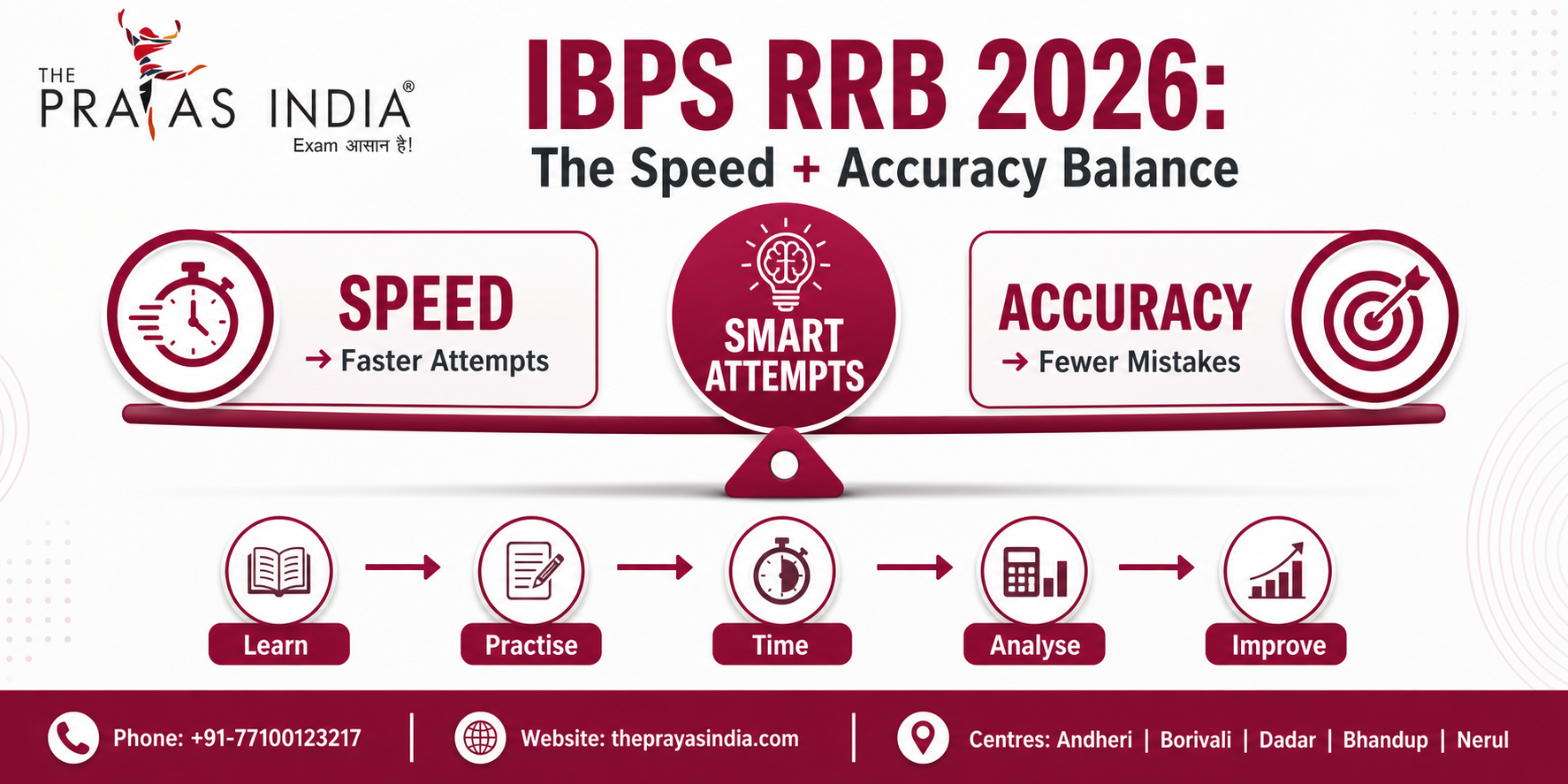
Speed helps you attempt a reasonable number of questions, while accuracy protects your score from unnecessary mistakes. Improving one without the other may not produce consistent results.
For example, if you attempt questions very quickly but make frequent calculation or interpretation errors, your attempts may increase without a corresponding improvement in performance. Similarly, if you solve every question carefully but take too much time, you may leave several manageable questions unattempted.
A practical preparation cycle is:
Learn → Practise → Time Yourself → Analyse → Improve → Retest
How to Improve Speed Without Losing Accuracy
Speed should develop through familiarity and practice rather than simply trying to solve everything faster.
Start by identifying the question types you already understand well. Practise these regularly under a timer and gradually reduce the time taken while maintaining accuracy.
For Quantitative Aptitude, calculation practice can make a significant difference. For Reasoning, familiarity with common question patterns can help reduce the time spent understanding the approach. In English, strong command over grammar, vocabulary and reading-based questions can improve both comprehension and response time.
Keep track of questions where you know the concept but take too long. These are often easier to improve than completely unfamiliar topics.
Focus on These Areas
- Faster calculations and approximation
- Quick recognition of familiar question types
- Better reading speed
- Learning efficient solving methods
- Avoiding unnecessary rechecking
- Knowing when to skip a lengthy question
The aim is not to rush through the paper. It is to become efficient without becoming careless.
How to Maintain Accuracy Under Time Pressure
Accuracy often decreases when aspirants become too focused on increasing attempts. This is why every timed practice session should track both speed and accuracy.
After a practice set or mock, check:
- How many questions did you attempt?
- How many were correct?
- How many were incorrect?
- Which mistakes were avoidable?
- Which questions consumed too much time?
- Did you attempt questions that should have been skipped?
Separate your mistakes into categories such as conceptual mistakes, calculation mistakes, reading mistakes and question-selection mistakes.
If the same type of error appears repeatedly, do not simply move on to another mock. Spend time correcting the underlying problem.
The Role of Mock Tests in IBPS RRB Preparation
Mock tests are useful because they bring together concepts, speed, accuracy and time management in one environment. However, taking mocks regularly is only half the process. Mock analysis is equally important.
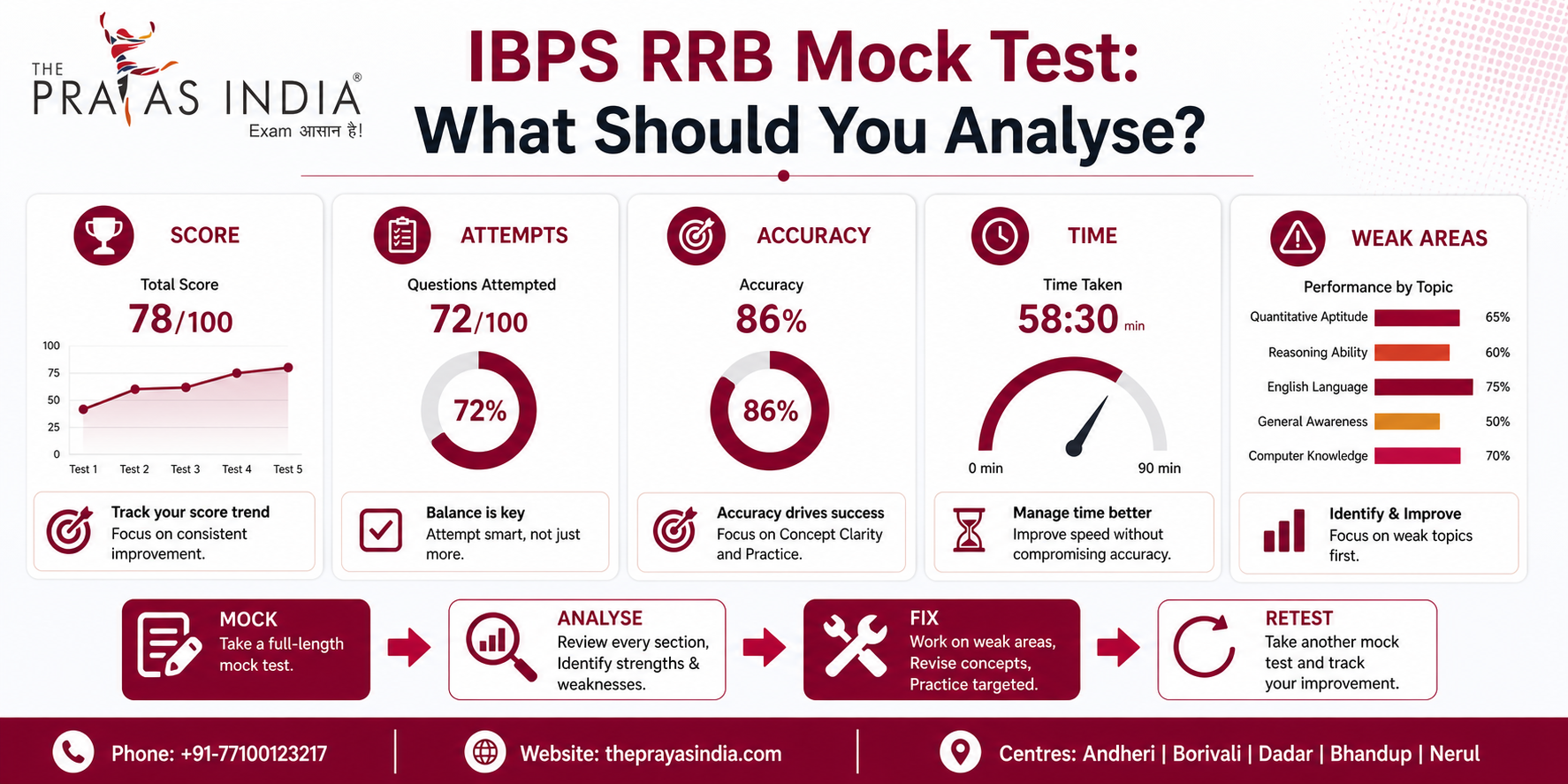
After every mock, review your performance rather than looking only at the final score.
A simple analysis framework is:
Score → Attempts → Accuracy → Wrong Answers → Time Loss → Weak Areas → Action Plan
For example, if your score is low because of poor accuracy, increasing attempts may not be the immediate solution. If your accuracy is good but your attempts are low, you may need to work on speed and question selection.
Similarly, if one section consumes too much time, practise that section separately instead of repeatedly taking full-length tests without addressing the problem.
How to Improve Question Selection
In a timed examination, not every question deserves the same amount of time.
During your mocks, identify three categories:
Easy: Recognise and solve quickly.
Moderate: Requires some calculation or reasoning but remains manageable.
Time-Consuming: Requires lengthy calculations, complicated reasoning or excessive reading.
Try to build the habit of solving easier questions first and returning to lengthy questions when appropriate.
Good question selection can improve your overall efficiency without requiring you to dramatically increase your solving speed.
A Simple Mock-Test Routine
As the IBPS RRB exams approach, your preparation can follow a structured cycle:
Step 1: Take a Timed Mock
Attempt the test under exam-like conditions.
Step 2: Analyse Your Performance
Review wrong answers, slow questions and skipped questions.
Step 3: Identify the Problem
Determine whether the issue is concept, accuracy, speed or selection.
Step 4: Practise the Weak Area
Work on the specific topic or skill responsible for the problem.
Step 5: Take Another Test
Check whether your performance has improved.
This process is much more useful than taking multiple mocks without analysing them.
IBPS RRB 2026 Preparation: Start Structured Practice Now
With Officer Scale-I Prelims on November 21–22, 2026 and Office Assistant Prelims on December 6, 12 and 13, 2026, aspirants should use the remaining preparation period carefully.
The focus should gradually move from syllabus completion towards timed practice, mock tests, revision, accuracy and exam strategy. Students who are still building their fundamentals should combine concept learning with regular practice rather than waiting until the final weeks to begin mock tests.
A structured coaching programme can make this process more organised by providing guided classes, study material, practice questions, mock tests and revision support.
At The Prayas India, aspirants can prepare for banking examinations through online and offline coaching, with structured guidance designed to support consistent preparation and regular practice.
Final Takeaway
Success in IBPS RRB preparation is not simply about solving the maximum number of questions. It is about solving the right questions with the right balance of speed and accuracy.
Use mock tests to understand your current performance, analyse every important mistake, identify time-consuming questions and work specifically on your weak areas.
Remember the cycle:
Practise → Take Mock → Analyse → Improve → Retest
With the IBPS RRB 2026–27 examination schedule approaching, a focused preparation strategy can help you make better use of your study time and enter the examination with greater familiarity with the test environment.
For aspirants looking for structured guidance, The Prayas India offers IBPS RRB preparation through online and offline coaching options.
FAQs on How to Prepare for IBPS RRB
1. How can I improve speed for IBPS RRB?
Practise regularly with a timer, improve calculations, become familiar with common question types and learn to identify questions that can be solved quickly.
2. How can I maintain accuracy while increasing speed?
Increase speed gradually. Track incorrect answers after every timed practice session and identify whether mistakes are caused by calculation, concepts, reading or question selection.
3. Are mock tests important for IBPS RRB?
Yes. Mock tests help you practise under time pressure and evaluate speed, accuracy, attempts and question selection.
4. Should I analyse every IBPS RRB mock?
Yes. Mock analysis helps identify the specific reasons behind mistakes and shows which areas require additional practice.
5. How should I manage time during IBPS RRB Prelims?
Practise section-wise timing and prioritise questions based on difficulty and solving time. Avoid spending too much time on a single difficult question.
6. Can coaching help with IBPS RRB preparation?
Structured coaching can provide guided learning, regular practice, mock tests, study material and revision support. The Prayas India offers IBPS RRB preparation through online and offline learning options.
Boost Your Speed & Accuracy for IBPS RRB Exams!
Mastering time management is the key to cracking the IBPS RRB exam. Connect with the banking exam experts at The Prayas India to build a personalized preparation roadmap and maximize your scores.
Official Website: theprayasindia.com
Visit Our Mumbai Centres: