IBPS PO Mains 2026 Last-Minute Strategy: Revision, Mocks & Time Management | The Prayas India
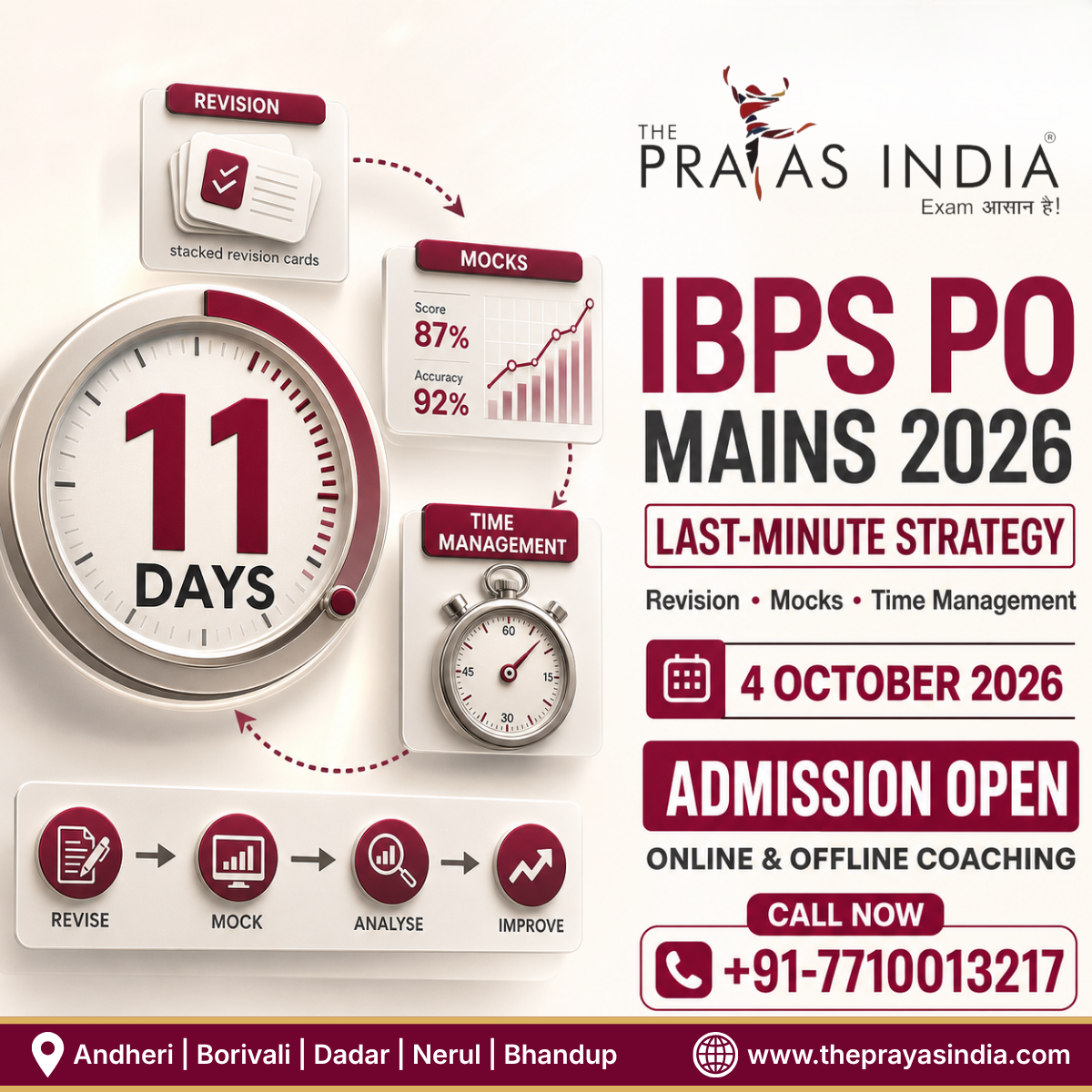
The IBPS PO Mains 2026 exam is scheduled for 4 October 2026, which means aspirants now have only a short final preparation window. At this stage, the objective should not be to start preparing everything from scratch. The focus should shift towards targeted revision, mock-test practice, current affairs revision, time management and eliminating repeated mistakes. The official IBPS calendar lists 4 October 2026 as the tentative Mains examination date for PO/MT-XVI.
The final days before an exam can make preparation feel overwhelming because there is always another topic, another mock or another set of current-affairs notes waiting to be covered. However, effective last-minute preparation is less about studying more material and more about using the remaining time intelligently.
For IBPS PO Mains, candidates need to manage multiple sections under separately timed tests. As per the current official pattern, the objective examination consists of Reasoning, General/Economy/Banking Awareness including Digital and Financial Awareness, English Language, and Data Analysis & Interpretation, followed by a descriptive paper. The objective tests together carry 200 marks and have a total duration of 160 minutes, while the descriptive paper carries 25 marks and has 30 minutes allotted.
With limited time remaining, your preparation should therefore follow a simple principle:
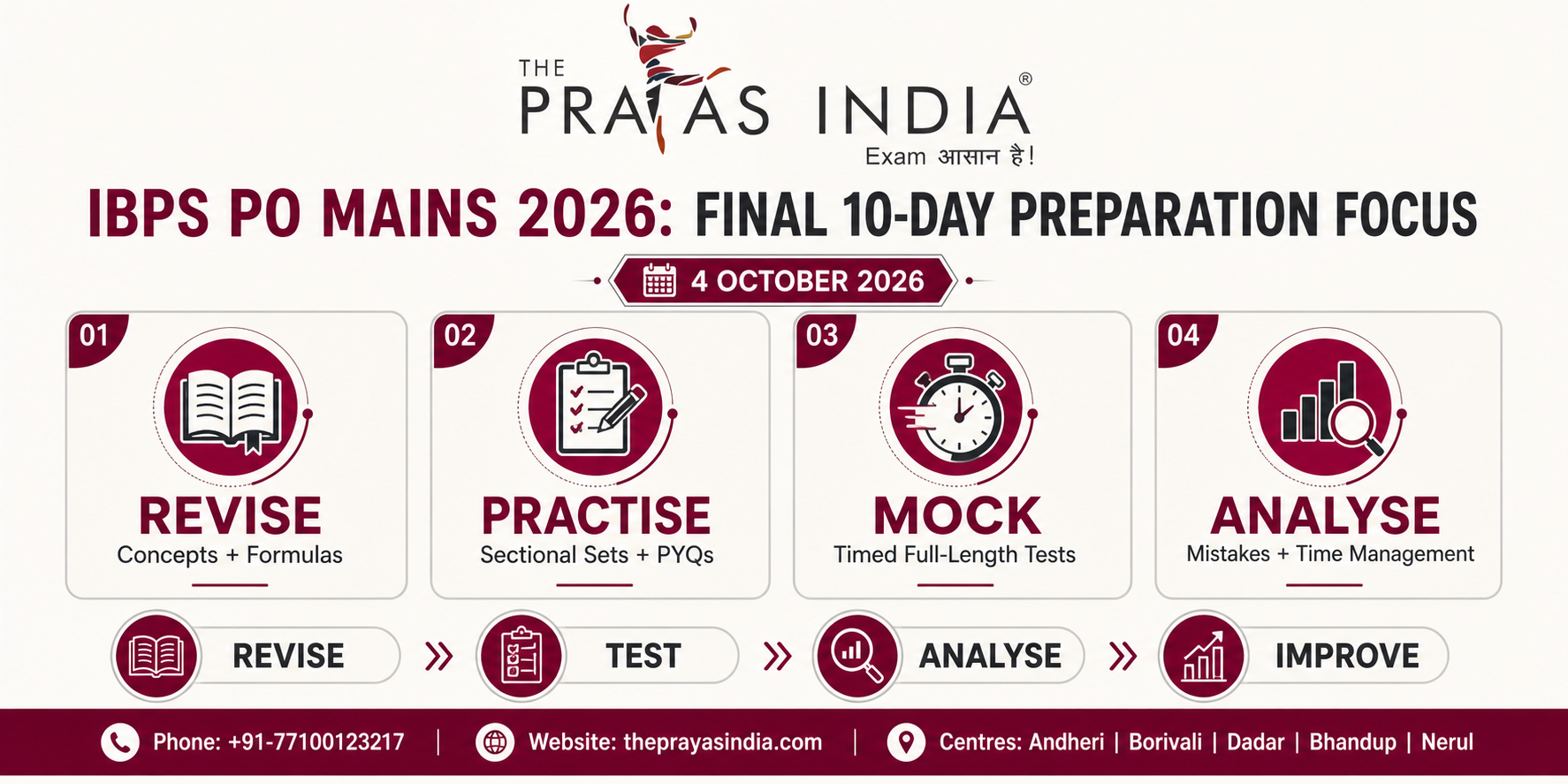
Revise Smart → Practise Under Time Pressure → Analyse → Improve → Repeat
What Should You Focus on in the Last 10–11 Days?
The biggest mistake at this stage is trying to complete every possible topic. Your remaining preparation should be based on priority and performance, not on the desire to finish every chapter.
Divide your preparation into four broad areas:
- Revision of already studied concepts
- Current affairs and banking awareness
- Mock tests and sectional practice
- Mistake correction and time management
If a topic is already strong, maintain it through revision and practice. If a topic is moderately prepared, use targeted question sets to improve it. For a completely unfamiliar topic, consider the time required before deciding whether it deserves attention in the final days.
The purpose of the final phase is to make your existing preparation more reliable.
IBPS PO Mains 2026: Subject-Wise Last-Minute Revision
1. Reasoning
Reasoning preparation during the final days should focus heavily on question selection and timed practice.
Instead of trying to learn numerous new concepts, revise the question types you have already practised. Solve selected sets under time pressure and identify the types of questions where you spend too much time.
After every practice session, ask yourself:
- Did I identify the right questions quickly?
- Which set consumed the most time?
- Where did I make an avoidable mistake?
- Did I change a correct approach unnecessarily?
The objective is not simply to solve difficult questions. It is to become more efficient at deciding which questions deserve your time.
2. Data Analysis & Interpretation
DI can become particularly time-consuming when calculations are slow or when a candidate spends too long understanding one set.
During the final days, practise selected DI sets involving calculations, data comparison and interpretation. Pay attention to calculation-heavy questions and develop a habit of estimating whether a set is worth attempting before investing too much time.
Do not spend the final days attempting every difficult DI set you can find. Focus on improving the types of questions you can realistically solve accurately under timed conditions.
3. English Language
For English, revision should focus on accuracy, comprehension and familiarity with common question formats.
Practise reading-based questions under time limits and review your errors carefully. If you repeatedly make mistakes in grammar, vocabulary or comprehension, identify the specific pattern instead of simply solving more questions.
Your final-day English practice should be controlled rather than excessive. The goal is to enter the examination with a clear approach to reading, eliminating options and managing time.
4. General, Economy, Banking, Digital & Financial Awareness
This section deserves special attention during the final preparation phase because the syllabus covers current and banking-related information.
Focus on:
- Recent current affairs
- Banking and financial awareness
- Important economic developments
- RBI-related updates and concepts
- Digital banking and financial technology
- Important banking terminology
- Government and financial-sector developments relevant to the examination
Avoid continuously adding new sources. Choose a reliable set of notes or revision material and revise it repeatedly.
The official IBPS pattern specifically includes General/Economy/Banking Awareness along with Digital/Financial Awareness, including RBI circulars.
How to Use Mock Tests in the Final Days
At this stage, mock tests should not be treated simply as a way to check your score. Their real value comes from analysis.
Taking several mocks without analysing them can result in the same mistakes being repeated. After every mock, review your performance section by section.
Look at:
Accuracy: Which questions were wrong and why?
Time: Which section or question type consumed excessive time?
Selection: Did you attempt questions that should have been skipped?
Concepts: Which mistakes indicate a knowledge gap?
Execution: Which mistakes happened despite knowing the concept?
This analysis should determine what you practise next.
For example, if your mock shows that you understand a topic but take too long to solve its questions, the solution is not another round of theory. You need timed practice.
Similarly, if you are making repeated conceptual mistakes, another full mock may not solve the problem. A short targeted revision session followed by practice would be more useful.
How Many Mocks Should You Take Before IBPS PO Mains?
There is no universal number of mocks that every candidate must attempt. The useful number depends on your current preparation level and how effectively you analyse each test.
In the final days, quality matters more than simply increasing the number of tests.
A possible approach is:
Full-Length Mock → Detailed Analysis → Targeted Practice → Revision → Next Mock
Avoid taking one mock immediately after another without reviewing your mistakes.
Your mock score should be treated as feedback rather than the final measure of your preparation.
Time Management: Practise the Actual Exam Environment
The current official IBPS PO Mains pattern has separately timed objective tests. The official notification specifies 50 minutes for Reasoning, 25 minutes for General/Economy/Banking Awareness and Digital/Financial Awareness, 40 minutes for English and 45 minutes for Data Analysis & Interpretation. The descriptive paper has a separate 30-minute time limit.
This makes time management an important part of preparation.
During your final mocks, practise within the prescribed section timings. Do not pause the test to check solutions or take unnecessary breaks.
You should gradually develop a clear understanding of:
- Which questions you will attempt first
- Which questions you will leave initially
- How much time you can spend on a difficult question
- When to move away from a time-consuming set
- How you will handle the descriptive section
The final objective is to make your test-taking approach predictable rather than experimental.
Don’t Start Chasing New Topics in the Final Days
One of the biggest problems with last-minute preparation is information overload.
You may come across a new PDF, a new video, a new question set or a new strategy every day. Constantly changing your preparation source can create confusion and reduce revision time.
The final days should primarily be about strengthening what you already know.
If you have a specific weak area that can be improved through short targeted practice, work on it. But avoid completely rebuilding your preparation around a new source or an unfamiliar strategy.
Your final preparation should feel more focused every day, not more complicated.
IBPS PO Mains Descriptive Paper: Don’t Ignore the Final 30 Minutes
The descriptive paper is separately timed and carries 25 marks. Under the current official pattern, it consists of two questions based broadly on areas such as economic and social issues, emerging trends in banking and technology, current events and ethics.
Therefore, descriptive preparation should not be left entirely for the final day.
Use the remaining days to practise writing within the prescribed time. Focus on:
- Understanding the topic quickly
- Creating a logical structure
- Writing a clear introduction
- Developing relevant points
- Using appropriate examples
- Maintaining coherence
- Concluding effectively
- Checking grammar and clarity
Do not memorise complete essays. Instead, prepare frameworks around commonly relevant themes so that you can organise your thoughts quickly.
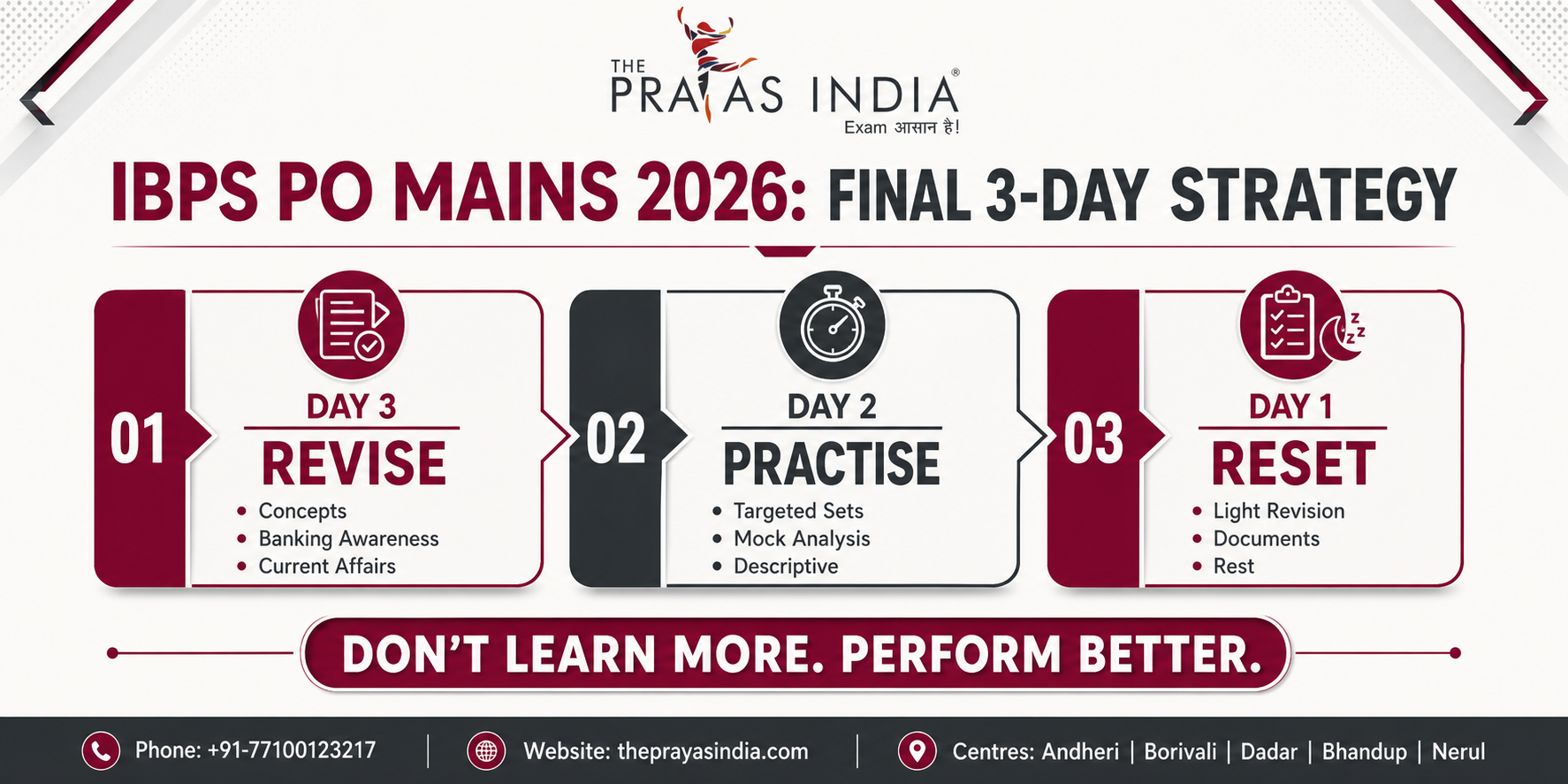
Final 3 Days: Shift From Preparation to Performance
The last three days should have a different character from the previous weeks.
At this point, avoid unnecessarily expanding your syllabus. Focus on revision, selected practice and maintaining confidence in your existing strategy.
Three Days Before the Exam
Revise important concepts and current-affairs notes. Take a mock if it is part of your established routine and analyse it carefully.
Two Days Before the Exam
Focus more on revision and targeted question practice. Review your mistake notebook and important banking-awareness material.
One Day Before the Exam
Keep preparation light and organised. Revise concise notes rather than attempting large new question sets. Check your examination documents, reporting details and required items in advance.
The objective on the final day is to remain mentally fresh rather than exhausting yourself with another intensive study session.
How to Analyse Your Final IBPS PO Mains Mock
Your final mocks should be treated as performance diagnostics rather than simply score-generating exercises. After completing a mock, spend enough time understanding what happened during the test.
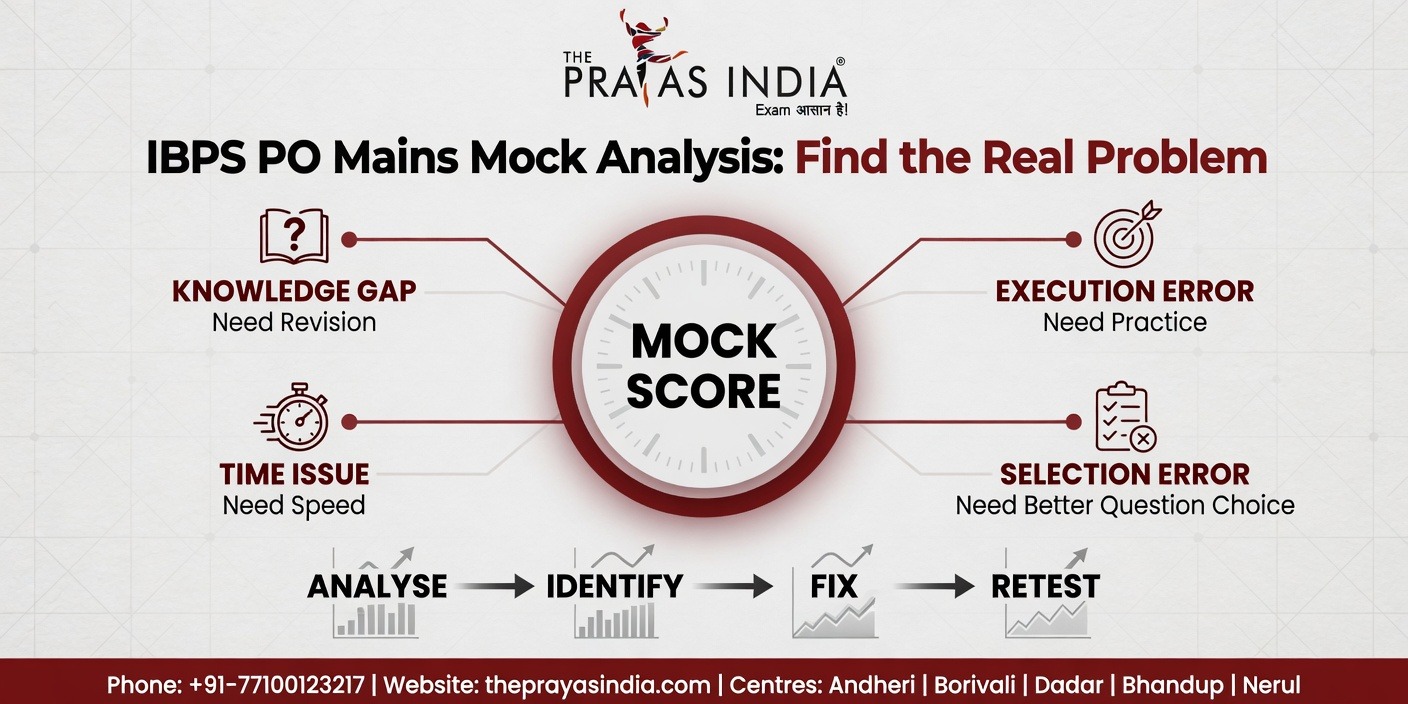
Create four categories for every mistake:
1. Knowledge Gap — You did not know the concept or information.
2. Execution Error — You knew the concept but made a calculation, reading or application mistake.
3. Time-Management Error — You spent too much time on a question or set.
4. Selection Error — You attempted a question that was not suitable for your available time.
This classification makes your revision much more targeted. For example, if most of your errors are execution-based, repeatedly reading theory may not improve your performance. You need more timed practice and careful solution review.
Similarly, if you are losing time because of question selection, your priority should be improving your ability to identify manageable questions quickly.
A Simple Mock Analysis Table
| Check | What to Ask |
|---|---|
| Accuracy | Which questions did I get wrong? |
| Time | Where did I lose valuable minutes? |
| Selection | Which questions should I have skipped? |
| Concepts | Which topics need revision? |
| Repeated Errors | Which mistakes are appearing again? |
| Improvement | What will I change in my next mock? |
The goal is to make every mock contribute something to your next attempt.
What to Do If Your Mock Score Is Lower Than Expected
A low mock score during the final days can create unnecessary panic. One mock does not automatically define your actual examination performance.
Instead of immediately changing your entire strategy, investigate the reason behind the score.
If the score dropped because of poor accuracy, identify the questions responsible. If you attempted too many difficult questions, work on selection. If one section consumed disproportionate time, review your approach to that section.
Also compare the mock with your previous attempts. Look for trends rather than reacting emotionally to one score.
For example:
- Attempts increasing + accuracy falling: focus on question selection.
- Attempts falling + accuracy improving: work on speed while protecting accuracy.
- Score stable + repeated mistakes: target those specific weaknesses.
- Score fluctuating significantly: examine whether your strategy is changing from mock to mock.
This type of analysis is more useful than simply taking another mock immediately.
Final-Week Revision Strategy for Banking Awareness and Current Affairs
The final week should include repeated revision of your prepared current-affairs and banking-awareness material.
Rather than collecting multiple new PDFs, use one organised source and revise it systematically.
Pay particular attention to:
- Banking and financial-sector developments
- RBI-related updates
- Important appointments
- Government schemes
- Reports and indexes
- Economic developments
- Important national and international events
- Digital banking and financial technology
- Important banking terminology
Create short revision sheets for information you repeatedly forget.
The final goal is quick recall, not creating more notes.
Section-Wise Time Management Checklist
Because the objective examination has separately timed sections, your preparation should include section-specific strategies rather than relying on one overall time-management plan.
Reasoning
Start with question types that you can identify and solve efficiently. Do not allow one difficult puzzle or set to consume excessive time.
Data Analysis & Interpretation
Assess the calculation requirement before committing to a lengthy set. If the initial questions indicate that a set is consuming too much time, move on where appropriate.
English
Maintain a steady reading pace. Avoid spending disproportionate time debating between two options when the evidence in the passage or question does not support further analysis.
General/Economy/Banking Awareness
This section can reward quick recall. Avoid overthinking questions when you are reasonably certain of the answer.
Descriptive Paper
Use the available time carefully. Spend a short amount of time understanding the topic and planning your response before writing.
Common Mistakes to Avoid in the Last 10 Days
The final days are not the time to make drastic changes to your preparation without a clear reason.
Avoid:
Starting too many new resources: More PDFs and videos do not necessarily mean better preparation.
Taking mocks without analysis: The value of a mock lies largely in what you learn from it.
Ignoring the descriptive paper: It has a separate time allocation and should receive some preparation.
Studying continuously without revision: New information is less useful if previously studied material is being forgotten.
Comparing every mock score with someone else’s: Your own performance trend is more relevant to your preparation decisions.
Changing your strategy every day: Build familiarity with your approach before exam day.
Neglecting sleep and routine: Excessive last-minute studying can interfere with concentration and consistency.
IBPS PO Mains Exam-Day Strategy
On examination day, your preparation should translate into a controlled execution strategy.
Before leaving for the examination centre, ensure that you have checked the instructions applicable to your examination and arranged the required documents and items according to the official communication.
During the examination, remember that every question does not need to be attempted. The objective should be to maximise the value of your available time while maintaining accuracy.
If a question appears unexpectedly difficult, avoid allowing it to affect your approach to the remaining questions. Move forward according to the strategy you have practised in your mocks.
Since the objective tests are separately timed, candidates should be familiar with the section-specific time limits before entering the examination.
For the descriptive paper, read the prompt carefully and structure your response before beginning to write.
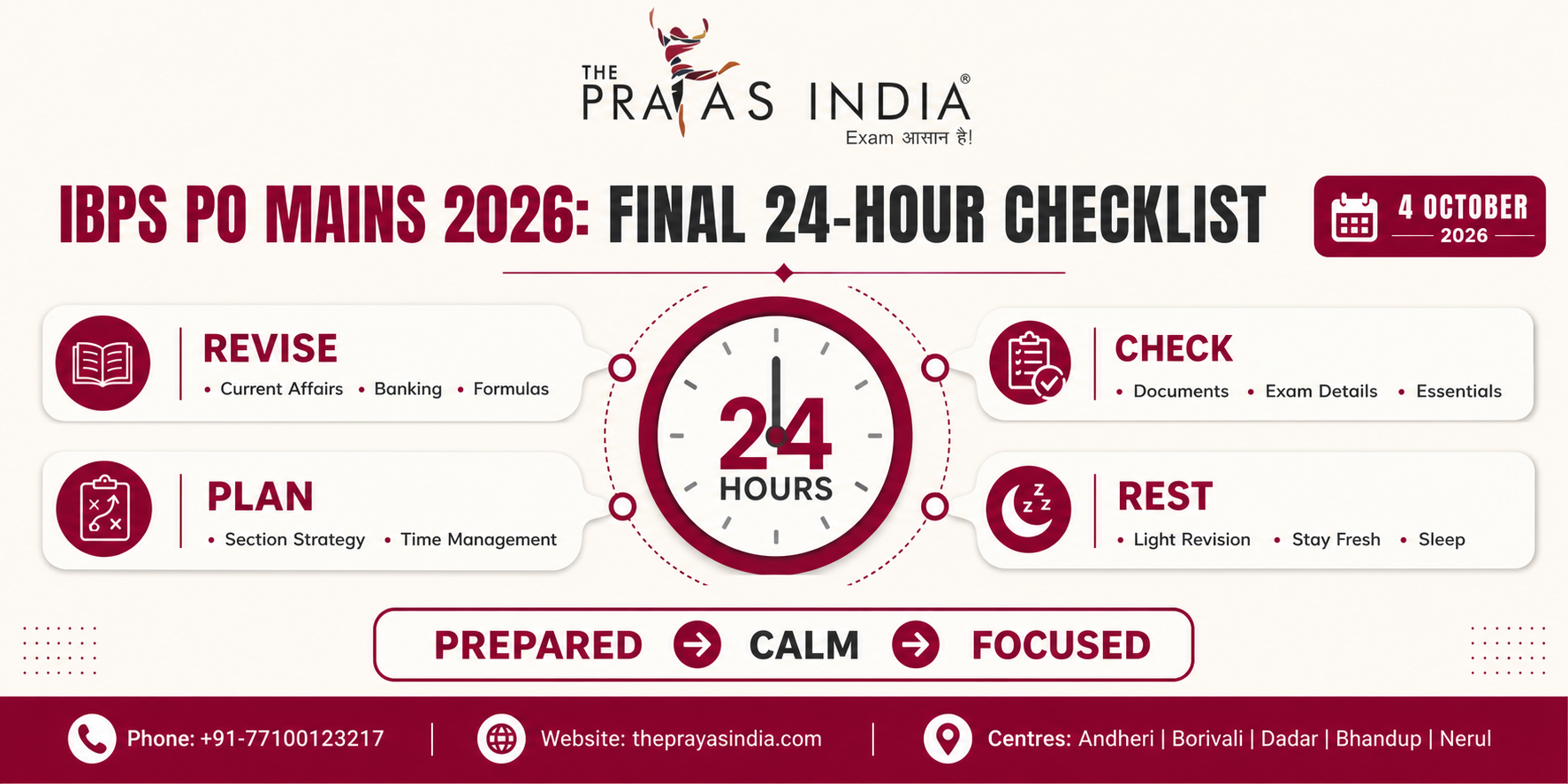
What Should Your Last 24 Hours Look Like?
The final 24 hours should be about calm revision and preparation, not trying to complete an entirely new syllabus.
A practical approach is:
Morning: Revise important banking/current-affairs notes.
Afternoon: Review formulas, important concepts and your mistake notebook.
Evening: Keep revision light and organise examination-related requirements.
Night: Stop intensive studying and get adequate rest.
The exact routine can vary from candidate to candidate, but the principle remains the same: reach the examination with your preparation organised and your mind reasonably fresh.
How The Prayas India Can Support Your Banking Exam Preparation
The final days before an important examination can be challenging, particularly when an aspirant is managing revision, mock tests, current affairs and time management simultaneously.
A structured preparation environment can help candidates follow a planned learning schedule, practise questions regularly, analyse test performance and work systematically on weaker areas.
The Prayas India provides online and offline coaching for competitive and banking examinations, allowing aspirants to prepare through a structured learning approach.
For candidates preparing for IBPS PO and other banking examinations, guided preparation can be useful from the foundation stage through to mock-test practice and revision.
If you are planning to continue your preparation for upcoming banking examinations after the IBPS PO Mains cycle, joining a structured programme can also help you maintain consistency instead of restarting preparation every time a new notification arrives.
Final IBPS PO Mains 2026 Checklist
Before the exam, make sure you have:
- Revised important concepts and formulas.
- Revised banking and current-affairs notes.
- Practised relevant sectional questions.
- Taken and analysed mock tests.
- Identified repeated mistakes.
- Practised descriptive writing.
- Developed a section-wise time-management approach.
- Reviewed your question-selection strategy.
- Checked the official examination instructions.
- Arranged the required documents and essentials.
- Avoided unnecessary last-minute resources.
- Prioritised adequate rest before the examination.
Final Takeaway
With the IBPS PO Mains 2026 examination scheduled for 4 October, the final days should be used for focused revision, controlled practice and performance improvement rather than attempting to learn everything from the beginning.
Use mocks to identify your actual problems. Revise current affairs and banking awareness systematically. Practise the sections where you lose time, improve question selection and keep your descriptive preparation active.
Most importantly, do not allow one difficult mock or one weak score to completely change your preparation strategy. Analyse the reason, correct the issue and move forward.
The final phase is about converting your preparation into examination performance:
Revise → Practise → Analyse → Improve → Perform
For aspirants who want structured guidance for IBPS PO and other banking examinations, The Prayas India offers online and offline coaching designed to support consistent preparation, practice and test-based improvement.
FAQs on IBPS PO Mains 2026 Last-Minute Strategy
1. How many days are left for IBPS PO Mains 2026?
With the exam scheduled for 4 October 2026 and this article focused on 23 September, candidates have approximately 11 days for final preparation.
2. What should I study in the last 10 days for IBPS PO Mains?
Prioritise revision of studied concepts, banking and current affairs, targeted practice, mock tests, mistake correction and descriptive writing.
3. Should I take mock tests every day before IBPS PO Mains?
There is no fixed requirement to take a full mock every day. Choose a frequency that allows enough time for detailed analysis and targeted improvement.
4. How should I analyse my IBPS PO Mains mock?
Check incorrect answers, time-consuming questions, unattempted questions, selection mistakes and repeated errors. Categorise each problem and use the findings to plan your next revision session.
5. Should I study new topics in the final week?
Prioritise topics that can realistically improve your performance. Avoid trying to cover large amounts of unfamiliar material at the cost of revision and practice.
6. How can I improve my IBPS PO Mains time management?
Practise under the actual sectional time limits and analyse where you lose time. Work on question selection and avoid spending excessive time on individual difficult questions.
7. Is descriptive writing important for IBPS PO Mains?
Yes. Under the current official pattern, the descriptive paper is separately timed and carries 25 marks, so candidates should include some timed writing practice in their final preparation.
8. What should I revise for IBPS PO Banking Awareness?
Revise your prepared material covering banking, financial awareness, RBI-related developments, economic developments, digital banking and relevant current affairs.
9. What should I do if my mock score suddenly drops?
Analyse the reason instead of immediately changing your entire strategy. Check accuracy, attempts, time distribution, question selection and repeated mistakes.
10. What should I do one day before IBPS PO Mains?
Keep revision light, review concise notes, check examination requirements and prioritise adequate rest.
11. Can I still improve my IBPS PO Mains preparation in the last 10 days?
Yes. While this is not the stage for completely rebuilding your preparation, targeted revision, mock analysis, current-affairs revision and time-management practice can help you use the remaining preparation period effectively.
12. Does The Prayas India provide IBPS PO coaching?
The Prayas India offers online and offline coaching support for banking and competitive examinations. Aspirants can explore structured preparation options according to their learning requirements.
Maximize Your IBPS PO Mains Score in the Last 11 Days!
Don’t let last-minute panic affect your performance. Connect with the banking exam experts at The Prayas India to fine-tune your mock test evaluation, lock down your General Awareness revision, and perfect your descriptive writing strategy.
Official Website: theprayasindia.com
Visit Our Mumbai Centres: