RRB NTPC 2026 Mock Test Strategy: How to Attempt, Analyse & Improve Your Score | The Prayas India
Preparing for RRB NTPC 2026 is not only about completing the syllabus. Once candidates have covered the major topics in Mathematics, General Intelligence and Reasoning, and General Awareness, the next challenge is to convert that preparation into marks under actual exam conditions. This is where mock tests become important. A well-planned mock test strategy can help candidates improve question selection, time management, accuracy, speed and exam temperament.
Many aspirants make the mistake of treating a mock test simply as another question paper. They attempt the test, check the score and move on to the next mock. That approach misses the most valuable part of mock-test preparation: analysis. A mock test should tell you not only how many questions you got right, but also why you lost marks, which topics are consuming too much time, where you are making avoidable mistakes and which questions you should have skipped.
For RRB NTPC 2026, candidates should therefore treat mock tests as a preparation and diagnostic tool rather than merely a source of practice questions. The objective is to gradually build an exam strategy that allows you to maximise accurate attempts within the available time.
RRB NTPC 2026 Exam Pattern: Why Mock Tests Matter
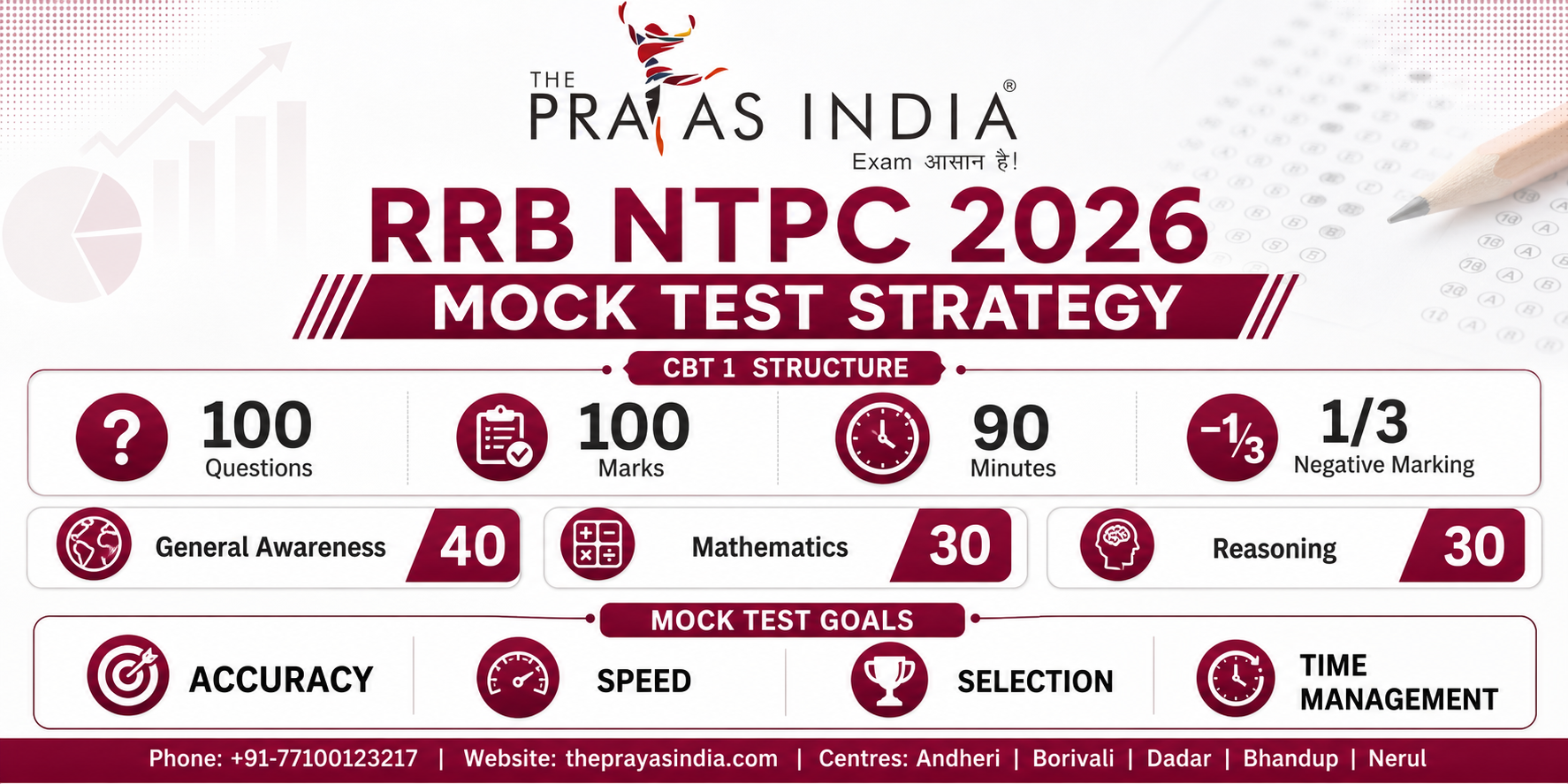
The RRB NTPC CBT 1 examination consists of 100 questions carrying 100 marks. The indicative distribution includes 40 questions from General Awareness, 30 from Mathematics and 30 from General Intelligence and Reasoning. Candidates get 90 minutes to complete the examination. The current pattern also includes a negative marking provision of one-third mark for every incorrect answer.
This makes accuracy and time management particularly important. A candidate may know the concepts but still lose marks if too much time is spent on difficult questions or if guesses lead to unnecessary negative marking.
CBT 2 has a different distribution, with 50 questions from General Awareness, 35 from Mathematics and 35 from General Intelligence and Reasoning, for a total of 120 questions. The duration remains 90 minutes, and the one-third negative marking provision applies here as well.
The exact exam schedule, detailed instructions and applicable recruitment rules should always be checked against the latest official RRB notification.
Why This Pattern Changes Your Mock-Test Strategy
The purpose of a mock is not simply to finish 100 questions in 90 minutes. Your strategy should answer four practical questions:
- Which questions should I attempt first?
- Which questions should I postpone?
- How much time should I spend on a difficult question?
- How can I maximise accurate marks while controlling negative marking?
A candidate who answers 75 questions with high accuracy can potentially perform differently from a candidate who attempts 90 questions but makes many avoidable errors. Therefore, mock-test analysis should focus on the quality of attempts rather than only the raw number of attempts.
Important: Focus on Quality of Attempts
The number of questions attempted should never become the only target. The more useful goal is to improve the combination of attempts, accuracy, question selection and time utilisation. A well-balanced approach can help you make better decisions during the RRB NTPC examination while reducing unnecessary mistakes and time loss.
When Should You Start Taking RRB NTPC Mock Tests?
There is no need to wait until the entire syllabus has been completed before taking your first mock. However, the purpose of mocks should change according to your preparation stage.
During the initial stage, sectional tests and topic-wise tests are generally more useful because they help you understand your strengths and weaknesses without putting unnecessary pressure on your overall score. For example, after completing a set of Arithmetic topics, you can take a Mathematics sectional test to check whether you can apply those concepts under time pressure.
Once you have covered a substantial portion of the syllabus, gradually introduce full-length mocks. At this stage, the objective is to reproduce the conditions of the actual examination: fixed time, no interruptions, controlled question selection and disciplined use of the on-screen test interface.
During the final phase of preparation, full-length mocks should become an important part of your routine. However, taking a large number of mocks without analysing them can produce very little improvement. One carefully analysed mock can be more useful than several tests that are attempted casually.
RRB NTPC Mock Test Strategy According to Preparation Stage
Stage 1: Foundation Phase
When your preparation has just started, focus primarily on concepts and topic-wise practice. You can introduce short sectional tests after completing individual topics.
For example, after completing percentages, profit and loss, ratio, average and basic arithmetic, take a short Mathematics test. Similarly, after covering coding-decoding, analogy, series and classification, take a Reasoning sectional test.
At this stage, do not become overly concerned about your overall mock score. Instead, identify whether you understand the question type and whether you can solve it within a reasonable amount of time.
Stage 2: Syllabus Coverage Phase
Once a large portion of the syllabus is covered, increase the frequency of sectional tests and begin introducing full-length mocks.
The main objective now is to connect different topics. In an actual examination, questions do not appear chapter-wise. A candidate may encounter an easy percentage question, followed by a difficult reasoning question, a current-affairs question and then a lengthy arithmetic problem.
Your mock practice should therefore train your brain to switch between different subjects and difficulty levels.
Stage 3: Exam Simulation Phase
In the final preparation stage, full-length mocks should be treated as examination simulations. Sit for the mock at a fixed time, keep your environment free from distractions and complete the entire test in one sitting.
Do not pause the test to check formulas or revise facts. Do not restart because the first few questions were difficult. The purpose of this phase is to develop the ability to remain composed and make decisions when the paper does not go exactly according to your expectations.
How Many RRB NTPC Mock Tests Should You Attempt?
There is no officially prescribed number of mock tests that every candidate must attempt. The ideal number depends on your preparation level, available time and the quality of analysis you perform after each test.
A useful progression can be:
| Preparation Stage | Suggested Practice |
|---|---|
| Early preparation | Topic-wise and sectional tests |
| Mid preparation | Regular sectional + occasional full mocks |
| Advanced preparation | Frequent full-length mocks |
| Final phase | Full mocks + intensive analysis + revision |
The important principle is simple: do not chase the number of mocks; chase improvement between mocks.
If your fifth mock has the same mistakes as your first mock, simply taking more tests is not solving the underlying problem.
The Most Important Part: How to Analyse an RRB NTPC Mock Test
Mock analysis is where much of the actual improvement happens.
After completing a test, divide your questions into four categories:
Category 1: Correct and Confident
These are questions you knew and solved correctly without excessive time consumption. They represent your dependable scoring areas.
Do not completely ignore these topics after getting them right. Instead, maintain them through periodic revision and practice.
Category 2: Correct but Took Too Much Time
This category is extremely important.
You may have solved the question correctly, but if it consumed three or four minutes, it may not be a practical examination attempt. Your knowledge is not necessarily the problem; your approach or calculation speed may be.
Mark these questions separately and look for shorter methods, better calculation techniques or alternative approaches.
Category 3: Incorrect but You Knew the Concept
These are often avoidable mistakes.
Examples include:
- Misreading the question
- Calculation error
- Choosing the wrong option despite knowing the concept
- Missing a word such as “not” or “incorrect”
- Marking the wrong answer in a hurry
- Making an arithmetic mistake
These errors should be recorded in an error notebook because they can reduce your score without indicating a genuine conceptual weakness.
Category 4: Incorrect Because You Did Not Know the Concept
These questions identify genuine knowledge gaps.
If you repeatedly miss questions from the same topic, return to the relevant concept and study it again. Then solve a fresh set of questions from that topic.
This creates a useful cycle:
Mock → Identify Gap → Revise → Practise → Re-test
That cycle is much more valuable than simply moving from one mock to another.
Mock Test Analysis Sheet You Should Maintain
After every full-length mock, record at least the following information:
| Parameter | What to Record |
|---|---|
| Total Score | Overall marks |
| Attempts | Total questions attempted |
| Correct | Number of correct responses |
| Incorrect | Number of incorrect responses |
| Accuracy | Correct ÷ Attempts × 100 |
| Unattempted | Questions left unanswered |
| Time Used | Total test duration |
| Slow Topics | Topics consuming excess time |
| Concept Errors | Questions requiring revision |
| Silly Errors | Avoidable mistakes |
| Guessing Errors | Incorrect uncertain attempts |
| Action Plan | What to improve before next mock |
This record allows you to compare your performance across multiple tests rather than judging yourself from one score.
Accuracy vs Attempts: What Should You Track?
Both matter, but they answer different questions.
Attempts tell you how many questions you are willing to engage with.
Accuracy tells you how reliably you are converting those attempts into marks.
Suppose your performance changes like this:
- Mock 1: 72 attempts, 82% accuracy
- Mock 2: 76 attempts, 85% accuracy
- Mock 3: 79 attempts, 88% accuracy
The important improvement is not simply that your attempts increased. Your accuracy improved at the same time.
On the other hand, if attempts increase from 75 to 88 but accuracy falls sharply, the additional attempts may not be beneficial.
Therefore, your target should be controlled attempts with strong accuracy, rather than maximum attempts at any cost.
How to Improve Speed Through Mock Tests
Speed should not be improved by simply trying to solve every question faster. Instead, identify where your time is actually going.
After every mock, ask:
- Which subject consumed the most time?
- Which topics caused repeated calculation delays?
- Which questions should have been skipped earlier?
- Did I spend too long trying to solve one difficult question?
- Did I return to questions that were actually not worth attempting?
- Did I waste time switching unnecessarily between sections?
For Mathematics, calculation practice can improve speed. For Reasoning, recognising familiar patterns can reduce solving time. For General Awareness, faster recall comes primarily from repeated revision and question practice.
Speed is therefore a result of familiarity + decision-making + practice, not just rushing.
The 90-Minute Mock-Test Mindset
A full-length CBT 1 mock should be treated as a limited resource-management exercise.
You have 90 minutes and 100 questions. That means you cannot afford to treat every question as equally important.
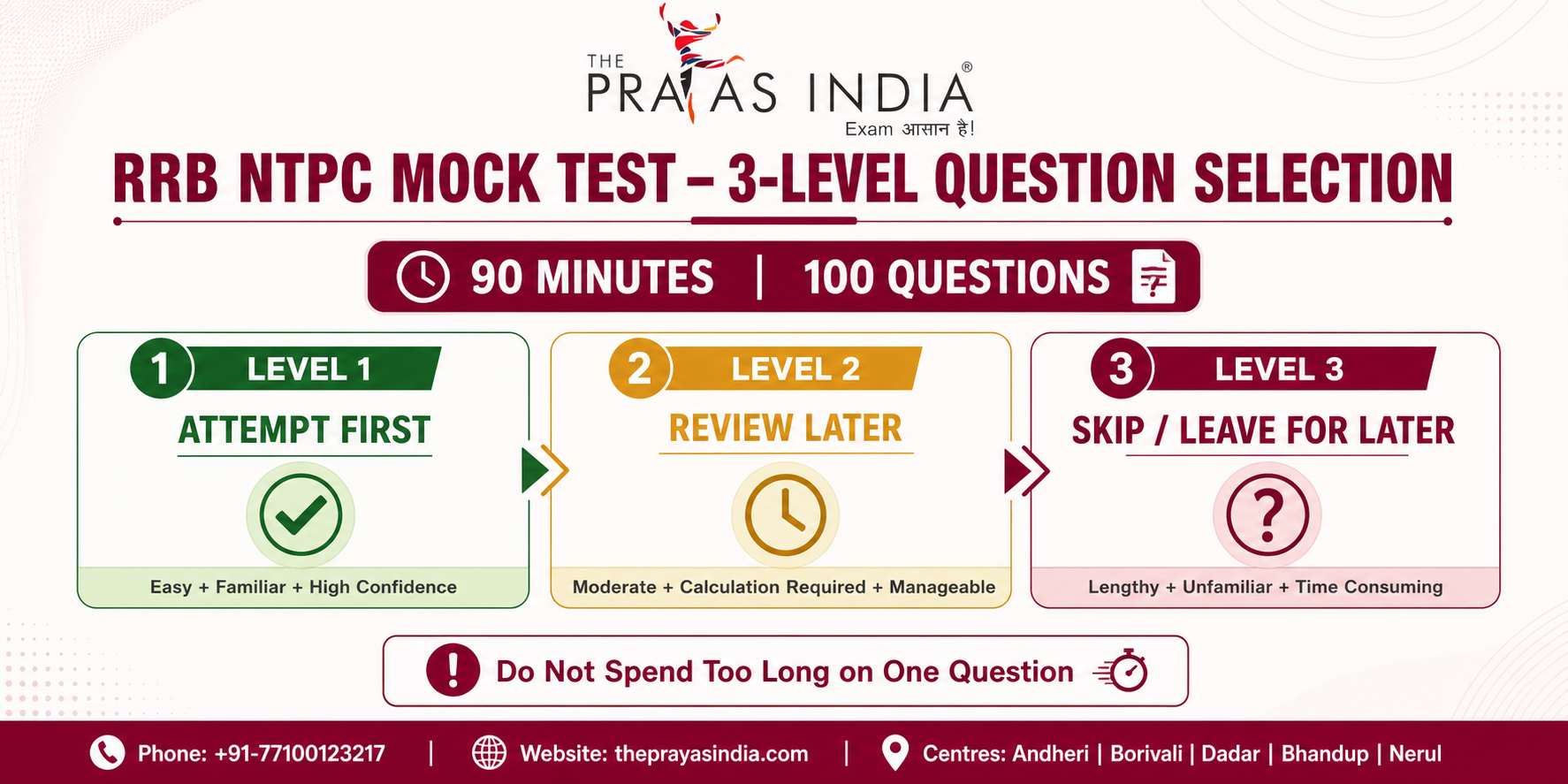
A practical three-level classification is:
Level 1 – Immediate Attempts:
Questions that are familiar, straightforward and likely to be solved accurately.
Level 2 – Review Attempts:
Questions that require some calculation or thinking but appear manageable.
Level 3 – Skip/Leave for Later:
Questions that are lengthy, unfamiliar, confusing or likely to consume disproportionate time.
This classification should become automatic through repeated mock practice.
Subject-Wise Mock Test Strategy for RRB NTPC 2026
A full-length mock test tells you how you perform under overall exam pressure, but subject-wise analysis tells you exactly where your preparation needs improvement. Since RRB NTPC CBT 1 combines General Awareness, Mathematics and General Intelligence & Reasoning in a 90-minute paper, your mock strategy should not treat all three sections in exactly the same way. Each subject requires a different approach to question selection, speed, accuracy and revision.
Mathematics: Focus on Calculation Speed and Question Selection
In Mathematics, mock tests should help you identify not only which topics you can solve but also how quickly you can solve them. A question that takes three minutes in a mock may indicate a problem even if your final answer is correct. The objective is to develop the ability to recognise standard question patterns and apply the appropriate method without unnecessary calculation.
During mock analysis, divide Mathematics questions into categories such as questions solved quickly and correctly, questions solved correctly but with excessive time, questions where calculation errors occurred, questions where the concept was known but the method was inefficient, and questions that you could not solve because the underlying concept was unclear.
Pay particular attention to recurring arithmetic areas such as percentage, ratio and proportion, profit and loss, simple and compound interest, time and work, time and distance, averages, number system and basic algebra. The exact importance of individual topics can vary across papers, so your own mock and PYQ analysis should guide your final revision priorities.
A useful target is not simply to increase the number of Mathematics attempts after every mock. Instead, try to increase the number of questions you can solve accurately within a reasonable time. If your attempts rise but your negative marks also increase, the mock has identified a decision-making problem rather than a speed problem.
Reasoning: Improve Pattern Recognition and Question Selection
Reasoning can become a strong scoring area when you learn to recognise familiar patterns quickly. Mock tests should therefore be used to measure how effectively you identify easy and moderate questions rather than attempting every question in the order presented.
After each mock, examine questions involving analogy, classification, series, coding-decoding, syllogism, blood relations, directions, mathematical operations, statement-based reasoning, puzzles and other relevant reasoning areas. Identify which question types you recognise immediately and which ones continue to consume excessive time.
If you regularly spend too much time on a particular puzzle or arrangement, do not simply solve more questions of the same type. First determine why the time is increasing. The issue may be an inefficient representation, difficulty identifying the starting point, or failure to leave a question when the required time becomes disproportionate.
The purpose of mock practice is to develop a practical decision rule: recognise the question, estimate the effort required, decide whether it is worth attempting immediately, and move ahead when it is not.
General Awareness: Focus on Recall, Revision and Accuracy
General Awareness requires a different mock-test approach because many questions depend on factual recall. When you get a GA question wrong, the mistake may not necessarily indicate poor problem-solving ability. It may indicate that the fact was never studied, was studied but forgotten, was confused with another fact, or was misread during the mock.
Maintain separate categories for these mistakes. Questions based on completely unknown information should be added to your study list only when they are relevant to the syllabus and useful for future revision. Forgotten information should be revised repeatedly. Confused facts should be placed in a comparison-based revision notebook. Misread questions should be treated as an exam-attention issue.
This distinction is important because simply increasing the number of GA questions you attempt will not automatically improve your score. The improvement comes from converting repeated mistakes into revised knowledge.
The 5-Step Mock Test Analysis System
Taking a mock test without analysing it properly significantly reduces its value. The real learning begins after the test ends. A useful analysis system can be divided into five steps.
Step 1: Check Your Overall Score
Record your total marks, number of attempts, correct answers, incorrect answers and unattempted questions. Do not judge your preparation from the total score alone.
For example, two candidates may obtain a similar score but have completely different performance patterns. One may have high accuracy but fewer attempts, while another may have many attempts accompanied by a high number of incorrect answers. Their next preparation steps should therefore be different.
Step 2: Analyse Each Section Separately
Record your performance in General Awareness, Mathematics and Reasoning separately. This helps identify whether your overall performance is being affected by one particular section.
Look at:
- Attempts
- Correct answers
- Incorrect answers
- Accuracy
- Time consumed
- Questions left unattempted
- Topics responsible for mistakes
- Questions that consumed excessive time
This section-wise view is much more useful than simply recording the total score.
Step 3: Identify the Reason Behind Every Mistake
Every wrong answer should have a reason. Classify mistakes into categories such as:
Conceptual mistake: You did not know the required concept.
Calculation mistake: You knew the method but made an arithmetic error.
Interpretation mistake: You misunderstood what the question was asking.
Memory mistake: You had studied the information but could not recall it.
Time-pressure mistake: You rushed because of insufficient time.
Question-selection mistake: You chose a question that should have been postponed or skipped.
Guessing mistake: You attempted without sufficient confidence.
This classification helps you avoid generic statements such as “I need to study more.”
Step 4: Find Questions That Took Too Long
Correct answers can also contain valuable information. If a question was answered correctly but took considerably longer than expected, mark it for review.
A mock test is not only about identifying wrong answers. It should also reveal inefficient methods. Reducing the time taken on questions you already know can create additional time for difficult sections.
Step 5: Convert Analysis into Action
The final step is the most important. Your analysis should result in a specific study action.
If Mathematics calculation errors are high, schedule calculation practice.
If Reasoning puzzles are taking too long, practise question selection and timed sets.
If GA mistakes are mostly forgotten facts, revise your notes repeatedly.
If your accuracy falls sharply near the end of the paper, practise timed full-length tests.
If you attempt too many doubtful questions, work on guessing control.
The purpose of analysis is not to record mistakes. It is to eliminate them from future mocks.
Maintain an RRB NTPC Mock Test Error Notebook
An error notebook can become one of the most useful tools during the final phase of preparation. However, it should not become another large textbook. Keep it short, selective and revision-friendly.
For Mathematics, record formulas, recurring calculation mistakes, shortcut methods and question types that repeatedly cause problems.
For Reasoning, record patterns, approaches and specific question types where you repeatedly lose time.
For General Awareness, record important facts that you repeatedly forget or confuse.
You can also create a simple table:
| Mistake Type | Example | Reason | Corrective Action |
|---|---|---|---|
| Concept | Formula not known | Weak topic | Revise concept |
| Calculation | Wrong multiplication | Rushed calculation | Practise timed calculations |
| Memory | Fact forgotten | Weak revision | Add to revision cycle |
| Selection | Difficult puzzle attempted first | Poor selection | Practise question prioritisation |
| Guessing | Low-confidence answer | Over-attempting | Improve elimination discipline |
The notebook should be reviewed before every mock and again after every mock. Over time, repeated mistakes should gradually disappear from the list.
Do Not Let Guessing Control Your Mock Performance
Negative marking makes careless guessing an important issue in RRB NTPC preparation. Since one-third of the marks are deducted for an incorrect answer, candidates should not treat every doubtful question as an automatic attempt.
The purpose of mock tests is to develop a clear decision-making system. If you know the answer or can reach it through a reliable method, attempt it. If you can eliminate options and have a reasonable basis for choosing an answer, evaluate the risk carefully. If the question is completely unfamiliar and there is no meaningful basis for selection, leaving it may be more appropriate than making a random attempt.
Your mock analysis should therefore include a separate count of questions attempted with low confidence. If these repeatedly produce negative marks, the problem is not simply knowledge; it is attempt selection.
What If Your Mock Test Score Is Not Improving?
A stagnant mock score does not necessarily mean that your preparation has stopped improving. First identify what is happening inside the score.
Situation 1: Attempts Are Increasing but Accuracy Is Falling
This usually indicates that you are trying to increase attempts without improving question selection. Review your incorrect questions and identify whether they came from rushed calculations, guessing or questions that should have been left for later.
Situation 2: Accuracy Is High but Attempts Are Low
In this case, the focus should shift towards speed and question selection. Analyse how much time you spend on individual questions and whether you are spending too long trying to solve questions that could have been postponed.
Situation 3: Both Attempts and Accuracy Are Low
This may indicate incomplete preparation or insufficient familiarity with the question patterns. Return to topic-wise practice and sectional tests before increasing the frequency of full-length mocks.
Situation 4: Scores Fluctuate Significantly
Large score fluctuations may occur because of differences in question difficulty, especially in General Awareness. Instead of focusing on one mock score, examine the trend across multiple tests and analyse your accuracy, section-wise performance and repeated mistakes.
Situation 5: Your Score Is Stable but Time Management Is Poor
If your score remains reasonable but you regularly finish with questions left, start tracking time more carefully. The objective should be to reduce unnecessary time spent on individual questions without damaging accuracy.
The 7-Day Mock Improvement Cycle
A short improvement cycle can help you turn mock-test analysis into measurable preparation.
Day 1 – Full-Length Mock: Attempt the mock under exam-like conditions without interruptions.
Day 2 – Detailed Analysis: Analyse every wrong, skipped and time-consuming question.
Day 3 – Concept Correction: Revise the concepts responsible for mistakes.
Day 4 – Topic-Wise Practice: Solve targeted questions from weak areas.
Day 5 – Timed Sectional Practice: Practise the weak section under a strict time limit.
Day 6 – Revision: Revise the error notebook, formulas, difficult facts and recurring mistakes.
Day 7 – Full-Length Mock: Take another mock and compare the results with Day 1.
The comparison should go beyond total marks. Check whether accuracy improved, whether time-consuming questions were reduced, whether your question selection became better and whether the same mistakes appeared again.
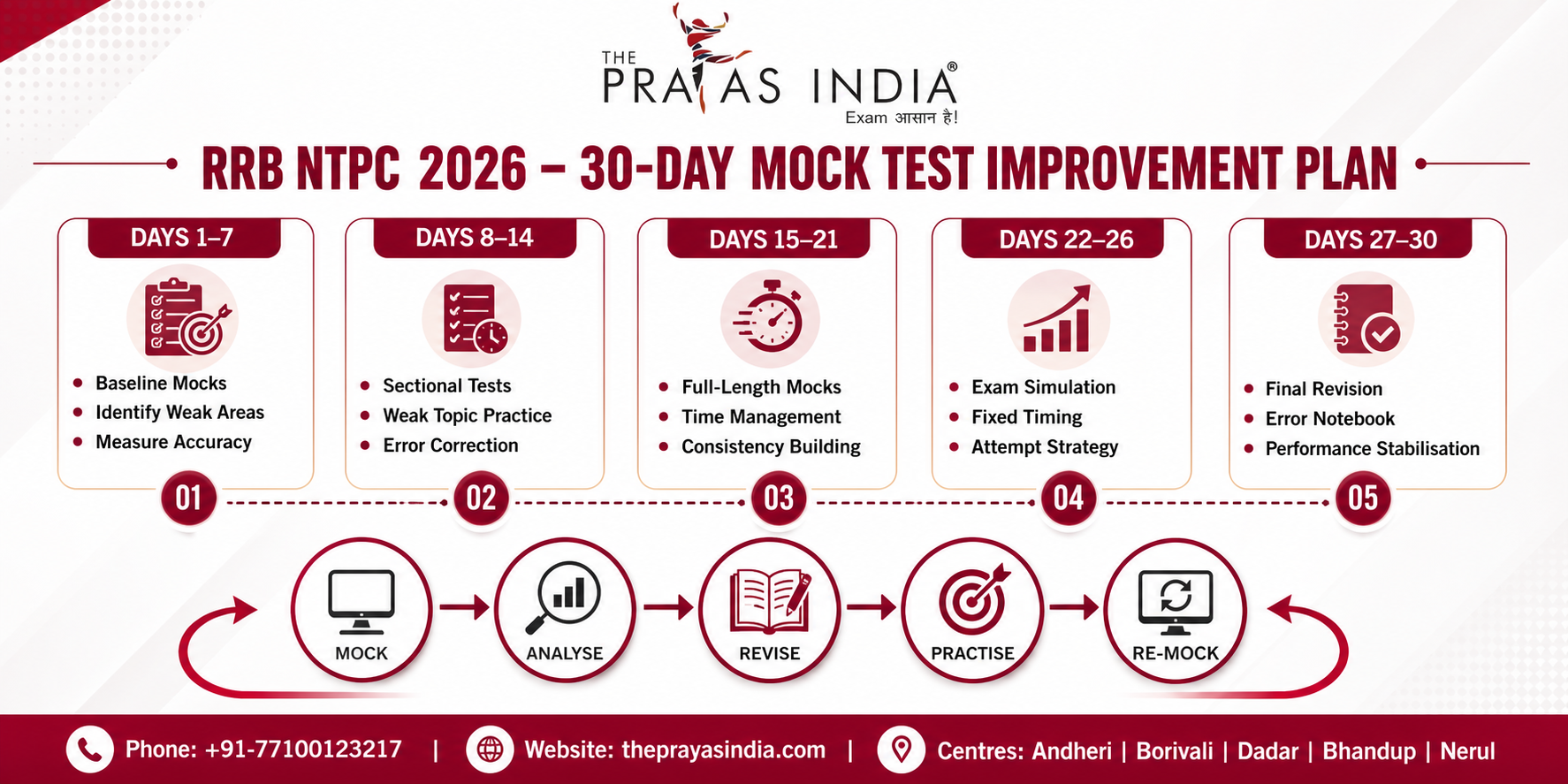
RRB NTPC 2026 30-Day Mock Test Strategy
During the final month, mock tests should become increasingly exam-oriented. However, the exact number of mocks should depend on your preparation level and the amount of time available for analysis.
Days 1–7: Establish Your Baseline
Take full-length mocks under realistic conditions. Do not immediately focus on achieving a particular score. Instead, identify your current strengths, weak areas, time-management problems and common mistakes.
Use the first week to understand your actual performance rather than relying only on your expectations.
Days 8–14: Strengthen Weak Sections
Combine sectional tests with full-length practice. Spend more time correcting the areas that repeatedly appear in your mock analysis.
If Mathematics is causing time pressure, add timed calculation practice. If Reasoning is taking too long, practise question selection. If GA accuracy is weak, increase structured revision.
Days 15–21: Increase Full-Length Practice
Move towards more frequent full-length mocks. Each test should be followed by proper analysis. Avoid the mistake of taking multiple mocks on the same day while barely analysing any of them.
The purpose of this phase is to build consistency under exam-like conditions.
Days 22–26: Simulate the Examination
Attempt mocks at the same time of day whenever practical. Follow the same sitting conditions, avoid unnecessary breaks and use the same strategy you intend to use in the examination.
This phase should help you test whether your strategy remains effective under pressure.
Days 27–30: Revise and Stabilise
Do not try to learn everything from scratch in the final days. Revise your error notebook, formulas, important General Awareness notes and repeatedly forgotten concepts.
Use mocks selectively and focus on maintaining accuracy and confidence rather than chasing an artificial attempt target.
How to Compare Two Mock Tests Properly
Comparing two mocks is more useful when you compare performance patterns rather than only scores.
| Performance Area | Mock 1 | Mock 2 | What to Check |
|---|---|---|---|
| Total Attempts | — | — | Has selection improved? |
| Correct Answers | — | — | Is useful output increasing? |
| Incorrect Answers | — | — | Are repeated mistakes reducing? |
| Accuracy | — | — | Is quality improving? |
| GA Performance | — | — | Is revision helping? |
| Mathematics Performance | — | — | Is calculation improving? |
| Reasoning Performance | — | — | Is speed improving? |
| Time Left | — | — | Is time utilisation better? |
| Guessing Attempts | — | — | Is unnecessary risk reducing? |
A higher score is useful information, but the deeper objective is to understand why the score changed. If the score improves because accuracy increased while attempts remained stable, that tells you something different from an improvement caused by simply attempting many more questions.
Common Mistakes Candidates Make While Taking RRB NTPC Mocks
One of the biggest mistakes is taking mocks without analysing them. A mock test is not a preparation achievement by itself. Its value comes from the corrections that follow.
Another common mistake is changing the strategy after every mock. If you change your section order, attempt strategy and time allocation after every small fluctuation, it becomes difficult to determine what actually works for you. Test a strategy across multiple mocks before making major changes.
Candidates also sometimes compare their mock scores too closely with other students. Mock difficulty varies, and different test platforms may use different question sets and difficulty levels. Your own performance trend is generally more informative for preparation.
Another problem is treating every incorrect answer equally. A calculation mistake, a forgotten GA fact and an incorrectly selected difficult puzzle require different corrective actions.
Finally, some candidates increase the number of mocks during the final weeks while reducing revision and analysis time. More tests are not automatically better. The quality of the complete cycle—attempt, analyse, correct, revise and re-test—matters more.
How to Build Your Final RRB NTPC Exam Strategy Through Mock Tests
Your final examination strategy should emerge from your mock-test data rather than being created at the last minute.
By the final phase, you should have a clear understanding of:
- Which section you are most comfortable starting with
- Which section tends to consume the most time
- Which question types should be attempted immediately
- Which question types should be postponed
- How much time you need for each section
- How you respond when a difficult question appears
- How many questions you can realistically attempt with good accuracy
- Which mistakes you repeatedly make under pressure
There is no universally correct section order or fixed attempt number for every candidate. The right approach is the one you have tested repeatedly and can execute with reasonable accuracy and time control.
The examination should not be treated as a race to attempt the maximum possible number of questions. It is a controlled decision-making exercise in which you need to use your available time efficiently while protecting accuracy.
RRB NTPC Mock Test Final Checklist
Before taking every full-length mock, check whether you are following the same conditions you intend to follow during the examination.
Before the mock:
- Sit in a quiet environment.
- Keep the required time window completely free.
- Keep rough-work material ready.
- Avoid checking solutions during the test.
- Follow your planned section strategy.
During the mock:
- Read questions carefully.
- Avoid spending excessive time on one question.
- Monitor your pace.
- Avoid unnecessary guessing.
- Mark difficult questions for review when appropriate.
After the mock:
- Record total attempts and accuracy.
- Analyse every incorrect answer.
- Identify time-consuming questions.
- Update your error notebook.
- Revise weak concepts.
- Practise recurring problem areas.
- Compare your performance with previous mocks.
Key Takeaways for RRB NTPC 2026 Mock Test Preparation
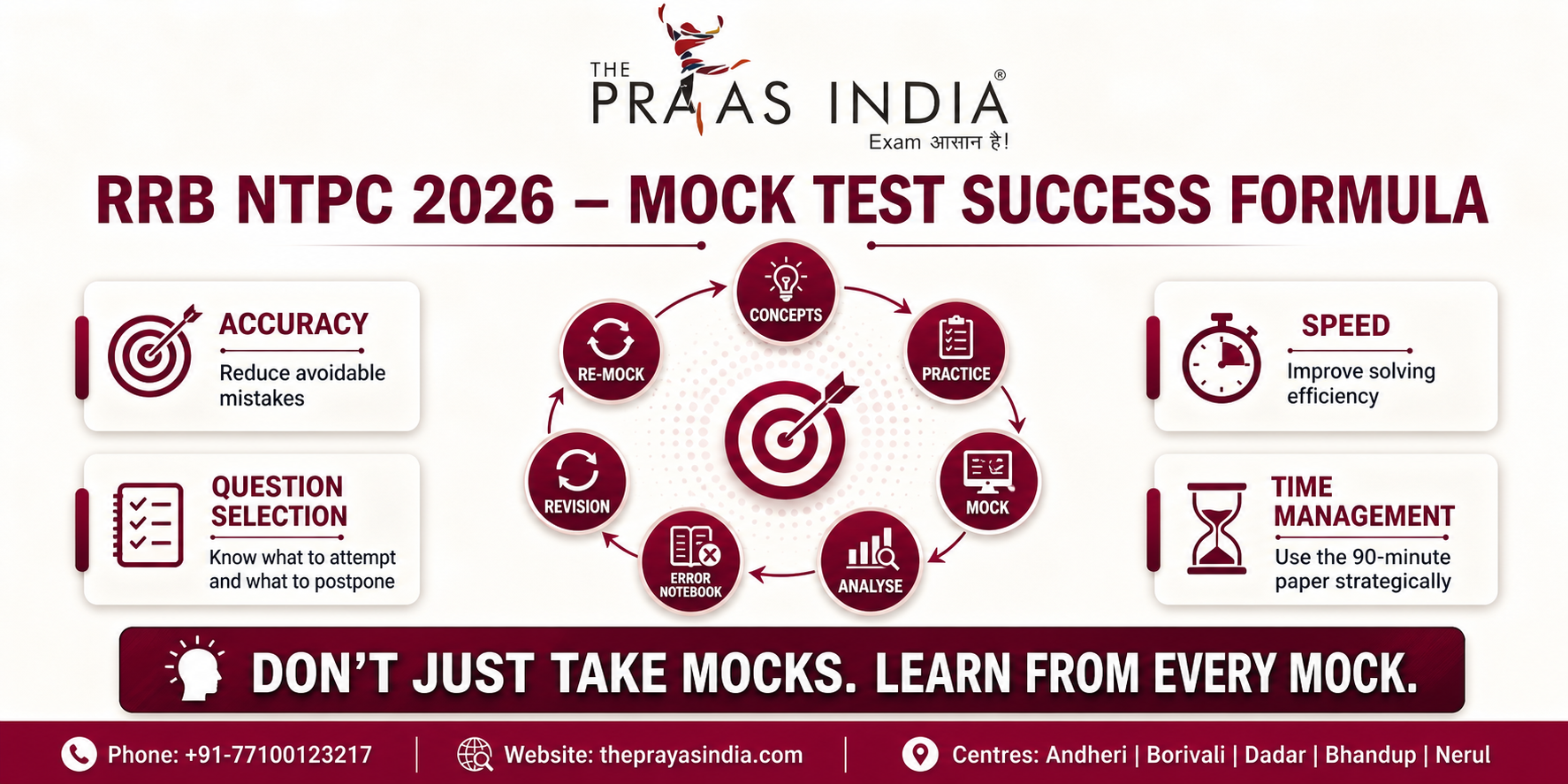
Mock tests should be treated as a complete learning system rather than simply a way to measure marks.
The most useful cycle is:
Prepare → Practise → Attempt Mock → Analyse → Identify Errors → Revise → Practise Again → Re-Mock
Remember that the number of questions attempted should never become the only target. The more useful goal is to improve the combination of attempts, accuracy, question selection and time utilisation.
A candidate who understands why mistakes happen can improve more effectively than someone who simply keeps taking new tests without reviewing previous performance.
The ultimate purpose of mock tests is to make your actual examination decisions more predictable, controlled and disciplined.
Prepare for RRB NTPC 2026 with Structured Guidance
RRB NTPC preparation requires consistent practice across General Awareness, Mathematics and Reasoning along with regular mock-test analysis. A structured preparation approach can help you maintain continuity between concept learning, question practice, revision and exam simulation.
The Prayas India provides exam-oriented preparation support for competitive examinations, with structured classes, practice, revision and test-based preparation designed to help aspirants build consistency.
If you are preparing for RRB NTPC 2026 and want a more organised approach to your preparation, you can explore the available RRB NTPC preparation programs and choose a study plan that matches your current level and preparation requirements.
RRB NTPC 2026 Mock Test Strategy – FAQs
When should I start taking RRB NTPC mock tests?
You can begin with sectional or topic-based tests once you have covered the basic concepts. Full-length mocks become increasingly useful as your syllabus coverage improves. In the final phase, combine them with detailed analysis and revision rather than taking tests without reviewing your mistakes.
How many RRB NTPC mocks should I attempt?
There is no universally fixed number of mocks that guarantees improvement. The useful number depends on your preparation level, available time and ability to analyse each test properly. A smaller number of well-analysed mocks can be more useful than a large number of tests taken without review.
Should I focus on increasing my number of attempts?
Not by itself. Attempts should be considered together with accuracy, question selection and time utilisation. Increasing attempts while significantly increasing incorrect answers can reduce your effective performance because of negative marking.
How should I analyse an RRB NTPC mock test?
Check your total score, attempts, accuracy, section-wise performance, incorrect answers, unattempted questions and time spent. Then classify mistakes according to their cause, such as conceptual gaps, calculation errors, memory issues, misreading, poor selection or guessing.
Should I maintain an error notebook?
Yes. A short and selective error notebook can help you repeatedly revise formulas, difficult concepts, forgotten General Awareness facts and recurring mistakes. Keep it concise enough to revise regularly.
What should I do if my mock score is not improving?
First identify what is limiting your score. Check whether the problem is low accuracy, insufficient attempts, weak concepts, poor time management, excessive guessing or repeated mistakes. Then target the specific issue through practice and revision.
Should I take a mock test every day?
Not necessarily. Your schedule should leave sufficient time for analysis, revision and targeted practice. If taking a daily mock prevents you from correcting your mistakes, the frequency may be counterproductive.
Should I follow the same section order in every mock?
You can test different approaches initially, but once you identify a workable section order, practise it consistently across multiple mocks. This helps you develop a predictable exam routine.
Are mock-test scores always comparable?
Not perfectly. Different mock providers can use different question distributions and difficulty levels. Instead of focusing only on absolute scores, compare your accuracy, attempts, section-wise performance, time management and recurring mistakes over multiple tests.
What is the most important objective of an RRB NTPC mock test?
The objective is not simply to obtain a high mock score. A mock should help you improve your ability to select questions, maintain accuracy, manage time, recognise weaknesses and make better decisions under exam-like pressure.
Prepare for RRB NTPC 2026 with the Right Strategy
Build a structured RRB NTPC 2026 preparation strategy with focused classes, regular practice, mock tests, performance analysis, revision support and exam-oriented guidance. Learn how to improve your accuracy, speed, question selection and time management with a consistent preparation approach.
Admissions Open for RRB NTPC Preparation
Centres: Andheri | Borivali | Dadar | Nerul | Bhandup
Get in touch with The Prayas India and take the next step towards structured RRB NTPC 2026 preparation.