7 Problems in SSC CGL Preparation: What Students Face Without Proper Guidance | The Prayas India
Preparing for SSC CGL can look straightforward from the outside. There is a syllabus, there are books and online resources, previous-year questions are easily available, and thousands of students prepare through self-study every year. Yet, many aspirants discover that having access to study material is very different from having a well-organised preparation strategy.
The real challenge is often not finding something to study. It is deciding what to study first, how much to study, which resources to trust, how to practise, when to take mocks, how to analyse mistakes and how to stay consistent for months.
SSC CGL preparation requires candidates to manage multiple subjects and gradually develop both conceptual understanding and exam-oriented speed. The official examination framework includes Reasoning, General Awareness, Quantitative Aptitude and English in Tier-I, while Tier-II Paper-I requires candidates to deal with Mathematical Abilities, Reasoning, English, General Awareness, Computer Knowledge and DEST-related requirements.
This makes planning particularly important.
If you are preparing for SSC CGL and feel that you are studying regularly but still do not know whether you are moving in the right direction, the problem may not be your effort. It may be the absence of a structured system around that effort.
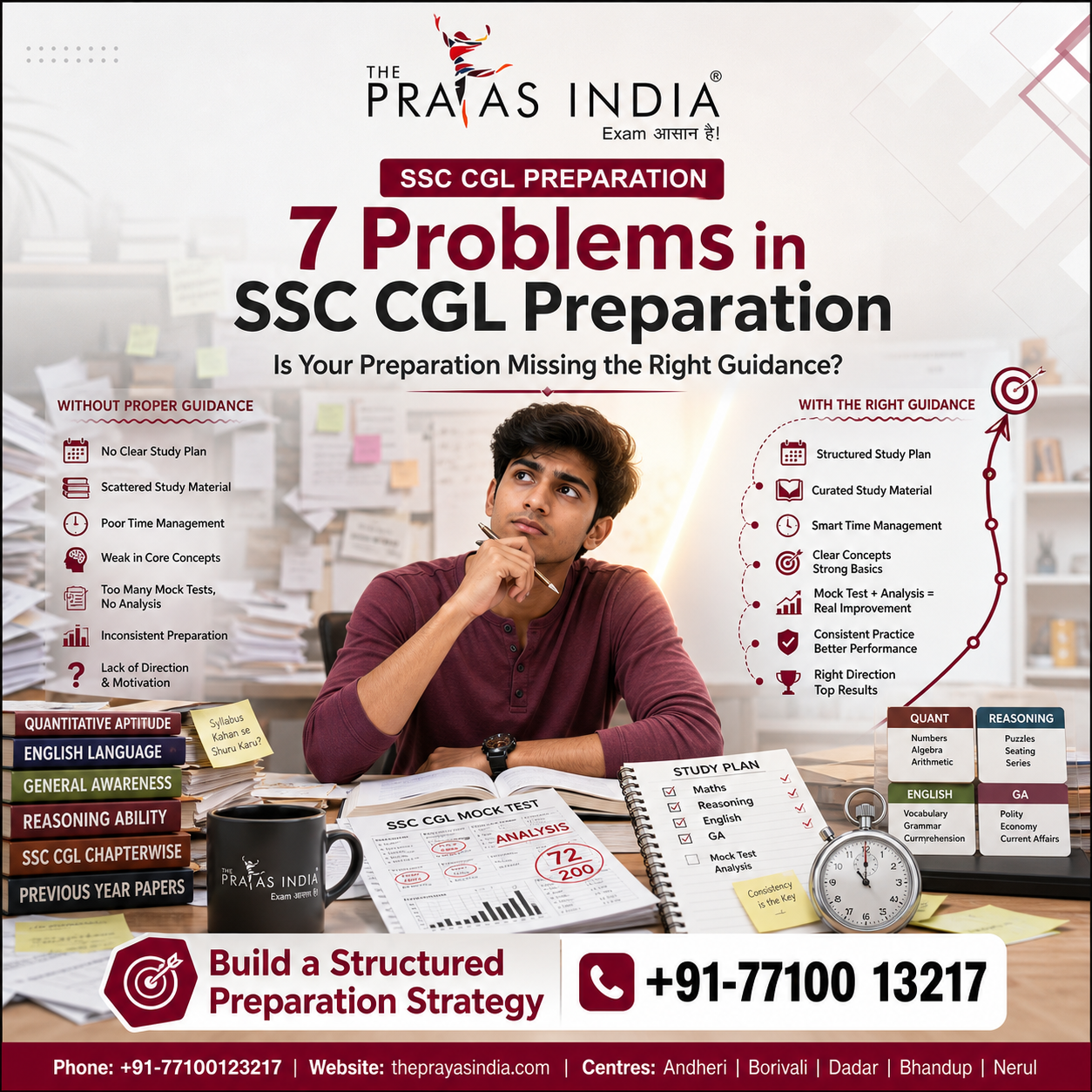
Here are seven common problems students can face when preparing for SSC CGL without proper guidance—and what can be done to address them.
1. You Do Not Have a Clear Study Sequence
One of the first problems beginners face is a simple question:
“What should I study first?”
SSC CGL has multiple subjects and each subject contains numerous topics. A beginner may start with whichever chapter appears interesting on a particular day. One day may be spent solving percentage questions, the next watching an English vocabulary video, followed by a few reasoning questions and some current affairs.
There is nothing inherently wrong with studying different subjects. The problem begins when there is no larger sequence connecting those activities.
For example, a student may start advanced Quantitative Aptitude questions without being comfortable with percentages, ratios or basic arithmetic. Another may spend weeks memorising vocabulary but barely practise reading comprehension or grammar. Someone else may solve reasoning questions randomly without identifying which topics are strong and which need improvement.
The result can be a lot of activity without sufficient progress.
What a structured sequence should look like
A systematic SSC CGL preparation plan should generally move through stages such as:
Foundation → Concept Building → Topic-wise Practice → Mixed Practice → Sectional Tests → Mock Tests → Analysis → Revision
The exact sequence can vary according to the student’s level, but the principle remains the same.
You should know what you are studying now, why you are studying it and what comes next.
This becomes particularly important when preparing for both tiers instead of treating Tier-II as something to worry about only after Tier-I.
How structured guidance can help
A structured programme can provide a predefined study sequence, allowing students to spend more time learning and practising instead of repeatedly deciding what to study next.
For a beginner, that clarity alone can remove a considerable amount of preparation-related confusion.
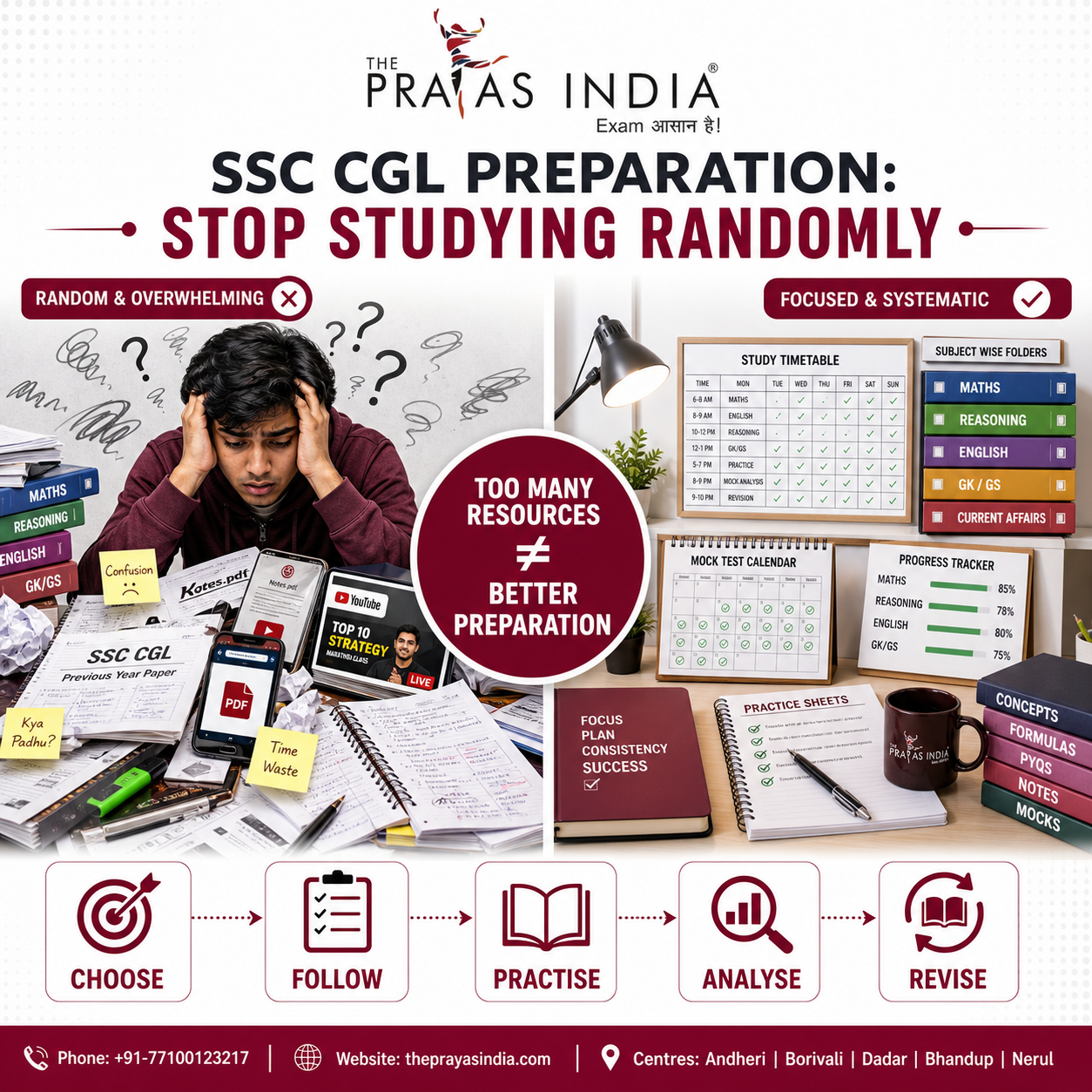
2. Too Many Books, PDFs, Videos and Online Resources
The internet has made study material incredibly accessible.
It has also created a new problem: resource overload.
Search for “SSC CGL Maths preparation” and you can find hundreds of videos. Search for English vocabulary and there are countless word lists. There are Telegram channels, PDFs, YouTube playlists, test platforms, books, apps, websites and social-media recommendations.
Initially, this feels like an advantage.
After some time, it can become distracting.
A student may start one teacher’s Quant playlist, switch to another after a few days, download three PDFs, purchase two books and then wonder which material should actually be completed.
Instead of studying, the student keeps searching for the perfect resource.
The resource-collection trap
Collecting material can create the illusion of preparation.
You may have:
- 10 PDFs
- 5 books
- 4 test-series accounts
- dozens of bookmarked videos
- multiple vocabulary lists
But if you have not systematically completed and revised even one reliable preparation source, the quantity of material is not helping you.
SSC CGL preparation requires repeated practice and revision. Constantly changing resources can make that process more difficult.
What should students do instead?
Choose resources based on:
- Concept clarity
- Relevance to the syllabus
- Quality of practice questions
- Previous-year question coverage
- Explanation quality
- Revision support
- Test integration
Then complete the chosen resource before moving to another one.
How coaching can reduce this problem
A structured coaching programme can bring classes, study material, practice questions and testing into a defined preparation system.
Instead of asking:
“Which of the 20 resources should I use?”
the student can focus on:
“Have I completed today’s assigned learning and practice?”
That is a much more productive question.
3. Weak Fundamentals Make Advanced Questions Look More Difficult
Another common problem is trying to solve questions before building the underlying concepts.
This is especially visible in Quantitative Aptitude.
A student may start with difficult arithmetic questions and conclude:
“My Maths is weak.”
But sometimes the actual issue is much more basic.
Perhaps percentages are unclear.
Perhaps ratio concepts are not strong.
Perhaps calculation speed is poor.
Perhaps the student knows a formula but does not know when to apply it.
The same issue can occur in English and Reasoning.
A student struggling with English may need to strengthen grammar fundamentals rather than simply memorise hundreds of vocabulary words.
A reasoning student may need to understand the structure of a particular question type before attempting timed sets.
The danger of skipping the foundation
When fundamentals are weak, advanced practice can become frustrating.
The student makes mistakes repeatedly but does not know whether the problem is:
- Conceptual
- Calculation-based
- Interpretational
- Procedural
- Time-related
Without identifying the underlying problem, practice becomes repetitive rather than corrective.
Build from the bottom up
A better approach is:
Understand → Solve Basic Questions → Solve Application Questions → Practise PYQs → Introduce Time Pressure
For example, in Quant, a beginner can first build comfort with arithmetic fundamentals before progressing to more complex applications.
In English, grammar concepts can be strengthened before moving into intensive error detection and mixed practice.
In Reasoning, learn the structure of individual topics before attempting large mixed sets.
Why guided learning can help
A faculty-led programme can make it easier to identify whether a student needs foundation-level learning or exam-level practice.
That distinction is important.
Not every student needs more questions.
Sometimes the student needs a better explanation.
4. Inconsistent Practice Breaks Preparation Momentum
SSC CGL preparation is not usually a short-term activity.
Students may start with tremendous motivation.
They study for six hours on Monday, eight hours on Tuesday and then struggle to maintain the same routine for the rest of the week.
The following Monday, they restart.
Then the cycle repeats.
This creates a dangerous pattern:
Start → Study intensely → Lose consistency → Fall behind → Restart
The issue is not always lack of motivation. Often, the timetable itself is unrealistic.
Why unrealistic schedules fail
Suppose a student plans:
- 3 hours Quant
- 2 hours Reasoning
- 2 hours English
- 2 hours GA
- 2 hours revision
- 1 hour mock analysis
every day.
It may look impressive on paper.
But if the student’s college, job, family responsibilities or other commitments make that routine impossible, the schedule will eventually collapse.
A better strategy is to create a sustainable routine.
Consistency is easier when the plan is measurable
Instead of saying:
“I will study a lot today.”
set specific tasks:
- Complete one Quant topic
- Solve 40 practice questions
- Revise 30 vocabulary words
- Attempt one reasoning set
- Read and revise today’s GA material
- Analyse yesterday’s mistakes
This makes progress visible.
How a structured programme can help
Regular classes, assignments, tests and deadlines create external structure.
You no longer have to rely entirely on motivation to decide whether you will study.
That does not replace personal effort, but it can make consistent preparation easier.
5. Taking Mock Tests Without Proper Analysis
This is one of the most important problems in competitive-exam preparation.
Many students believe:
More mocks = Better preparation.
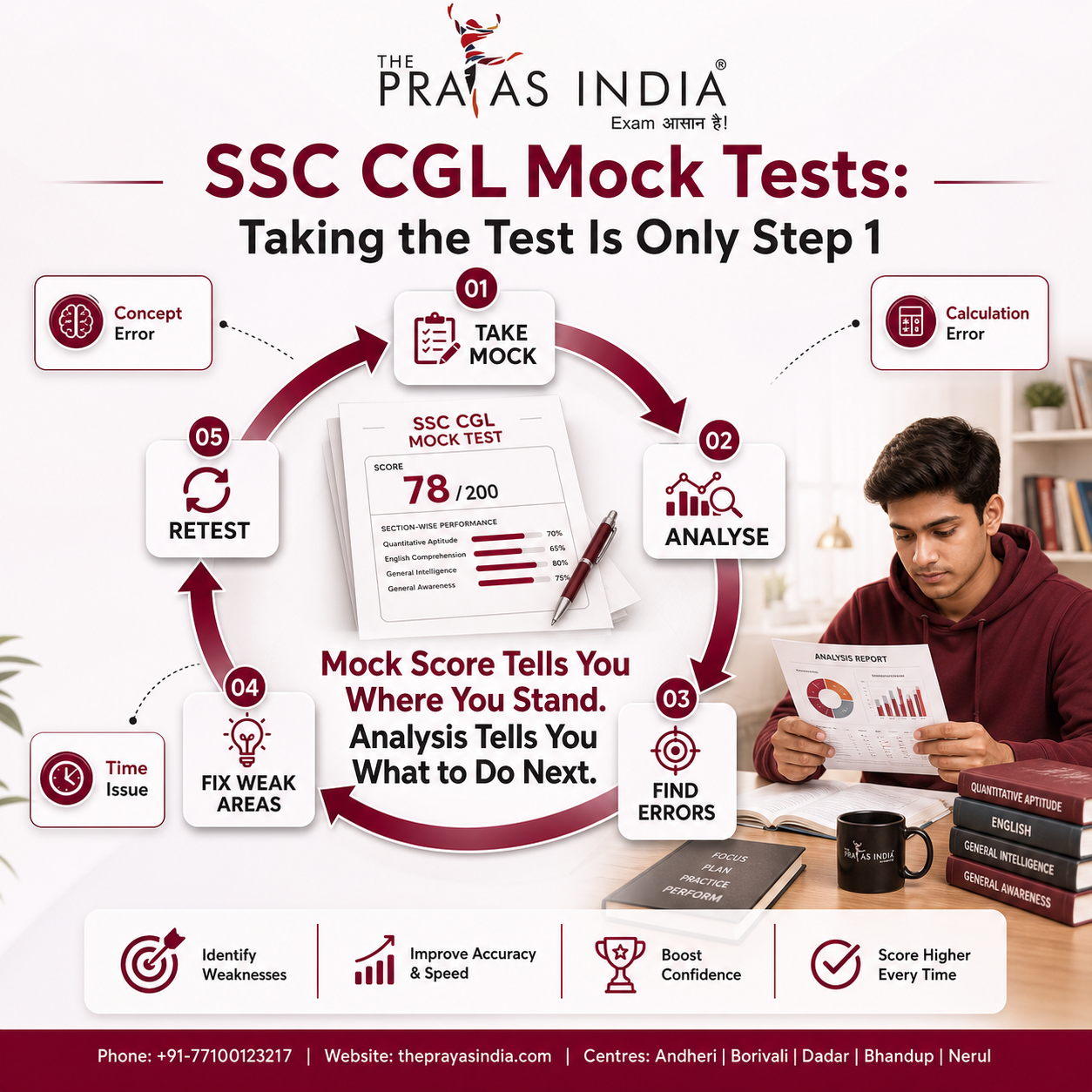
But taking a mock is only the beginning.
The real learning often starts after the mock.
Suppose you score 125 in one test.
What should you do next?
Simply take another test?
Not necessarily.
First ask:
- Which questions did I get wrong?
- Which questions did I leave?
- Which questions took too much time?
- Which errors were conceptual?
- Which were calculation mistakes?
- Which were caused by misreading?
- Which questions could have been solved faster?
- Which topics repeatedly cause problems?
Without this analysis, a mock test becomes just another question paper.
A useful mock-analysis framework
After every test, divide questions into four categories:
1. Correct + Fast
Keep the method and reinforce it.
2. Correct + Slow
Look for a more efficient approach.
3. Incorrect + Conceptual Error
Return to the topic and relearn it.
4. Incorrect + Silly/Calculation Error
Identify the exact reason and create a correction habit.
Also track questions that you could not attempt because of time.
This can reveal whether your main issue is knowledge, accuracy, speed or question selection.
Why mentorship matters here
Students often know their score but do not know what the score is telling them.
Regular performance analysis can turn mock tests into a feedback system.
That is one of the areas where structured preparation and faculty guidance can be particularly useful.
6. Managing All SSC CGL Subjects Becomes Difficult
SSC CGL preparation requires students to manage several subjects simultaneously.
This can create another common problem:
Students spend too much time on one subject and neglect another.
For example, a student may be comfortable with Reasoning and therefore spend most of the day solving reasoning questions.
Meanwhile, Quant remains weak.
Another student may spend hours on General Awareness but not allocate enough time to English practice.
This creates an uneven preparation profile.
The strongest subject can become a comfort zone
Studying what you already like feels productive.
Studying what you struggle with feels difficult.
As a result, students may unintentionally spend more time on their strengths.
But preparation should be driven by priority, not comfort.
Create a subject rotation
A balanced preparation system can include:
Quant: Concept + Practice
Reasoning: Topic-wise + Timed Sets
English: Grammar + Vocabulary + Comprehension + Practice
GA: Static Topics + Current Affairs + Revision
As preparation advances, the focus can gradually shift towards mixed practice, sectional tests and mocks.
What structured preparation changes
A planned timetable can ensure that every subject receives attention.
It can also help identify when to shift from learning to revision and testing.
The objective is not to study every subject for exactly the same number of hours.
It is to ensure that no important area remains neglected because it is uncomfortable.
7. Lack of Accountability Makes It Easy to Fall Behind
Perhaps the most underrated problem in self-study is accountability.
When you study alone, there may be no one asking:
Did you complete the topic?
Why did your mock score fall?
Why are you repeatedly making the same mistake?
Have you revised last month’s topics?
Are you actually following your timetable?
Initially, self-discipline may be enough.
But over a long preparation cycle, consistency can become difficult.
A missed day becomes two.
Two become a week.
Then the student realises that several topics are still incomplete.
Accountability does not mean pressure
A good preparation system should not simply tell students to study more.
It should help them understand:
- What they have completed
- What remains
- Where they are weak
- How they are performing
- What needs revision
- What they should focus on next
Regular tests, assignments, classes and performance discussions can create this structure.
Why this matters for SSC CGL
Competitive preparation is not only about intelligence or the number of hours spent studying.
It is also about maintaining a system consistently enough to convert preparation into performance.
That is difficult to do when every part of the process has to be self-managed.
How a Structured SSC CGL Programme Can Address These 7 Problems
The purpose of structured coaching should not simply be to provide lectures.
A useful preparation system should connect different parts of the student’s journey.
1. Structured Learning Plan
Instead of randomly selecting chapters, students can follow a planned sequence.
2. Concept Building
Fundamental concepts can be taught before students are pushed towards advanced or timed practice.
3. Practice
Regular assignments and topic-wise questions help convert concepts into solving ability.
4. Doubt Support
Students can address questions they cannot understand rather than carrying the same confusion into future topics.
5. Sectional Tests
These help students evaluate their performance subject by subject.
6. Mock Tests
Full-length tests provide an opportunity to practise examination-level decision-making.
7. Performance Analysis
Test results can be used to identify weaknesses and plan corrective practice.
8. Revision
Regular revision prevents previously completed topics from disappearing from memory.
9. Mentorship
Students can discuss preparation-related challenges and understand what they should focus on next.
10. Accountability
A structured environment creates milestones that make it easier to remain consistent.
This is the difference between simply having study material and having a preparation system.
Self-Study vs Structured SSC CGL Preparation
Self-study can work very well for students who already have strong fundamentals, understand the examination requirements and can maintain a disciplined study schedule.
However, some students face a different situation.
They may be asking:
- Where should I start?
- Which book should I follow?
- How much should I practise?
- When should I begin mocks?
- Why is my score not improving?
- Which topics should I revise?
- How do I prepare all subjects together?
- Am I actually progressing?
If these questions repeatedly arise, the issue may not be your willingness to study.
It may be that you need more structure around your preparation.
A coaching programme can provide that structure, while the student’s own effort remains essential.
Therefore, instead of asking whether coaching is universally necessary, ask:
Would structured guidance save me preparation time, reduce confusion and help me stay accountable?
If the answer is yes, speaking with a faculty or counselling team can help you understand whether a structured SSC CGL programme fits your preparation needs.
How to Decide Whether You Need SSC CGL Coaching
Before enrolling in any coaching programme, students should evaluate what they actually need.
Ask yourself:
Do I know my preparation sequence?
If not, structured planning may help.
Can I identify my weak topics?
If not, regular testing and analysis can help.
Do I consistently follow my timetable?
If not, accountability may be useful.
Do I analyse my mocks properly?
If not, guided performance analysis can improve your preparation process.
Do I have strong fundamentals?
If not, concept-focused classes may be valuable.
Am I comfortable preparing for multiple subjects simultaneously?
If not, a structured timetable can reduce the planning burden.
The objective should be to choose a preparation method that matches your needs rather than joining coaching simply because others are doing so.
Why Starting with the Right System Can Save Preparation Time
One of the biggest hidden costs in competitive-exam preparation is time spent correcting an inefficient strategy.
Consider a student who spends three months studying randomly.
Later, they realise:
- Several important topics were skipped.
- Their basics are weak.
- Their mock performance was never analysed.
- Their study material is incomplete.
- Their revision plan does not exist.
They now have to rebuild the preparation system while simultaneously trying to cover the syllabus.
A structured approach can reduce this risk by giving the student a framework from the beginning.
The goal is not to eliminate hard work.
The goal is to make sure that the hard work is moving in the right direction.
SSC CGL Preparation Is More Than Completing the Syllabus
Completing a syllabus does not automatically mean you are exam-ready.
You also need to develop:
Conceptual understanding
↓
Question-solving ability
↓
Accuracy
↓
Speed
↓
Question selection
↓
Test-taking ability
↓
Performance consistency
That is why preparation should not end when the last chapter is completed.
The later stages of preparation should increasingly involve revision, sectional testing, full-length mocks and detailed analysis.
Why a Structured Programme Can Be Particularly Useful for Beginners
Beginners face a unique challenge.
They have to learn the syllabus and learn how to prepare.
An experienced aspirant may already know how to analyse a mock, revise a topic or identify a weak area.
A beginner may not.
For a beginner, structured guidance can therefore reduce the number of decisions they have to make independently.
Instead of spending days asking:
“What should I do?”
they can focus on:
“How well can I execute the plan?”
That shift can make preparation more manageable.
A Practical SSC CGL Preparation Framework
Whether you choose self-study or coaching, your preparation should ideally include these components:
| Preparation Area | What You Should Focus On |
|---|---|
| Concept Building | Understand fundamentals |
| Topic Practice | Strengthen individual chapters |
| PYQs | Understand actual question styles |
| Revision | Retain previously studied concepts |
| Sectional Tests | Identify subject-wise performance |
| Mock Tests | Develop exam-level practice |
| Mock Analysis | Identify the reason behind mistakes |
| Weak-Area Practice | Correct recurring problems |
| Time Management | Improve solving efficiency |
| Mentorship/Accountability | Stay consistent and focused |
The exact schedule will vary from student to student, but leaving any of these areas completely unattended can create gaps in preparation.
How The Prayas India Can Help Bring Structure to SSC CGL Preparation
For students who are finding it difficult to organise their SSC CGL preparation independently, a structured learning environment can provide a clear framework around the preparation process.
The focus should be on more than just completing classes.
A well-organised programme can bring together:
- Concept-focused teaching
- Topic-wise practice
- Doubt solving
- Study planning
- Sectional testing
- Mock tests
- Performance analysis
- Revision
- Mentorship
- Regular preparation milestones
The Prayas India can be considered by students who want to explore a more structured approach to SSC CGL preparation.
If you are unsure whether you need coaching, you do not have to make the decision based only on advertisements or what other students are doing. Discuss your current preparation level, understand the available batches and preparation structure, and then decide what works for you.
That conversation can help you understand whether structured guidance is appropriate for your preparation needs.
When Should You Consider Joining SSC CGL Coaching?
There is no single correct starting point for every aspirant.
However, if you repeatedly experience problems such as:
- Not knowing what to study
- Switching between resources
- Weak fundamentals
- Irregular study
- Low mock scores
- Poor mock analysis
- Difficulty managing multiple subjects
- Lack of motivation or accountability
then waiting for these problems to disappear on their own may not be the most productive approach.
Instead, consider getting a structured assessment of your preparation.
The earlier you identify the problem, the more time you have to correct it.
Final Takeaway: Your Effort Needs the Right Direction
Preparing for SSC CGL requires consistent effort, but effort without direction can become inefficient.
The seven problems discussed in this article are common:
- No clear study sequence
- Too many resources
- Weak fundamentals
- Inconsistent practice
- Poor mock analysis
- Difficulty managing all subjects
- Lack of accountability
None of these problems means that you cannot prepare successfully.
They simply indicate areas where your preparation system may need improvement.
A structured approach can help connect the different parts of preparation:
Learn → Practise → Test → Analyse → Improve → Revise → Repeat
And that is ultimately what serious SSC CGL preparation should be about.
If you are currently preparing on your own and feel that you are putting in effort without knowing whether you are progressing correctly, this may be the right time to speak with a preparation expert.
Discuss your current level, understand the available SSC CGL preparation options at The Prayas India, and choose a preparation approach that gives you the structure, practice and guidance you need.
Frequently Asked Questions
1. Can I prepare for SSC CGL without coaching?
Yes, self-study can work when you have strong fundamentals, reliable study material, a clear preparation plan and the discipline to follow it consistently. However, students who struggle with planning, doubts, mock analysis or consistency may benefit from structured guidance.
2. What are the common problems students face during SSC CGL preparation?
Common challenges include not having a clear study sequence, using too many resources, weak fundamentals, inconsistent practice, poor mock-test analysis, difficulty managing multiple subjects and lack of accountability.
3. Why is my SSC CGL mock-test score not improving?
Your score may remain stagnant because of conceptual gaps, repeated calculation mistakes, poor time management, incorrect question selection or insufficient revision. Taking more mocks without analysing the reasons behind your mistakes may not address the actual problem.
4. How important is mock-test analysis for SSC CGL?
Mock-test analysis is important because it helps identify conceptual errors, calculation mistakes, time-management issues and weak topics. Reviewing your performance after every test can help you decide what needs to be improved before taking the next test.
5. How can I manage Quant, Reasoning, English and General Awareness together?
Create a realistic subject-wise schedule instead of studying only your favourite subjects. Allocate regular time for concept building, practice, revision and testing across all major areas, while giving additional attention to your weaker subjects.
6. Is structured SSC CGL coaching useful for beginners?
Structured coaching can be useful for beginners who need help with the study sequence, concept building, practice, doubt solving, testing and performance tracking. Students should assess their own preparation needs before choosing a coaching programme.
7. What should I check before joining SSC CGL coaching?
Check the teaching approach, faculty support, study material, doubt-solving system, topic-wise practice, mock-test schedule, performance analysis, revision process and mentorship support before making your decision.
8. How can I enquire about SSC CGL preparation at The Prayas India?
You can contact The Prayas India to discuss your current preparation level and understand the available SSC CGL courses, batches, learning options and admission details. The institute currently offers structured SSC CGL preparation with practice, testing, performance tracking and mentorship support.
Prepare for SSC CGL with the Right Guidance
Studying harder is important, but having the right preparation structure can help you use your time more effectively. Build strong concepts, practise consistently, analyse your performance and stay on track with structured SSC CGL preparation.
Admissions Open for SSC CGL Preparation
Centres:
Andheri | Borivali | Dadar | Bhandup | Nerul
Speak with our team to understand the right SSC CGL preparation option, batch and admission details for you.