RBI Assistant Preparation Strategy for Beginners: A Complete Guide to Start Your Preparation
Preparing for the RBI Assistant examination can be a great opportunity for graduates who want to build a career in the banking sector. However, for beginners, starting preparation often brings several questions: Which subjects should you study first? How many hours should you dedicate daily? Which books and resources should you follow? How should you prepare for Prelims and Mains?
The key to preparing effectively for the RBI Assistant examination is to understand the exam pattern, strengthen your fundamentals, practise questions regularly and develop accuracy along with speed.
For students preparing in Mumbai, The Prayas India – Andheri can be a relevant option to explore for competitive-exam preparation. Aspirants from Andheri West, Andheri East, Lokhandwala, Oshiwara, Jogeshwari, Versova and Goregaon can also consider the convenience of the Andheri branch when planning their preparation.
This guide explains a practical, step-by-step RBI Assistant preparation strategy for beginners, including subject-wise preparation, a daily timetable, mock-test planning and common mistakes to avoid.
Understand the RBI Assistant Examination Before Starting
The first step in any competitive examination preparation is understanding the selection process and the subjects covered in the examination.
The RBI Assistant examination generally consists of three stages:
- Preliminary Examination
- Main Examination
- Language Proficiency Test (LPT)
Candidates need to qualify through the applicable selection stages. The Language Proficiency Test assesses proficiency in the local language of the state or region for which the candidate has applied.
Beginners should understand that clearing Prelims is only the first stage. Preparation should gradually cover the requirements of both Prelims and Mains.
RBI Assistant Exam Pattern
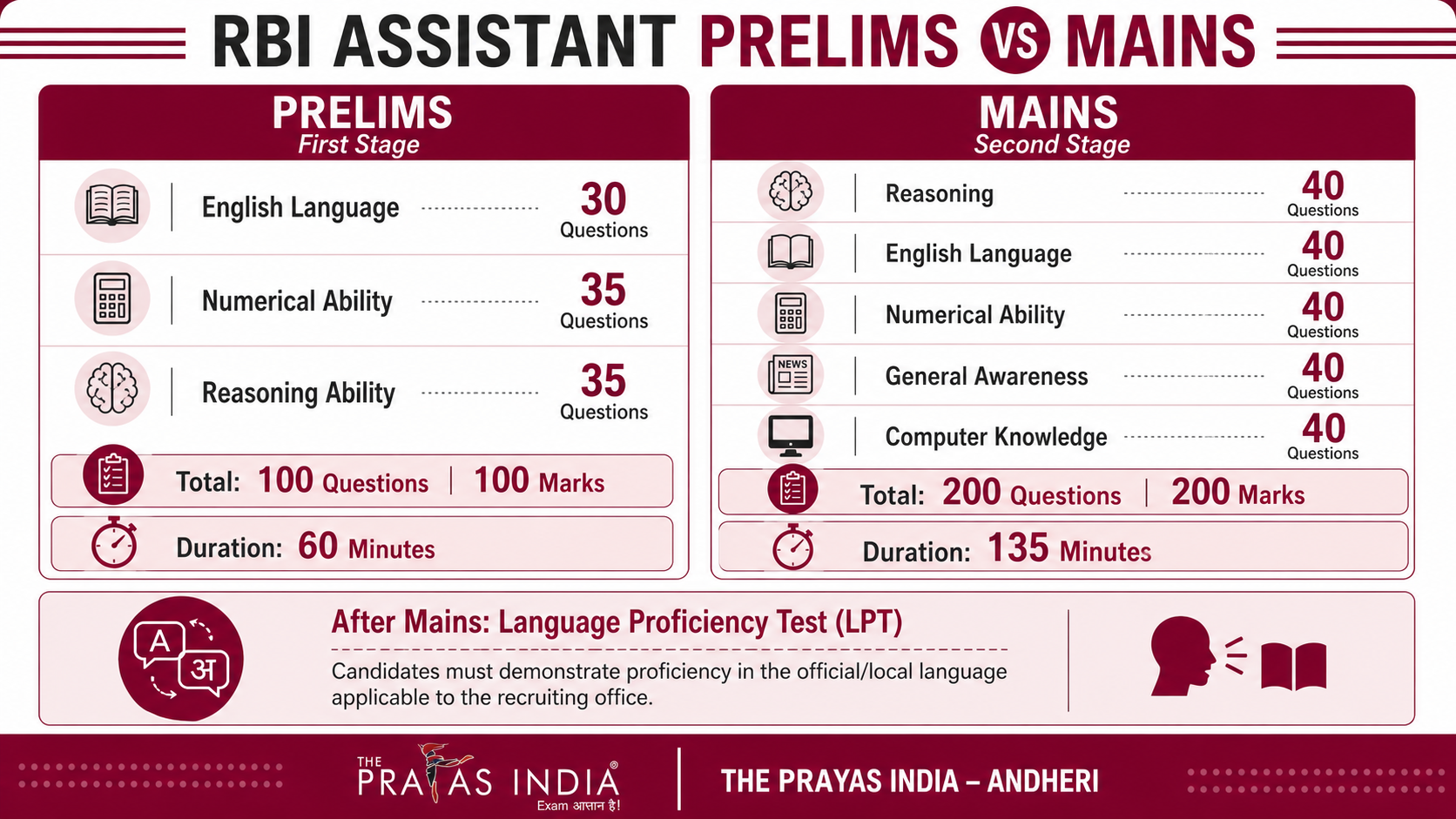
The commonly followed examination structure is:
Preliminary Examination
| Subject | Questions | Marks | Time |
|---|---|---|---|
| English Language | 30 | 30 | 20 minutes |
| Numerical Ability | 35 | 35 | 20 minutes |
| Reasoning Ability | 35 | 35 | 20 minutes |
| Total | 100 | 100 | 60 minutes |
Main Examination
| Subject | Questions | Marks | Time |
|---|---|---|---|
| Reasoning | 40 | 40 | 30 minutes |
| English Language | 40 | 40 | 30 minutes |
| Numerical Ability | 40 | 40 | 30 minutes |
| General Awareness | 40 | 40 | 25 minutes |
| Computer Knowledge | 40 | 40 | 20 minutes |
| Total | 200 | 200 | 135 minutes |
There is generally a penalty of one-fourth of the marks assigned to a question for each incorrect answer in the objective tests.
Important: This is the commonly used RBI Assistant examination structure, not a substitute for the latest official recruitment notification. Always verify the applicable pattern, eligibility, vacancies, dates and instructions in the notification for your examination cycle.
Why should beginners understand the pattern?
Understanding the pattern helps you:
- Identify the subjects that require more attention.
- Divide preparation time according to the examination requirements.
- Avoid studying irrelevant topics.
- Plan separate strategies for Prelims and Mains.
- Understand the importance of sectional time management.
Know the RBI Assistant Syllabus Subject-Wise
Before purchasing books or attempting mock tests, prepare a topic-wise list of the syllabus.
Beginners should avoid studying every topic simultaneously. Instead, divide the syllabus into manageable sections and complete foundational concepts before moving towards advanced questions.
A. English Language
English is an important subject in both Prelims and Mains. Candidates should focus on grammar, vocabulary, reading comprehension and sentence-based questions.
Important topics include:
- Reading Comprehension
- Cloze Test
- Error Detection
- Sentence Improvement
- Para Jumbles
- Fill in the Blanks
- Phrase Replacement
- Vocabulary
- Word Usage
- Sentence Rearrangement
Preparation strategy:
Start by reading an English newspaper or a quality editorial for approximately 20–30 minutes daily. Focus on understanding sentence structure, identifying unfamiliar words and improving reading speed.
Practise grammar questions regularly instead of memorising rules without applying them.
Beginners should also maintain a vocabulary notebook containing new words, meanings, synonyms, antonyms and example sentences.
B. Numerical Ability / Quantitative Aptitude
Numerical Ability requires conceptual clarity, calculation speed and accuracy.
Important topics include:
- Simplification and Approximation
- Number Series
- Quadratic Equations
- Percentage
- Ratio and Proportion
- Average
- Profit and Loss
- Simple and Compound Interest
- Time and Work
- Time, Speed and Distance
- Partnership
- Mixture and Allegation
- Data Interpretation
Preparation strategy:
Start with basic arithmetic rather than immediately attempting difficult Data Interpretation sets.
Follow this learning sequence:
- Understand basic mathematical operations.
- Learn percentage, ratio and average.
- Practise profit and loss and interest.
- Move towards time and work and speed and distance.
- Begin Data Interpretation.
- Practise timed sectional tests.
Spend 15–20 minutes daily improving calculation speed through tables, squares, cubes and mental mathematics.
C. Reasoning Ability
Reasoning is a subject where regular practice can make a significant difference.
Important topics include:
- Puzzles
- Seating Arrangement
- Syllogism
- Inequality
- Coding-Decoding
- Blood Relations
- Direction Sense
- Alphanumeric Series
- Order and Ranking
- Pair Formation
- Input-Output
- Logical Reasoning
Preparation strategy:
Beginners should first complete comparatively fundamental topics such as inequalities, syllogisms, direction sense and blood relations.
After developing confidence, move towards puzzles and seating arrangements.
Do not spend too much time trying to solve one difficult puzzle. Learn to identify the right starting point and leave questions that consume excessive time during timed practice.
D. General Awareness
General Awareness is particularly important for the Mains examination.
Candidates should develop a habit of following banking, financial and economic developments.
Important areas include:
- Current Affairs
- Banking Awareness
- RBI Functions and Policies
- Monetary Policy
- Financial Institutions
- Government Schemes
- Important Appointments
- Reports and Indexes
- Economic Developments
- National and International Events
Preparation strategy:
Read daily current affairs and revise important information regularly.
Pay particular attention to RBI-related developments, banking terminology, financial inclusion, monetary policy and major economic announcements.
Avoid collecting too many monthly current affairs PDFs. Choose a reliable source and revise it multiple times.
E. Computer Knowledge
Computer Knowledge is included in the commonly followed RBI Assistant Mains pattern.
Important topics include:
- Fundamentals of Computers
- Hardware and Software
- Operating Systems
- MS Office
- Internet and Networking
- Computer Memory
- Input and Output Devices
- Database Fundamentals
- Computer Abbreviations
- Cybersecurity Basics
Preparation strategy:
Beginners should understand the basic terminology and functions of computer components.
Prepare short notes and practise objective questions after completing each topic.
Follow a Step-by-Step RBI Assistant Preparation Strategy
A common mistake among beginners is trying to complete the entire syllabus within a few days.
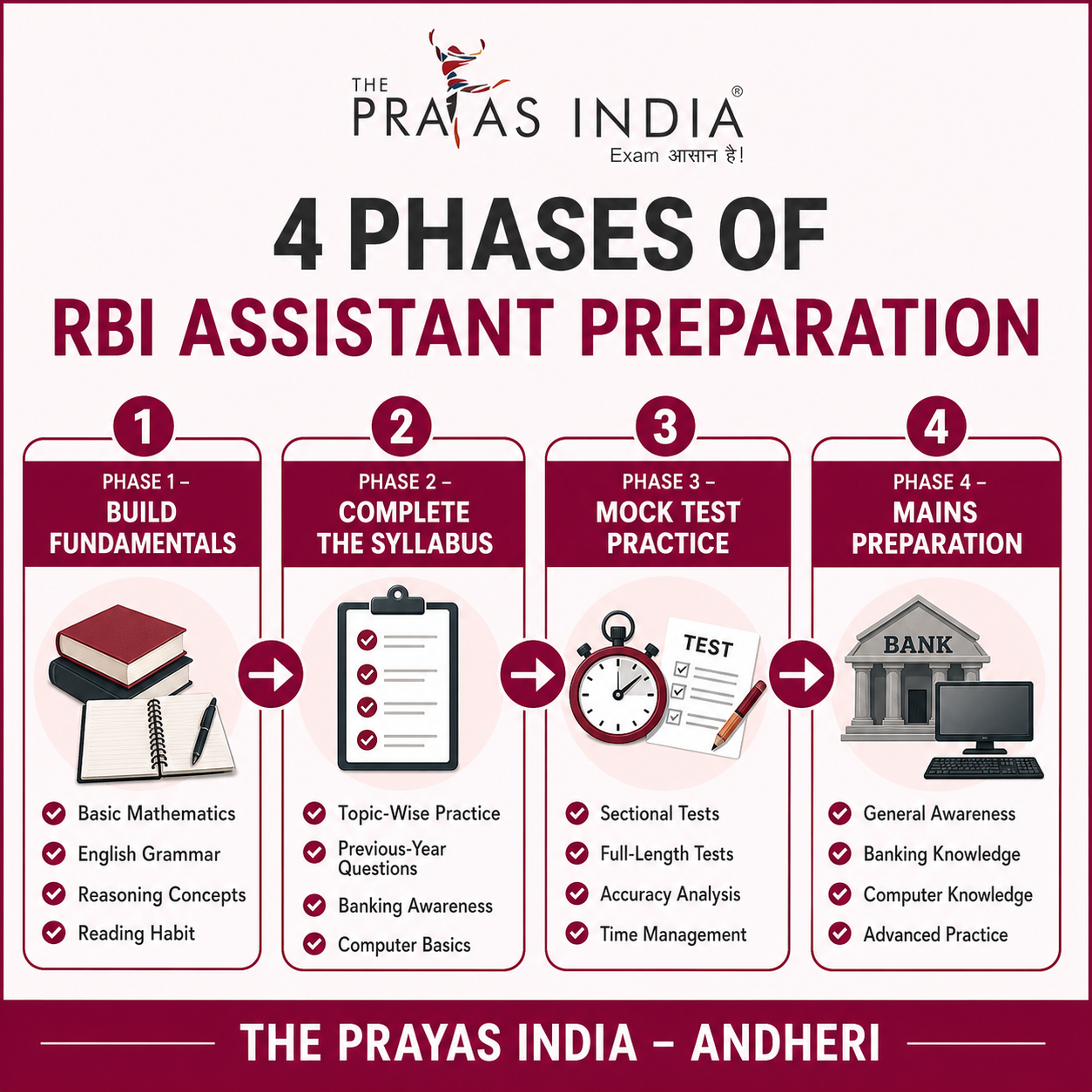
Instead, divide your preparation into phases.
Phase 1: Build Strong Fundamentals
During the first phase, focus on understanding concepts.
Your priorities should be:
- Learn basic arithmetic concepts.
- Strengthen English grammar.
- Understand fundamental reasoning topics.
- Develop reading habits.
- Become familiar with banking terminology.
- Understand the examination pattern.
Do not worry excessively about attempting a large number of questions at this stage.
The objective is to develop a strong foundation.
Phase 2: Complete the Important Topics
Once your fundamentals are clear, gradually increase your practice level.
Start solving:
- Topic-wise questions.
- Previous-year questions.
- Moderate-level reasoning sets.
- Arithmetic-based questions.
- English sectional exercises.
- General Awareness quizzes.
Analyse the questions you get wrong and identify whether the problem is conceptual understanding, calculation, interpretation or time management.
Phase 3: Begin Mock Test Practice
Mock tests help candidates understand the examination environment.
Start with one or two sectional tests after completing the relevant topics.
Gradually introduce full-length Prelims mock tests.
After every test, analyse:
- Total attempted questions.
- Correct answers.
- Incorrect answers.
- Questions left unattempted.
- Time spent on each section.
- Accuracy percentage.
- Topics requiring improvement.
Remember that taking a mock test without analysing it reduces its learning value.
Phase 4: Prepare for Mains Alongside Prelims
Do not wait until Prelims results to begin Mains preparation.
Along with Prelims subjects, regularly study:
- General Awareness.
- Banking Awareness.
- Computer Knowledge.
- Advanced Reasoning.
- Mains-level Quantitative Aptitude.
- Mains-level English.
This approach helps prevent last-minute pressure.
Create a Practical Daily Study Timetable
A well-planned timetable helps beginners maintain consistency.
You do not necessarily need to study for 10–12 hours every day. What matters is how effectively you use your available preparation time.
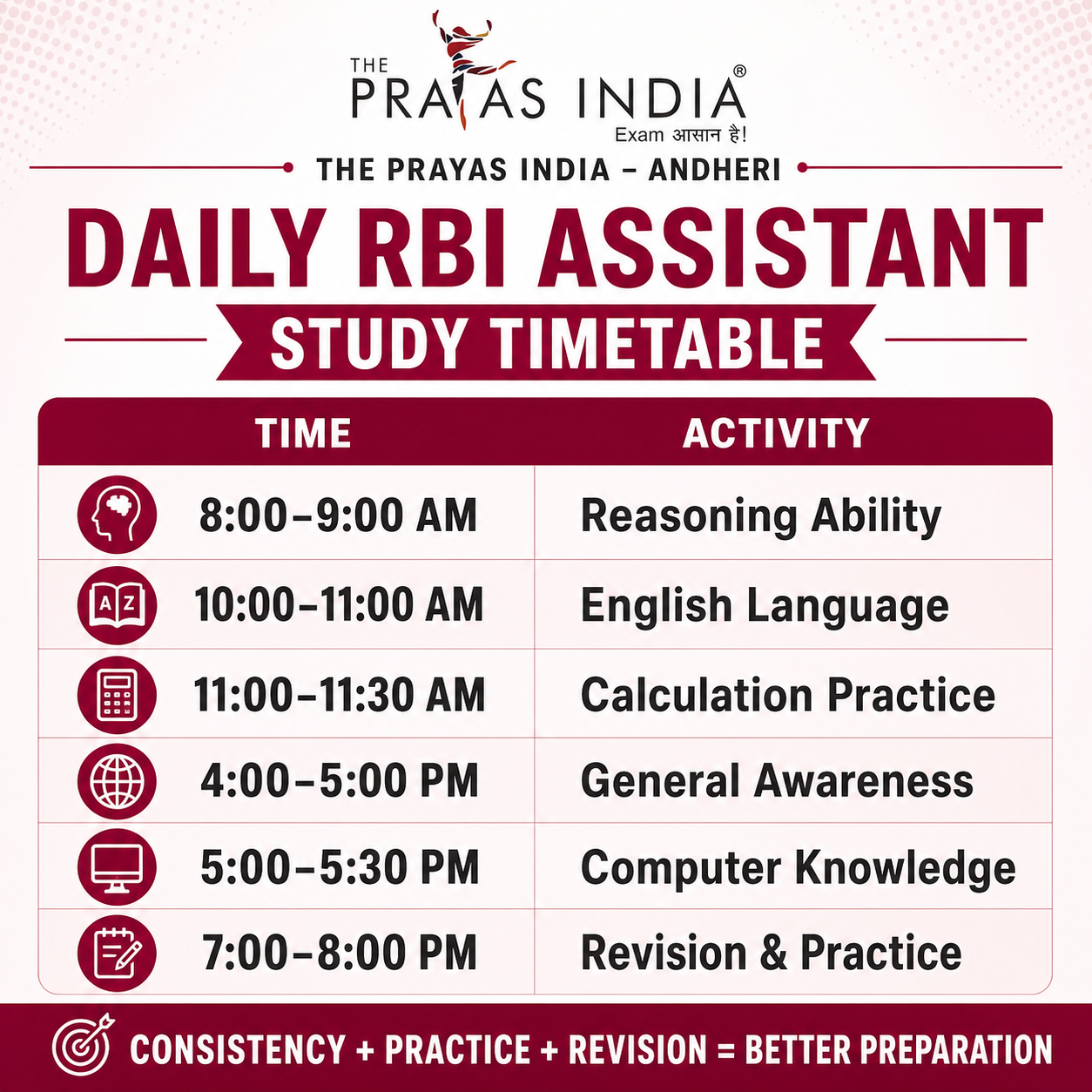
Here is a suggested daily timetable for someone who can dedicate approximately six hours to preparation.
Daily RBI Assistant Study Plan
| Time | Subject / Activity | Duration |
|---|---|---|
| 7:00–8:00 AM | Quantitative Aptitude | 1 hour |
| 8:00–9:00 AM | Reasoning Ability | 1 hour |
| 10:00–11:00 AM | English Language | 1 hour |
| 11:00–11:30 AM | Calculation Practice | 30 minutes |
| 4:00–5:00 PM | General Awareness | 1 hour |
| 5:00–5:30 PM | Computer Knowledge | 30 minutes |
| 7:00–8:00 PM | Revision and Practice Questions | 1 hour |
| Total | Banking Exam Daily Master Routine | 6 hours |
This timetable is flexible. Students who attend college or work can distribute the same study hours across morning and evening sessions.
How should you use your study hours?
- Dedicate the first session to concept learning.
- Use the next session for solving questions.
- Keep a separate slot for current affairs.
- Revise previously studied topics regularly.
- Maintain an error notebook.
- Reserve time for mock-test analysis.
Consistency is more important than following a rigid timetable that becomes difficult to maintain.
How to Prepare for RBI Assistant Prelims Effectively
The Preliminary Examination is the first major challenge for candidates.
Since the examination has sectional timing, students must develop the ability to solve questions within a limited time.
English Language: Focus on Accuracy and Reading Speed
For English, divide your preparation into three areas:
Grammar
- Subject-Verb Agreement
- Tenses
- Articles and Prepositions
- Parts of Speech
- Conditional Sentences
Vocabulary
- Synonyms and Antonyms
- One-Word Substitution
- Idioms and Phrases
- Contextual Vocabulary
Practice
- Reading Comprehension
- Cloze Test
- Error Detection
- Sentence Improvement
Try solving short English exercises every day.
Numerical Ability: Improve Calculation Speed
In Numerical Ability, calculation speed can help you save valuable time.
Practise:
- Multiplication tables.
- Squares and cubes.
- Fraction-to-percentage conversions.
- Approximation.
- Simplification.
- Basic arithmetic.
Do not focus only on shortcuts. First understand the underlying mathematical concepts.
Reasoning Ability: Develop a Question Selection Strategy
Reasoning questions require logical thinking and careful interpretation.
Start with topics that you understand well. Gradually increase the difficulty of puzzles and seating arrangements.
During mock tests, learn to identify questions that can be solved quickly and those that require more time.
Manage Sectional Timing
The Prelims examination has separate 20-minute slots for each subject.
Therefore, candidates should practise each section under its actual time limit rather than relying only on untimed exercises.
A good strategy is to:
- Attempt familiar questions first.
- Avoid spending too long on one question.
- Maintain accuracy.
- Keep track of negative marking.
- Practise with sectional timers.
Start Mains Preparation Early
Many beginners make the mistake of concentrating entirely on Prelims.
However, the Mains examination requires additional preparation, particularly in General Awareness and Computer Knowledge.
General Awareness Preparation
Make current affairs a daily habit.
Focus on:
- RBI announcements and circulars.
- Banking and financial news.
- Monetary Policy Committee developments.
- Important economic indicators.
- Government financial schemes.
- National and international current affairs.
Prepare short monthly revision notes.
Banking Awareness
Understand important concepts such as:
- Repo Rate
- Reverse Repo Rate
- Cash Reserve Ratio (CRR)
- Statutory Liquidity Ratio (SLR)
- Monetary Policy
- Inflation
- Non-Performing Assets (NPA)
- Financial Inclusion
- Digital Banking
- Payment Systems
Do not simply memorise definitions. Understand how these concepts work in the banking system.
Computer Knowledge
Build familiarity with basic computer concepts, internet terminology, operating systems, networking and commonly used office applications.
Practise objective questions to test your understanding.
English for Mains
Improve your reading comprehension, vocabulary and ability to understand longer passages.
Practise questions involving sentence rearrangement, contextual vocabulary and grammar.
Importance of Mock Tests and Previous-Year Papers
Mock tests are an essential part of competitive-exam preparation.
They help candidates understand the question format, identify weak areas and improve time management.
However, beginners should not start by attempting multiple full-length tests without understanding the basic concepts.
When Should Beginners Start Mock Tests?
A practical approach is:
| Preparation Stage | Recommended Practice |
|---|---|
| Foundation Stage | Topic-wise questions |
| Syllabus Progress | Sectional tests |
| Intermediate Stage | Timed sectional tests |
| Advanced Stage | Full-length mock tests |
| Final Revision | Mock tests and error analysis |
How to Analyse a Mock Test
After every test, examine the following:
1. Accuracy: How many attempted questions were correct?
2. Speed: Which questions took longer than expected?
3. Weak Topics: Which chapters repeatedly caused mistakes?
4. Question Selection: Did you spend too much time on difficult questions?
5. Improvement: What changes should you make before the next test?
Why Are Previous-Year Question Papers Important?
Previous-year papers help aspirants understand the types of questions asked in earlier examination cycles.
They are useful for:
- Identifying recurring question formats.
- Understanding difficulty levels.
- Improving topic-wise preparation.
- Practising examination-style questions.
- Evaluating preparation progress.
Remember that previous-year questions are a practice resource, not a guarantee of what will appear in the next examination.
Common Mistakes Beginners Should Avoid
Aspirants often lose preparation time because of avoidable mistakes.
Here are some common problems and how to overcome them.
| Common Mistake | Better Approach |
|---|---|
| Studying without understanding the syllabus | Start with the official exam pattern and syllabus |
| Using too many books | Follow a limited number of reliable resources |
| Ignoring General Awareness | Study current affairs daily |
| Avoiding mock tests | Introduce timed tests progressively |
| Memorising shortcuts | Understand concepts before shortcuts |
| Not revising | Follow a weekly revision schedule |
| Guessing too many answers | Prioritise accuracy because of negative marking |
| Preparing only for Prelims | Include Mains subjects from the beginning |
Avoid Resource Overload
One of the biggest mistakes is collecting too many PDFs, books, online lectures and practice materials.
Instead, select a manageable set of resources and complete them systematically.
Maintain an Error Notebook
Whenever you make a mistake, write down:
- The question or topic.
- Why you made the mistake.
- The correct concept.
- How you can avoid the same error.
Review this notebook every week.
A 90-Day RBI Assistant Preparation Roadmap for Beginners
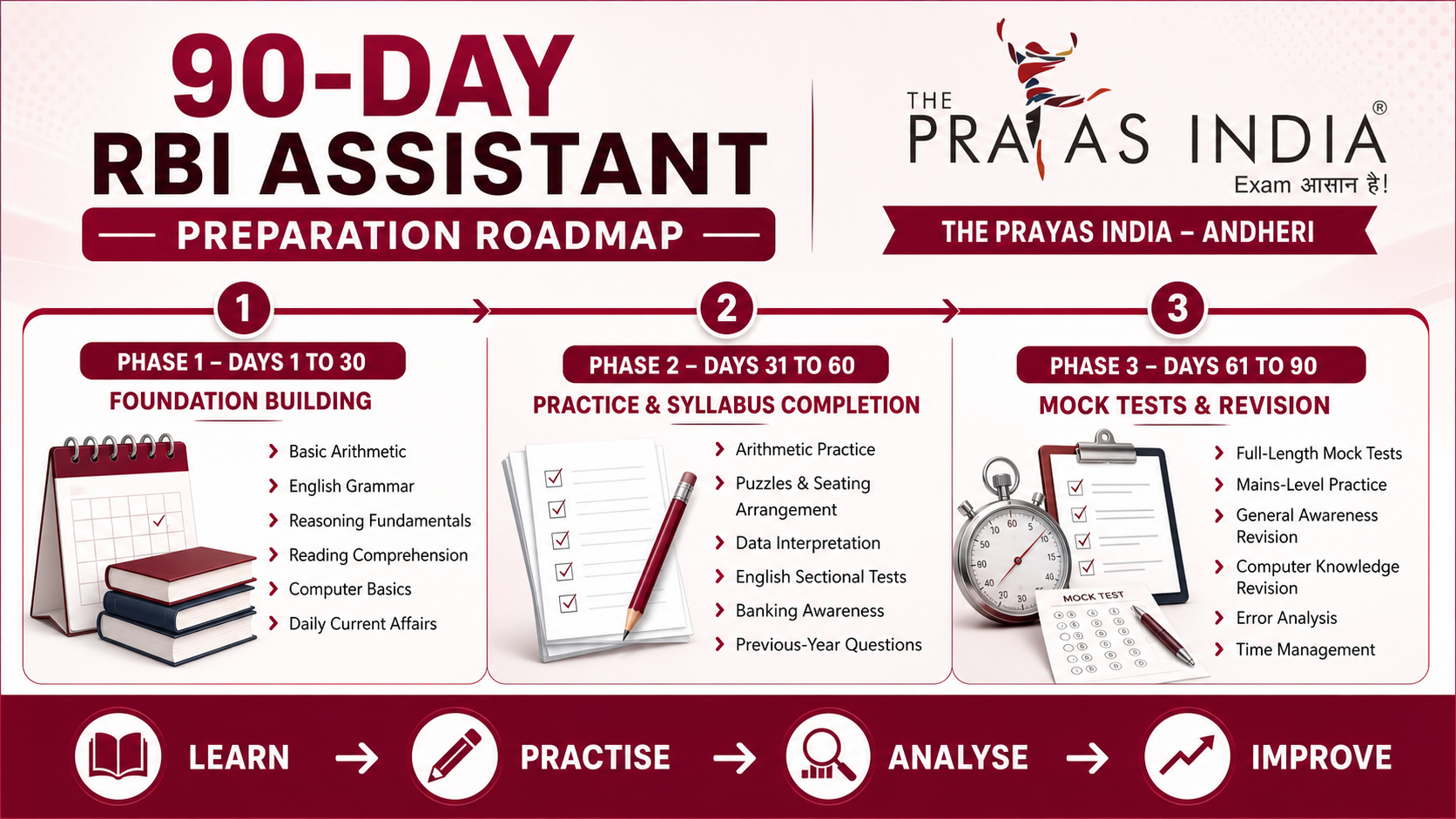
A 90-day preparation plan can help beginners organise their learning. It should be adjusted according to the time available, previous knowledge and the examination schedule.
Days 1–30: Foundation Building
Focus on:
- Basic Arithmetic.
- English Grammar.
- Fundamental Reasoning.
- Reading Comprehension.
- Daily Current Affairs.
- Computer Fundamentals.
Target: Develop conceptual clarity and establish a consistent study routine.
Days 31–60: Practice and Syllabus Completion
Focus on:
- Arithmetic-based questions.
- Puzzles and Seating Arrangements.
- English sectional exercises.
- Data Interpretation.
- Banking Awareness.
- Computer Knowledge.
- Previous-Year Questions.
Target: Improve problem-solving ability and complete the major syllabus areas.
Days 61–90: Mock Tests and Revision
Focus on:
- Full-length Prelims mock tests.
- Mains-level practice.
- General Awareness revision.
- Computer Knowledge revision.
- Error analysis.
- Time management.
Target: Improve examination readiness and identify the topics requiring additional attention.
How Can Students in Andheri Plan Their RBI Assistant Preparation?
Preparing for a competitive banking examination requires consistency, structured learning and regular practice.
For students in Mumbai, selecting a convenient preparation location can also help make a regular study routine easier to maintain.
Students living in or around the following localities may consider exploring coaching options in Andheri:
- Andheri West: Convenient for students living around the western residential and commercial areas.
- Andheri East: An option to consider for aspirants looking for a preparation centre in the Andheri area.
- Lokhandwala: Students can explore nearby Andheri West preparation options.
- Oshiwara: Aspirants can consider the accessibility of the Andheri West branch.
- Jogeshwari: Students can evaluate travel convenience while selecting a coaching centre.
- Versova: A nearby locality from which Andheri West can be considered.
- Goregaon: Aspirants can compare commuting time and study schedules before choosing a centre.
Explore The Prayas India – Andheri
Students interested in competitive-exam preparation can contact the Andheri branch to enquire about relevant courses, batch availability and preparation guidance.
Branch Address:
Office 803, Time Chambers, Swami Vivekanand Road, near Paneri, Andheri West, Mumbai, Maharashtra 400058.
Phone: 08355951603
WhatsApp: 08355951603
For students from Andheri, Lokhandwala, Oshiwara, Jogeshwari, Versova and Goregaon, the branch location can be evaluated based on individual commuting convenience.
Final Tips for RBI Assistant Beginners
Before starting your preparation, keep these important points in mind:
- Understand the latest official examination pattern.
- Complete basic concepts before attempting advanced questions.
- Practise Quantitative Aptitude and Reasoning every day.
- Improve English through reading and regular exercises.
- Follow banking and financial current affairs.
- Begin Mains preparation alongside Prelims.
- Take mock tests and analyse your performance.
- Revise topics regularly.
- Avoid unnecessary study resources.
- Maintain consistency throughout your preparation.
The RBI Assistant examination requires a balanced approach towards conceptual understanding, accuracy, speed and revision. Beginners who follow a structured preparation strategy can gradually improve their performance and become more confident about the examination.
If you are preparing in Mumbai, you can also explore The Prayas India – Andheri to enquire about suitable competitive-exam preparation options.
Start with the fundamentals, practise consistently and keep improving with every test.
Frequently Asked Questions – RBI Assistant Preparation
1. How should beginners start preparing for the RBI Assistant examination?
Beginners should first understand the examination pattern and syllabus. Start with basic concepts in Quantitative Aptitude, Reasoning and English. Develop a daily current affairs habit and gradually include Banking Awareness, Computer Knowledge, sectional tests and mock examinations.
2. How many hours should I study daily for RBI Assistant?
Beginners can start with four to six focused study hours daily, depending on their existing knowledge and schedule. Divide the time between Quantitative Aptitude, Reasoning, English, General Awareness, Computer Knowledge and revision. Consistency and effective practice matter more than simply counting study hours.
3. Can I prepare for RBI Assistant without coaching?
Yes. Candidates can prepare through self-study using reliable books, online learning resources, previous-year questions and mock tests. Coaching may provide structured guidance and a learning schedule, but candidates should choose an approach according to their learning needs.
4. Is the RBI Assistant examination difficult for beginners?
The examination can be challenging because it tests speed, accuracy and conceptual understanding under sectional time limits. Beginners should focus on strengthening fundamentals, practising regularly and gradually attempting questions of higher difficulty.
5. Is General Awareness important for RBI Assistant?
Yes. General Awareness is an important section of the Mains examination. Candidates should regularly study current affairs, banking awareness, RBI developments, financial news, government schemes and important economic events.
6. How many months are required to prepare for RBI Assistant?
The preparation period depends on a candidate’s existing knowledge, available study time and learning speed. A 90-day structured plan can help organise preparation, but beginners who need to strengthen their fundamentals may require additional time.
7. What is the Language Proficiency Test in RBI Assistant recruitment?
The Language Proficiency Test is conducted after the Main Examination for provisionally shortlisted candidates. It assesses proficiency in the official or local language applicable to the recruiting office, including reading, writing, speaking and understanding. Candidates who do not meet the language requirement are disqualified.
Start Your Competitive Exam Preparation with The Prayas India – Andheri
Looking for competitive-exam preparation guidance in Mumbai? Contact our Andheri branch to enquire about courses and batch availability.
Address: Office 803, Time Chambers, Swami Vivekanand Road, near Paneri, Andheri West, Mumbai, Maharashtra 400058.
Phone: 08355951603
THE PRAYAS INDIA – ANDHERI