How to Improve Calculation Speed for Banking Exams: 10 Effective Tips for Aspirants
Have you ever solved a mathematics question correctly but lost valuable time while calculating the final answer? This is a common challenge among candidates preparing for IBPS PO, IBPS Clerk, SBI PO, SBI Clerk, and other banking examinations.
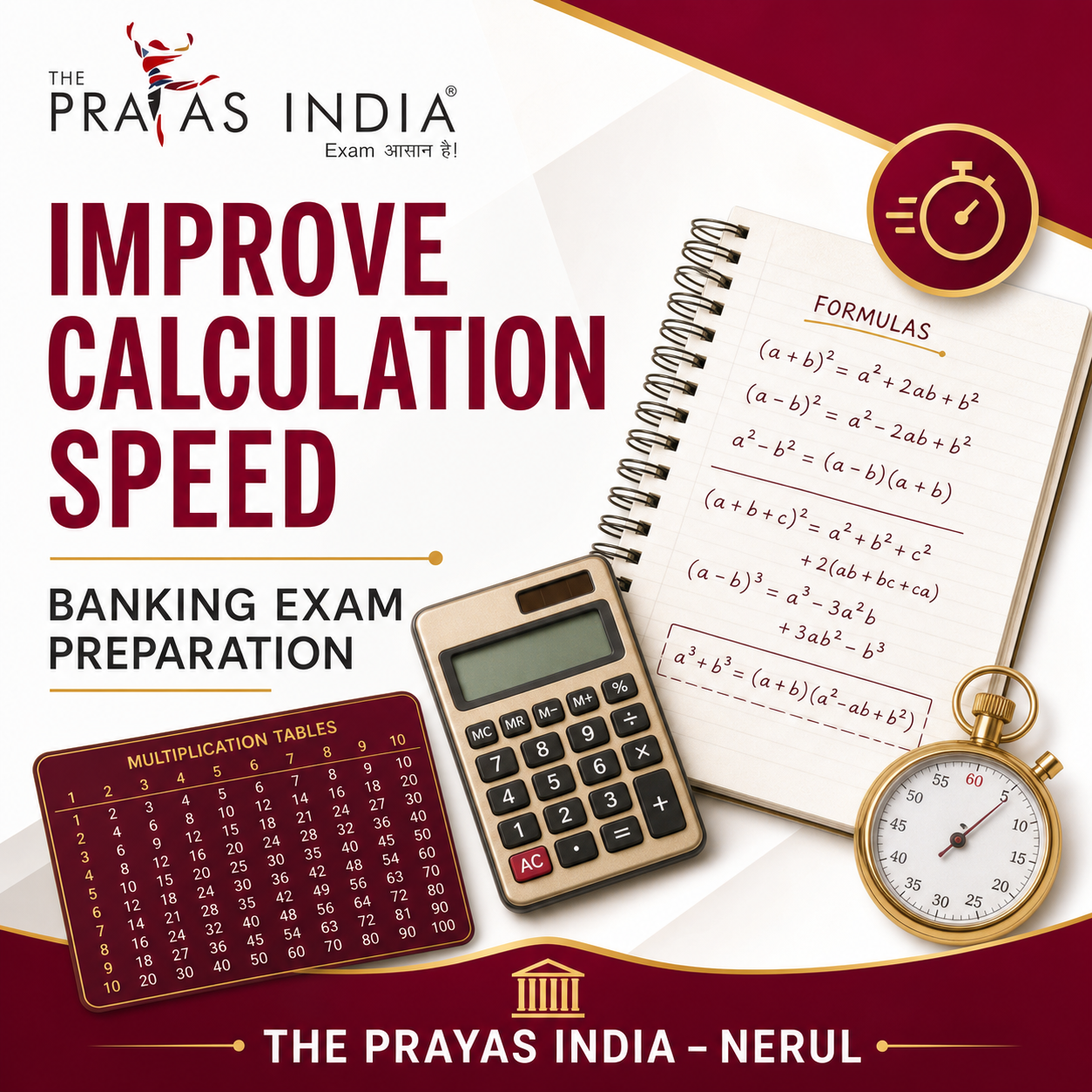
In banking exams, knowing the correct formula is not always enough. You must also solve questions accurately within a limited time. Slow calculations can affect your performance in Simplification, Number Series, Data Interpretation, and Arithmetic.
The good news is that calculation speed is a skill that can be developed through regular practice and the right techniques.
Whether you are preparing independently or exploring Best Banking Coaching in Navi Mumbai, these practical methods can help you improve your calculation ability and become more confident in the Quantitative Aptitude section.
Strengthen Your Basic Mathematical Skills
Before learning advanced shortcuts, make sure your mathematical fundamentals are clear.
Many students struggle with calculations because they are not comfortable with basic multiplication, division, fractions, or percentages.
Start by practising:
- Multiplication tables from 1 to 30.
- Squares of numbers from 1 to 50.
- Cubes of numbers from 1 to 20.
- Fraction-to-percentage conversions.
- Basic addition and subtraction.
- Division and multiplication techniques.
- Common decimal values.
For example, remember these useful conversions:
| Fraction | Percentage |
|---|---|
| 1/2 | 50% |
| 1/3 | 33.33% |
| 1/4 | 25% |
| 1/5 | 20% |
| 1/6 | 16.67% |
| 1/8 | 12.5% |
| 1/10 | 10% |
| 1/12 | 8.33% |
| 1/16 | 6.25% |
| 1/20 | 5% |
Knowing these conversions can save time in percentage and Data Interpretation questions.
Learn Vedic Maths Techniques for Faster Calculations
Vedic Maths techniques can help simplify certain calculations when applied correctly.
For example, consider multiplication by 11.
Example: 43 × 11
- Write the first digit: 4
- Add both digits: 4 + 3 = 7
- Write the last digit: 3
Answer = 473
Another example:
Example: 52 × 11
- First digit: 5
- Sum: 5 + 2 = 7
- Last digit: 2
Answer = 572
These techniques are useful for selected calculations, but you should understand when they apply. Do not force a shortcut into every question.
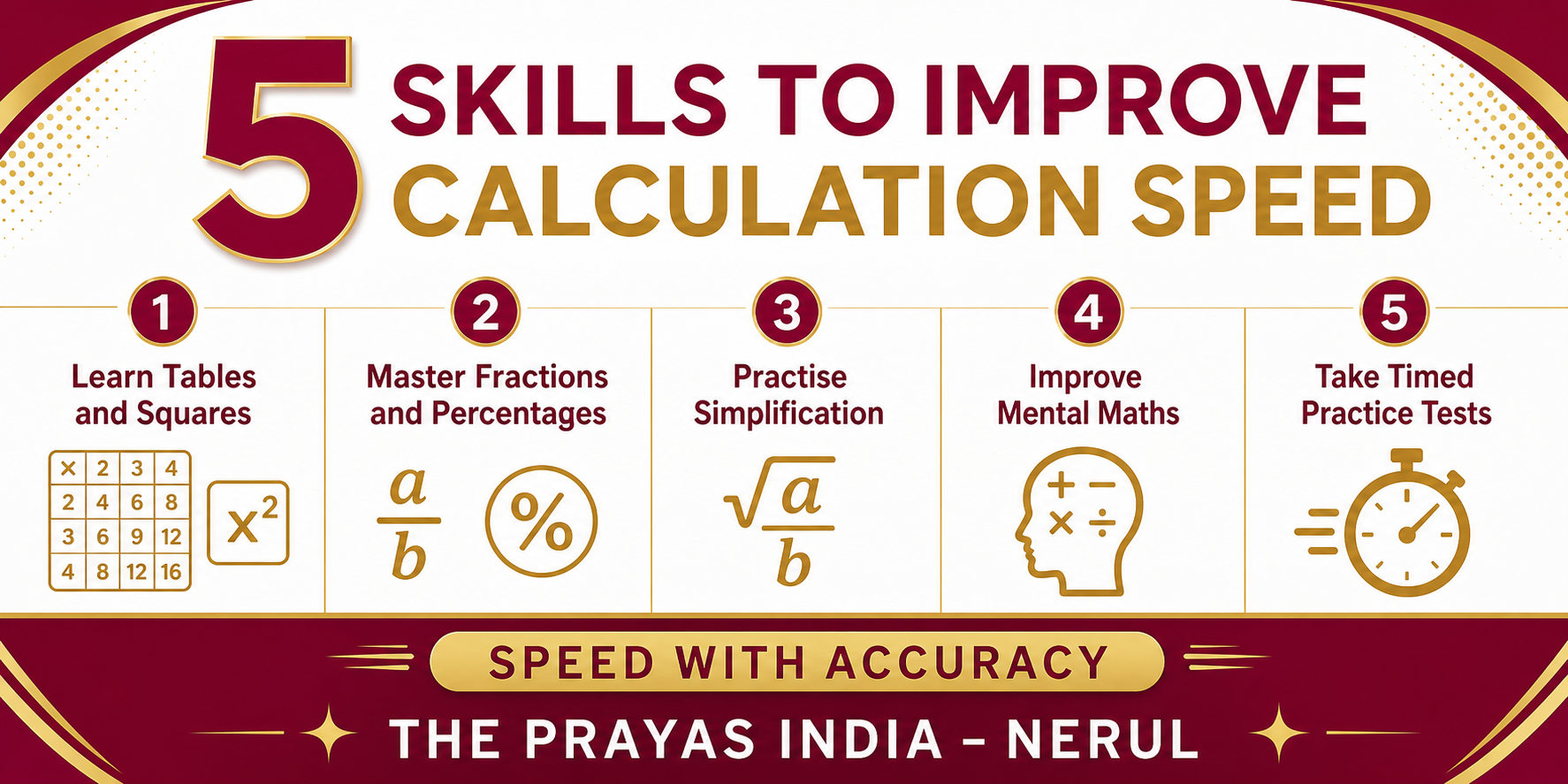
Practise Squares and Square Roots Regularly
Squares and square roots frequently appear in banking examination preparation, especially in Simplification, Approximation, and related calculation-based questions.
Memorise squares of commonly used numbers.
| Number | Square |
|---|---|
| 12 | 144 |
| 15 | 225 |
| 18 | 324 |
| 20 | 400 |
| 22 | 484 |
| 25 | 625 |
| 30 | 900 |
| 35 | 1225 |
| 40 | 1600 |
| 45 | 2025 |
| 50 | 2500 |
Practise recognising perfect squares quickly. This can help you avoid unnecessary written calculations.
Improve Your Speed in Simplification and Approximation
Simplification and Approximation questions can be useful opportunities to practise fast calculations.
Consider the following:
Example:
25% of 480 + 15 of 200
Step 1: Calculate 25% of 480.
= 120
Step 2: Calculate 15% of 200.
= 30
Step 3: Add both values.
= 120 + 30 = 150
Instead of calculating percentages through lengthy multiplication, learn common fraction equivalents and practise mental calculations.
For approximation questions, understand the required level of precision and follow the instructions given in the question.
Master Percentage and Fraction Shortcuts
Percentage calculations are important for banking exams because they are used in several arithmetic and Data Interpretation questions.
For example:
Find 20% of 650.
Since 20% = 1/5,
650 ÷ 5 = 130
Similarly:
Find 12.5% of 800.
Since 12.5% = 1/8,
800 ÷ 8 = 100
Learn commonly used percentages and their fraction equivalents. This reduces the time spent on repetitive calculations.
Use the Approximation Method Where Appropriate
Approximation can save time when the question asks for an approximate answer.
For example:
498 x 19.8
You can estimate:
500 x 20 = 10000
The approximate answer is around 10,000.
However, approximation should only be used when the question allows it and the answer options support an estimated approach. For exact-answer questions, calculate accurately.
Practise Data Interpretation Daily
Data Interpretation is an important part of Quantitative Aptitude in banking examinations.
Questions may involve:
- Tables
- Bar Graphs
- Pie Charts
- Line Graphs
- Caselet DI
- Mixed Graphs
These questions require you to read data, identify relationships, and perform calculations efficiently.
To improve your speed:
- Read the question before performing calculations.
- Identify the relevant values in the chart.
- Convert fractions and percentages mentally where possible.
- Avoid calculating unnecessary values.
- Practise comparison-based questions.
- Check whether approximation is permitted.
The goal is not simply to calculate faster but to identify the shortest accurate route to the answer.
Follow a 30-Minute Daily Calculation Practice Routine
You do not need to spend several hours only practising calculations. A focused daily routine can help build consistency.
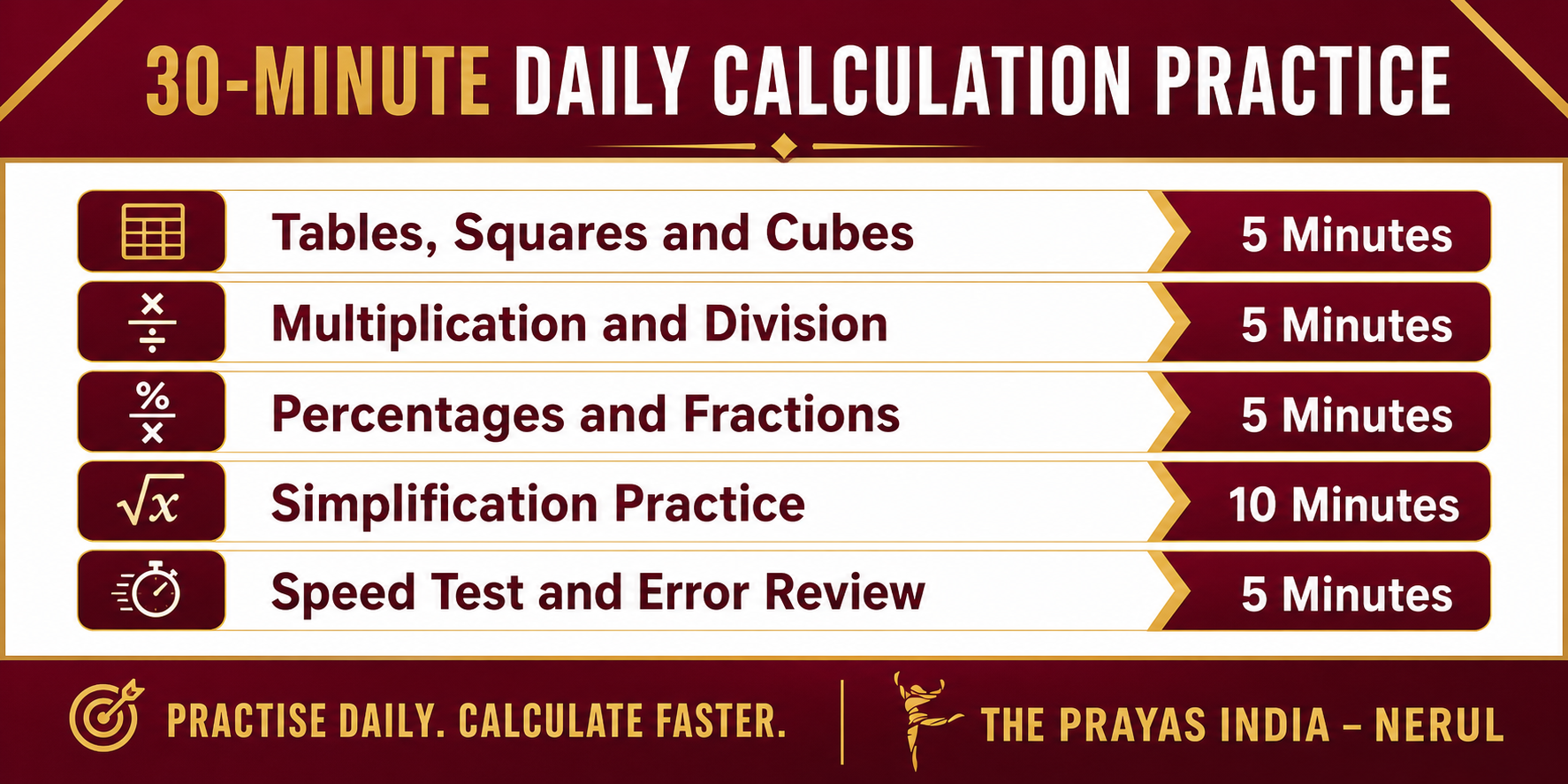
Here is an illustrative 30-minute practice plan:
| Practice Activity | Time |
|---|---|
| Tables, Squares and Cubes | 5 Minutes |
| Multiplication and Division | 5 Minutes |
| Percentage and Fraction Practice | 5 Minutes |
| Simplification Questions | 10 Minutes |
| Speed Test and Error Review | 5 Minutes |
| Total | 30 Minutes |
Maintain a notebook of difficult calculations and repeat them until you become comfortable.
Use a Stopwatch to Track Your Progress
Practising without tracking time may not help you understand whether your calculation speed is improving.
Use a stopwatch during short practice sessions.
For example:
- Attempt 10 simplification questions.
- Record the time taken.
- Check your answers.
- Identify calculation errors.
- Repeat a similar set after revision.
Track both speed and accuracy.
If you solve questions quickly but make frequent mistakes, slow down slightly and improve accuracy first. Speed should develop alongside correctness.
Avoid These Common Calculation Mistakes
Many banking aspirants lose marks because of small calculation errors.
Watch out for the following:
- Confusing percentages and fractions.
- Making multiplication errors.
- Ignoring decimal placement.
- Using shortcuts without understanding them.
- Spending too much time on one question.
- Performing unnecessary calculations.
- Relying entirely on mental maths.
- Ignoring accuracy while trying to improve speed.
A good calculation strategy should make your work faster without making it careless.
Subject-Wise Importance of Calculation Speed in Banking Exams
Calculation speed supports several topics across banking examinations.
| Topic | How Calculation Speed Helps |
|---|---|
| Simplification | Faster arithmetic operations |
| Approximation | Quick estimation |
| Number Series | Faster identification of numerical patterns |
| Data Interpretation | Efficient analysis of numerical data |
| Quadratic Equations | Faster comparison and calculation |
| Arithmetic | Better handling of multi-step problems |
| Percentage | Quicker fraction and percentage conversion |
Candidates preparing for IBPS PO, IBPS Clerk, SBI PO, and SBI Clerk should practise these areas according to their respective examination patterns.
How to Choose the Best Banking Coaching in Nerul?
Improving calculation speed requires regular practice, concept clarity, and feedback. Some students prefer structured guidance to develop these skills.
If you are searching for Best Banking Coaching in Nerul or Top Banking Coaching in Navi Mumbai, consider these factors before choosing an institute:
- Faculty support for Quantitative Aptitude.
- Clear explanation of calculation techniques.
- Regular speed-based practice sessions.
- Topic-wise tests and mock tests.
- Doubt-solving opportunities.
- Coverage of important banking exam topics.
- Convenient batch timings and location.
For students living in Nerul, Seawoods, Juinagar, and nearby areas, a conveniently located institute can make regular classroom attendance easier.
Why Consider The Prayas India for Banking Exam Preparation?
Students searching for Best Banking Coaching in Navi Mumbai can consider The Prayas India as one of the local institutes to contact for information about banking exam preparation.
The Prayas India has a Nerul branch that students from Nerul and nearby areas can visit to enquire about currently available programmes.
Aspirants can discuss their preparation requirements, Quantitative Aptitude learning needs, available batch schedules, teaching approach, and practice support before enrolling.
Whether you are preparing for IBPS PO, IBPS Clerk, or other banking examinations, choose a learning programme that complements your daily self-study and calculation practice.
The Prayas India – Nerul Branch
- Address: F-105, 1st Floor, Nerul West, Nerul, Maharashtra 400706
- Call: +91 77100 13217
Conclusion
Improving calculation speed for banking exams is not about memorising hundreds of shortcuts. It is about developing strong fundamentals, recognising number patterns, practising mental calculations, and selecting efficient solving methods.
Spend at least 30 minutes daily on calculation exercises. Practise Simplification, Approximation, Percentages, and Data Interpretation regularly. Track your accuracy and gradually increase your speed.
If you are looking for Best Banking Coaching in Nerul or Top Banking Coaching in Navi Mumbai, contact The Prayas India to enquire about currently available banking exam preparation programmes.
Remember: fast calculations are useful, but accurate calculations are essential.
Frequently Asked Questions About Calculation Speed for Banking Exams
1. How can I improve calculation speed for banking exams?
Practise multiplication tables, squares, cubes, fractions, percentages, simplification, and approximation daily. Use timed exercises to measure your progress while maintaining accuracy.
2. How much time should I spend on calculation practice daily?
Beginners can start with 20–30 minutes of focused daily practice. Gradually increase the duration according to your preparation requirements.
3. Which topics require fast calculations in banking exams?
Simplification, Approximation, Data Interpretation, Percentage, Number Series, and Arithmetic are some important areas where calculation speed is useful.
4. Are Vedic Maths tricks useful for IBPS PO and Clerk exams?
Selected Vedic Maths techniques can simplify certain calculations. However, candidates should understand the concepts and practise different methods before using shortcuts in timed examinations.
5. How can I improve mental maths for banking exams?
Practise basic arithmetic, memorise commonly used squares and percentage conversions, solve short calculation exercises, and review mistakes regularly.
6. Where can I enquire about banking exam coaching in Nerul?
You can contact The Prayas India at F-105, 1st Floor, Nerul West, Navi Mumbai, to enquire about currently available banking exam preparation programmes.
Improve Your Banking Exam Preparation with The Prayas India
Looking for banking exam preparation guidance in Nerul or Navi Mumbai? Contact The Prayas India to enquire about currently available programmes, batch schedules, and academic support.