Adriatic Sea: Physical Geography, Oceanography, Economy, and Geopolitical Significance
- GS Paper 1: Physical Geography, Ocean Geography, World Geography
- GS Paper 3: Environment, Marine Ecology, Climate Change, Maritime Trade
- Prelims: Seas of Europe, Map-based Questions, Coastal Features
- Geography Optional: Oceanography, Regional Geography of Europe, Marine Ecosystems
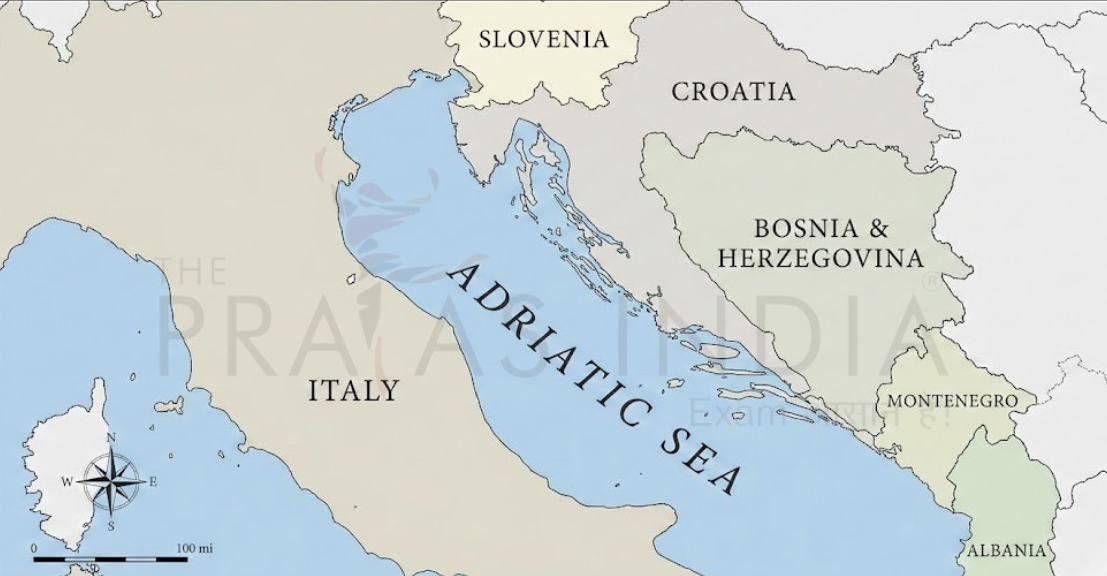
The Adriatic Sea is a marginal sea of the Mediterranean Sea, situated between the Italian Peninsula to the west and the Balkan Peninsula to the east. It is one of the most distinctive semi-enclosed seas of Europe, characterized by its elongated northwest–southeast orientation, shallow northern shelf, and deeply indented eastern coastline.
Geographically, the Adriatic Sea functions as a transitional marine space linking continental Europe with the broader Mediterranean system through the Strait of Otranto, which connects it to the Ionian Sea. Historically, it has played a crucial role in Mediterranean trade, cultural exchange, naval strategy, and empire-building, particularly during the Roman, Venetian, and Ottoman periods.
In contemporary times, the Adriatic Sea remains vital for European maritime trade, fisheries, tourism, energy transit, and regional security, making it highly relevant for UPSC Geography and International Relations.
Location & Extent

The Adriatic Sea occupies a north–south elongated basin in southern Europe.
Boundaries
- Northern Boundary: Gulf of Venice
- Southern Boundary: Strait of Otranto (connects Adriatic Sea with the Ionian Sea)
Bordering Countries
- Western Coast: Italy
- Eastern Coast: Slovenia, Croatia, Bosnia & Herzegovina, Montenegro, Albania
Spatial Dimensions
- Length: ~800 km
- Average Width: ~160 km
- Surface Area: ~138,600 sq km
The sea narrows significantly in the north and widens toward the south, reflecting its geological evolution and the configuration of its continental shelf.
Geological Origin & Tectonic Setting
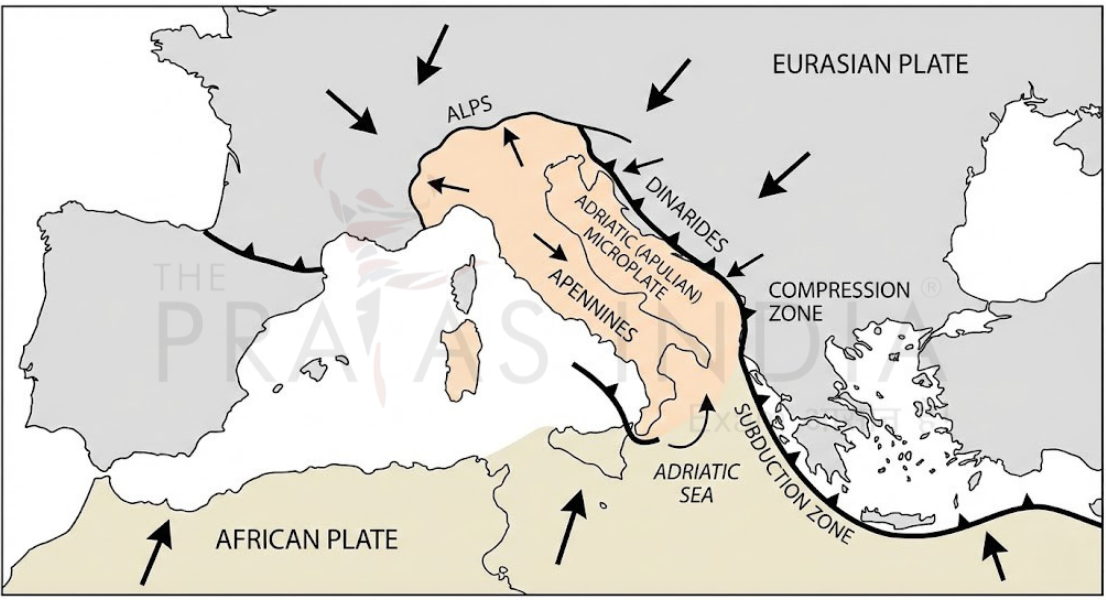
The geological evolution of the Adriatic Sea is closely linked to the convergence between the African and Eurasian tectonic plates.
Key Geological Features
- The Adriatic microplate (also called the Apulian Plate) lies between Africa and Eurasia.
- Northward movement of the African Plate caused compression, folding, and subsidence.
- Differential uplift and subsidence shaped the asymmetric coastlines.
Seismicity
- The eastern Adriatic coast (especially Croatia and Montenegro) is seismically active.
- Coastal uplift and karstification are evident due to limestone dominance.
Physical Characteristics
a. Basin Structure
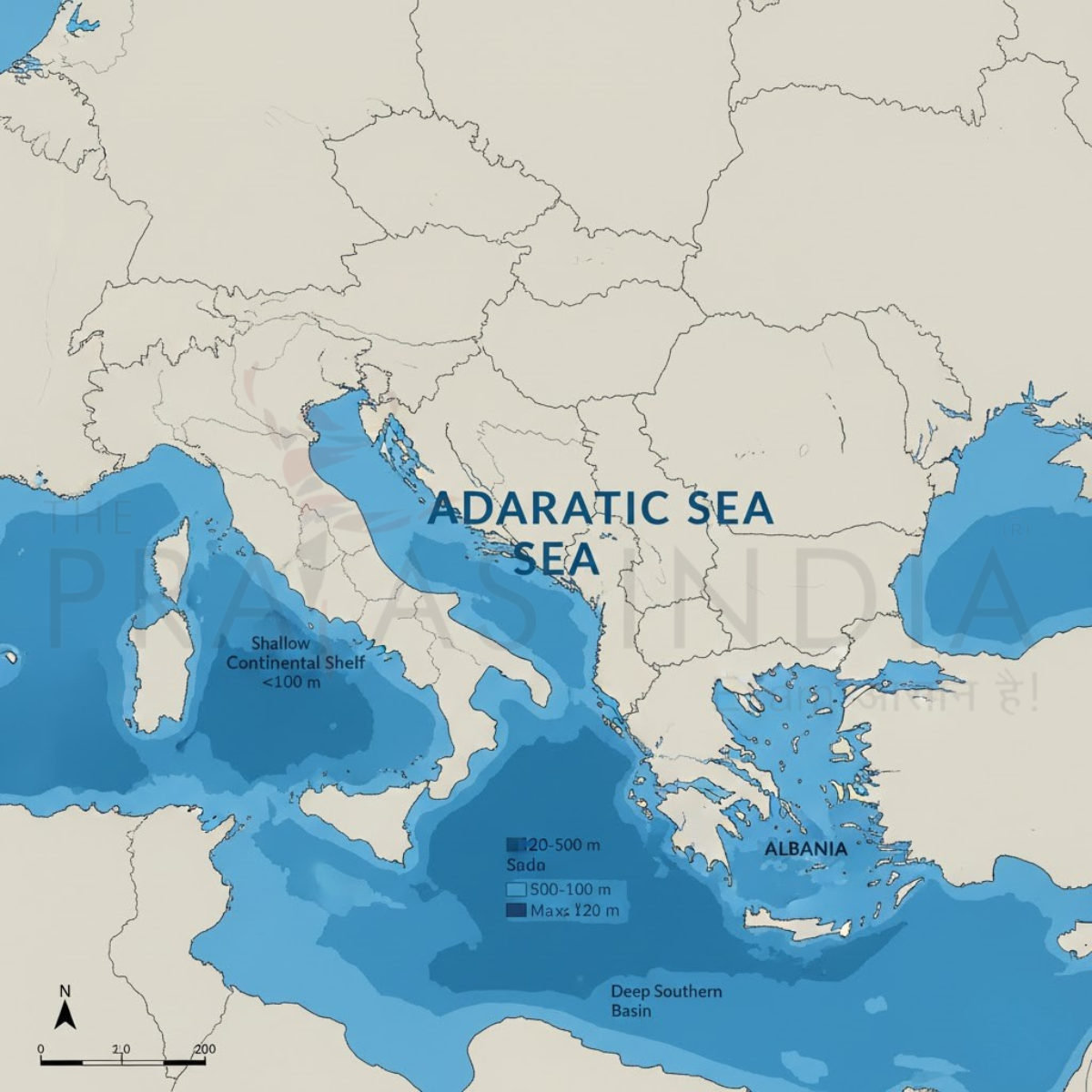
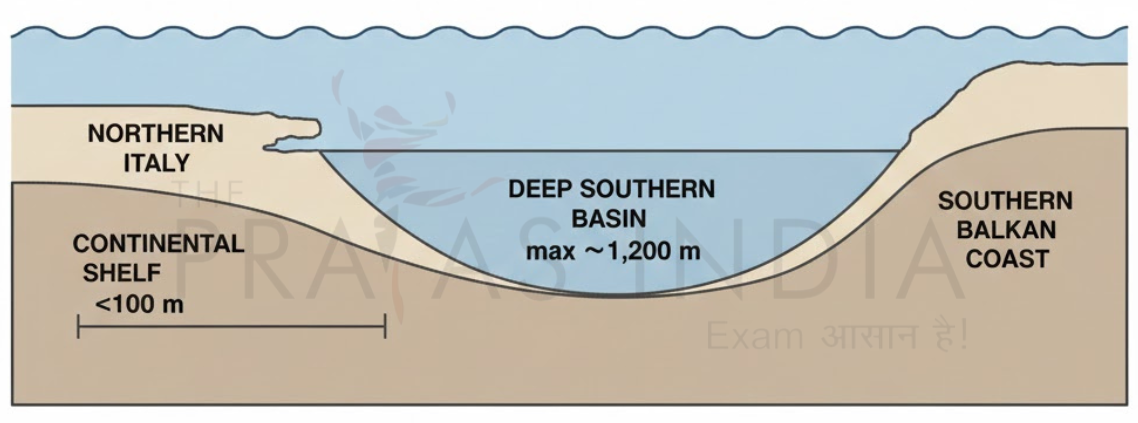
The Adriatic Sea displays a marked north–south depth contrast.
- Northern Adriatic:
- Extremely shallow
- Broad continental shelf
- Average depth less than 50 m
- Southern Adriatic:
- Narrow but deep basin
- Hosts the deepest point of the Adriatic Sea
b. Depth & Salinity
- Average Depth: ~250 m
- Maximum Depth: ~1,233 m (South Adriatic Pit)
Salinity varies spatially:
- Lower salinity in the north due to heavy river inflow
- Higher salinity in the south, influenced by Mediterranean water exchange
Hydrology & Oceanographic Features
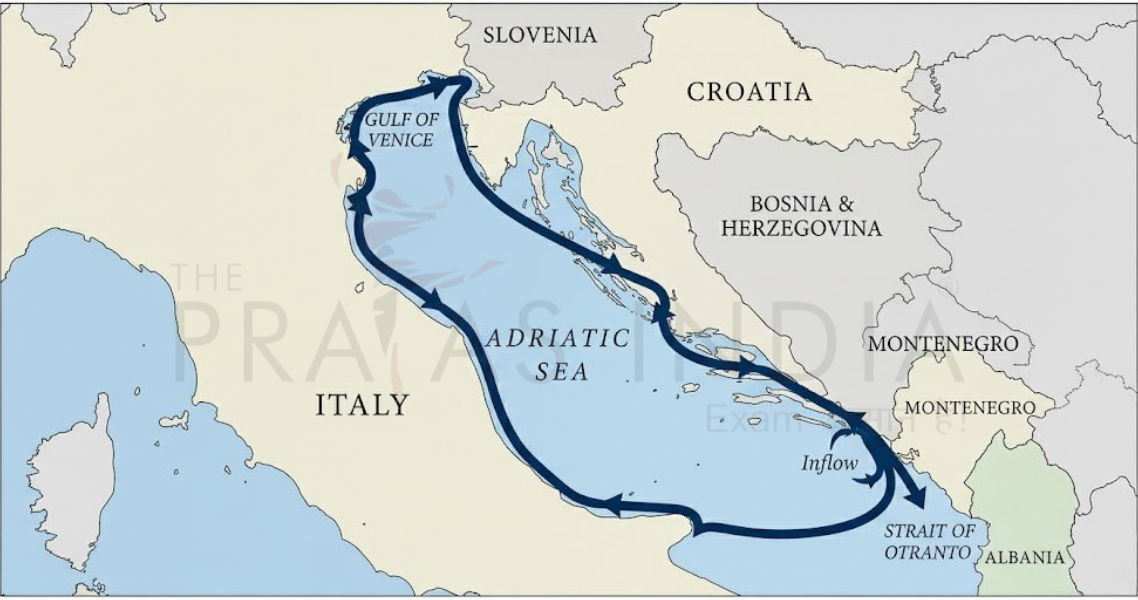
River Inflow
Major rivers draining into the Adriatic Sea include:
- Po River (largest contributor)
- Adige
- Neretva
- Brenta
The Po River alone contributes significantly to freshwater input, sediment load, and nutrient enrichment.
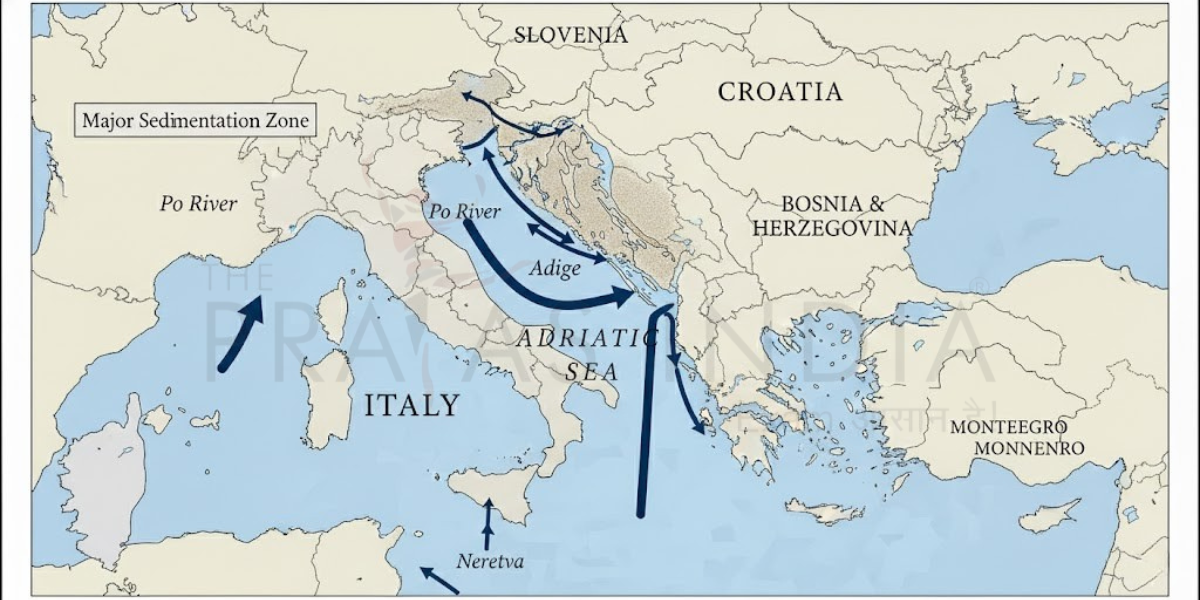
Circulation Pattern
- The Adriatic Sea exhibits a counter-clockwise (cyclonic) circulation
- Surface waters move northward along the eastern coast and southward along the Italian coast
Water Exchange
- Seasonal water exchange occurs through the Strait of Otranto
- Dense Adriatic Deep Water contributes to Mediterranean thermohaline circulation
Climate Influence
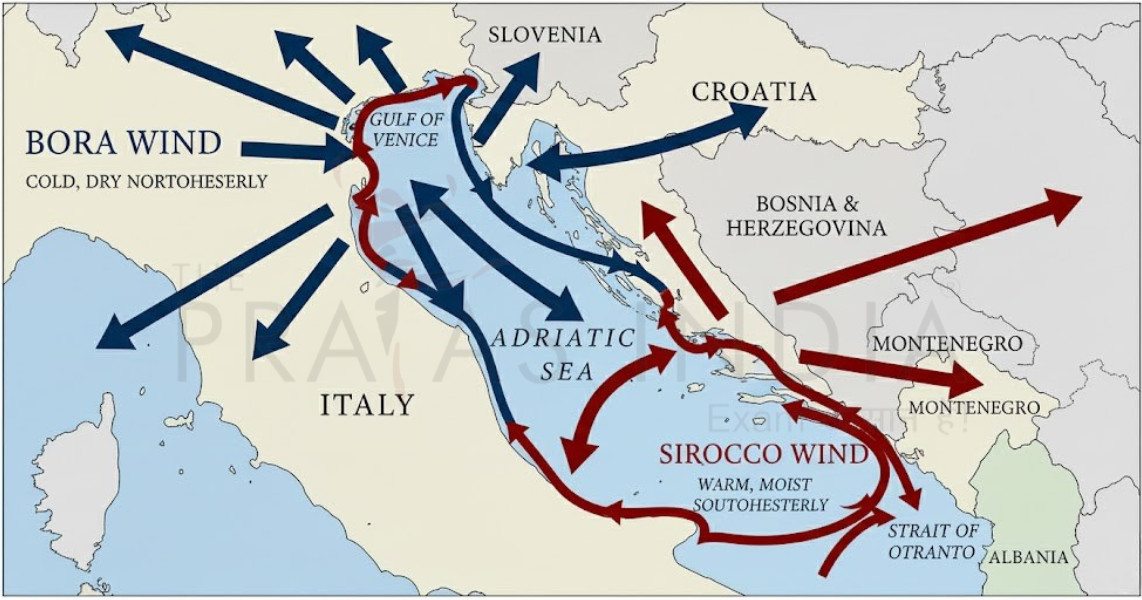
The Adriatic region experiences a Mediterranean climate, but with strong local wind systems.
Major Winds
- Bora:
- Cold, dry, northeasterly wind
- Causes sudden temperature drops and rough seas
- Major hazard for navigation
- Sirocco:
- Warm, moist southeasterly wind
- Brings rain and dust from North Africa
Climatic Impacts
- Influences fishing cycles
- Affects port operations
- Shapes coastal settlement patterns
Coastal Landforms & Islands
Italian Coast
- Sandy beaches
- Coastal lagoons (e.g., Venice Lagoon)
- Deltaic plains formed by river sedimentation
Balkan Coast
- Rugged, indented coastline
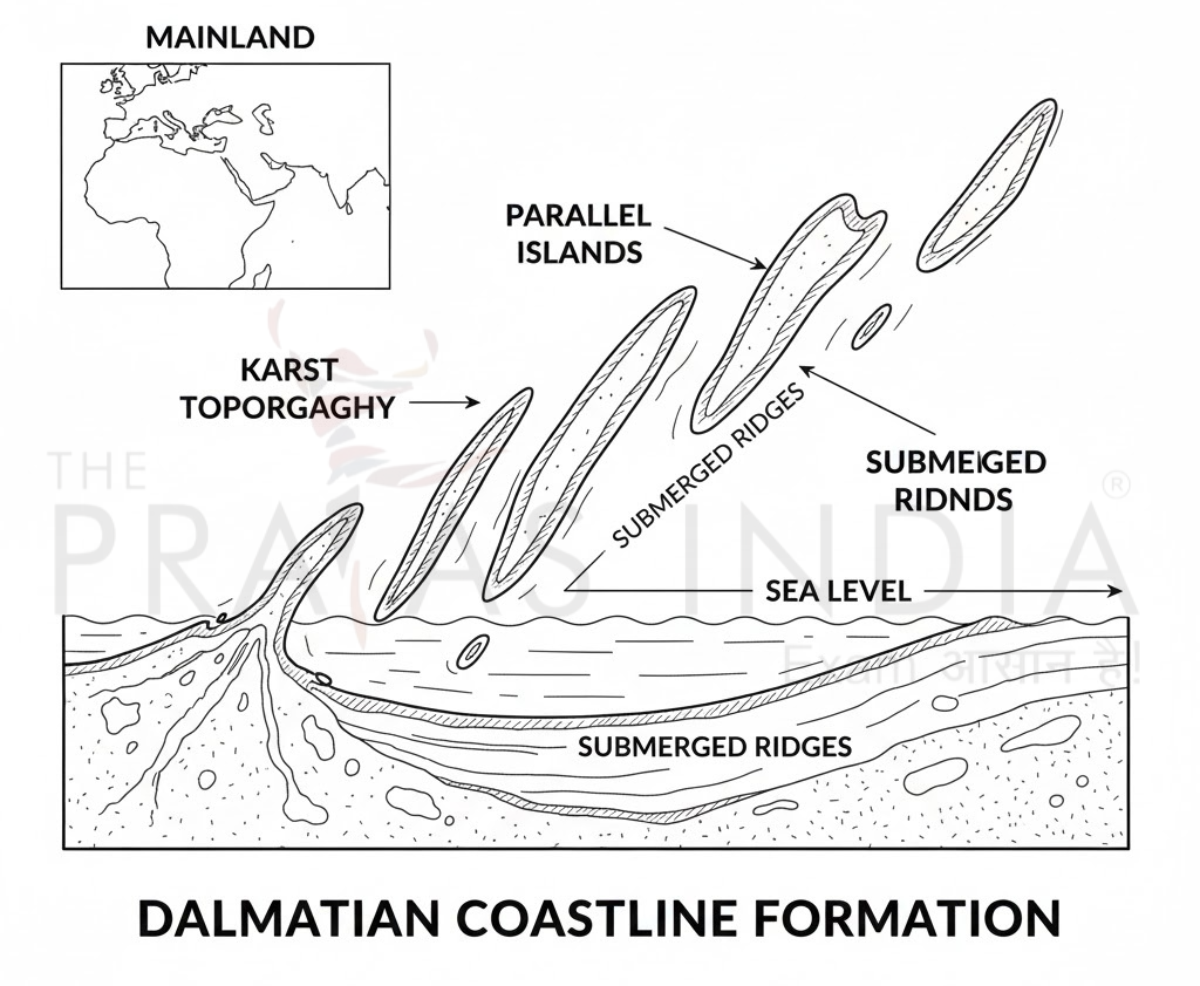
- Dominated by karst topography
- Hundreds of islands aligned parallel to the coast
Dalmatian Coast
- Classic example of Dalmatian-type coastline
- Formed due to the submergence of folded limestone ridges
Marine Ecosystems & Biodiversity
Key Ecosystems
- Posidonia oceanica seagrass meadows
- Coastal wetlands and estuaries
- Pelagic and benthic ecosystems
Biodiversity
- Rich fish stocks (sardines, anchovies)
- Marine mammals (dolphins)
- High ecological productivity in shallow northern waters
Conservation
- Several Marine Protected Areas (MPAs)
- EU conservation directives play a key role
Economic Importance
a. Fisheries & Aquaculture
- Traditional fishing grounds
- Shellfish farming along sheltered coasts
- Overfishing concerns in the northern Adriatic
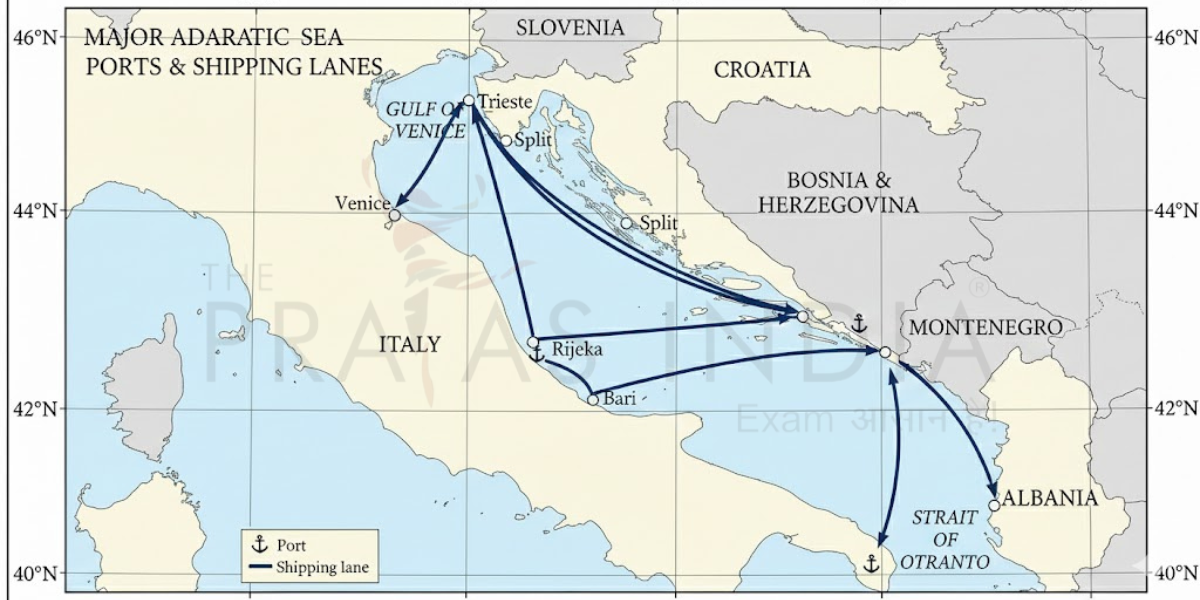
b. Trade & Ports
Major ports include:
- Venice
- Trieste
- Rijeka
- Split
- Bari
The Adriatic acts as a maritime gateway between Central Europe and the Mediterranean.
c. Tourism
- One of Europe’s most popular coastal tourism belts
- Croatia and Italy dominate tourism revenues
Environmental Issues
- Nutrient pollution from rivers
- Eutrophication in northern Adriatic
- Overfishing and habitat loss
- Sea-level rise and coastal erosion
- Industrial and plastic pollution
Geopolitical & Strategic Importance
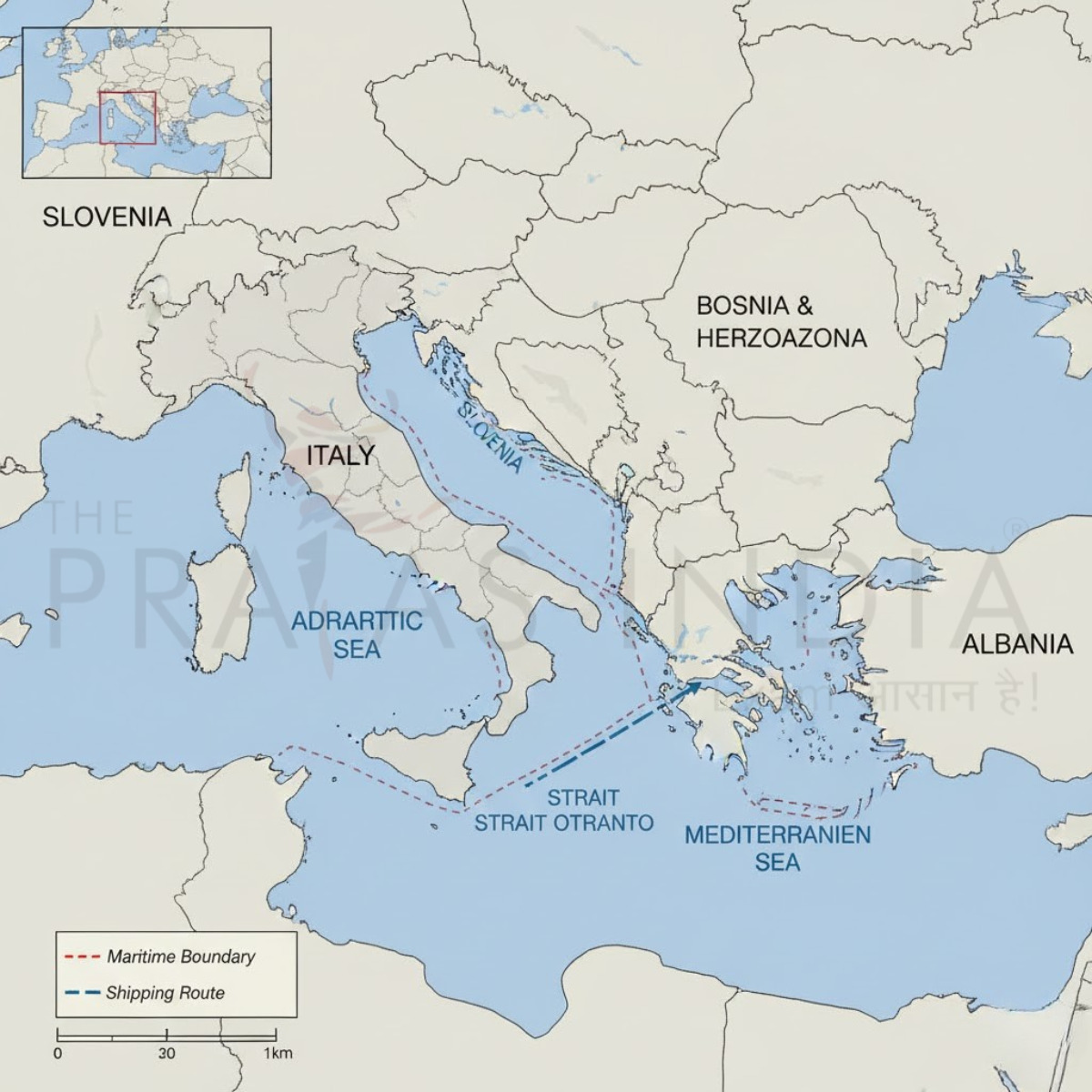
- Maritime boundary agreements among coastal states
- NATO naval presence
- EU maritime security cooperation
- Strategic corridor for European trade and energy movement
Comparison Table
Adriatic Sea vs Aegean Sea vs Ionian Sea
| Parameter | Adriatic Sea | Aegean Sea | Ionian Sea |
|---|---|---|---|
| Depth | Shallow north, deep south | Highly variable | Deepest |
| Coastline | Smooth west, rugged east | Highly indented | Relatively smooth |
| Biodiversity | Moderate | High | Moderate |
| Economic Role | Trade, tourism | Tourism, shipping | Shipping, energy |
Frequently Asked Questions (FAQs) – Adriatic Sea (UPSC-Oriented)
Q1. Why is the Adriatic Sea classified as a marginal sea?
The Adriatic Sea is classified as a marginal sea because it is partially enclosed by land and connected to the Mediterranean Sea through the Strait of Otranto, allowing limited water exchange.
Q2. Which tectonic plates influence the formation of the Adriatic Sea?
The Adriatic Sea is influenced by the convergence of the African Plate, Eurasian Plate, and the Adriatic (Apulian) microplate.
Q3. Why is the northern Adriatic Sea much shallower than the southern part?
The northern Adriatic lies over a broad continental shelf and receives heavy sediment deposition from rivers like the Po, while the southern Adriatic is a tectonically subsided deep basin.
Q4. What is the significance of the Strait of Otranto?
The Strait of Otranto connects the Adriatic Sea with the Ionian Sea and controls water exchange, circulation patterns, and strategic maritime access.
Q5. What are Bora and Sirocco winds?
Bora is a cold, dry northeasterly wind affecting navigation, while Sirocco is a warm, moist southeasterly wind bringing rainfall and dust.
Q6. Why is the Dalmatian coast geomorphologically important?
It is a classic example of a Dalmatian-type coastline formed due to submergence of folded limestone ridges parallel to the coast.
Q7. Name major rivers draining into the Adriatic Sea.
Po, Adige, Neretva, and Brenta are the major rivers draining into the Adriatic Sea.
Q8. How does the Adriatic Sea contribute to Mediterranean circulation?
Dense water formed in the Adriatic contributes to deep-water formation and thermohaline circulation in the Mediterranean Sea.
Q9. What are the major environmental challenges faced by the Adriatic Sea?
Eutrophication, pollution from river discharge, overfishing, habitat degradation, and climate change impacts.
Q10. Why is the Adriatic Sea geopolitically significant?
It supports major European ports, NATO naval presence, EU maritime cooperation, and serves as a strategic trade corridor.
Conclusion
The Adriatic Sea represents a geographically unique, economically vital, and geopolitically sensitive marginal sea of Europe. Its shallow northern shelf, karstic eastern coastline, and strategic connectivity with the Mediterranean make it central to European maritime geography. However, environmental pressures and climate change necessitate coordinated conservation and sustainable management, ensuring its continued relevance for future generations and for UPSC aspirants studying physical geography and international maritime dynamics.