Atmosphere and Its Layers – Structure, Composition, and Climatic Significance
- Prelims: Questions on atmospheric layers, ozone, lapse rate, greenhouse gases, aerosols, temperature inversion.
- GS Paper 1: Climatology, weather systems, atmospheric structure.
- GS Paper 3: Climate change, pollution, disaster management.
- Geography Optional: Short notes on ionosphere, ozone, ABL, heterosphere, temperature inversion.
Introduction
The atmosphere is a vast envelope of gases surrounding the Earth, held in place by gravitational force. It extends up to nearly 10,000 km, though most weather and climate-forming processes occur within the lowest 50 km. The atmosphere is indispensable for sustaining life by regulating temperature, enabling the hydrological cycle, and filtering harmful solar radiation.
It plays a crucial role in heat balance, weather formation, climate regulation, and protection from meteoroids and UV radiation. Based on temperature gradients, the atmosphere is vertically divided into five principal layers—troposphere, stratosphere, mesosphere, thermosphere, and exosphere—each with distinct physical and chemical characteristics.
Composition of the Atmosphere
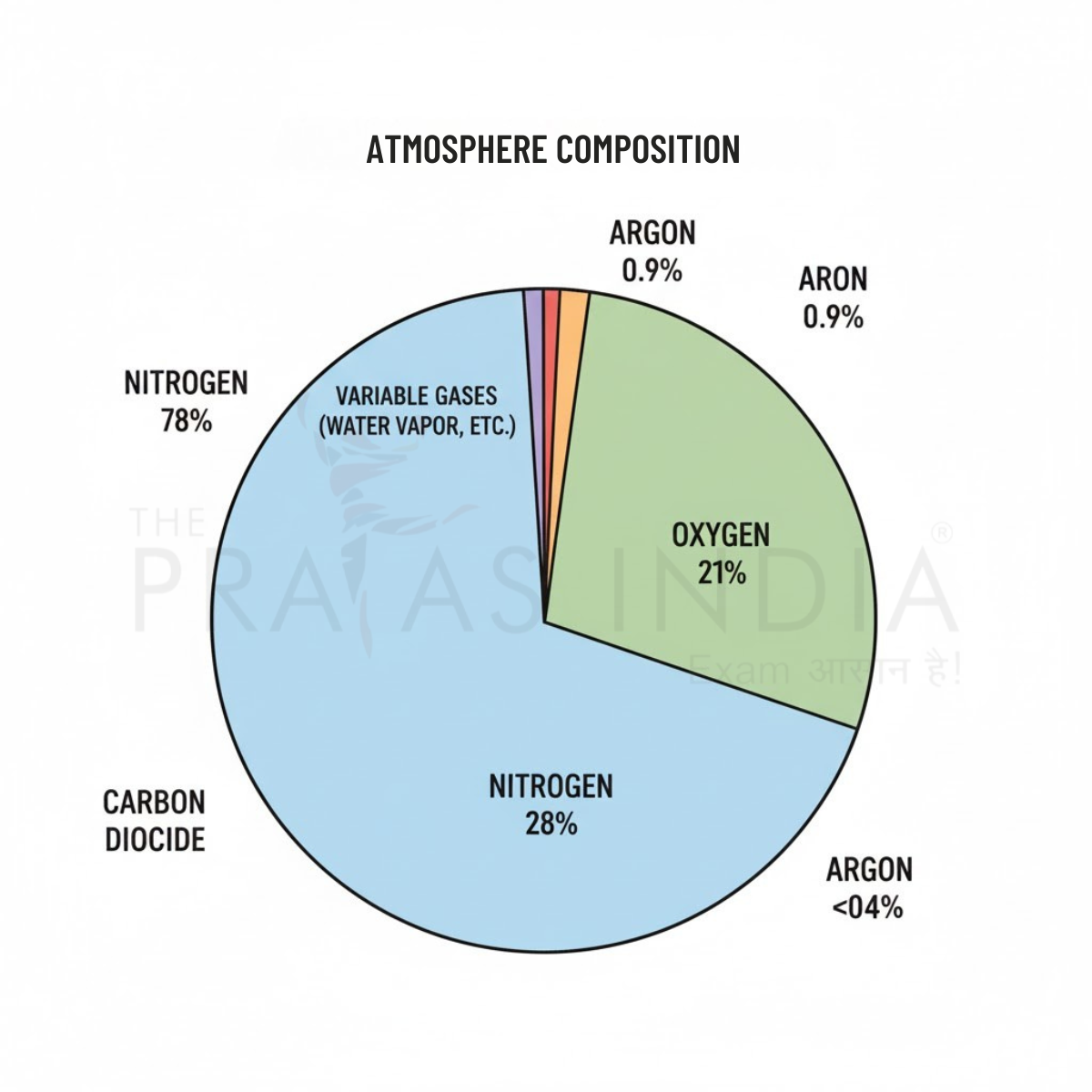
The atmosphere is composed of permanent gases, variable gases, and a variety of particulates. The composition gradually changes with altitude, latitude, and local environmental conditions.
A. Permanent Gases (Stable Proportion)
- Nitrogen (78.08%) – Maintains atmospheric stability and supports biological nitrogen fixation.
- Oxygen (20.95%) – Essential for respiration and combustion; also forms ozone through photochemical reactions.
- Argon (0.93%) – Inert gas with minimal climatic influence.
- Others: Neon, Helium, Krypton, Xenon (<0.01%)
B. Variable Gases (Spatial & Temporal Variation)
- Water Vapour (0–4%) – Drives hydrological cycle, cloud formation, latent heat transfer, and greenhouse effect.
- Carbon Dioxide (0.04%) – Crucial greenhouse gas; concentration rising due to anthropogenic activity.
- Ozone (O₃) – Vital for UV protection; concentrated in stratosphere.
- Methane, Nitrous Oxide, CFCs – Potent greenhouse gases.
C. Particulates (Aerosols)
Includes dust, sea salt, smoke, pollen, volcanic ash, soot, and industrial pollutants. Aerosols influence cloud formation, scattering of sunlight, monsoon behaviour, and visibility.
Variation of Composition with Altitude
- Water vapour decreases sharply with altitude.
- Oxygen content diminishes, affecting respiration in higher mountains.
- Above ~90 km, light gases (H, He) dominate, forming the heterosphere.
Structure of the Atmosphere (Temperature-Based Layers)
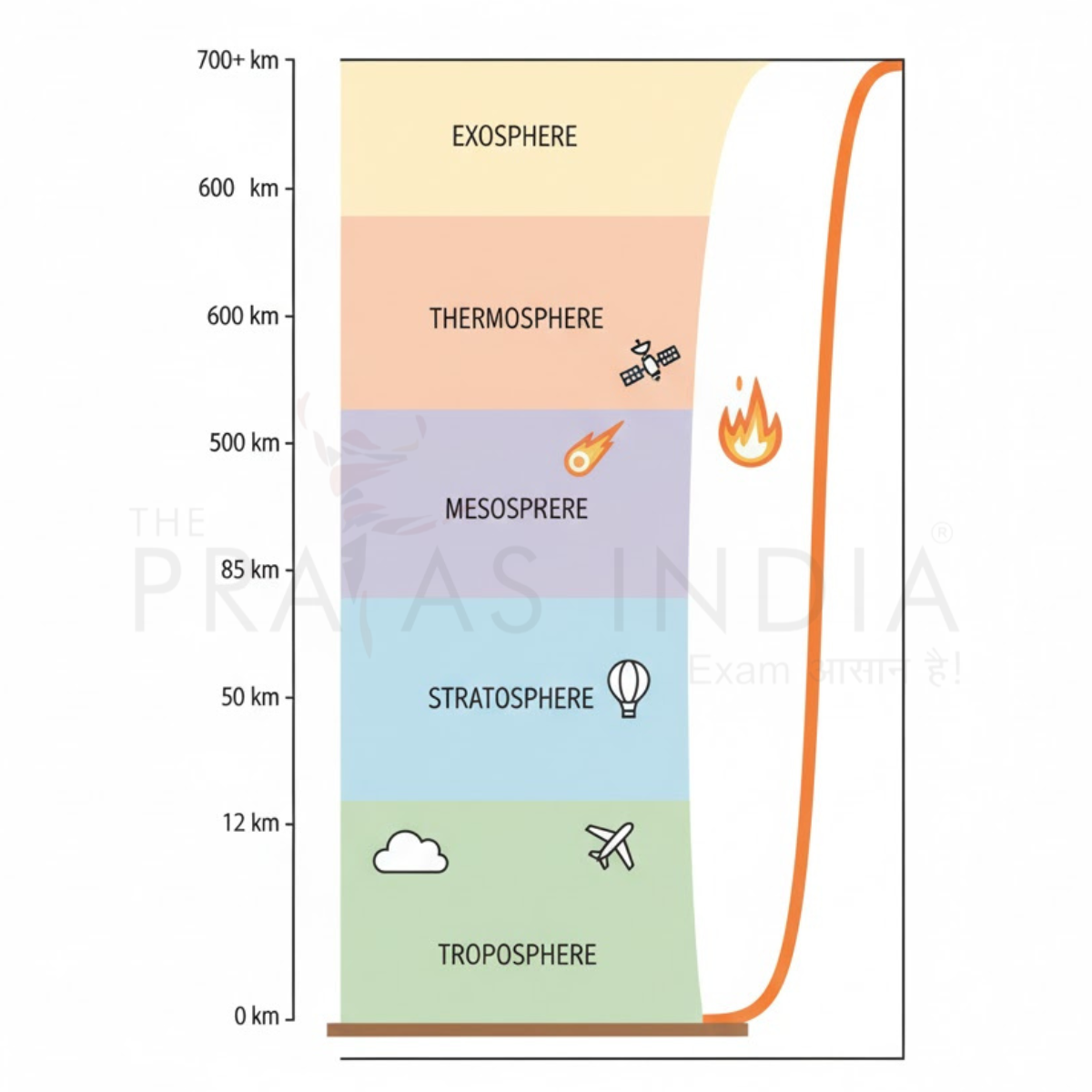
Temperature trends (lapse rates) define the vertical layering of the atmosphere. Each layer plays a distinct role in shaping weather, climate, radiation balance, and communication systems.
A. Troposphere
- Extent:
- 0–8 km at poles,
- 0–18 km at tropics (due to convection).
- Features:
- All weather phenomena occur here—clouds, storms, fog, rainfall.
- Temperature decreases with height: 6.4°C per km (Normal Lapse Rate).
- Contains 99% of water vapour and 75% of total atmospheric mass.
- Tropopause:
- Thin boundary where temperature stabilizes.
- Its height varies with seasons and latitude.
B. Stratosphere
- Extent: 18–50 km
- Temperature Trend: Increases with altitude due to ozone absorption of UV radiation.
- Ozone Layer:
- Maximum concentration lies between 20–35 km.
- Protects life from harmful UV-B radiation.
- Other Features:
- Zone of jet streams (upper troposphere-lower stratosphere).
- No weather disturbances; ideal for aircraft operations.
C. Mesosphere
- Extent: 50–80 km
- Coldest Zone: Temperatures may fall below −90°C.
- Meteors burn in this layer due to friction.
- Mesopause: Boundary with thermosphere.
D. Thermosphere
- Extent: 80–500 km
- Temperature: Very high (up to 1500°C and above) due to absorption of short-wave solar radiation.
- Contains the ionosphere (90–400 km):
- Ionised particles reflect radio waves and influence communication.
- Auroras: Caused by interaction of charged particles with Earth’s magnetic field (Aurora Borealis & Australis).
E. Exosphere
- Extent: 500–10,000 km
- Characteristics:
- Transition between Earth’s atmosphere and outer space.
- Very low density; gases escape into space.
- Mostly hydrogen and helium.
Other Vertical Divisions of the Atmosphere
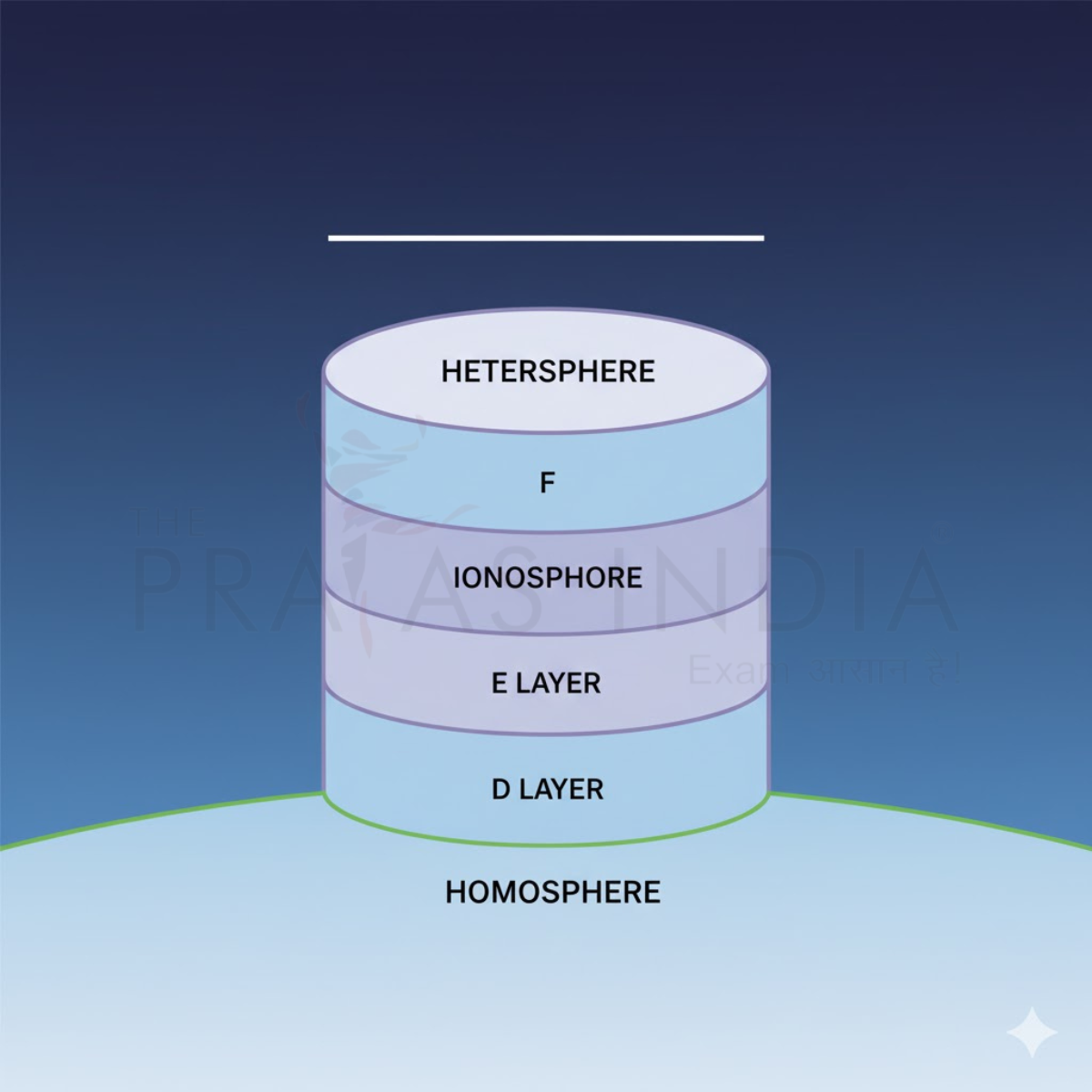
A. Ionosphere
- Located mostly within thermosphere.
- Divided into D, E, F1, F2 layers.
- Crucial for radio wave propagation, GPS, and long-distance communication.
- Highly influenced by solar activity (sunspots, solar flares).
B. Ozonosphere
- Concentrated in stratosphere; absorbs UV radiation.
- Central to radiative balance and ozone chemistry.
C. Homosphere vs Heterosphere
- Homosphere (0–90 km):
- Uniform composition due to turbulent mixing.
- Heterosphere (above 90 km):
- Gases layered by molecular weight—O₂ below, He and H above.
Temperature Inversion
Definition
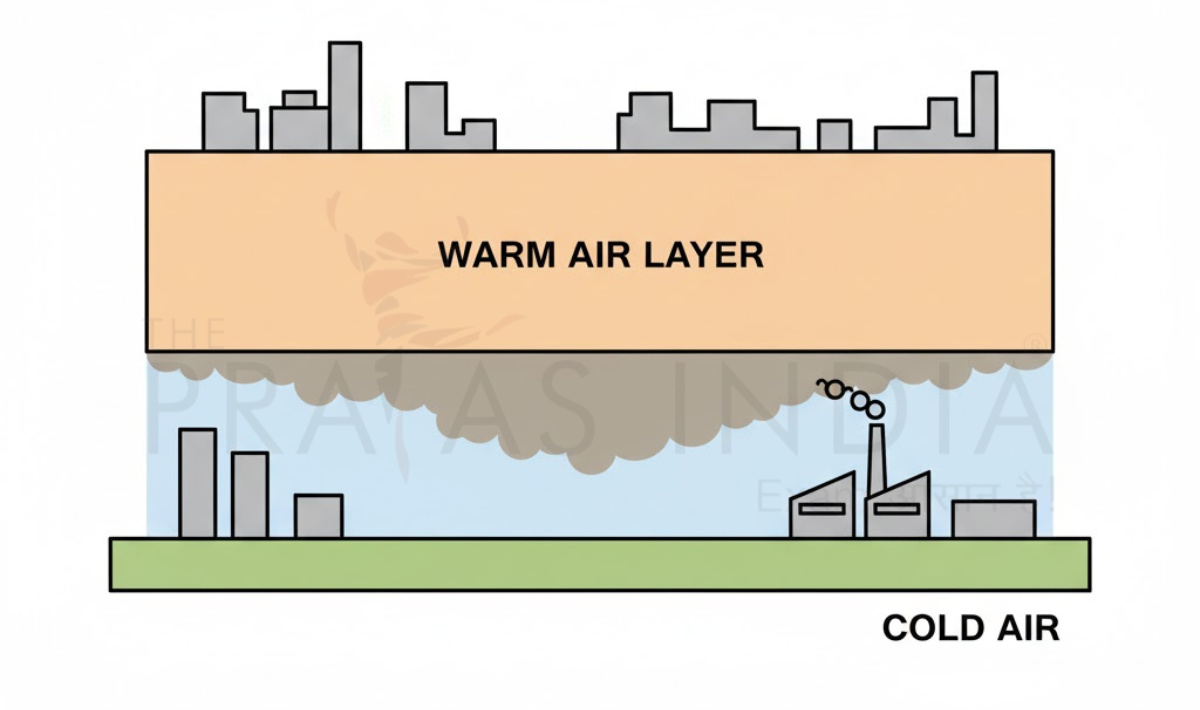
A phenomenon where temperature increases with height, contrary to the normal lapse rate.
Causes
- Radiation cooling of surface during winter nights.
- Subsidence inversion due to descending air in anticyclones.
- Valley inversion—cold air traps beneath warmer layers.
- Foggy conditions with moisture-laden air near the ground.
Impact on Pollution (Indian Context)
- Traps pollutants close to ground, causing smog episodes.
- Severe in Delhi-NCR winters due to low wind speed, stubble burning, and emissions.
- Reduces visibility, worsening respiratory diseases.
Importance of the Atmosphere
- Climate regulation through heat distribution and greenhouse effect.
- Weather formation—clouds, rainfall, storms.
- Protection from UV radiation, meteoroids, and harmful solar particles.
- Enables radio communication through the ionosphere.
- Balances energy budget through reflection, absorption, and emission.
- Supports life through oxygen and carbon cycle.
Atmospheric Boundary Layer (ABL) & Weather Systems
The ABL is the lowest part of the troposphere directly influenced by the Earth’s surface.
Characteristic Features
- Height varies from 100 m (night) to 2 km (day).
- Driven by turbulence, convection, and surface friction.
- Strongly affects monsoon winds, sea breezes, thunderstorms, and cyclogenesis.
Role in Weather Systems
- Influences local winds, fog, storms.
- Determines heat island effects in urban regions.
- Controls moisture transport crucial for monsoon onset and withdrawal.
Human Impact on the Atmosphere
A. Greenhouse Gas Accumulation
Human activities release CO₂, CH₄, N₂O, causing enhanced greenhouse effect, global warming, heatwaves, and rainfall anomalies.
B. Ozone Depletion
CFCs and halons destroy stratospheric ozone.
The Montreal Protocol (1987) has enabled recovery, though vulnerable regions remain.
C. Air Pollution
- Particulate matter (PM2.5, PM10), SO₂, NOx, ozone.
- Smog formation in megacities like Delhi, Mumbai, Beijing.
D. Aerosols and Climate Forcing
Aerosols can cool (sulphates) or warm (black carbon) the atmosphere, affecting monsoon behaviour.
E. Urban Heat Island (UHI) Effect
Cities exhibit higher temperatures than rural areas due to concrete surfaces, emissions, and lack of vegetation.
Case Studies
A. Ozone Hole Over Antarctica
- Caused by polar stratospheric clouds and CFC reactions.
- Largest during September–November.
- Gradual healing observed due to global policy interventions.
B. India’s Smog Episodes
- Delhi experiences recurring toxic smog in winter due to inversion, transport emissions, industrial pollution, and biomass burning.
C. Extreme Heat Trends
- Increased frequency of heatwaves in India due to warming troposphere.
- IMD recorded record-breaking temperatures in several states.
D. Atmospheric Instability Events
- Rise in cloudburst incidents in Himalayan regions due to tropospheric instability and warming.
Conclusion
The atmosphere is central to Earth’s climate stability, heat balance, and biospheric functioning. Its layered structure ensures protection from radiation, supports the hydrological cycle, and regulates global weather systems. However, anthropogenic pressures—GHG emissions, aerosols, ozone depletion, and pollution—are altering atmospheric dynamics.
Preserving atmospheric quality is essential for planetary sustainability. Strong climate governance, global cooperation under frameworks such as the UNFCCC and the Paris Agreement, and national policies on air quality and emissions are crucial to securing a balanced and resilient atmosphere for future generations.