Bal Gangadhar Tilak – Ideologue of Assertive Nationalism and Mass Politics
- GS Paper 1: Modern Indian History (Freedom Struggle, National Movement)
- GS Paper 4: Ethics – Values, Leadership, Moral Courage (limited linkage)
- Prelims: Extremist leaders, Congress sessions, newspapers, slogans
- Optional (History): National Movement, Extremist Phase, Political Ideologies
Introduction
Bal Gangadhar Tilak (1856–1920) occupies a central place in the evolution of Indian nationalism. Revered as Lokmanya—“beloved leader of the people”—Tilak was among the first leaders to transform nationalism from an elite intellectual discourse into a mass-based political movement. His famous declaration, “Swaraj is my birthright and I shall have it,” encapsulated a new assertive spirit in India’s freedom struggle.
Tilak is often regarded as a bridge between moderate constitutional nationalism and later revolutionary or mass nationalism. While operating within the Indian National Congress, he fundamentally altered its ideological orientation and methods, laying the groundwork for the Gandhian phase of mass politics. His contribution marked the transition from prayer-petition politics to resistance-based nationalism.
Early Life and Intellectual Background
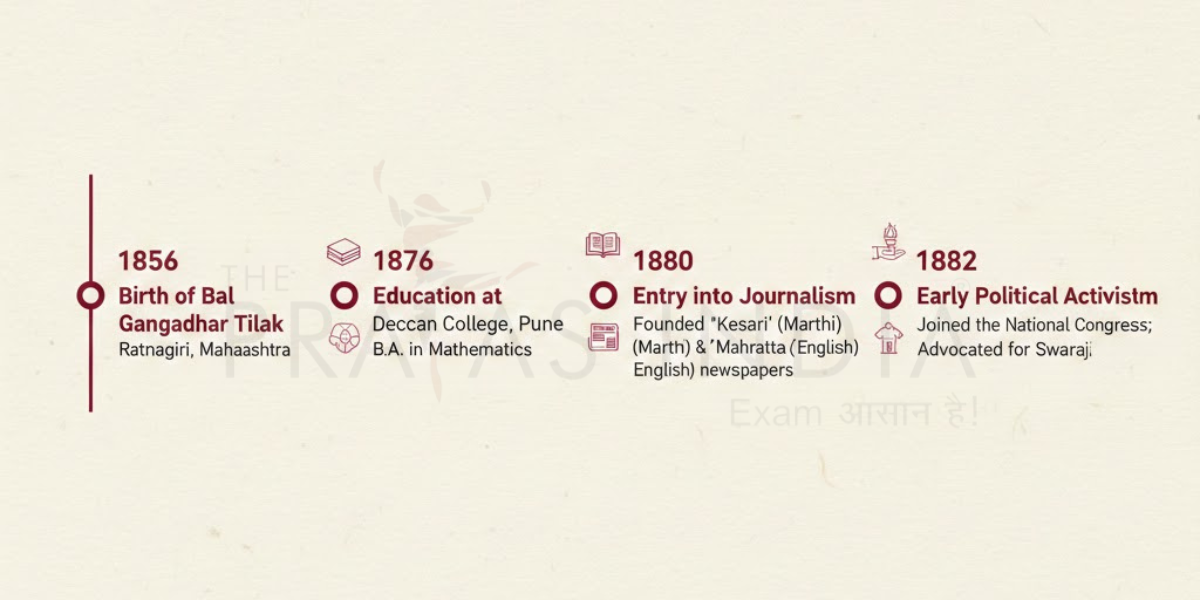
Bal Gangadhar Tilak was born in 1856 at Ratnagiri in the Bombay Presidency. He was educated at Deccan College, Pune, where he studied mathematics and law. Tilak combined Western education with a deep engagement in Indian history, philosophy, and culture, a synthesis that shaped his distinctive political worldview.
Early in his career, Tilak became associated with educational initiatives such as the Deccan Education Society, believing that political awakening must rest on national education. His intellectual grounding in Indian scriptures, combined with exposure to Western political ideas like liberty and self-rule, produced a form of nationalism that was assertive, culturally rooted, and politically uncompromising.
Tilak as a Nationalist Ideologue
Concept of Swaraj
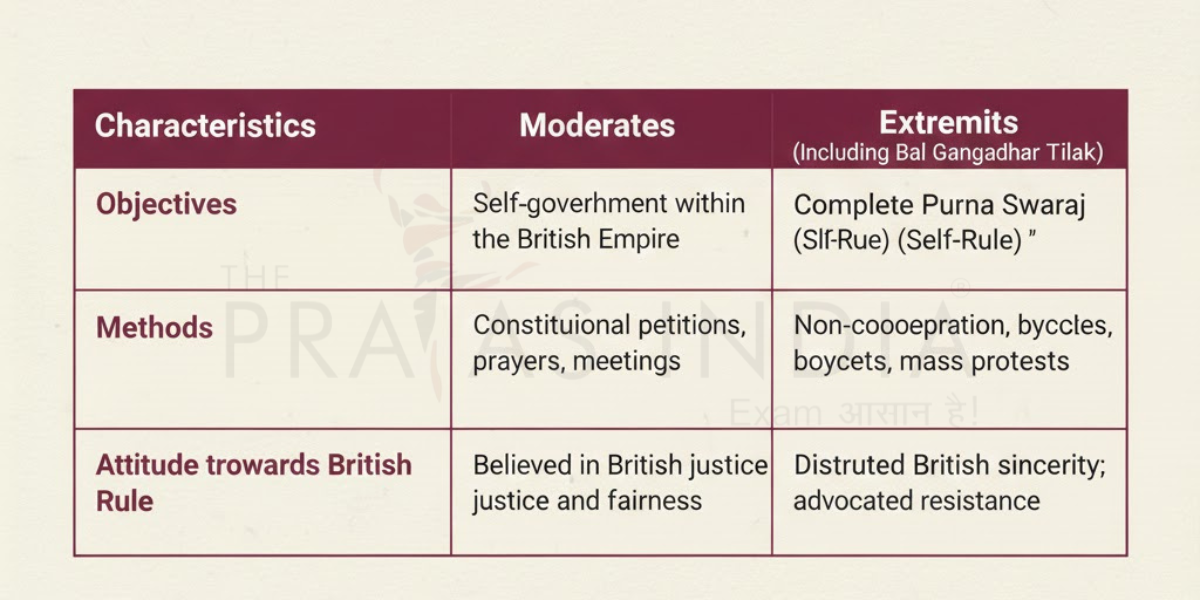
For Tilak, Swaraj meant self-rule as an inherent right, not a concession to be gradually earned through loyalty to colonial rule. Unlike the Moderates, who viewed political reforms as a gift of British liberalism, Tilak asserted that freedom could be achieved only through persistent struggle.
Interpretation of Nationalism
Tilak’s nationalism was cultural and historical, drawing inspiration from India’s past rather than solely from Western constitutionalism. He believed that national pride and collective self-confidence were prerequisites for political liberation.
Use of History and Religion
Tilak used Indian history and religious symbolism not as ends in themselves but as mobilising tools. Figures like Shivaji were projected as symbols of resistance and self-rule, fostering unity and political consciousness among the masses.
Role in the Indian National Congress (Extremist Phase)
By the early 20th century, ideological differences within the Congress crystallised into a split between Moderates and Extremists.
Surat Split (1907)
The Surat session of 1907 marked the formal division. Tilak emerged as a leading figure of the Extremists, advocating:
- Boycott of British goods
- Swadeshi and national education
- Passive resistance to unjust laws
Tilak’s leadership style was direct, confrontational, and mass-oriented, sharply contrasting with the cautious constitutionalism of the Moderates.
Methods of Mass Mobilisation
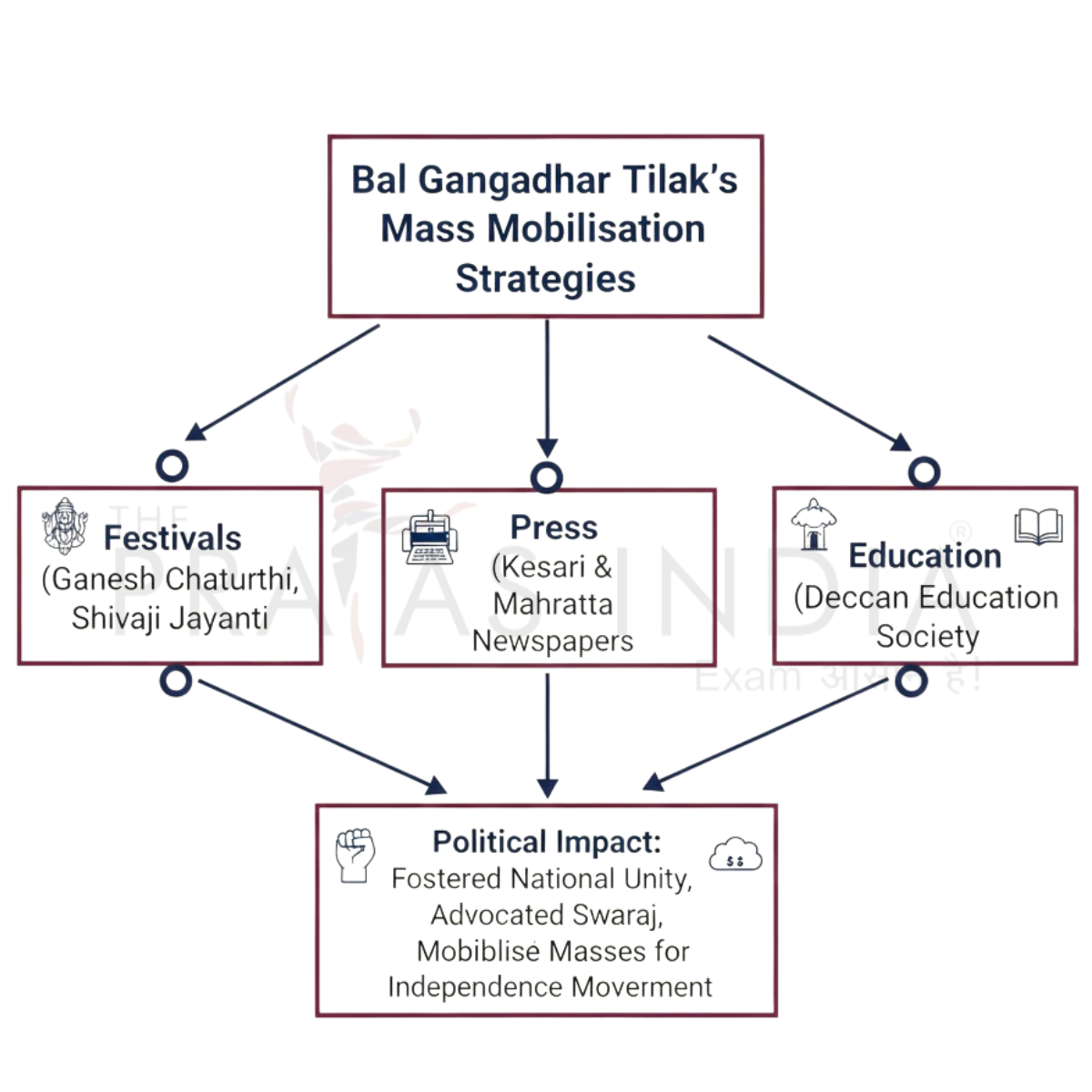
Tilak’s most enduring contribution was his innovation in mass mobilisation, which brought ordinary people into the nationalist fold.
Ganapati and Shivaji Festivals
Tilak transformed religious and historical festivals into public political platforms, breaking colonial restrictions on political gatherings and fostering collective participation.
Vernacular Press
Through newspapers like Kesari (Marathi) and Mahratta (English), Tilak communicated nationalist ideas in accessible language, criticising colonial policies and educating the masses politically.
Political Education
Tilak believed that political consciousness, not elite negotiation, was the foundation of freedom. His methods democratised nationalism.
Revolutionary and Radical Nationalism
Tilak openly supported boycott, swadeshi, and passive resistance, and though not directly associated with revolutionary violence, he defended the right of Indians to resist oppressive rule.
Trials and Imprisonment
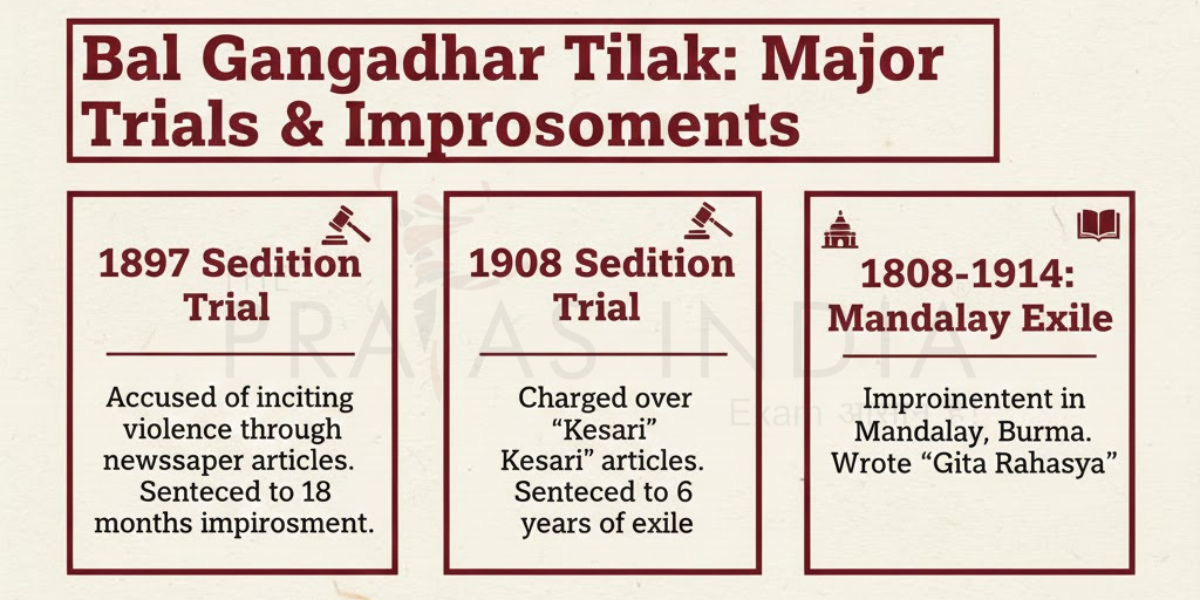
Tilak was repeatedly tried for sedition. His imprisonment in Mandalay (1908–1914) became a symbol of colonial repression and further elevated his stature among nationalists.
Home Rule Movement
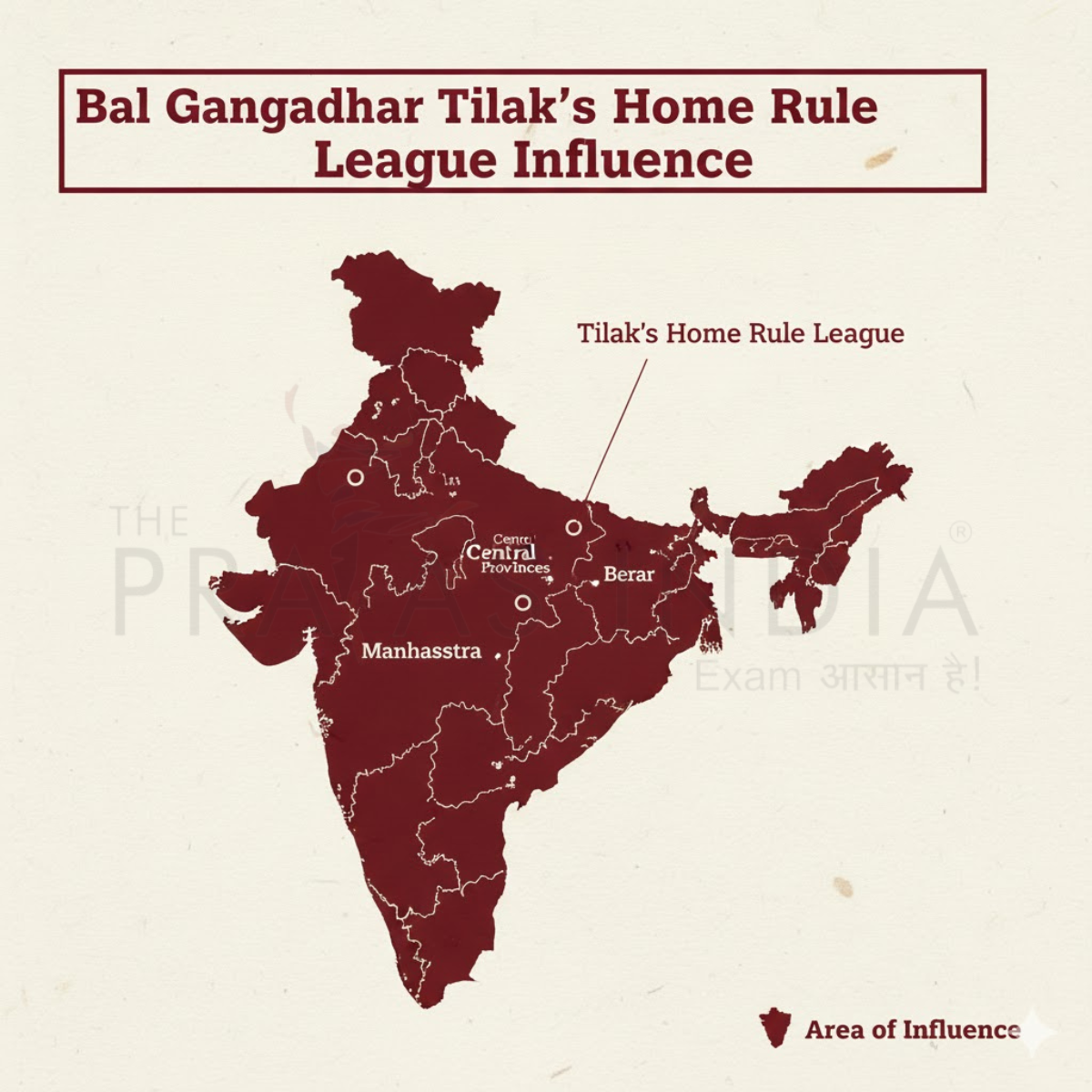
After his release, Tilak launched the Home Rule League (1916), demanding self-government within the British Empire on the lines of dominions like Australia.
Objectives and Methods
The movement aimed at political education, mobilising public opinion, and pressuring the colonial government through constitutional agitation.
Contribution
The Home Rule Movement marked a nationwide political awakening and reunited Extremists and Moderates under a common platform, preparing the ground for Gandhian mass movements.
Tilak’s Role in Social and Educational Reform
Tilak supported national education and opposed colonial control over learning. However, his stance on social reforms—especially women’s rights and caste issues—was conservative compared to other reformers.
While he feared that premature social reform might weaken national unity, critics argue that this limited the inclusiveness of his nationalism.
Contributions to National Integration and Political Thought
Tilak’s greatest legacy lies in reshaping Indian nationalism:
- Assertive politics replaced loyalist constitutionalism
- Mass participation became central
- Swaraj emerged as a non-negotiable goal
Leaders like Gandhi acknowledged Tilak’s role in awakening the masses and politicising Indian society.
Critical Evaluation
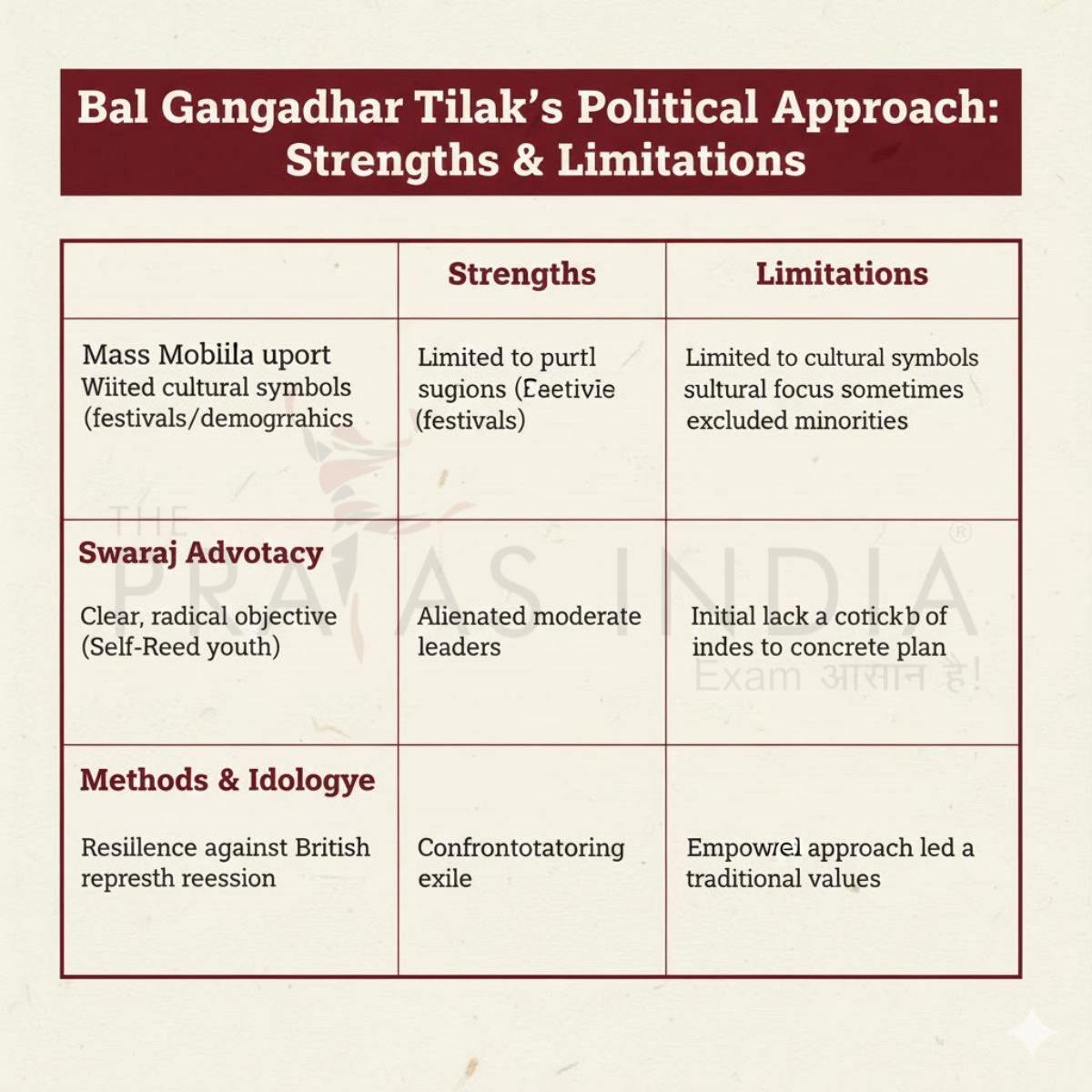
Strengths
- Pioneered mass nationalism
- Asserted self-rule as a right
- Broke colonial moral authority
Limitations
- Cultural nationalism risked communal interpretation
- Limited engagement with social reform
- Confrontational methods sometimes led to repression
Historians differ on whether Tilak’s approach was divisive or necessary, but most agree that it marked a decisive turning point.
Frequently Asked Questions on Bal Gangadhar Tilak – UPSC GS-I
Q1. Why is Bal Gangadhar Tilak called the ‘Father of Indian Unrest’?
Tilak earned this title due to his assertive nationalism, mass mobilisation strategies, and open challenge to British authority through swadeshi, boycott, and passive resistance, which unsettled colonial rule.
Q2. What was Tilak’s concept of Swaraj?
Tilak viewed Swaraj as an inalienable birthright, not a concession by the British. He believed freedom could only be achieved through sustained political struggle and mass awakening.
Q3. How did Tilak differ from the Moderates in the Congress?
While Moderates relied on constitutional methods and petitions, Tilak advocated direct political action, mass participation, and resistance-based nationalism.
Q4. What role did Tilak play in the Surat Split of 1907?
Tilak emerged as a leading Extremist figure. The split reflected ideological differences between Moderates and Extremists over methods and objectives of the freedom struggle.
Q5. How did Tilak mobilise the masses politically?
He used Ganapati and Shivaji festivals, vernacular newspapers (Kesari, Mahratta), and public speeches to politicise ordinary people and bypass colonial restrictions.
Q6. What was Tilak’s contribution to the Home Rule Movement?
Tilak founded the Home Rule League in 1916 to demand self-government, politically educate the masses, and unify nationalist forces across India.
Q7. Was Tilak a revolutionary nationalist?
Tilak was not a revolutionary in the violent sense, but he intellectually defended resistance against unjust colonial rule and supported boycott and swadeshi.
Q8. What criticisms are associated with Tilak’s ideology?
Critics argue that his cultural nationalism risked communal overtones and that his conservative stance on social reforms limited inclusiveness.
Q9. How did Tilak influence later leaders like Gandhi?
Tilak’s emphasis on mass mobilisation, national education, and self-rule laid the foundation for Gandhian mass movements and non-cooperation.
Q10. Why is Tilak important for UPSC GS-I?
Tilak represents the Extremist phase of the Congress, the evolution of mass nationalism, and ideological debates within the freedom movement—frequently asked areas in mains.
Conclusion
Bal Gangadhar Tilak stands as a pioneer of militant and assertive nationalism in India’s freedom struggle. He transformed nationalism into a mass movement, asserted Swaraj as a fundamental right, and infused political struggle with cultural confidence. Though not without limitations, his role was historically indispensable. Tilak’s legacy lies not merely in what he achieved, but in how he redefined the very nature of Indian nationalism, making freedom a collective aspiration rather than an elite demand.