Banking Exam Preparation from Zero: Where Should Beginners Start? | The Prayas India
Starting banking exam preparation from zero can feel confusing. You may know that exams such as IBPS PO, IBPS Clerk/Customer Service Associate, SBI PO, SBI Clerk and IBPS RRB offer opportunities in the banking sector, but knowing where to begin, what to study first, which books to follow and how to build speed is a completely different challenge.
For a beginner, the biggest problem is usually not a lack of motivation. It is the absence of a clear preparation system.
Should you start with Quantitative Aptitude or Reasoning? Should you complete the entire syllabus before solving previous-year questions? How much time should you spend on English and General Awareness? When should you start mock tests? If your mathematics basics are weak, should you first spend months studying school-level concepts?
These questions can make the first few weeks of preparation unnecessarily difficult.
The good news is that banking exam preparation becomes much more manageable when you divide it into clear stages. Instead of trying to study everything at once, beginners should first understand the examination ecosystem, assess their current level, strengthen fundamentals, develop question-solving ability and gradually move towards timed practice and mock tests.
This article explains how to start banking exam preparation from zero and how a structured approach can help you avoid the confusion that many beginners face.
Why Banking Exam Preparation Can Feel Difficult for Beginners
Banking exams are competitive examinations, so preparation involves more than simply knowing the syllabus. You need to develop a combination of conceptual clarity, calculation ability, reasoning skills, English proficiency, awareness of banking and current affairs, speed, accuracy and examination temperament.
The challenge becomes even greater because different banking examinations can have different structures, stages, sectional requirements and selection processes. For example, the current IBPS calendar covers separate recruitment processes for PO/MT, Specialist Officers and Customer Service Associates, while IBPS RRB has separate processes for Officer and Office Assistant posts. The official calendar also makes clear that dates are tentative and candidates should follow the individual notifications for final details.
That is why a beginner should not build preparation around one random timetable copied from the internet. The better approach is to build a common banking-exam foundation first and then adapt preparation to the specific exam being targeted.
Step 1: Decide Which Banking Exams You Want to Target
Before opening your first book, identify the exams you are realistically interested in.
Depending on your eligibility, career preference and preparation timeline, you may consider examinations conducted by IBPS, SBI and other banking recruitment bodies. Within the IBPS ecosystem, for example, the 2026–27 calendar includes PO/MT, CSA and RRB recruitment processes.
You do not necessarily need to prepare separately for every examination from Day 1.
A smarter beginner strategy is to identify the common preparation areas first:
- Quantitative Aptitude
- Reasoning Ability
- English Language
- General Awareness and Current Affairs
- Banking Awareness where relevant
- Computer-related preparation where required
- Descriptive or other mains-specific components where applicable
The exact requirements should always be checked against the latest official notification of the examination you plan to take.
The purpose of choosing your target exams early is not to restrict yourself. It is to give your preparation a direction.
A useful beginner question
Instead of asking, “Which banking exam should I study for first?”, ask:
“Which banking exams share the preparation areas I can build together?”
That shift can help you create a broader preparation base while keeping your strategy focused.
Step 2: Understand Your Current Level Before Starting
One of the most common mistakes beginners make is immediately purchasing multiple books and starting random chapters.
Before doing that, spend a few days understanding your current level.
Try basic questions from Quantitative Aptitude, Reasoning and English without worrying about your score. The objective is not to prove whether you are good or bad at the subjects. The objective is to discover your starting point.
For example, you may discover that:
- Your basic calculations are slow.
- Percentages and ratios are difficult.
- You understand reasoning concepts but take too long to solve puzzles.
- Your English grammar is reasonable but reading comprehension takes time.
- You know basic current affairs but have no organised revision system.
- You understand questions but make avoidable mistakes under time pressure.
This diagnostic stage is extremely useful because it prevents you from following a preparation plan that does not match your actual needs.
A beginner with strong mathematical fundamentals should not follow exactly the same starting plan as someone who has struggled with mathematics for years.
Step 3: Build Your Quantitative Aptitude Foundation
For many beginners, Quant is the section that creates the most anxiety.
The solution is not to immediately start solving difficult banking-level questions.
Start with calculation and arithmetic fundamentals.
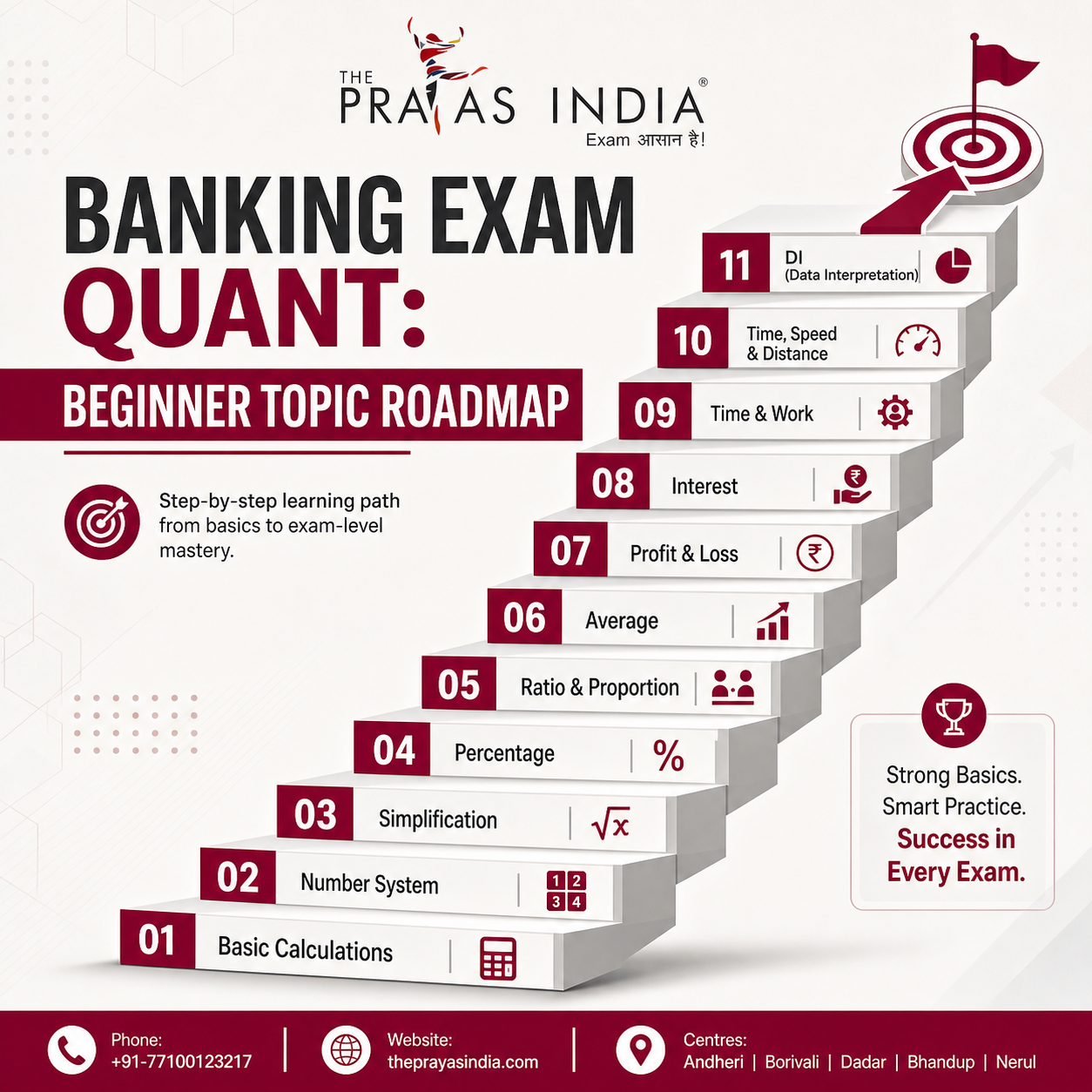
A practical progression can look like this:
Basic Calculations → Number System → Simplification → Percentage → Ratio & Proportion → Average → Profit & Loss → Simple & Compound Interest → Time & Work → Time, Speed & Distance → Mixture & Alligation → Data Interpretation → Advanced Arithmetic
The sequence can be adjusted depending on your existing level and the requirements of your target examination.
Start with calculations
Before chasing shortcuts, become comfortable with:
- Tables
- Squares and cubes
- Fractions and decimals
- Percentage conversions
- Basic multiplication and division
- Approximation
- Mental calculations
Speed in banking exams is built gradually. If basic calculations consume too much time, even a candidate who understands advanced concepts can struggle to complete a timed paper.
Then move towards arithmetic
Arithmetic topics such as percentages, ratio, averages, profit and loss, time and work, and time-speed-distance form an important foundation for many competitive-exam Quant questions.
Do not treat each chapter as an isolated topic.
For example, percentage knowledge supports profit and loss, discounts, interest and data interpretation. Ratio concepts support averages, mixtures and proportional reasoning.
Understanding these connections makes preparation more efficient.
Step 4: Start Reasoning from Concepts, Not Just Puzzles
Reasoning can initially look easier than Quant because many questions do not involve lengthy calculations. However, banking-level reasoning requires speed, logical organisation and efficient decision-making.
A beginner should first understand the basic question types and the logic behind them.
Start with topics such as:
- Inequality
- Syllogism
- Coding-Decoding
- Blood Relations
- Direction Sense
- Order and Ranking
- Alphanumeric Series
- Seating Arrangement
- Puzzles
- Input-Output
- Data Sufficiency and other relevant areas
The important point is to avoid spending hours attempting difficult puzzles before understanding the underlying approach.
For example, if you repeatedly struggle with seating arrangement questions, solving 30 random puzzles may not fix the problem. You need to understand how to translate conditions into a structured arrangement, identify fixed information, manage possibilities and eliminate cases efficiently.
This is one area where guided practice can be valuable for beginners. Instead of spending excessive time trying to discover the approach independently, students can learn standard methods, practise them and receive feedback when their approach is inefficient.
Step 5: Build English Through Daily Practice
English preparation should not be postponed until Quant and Reasoning are completed.
For beginners, English works best as a consistent daily subject.
Your preparation can include:
- Grammar fundamentals
- Vocabulary
- Reading comprehension
- Cloze tests
- Error detection
- Sentence-based questions
- Para-based questions
- Fillers
- Reading practice
However, avoid turning English preparation into a memorisation exercise.
Reading regularly is particularly important because it improves comprehension, vocabulary exposure and familiarity with different sentence structures.
A simple routine could include reading an editorial or quality article, learning a limited number of useful words, revising grammar concepts and solving a small set of exam-level questions.
Consistency is more valuable than studying English for five hours once a week.
Step 6: Do Not Ignore General Awareness and Banking Awareness
Beginners often make one of two mistakes with General Awareness.
Some students completely ignore it until the final few weeks. Others try to memorise everything they see online.
Neither approach is particularly efficient.
A better system is to create a daily current-affairs routine from the beginning.
Depending on your target examination, your preparation may include:
- Current affairs
- Banking and financial awareness
- RBI-related developments
- Government schemes
- Important economic developments
- Banking terminology
- Important appointments
- Awards and reports
- National and international events
The exact scope should be aligned with the latest notification and recent examination trends for your target exam.
The objective is to build a revision-friendly knowledge base rather than continuously consume news without retaining it.
Step 7: Follow the Right Study Sequence
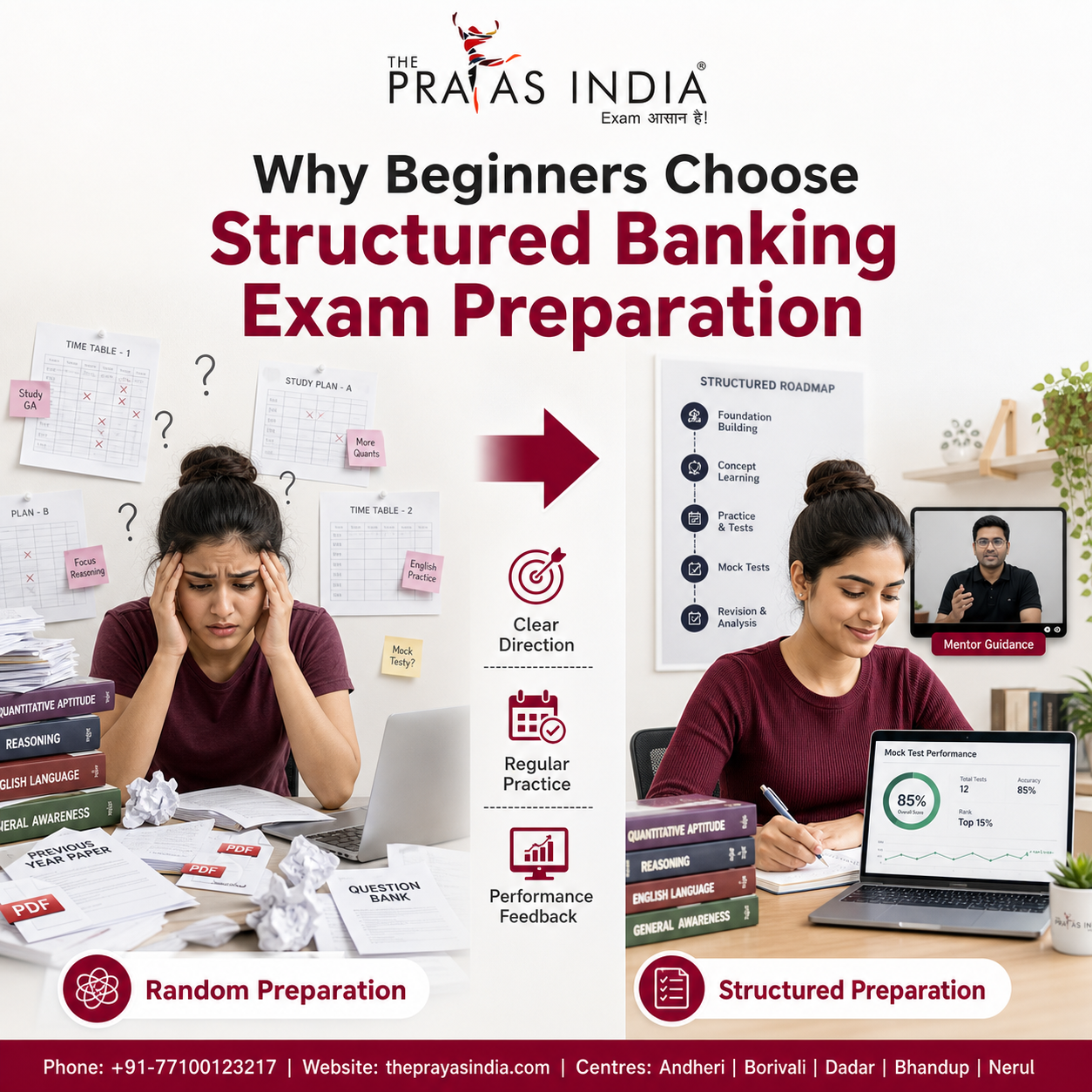
One of the biggest differences between random preparation and structured preparation is sequence.
A beginner often follows this pattern:
New YouTube video → random PDF → difficult question → another book → mock test → another strategy video
This creates the feeling of studying without creating measurable progress.
A better system is:
Concept → Examples → Topic Practice → Previous-Year Questions → Timed Practice → Sectional Test → Analysis → Revision
This cycle should be repeated for every major topic.
For example, if you are learning percentages, do not simply watch a lecture and move on.
First understand the concept. Then solve guided examples. Practise basic questions. Move towards exam-level questions. Solve relevant previous-year questions. Finally, test yourself under time pressure.
This transforms passive learning into active preparation.
Step 8: Use Previous-Year Questions Early
Beginners sometimes postpone previous-year questions because they believe PYQs should only be solved after completing the syllabus.
That approach can delay understanding of the actual examination.
Previous-year questions help you understand what the exam expects from you.
They can show you:
- What types of questions are repeatedly tested
- How concepts are applied
- Which topics require more practice
- How difficult questions actually feel
- Where you are making mistakes
- How much time certain question types consume
However, do not use PYQs merely as another question bank.
Analyse them.
If you get a question wrong, ask:
Did I not understand the concept?
Did I forget the method?
Did I make a calculation mistake?
Did I misunderstand the question?
Did I spend too much time on it?
This type of analysis gradually improves both accuracy and exam decision-making.
Step 9: Develop Speed Only After Building Accuracy
A common beginner mistake is trying to become fast before becoming accurate.
Speed matters in banking examinations, but uncontrolled speed creates negative consequences: calculation errors, incorrect option selection and unnecessary attempts.
The better progression is:
Conceptual clarity → Accuracy → Familiarity → Timed practice → Speed → Exam strategy
Suppose you can solve 15 questions correctly but need excessive time. Your next goal should not immediately be “solve 30.”
Instead, identify why those 15 questions take so long.
Perhaps your calculations are slow. Perhaps you are repeatedly using lengthy methods. Perhaps you are spending too much time on one difficult question.
Fix the underlying issue first.
Speed is often the result of familiarity, efficient methods and repeated timed practice.
Step 10: Introduce Sectional Tests at the Right Stage
You do not need to take full-length mocks from your first day of preparation.
Initially, your focus should be on learning.
Once you have developed a reasonable foundation, introduce sectional tests.
For example:
Stage 1: Topic-wise practice
Stage 2: Mixed-topic practice
Stage 3: Sectional tests
Stage 4: Full-length mocks
Stage 5: Exam-level simulation and revision
This gradual progression prevents mock tests from becoming discouraging.
The purpose of a test is not simply to produce a score.
A good test should tell you what to improve next.
Step 11: Learn How to Analyse Your Mock Tests
A mock test without analysis is often just a score.
After every serious mock, divide your questions into categories:
Correct and confident
These are your strengths. Maintain them.
Correct but time-consuming
These need speed improvement.
Incorrect despite knowing the concept
These indicate execution or concentration problems.
Incorrect because the concept is weak
These need revision.
Unattempted but solvable
These may indicate time-management or question-selection issues.
Unattempted because they were genuinely difficult
These should not automatically become your priority.
This analysis helps you build a preparation strategy around your actual performance instead of following generic advice.
Step 12: Create a Realistic Daily Routine
A beginner does not necessarily need to study for 10–12 hours every day.
The more important question is whether the study hours are organised and sustainable.
For example, a working beginner might divide preparation into:
Quant: 90 minutes
Reasoning: 75 minutes
English: 60 minutes
Current Affairs/Banking Awareness: 45 minutes
Revision/PYQs: 30 minutes
A full-time aspirant may allocate more time.
The exact schedule should depend on your available hours, target examination and current level.
The key is to create fixed study blocks rather than deciding every morning what to study.
A Beginner-Friendly Weekly Preparation Structure
A simple weekly framework could look like this:
| Area | Primary Focus |
|---|---|
| Quant | Concept + Practice |
| Reasoning | Concepts + Puzzles |
| English | Grammar + Reading + Questions |
| GA | Current Affairs + Revision |
| Banking Awareness | Conceptual + Current Updates |
| PYQs | Topic-wise practice |
| Tests | Sectional/Timed practice |
| Revision | Error notebook + weak topics |
The schedule should evolve as your preparation improves.
During the foundation phase, concepts deserve more time. During the practice phase, questions and PYQs should increase. During the test phase, mocks and analysis become increasingly important.
That is why a fixed timetable for the entire preparation journey is rarely ideal.
What Should a Beginner Study in the First Three Months?
A structured three-month foundation can give beginners a useful starting framework.
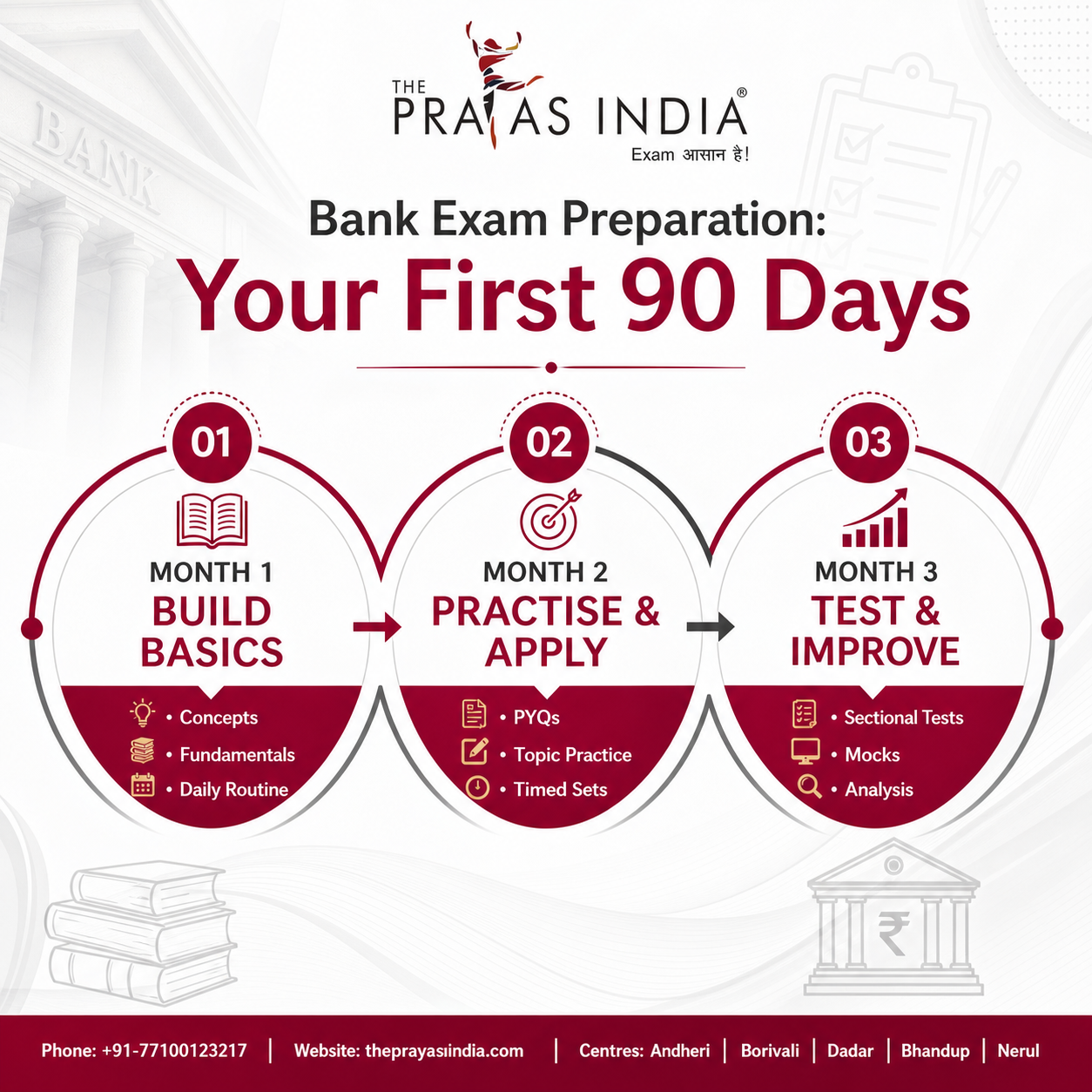
Month 1: Build the Foundation
The first month should focus heavily on fundamentals.
Quant should begin with calculations, number basics, simplification, percentages, ratios and averages.
Reasoning can start with fundamental topics such as inequality, syllogism, coding-decoding, direction sense, blood relations and ranking.
English should include grammar basics, vocabulary development and daily reading.
Current affairs should become a daily habit rather than a last-minute activity.
The objective of Month 1 is not to finish the syllabus.
It is to make the basics comfortable enough that you can begin solving questions independently.
Month 2: Increase Question Practice
Once the basic concepts are in place, increase the number and difficulty of questions.
Quant can move towards profit and loss, interest, time and work, time-speed-distance, mixtures and other arithmetic areas.
Reasoning should increasingly include seating arrangements and puzzles.
English should include more exam-oriented question practice and reading comprehension.
Start solving relevant previous-year questions topic-wise.
At this stage, begin introducing timed practice.
Month 3: Move Towards Exam-Oriented Preparation
By the third month, your preparation should become increasingly test-oriented.
You should begin:
- Taking sectional tests
- Solving mixed-topic sets
- Revising weak concepts
- Analysing mistakes
- Improving calculation speed
- Solving more PYQs
- Building a revision system
- Gradually introducing full-length mocks
The exact pace should depend on your target exam and how quickly you build fundamentals.
The important transition is from “I am studying chapters” to “I am preparing to perform under exam conditions.”
The Most Common Mistakes Beginners Should Avoid
Starting from zero does not mean you have to make every beginner mistake.
1. Collecting too many resources
Five books and ten Telegram PDFs do not automatically create better preparation.
Choose reliable resources and complete them properly.
2. Changing strategy every week
One week you follow one teacher, the next week you change books, and the following week you adopt another timetable.
This creates inconsistency.
3. Chasing shortcuts before concepts
Shortcuts are useful after understanding the underlying method.
They should make preparation faster, not replace understanding.
4. Ignoring weak subjects
Students naturally spend more time on subjects they enjoy.
But competitive examinations require balanced preparation.
5. Avoiding mocks because the score is low
Low scores during preparation are not necessarily a problem.
Ignoring the information those scores provide is the bigger problem.
6. Studying without revision
A concept studied once is not necessarily a concept retained.
Revision should be built into the weekly schedule.
7. Preparing only for Prelims
For exams that have multiple stages, your preparation should eventually account for the requirements of the later stage as well.
IBPS PO, for example, follows a multi-stage process involving Preliminary and Main examinations, with later stages specified in the recruitment process.
Self-Study or Coaching: What Should a Beginner Consider?
Self-study can work very well for a disciplined student who has reliable resources, understands the syllabus, can build a realistic timetable and is capable of analysing performance independently.
However, beginners often struggle with exactly these areas.
They may know that they need to study Quant, Reasoning and English but do not know which topics should come first. They may solve hundreds of questions without understanding why their mock scores are not improving. They may spend weeks collecting material instead of completing a structured course of study.
This is where coaching can provide structure.
The value of a good banking preparation programme should not simply be measured by the number of lectures available. A useful programme should connect:
Concepts → Practice → PYQs → Tests → Analysis → Revision → Mentorship
The Prayas India’s banking-exam preparation ecosystem highlights structured learning, faculty guidance, study material, mock-test practice, performance analysis and doubt support as components of its preparation approach.
For a beginner, this can reduce the amount of time spent figuring out the preparation system and allow more time to be spent actually learning and practising.
How to Choose the Right Banking Coaching Programme
Do not choose a coaching institute simply because an advertisement says it is the “best.”
Instead, ask practical questions.
Check the faculty
Can the faculty explain fundamentals clearly to beginners?
Check the study plan
Does the programme provide a logical progression from basics to exam-level practice?
Check practice support
Are there sufficient topic-wise questions, PYQs, sectional tests and full-length mocks?
Check performance analysis
Will you understand why you are losing marks and time?
Check doubt support
Can you get your doubts resolved without waiting indefinitely?
Check mentorship
Is there someone helping you evaluate your preparation and adjust your strategy?
Check flexibility
Are online/offline learning options and batch timings compatible with your schedule?
Check the target exams
Does the programme support the banking examinations you actually intend to target?
These factors matter much more than simply choosing the institute with the largest collection of study material.
Where Structured Guidance Can Make the Biggest Difference
A beginner usually needs guidance at three critical points.
First: Direction.
You need to know what to study and in what order.
Second: Correction.
You need to know when your method is inefficient or your preparation is moving in the wrong direction.
Third: Accountability.
You need a system that encourages you to maintain consistency, complete targets and regularly measure progress.
This is particularly relevant when you are preparing for competitive examinations alongside college, work or other responsibilities.
The Prayas India offers banking and competitive-exam preparation through structured learning formats and has centres including Andheri, Borivali, Dadar, Bhandup and Nerul, along with other locations listed on its official platform.
For students who prefer a guided environment, enquiring about the course structure, batch schedule, teaching methodology and admission process before enrolling can help them understand whether the programme matches their preparation needs.
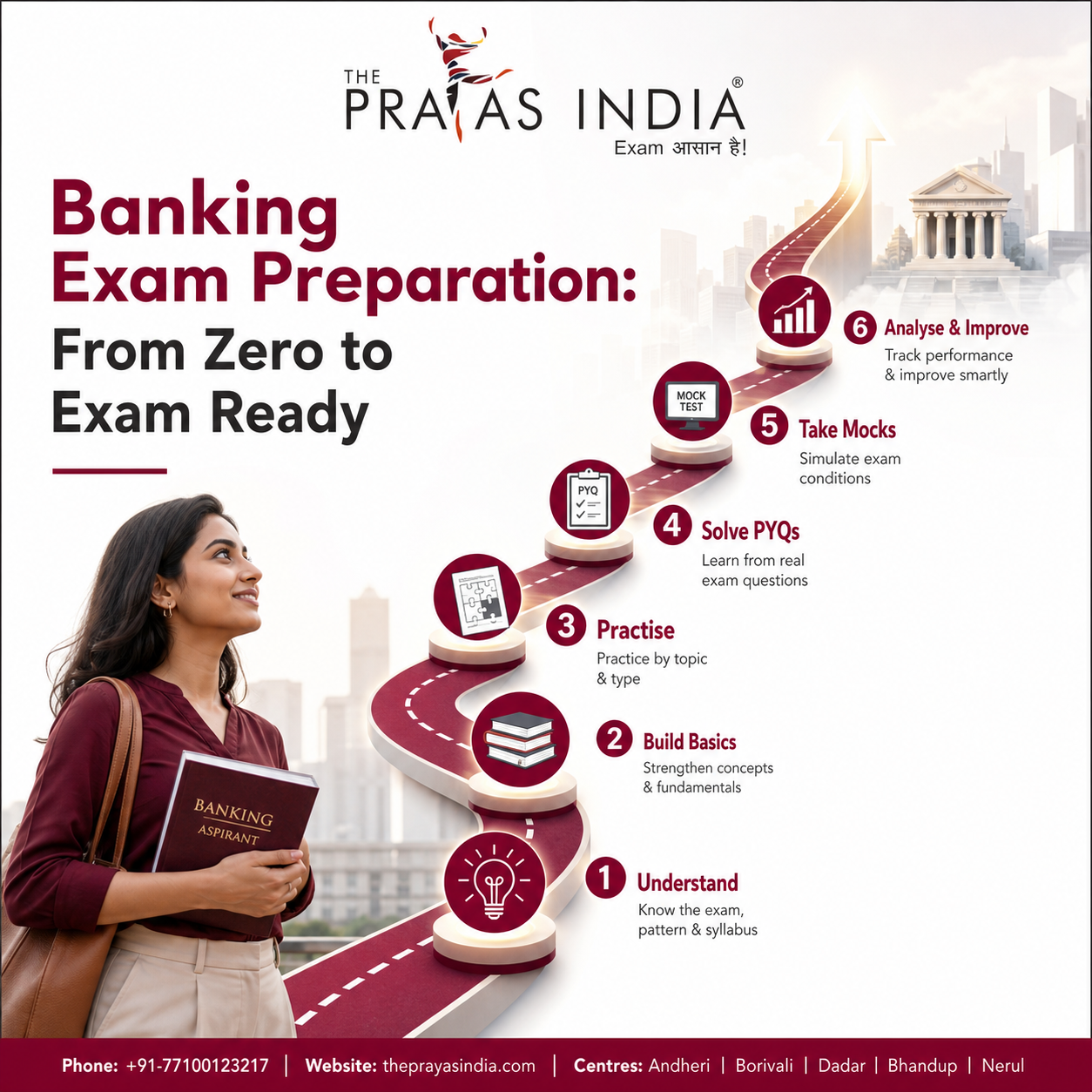
A Practical Banking Exam Preparation Roadmap from Zero
If you are starting completely from scratch, your journey can be divided into six broad stages.
Stage 1: Understand
Learn the exam structure, identify target exams and understand the subjects.
Stage 2: Build
Strengthen Quant, Reasoning and English fundamentals while establishing a current-affairs routine.
Stage 3: Practise
Solve topic-wise questions and gradually move towards exam-level problems.
Stage 4: Apply
Use previous-year questions and timed sets to understand how concepts appear in actual examinations.
Stage 5: Test
Introduce sectional tests and full-length mocks.
Stage 6: Improve
Analyse mistakes, revise weak areas, improve speed and refine question-selection strategy.
This is the stage where preparation becomes increasingly personalised.
Two students may have completed the same syllabus but still require completely different improvement plans.
One may need to improve Quant speed. Another may need better puzzle selection. A third may need English accuracy. A fourth may need stronger General Awareness revision.
Therefore, the final phase should be driven by performance data rather than assumptions.
What If Your Maths Is Weak?
Do not assume that weak mathematics means banking exams are not for you.
If your fundamentals are weak, start from the beginning.
Learn the basic concepts properly. Practise simple questions. Build calculation speed. Move gradually towards exam-level problems.
The mistake is expecting yourself to solve difficult questions immediately.
A strong foundation is not a sign that you are behind. It is the preparation stage that allows you to eventually handle higher-level questions with greater confidence.
The same principle applies to Reasoning and English.
You do not need to be excellent on Day 1.
You need a system that allows you to improve consistently.
What If You Are Starting Late?
Starting late does not mean you should study randomly for longer hours.
It means your preparation needs to become more selective.
Prioritise:
- High-value fundamentals
- Frequently tested concepts
- Previous-year questions
- Weak areas
- Timed practice
- Mock analysis
- Revision
Avoid spending excessive time on low-priority resources or repeatedly changing your strategy.
If your exam is approaching, a mentor or structured programme can also help you understand how to prioritise your remaining preparation time.
When Should You Consider Joining Banking Exam Coaching?
There is no universal rule that every banking aspirant must join coaching.
But structured coaching can be particularly useful if:
- You are completely new to competitive exams.
- You do not know where to start.
- Your Quant or Reasoning fundamentals are weak.
- You struggle to maintain consistency.
- You keep changing resources.
- You do not know how to analyse mocks.
- Your scores remain stagnant despite regular study.
- You need regular doubt-solving support.
- You want a fixed preparation structure.
- You prefer learning with faculty guidance and mentorship.
The decision should ultimately depend on your learning style, available time, current level and preparation needs.
What matters is choosing a programme that provides more than lectures.
Start Your Banking Exam Preparation With a System, Not Just a Syllabus
The first step in banking exam preparation is not buying ten books or downloading hundreds of PDFs.
It is creating clarity.
Know your target exams. Understand the subjects. Assess your current level. Build your fundamentals. Practise systematically. Use PYQs. Introduce tests gradually. Analyse your performance. Revise regularly.
Most importantly, do not confuse being busy with making progress.
Three hours of focused study with a clear objective can be more useful than an entire day spent switching between resources.
If you are a beginner and feel confused about where to start, this is also the right time to explore whether structured coaching can make your preparation more organised.
A guided programme can provide the sequence, practice environment, testing framework and mentorship that many beginners struggle to create on their own. The Prayas India positions its banking preparation around structured learning, faculty support, mock tests, performance analysis and doubt resolution.
You can explore the available programme, understand the batch structure and speak with the team before deciding whether the course fits your preparation requirements.
Your banking exam preparation does not have to begin with knowing everything. It needs to begin with knowing what to do next.
Frequently Asked Questions About Banking Exam Preparation
1. Can I start banking exam preparation from zero?
Yes. Beginners can start with basic concepts in Quantitative Aptitude, Reasoning and English before gradually moving towards exam-level questions, previous-year papers, sectional tests and mock tests.
2. Which subjects should I study first for banking exams?
Start by building fundamentals in Quantitative Aptitude, Reasoning Ability and English while developing a regular Current Affairs and Banking Awareness routine. Your exact preparation should be aligned with the requirements of your target examination.
3. How many hours should I study for bank exams?
There is no fixed number of hours that works for every aspirant. Create a realistic daily schedule based on your current level, target exam and available time, and focus on maintaining consistency.
4. Should beginners take mock tests?
Initially, beginners should focus on concepts and topic-wise practice. Once the fundamentals become stronger, sectional tests and full-length mocks should be introduced gradually along with detailed performance analysis.
5. Are previous-year questions important for banking exams?
Yes. Previous-year questions help aspirants understand how concepts are tested, identify recurring question types and become familiar with the level and style of the examination.
6. What if my Quantitative Aptitude is weak?
Start with basic calculations and fundamental arithmetic concepts. Build accuracy first and then gradually work on speed, shortcuts and exam-level questions through consistent practice.
7. Is coaching necessary for banking exam preparation?
Coaching is not compulsory for every student. However, structured coaching can be useful for beginners who need a clear study sequence, faculty guidance, regular practice, mock tests, doubt resolution and mentorship.
8. How can The Prayas India help banking exam beginners?
The Prayas India follows a structured preparation approach that includes learning, practice and testing, along with faculty guidance, study material, mock-test practice, performance tracking, doubt support and foundation support for beginners.
9. Can I prepare for IBPS, SBI and RRB exams together?
You can build a common foundation for many banking examinations and then customise your preparation according to the specific exam. Always check the latest official notification for the exact syllabus, pattern and selection process.
10. How can I enquire about banking exam classes at The Prayas India?
You can contact The Prayas India to understand the available banking exam courses, batch timings, online/offline options, course structure and admission process before making your enrolment decision.
Start Your Banking Exam Preparation With the Right Guidance
Starting from zero becomes easier when you have a clear preparation roadmap, experienced faculty, regular practice, mock tests and consistent academic support. If you are confused about where to begin or how to structure your preparation, explore a guided banking exam preparation programme before making your next move.
Admissions Open for Banking Exam Preparation
Get guidance on course structure, batches, preparation methodology and admission options.
Our Centres
Andheri | Borivali | Dadar | Bhandup | Nerul
Speak with our team to understand the right banking exam course, batch and preparation option for your current level. Take the first step towards a more structured preparation journey.