
Caspian Sea: Physical Geography, Geological Evolution, Ecology, Economy, and Geopolitical Significance
- GS Paper 1: Physical Geography, Ocean Geography, World Geography
- GS Paper 3: Environment, Energy Resources, Climate Change
- Prelims: Seas & Lakes, Inland Water Bodies, Map-based Questions, Resources
- Geography Optional: Oceanography, Inland Seas, Environmental Geography, Resource Geography
The Caspian Sea is the world’s largest enclosed inland water body, occupying a unique position at the crossroads of Europe and Asia. Despite being called a “sea,” it is technically an endorheic (closed) basin with no natural outlet to the world oceans. Its waters are saline, though less salty than open oceans, which has historically fueled the debate over whether it should be classified as a sea or a lake.
From a geographical perspective, the Caspian Sea represents a relict water body, a remnant of ancient marine systems that once connected Europe, Asia, and the Middle East. Strategically, it holds immense importance due to its rich hydrocarbon reserves, unique biodiversity, critical transport routes, and complex geopolitical dynamics among its littoral states.
In the Eurasian geopolitical landscape, the Caspian Sea functions as a resource hub, ecological hotspot, and strategic buffer zone, making it a topic of high relevance for UPSC examinations.

Location & Extent
The Caspian Sea is located between Eastern Europe and Central Asia, extending roughly in a north–south orientation.
Bordering Countries
Five sovereign states border the Caspian Sea:
- Russia (northwest)
- Kazakhstan (northeast)
- Turkmenistan (southeast)
- Iran (south)
- Azerbaijan (west)
Spatial Dimensions
- Length: ~1,200 km
- Maximum width: ~435 km
- Surface area: ~371,000 sq km
- Shoreline length: ~7,000 km
The coastline varies significantly:
- Low-lying deltas and wetlands in the north
- Steep, mountainous margins along the southern Iranian coast
- Arid, desert fringes in the east (Turkmenistan)

Geological Origin & Evolution
a. Remnant of the Tethys Sea
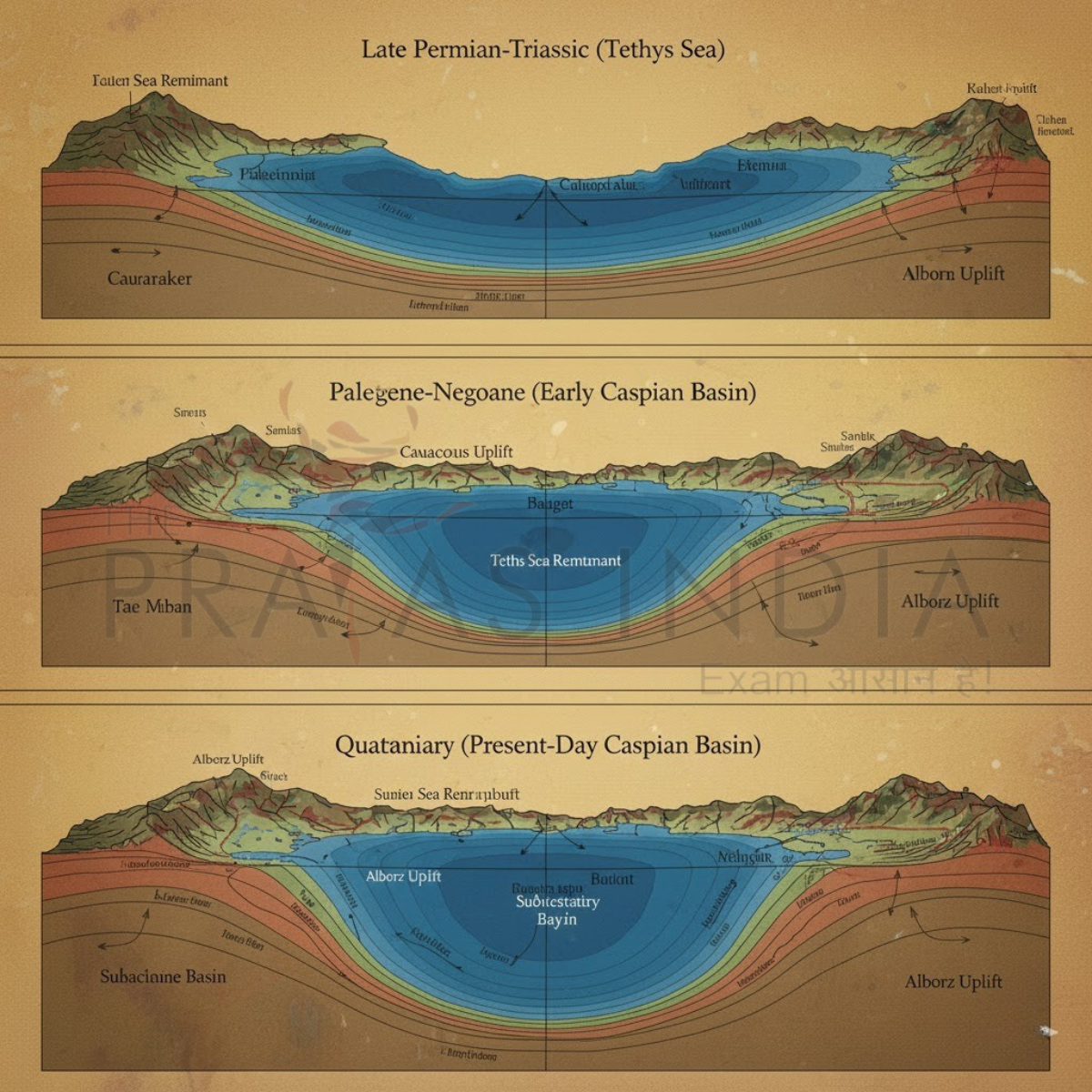
The Caspian Sea is a relict basin of the ancient Tethys Sea, which existed during the Mesozoic era. As tectonic movements reshaped Eurasia, the Tethys Sea gradually fragmented into smaller basins.
b. Tectonic Isolation
- The uplift of the Alpine–Himalayan belt isolated the Caspian basin.
- Progressive crustal subsidence trapped water, forming an enclosed basin.
- The Caspian became fully isolated during the Late Cenozoic period.
c. Seismic Activity
-
Southern margins, particularly near Iran, lie close to active tectonic zones.
-
Earthquakes are frequent, affecting seabed stability and offshore infrastructure.
Physical Characteristics
a. Basin Division
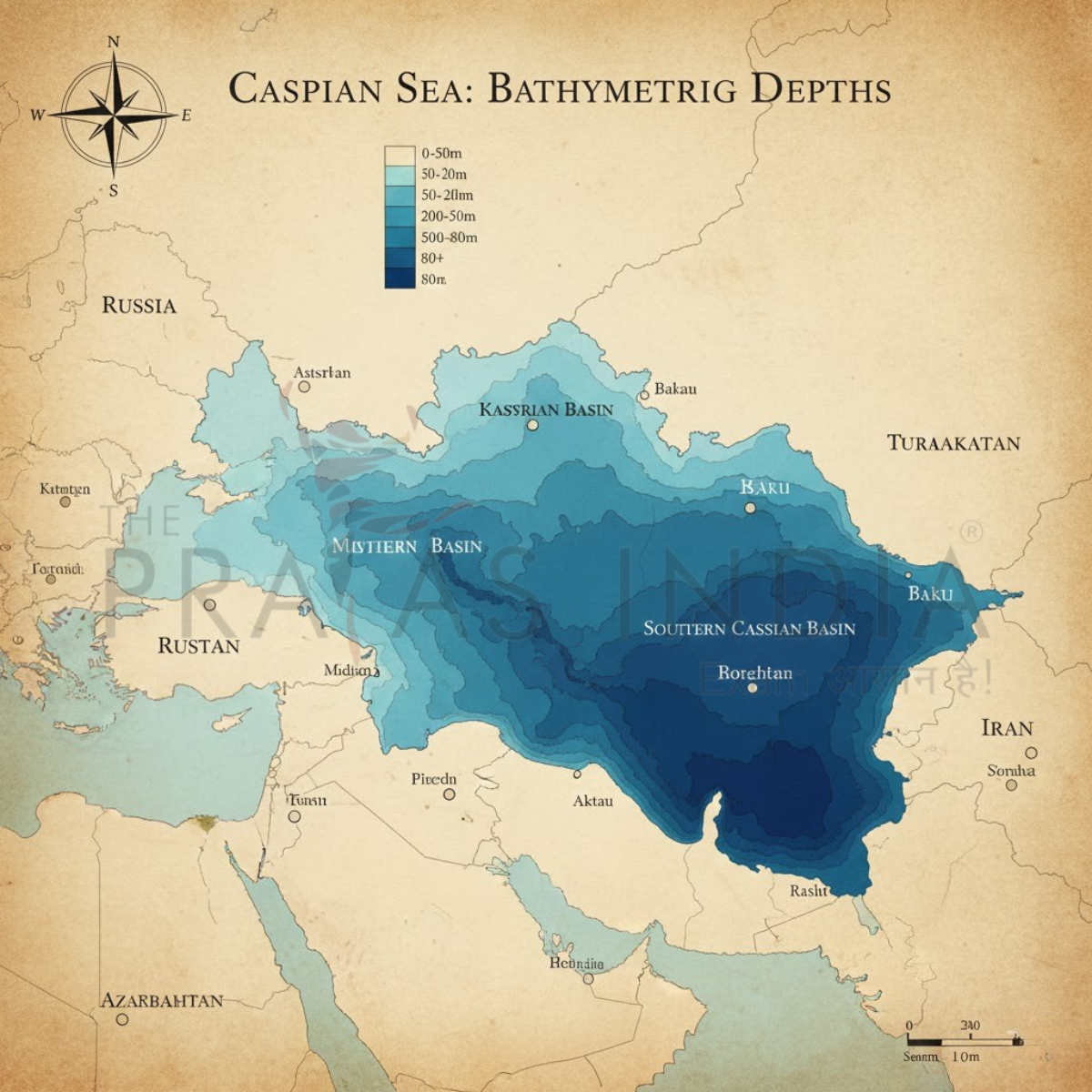
The Caspian Sea is conventionally divided into three distinct basins:
-
Northern Caspian
Very shallow (average depth <10 m)
Extensive wetlands and deltas
Low salinity due to heavy river inflow
-
Middle Caspian
Moderate depth
Transitional salinity
Relatively stable hydrological conditions
-
Southern Caspian
Deepest region
Steep continental slopes
Highest salinity
b. Depth & Salinity
- Average depth: ~211 m
- Maximum depth: ~1,025 m (Southern Caspian)
- Salinity:
- Northern Caspian: nearly freshwater
- Southern Caspian: ~1.2–1.3% (much lower than oceanic 3.5%)
Hydrology & Water Balance
a. Major Inflowing Rivers
The Caspian Sea receives water from over 130 rivers, the most important being:
- Volga River (contributes ~80% of total inflow)
- Ural
- Terek
- Kura
b. Closed Basin System
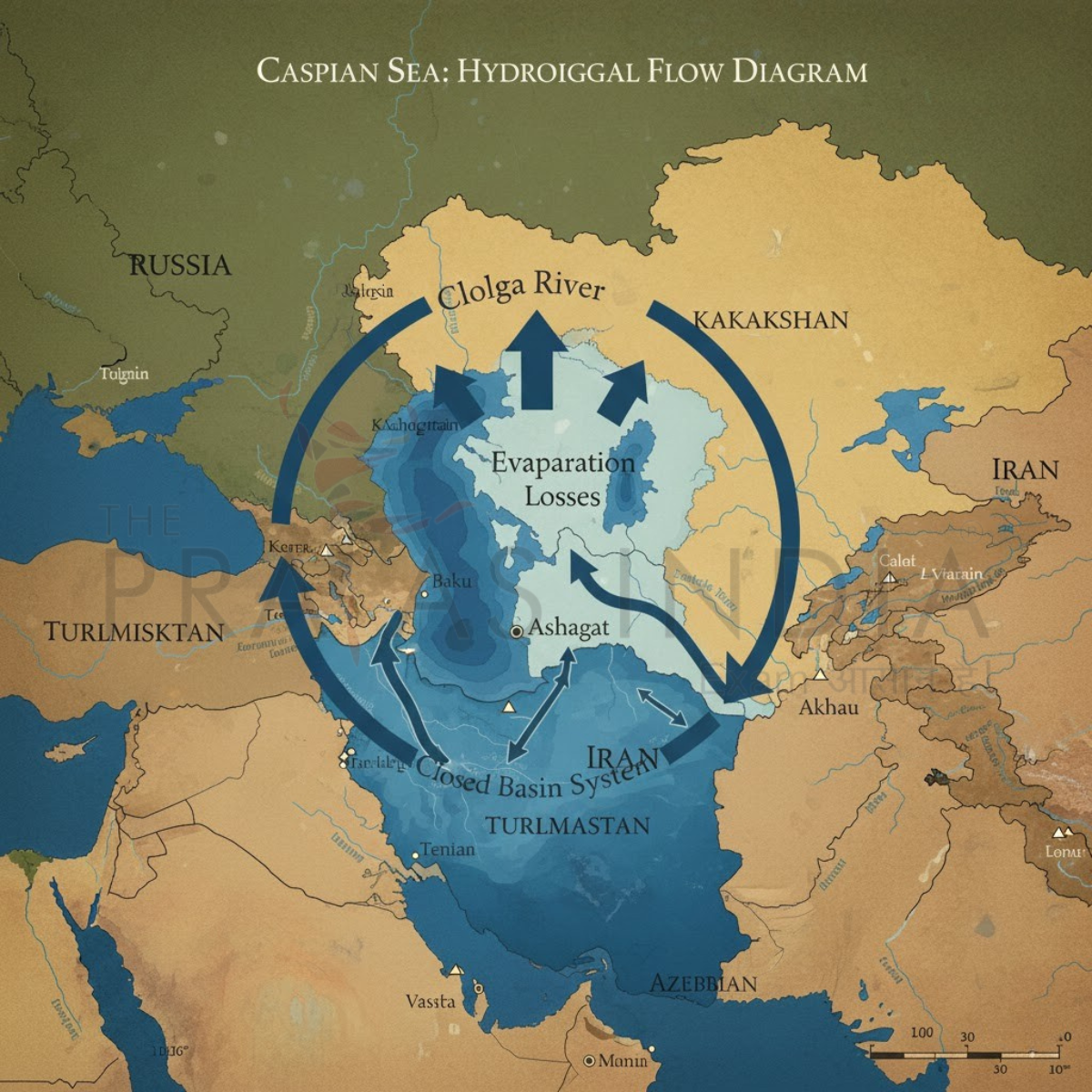
- No natural outlet to any ocean.
- Water loss occurs primarily through evaporation.
c. Fluctuating Water Levels
- Caspian Sea levels have shown significant fluctuations historically.
- Sensitive to:
- Climate variability
- River discharge changes
- Temperature-driven evaporation
Climate Influence
- Northern Caspian:
- Continental climate
- Severe winters
- Seasonal ice formation
- Southern Caspian:
- Milder, semi-arid climate
- Higher humidity near Iranian coast
Climate Change Impacts
- Rising temperatures increase evaporation
- Declining water levels threaten:
- Wetlands
- Fisheries
- Coastal settlements
Biodiversity & Ecosystems
The Caspian Sea hosts unique and fragile ecosystems.
a. Endemic Species
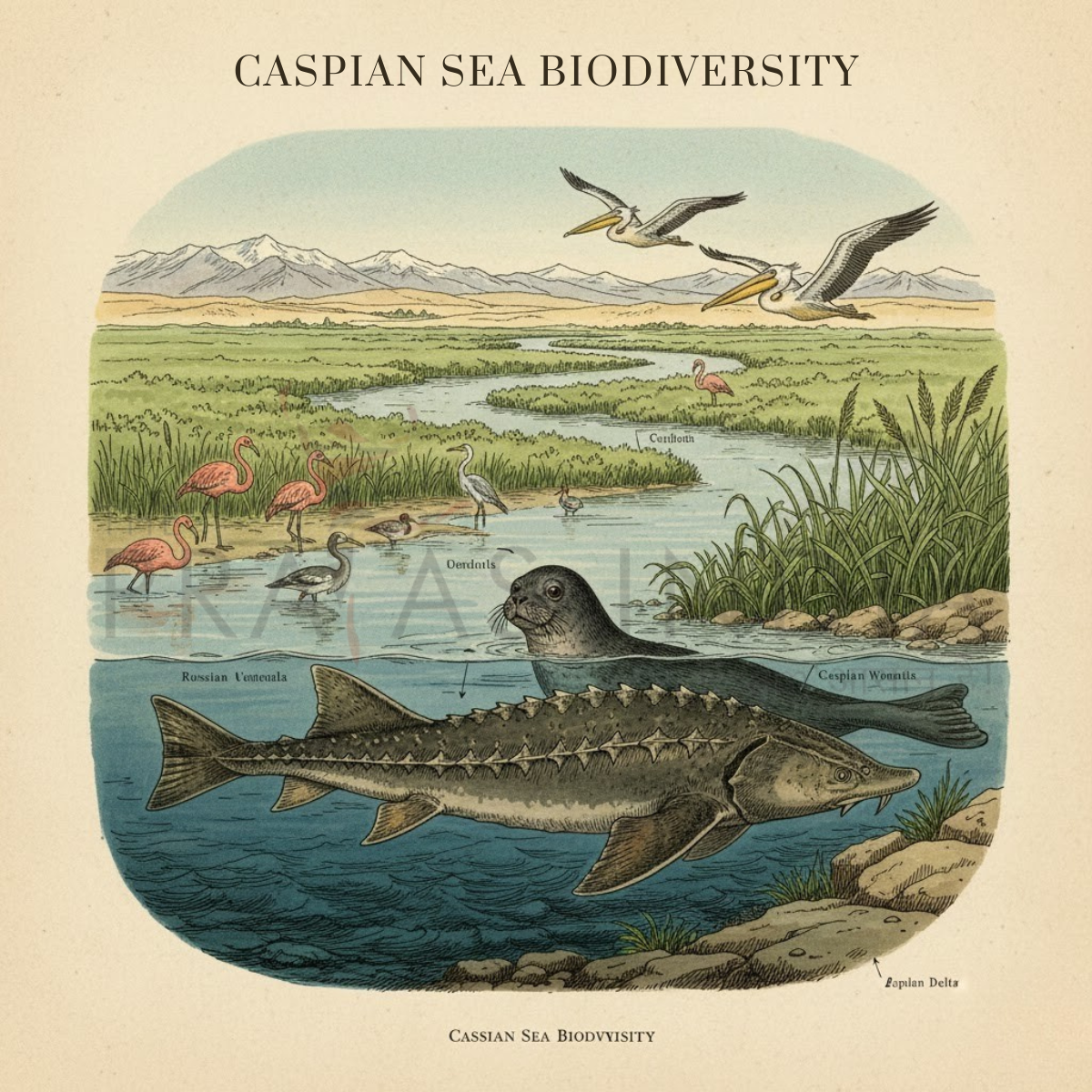
- Caspian Seal (only marine mammal in the sea)
- Several endemic fish species
b. Sturgeon Population
- Produces over 90% of the world’s sturgeon
- Global center of caviar production
c. Wetlands & Deltas
- Volga Delta: one of Europe’s largest wetland systems
- Critical breeding ground for migratory birds
Economic Importance
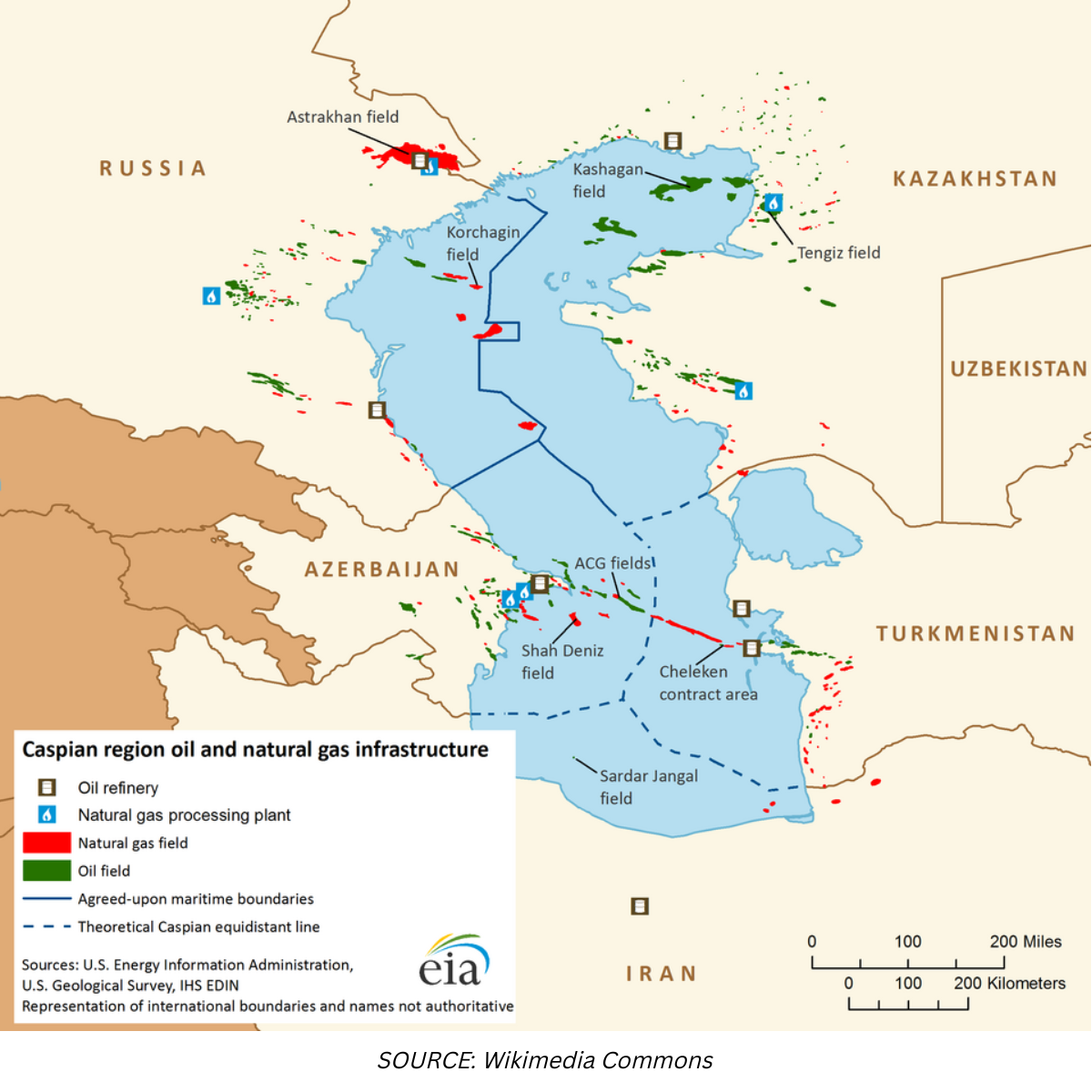
a. Energy Resources
- Significant oil and natural gas reserves
- Offshore fields: Kashagan, Azeri–Chirag–Guneshli
- Strategic pipelines reduce dependence on Middle Eastern routes
b. Fisheries
- Historically rich fishing grounds
- Overfishing and poaching threaten sustainability
c. Transport & Trade
- Inland shipping routes connect:
- Caspian Sea → Volga → Black Sea → Baltic Sea
- Facilitates Eurasian trade and logistics
Geopolitical Significance
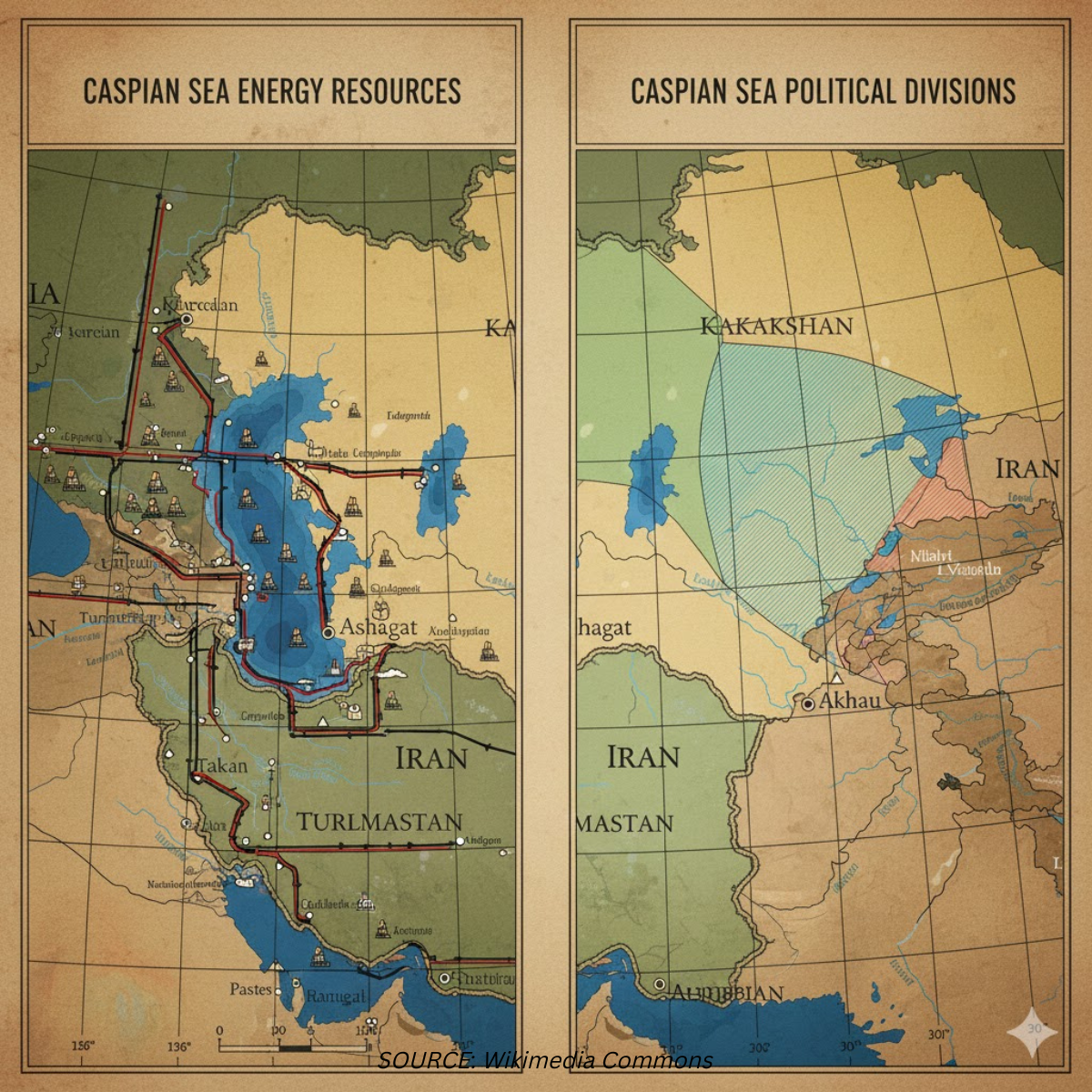
a. Legal Status Dispute
For decades, debate persisted:
- Sea → EEZ-based division
- Lake → shared ownership
b. 2018 Caspian Convention
- Recognized unique legal status
- Seabed divided into national sectors
- Surface waters shared
c. Security Dimensions
- Naval forces of littoral states
- Restriction on non-regional military presence
- Balancing cooperation and rivalry
Environmental Challenges
- Oil spills from offshore drilling
- Declining water levels
- Habitat fragmentation
- Industrial pollution
- Decline in sturgeon population
- Climate-induced ecosystem stress
Comparison: Caspian Sea vs Aral Sea vs Black Sea
| Parameter | Caspian Sea | Aral Sea | Black Sea |
|---|---|---|---|
| Size | Largest enclosed water body | Shrinking inland lake | Large marginal sea |
| Salinity | Moderate | High (increased) | Marine salinity |
| Water Balance | Closed basin (endorheic) | Severely disrupted | Open sea (connected to oceans) |
| Environmental Issues | Pollution, water-level decline | Ecological collapse | Eutrophication, pollution |
| Human Impact | Energy extraction | River diversion for irrigation | Shipping and industrial activity |
Frequently Asked Questions (FAQs) – Caspian Sea (UPSC Focus)
Q1. What is the Caspian Sea? Is it a sea or a lake?
The Caspian Sea is the world’s largest enclosed inland water body, classified physically as an endorheic basin (no natural outlet).
Despite being called a “sea,” it is legally debated whether it should be treated as a sea or a lake because:
- It is saline
- It has marine ecosystems
- But it is landlocked with no connection to the world ocean
This classification has major geopolitical and legal implications.
Q2. Which countries border the Caspian Sea?
Five countries border the Caspian Sea:
- Russia (northwest)
- Kazakhstan (north and northeast)
- Turkmenistan (southeast)
- Iran (south)
- Azerbaijan (west)
This makes the Caspian Sea a strategically important Eurasian water body.
Q3. Why is the Caspian Sea strategically important?
The Caspian Sea is important because of:
- Large oil and natural gas reserves
- Strategic energy transport routes
- Rich fisheries (sturgeon & caviar)
- Naval and security interests of regional powers
- Role in Central Asia–Europe connectivity
It is a key zone in energy geopolitics.
Q4. What is the geological origin of the Caspian Sea?
The Caspian Sea is a remnant of the ancient Tethys Sea, which existed millions of years ago.
Due to:
- Tectonic uplift
- Crustal subsidence
- Isolation from oceans,
it evolved into a closed inland basin during the Cenozoic era.
Q5. How is the Caspian Sea divided physiographically?
The Caspian Sea is divided into three basins:
- Northern Caspian – shallow, low salinity, colder climate
- Middle Caspian – moderate depth
- Southern Caspian – deepest region (over 1,000 m), highest salinity
This basin variation affects climate, biodiversity, and economic activity.
Q6. Which is the largest river flowing into the Caspian Sea?
The Volga River is the largest and most important river flowing into the Caspian Sea, contributing:
- Around 80% of total inflow
- Nutrients supporting fisheries
- Sediments forming the Volga Delta
Other rivers include Ural, Terek, and Kura.
Q7. Why does the Caspian Sea have fluctuating water levels?
The Caspian Sea’s water level fluctuates due to:
- High evaporation
- Climate variability
- Changes in river inflow (especially Volga)
- Global climate change impacts
Since it has no natural outlet, even small climatic changes significantly affect water levels.
Q8. What are the major ecological features of the Caspian Sea?
Key ecological features include:
- Caspian seal (only marine mammal, endemic)
- World’s largest population of sturgeon
- Rich wetland ecosystems (Volga Delta)
- High level of endemism
The Caspian Sea supports one of the world’s most unique inland ecosystems.
Q9. Why is the Caspian Sea famous for caviar?
The Caspian Sea hosts the world’s richest sturgeon fisheries, which produce black caviar, a high-value luxury product.
However:
- Overfishing
- Illegal trade
- Habitat degradation
have led to strict regulations and declining stocks.
Q10. What is the Caspian Convention (2018)?
The Convention on the Legal Status of the Caspian Sea (2018):
- Was signed by all five littoral states
- Defined rules for resource sharing
- Allowed national seabed sectors
- Prohibited foreign military presence
- Promoted regional cooperation
It partially resolved decades-long legal disputes.
Q11. Why was the legal status of the Caspian Sea disputed?
The dispute arose because:
- If treated as a sea → UNCLOS applies (EEZs)
- If treated as a lake → resources shared jointly
Different interpretations affected energy rights, navigation, and security, delaying agreements for decades.
Q12. What are the major environmental challenges facing the Caspian Sea?
Key challenges include:
- Oil pollution from offshore drilling
- Declining water levels
- Overfishing
- Industrial waste
- Habitat loss in deltas and wetlands
Environmental degradation threatens both biodiversity and livelihoods.
Q13. How does the Caspian Sea differ from the Aral Sea?
| Aspect | Caspian Sea | Aral Sea |
|---|---|---|
| Size | World’s largest inland water body | Shrunk drastically |
| Water Source | Natural rivers | Diverted rivers |
| Salinity | Moderate to high | Extremely high |
| Human Impact | Manageable but serious | Environmental catastrophe |
Q14. Is the Caspian Sea important for UPSC?
Yes. The Caspian Sea is relevant for:
- GS Paper I – Physical geography, inland seas
- GS Paper II – International relations, energy geopolitics
- Prelims – Maps, rivers, biodiversity, conventions
- Optional Geography – Basin evolution & hydrology
Q15. Why is the Caspian Sea called a “geopolitical lake”?
Because:
- It is surrounded by five nations
- Holds vast energy resources
- Has military and security importance
- Lacks foreign naval access
making it a regionally controlled strategic water body.
Conclusion
The Caspian Sea is a geographical anomaly and geopolitical asset. As the world’s largest enclosed water body, it combines the characteristics of both a sea and a lake. Its geological history, unique hydrology, exceptional biodiversity, and vast energy resources make it central to Eurasian geopolitics. However, environmental degradation, climate change, and resource exploitation pose serious challenges.
For UPSC aspirants, the Caspian Sea represents an important case study linking physical geography, environment, resource geopolitics, and international relations, making it highly relevant across multiple GS papers.