Census-2027 Digital Tools: India’s First Fully Digital Census Explained
India is preparing for its first fully digital census in 2027, with Union Home Minister Amit Shah soft‑launching four core digital platforms and unveiling mascots “Pragati” (female) and “Vikas” (male) on 5 March 2026. These tools aim to replace paper schedules with real‑time, geo‑tagged, encrypted data collection, making Census‑2027 central to India’s broader digital‑governance agenda.
Digital Census 2027: What Has Been Launched?
According to the Ministry’s statements and media reports, four key platforms—developed by C‑DAC—form the backbone of the Digital Census.
1. HLBC App – Houselisting Block Creator (Web Application)
- The HLBC web application is a digital mapping tool that uses satellite imagery and a web‑map interface to create standardized houselisting blocks across India.
- It helps officials digitally delineate and number every enumeration block, ensuring complete coverage and avoiding overlaps or gaps in the first phase (House Listing & Housing Census).
- By geo‑referencing every structure, HLBC builds a spatial foundation for later population enumeration and for integrating census outputs with GIS-based planning.
2. HLO App – Houselisting Operations (Mobile Application)
- The HLO mobile app is a secure, mostly offline‑capable app for enumerators to collect houselisting and housing data on the ground.
- It replaces paper forms and clipboards, allowing field staff to capture data on handheld devices and sync it to the central server when connectivity is available.
- This reduces manual data entry errors, speeds up compilation, and lets supervisors monitor field progress more accurately.
3. SE Portal – Self‑Enumeration Portal
- The Self‑Enumeration (SE) Portal is a public‑facing web platform where households can log in and enter their own census details online before the enumerator’s visit.
- For the first time, citizens will be given a defined window (e.g., 15 days before field work in a state, as piloted in preparatory guidance) to self‑enumerate and generate a reference number.
- During fieldwork, the enumerator only needs to verify details against this reference, which reduces door‑to‑door workload and can improve participation in urban and digitally‑connected areas.
4. CMMS Portal – Census Management & Monitoring System
- The CMMS Portal is a centralized, web‑based command dashboard for planning, managing, and monitoring census operations from national to local levels.
- Officials can track real‑time progress—completed blocks, pending households, data upload status—and identify under‑performing areas or anomalies quickly.
- The system is designed to coordinate activities of around 3.2 million field functionaries (enumerators + supervisors) and to ensure time‑bound completion of one of the world’s largest administrative exercises.
Census 2027 PDF
Pragati & Vikas: The Public Face of Census‑2027
- PIB notes that Amit Shah formally unveiled mascots “Pragati” (female) and “Vikas” (male) as the citizen‑friendly faces of Census‑2027.
- These mascots will front the IEC (Information, Education, Communication) campaign, explaining why census data matters for welfare schemes, infrastructure, and representation, and how to safely use the self‑enumeration options.
- The aim is to build trust and participation, especially among first‑time digital users, by making the exercise feel approachable rather than intimidating.
Key Policy Shifts Embedded in the Digital Census
1. Linking Census, NPR and Civil Registration (CRS)
- Amit Shah has publicly indicated that India’s “e‑Census” will be linked with birth and death registration, so that the National Population Register (NPR) can be updated dynamically as new births and deaths are recorded.
- In his earlier speeches on the digital census, he described an architecture where a birth recorded in CRS triggers an NPR update and inclusion in the electoral roll at 18, and a death results in automatic deletion.
- This is a shift from once‑in‑10‑years static counts to continuous population updating, improving the timeliness of demographic baselines used for policy.
2. Data Security and “Privacy by Design”
- Editorial and policy commentary has underlined that a digital census raises new data‑privacy and cyber‑security challenges because rich personal data is stored digitally.
- The government has emphasized end‑to‑end encryption, strict access controls and use of secure government infrastructure, stating that census data will be used only for statistical purposes, not for targeted surveillance.
- For exam answers, it’s important to balance the governance benefits of big data with concerns over consent, anonymisation, and adherence to India’s emerging data‑protection framework.
3. Self‑Enumeration and e‑Governance
- The SE Portal and HLO app operationalise a core Digital India principle—using online platforms and mobile apps for large‑scale service delivery and data collection.
- Officials expect faster processing and early release of Census‑2027 results, with some sources indicating that digital workflows could cut the time for national tabulation to around nine months after enumeration.
- This has big implications for e‑governance: fresher data for delimitation, finance commission formulae, and scheme targeting, instead of relying on decade‑old baselines.
4. Caste Data: Capability vs. Policy Choice
- The digital architecture (apps + portal) can technically handle more granular variables, including caste, migration, and other socio‑economic markers.
- However, the central government has not announced any final decision on conducting a full‑scale caste census beyond SC/ST in Census‑2027; this remains a policy decision, not a technological constraint.
- For UPSC, treat this as an open question: digital tools expand capacity, but questionnaire content is decided via notification and political consensus.
DECENNIAL POPULATION CENSUS
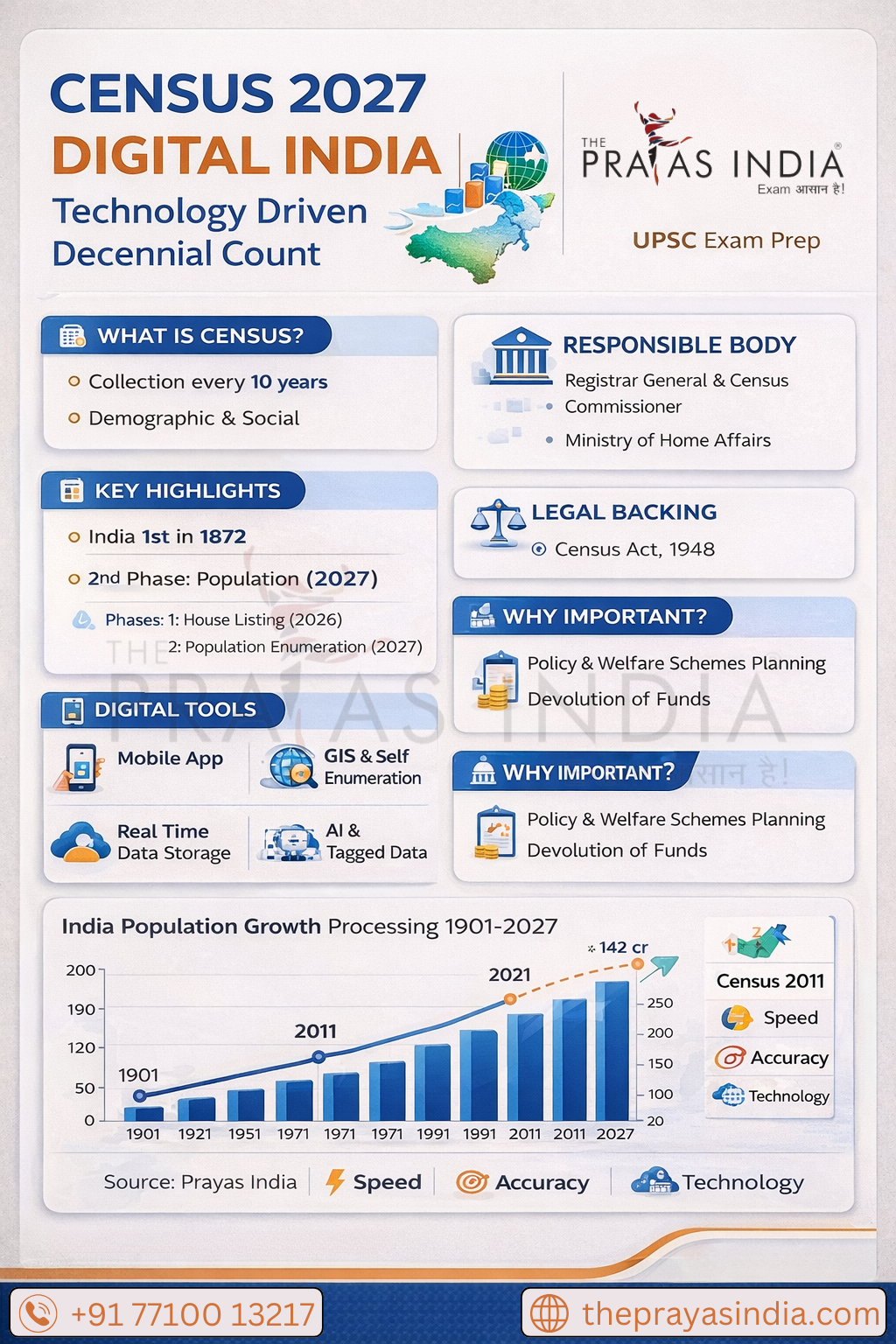
Definition:
A process of collecting, compiling, analysing and disseminating demographic, economic and social data (at a specific time) of all persons in a country.
BRIEF HISTORY
- Earliest mentions: Rigveda (800–600 BC), Arthashastra (300 BC) & Ain-i-Akbari (16th century)
- 1st Non-synchronous Census (held in a few places): 1872 under Gov. Gen. Lord Mayo
- 1st Synchronous Census (held all over British India): 1881 by W.C. Plowden (Census Commissioner of India) under Lord Ripon
RESPONSIBLE BODY
- Until 1951, Census Organisation was set up on an ad-hoc basis for each Census
- Since 1951, Office of the Registrar General and Census Commissioner (MHA)
LEGAL BACKING
- A Union list subject under Article 246
- Conducted under Census Act (CA), 1948
CONFIDENTIALITY OF INFORMATION COLLECTED
- Guaranteed under CA 1948
- Information not even accessible to the courts of law
SIGNIFICANCE
- Largest single source of statistical information about people of India
- Used for good governance purposes
- Demarcation of constituencies & representation in Legislature
CENSUS – MAJOR EVENTS
| Census | Major Event |
|---|---|
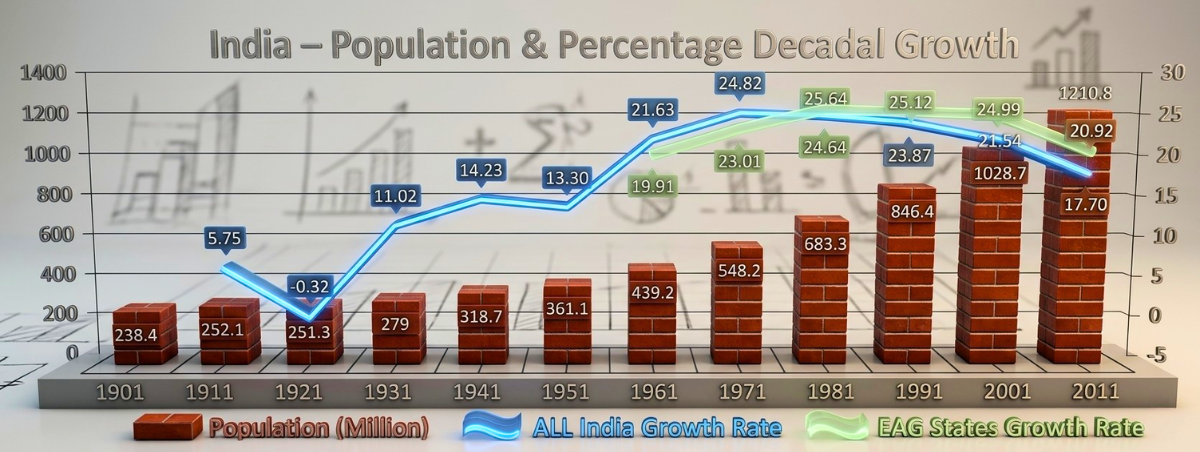
| 5th (1921) | Only census to witness a decadal population decline (0.31%) – “The Great Divide” |
| 11th (1971) | Added information on fertility for currently married women |
| 13th (1991) | Concept of literacy changed to children aged 7+ (previously 4+) |
| 14th (2001) | Leap in tech front; usage of Intelligent Character Reading (ICR) |
| 15th (2011) | Notable fall in case of Empowered Action Group (EAG) States noticed first time |
SOCIO-ECONOMIC AND CASTE CENSUS (SECC)
ABOUT
- Conducted in 2011 for the first time since 1931
COMPONENTS
- Economic status (to define a poor/deprived person)
- Specific caste (to evaluate caste groups that are economically worse/better off)
CONSTITUTIONAL BACKING
- Article 340 mandates the appointment of a commission to investigate conditions of socially/educationally backward classes
CENSUS vs SECC
- SECC identifies beneficiaries of state support (Census → national population data)
- SECC data open for use by govt departments (Census data → confidential)
SIGNIFICANCE
- Better inequality mapping
- Quantifiable data to support existing reservation levels
SOME KEY FINDINGS OF SECC 2011
- Total Households: 24.49 crore
- Rural: 17.97 crore
- SC/ST Households: 3.87 crore (21.56%)
- Households with no literate adult (age >25): 23.5%
Why Census‑2027 Digital Tools Matter for UPSC
Polity & Federalism
- Census data influences delimitation of constituencies, seat distribution and Finance Commission transfers.
- A faster, more granular digital census can sharpen the debates on representation, regional disparities, and formulae for tax devolution and grants.
Governance & Administration
- Digital census infrastructure embodies “data‑driven governance”—where real‑time or near‑real‑time statistics guide planning for health, education, housing and social protection.
- It also raises questions of capacity building: training ~30+ lakh enumerators, handling outages, cyber‑attacks, and digital divides in remote or marginalized communities.
Sociology & Human Geography
- High‑quality digital data can better capture patterns of migration, urbanisation, slum growth, and linguistic change, especially if integrated with GIS.
- For optional subjects like Sociology or Geography, this is a live example of how technology reshapes social statistics and the state–citizen data relationship.
FAQs
Q1. What are the four digital tools launched for Census‑2027?
They are the HLBC web app (Houselisting Block Creator), HLO mobile app (Houselisting Operations), the Self‑Enumeration (SE) Portal, and the Census Management & Monitoring System (CMMS) Portal.
Q2. What is special about the SE (Self‑Enumeration) Portal?
It allows households to submit their details online before the field visit, generates a reference number, and lets enumerators mainly verify rather than record information from scratch.
Q3. Who are Pragati and Vikas in the context of Census‑2027?
They are the official mascots—Pragati (female) and Vikas (male)—unveiled by Amit Shah to lead citizen‑facing communication on the digital census.
Q4. Will Census‑2027 automatically update NPR and electoral rolls?
Shah has outlined a model where the digital census ecosystem is linked to birth and death registers, enabling dynamic NPR updates and streamlined additions/removals from rolls over time, subject to legal/procedural frameworks.
Q5. Is a full caste census confirmed for 2027?
No. While digital tools can support detailed socio‑economic data capture, the government has not formally announced a full caste census beyond SC/ST categories for Census‑2027.