Common SSC Exam Preparation Mistakes and How to Avoid Them
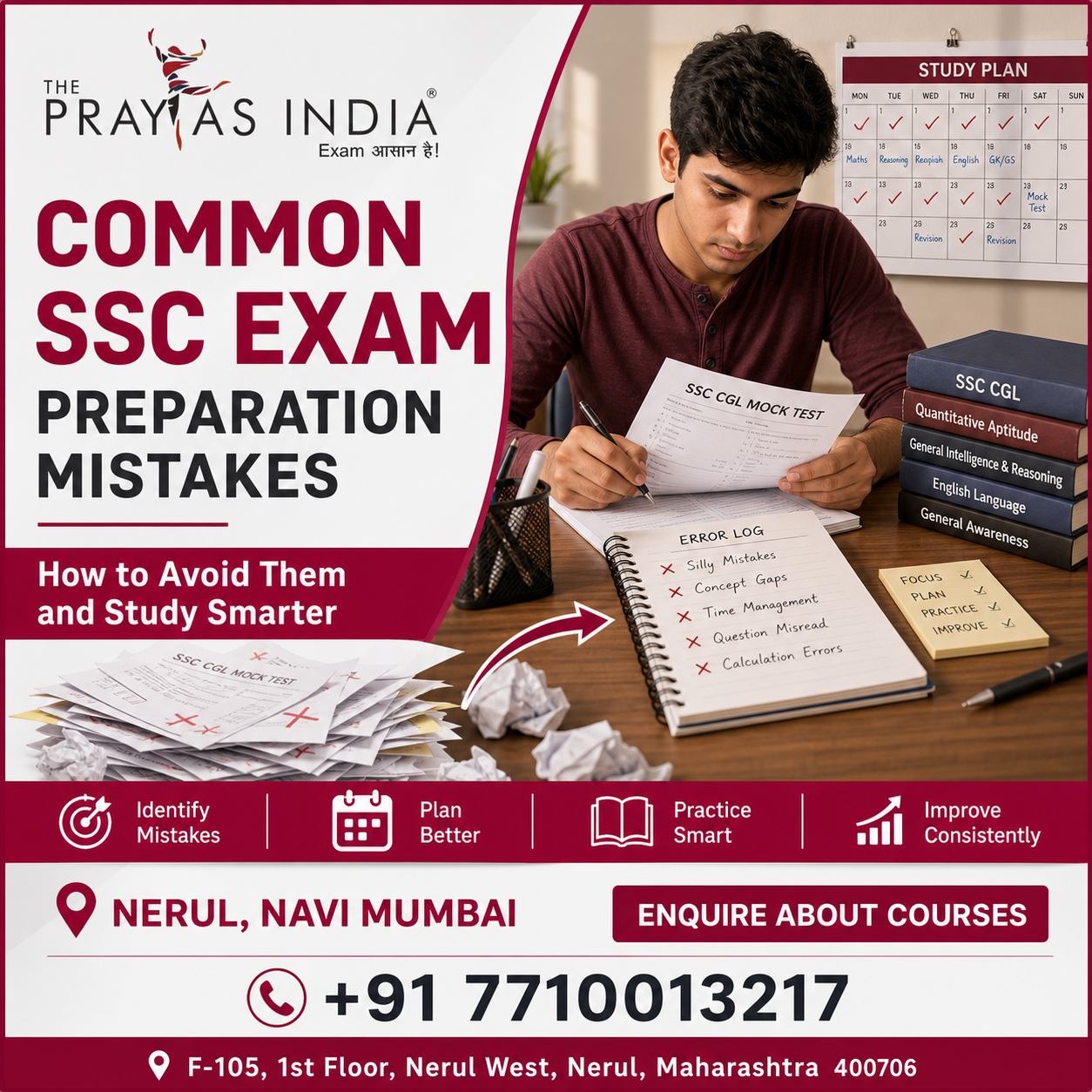
Preparing for Staff Selection Commission (SSC) examinations requires a clear strategy, regular practice, and consistent revision. Many aspirants work hard but struggle to improve because they make common preparation mistakes, such as following an unrealistic timetable, ignoring mock-test analysis, or spending too much time on topics they already understand.
Whether you are preparing for SSC CGL, SSC CHSL, SSC MTS, SSC GD, or another SSC examination, identifying these mistakes early can help you make your preparation more organised.
For students looking for SSC exam preparation guidance in Nerul, Navi Mumbai, understanding what to avoid is just as important as knowing what to study. Here are the most common SSC preparation mistakes and practical ways to overcome them.
Starting Preparation Without Understanding the Syllabus
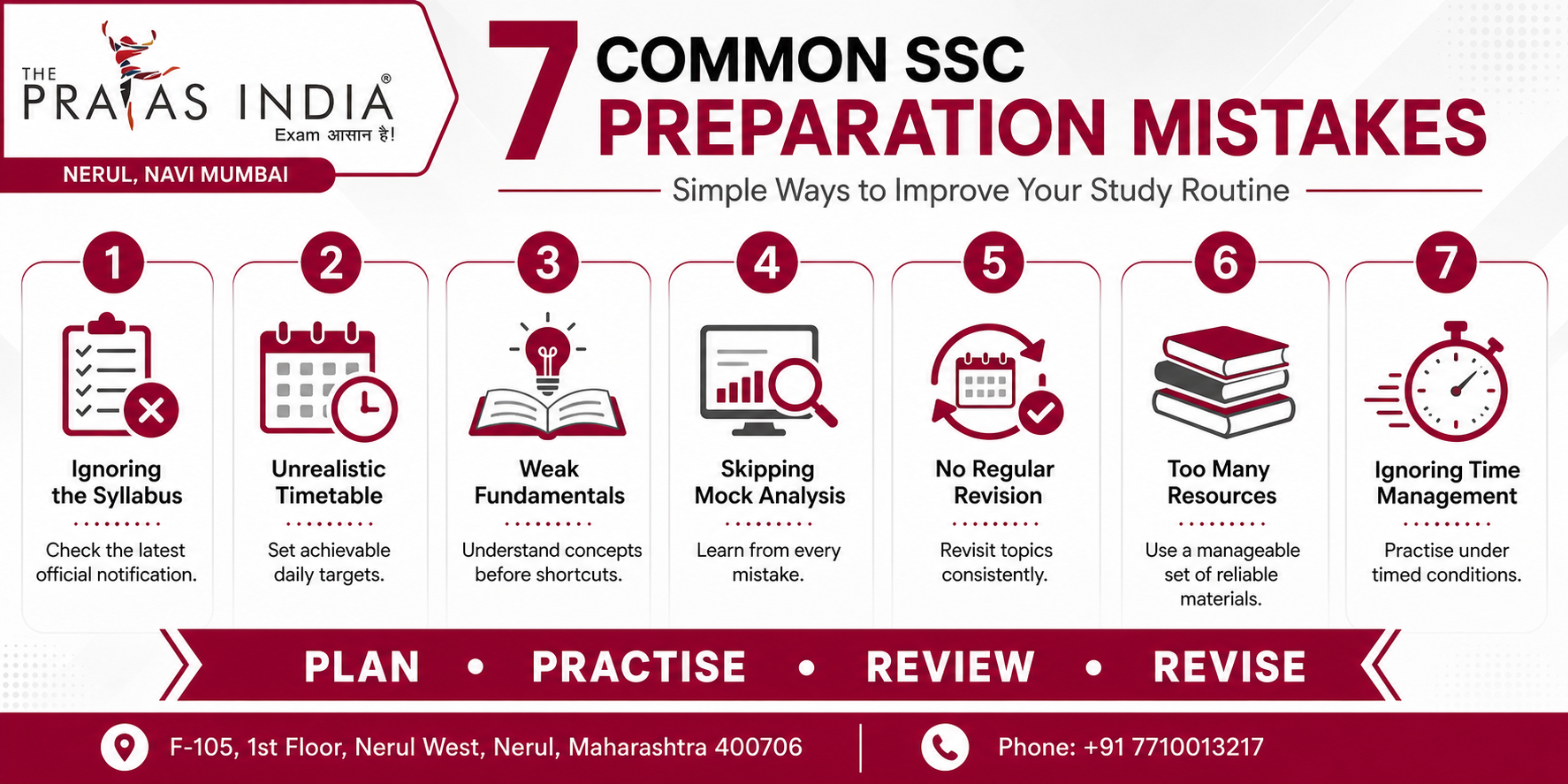
One of the biggest mistakes SSC aspirants make is beginning their preparation without checking the syllabus and examination pattern for their target exam.
SSC examinations can differ in their subjects, stages, eligibility conditions, and skill-test requirements. Studying without a clear understanding of these differences may lead to wasted time and incomplete preparation.
How to avoid this mistake:
- Identify the SSC examination you want to take.
- Read the latest official notification and syllabus.
- Understand the examination stages and applicable requirements.
- Divide the syllabus into manageable topics.
- Track your progress as you complete each topic.
A clear syllabus-based plan gives you a practical starting point and helps you prioritise your studies.
Following an Unrealistic Study Timetable
Some students create ambitious timetables that involve studying for many hours every day. However, a schedule that is difficult to maintain can quickly lead to frustration and inconsistent preparation.
How to avoid this mistake:
Create a timetable that matches your daily routine, college schedule, or working hours. Set achievable daily targets and increase your study time gradually when necessary.
For example, a beginner might divide a two-hour study session into concept learning, question practice, revision, and mistake analysis. The exact distribution can be adjusted according to the student’s strengths and target examination.
Consistency is more useful than following an exhausting schedule for only a few days.
Ignoring Basic Concepts
In subjects such as Quantitative Aptitude and Reasoning, some aspirants focus on shortcuts before developing a proper understanding of the fundamentals. This can make unfamiliar or slightly modified questions difficult to solve.
How to avoid this mistake:
- Learn the basic concept before memorising a shortcut.
- Solve simple questions before moving to more difficult ones.
- Practise different question types from the same topic.
- Revisit concepts when you repeatedly make similar mistakes.
For English, focus on grammar, vocabulary, sentence structure, and reading comprehension. For General Awareness, use reliable study resources and revise information regularly.
Strong fundamentals provide a better foundation for timed practice.
Practising Questions Without Analysing Mistakes
Solving a large number of questions does not automatically guarantee improvement. If you repeatedly make the same mistakes without understanding why they happen, your progress may remain limited.
How to avoid this mistake:
Maintain an error notebook containing:
- The question or topic you got wrong.
- The reason for the mistake.
- The correct method or explanation.
- The concept you need to revise.
- A date to practise a similar question again.
Classify errors as conceptual mistakes, calculation errors, misreading, or poor time management. This makes it easier to decide what to improve next.
Reviewing mistakes regularly turns practice into a learning process.
Avoiding Mock Tests Until the Last Minute
Some aspirants delay mock tests because they believe they must complete the entire syllabus first. As a result, they may have limited experience with timed tests when the examination approaches.
How to avoid this mistake:
Begin with topic-wise tests after studying individual concepts. Gradually introduce sectional tests and full-length mock tests according to your preparation level and the relevant examination pattern.
After every mock test, review:
- Questions answered incorrectly.
- Questions that took too long.
- Topics where accuracy was low.
- Questions that could have been skipped.
- Opportunities to manage time more effectively.
The goal is not simply to increase the number of mock tests. It is to learn from each attempt and improve your approach.
Focusing Only on Speed and Ignoring Accuracy
Speed matters in competitive examinations, but rushing through questions can increase careless errors. Attempting questions without reading them carefully or checking calculations can affect your overall performance.
How to avoid this mistake:
Build accuracy while learning a topic, then gradually practise solving questions within a time limit.
Identify which questions you can solve confidently and which require more practice. If the applicable examination has negative marking, understand its current rules and consider the risk of uncertain answers when developing your attempt strategy.
A balanced approach to speed and accuracy is more effective than rushing through every question.
Neglecting General Awareness and Current Affairs
Some students concentrate heavily on Mathematics, Reasoning, or English and leave General Awareness until the final weeks. This can create a large revision burden.
How to avoid this mistake:
Allocate regular time to General Awareness and current affairs where relevant to your examination. Use a reliable source, prepare concise notes, and revise them at regular intervals.
Static General Awareness topics may include history, geography, polity, economics, and general science, depending on the examination syllabus.
Avoid collecting information from too many sources. A manageable resource that you revise consistently can be more useful than several sources you never complete.
Using Too Many Books, Apps, and Study Resources
Switching between multiple books, videos, apps, and notes can make preparation fragmented. Students may spend more time searching for resources than practising questions.
How to avoid this mistake:
Select a limited set of reliable resources for each subject. Use previous-year question papers, relevant practice material, and mock tests to assess whether your resources meet your needs.
Before adding a new book or course, ask yourself whether it fills a genuine gap in your preparation.
Keep your notes organised so that revision remains straightforward, especially as the examination date approaches.
Neglecting Revision
Learning a topic once is rarely enough. Without revision, formulas, grammar rules, vocabulary, and important facts can become difficult to recall during a timed test.
How to avoid this mistake:
Schedule revision from the beginning of your preparation.
- Review recently studied topics.
- Revisit difficult questions from your error notebook.
- Practise important formulas and concepts.
- Use short topic-wise quizzes to check recall.
- Reserve time each week for reviewing earlier material.
Regular revision helps you identify forgotten concepts before they become a problem during mock tests.
Comparing Your Progress With Other Aspirants
Seeing other students complete more mock tests or study for longer hours can create unnecessary pressure. Every aspirant starts with a different level of understanding, available study time, and preparation background.
How to avoid this mistake:
Measure your progress against your own previous performance. Track improvements in accuracy, topic completion, question-solving time, and the number of repeated errors.
Use other aspirants’ study methods as ideas, not as a timetable you must copy.
A preparation plan should reflect your target examination and personal circumstances.
Ignoring Health, Sleep, and Breaks
Studying for long periods without adequate rest can make it harder to concentrate and retain information. Sacrificing sleep to complete an unrealistic timetable may also affect your ability to practise effectively.
How to avoid this mistake:
Maintain a sustainable routine with adequate sleep, short breaks, regular meals, and some physical activity. Break lengthy study sessions into manageable blocks.
If you are balancing SSC preparation with work or college, plan your most demanding study tasks around the times when you can concentrate best.
A sustainable routine can help you remain consistent over the long term.
Not Seeking Guidance When You Are Stuck
Self-study works well for many aspirants, but some students struggle to identify their weak areas, organise the syllabus, or understand difficult concepts independently.
Continuing with the same ineffective approach can waste valuable preparation time.
How to avoid this mistake:
Review your progress honestly. If you repeatedly struggle with a topic, seek a clear explanation, consult a reliable teacher, or use structured practice material.
Students considering coaching can compare faculty, syllabus coverage, mock-test arrangements, doubt-solving support, fees, and batch timings before enrolling.
Coaching is not compulsory for every aspirant, but suitable guidance may help students who need additional structure and feedback.
A Simple Weekly SSC Preparation Routine
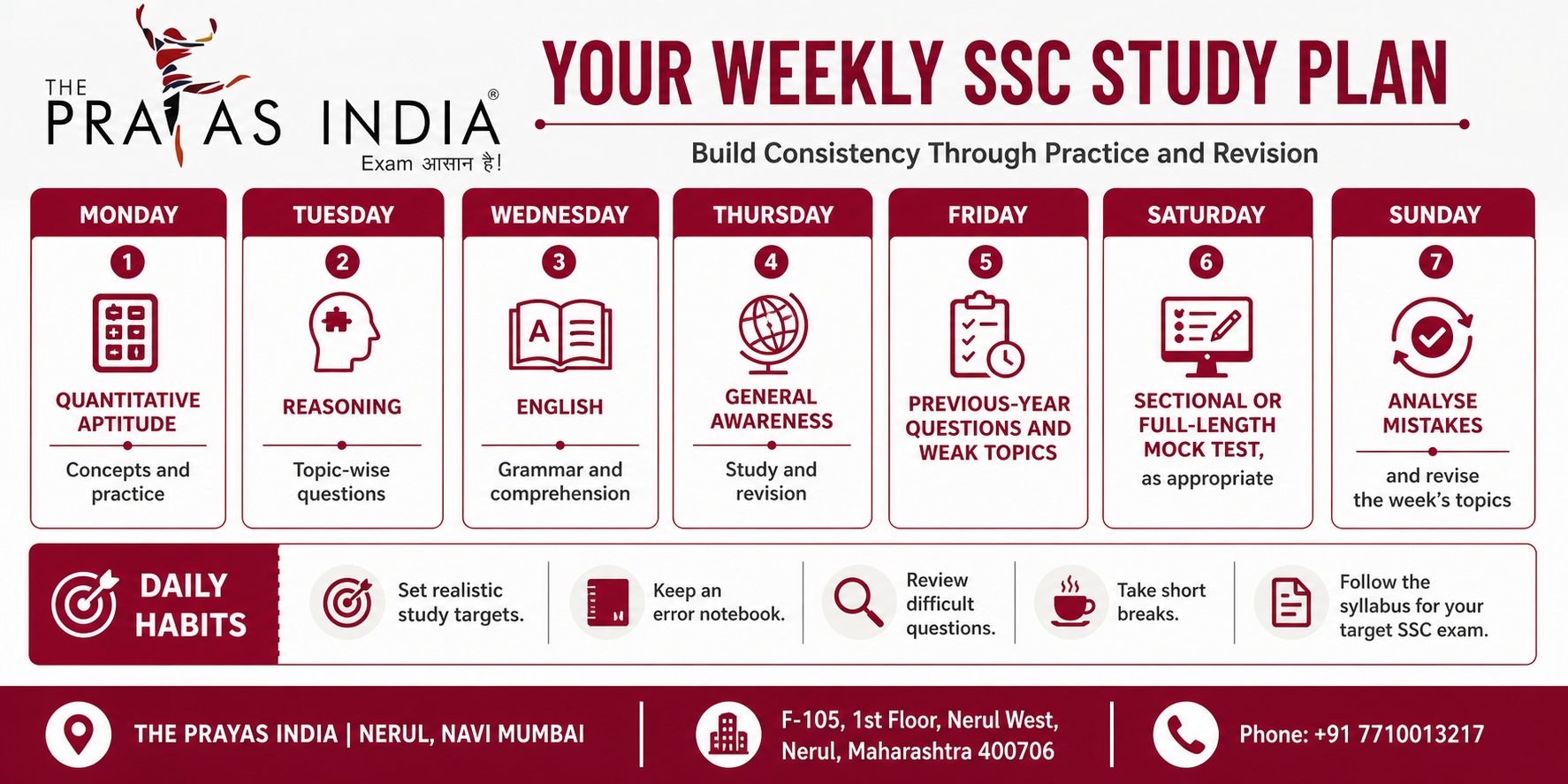
A balanced weekly routine can help you combine learning, practice, testing, and revision.
| Day | Preparation focus |
|---|---|
| Monday | Learn concepts and practise Quantitative Aptitude |
| Tuesday | Reasoning concepts and topic-wise questions |
| Wednesday | English grammar, vocabulary, and comprehension |
| Thursday | General Awareness and revision |
| Friday | Practise weaker topics and solve previous-year questions |
| Saturday | Attempt a sectional or full-length mock test as appropriate |
| Sunday | Analyse mistakes and revise the week’s topics |
Adapt this schedule to your target examination, current preparation level, and available study time. Check the latest official SSC syllabus to confirm which subjects and test components apply to your exam.
Looking for SSC Exam Preparation Guidance in Nerul?
Students searching for SSC coaching in Nerul, Navi Mumbai, can contact The Prayas India to enquire about currently available SSC preparation programmes and the support offered.
Before choosing a course, discuss your target examination, preparation level, preferred batch timings, course duration, study material, mock-test arrangements, and fee structure.
Conclusion
Common SSC preparation mistakes often involve poor planning, weak fundamentals, insufficient revision, limited mock-test analysis, and unrealistic expectations. The good news is that these habits can be addressed through a more organised and consistent approach.
Start with the official syllabus, create a realistic timetable, practise regularly, analyse mistakes, and revise what you learn. If you need additional support, compare suitable preparation options before deciding whether coaching is right for you.
For aspirants in Nerul, Navi Mumbai, the key is to choose a preparation method that fits your needs and follow it consistently. Progress comes from understanding your mistakes and making steady improvements, one study session at a time.
Frequently Asked Questions
1. What are the most common SSC exam preparation mistakes?
Common mistakes include ignoring the syllabus, following an unrealistic timetable, neglecting revision, avoiding mock tests, failing to analyse mistakes and using too many study resources.
2. How can I improve my SSC exam preparation?
Understand the official syllabus, set realistic daily goals, strengthen your concepts, practise previous-year questions, take mock tests and revise consistently.
3. Are mock tests important for SSC exams?
Yes. Mock tests help you practise under timed conditions, assess accuracy, identify weak topics and improve your time-management strategy. Reviewing mistakes after each test is important.
4. How often should SSC aspirants revise?
Revision should be part of your regular study routine. Review recently studied concepts, revisit difficult questions and set aside time each week to revise earlier topics.
5. Should SSC beginners use multiple books and apps?
It is usually more manageable to begin with a limited set of reliable resources aligned with your target examination. Add new materials only when they address a specific preparation need.
6. Where can I enquire about SSC coaching in Nerul?
You can contact The Prayas India at +91 7710013217 or visit the Nerul branch at F-105, 1st Floor, Nerul West, Nerul, Maharashtra 400706. Ask the centre about currently available SSC programmes, fees and batch timings.
Need Guidance for SSC Exam Preparation?
Connect with The Prayas India in Nerul to enquire about currently available SSC preparation programmes, course details and batch timings.
The Prayas India – Nerul Branch
F-105, 1st Floor, Nerul West, Nerul, Maharashtra 400706
Phone: +91 7710013217