Coral Reefs – Formation, Distribution, Importance & Conservation
(UPSC Geography – Environment & Physical Geography)
- GS Paper 1: Physical Geography, Biogeography, Ocean Geography
- GS Paper 3: Environment, Climate Change, Conservation
- Prelims: Marine Ecosystems, Coral Types, Coastal Geography
- Geography Optional: Biogeography, Marine Ecology, Environmental Geography, Coastal Landforms
Introduction
Coral reefs are among the most biologically diverse and ecologically productive ecosystems on the planet. Often called the “rainforests of the sea,” they occupy less than 0.1% of the ocean floor but support nearly 25% of all marine species. Coral reefs are built by tiny marine organisms called coral polyps, which secrete calcium carbonate (CaCO₃) skeletons over generations, forming massive limestone structures.
Biologically, corals belong to the phylum Cnidaria, and most reef-building corals are colonial species that house symbiotic algae called zooxanthellae in their tissues. This relationship enables efficient nutrient recycling and high productivity in otherwise nutrient-poor tropical waters.
Globally, coral reefs occur primarily in tropical and subtropical regions, between 30°N and 30°S, where warm water, sunlight, and stable conditions allow for sustained coral growth. From the Great Barrier Reef to the Maldives and India’s Gulf of Mannar, coral reefs provide essential ecosystem services, economic benefits, and coastal protection.
Formation of Coral Reefs
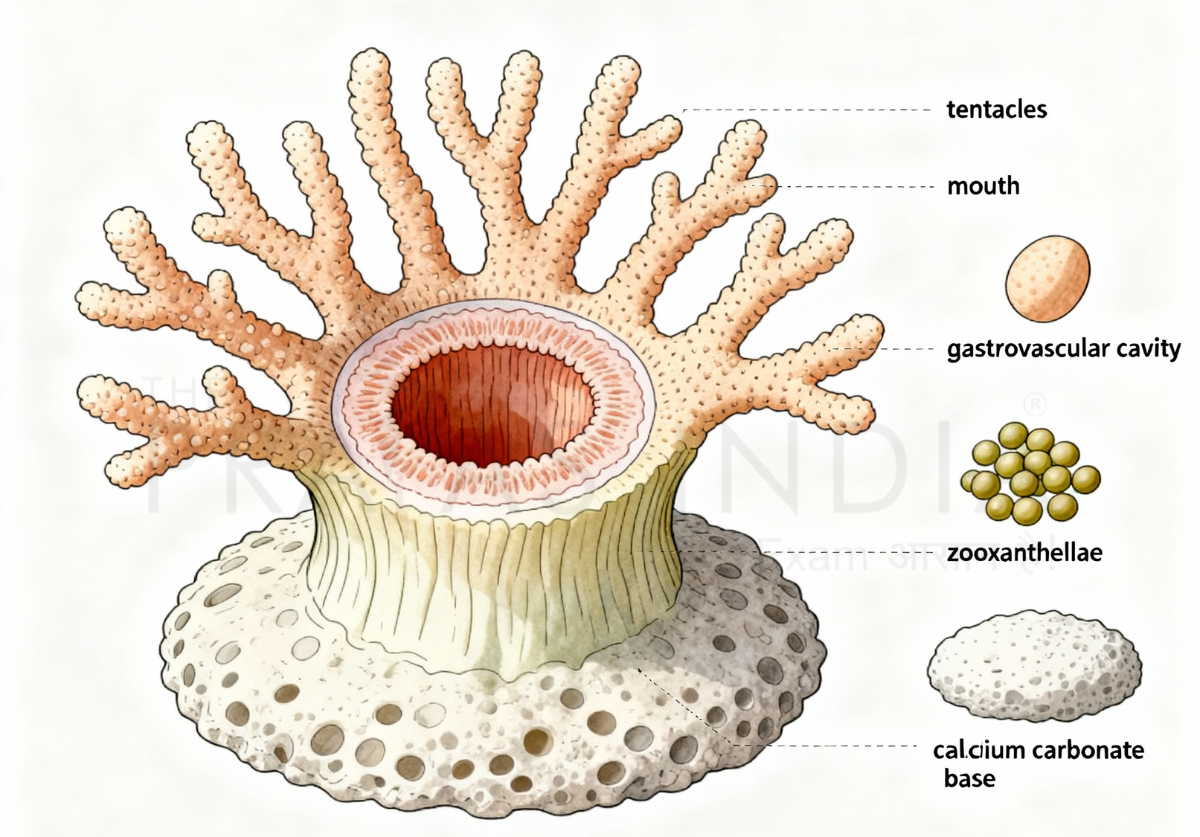
Coral Polyp Structure
A coral polyp is a tiny, cylindrical marine organism with:
- Tentacles armed with nematocysts (stinging cells)
- A central mouth opening
- A gastrovascular cavity for digestion
- A basal disc that secretes calcium carbonate
- Endosymbiotic zooxanthellae that aid in photosynthesis
Symbiotic Relationship (Coral–Zooxanthellae)
Zooxanthellae (dinoflagellate algae) provide corals with:
- Glucose, amino acids, oxygen
- Up to 90% of their daily nutritional requirements
- Bright coloration to coral tissues
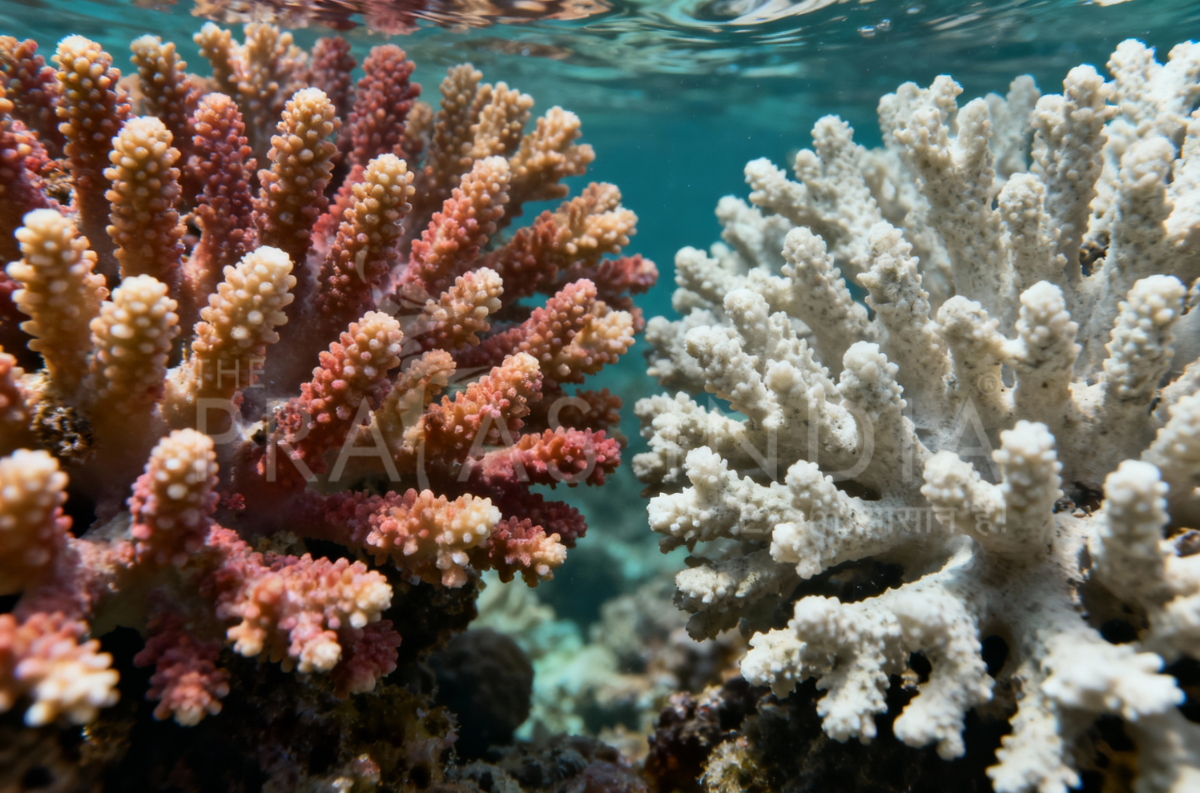
In return, corals provide shelter and CO₂ to the algae. This mutualism is vital; stress-induced expulsion of zooxanthellae leads to coral bleaching.
Environmental Conditions for Coral Growth
| Parameter | Ideal Range/Condition |
|---|---|
| Temperature | 23–29°C (tropical waters) |
| Depth | < 50 m for sufficient sunlight |
| Salinity | 32–35 ppt |
| Substrate | Hard, rocky platforms |
| Water clarity | Low turbidity |
| Currents | Moderate to high, for oxygen and nutrient exchange |
Types of Coral Reefs
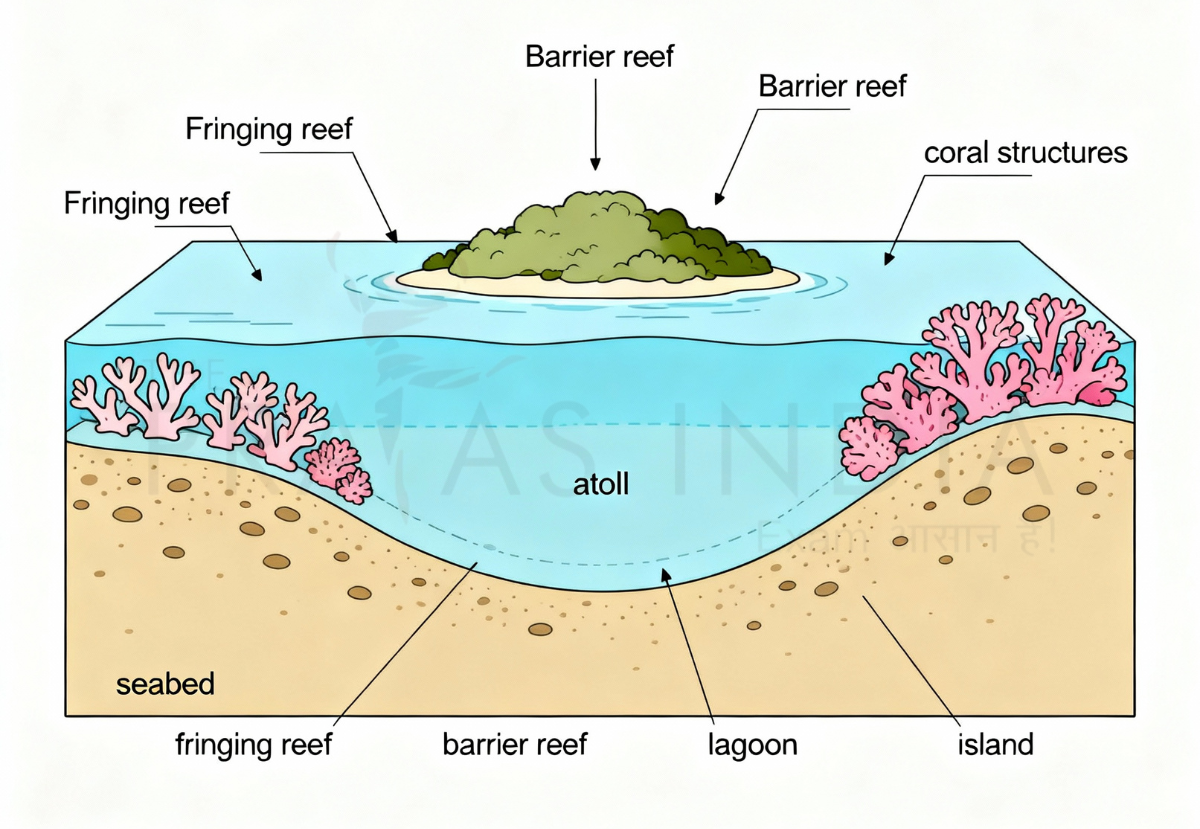
Coral reefs evolve over time through subsidence, sea-level changes, and coral growth. According to Darwin’s subsidence theory, reefs transform from fringing reefs to barrier reefs and atolls.
1. Fringing Reefs
- Develop along continental margins or island coasts
- Shallowest and most direct attachment to land
- Example: Gulf of Mannar (India), Red Sea
2. Barrier Reefs
- Separated from the coast by a lagoon
- Larger and more complex structures
- Example: Great Barrier Reef (Australia)
3. Atolls
- Circular or horseshoe-shaped coral rings
- Enclose a central lagoon
- Formed on sinking volcanic islands
- Example: Lakshadweep atolls
4. Patch Reefs (Optional)
- Localised, irregular coral patches in a lagoon
- Common in the Caribbean and Pacific
Global Distribution of Coral Reefs
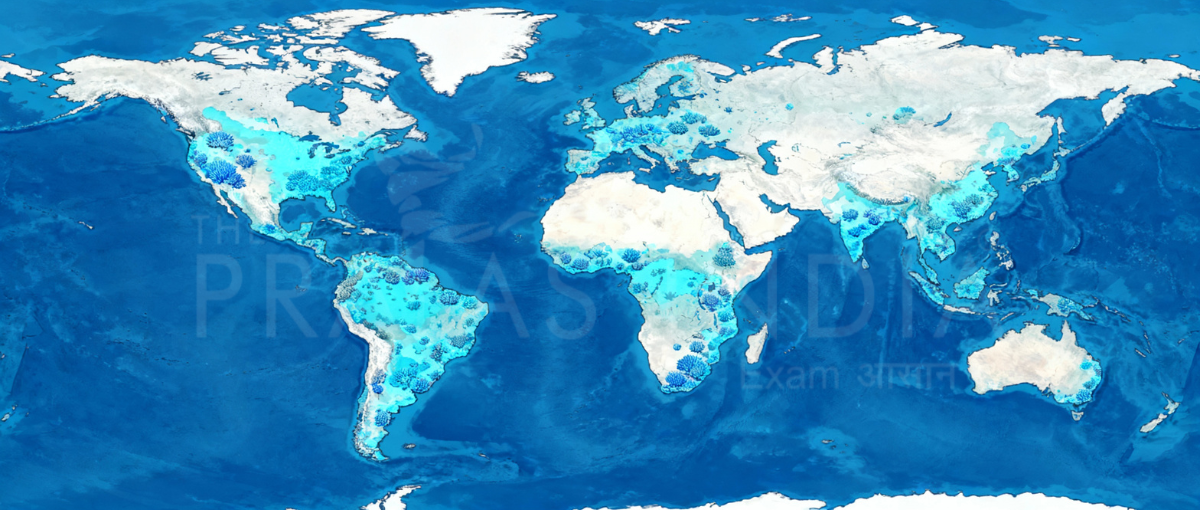
Coral reefs are concentrated in warm, clear, shallow tropical waters between 30°N–30°S.
Major Global Regions
- Indo-Pacific Region – Highest diversity
- Coral Triangle (Indonesia, Malaysia, Philippines, Papua New Guinea, Solomon Islands, Timor-Leste)
- Great Barrier Reef
- Maldives, Seychelles
- Caribbean Region
- Bahamas, Belize, Cuba
- Mesoamerican Barrier Reef
- Red Sea Reefs
- Highly saline but extremely resilient ecosystems
Factors Influencing Spatial Distribution
- Warm sea surface temperature
- Sunlight availability
- Ocean currents (like the Kuroshio and East Australian Current)
- Stable salinity and low sedimentation
- Continental shelf width
Coral Reefs in India
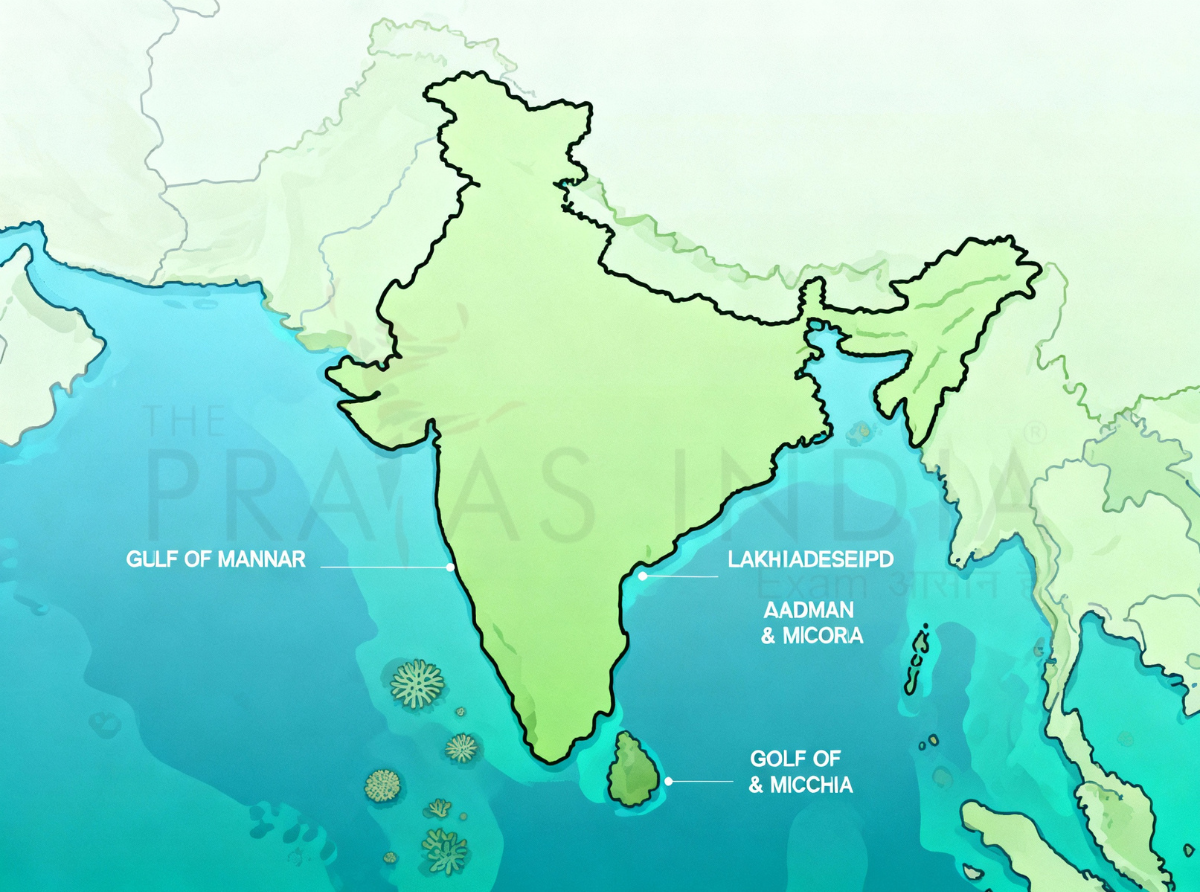
India hosts coral reefs in four major regions:
1. Gulf of Mannar (Tamil Nadu)
- One of the richest marine biodiversity zones in the Indian Ocean
- Home to over 100 coral species
- Declining due to pollution, trawling, and siltation
2. Lakshadweep Islands
- Atoll-type reefs
- High ecological sensitivity
- Coral bleaching events in 1998, 2010, 2016 affected recovery
3. Andaman & Nicobar Islands
- Fringing and barrier reefs
- Rich species diversity
- Rani Jhansi Marine National Park is a major coral habitat
4. Gulf of Kachchh (Gujarat)
- Only cold-water, high-turbidity coral system in India
- Significant anthropogenic pressures from industries
Importance for India
- Coastal protection (especially for A&N and Lakshadweep)
- Key to fisheries and tourism
- Supports unique biodiversity for scientific research
- Cultural and livelihood support for coastal communities
Ecological Importance of Coral Reefs
1. Biodiversity Hotspots
- Support fish, molluscs, crustaceans, sponges, and marine mammals
- Dense food webs and unique evolutionary niches
2. Carbon Sequestration
- Corals fix carbon in calcium carbonate
- Act as long-term carbon sinks
3. Coastal Protection
- Reduce wave energy by up to 97%
- Protect shorelines from cyclones, tsunamis, and erosion
4. Livelihoods and Economy
- Fisheries sustain millions of coastal families
- Tourism generates significant revenue in islands and coastal states
5. Nutrient Cycling
- Support nitrogen fixation, ammonia recycling, and primary productivity
Threats to Coral Reefs
1. Climate Change
- Increased sea temperatures → coral bleaching
- Mass bleaching events: 1998, 2010, 2016–17 (Great Barrier Reef experienced >50% mortality)
2. Ocean Acidification
- Rising CO₂ reduces carbonate ion concentration
- Slows coral calcification
- Reduces skeletal strength
3. Pollution & Eutrophication
- Agricultural runoff, sewage discharge
- Algal blooms outcompete corals
4. Overfishing & Destructive Fishing
- Blast fishing, cyanide poisoning
- Removal of keystone species destabilizes ecosystems
5. Sedimentation & Coastal Development
- Ports, dredging, construction reduce light penetration
- Smothers coral larvae and polyps
6. Unsustainable Tourism
- Anchoring damage, trampling, and waste dumping
7. Coral Mining (Historic)
- Previously used in construction and lime production
- Now banned but remnants of damage still visible
Conservation Measures
Global Initiatives
- ICRI (International Coral Reef Initiative)
- ICRAN (International Coral Reef Action Network)
- UNEP Regional Seas Programme
- CITES protection for select coral species
-
SDG 14: Life Below Water
India-Specific Measures
- National Coral Reef Monitoring Programme (NCRMP)
- Coral Reef Task Force
- Marine Protected Areas:
- Gulf of Mannar Biosphere Reserve
- Mahatma Gandhi Marine National Park, A&N
- Coastal Regulation Zone (CRZ) Notification
- Ban on coral mining
- Community-based reef monitoring in Lakshadweep
New Technologies
- Coral Gardening – Fragment transplantation
- Artificial Reefs – Concrete modules, biorock technology
- Assisted Evolution – Heat-resistant coral breeding
- 3D Printing – Coral-shaped structures for regeneration
Case Studies
1. Great Barrier Reef (Australia)
- World’s largest reef system
- Severe bleaching in 2016–17
- Large-scale restoration underway using assisted evolution
2. Coral Triangle
- Highest marine biodiversity globally
- Climate change and overfishing main threats
- Regional cooperation through CTI-CFF
3. Gulf of Mannar (India)
- 4,223 km² biosphere reserve
- Notable decline in branching corals
- Community-based conservation shows improvement
4. Maldives & Mauritius
- Successful use of coral gardening and artificial reefs
- Tourism-driven funding supports restoration efforts
Conclusion
Coral reefs are vital ecological assets that sustain marine biodiversity, stabilize coastlines, support livelihoods, and regulate the global carbon cycle. However, rapid climate change, human pressures, and ocean dynamics threaten their survival at unprecedented scales. Conservation requires a combination of global climate action, marine protected areas, technological restoration, and community-based stewardship.
For India, safeguarding coral ecosystems in the Gulf of Mannar, Lakshadweep, and A&N Islands is essential for environmental security, food sustainability, and disaster mitigation. Sustainable development and marine governance will determine the future of these fragile yet invaluable ecosystems.