Deserts in the World – Geography, Distribution, and Global Significance
- GS Paper 1: Physical Geography — Climate, Landforms, Biogeography
- GS Paper 3: Environment, Desertification, Climate Change
- Prelims: Climatic regions, desert distribution, soil types, atmospheric circulation
- Geography Optional: Climatology, Geomorphology (Aeolian processes), Biogeography
Introduction
Deserts are arid climatic regions characterized by annual precipitation of less than 250 mm, extremely high evaporation rates, and sparse vegetation. They represent about 33% of Earth’s land surface, playing a crucial role in shaping global climate systems, biogeography, and human adaptation.
Types of Deserts
Deserts occur in diverse settings and can be classified as:
- Hot deserts (Sahara, Arabian, Thar)
- Cold deserts (Gobi, Antarctica)
- Coastal deserts (Atacama, Namib)
- Rainshadow deserts (Ladakh, Patagonian)
- Mid-latitude/Continental deserts (Great Basin, Central Asian deserts)
Despite harsh conditions, deserts are significant due to:
- unique ecosystems and biodiversity,
- minerals and hydrocarbons,
- distinctive landforms shaped by wind,
- cultural and historical development (Egypt, Mesopotamia).
Characteristics of Deserts
a) Low Precipitation
Annual rainfall <250 mm; often irregular, localized, and intense.
b) High Temperature Variability
Hot deserts exhibit diurnal temperature variations up to 40°C.
Cold deserts witness freezing temperatures due to high-altitude or high-latitude location.
c) High Wind Velocity
Strong winds lead to aeolian erosion, dune formation, dust storms, and loess deposits.
d) Sparse Vegetation
Vegetation is xerophytic: deep roots, thick cuticles, reduced leaves.
e) Saline and Alkaline Soils
Aridisols dominate, marked by salinity, low humus, and high mineral accumulation.
f) Biodiversity Adaptation
Plants and animals exhibit specialized adaptations (water storage, nocturnal behavior, burrowing).
Classification of Deserts
A. Hot Deserts
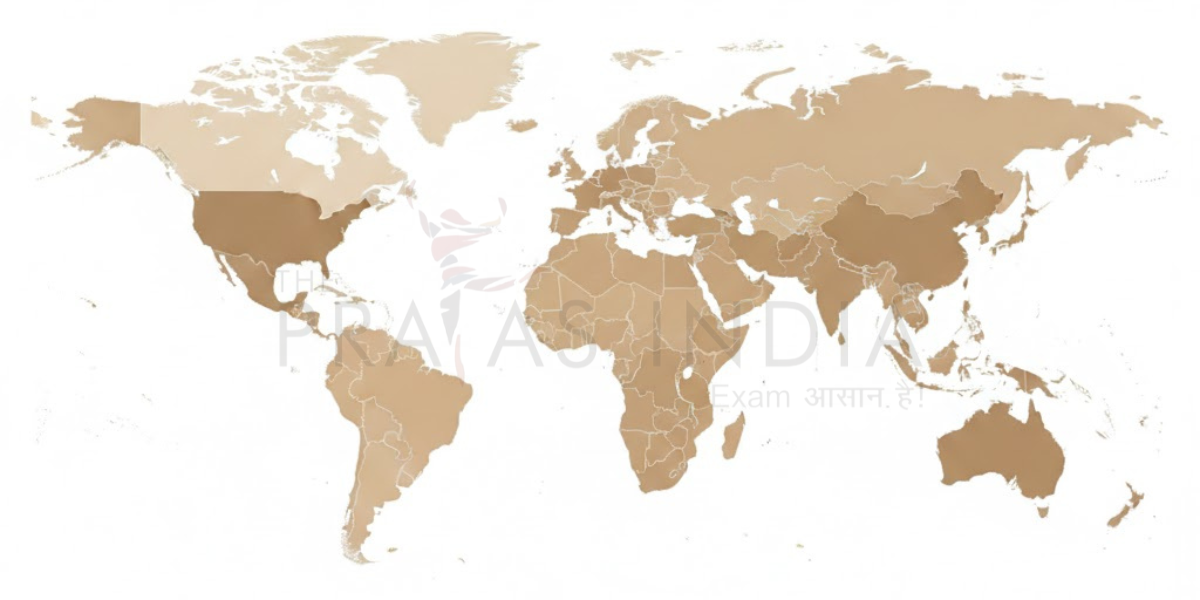
Located along the Tropic of Cancer and Capricorn under subtropical high-pressure zones.
Examples: Sahara, Arabian, Thar, Kalahari, Australian deserts.
B. Cold Deserts
Situated in high altitudes/latitudes with low temperature and evaporation.
Examples: Gobi, Taklamakan, Antarctica, Arctic desert.
C. Coastal Deserts
Influenced by cold ocean currents causing stable, dry air masses.
Examples: Atacama, Namib.
D. Rainshadow Deserts
Formed by mountains blocking moisture-bearing winds.
Examples: Ladakh (India), Patagonian, parts of Thar.
E. Mid-latitude / Continental Deserts
Located deep within continents, far from moisture sources.
Examples: Great Basin, Central Asian deserts.
Major Deserts of the World
Below is an analytical overview:
HOT DESERTS
Sahara Desert (Africa)
- Location: North Africa, world’s largest hot desert (over 9 million sq km).
- Climate: Extremely hot, <100 mm rainfall annually.
- Landforms: Erg (sand seas), regs, hammadas, yardangs, wadis.
- Biodiversity: Date palms, acacias, fennec fox, addax.
- Human Life: Nomads (Tuaregs), oil and gas (Libya, Algeria).
Arabian Desert
-
Covers Saudi Arabia, UAE, Oman, Yemen.
-
Features: Rub’ al Khali (Empty Quarter) – world’s largest sand desert.
-
Wealth from hydrocarbons; urbanization (Dubai, Riyadh).
Thar Desert (India–Pakistan)
- Hot semi-arid desert; highest population density among deserts.
- Dunes, dust storms, monsoon marginality; IGNP has transformed parts into agricultural zones.
Kalahari Desert
- Semi-arid; home to San tribes.
- Better vegetation due to summer rainfall.
Australian Deserts
- Great Victoria, Great Sandy, Simpson.
- Sparse population, rich in minerals (iron ore, uranium).
COLD DESERTS
Gobi Desert (Mongolia–China)
- Cold winter desert; temperature ranges from -40°C to +45°C.
- Rocky surface; important trade routes (historically Silk Road).
Taklamakan Desert
- “Sea of death,” extremely dry.
- Surrounded by high mountains creating a deep rainshadow.
Atacama Desert (Chile) – cold coastal desert
- Driest non-polar desert; some regions have never recorded rainfall.
- Controlled by Humboldt Current and temperature inversion.
- Lithium mining.
Patagonian Desert
- Caused by the Andes’ rainshadow effect.
Antarctica & Arctic Deserts
- World’s largest cold deserts; extremely low precipitation and high albedo.
COASTAL DESERTS
Atacama (Chile) – already covered
Namib Desert (Namibia)
- One of the oldest deserts; fog desert due to Benguela Current.
RAINSHADOW DESERTS
Ladakh (India)
- High-altitude cold desert due to Himalayas blocking monsoon.
- Sparse vegetation, glacial streams, unique fauna.
Part of Thar Desert
-
Aravallis block Arabian Sea branch, creating semi-arid conditions.
Colorado Plateau (USA)
- Desert due to Sierra Nevada and Rockies blocking moisture.
Climatic Causes of Desert Formation
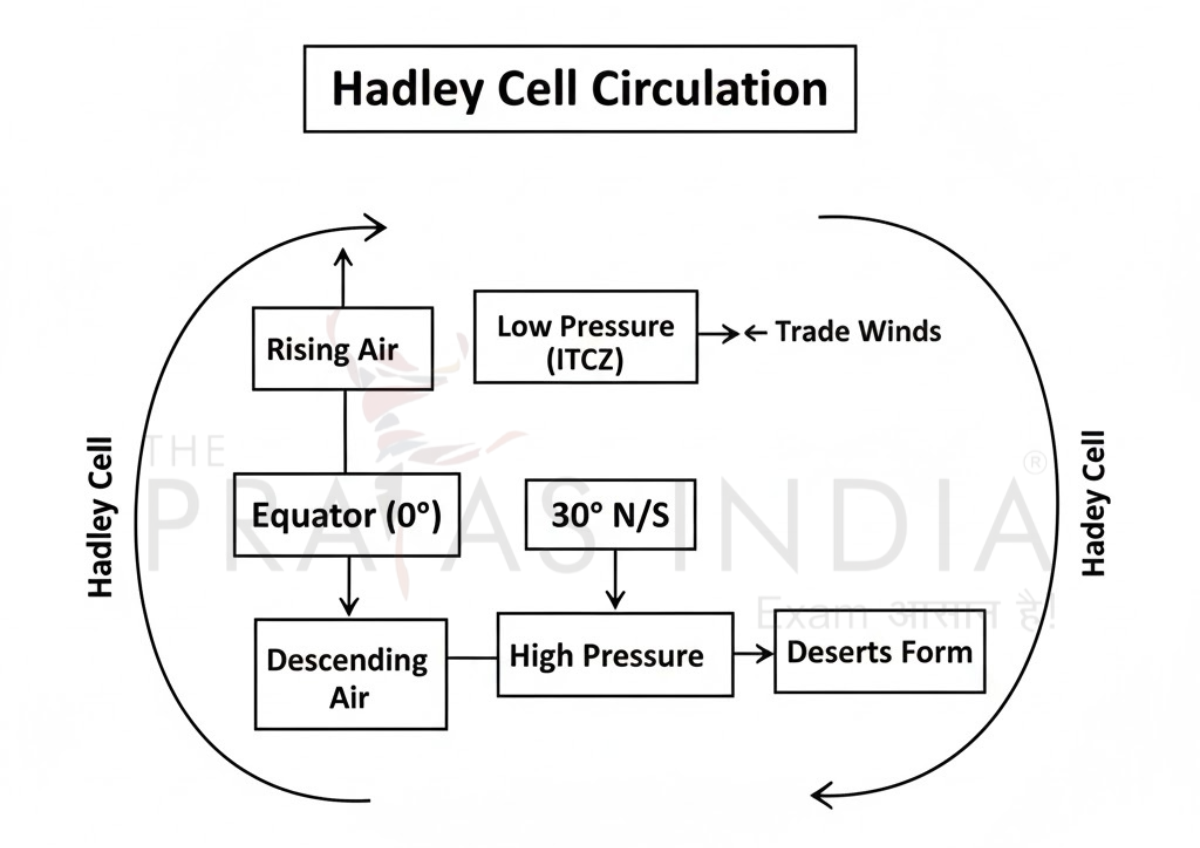
1. Subtropical High-Pressure Belts (Hadley Cell)
Air descends around 30° N & S, compressing and warming → no clouds → arid climate.
2. Cold Ocean Currents
Cold currents cool air → reduces evaporation → stable air → dry coastal deserts.
Examples: Atacama (Humboldt Current), Namib (Benguela Current).
3. Rainshadow Effect
Moist winds rise over mountains → lose moisture → dry descending winds create deserts.
4. Continentality
Regions far from moisture sources receive negligible precipitation.
5. Temperature Inversion
Common in coastal deserts → prevents vertical uplift → no rainfall.
6. Global Circulation Patterns
Trade winds, subtropical ridges, and jet streams influence desert climates.
Desert Landforms
A. Aeolian Erosional Landforms
- Yardangs – streamlined ridges shaped by wind erosion
- Rock Pedestals
- Deflation Hollows
B. Aeolian Depositional Landforms
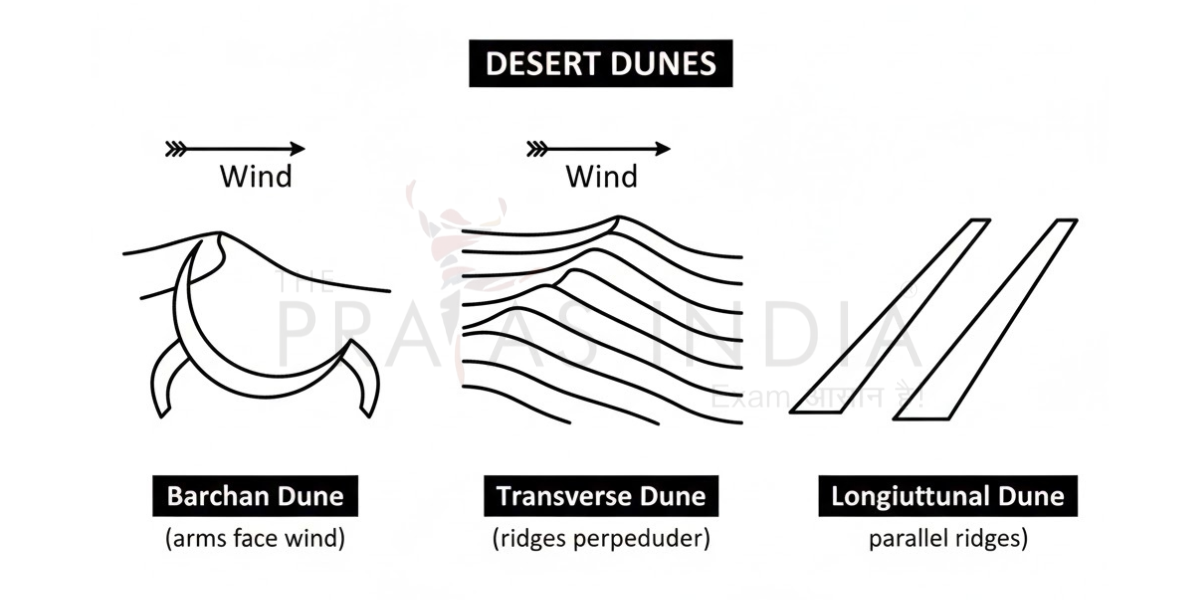
- Barchan dunes – crescent-shaped dunes
- Transverse dunes – perpendicular to wind
- Longitudinal dunes – parallel to wind
- Loess – wind-blown silt deposits
Desert Ecology & Biodiversity
- Xerophytic flora: cactus, date palm, acacia, creosote bush
- Fauna: camels, jerboa, fennec fox, reptiles, beetles
- Adaptations: water storage, nocturnal habits, burrowing, reduced transpiration
- Soils: aridisols with low humus, high salt concentration
- Food chains are simple but highly specialized.
Human Life in Deserts
- Nomadic pastoralism (Bedouins, Tuaregs, Raikas)
- Oasis agriculture – date palms, barley, millet
- Urbanization – Las Vegas, Phoenix, Dubai
- Minerals – copper, gold, lithium
- Petroleum – Middle East deserts
- Cultural history – Egypt, Mesopotamia originated in desert river valleys.
Deserts in India
Thar Desert
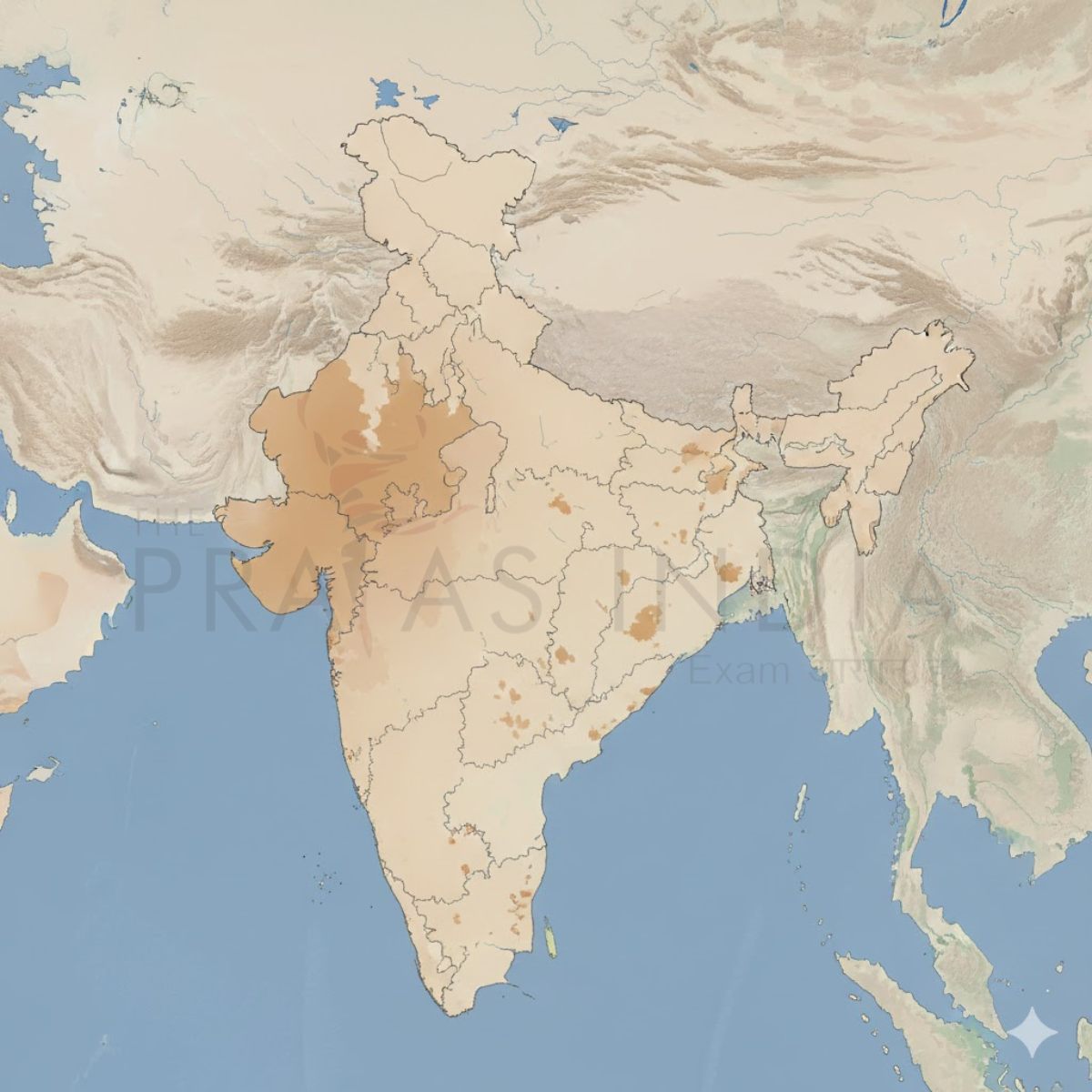
- Covers Rajasthan and parts of Gujarat, Haryana, Punjab.
- Dunes (barchans, parabolic), high population density, monsoon variability.
- Biodiversity: Great Indian Bustard, blackbuck, camels.
- IGNP has enabled agriculture and settlement.
Cold Deserts
Ladakh
- High altitude, extremely low precipitation.
- Glacial melt sustains streams.
- Unique fauna: snow leopard, kiang.
Lahaul–Spiti & Kargil
- Rainshadow of Himalayas.
- Sparse vegetation, Buddhist cultural landscape.
Desertification in India
- Arid/semi-arid regions expanding due to overgrazing, deforestation, mismanagement.
- India is a signatory to UNCCD.
Global Issues Related to Deserts
- Desertification (Africa’s Sahel, Aralkum desert formation)
- Climate change intensifying droughts
- Brown clouds and dust storms affecting global temperatures
- Water scarcity leading to migration
- Biodiversity loss in fragile ecosystems
Conservation Measures
- UNCCD policies
- Afforestation, shelterbelts
- Dune stabilization
- Contour trenching & bunding
- Watershed management
- Drip irrigation
- Rainwater harvesting
- Sustainable grazing practices
Case Studies
1. Aralkum Desert
- Formed from shrinking Aral Sea due to water diversion.
- Illustrates human-induced desertification.
2. Thar Desert & Indira Gandhi Canal
- Canal has transformed desert agriculture.
- Also created ecological pressures (invasive species).
3. Atacama’s Hyper-Aridity
- Fog-fed ecosystems (lomas).
- Lithium mining impacts.
4. Ladakh Cold Desert Ecosystem
- High-altitude microclimates, climate sensitivity.
- Solar villages, sustainable tourism.
UPSC Prelims & Mains Focus Points
Prelims Areas
- Location of deserts
- Cold currents → deserts
- Rainshadow deserts
- Dune types
- Soil types (Aridisols)
Mains Themes
- Desertification
- Human adaptation
- Role of deserts in climate regulation
- Aeolian processes
- Desert ecology and conservation
FAQs on Deserts in the World
1. What is the definition of a desert?
A desert is a climatic region that receives less than 250 mm of rainfall annually, characterized by low humidity, high evaporation, sparse vegetation, and extreme temperature variations.
2. How much of Earth’s land surface is covered by deserts?
Deserts occupy around 33% (one-third) of the Earth’s land area, including both hot and cold deserts.
3. What are the major types of deserts?
Deserts are classified into:
- Hot Deserts (Sahara, Thar)
- Cold Deserts (Gobi, Ladakh)
- Coastal Deserts (Atacama, Namib)
- Rainshadow Deserts (Ladakh, Patagonia)
- Continental Deserts (Central Asia)
4. Why do deserts form in subtropical regions?
Most deserts lie along 20°–30° latitudes due to descending dry air of the Hadley Cell, creating high-pressure zones that inhibit rainfall.
5. What are the major desert landforms?
Common landforms include barchan dunes, longitudinal dunes, yardangs, mesas, buttes, pediments, and alluvial fans shaped by wind (aeolian processes) and water erosion.
6. How do plants survive in deserts?
Desert flora (xerophytes) survive through:
- Thick cuticles
- Reduced leaves
- Deep or widespread roots
- Water storage tissues
- CAM photosynthesis
7. Which desert is the hottest in the world?
The Sahara Desert records the highest land surface temperatures globally.
8. Which is the driest desert on Earth?
The Atacama Desert (Chile) is the driest, with some areas receiving 0 mm rainfall for decades.
9. What are India’s major deserts?
India has:
- Thar Desert (hot desert) – Rajasthan, Gujarat
- Cold Deserts – Ladakh, Lahaul–Spiti, Kargil
10. What is desertification?
Desertification is the land degradation in arid and semi-arid regions due to climate change, overgrazing, deforestation, and unsustainable farming.
11. How does climate change affect deserts?
Climate change intensifies desertification, increases heatwaves, expands dry zones, and alters species survival patterns.
12. Which global organisation works on desertification?
The UN Convention to Combat Desertification (UNCCD) coordinates international efforts to manage drylands and prevent desert expansion.
Conclusion
Deserts are one of Earth’s most dynamic and climate-sensitive ecosystems. Far from being barren wastelands, they host unique flora, fauna, minerals, and cultures. Understanding desert climatology, landforms, and ecological challenges is essential for sustainable development, especially as climate change intensifies aridity and desertification. Effective management, scientific planning, and global cooperation are crucial to protecting these fragile landscapes.