Digital Rupee (e₹): India’s Central Bank Digital Currency Explained
The Digital Rupee is relevant to UPSC as it integrates economics, governance, and technology. It intersects GS Paper 2 topics like Government policies, governance reforms, and financial inclusion, as well as GS Paper 3 areas covering internal security, banking reforms, cyber laws, and technology-driven economic growth. It is a popular topic for prelims factual questions and mains essays on digital economy, monetary policies, and ethics of privacy vs public interest.
Introduction
The Digital Rupee (e₹) represents India’s foray into Central Bank Digital Currency (CBDC), a sovereign digital currency issued by the Reserve Bank of India (RBI). As economies worldwide transition towards digital payments, CBDCs offer a government-backed alternative to both physical cash and private cryptocurrencies. India’s Digital Rupee aims to modernize payments, secure monetary sovereignty, and advance financial inclusion—all while balancing privacy, regulatory stability, and technological innovation.
What is Digital Rupee (e₹)?
The Digital Rupee, also known as e₹, is a legal tender issued electronically by the RBI. Unlike physical banknotes, it exists in digital form but retains the same face value and trust of Indian currency. It combines the instantaneous settlement of online payment methods with the direct control and safety of sovereign money. Key characteristics include:
- Issued and guaranteed by the RBI.
- Directly exchangeable with cash at par.
- Stored in secured digital wallets (mobile or card-based).
- Can be transacted offline (in pilot or limited modes).
- Designed to mirror some properties of cash—anonymity, finality, and direct transfer.
Difference: Physical Rupee vs. Digital Rupee
| Feature | Physical Rupee | Digital Rupee (e₹) |
|---|---|---|
| Form | Paper, coin | Electronic, computer code |
| Issuer | RBI (minting) | RBI (digital issuance) |
| Transfer | Hand-to-hand | Peer-to-peer wallet or online |
| Settlement | Immediate, offline | Immediate, online/offline |
| Anonymity | Full | Programmable/partial (pilot) |
| Counterfeit Risk | Medium | Very low |
Background & Global Context
Evolution of Digital Currencies
Digital money concepts (like e-money, prepaid cards) have existed for years, but CBDCs are a newer class—digital currency that functions as official money, not just a claim on the central bank. CBDCs bridge the reliability of central bank money and the flexibility, speed, and programmability of digital payment systems.
International CBDC Examples
- China: Digital Yuan (e-CNY) pilot has reached millions.
- Nigeria: eNaira—Africa’s first actively used CBDC.
- Bahamas: Sand Dollar, focused on inclusion and resilience.
- EU, UK, US: Various pilot programs and policy frameworks are under analysis.
India’s Policy Motivation
With a strong digital infrastructure (Aadhaar, UPI, Jan Dhan), India targets a “digital-first” approach. The Digital Rupee aims to:
- Modernize financial infrastructure.
- Strengthen monetary sovereignty and currency security.
- Create an alternative to volatile private cryptocurrencies.
- Reduce the country’s reliance on costly cash management.
Objectives of Digital Rupee (CBDC India)
Currency Sovereignty: Counter risks posed by private digital coins and foreign tech players.
Reduce Cash Handling Costs: Printing, transporting, and safeguarding physical cash is expensive and inefficient.
Enhance Payment Efficiency: Faster, more reliable, transparent, and programmable transactions, even in remote areas.
Financial Inclusion: Eases banking for the unbanked, deepens access in rural and remote regions.
Improve Monetary Policy Transmission: Facilitates innovative tools—like programmable or targeted money.
Types of Digital Rupee
India deploys two primary forms of CBDC:
| Type | Name | Target Users | Use Cases |
|---|---|---|---|
| Retail | e₹-R | General public | Person-to-person, retail payments (shops, peer transfer) |
| Wholesale | e₹-W | Financial institutions | Inter-bank settlements, government securities |
Retail vs Wholesale Digital Rupee
| Criteria | Retail CBDC (e₹-R) | Wholesale CBDC (e₹-W) |
|---|---|---|
| Users | Individuals, businesses | Banks, financial institutions |
| Transaction type | Small value, high frequency | Large value, low frequency |
| Purpose | Everyday payments, remittances | Interbank, securities |
| Interface | Mobile wallets, QR, smart cards | Bank systems, RTGS/NEFT |
| Privacy | Likely higher for users | Inter-institutional only |
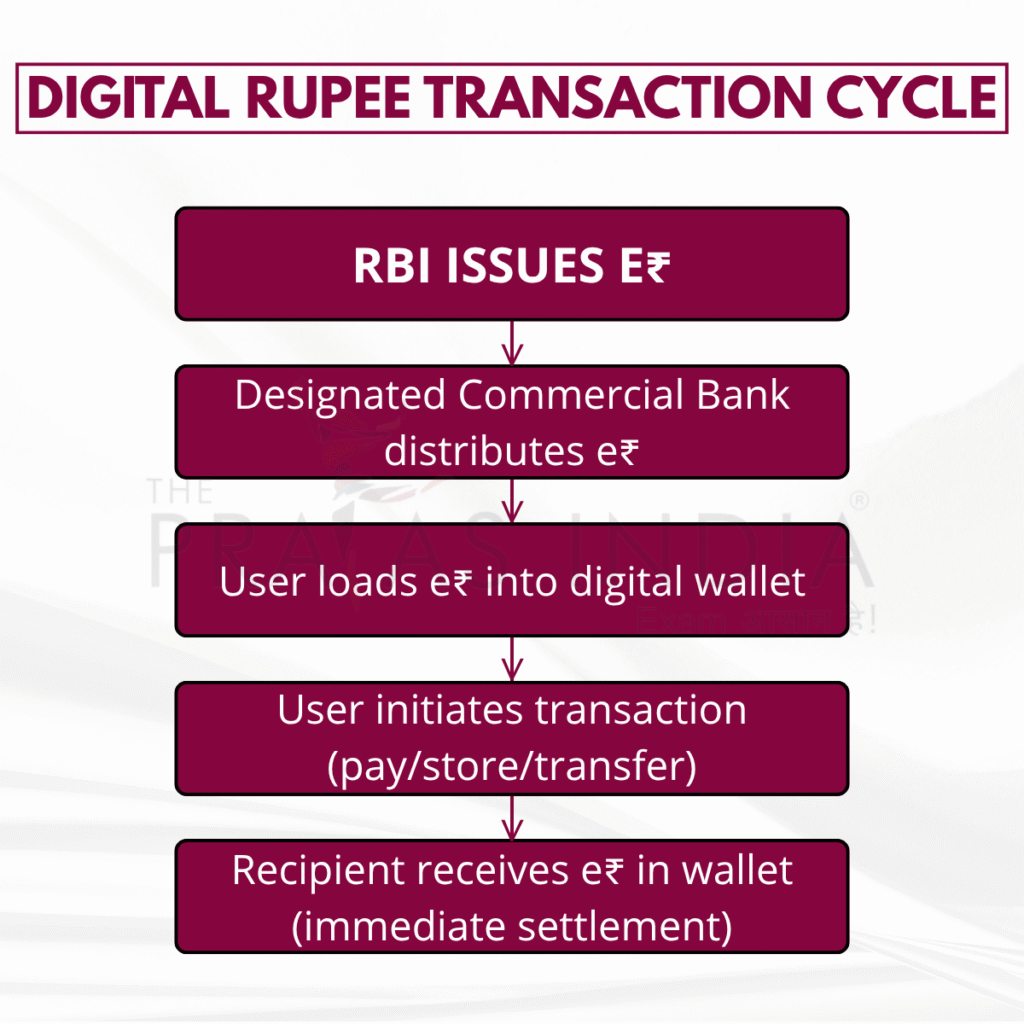
How Digital Rupee Works
Issuance: RBI issues e₹ digitally (centralized/token-based).
Distribution: Distributed via select commercial banks or directly through RBI.
Wallets: Citizens/businesses access e₹ using RBI-approved apps or digital wallets (hot/cold).
Transaction Flow: Sender uses wallet to pay/transfer e₹ to recipient’s wallet. Settlement is real-time and final. Offline capability is possible in certain use cases.
Digital Rupee Transaction Cycle
Features of the Digital Rupee
Legal Tender: e₹ is a valid, recognized form of Indian currency.
Programmability: Can be coded to serve specific purposes (e.g., welfare transfers that can only be spent on specified goods).
Offline Functionality: Potential to transact without internet—critical for rural access.
Interoperability: Can integrate with existing payment technology (UPI, IMPS) while being a separate form of currency.
Traceability & Transparency: Each e₹ unit has a digital record, aiding anti-fraud, anti-money laundering, and audit trails.
Finality & Instant Settlement: Transactions are instantaneous and irreversible.
Digital Rupee vs UPI vs Crypto vs Cash
| Criteria | Digital Rupee (e₹) | UPI | Crypto Assets | Physical Cash |
|---|---|---|---|---|
| Issuer | RBI | NPCI, private banks | Decentralized, global | RBI |
| Legal Tender | Yes | No (transfers INR) | No | Yes |
| Settlement | Direct, real-time | Bank-mediation, fast | Consensus, variable | Immediate |
| Anonymity | Partial (policy) | None | Variable/anonymity | Full |
| Programmability | Yes (future) | No | Yes | No |
| Subject to Policy | Yes (RBI controls) | Yes (Indian Law) | No central control | RBI policy |
| Offline Use | Possible in pilot | No | Partly (wallet based) | Yes |
| Volatility/Risk | Stable | Stable | Highly volatile | Stable |
Benefits to India
Instant, Secure Transactions: Promotes fast, low-cost transfers between individuals and institutions.
Reduced Cash Management Burden: Eliminates logistical, printing, and cash-handling costs for RBI/government.
Improved Transparency: Every transaction leaves a digital footprint, enhancing audit capability and financial oversight.
Enhanced Financial Inclusion: Reduces barriers for unbanked/rural populations; can reach mobile-first users.
Facilitates Direct Benefit Transfers: Programmability allows welfare funds to be spent as intended, reducing leakage.
Anti-Counterfeit: Virtually eliminates fake currency risks.
Support for e-Governance: Seamless integration with digital government initiatives and platforms.
Challenges & Concerns
Privacy Issues: Use of digital trails could compromise user anonymity if data is not sufficiently protected.
Cybersecurity Risks: Threat of hacking, system failure, or theft increases with digital-only assets.
Bank Disintermediation: If e₹ wallets become popular, commercial bank deposits may decrease, impacting banking sector liquidity.
Adoption Barriers: Existing dominance of UPI and limited digital literacy in parts of India could slow uptake.
Infrastructure Needs: Ensuring rural/remote areas access, offline use, and robust cyber systems is a significant hurdle.
Complexity of Implementing Programmability: Policy and technology must align to avoid misuse.
Benefits vs Challenges
| Benefits | Challenges |
|---|---|
| Faster payments | Data privacy risks |
| Lower transaction cost | High initial setup cost |
| Boosts formalization | Digital literacy required |
| Enables smart transfers | Cybersecurity threats |
| Reduces counterfeit currency | Impact on bank deposits/liquidity |
| Supports inclusion | Balancing transparency/privacy |
Economic & Policy Implications
Monetary Policy: e₹ gives RBI tools to manage money supply in real-time, possibly even at the micro-level.
Banking Sector: Banks may see reduced low-cost deposits as customers shift funds to digital wallets. This could impact credit creation, lending, and interest margins.
Crypto Regulation: Digital Rupee gives government a state-controlled answer to private cryptocurrencies, enhancing regulatory grip while reducing risks of financial instability.
Taxation & KYC: Digital trail supports compliance, monitoring, and anti-tax evasion efforts.
Government & RBI Policy Roadmap
RBI released the first CBDC Concept Note in October 2022.
Pilots:
Wholesale CBDC-W pilot launched in Nov 2022, first for interbank securities settlement.
Retail CBDC-R pilot started Dec 2022 among a select group of banks, merchants, and customers.
Stakeholders: RBI, commercial banks, fintech service providers, and central/federal government departments.
Legal Amendments: Required modifications to the RBI Act, 1934 for CBDC launch and regulation.
Consultation: Ongoing feedback from banks, businesses, and digital ecosystem partners to improve design, privacy, and usability.
Future Prospects
Cross-border CBDC: India could leverage e₹ for faster, cheaper international remittances and settlements, integrating with CBDCs of other major economies.
Smart Contracts: Programmable digital rupee can deploy conditional payments, automate compliance, and enable e-governance.
Tokenized Assets: e₹ could support tokenization of digital assets, securities, and other financial products on blockchain.
Offline Payments: Mobile and card-based offline storage solutions for rural inclusion.
Evolving Legal & Technical Framework: Enhanced privacy frameworks, interoperability standards, robust cyber-resilience.
Conclusion
India’s Digital Rupee (e₹) brings the promise of a modern, efficient, and secure payment future balanced with sovereign oversight and robust policy support. While the project faces real challenges in privacy, infrastructure, adoption, and bank dynamics, its benefits—improved financial inclusion, instant settlement, programmable money, and lower counterfeiting—are transformative. As CBDC India (e₹) matures, it is poised to coexist with traditional cash, digital payment platforms (like UPI), and the regulated fintech ecosystem, driving India further along the path of digital and inclusive growth.
FAQs
Q1: Is the Digital Rupee the same as UPI transactions?
No, Digital Rupee (e₹) is India’s official central bank digital currency issued by RBI, whereas UPI is a payments interface allowing electronic bank transfers.
Q2: What are the types of Digital Rupee?
Retail Digital Rupee (e₹-R) for general public usage and Wholesale Digital Rupee (e₹-W) for inter-bank and institutional settlements.
Q3: Can Digital Rupee be used offline?
Offline transaction capabilities are planned to enable usage in areas with poor internet connectivity.
Q4: Who issues Digital Rupee?
Issued and regulated solely by the Reserve Bank of India.
Q5: How does Digital Rupee differ from cryptocurrencies?
Digital Rupee is legal tender backed by RBI, stable in value, and regulated, whereas cryptocurrencies are decentralized, highly volatile, and not legal tender.