Earthquakes – Causes, Types, Impact, and Mitigation Strategies
Introduction
An earthquake is a sudden and rapid shaking of the Earth’s surface caused by the release of energy stored in the Earth’s lithosphere. This energy release generates seismic waves, which propagate outward from the point of origin. Earthquakes are among the most significant endogenic processes shaping the Earth’s crust and influencing geomorphology.
Earthquakes may occur due to natural processes—primarily tectonic movements, volcanic activity, or crustal adjustments—or due to anthropogenic activities such as mining, reservoir impoundment, and underground nuclear explosions.
Understanding earthquakes is essential for UPSC because it integrates geotectonics, disaster management, environmental security, and infrastructure resilience.
Causes of Earthquakes
Tectonic Causes
Tectonic earthquakes constitute more than 90% of global seismicity. They originate from stresses produced by plate interactions.
Plate Movements
Earth’s lithosphere is divided into seven major and several minor plates. Movements along convergent, divergent, and transform boundaries result in strain accumulation.
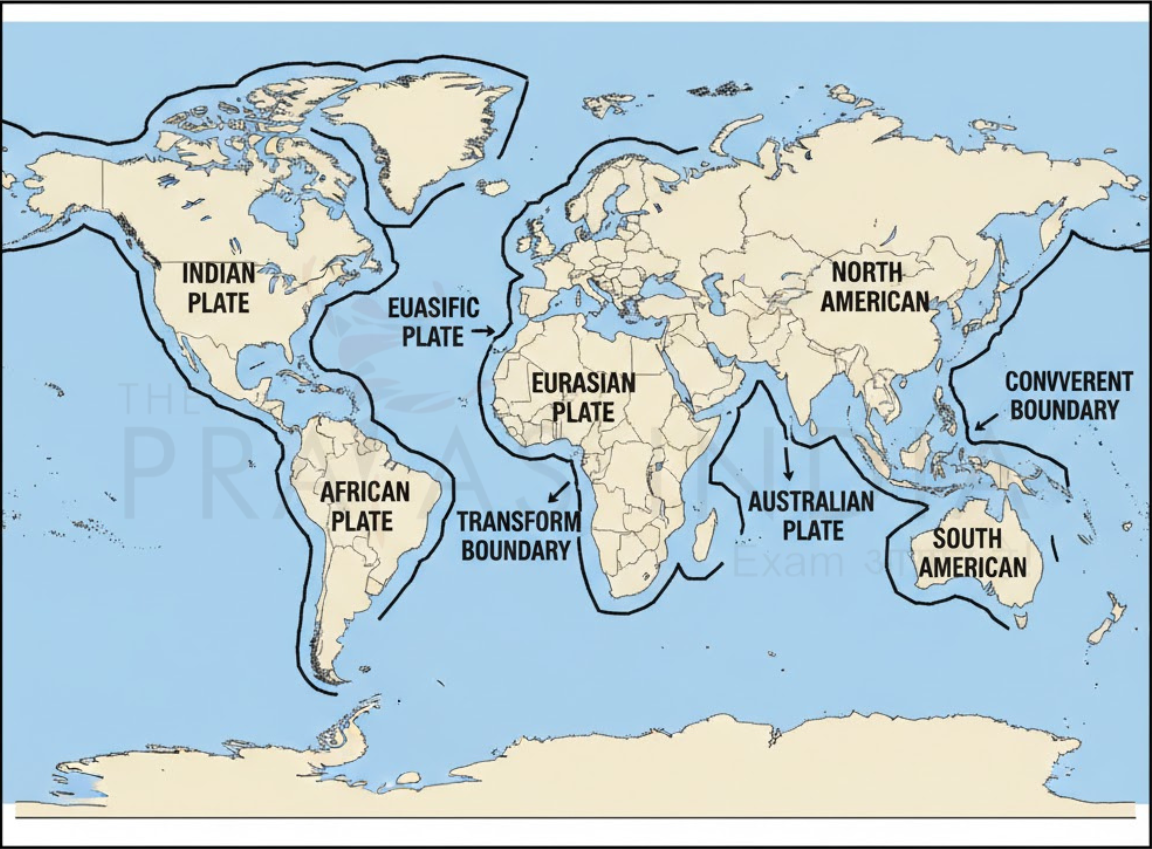
Convergent Boundaries
When two plates collide or one subducts beneath another, it leads to megathrust earthquakes, the most powerful type. Examples include:
- 2011 Tōhoku earthquake (Japan) — Pacific Plate subducting beneath Eurasian Plate.
- 2004 Sumatra Earthquake — Indo-Australian Plate subducting beneath Eurasian Plate.
Divergent Boundaries
At mid-oceanic ridges, plates move apart, producing shallow-focus earthquakes. Example: Mid-Atlantic Ridge.
Transform Boundaries
Plates slide horizontally past each other, generating frequent shallow quakes. Example: San Andreas Fault, USA.
Elastic Rebound Theory
Proposed by H.F. Reid (1911), it explains that rocks accumulate elastic strain until they rupture, releasing energy.
Volcanic Earthquakes
Associated with magma movement. Common around Iceland, Hawaii, Java, and Andaman–Nicobar.
Reservoir-Induced Seismicity (RIS)
Impoundment of large water reservoirs increases pore pressure and triggers earthquakes.
Examples:
- Koyna Earthquake (1967)
- Narmada Sardar Sarovar Region
- Tehri Dam (Potential RIS zone)
Human-Induced Tremors
- Deep mining (South Africa)
- Hydrocarbon extraction and fracking (USA)
- Underground nuclear tests (Pokhran detected globally)
Types of Seismic Waves
Earthquakes release three major categories of waves.
Body Waves
P-Waves (Primary)
Fastest seismic waves; travel through solids, liquids, and gases. Compressional in nature.
S-Waves (Secondary)
Slower; travel only through solids. Cause shearing motion.
Surface Waves
Love Waves
Generate horizontal shearing; major cause of infrastructural damage.
Rayleigh Waves
Move in a rolling motion; highly destructive in populated areas.
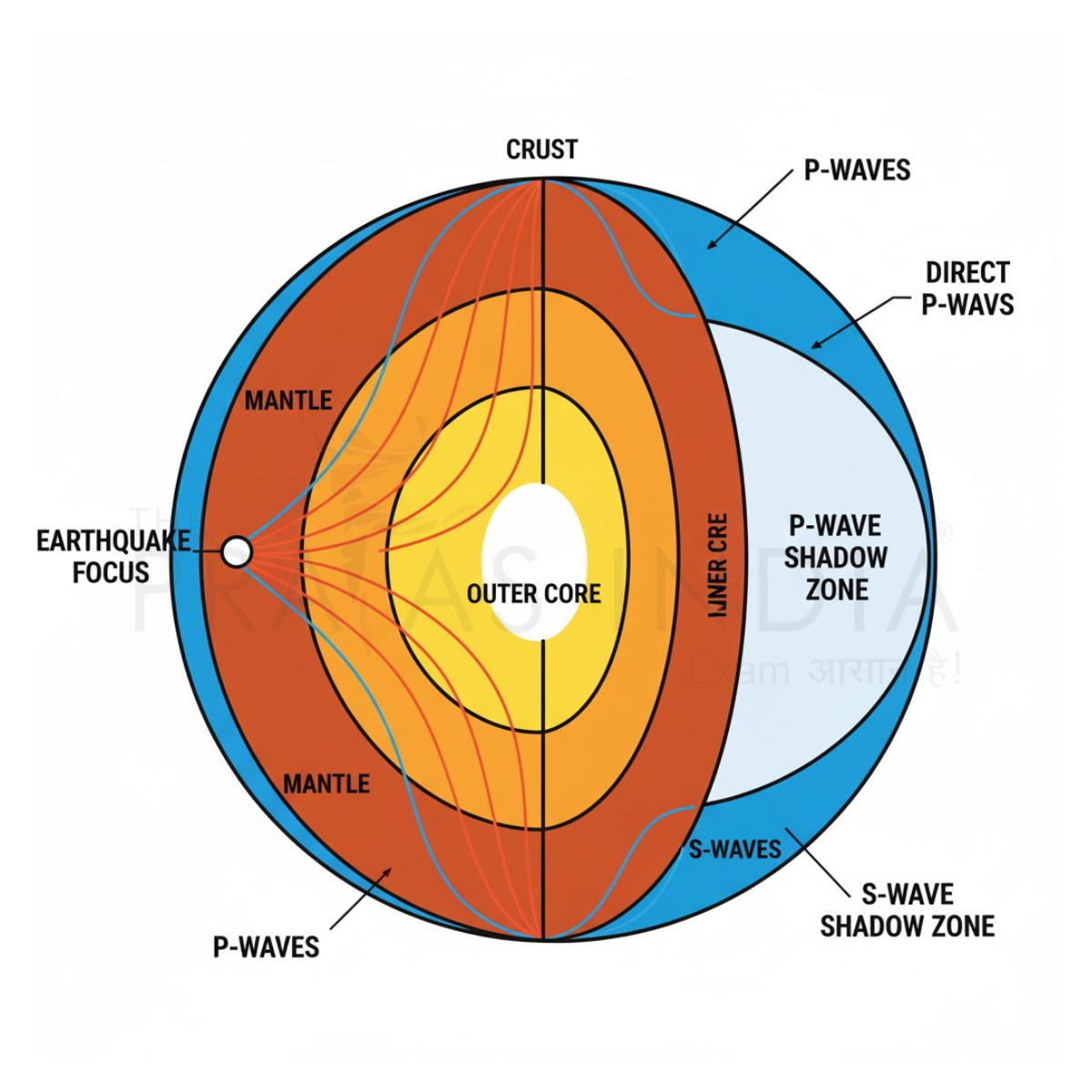
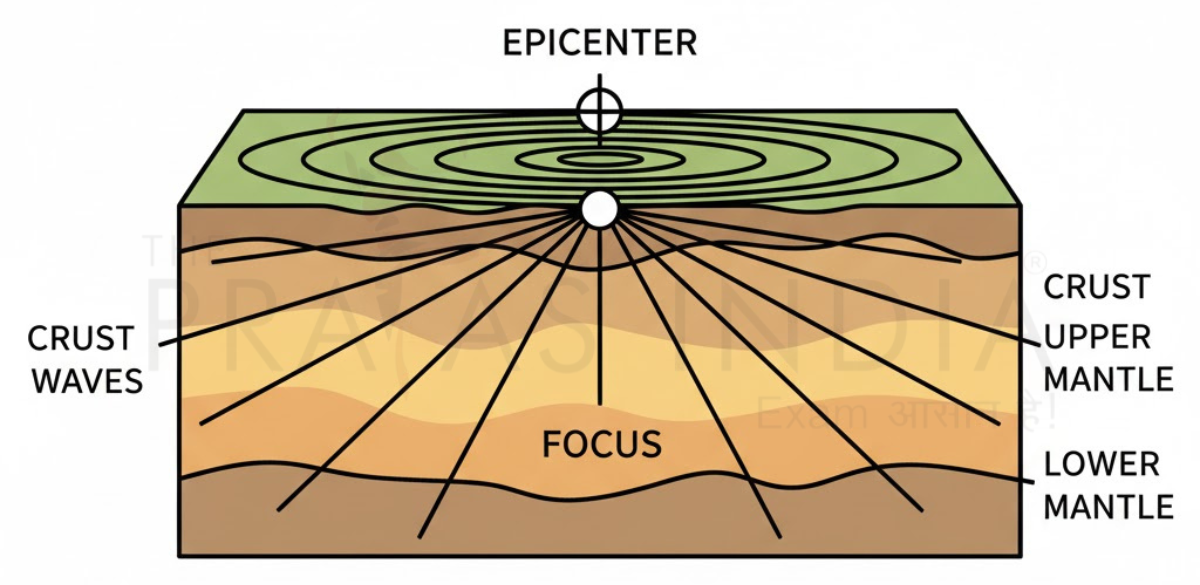
Focus, Epicenter & Earthquake Measurement
Focus (Hypocenter)
The point inside Earth where the earthquake originates.
Epicenter
Point directly above the focus on Earth’s surface.
Measuring Earthquakes
Magnitude Scales
- Richter Scale (ML): Measures energy released; logarithmic.
- Moment Magnitude Scale (Mw): Most widely used; accurate for large quakes.
Intensity Scales
- Modified Mercalli Intensity Scale (MMI): Measures observed effects on surface and structures.
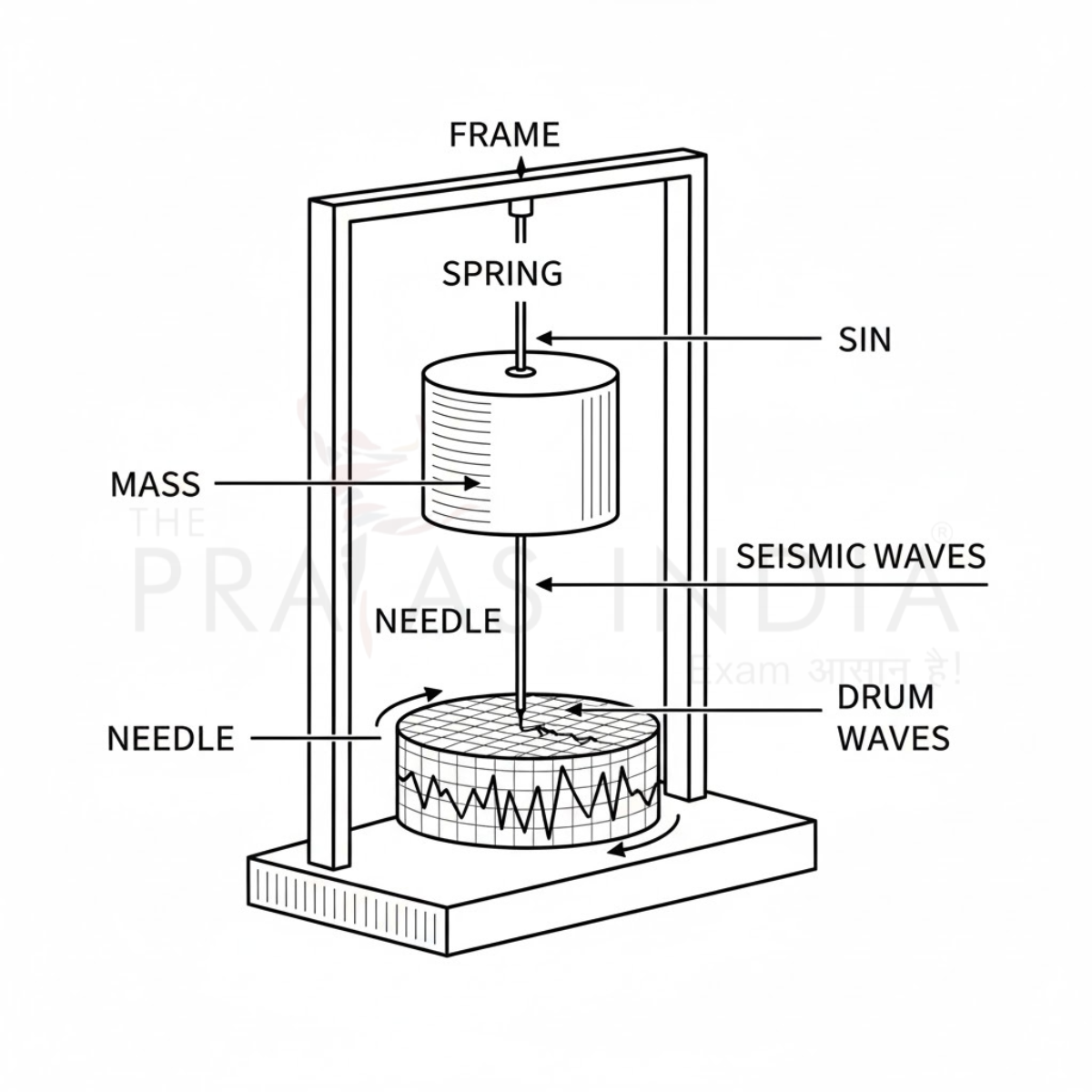
Seismograph and Seismogram
A seismograph records ground motion, producing a seismogram used for magnitude calculation.
Distribution of Earthquakes
Global Distribution
Earthquakes are concentrated along major plate boundaries. Three major belts account for most seismic activity:
Pacific Ring of Fire
- Around 70% of global earthquakes
- Surrounds the Pacific Ocean
- Highly active subduction zones
Mid-Atlantic Ridge
- Divergent boundary
- Produces mild, frequent earthquakes
Alpine-Himalayan Belt
- Extends from Southern Europe through Middle East to Himalayas
- Includes Turkey, Iran, Himalayas—some of the most dangerous zones
Indian Context
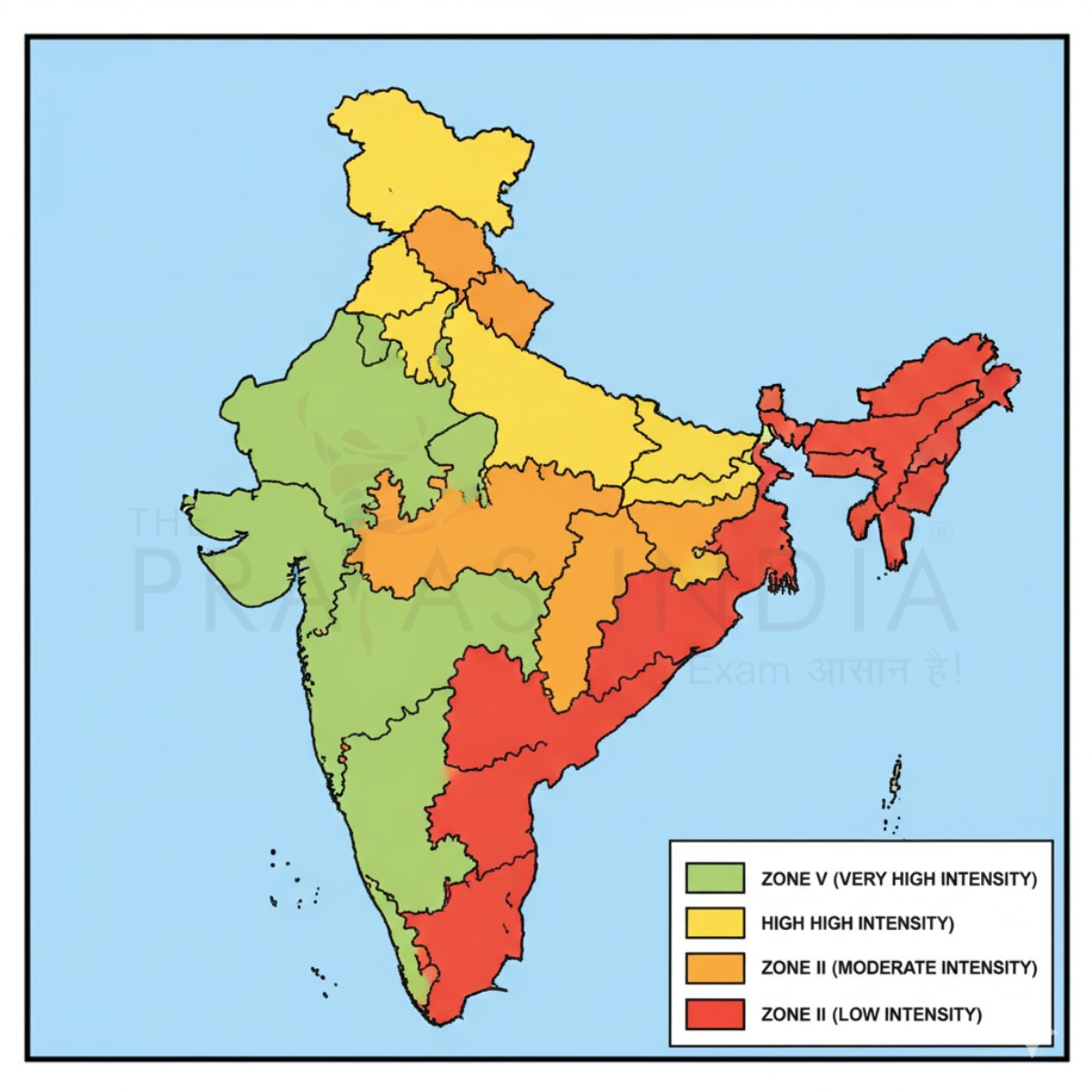
India has diverse seismic zones:
- Himalayan region – Zone V (highest risk)
- North-east India – Highly active due to Indo-Burmese arc
- Kutch Region (Gujarat) – Seismically active stable continental region
- Peninsular India – Stable but vulnerable to intraplate and RIS earthquakes
Earthquake-Prone Regions of the World
Circum-Pacific Belt
Most active seismic belt; includes Japan, Philippines, Chile, Alaska.
Mediterranean–Trans-Asiatic Belt
Earthquakes from Europe through Iran, Afghanistan, to Himalayas.
Mid-Oceanic Ridge Belt
Divergent boundaries producing mild quakes across the Atlantic and Indian Oceans.
Major Historical Earthquakes
- Chile 1960 (Mw 9.5) – strongest recorded
- Indian Ocean 2004 (Mw 9.1)
- Tangshan, China 1976 – one of the deadliest
Effects of Earthquakes
Primary Effects
Ground Shaking
Leads to building collapse; major cause of deaths.
Surface Rupture
Visible displacement along faults.
Liquefaction
Water-saturated sediments lose strength, causing buildings to sink. Example: 2001 Bhuj earthquake.
Secondary Effects
Tsunamis
Triggered by undersea megathrust earthquakes.
Example: 2004 Indian Ocean Tsunami.
Landslides
Common in Himalayan regions — Uttarkashi 1991, Chamoli 1999.
Fires
Due to ruptured gas lines and electrical damage.
Economic and Environmental Effects
- Massive reconstruction costs
- Disruption of livelihoods
- Alteration of river courses
- Groundwater changes
Earthquake Prediction and Forecasting
Prediction
Short-term prediction remains scientifically impossible.
Forecasting
Based on long-term probabilities.
Seismic Gap Theory
Segments of faults with no recent activity may be due for a major earthquake.
Monitoring Methods
- GPS and InSAR for crustal deformation
- Seismometers to detect foreshocks
- Gas emission studies (e.g., radon levels)
Early Warning Systems
Japan and Mexico have world-class systems providing seconds of warning.
India’s Initiatives
- National Seismological Network
- Indian Tsunami Early Warning Centre
- Projects on Real-Time Seismic Monitoring of buildings
Mitigation, Preparedness & Disaster Management
Structural Measures
- Earthquake-resistant design
- Base isolation technology
- Retrofitting of old structures
- Construction using ductile materials
Standards & Codes
- IS 1893: Earthquake-resistant design
- IS 4326: Building construction in seismic zones
Non-Structural Measures
- Community awareness campaigns
- Land-use zoning to avoid fault zones
- School and workplace drills
- Emergency communication networks
Institutional Framework in India
- National Disaster Management Authority (NDMA)
- State Disaster Management Authorities (SDMAs)
- National Earthquake Risk Mitigation Project (NERMP)
International Best Practices
- Japan’s strict building codes
- California’s fault zoning laws
- Turkey’s mandatory seismic insurance
Case Studies
2011 Tōhoku Earthquake, Japan
- Mw 9.0
- Triggered a devastating tsunami
- Caused Fukushima nuclear disaster
- Japan’s early warning system reduced casualties
2001 Bhuj Earthquake, India
- Mw 7.7
- Massive destruction in Gujarat
- Liquefaction in Kutch region
- Led to new Indian disaster management policies
2015 Nepal Earthquake
- Mw 7.8
- Impacted Kathmandu Valley
- High fatalities due to traditional buildings
- Highlighted Himalayas’ megathrust vulnerability
Conclusion
Earthquakes are inevitable manifestations of Earth’s internal dynamics. While prediction remains elusive, forecasting, preparedness, resilient infrastructure, and community awareness can significantly reduce risk. As India lies in a seismically active region, integrating scientific planning with robust governance is essential. Sustainable development and disaster-resilient infrastructure must be at the core of India’s long-term strategy.
FAQs on Earthquakes
1. What is an earthquake?
An earthquake is the sudden shaking of the Earth’s surface caused by the movement of tectonic plates along faults.
2. What causes earthquakes?
Most earthquakes occur due to tectonic plate movements, volcanic activity, or man-made reasons like mining and reservoir-induced seismicity.
3. What is the Richter Scale?
It is a logarithmic scale used to measure the magnitude (strength) of an earthquake.
4. What are seismic waves?
These are energy waves released during an earthquake. They include P-waves, S-waves, and surface waves.
5. What is the difference between the epicenter and the focus?
The focus is the underground point where the earthquake originates.
The epicenter is the point directly above it on the Earth’s surface.
6. Which regions in India are most earthquake-prone?
The Himalayan region, Indo-Gangetic plains, parts of Gujarat, Maharashtra, and Northeast India fall in high-risk seismic zones.
7. How can we stay safe during an earthquake?
Follow the “Drop, Cover, and Hold On” rule, stay away from windows, and move to open spaces if outdoors.
8. Can earthquakes be predicted?
No, earthquakes cannot be predicted with accuracy. Scientists can only assess risk zones, not exact timing.