East China Sea – Physical Geography, Ecosystems, Oceanography & Geopolitics
- GS Paper 1: Physical Geography, Ocean Geography, Geomorphology
- GS Paper 3: Environment, Marine Ecology, Climate Change, Maritime Resources
- Prelims: Seas, Straits, Ocean Currents, Maritime Boundaries, Disputed Islands
- Geography Optional: Oceanography, Biogeography, Plate Tectonics, Geopolitics of Seas
Introduction
The East China Sea (ECS) is a marginal sea of the Western Pacific Ocean, located between the eastern coast of China and the Japanese archipelago. It forms a key maritime zone in East Asia, linking major economies—China, Japan, Taiwan, and South Korea. The sea is known for its broad continental shelf, rich fisheries, strategic shipping lanes, and significant geopolitical disputes.
The ECS holds strategic, ecological, and economic importance due to:
- Its position as a major Indo-Pacific trade corridor
- Highly productive fisheries and coral ecosystems
- Key role in monsoon circulation and cyclone formation
- Presence of hydrocarbon reserves
- Intense territorial and maritime boundary disputes
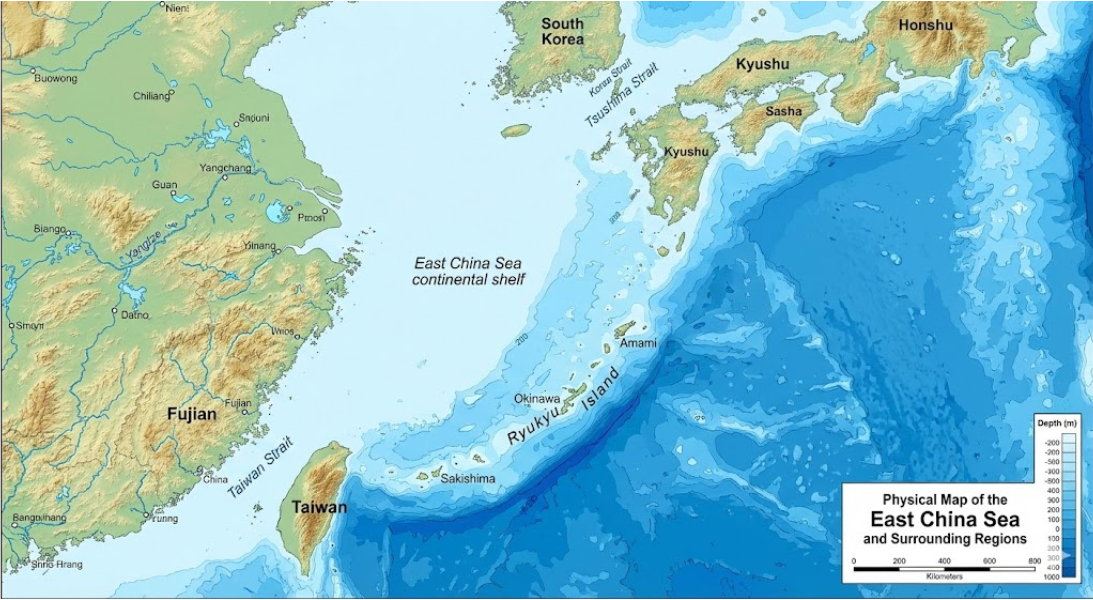
Location & Geographical Extent
The ECS covers approximately 1.25 million sq. km, making it one of the major marginal seas in East Asia.
Boundaries
- West: China’s eastern coastline (Zhejiang, Fujian provinces)
- East: Japan’s Kyushu and Okinawa (Ryukyu Islands)
- South: Northern coast of Taiwan
- North: South Korea & the Yellow Sea
Connections
- Yellow Sea: via the northern opening
- Pacific Ocean: east of the Ryukyu Arc
- South China Sea: through the Taiwan Strait

Geological & Oceanographic Features
a. Continental Shelf
The East China Sea contains one of the widest continental shelves in the world.
- Average depth: around 200 m
- Shelf width: extremely broad, especially near the Chinese coast
- Rich in nutrient upwelling, supporting fisheries
- Host to hydrocarbon fields such as Chunxiao
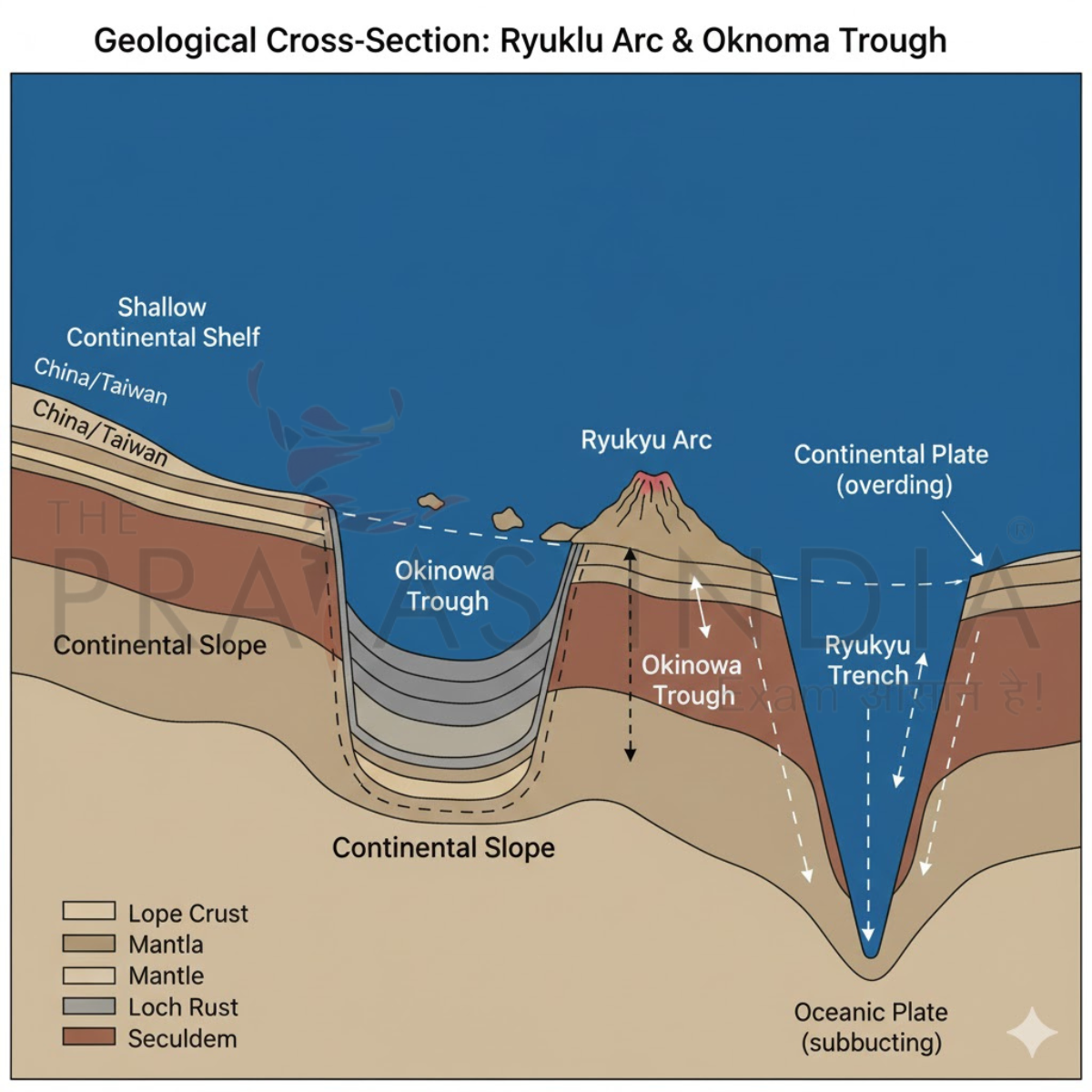
b. Tectonic Setting
The ECS lies along the Eurasian Plate’s eastern boundary, influenced by subduction processes.
Key tectonic features:
- Ryukyu Trench: where the Philippine Sea Plate subducts under Eurasia
- Active seismicity: frequent earthquakes
- Submarine volcanoes
- Arc–trench system forming the Ryukyu Arc
These tectonic interactions created the Okinawa Trough, an active back-arc basin.
c. Seafloor Topography
Major features include:
- Okinawa Trough:
- Located west of the Ryukyu Arc
- Depth ranges 1000–2000 m
- Formed by back-arc spreading
- Taiwan Accretionary Prism:
- Formed by collisions between the Eurasian Plate and Philippine Sea Plate
- Characterized by compressed sediment layers
- Underwater ridges & basins
- Complex bathymetry due to tectonic convergence
Ocean Currents & Climate Influence
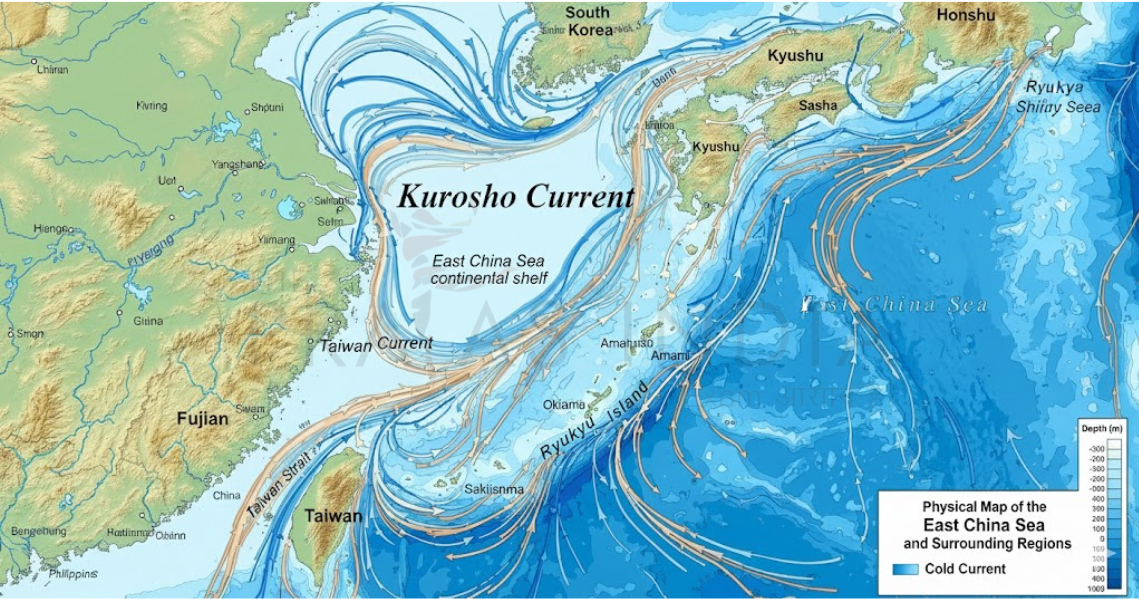
The Kuroshio Current, one of the world’s major warm currents, dominates circulation.
Kuroshio Current Characteristics
- Origin: Near the Philippines (Luzon Strait)
- Moves northward along Taiwan and Ryukyu Islands
- Contributes to:
- Warm waters
- High humidity
- Marine biodiversity patterns
- Cyclone movement paths
Monsoon Influence
- Summer monsoon (SW): brings warm, moist air → enhances rainfall
- Winter monsoon (NE): cold Siberian winds → cools surface waters
Cyclone Formation Zone
The ECS acts as a pathway for Western Pacific typhoons, especially August–October.
Seasonal Variations
- Large contrasts in sea surface temperature, salinity, and nutrient profiles
- Winter cooling enhances vertical mixing → supports phytoplankton blooms
Major Islands & Coastal Features
a. Ryukyu Islands (Japan)
- Chain stretching from Kyushu to Taiwan
- Volcanic origin
- Mix of coral reefs, limestone hills, and coastlines
- Important military installations, including US bases
b. Senkaku/Diaoyu Islands (Disputed)
- Uninhabited, small rocky islands
- Strategic for EEZ calculations
- Believed to lie near oil and natural gas reserves
- Major China–Japan flashpoint
c. Zhoushan Archipelago (China)
- Over 1,300 islands
- Major fishing and port region
- Proximity to Shanghai and Hangzhou Bay
d. Taiwan Coastal Zones
- Eastern coast: narrow shelf, steep drop into deep ocean
- Western coast: sedimented shelf facing ECS
- Mix of fishing ports, industrial clusters, coral areas
Climate & Weather Patterns
The East China Sea experiences a humid subtropical climate (Cfa).
Key Features
- Warm, humid summers
- Cold, dry winters influenced by the Siberian High
- Typhoons peak in August–October
- Fog formation common due to cold–warm current mixing
- Heavy rainfall along Chinese and Japanese coastlines
Marine Ecosystems & Biodiversity
The ECS supports diverse habitats due to:
- Kuroshio Current
- Nutrient mixing from continental rivers
- Upwelling zones
Major Ecosystems
- Phytoplankton-rich waters
- Mangroves along Chinese coast
- Coral reefs around Okinawa
- Kelp forests and seaweed beds
- Estuaries of major Chinese rivers (Yangtze, Qiantang)
Notable Species
- Tuna, mackerel, sardines
- Squid, cuttlefish
- Sea turtles
- Whales and dolphins
- Crustaceans & shellfish
Economic Importance
a. Fisheries
- One of Asia’s most productive fishing zones
- Major fleets: China, Taiwan, Japan, South Korea
- Major species: anchovies, mackerel, tuna, squid
- Overfishing has become a serious concern
b. Oil & Gas Resources
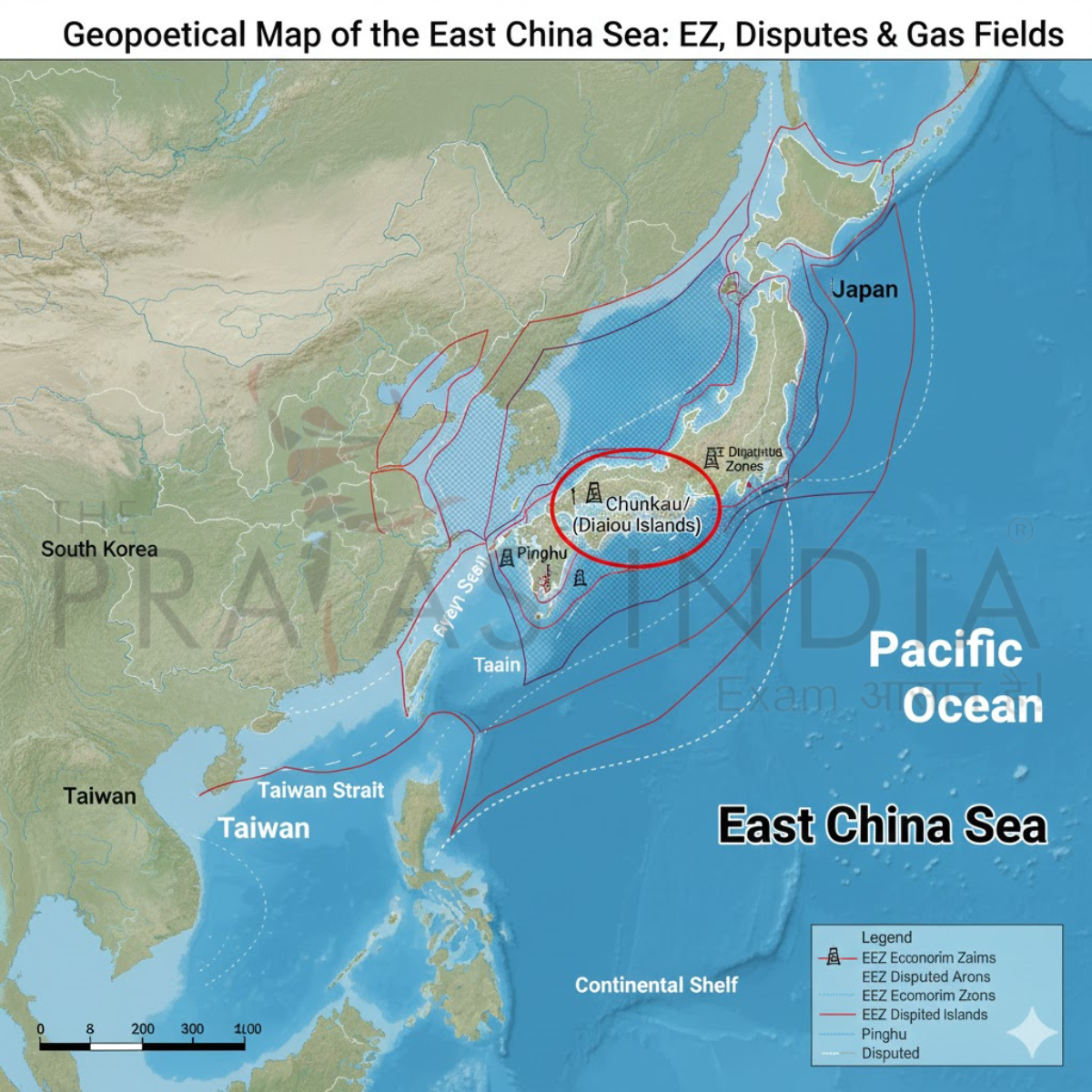
- Presence of gas fields like Chunxiao, claimed by both China and Japan
- Potential offshore reserves across the Okinawa Trough
- Energy security concern for East Asian states
c. Shipping & Trade Routes
- One of the world’s busiest maritime regions
- Crucial shipping lanes connecting:
- China → Japan → Korea → Southeast Asia
- Major ports involved:
- Shanghai, Ningbo, Fuzhou (China)
- Busan (South Korea)
- Nagasaki (Japan)
Human Settlements & Coastal Demographics
- Highly urbanized coastal belt
- Mega-cities: Shanghai, Ningbo
- Dense fishing communities in Zhejiang & Fujian
- Coastal industries: petrochemical zones, shipyards, logistics hubs
- Marine tourism in Okinawa & Taiwan
Geopolitical Significance & Territorial Disputes
a. Senkaku/Diaoyu Islands Dispute
Claimants:
- China (Diaoyu)
- Japan (Senkaku)
- Taiwan (Diaoyutai)
Reasons:
- Strategic maritime control
- EEZ expansion
- Possible oil & gas reserves
- Nationalistic narratives in China & Japan
b. Maritime Boundary Disputes
- EEZ overlaps among China, Japan, South Korea
- Different interpretations of UNCLOS provisions
- Issues of median line vs natural extension of shelf
c. Strategic Value
- Key zone in Indo-Pacific geopolitics
- US involvement through US–Japan Security Treaty
- Increasing military activities (surveillance aircraft, coast guard patrols)
Environmental Challenges
- Overfishing → stock depletion (especially sardines, mackerel)
- Coral reef degradation due to warming
- Plastic and industrial pollution from major coastal cities
- Eutrophication leading to algal blooms
- Sea surface temperature rise is impacting fish migration patterns
Comparison Table: East China Sea vs South China Sea vs Yellow Sea
| Feature | East China Sea | South China Sea | Yellow Sea |
|---|---|---|---|
| Average Depth | ~200 m (shallow shelf) | ~1200 m (deep basins) | ~44 m (very shallow) |
| Biodiversity | Corals, kelp forests, rich pelagic fish | World’s richest coral systems | Low biodiversity, turbid waters |
| Economic Importance | Fisheries, gas fields, shipping lanes | Oil/gas, shipping, fisheries | Fishing, shipping |
| Geopolitical Tensions | China–Japan over Senkaku | China–ASEAN multi-claimant disputes | Milder, mostly China–Korea issues |
| Ocean Currents | Kuroshio Current | Monsoon-driven circulation | Weak circulation |
Conclusion
The East China Sea is a crucial maritime space combining significant physical geography, rich marine ecosystems, important economic resources, and complex geopolitics. Its location astride key shipping lanes, continental shelves, and tectonic boundaries makes it central to East Asian security and economic interests.
For UPSC, the ECS is important because it links:
- Physical Geography: ocean currents, continental shelves, bathymetry
- Environment: fisheries, coral reefs, pollution
- International Relations: maritime disputes, UNCLOS, Indo-Pacific strategy
- Economy: trade routes, ports, hydrocarbons
A holistic understanding of the East China Sea helps connect GS1–GS3 topics with current affairs, especially India’s Indo-Pacific policy.