Gautam Buddha: Life, Teachings, and Historical Significance
- GS Paper 1: Ancient Indian History (Buddhism, Religious & Philosophical Movements)
- GS Paper 4: Ethics – Compassion, Middle Path, Moral Discipline
- Prelims: Life of Buddha, Four Noble Truths, Eightfold Path, councils, symbols
- Optional (History / Philosophy): Buddhism, Indian Philosophy, Shramana Traditions
Introduction
Gautam Buddha, also known as Siddhartha Gautam, was the founder of Buddhism, one of the most influential religious and philosophical traditions to emerge from ancient India. Living in the 6th century BCE, Buddha articulated a path of ethical conduct, mental discipline, and wisdom aimed at liberation from suffering. His teachings arose in a period of profound socio-religious ferment, marked by dissatisfaction with Brahmanical ritualism, rigid social hierarchies, and metaphysical speculation.
Buddhism represented a reformist response to these conditions, emphasizing moral living, rational inquiry, and individual effort over ritual sacrifice and inherited privilege. Over time, Buddhism developed into a major world religion, profoundly shaping Indian society, culture, art, and philosophy, and later spreading across Asia.
Historical Background
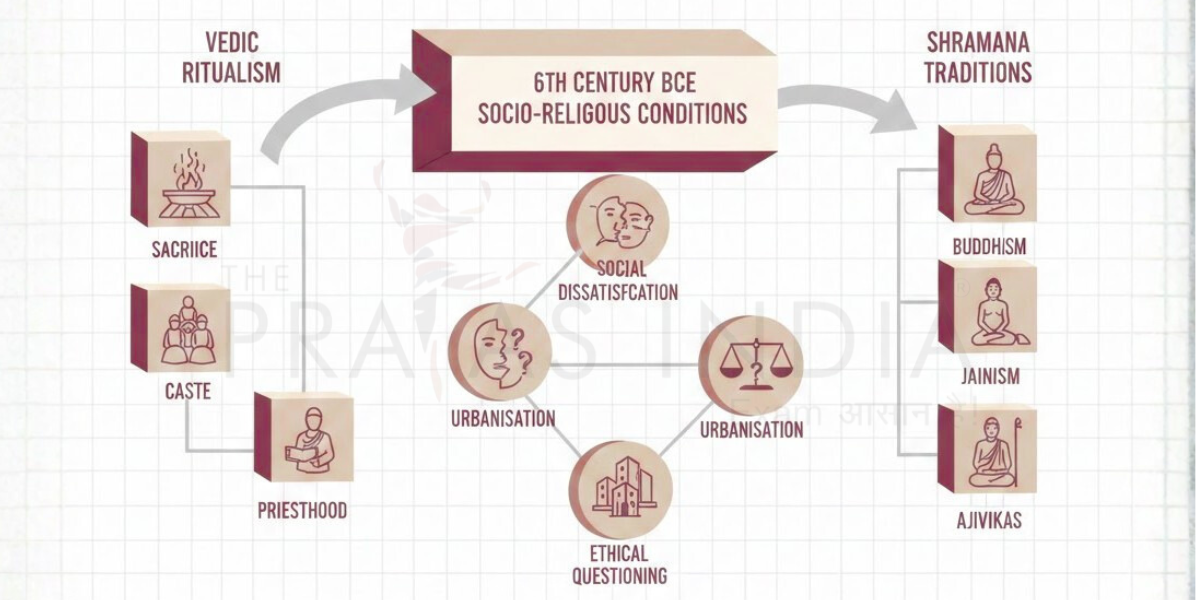
The 6th century BCE was a transformative period in Indian history. Politically, the emergence of large territorial states (mahajanapadas) such as Magadha led to centralized authority and standing armies. Economically, the growth of agriculture, trade, and urban centers generated new social groups, including merchants and artisans, who often questioned Brahmanical dominance.
Socially and religiously, dissatisfaction grew against elaborate Vedic rituals, animal sacrifices, and the rigid caste system. The Upanishads reflected philosophical questioning, while heterodox sects collectively known as the Shramana movements—such as Buddhism, Jainism, Ajivikas, and others—challenged orthodox practices. These movements emphasized asceticism, ethical conduct, and liberation through knowledge and self-discipline rather than ritual mediation.
Early Life of Gautam Buddha
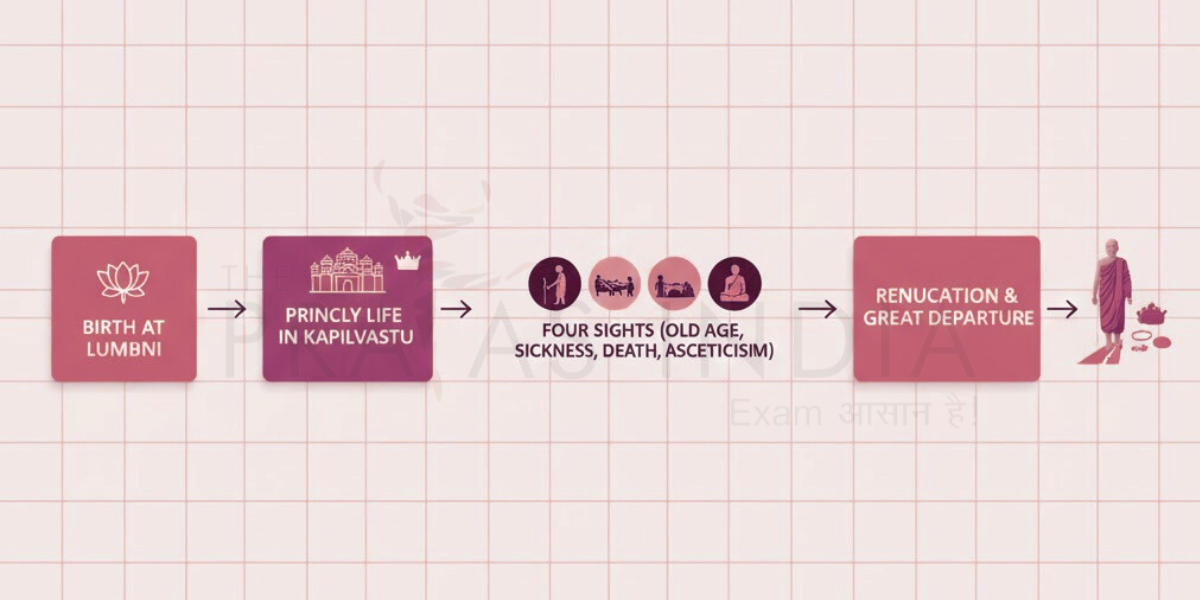
Gautam Buddha was born around 563 BCE at Lumbini (in present-day Nepal). He belonged to the Shakya clan and was born into a Kshatriya family. His father, Suddhodana, was the chief of the Shakya republic. Raised in relative comfort, Siddhartha was shielded from the harsher realities of life.
According to Buddhist tradition, Siddhartha encountered the “Four Sights”—an old man, a sick person, a corpse, and an ascetic—which profoundly affected him. These experiences exposed him to the universality of suffering and impermanence. At the age of 29, he renounced his princely life in search of a solution to human suffering.
Enlightenment and Teaching Career
After renunciation, Siddhartha practiced severe asceticism for several years but found it ineffective. He then adopted the Middle Path, rejecting both extreme asceticism and excessive indulgence. At Bodh Gaya, while meditating under the Bodhi tree, Siddhartha attained enlightenment (Bodhi) and became the Buddha—the Enlightened One.
His first sermon at Sarnath, known as the Dhammachakra Pravartana (Turning of the Wheel of Dharma), laid down the core principles of Buddhism. Buddha spent the next 45 years traveling across northern India, teaching people from all social backgrounds. He used simple language (Pali) and dialogic methods, making his teachings accessible to the masses.

Core Teachings of Buddhism
Four Noble Truths
At the heart of Buddhism lie the Four Noble Truths:
- Dukkha – Life involves suffering and dissatisfaction.
- Samudaya – Suffering arises from desire and ignorance.
- Nirodha – Cessation of suffering is possible.
- Magga – The path to cessation is the Eightfold Path.
These truths present a rational and experiential framework for understanding human existence.
Eightfold Path
The Eightfold Path provides a practical guide to ethical and mental development and is grouped into:
- Prajna (Wisdom): Right View, Right Intention
- Shila (Ethical Conduct): Right Speech, Right Action, Right Livelihood
- Samadhi (Mental Discipline): Right Effort, Right Mindfulness, Right Concentration
The path emphasizes moral behavior, mental cultivation, and insight as interconnected elements.

Philosophical Concepts
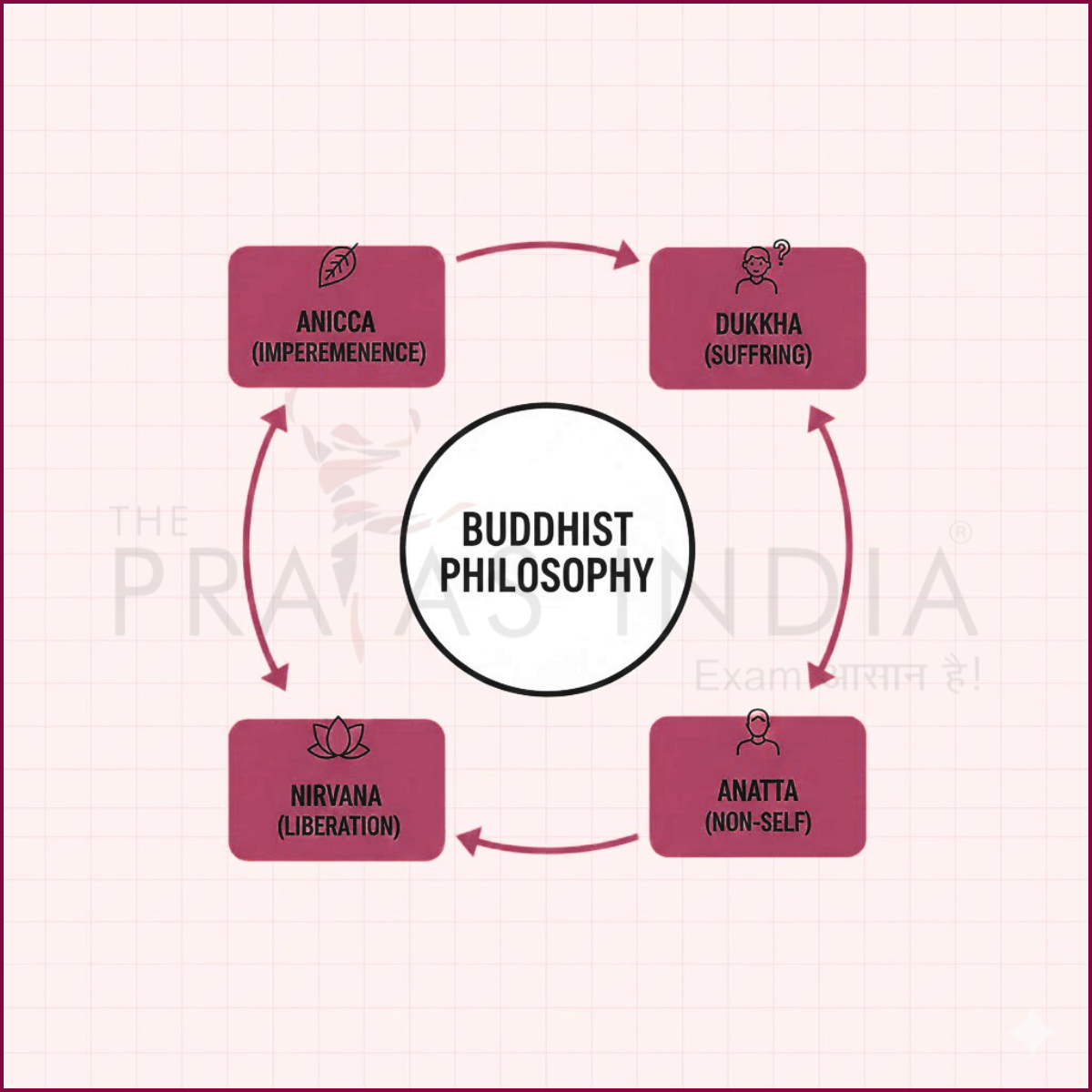
Buddhist philosophy is grounded in three fundamental concepts:
- Anicca (Impermanence): All conditioned phenomena are transient.
- Dukkha (Suffering): Attachment to impermanent things leads to suffering.
- Anatta (Non-self): There is no permanent, unchanging soul.
Nirvana represents the cessation of ignorance, desire, and suffering. Unlike Moksha in Brahmanical traditions, Nirvana is not union with a supreme being but liberation through insight and ethical living.
Buddhist Sangha and Organization
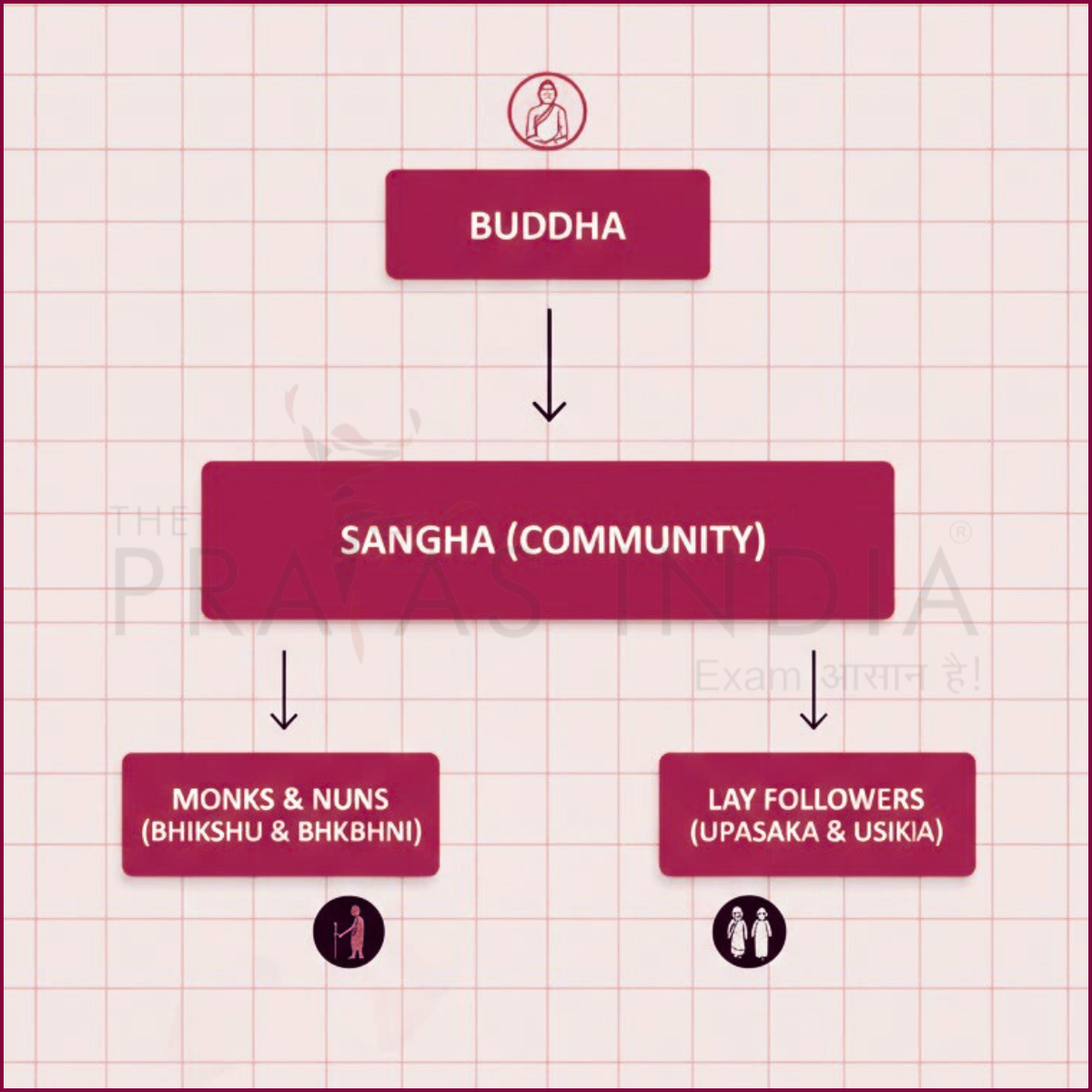
The Buddha established the Sangha, a monastic community of monks (bhikkhus) and nuns (bhikkhunis). The Sangha was governed by the Vinaya Pitaka, which laid down rules of discipline and conduct. Lay followers supported the Sangha through donations and adherence to moral precepts.
The organized nature of the Sangha enabled Buddhism to spread effectively. Regular assemblies, collective decision-making, and a code of discipline ensured institutional continuity.
Spread and Patronage of Buddhism
Buddhism received significant royal patronage, especially under Emperor Ashoka of the Mauryan dynasty in the 3rd century BCE. Ashoka embraced Buddhism after the Kalinga War and promoted its ethical principles through inscriptions, stupas, and missionary activities.
Buddhist Councils were convened to preserve and systematize teachings. Buddhism spread beyond India to Sri Lanka, Central Asia, China, Southeast Asia, Korea, and Japan, adapting to local cultures while retaining core principles.
Social and Ethical Impact
Buddhism challenged caste distinctions by emphasizing moral conduct over birth. The Sangha admitted individuals from all social backgrounds, including women and marginalized groups. Ethical values such as compassion (karuna), loving-kindness (metta), and non-violence reshaped social interactions.
Buddhist ethics influenced Indian society by promoting tolerance, rational inquiry, and social harmony. The emphasis on personal responsibility and ethical living resonated with urban populations and traders.
Comparison with Jainism (Brief)
Both Buddhism and Jainism emerged from the Shramana tradition and rejected Vedic authority. However, Jainism advocated extreme asceticism and considered karma as a material substance, while Buddhism followed the Middle Path and emphasized mental discipline. Buddhism rejected the notion of a permanent soul more explicitly than Jainism.
Decline of Buddhism in India (Brief Analysis)
The decline of Buddhism in India can be attributed to multiple factors: revival of Brahmanical traditions, loss of royal patronage, internal sectarian divisions, and absorption of Buddhist ideas into Hinduism. Invasions and destruction of monasteries further weakened institutional structures.
Historical Significance and Legacy
Buddhism made enduring contributions to Indian philosophy, ethics, and art. Buddhist stupas, monasteries, and sculptures represent a rich cultural heritage. As a global religion, Buddhism shaped civilizations across Asia and continues to influence contemporary thought on ethics, mindfulness, and non-violence.
Frequently Asked Questions (FAQs)
Q1. Why did Buddhism emerge in the 6th century BCE?
Buddhism emerged as a response to social inequalities, rigid caste hierarchy, excessive ritualism, and animal sacrifices associated with Brahmanical traditions. Economic and urban changes also encouraged ethical and philosophical questioning.
Q2. What is the significance of the Middle Path in Buddhism?
The Middle Path rejects both extreme asceticism and material indulgence. It forms the foundation of Buddhist practice, emphasizing balance, ethical conduct, and mental discipline.
Q3. How is Nirvana different from Moksha?
Nirvana refers to the cessation of suffering through the elimination of desire and ignorance, without belief in a permanent soul. Moksha, in Brahmanical traditions, often implies liberation of the soul and union with a higher reality.
Q4. What role did Ashoka play in the spread of Buddhism?
Ashoka provided royal patronage, promoted Buddhist ethics through inscriptions, built stupas, convened councils, and sent missionaries across Asia, making Buddhism a global religion.
Q5. Why did Buddhism decline in India?
Key reasons include revival of Brahmanism, loss of royal patronage, internal divisions, assimilation into Hindu practices, and destruction of monasteries during invasions.
Conclusion
Gautam Buddha stands as one of the greatest moral teachers in human history. His teachings offered a rational, ethical, and compassionate path to liberation, addressing universal human concerns. Rooted in the socio-religious realities of ancient India, Buddhism evolved into a global tradition, leaving a lasting imprint on world civilization. The enduring relevance of Buddha’s message lies in its emphasis on ethical living, self-awareness, and compassion in an impermanent world.