Glacial Landforms – A Comprehensive Geomorphic Analysis
- GS Paper 1: Geomorphology, Physical Geography
- GS Paper 3: Climate Change, Environment, Disaster Management
- Prelims: Geomorphic Processes, Physical Features, Ice Sheets & Glaciers, Erosional/Depositional Landforms
- Geography Optional: Geomorphology, Quaternary Geology, Glacial Processes, Landscape Evolution
Introduction
Glaciers are large, persistent masses of ice that originate on land through the accumulation and compaction of snow. They behave as dynamic systems that move downslope under the influence of gravity. The field of glacial geomorphology studies how glaciers erode, transport, and deposit materials, shaping distinctive landforms across high-latitude and high-altitude environments.
Glaciers are powerful agents of landscape evolution. Their ability to carve massive troughs, sculpt mountains, and deposit large quantities of sediment makes them crucial for understanding Earth’s geomorphic history. Globally, glaciers are predominantly located in:
- Polar regions – Greenland, Antarctica
- Temperate regions – Alaska, Patagonia, New Zealand
- Mountain/Alpine regions – Himalayas, Alps, Andes, Rockies
Glacial studies are important for UPSC because they explain paleoclimate reconstruction, hydrological systems, landform evolution, and climate-induced hazards such as GLOFs.

Glacial Processes (Very Important for UPSC)
Glacial processes determine the form and evolution of landscapes.
A. Erosion
Glaciers erode underlying bedrock through:
1. Abrasion
Rock fragments embedded in the glacier’s base act like sandpaper, grinding and polishing bedrock surfaces. Result: striations, polished surfaces, roche moutonnée.
2. Plucking (Quarrying)
When meltwater seeps into cracks, freezes, and pries rocks loose, the glacier incorporates the fragments into its body. Plucking is responsible for steep, jagged landforms.
Examples:
- U-shaped valleys of the Alps
- Plucked surfaces in Ladakh and Zanskar
B. Transportation
Glaciers carry enormous volumes of debris, classified based on position:
- Supraglacial load – on the surface
- Englacial load – within the ice
- Subglacial load – at the base, highly erosive
Unlike rivers, glaciers do not sort materials.
C. Deposition
When glaciers melt or lose energy, they deposit unsorted, angular sediment known as till. Depositional landforms include moraines, drumlins, eskers, etc.
D. Weathering Under Ice
Freeze–thaw cycles create fissures and break rocks apart, aiding glacial erosion. Frost action is widespread in periglacial environments such as Ladakh and the Tibetan Plateau.
Erosional Glacial Landforms
Each landform results from intense erosion by moving ice.
1. Cirque / Corrie / Cwm
A bowl-shaped, amphitheatre-like hollow at the head of a glacier.
Formation:
- Frost action + plucking deepen the hollow
- Abrasion smoothens the floor
- Steep backwalls form due to freeze–thaw
Examples:
- Snowdonia (UK)
- Nilgiri cirques (India – smaller scale alpine forms)
2. Arête
A narrow knife-edged ridge separating two cirques.
Examples:
- Striding Edge, UK
- Sharp ridges in the Kumaon Himalayas
3. Horn (Pyramidal Peak)
A sharp peak formed where several arêtes meet.
Examples:
- Matterhorn (Switzerland)
- Shivling Peak (Uttarakhand – classic pyramidal shape)
4. U-shaped Valley (Glacial Trough)
Glaciers widen and deepen V-shaped river valleys.
Features:
- Broad flat floor
- Steep straight sides
- Hanging tributary valleys
Examples:
- Yosemite Valley (USA)
- Nubra Valley, Ladakh
5. Hanging Valleys
Form when smaller tributary glaciers erode less deeply than main glaciers.
Examples:
- Bridalveil Falls (USA)
- Side valleys in Himachal Pradesh
6. Roche Moutonnée
Asymmetric rock mound with a smooth stoss side (abrasion) and a rough lee side (plucking).
7. Fjord
Drowned U-shaped valley after sea-level rise.
Examples: Norway, Alaska, New Zealand.
(UPSC frequently asks this.)
8. Ribbon Lake
Long, narrow lake in over-deepened glacial troughs.
Example:
- Lake Windermere (UK)

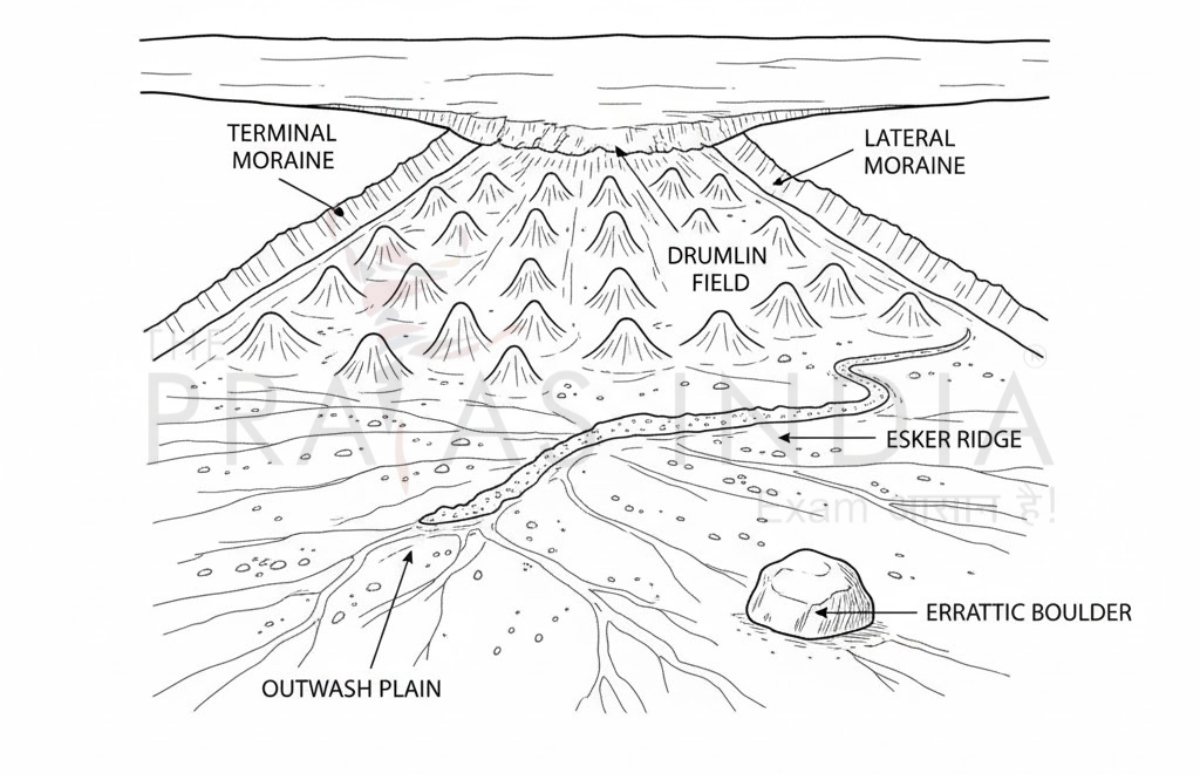
Depositional Glacial Landforms
Formed by deposition of till and meltwater sediments.
1. Moraines
- Terminal moraine – deposited at glacier snout
- Lateral moraine – along glacier sides
- Medial moraine – merging of two lateral moraines
- Ground moraine – blanket of till under glacier
Examples:
- Zanskar moraines
- Karakoram terminal moraines near Siachen
2. Drumlins
Streamlined, teardrop-shaped hills of till formed under ice.
Example:
-
Drumlin fields of Northern Ireland & Wisconsin
3. Eskers
Long, sinuous ridges formed by subglacial river deposits.
4. Kames
Mounded deposits from meltwater streams at glacier margins.
5. Outwash Plains
Fluvio-glacial sediments deposited by meltwater streams.
Example:
-
Sandurs of Iceland
6. Erratics
Large boulders transported far from their source.
Glacio-Fluvial Landforms
Glacial meltwater interacts with fluvial processes to create hybrid landforms.
1. Kettle Lakes
Depressions formed after buried ice blocks melt.
2. Outwash Fans
Deposits from meltwater emerging from snout.
3. Braided Rivers
Meltwater channels weaving around sediments.
4. Sandurs
Extensive outwash plains, common in Iceland.
5. Proglacial Lakes
Form at glacier fronts, often dammed by moraines.
Glaciation Cycles & Landscape Evolution
Glacial landforms reflect repeated advances and retreats during the Pleistocene Ice Age, influenced by Milankovitch cycles:
- Eccentricity (100,000 years)
- Obliquity (41,000 years)
- Precession (21,000 years)
Impacts:
- Northern Europe shaped by continental ice sheets
- North America: Great Lakes carved by glaciers
- Himalayas: rapid glacial retreat documented in last 40 years
Repeated glaciation produced classic features like fjords, drumlin fields, outwash plains, and morainic complexes.
Glacial Landforms in India
India’s glaciated landscapes are mainly in:
A. Himalayan Regions
Key glaciers:
- Gangotri
- Siachen
- Pindari
- Zemu
- Kolahoi
- Milam
Indian Glacial Landforms:
- Moraines: Extensive in Ladakh and Lahaul-Spiti
- Glacial lakes: Chandratal, Gurudongmar, Tso Moriri
- U-shaped valleys: Markha Valley, Nubra Valley
- Hanging valleys: Himachal and Uttarakhand high-altitude regions
GLOFs (Glacial Lake Outburst Floods)
- Triggered by moraine breach
- Impact zones: Sikkim (2023), Uttarakhand, Himachal
- NDMA guidelines emphasize early warning, lake monitoring, hazard mapping

Impacts of Glacial Processes
- Major landscape modification – carving valleys, creating lakes
- Water resources: Himalayan glaciers provide critical summer meltwater
- Hazards: GLOFs, avalanches, glacial retreat
- Climate implications: Glaciers are sensitive indicators of temperature rise
- Past desertification: The Thar Desert partly results from glacial-age climatic shifts
Human Interaction with Glacial Landscapes
- Tourism: Ladakh, Himachal, Scandinavia
- Military presence: Siachen Glacier – world’s highest battlefield
- Hydropower: Projects in glacial valleys (Alaknanda, Chenab basins)
- Indigenous communities: Changpas in Ladakh adapted to harsh climate
- Environmental stress: Road construction, mining, tourism pressure
Case Studies
1. Retreat of Gangotri Glacier
- Retreating ~15–20 metres per year
- Impact on Bhagirathi River flows
- Important indicator for Himalayan climate change
2. Iceland’s Glacial Geomorphology
- Classic drumlins, eskers, sandurs
- Active volcanic–glacial interactions
3. Great Lakes (USA–Canada)
- Overdeepened basins carved by Laurentide Ice Sheet
- Filled with meltwater post glacial retreat
4. Scandinavian Fjords
- Deep U-shaped valleys flooded by the sea after deglaciation
Conclusion
Glacial landforms provide essential insights into Earth’s climatic past, geomorphic processes, and landscape evolution. As climate change accelerates glacial retreat, these landforms are undergoing rapid transformation, altering water resources, increasing hazards like GLOFs, and modifying ecological systems. Sustainable management of glaciated regions—especially the Himalayas—is vital for environmental security, disaster mitigation, and long-term resilience.
FAQs on Glacial Landforms
1. What are glacial landforms?
Glacial landforms are physical features formed by the processes of glacial erosion, transportation, and deposition. They include cirques, moraines, drumlins, eskers, and U-shaped valleys.
2. How are erosional glacial landforms created?
Erosional landforms such as cirques, arêtes, horns, and U-shaped valleys are formed when glaciers erode bedrock through plucking and abrasion.
3. What are depositional glacial landforms?
Depositional features like moraines, drumlins, eskers, and outwash plains are formed when glaciers deposit sediments called glacial till during melting or retreat.
4. What is the difference between till and outwash?
Till is unsorted glacial debris deposited directly by ice, while outwash is sorted sediment deposited by meltwater streams from the glacier.
5. Why are glacial landforms important for UPSC?
They help understand paleoclimates, landscape evolution, river systems, and the impact of climate change. Glacial geomorphology is a common topic in GS1, Prelims, and Geography Optional.
6. What is a cirque and how is it formed?
A cirque is an amphitheatre-like hollow formed at the head of a glacier due to plucking and abrasion. It is often the birthplace of a valley glacier.
7. What causes the formation of U-shaped valleys?
As valley glaciers move downslope, they widen and deepen pre-existing V-shaped river valleys into broad U-shaped valleys through erosion.
8. What are moraines?
Moraines are accumulations of unsorted glacial till. Types include terminal, recessional, lateral, medial, and ground moraines.
9. How do eskers differ from drumlins?
Eskers are long, sinuous ridges formed by meltwater deposition under glaciers, whereas drumlins are smooth, oval-shaped hills formed by glacial reshaping of till.
10. Where are glacial landforms found in India?
Major glacial features occur in the Himalayas—Karakoram, Zanskar, Ladakh Range, Kumaon, and Himachal regions, including Gangotri, Siachen, and Zemu glaciers.